3,321 words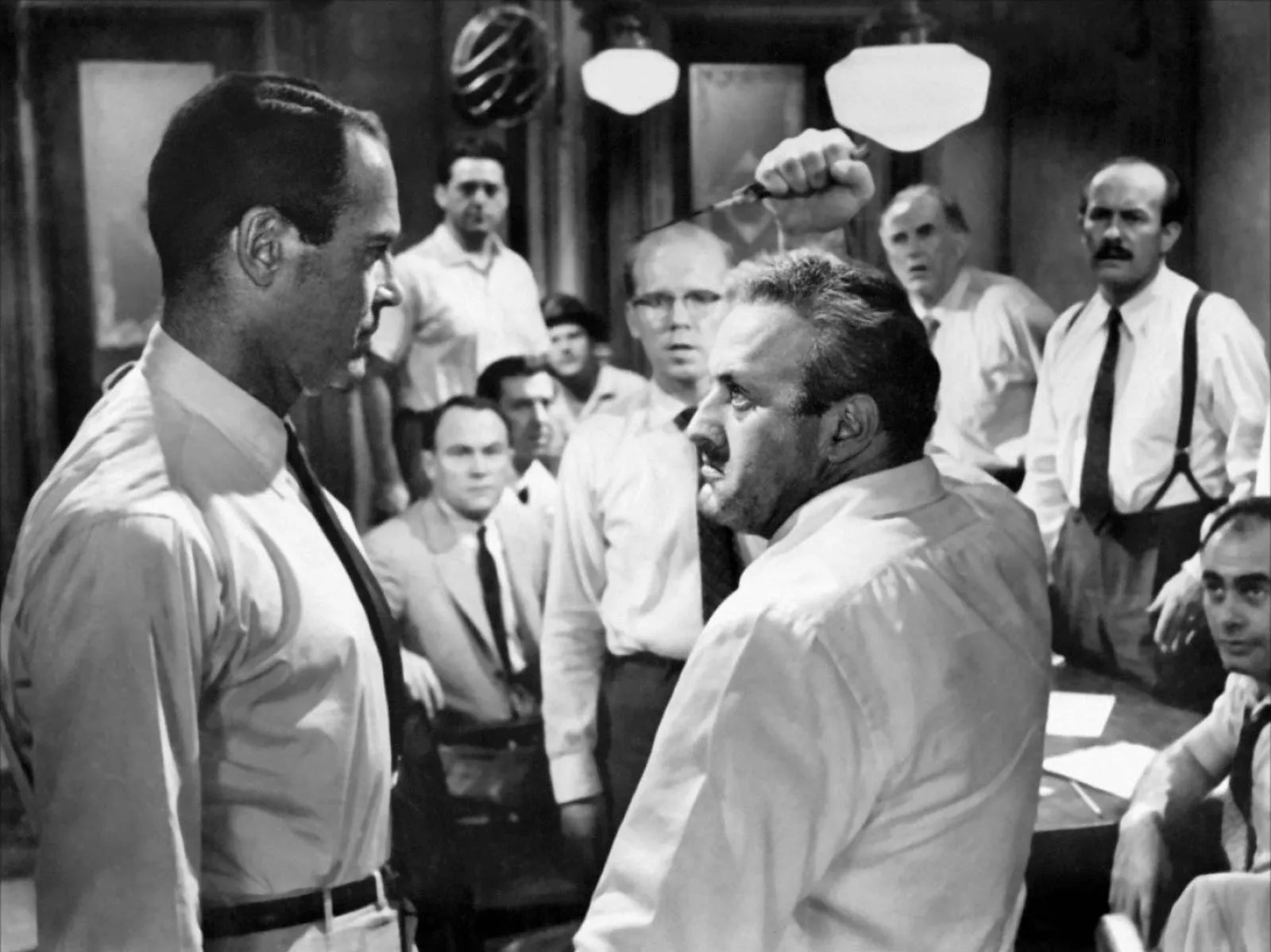
The 1957 courtroom drama 12 Angry Men is widely considered to be one of the best films ever made. The movie’s premise is that an 18-year-old boy is on trial in New York City for first-degree murder in the stabbing death of his father. If found guilty, he is to be sentenced to death. Other than brief opening and closing scenes, the entire movie takes place in the jury deliberation room. Twelve nameless jurors argue back and forth over whether or not the accused is guilty of the crime beyond a reasonable doubt as the decision to either convict or acquit must be unanimous.
At first, it appears to be an open and shut case in favour of a conviction. However, when they take a preliminary tally, one juror dissents against the consensus of “guilty” and votes “not guilty”, not wanting to send a boy to the electric chair without having had a discussion about it first. The other jurors are initially surprised, confused, or annoyed that the decision to convict isn’t unanimous, but as doubt is cast upon the each of the inculpatory pieces of evidence, one-by-one they switch their votes from “guilty” to “not guilty”. After an hour-and-a-half of fiery debate, they arrive at a final verdict of “not guilty”.
Unlike the typical Hollywood movie about a larger-than-life gunslinging hero embarking on an extraordinary adventure, 12 Angry Men features a group of men with ordinary jobs sitting around in a room discussing the intricacies of a legal case. The characters start off as random nondescript faces, but over the course of the film, each of their unique multi-layered personalities are revealed as they clash with one another over their conflicting perspectives on the case. What makes 12 Angry Men such a praiseworthy film is levels of heart-stopping drama it is able to create with an extremely simple concept.
The American Film Institute included 12 Angry Men at #87 on its list of the top 100 best films of the past century in 2007. The movie has a near perfect rating on sites like Rotten Tomatoes and Metacritic and was selected for preservation by the US Library of Congress for its cultural and artistic significance. Though I maintain that 12 Angry Men is an extraordinary work of drama, when analysing the morality preached by the film, I can’t help but see the underlying messages as subtly pernicious.
For some further context, 12 Angry Men was the first film directed by Jewish filmmaker Sidney Lumet and released in 1957 during what was known as the McCarthy Era in the United States. This period throughout the 1940s and 1950s saw a number of figures in Hollywood blacklisted for allegedly holding communist sympathies after the industry came under political scrutiny. 12 Angry Men is often interpreted as a critique of the “lynch mob” mindset behind the ostracization of members of the entertainment industry during the McCarthy era.
One extremely effective storytelling device employed in 12 Angry Men is that the truth of the accused’s guilt or innocence is never revealed. Like the twelve jurors, the audience are only privy to the evidence which had been presented during the offscreen trial. Rather than a debate on the likelihood of the boy’s guilt in reality, the debate is over whether or not he has been proven guilty beyond a reasonable doubt as is the standard required for conviction under American law. With this in mind, I still find the jury’s verdict of “not guilty” highly questionable.
The prosecution’s case alleges that the boy and his father got into a heated argument during which his father struck him twice, prompting the boy to yell “I’m going to kill you!”. The boy left the home, purchased a very unique switchblade from a pawnshop, and returned to stab his father to death. A woman in an apartment across a set of tracks witnessed the murder through the windows of a train car and the boy was seen fleeing down a staircase by an old man in the apartment below. The presumed killer returned to the home several hours later where the police were there to make the arrest.
The defence’s case alleges that the boy left his father’s home following the argument and went to the movie theatre for several hours. The boy admitted to purchasing a switchblade similar to the one used in the crime, yet he alleges that he lost it through a hole in his pocket. He returned home several hours later to find his father dead. The prosecution retorts that the boy was unable to recount details from the movies he had allegedly just finished watching when interviewed after returning to the scene and no witnesses nor additional evidence such as ticket purchases could place him at the theatre.
Over the course of their deliberation, the jury find cause for reasonable doubt with both the witness testimony and the circumstantial evidence. They reach the conclusions that the woman couldn’t have positively identified the boy since she had marks on her nose which indicated she wore glasses, which she wouldn’t have worn to bed. They conclude that the old man living on the floor below was too slow to have been able to reach the door in time to see the boy fleeing the scene. They theorize that phrase “I’m going to kill you!” might not have indicated an intention to commit murder as it is often used rhetorically.
For the circumstantial evidence, one juror found a knife for sale matching the one used for the crime in the same neighbourhood, meaning it wasn’t one-of-a-kind. They conclude that since the accused was handy with a switchblade, he would have used an upward stab rather than the downward one which was inflicted against his father. They deem his alibi plausible because it’s possible that he may have forgotten details about the movies he had just seen due to the high degree of stress he was under upon being accused of murder.
While the jurors succeed in arguing that the prosecution hadn’t proved the defendant guilty with 100% certainty, if we are to consider 90% or even 95% certainty to be beyond a reasonable doubt, I still believe that the prosecution has surpassed that threshold. The dismissal of the witness testimony is based on very selective speculation. It’s possible to come up with a number of speculative scenarios which would explain why their testimony was valid such as the woman being farsighted or the old man having made for the door a few seconds earlier. It’s possible for a witness to be mistaken, but it’s less likely that two would have both been mistaken, especially when they have no incentive to lie.
But even without the witness testimony, the circumstantial evidence in this fictional case should’ve been enough for a conviction. It may be hypothetically possible that an unknown intruder stabbed the father to death in his home after he had had a heated argument with his son using the exact same kind of knife his son bought then lost that same night. However, the likelihood of such a coincidence in comparison to the son being the killer, in my estimation, is less than 1%. The fact that the boy had a history of violence perpetrated using a switchblade is a lot more incriminating than the fact that the death blow was in a downward motion as opposed to an upward one is absolvitory.
Not only the amount inculpatory evidence, but also the lack of exculpatory evidence would convince me of the accused’s guilt beyond a reasonable doubt. There really is no alternative theory of the crime. There was no forced entry into the apartment, nor anything reportedly stolen. There are no alternative suspects who had a motive to murder the man. The boy being unable to recall details from the movies he claims to have just watched may not disprove his alibi, but there is no evidence to verify his alibi either. The absence of any witnesses placing him at the theatre or a ticket stub to substantiate his claim that he had been there means his alibi is most likely false.
I understand that the debate isn’t over whether or not it is more likely that the defendant is guilty on balance of probabilities, but if he is guilty beyond a reasonable doubt. Though the standard of reasonable doubt exists because one can never be proven guilty of a crime with 100% certainty. The fact that it’s simply imaginable that one is not guilty cannot be sufficient to constitute reasonable doubt and secure an acquittal. Under that standard, it would be impossible to convict anyone of any crime.
Now, 12 Angry Men is a fictional movie, not a real legal case. It may seem that I am overanalysing the minute details of an old film, but when considering morality it preaches, the faulty reasoning behind the verdict cannot simply be written off as dramatization for the purposes of storytelling. To understand the underlying message of the film, it’s important to look at how the characters in the story and ultimately the viewers themselves are persuaded of a “not guilty” verdict, because it’s not on the basis of the evidence.
The defendant in the plot is described as being a disadvantaged 18-year-old boy living in a slum in New York City with his abusive father. It doesn’t clarify his ethnic background, but he is referred to as an outsider from America’s WASP majority at the time, possibly an Italian or Puerto Rican. The hero of the film is Juror #8, brilliantly portrayed by legendary actor Henry Fonda. He is the only one to dissent against the initial consensus and vote “not guilty”, making the vote 11-1. While he is unsure of his decision, he does so out of a feeling of sympathy for the defendant due to the hapless circumstances of his upbringing.
The villains of the film are Juror #3 and Juror #10, the two most adamant advocates of a “guilty” verdict. Over the course of the film, their biases against the accused are revealed. Juror #10’s insistence on a “guilty” verdict is influenced by a deeply held prejudice against the unnamed ethnic group the boy belongs to, referring to him as “one of them”. Juror #3 remains the last one out of the twelve to obstinately maintain a “guilty” vote because he subconsciously sees the case as a proxy for getting revenge on his own estranged son who assaulted him after the two had a falling out.
The film gets the audience to sympathize with the defendant by painting him as a “victim” through the lens of Marxian critical theory. The emphasis on his socio-economic status, his ethnic background, and his relationship with the patriarch of his family establish him as a member of an underclass who have supposedly been wronged by society. As the jurors switch their votes from “guilty” to “not guilty”, the viewer is given the perception of a moral consensus that such a worldview is correct.
The movie does this effectively by presenting Juror #8 as a morally upstanding and humane everyman who just wants to do the right thing in good conscience. It’s worth noting that Henry Fonda was one of the most famous stars in Hollywood at the time and known for playing the archetypal “good guy”. Apart from Lee J. Cobb and Ed Begley playing the villains, the rest of the cast were relatively unknown, meaning a 1950s audience would immediately identify with Fonda’s character above the others. In contrast, Juror #3 and Juror #10 are presented as cruel, boorish, and ignorant, making their arguments for a “guilty” verdict unconvincing, regardless of the facts.
While this doesn’t answer the question as to whether the boy is guilty or not, this framing heavily biases the viewer towards the “not guilty” camp as it is established in their mind as the morally just position. At the conclusion, the ardent proponents of a “guilty” verdict are shown to be influenced by prejudice rather than evidence, but the same can be said for many of those who come to support a “not guilty” verdict.
Juror #9 changes his vote from “guilty” to “not guilty”, not based on the evidence presented, but because he views Juror #8’s cause as righteous. It is revealed that Juror #5 grew up in a slum and is offended by Juror #10’s derogatory remarks about the ethnic background of the accused. He changes his vote from “guilty” to “not guilty” because he identifies with the boy, having grown up in similar circumstances. Juror #5’s sympathy with the boy is portrayed as empathetic. Although Juror #3 is the primary antagonist of the film, his motivation could be interpreted as empathetic towards the victim since he too had been violently victimized by his own son. However, he is portrayed as calloused rather than compassionate.
Juror #10, the secondary antagonist, is portrayed as a bigoted racist whose staunch “guilty” vote is motivated by his prejudice against the ethnicity of the accused. Yet it is established that the boy had a history of violence and that the neighbourhoods populated by this unnamed ethnicity have high levels of crime. Juror #10’s motivation is represented as ignorant and discriminatory, but even within the film’s own narrative, his preconceptions of the defendant as having a propensity for violence have some basis in reality.
To the film’s credit, it addresses some of the counterpoints to the “not guilty” camp. Juror #8 contemplates the possibility that his vote could be allowing a murderer to get away with his crime. Juror #7 is more interested in the baseball game he has tickets to than the case and simply wants to get the process over with as soon as possible. At the start, he votes with the consensus of “guilty” when it was 11-1 but then switches his vote to “not guilty” when it is deadlocked at 6-6, not because he had changed his mind, but because he hopes it will speed up reaching a final verdict.
Juror #7 is chastised by Juror #11, who had also voted “not guilty”, for basing his vote on his own personal convenience rather than a regard for justice. This exchange also introduces another subversive theme into the story. Juror #11 reveals he immigrated to the United States as a refugee from Europe. His exact background isn’t clarified either, but he could be interpreted as being Jewish. He is portrayed as being more educated, enlightened, and devoted to the ideals of the American justice system than most of the native-born jurors. This shifts moral standing away from the WASP majority and towards another out-group. It’s also possible that director Sidney Lumet used Juror #11 as a proxy for himself in American society, given his background.
Juror #4 is shown as the most objective and analytical of the twelve. He is the least emotionally invested in the verdict and is solely focused on whether or not the defendant is guilty beyond a reasonable doubt. He is one of the last to change his vote from “guilty” to “not guilty”. This adds a seal of objectivity to their final verdict of “not guilty” and reveals the final holdout, Juror #3, to be motivated by a personal vendetta. This misleads the audience into believing that the “not guilty” is objectively correct when, as stated earlier, the case for the guilt of the accused beyond a reasonable doubt remains far more convincing in my opinion.
One element of human nature which 12 Angry Men illustrates extremely effectively is that everyone is biased in some way. The issue is that the film portrays bias in favour of a purported underclass as identified through the framing of critical theory as moral and bias in the opposite direction as immoral. And the film does this tremendously well. I only came to the conclusion that the verdict reached in the movie was incorrect after detaching myself from the story and attempting to analyze the facts of this fictional case as objectively as I possibly could.
During my first viewing of the film, I was franticly hoping for a “not guilty” verdict. Even now, after having come to the conclusion that the verdict was wrong, I still get a residual sense of wrongdoing in taking that position, as if I’m being cold-hearted and cruel. That’s a testament to the power of moral consensus. One will disregard all objectivity if it could lead to them feeling like a bad person in the eyes of those around them.
Why do liberals believe that Trayvon Martin, Michael Brown, Karmelo Anthony, and Christopher McCowen are victims of “institutional racism” and rather than offenders? It’s not because they have objectively considered the evidence in each of these cases and come to the well-reasoned conclusion that they did nothing wrong. It’s because they’ve been told that holding these beliefs is the morally correct position by the media, the highest moral authority in the modern world. This is the moral framework eroding Western society today, one of the early purveyors of which was 12 Angry Men.
Unlike present-day propaganda which is preachy, on-the-nose, and inane, 12 Angry Men is effective. In addition to being an outstanding work of drama, the film puts forward its messaging subtly, but successfully. Henry Fonda’s character, Juror #8, comes across as genuinely heroic and you leave the movie with a sense that justice has been done. However, by then you have forgotten that someone was murdered and no longer consider the possibility that the killer has just escaped justice and may go on to kill again, the likelihood of which is significant.
Only a decade after the release of 12 Angry Men, Lyndon Johnson, the president of the United States, more or less blamed the black riots of 1967 which caused dozens of deaths and thousands of injuries on the “racism” of white Americans. He posited that, while he doesn’t support lawlessness, those burning down dozens of cities across the country were actually victims driven to violence by such injustice. This sentiment would’ve been considered ridiculous in decades prior, but by then, this was the new moral consensus in America which Hollywood played a pivotal role in forming.
Sidney Lumet went on to direct The Pawnbroker, one of the first movies to push guilt over Jewish suffering during the Holocaust. It was also instrumental in overturning the Hays Code, allowing Hollywood to produce much more overtly sexualized media. He also directed Dog Day Afternoon, a movie about a pair of homosexual bank robbers attempting to pay for a gender reassignment operation. He later made Daniel, a film which lionizes Jewish communists Julius and Ethel Rosenberg. Nothing of the sort is featured in 12 Angry Men, but Lumet’s later work gives an insight into the mind behind the much renowned classic courtroom drama.
The story we are told about the McCarthy era today is that it was a paranoid witch hunt which unjustly tarnished the careers of filmmakers in Hollywood with baseless accusations. 12 Angry Men has been interpreted as a rebuttal of McCarthyism, but does it not serve to prove McCarthy’s fears valid? Firstly, the fact that the supposed victims had the ability to produce movies about their own victimhood proves that they weren’t powerless underdogs up against the establishment, but that they were the establishment. Secondly, when you consider the worldview which Hollywood played a vital role in promoting and the impact of such ideas in the present day, it’s hard not to see their influence as hostile.
12 Angry Men is the story of murder trial in which the case for a “guilty” verdict appears clearcut at first, but after a long and strenuous debate, concludes with a final verdict of “not guilty”. However, I’d argue that this conclusion isn’t a result of evidence-based fact, but of the perception of moral consensus. This manipulates the viewer into believing the case for acquittal is a lot more convincing than it should be. Perhaps, the same can be said of the established narrative of the McCarthy Era. Was acquitting those accused of malevolent subversion back then the correct verdict or have the decades since shown that they really were guilty as originally charged?
34 comments
I greatly enjoyed the movie decades ago when I saw it, but one thing bugged me. In one scene they decided that a witness only had about 25 seconds to complete an action, but they reenacted the event and timed it at 45 seconds, “proving” that the witness testimony was unreliable. But it felt off to me and I timed it myself, and their reenactment only took like 25 seconds. They simply declared 25 seconds to be 45. Lazy.
Anyway, this was a great analysis of an important piece of subversive film. To strengthen one point, when you said that, in your estimation, the likelihood of the alternative theory is less than 1%, my response is “way, way lower”.
I too enjoyed the film the first time I saw it, but upon a second viewing found it to be just another example of anti white propaganda.
Excellent essay. Thought I grant that this movie sticks with you, I’ve always hated it for its subversive themes. I also agree with you that the not guilty verdict is wrong. The preponderance of evidence against the boy is so strong that the defense would basically have to suggest a conspiracy to frame him. In that context, it makes sense as a rebuke of McCarthyism. For decades we were told that Alger Hiss, the Rosenbergs, etc. were framed simply due to antisemitism. Then when the Venona Project was declassified in 1995, the names of almost everyone accused were plainly listed as Soviet assets. The entire concept of the Red Scare is, to me, the most over hyped thing in American history.
I never got around to seeing this movie. Years ago, after I had just described my frustrating experience as a juror, in what should have been an open-and-shut [guilty] verdict against the District of Columbia govt*, my dad, recommended I watch it.
*D.C. govt attorney didn’t even deny the city was responsible (guilty!) for the elderly woman’s fall. She had slipped down a flight of wet marble stairs, because a janitor failed to put down a “wet floor” sign. One elderly, spiteful juror thought she was just gold-digging for $60K reimbursement for her medical bills, & he was determined to force a hung jury, so it would have to be tried all over again. It took THREE days, cooped up with a majority of testy, loud black jurors, to convince the one old black contrarian juror to be convinced he was wrong. At one point a chair was even thrown.
Jury duty is no joke when you’re dealing with a very a diverse jury!
OJ Simpson Juror: Not-Guilty Verdict Was ‘Payback’ for Rodney Kinghttps://www.thewrap.com/oj-simpson-juror-not-guilty-verdict-was-payback-for-rodney-king/
Regarding propaganda films, such as Dog Day Afternoon in ’75, I remember in the ’80s, I saw a 1961 movie on network TV called “The Children’s Hour” shot in black & white, & starring Audrey Hepburn and Shirley MacLaine. The plot was that a young girl student accused the two adult teachers of having an lesbian relationship. (Keep in mind, the Hayes Code was still in place at this time, up until 1968!) I remember thinking the entire thing was so outlandish on so many levels — for a young girl to comment on adult relationships, to criticize/question a teacher, or authority figure, for people to listen to unsolicited comments by a kid, that the kid is even aware that such closeted private relationship may exist in the first place, etc.
The young girl was right.
I haven’t seen the movie in ~40 years, but, no, Audrey Hepburn and Shirley MacLaine’s characters were not in a sexual relationship with each other. The girl was intentionally destructive to perpetuate a flat out lie.
Moreover, at that time, it was even considered impolite for adults to assume that other adults who were unmarried, & middle-aged, were anything other than eccentric folks, who just hadn’t met the right marriage prospect.
Brilliant analysis! I knew that there was something off about that movie.🙃
Great essay. Yes, people often have no idea what “Beyond Reasonable Doubt” means, but it does not mean beyond any doubt. Otherwise you could posit that the stabbing or robbery might have been done by space aliens with cloaking devices, and Rastus would therefore get off every time.
Another troublesome aspect is that because so many people are hostile to the Death Penalty, there is a huge bias in capital convictions. I’m opposed to dropping the DP just because the peanut gallery might not like it, or because foreign countries are reluctant to extradite perpetrators to DP countries like the USA. In 12 Angry Men, some jurors are clearly troubled that the stakes are high and are therefore biased in favor of acquittal.
If we are to keep the civilian jury system where you collar twelve people from the bus stop, then at the very least they should all be IQ tested and should all be required to possess above-average intelligence. Usually both sides in our adversarial legal system want the stupidest and most malleable persons as jurors. That is how we got the O.J. Simpson jury.
A minor quibble about the article, however. Although the Second Red Scare (1946-1954) involved Senator Joe McCarthy (R-WI), McCarthy’s Senate Subcommitee had nothing to do with Hollywood or the “Hollywood Ten.” That was the House Un-American Activities Committee (HUAC).
Sen. McCarthy started out crashing other Senate committees such as the Armed Services Committee, chaired by Senator Raymond E. Baldwin (R-CT). Therein McCarthy defended the youthful boys of the Waffen-SS who were sensationalistically accused of the Malmedy massacres, and McCarthy accused the Baldwin Committee itself of indulging in a “Roman Holiday” of atrocity porn.
After President Eisenhower’s election, McCarthy became chairman of a Subcommittee in charge of investigating the Executive branch, specifically the Army and the State Department ─ the later riddled with Globalist Liberals, if not always card-carrying Commies like Alger Hiss.
The problem was always that McCarthy had very little hard evidence but knew how to run a media circus to move the political needle. While this strategy worked great against President Truman and his coterie of Pinkos, it backfired when Eisenhower became the Chief. McCarthy then found himself in the crossfire between the Democrats and the Liberal Republicans, and the Senate censured him in late 1954.
All the Democrats were anti-McCarthy ─ that is to say, all of them besides the Kennedies. Senator JFK was the only Democrat who did not vote to censure McCarthy in 1954 because he was supposedly out sick, whereas RFK Sr. was actually McCarthy’s assistant legal counsel. The infamous (((Roy Cohn))) was McCarthy’s chief legal counsel.
Roy Cohn has been accused of sabotaging McCarthy with his aggressive conduct, and this is a fair criticism. The Army-McCarthy hearings in the Senate were televised live to the nation, and Joe McCarthy suddenly found himself out of his element like Dick Nixon debating a suntanned JFK in 1960 on the small screen with a sickly pallor and a five o’clock shadow. Most people who heard the debate on the radio thought that Nixon won; those who watched it on black & white TV thought that JFK won.
The televised Army-McCarthy hearings were about Cohn’s supposedly abusive tactics against Army officials, and Cohn unfairly attempting to get his former aide, Private (((G. David Schine))) a Draft deferment. The Army accused Cohn of coercive tactics since its Secretary, Robert T. Stevens was under criticism. Nothing was ever proved against McCarthy and his team, but it was a PR disaster and the Senate then voted to censure McCarthy.
Journalists like Drew Pearson and Edward R. Murrow were quick to coin the term “McCarthyism,” as though questioning Leftists for their questionable sympathies was somehow wrong.
Roy Cohn was a 30 year old hot shot New York Jewish lawyer who had once been engaged to Barbara Walters and had been on the prosecution team of the (((Julius and Ethel Rosenberg))) atomic espionage trial, which went before Judge (((Irving R. Kaufman))) and led to their electrocutions in 1953. Roy Cohn was later outted as a homosexual who died of AIDS in 1986.
In the 2023 Oppenheimer film, the only atomic spy mentioned was the lone Gentile, the German-British Communist Klaus Fuchs. The Manhattan Project and everything else was loaded with Jewish spies.
🙂
Most communists in Europe and the US were Jews, and most Jews were communist sympathizers. They always try to conceal this fact, thru diversionary tactics, outright lies and (of course) accusations of so-called “antisemitism”.
Robert Oppenheimer himself was a Soviet spy, who passed detailed information about the A-bomb to Soviet agents. In his memoirs, Special Tasks (1994), Pavel Sudoplatov proves that Oppie and other Jews helped Stalin get the bomb.
Sudoplatov was a top official in the NKVD, in charge of the Soviet spy-rings in the US, who reported directly to Beria and Stalin. He was also a philo-semite.
I should add that Edward R. Murrow had some major globalist connections. One of the future CFR directors tapped him to head a foundation that ferried 2000 (((Marxist professors))) out of Germany, grease the skids with immigration, and get them jobs at American universities, Bob’s yer uncle. Little Eddie at the time was a kid just a year out of college when he got the job – surely there’s a story in it somewhere! Soon after, his star rose rapidly at CBS and he became a CFR member too. Interestingly, Murrow did his hit piece on Senator McCarthy soon after he’d mentioned something about a foundation that had imported a bunch of pinko professors.
Ron Unz recently wrote a three part analysis of “McCarthy-ism” that is outstanding.
https://www.unz.com/runz/american-pravda-mccarthyism-part-iii-the-jewish-angle/
Is Ron’s article your key reference?
I agree that Unz’s material is outstanding, although I am not a fan of the late conspiracy-theorist Michael Collins Piper, so some of my takes on McCarthy will differ.
“Is Ron’s article your key reference?”
Hoo no. I majored in Electronics Engineering Technology and History and I was writing papers on Senator Joe as early as the 1980s, and those papers would not differ much from something that I wrote today except that I might be a slightly better writer now.
My main source is William F. Buckley and L. Brent Bozell (1954) with insight into the Jewish Question by the American Nazi Party Commander George Lincoln Rockwell that dates back to the early 1960s.
Rockwell was a close associate of Wm. F. Buckley and said that he was “100 percent square” (which was saying something as Conservative political activists tended to be hardcore weasels) with the important EXCEPTION of the Jewish Question.
Rockwell said that Buckleyites were “Kosher Conservatives” (his coinage) and he correctly analyzed why Conservative political movements always fail and usually miss the forest for the trees.
Rockwell was himself pro-McCarthy and his analysis is 99 percent on target.
This was long before the Venona decrypts were declassified circa 1995, and also, it was not until 1986 when (((Roy Cohn))) died of AIDS that the final pieces fit.
The 1980s was about the time period that I was boldly working on McCarthy as a research project. However, I don’t have any copies of any old papers of mine as this was the age of typewriters and not computer word processors.
Anyway, the classic 1954 book by Buckley and Bozell, written just after McCarthy’s Senate censure tells the story well ─ although sanitized to remove the (crucial) Jewish angle.
Buckley, William F., and L. Brent Bozell. McCarthy and His Enemies : The Record and Its Meaning. Arlington House (1954).
OCLC: 103926
Also the reason that McCarthy got into the Second Red Scare ─ which really took off after the Soviets exploded their own atomic bomb in 1949, which was a copy of the Fat Man design used at Trinity and Nagasaki in 1945 ─ can be summed up by reading McCarthy’s 1951 booklet called “America’s Retreat from Victory,” delivered by McCarthy on the Senate floor (LINK).
McCarthy, Joseph. America’s Retreat from Victory : The Story of George Catlett Marshall. Devin-Adair, 1951.
OCLC: 771386
Sen. McCarthy’s paper was critical of Secretary of State/Defense Gen. George C. Marshall and President Truman’s foreign policy and their handling of the Korean War.
It should be noted that the mishandling of the Korean War and the President Truman’s firing of anti-Communist Gen. Douglas MacArthur was the trigger than sent George Lincoln Rockwell in search of answers.
I am an American Firster and an Isolationist like Charles Lindbergh who favored a strong military for continental defense.
However, McCarthy was a WWII veteran who believed in Pax Americana. In other words, if the United States had a global empire at all inherited from WWII or from the dissolution of the Anglosphere, it at least needed to be operated in American national interests and to fight Communism decisively, and definitely NOT in support of Internationalist interests or worse, which is what FDR, Truman and Marshall were all about.
McCarthy and his supporters were Trad Catholics who thought they were playing tactical 4D chess by not emphasizing the Jewish Question, which they understood perfectly well.
What they hoped to do was get ahead of the inevitable and debilitating Nazi/anti-Semite allegations by bringing on board extreme Rightwing Jews like Cohn and Schine who hated the Communists too, but mainly because they made Jews look bad.
Cohn was a young Columbia-educated lawyer who had assisted the prosecution of the Rosenbergs, and Schine had graduated from Harvard and had written a decent paper on Communism, which was being widely distributed by the Right.
But as Rockwell noted, this all sabotaged McCarthy’s movement because no matter what Jews think on any given issue, they are firstly Jews ─ and it is simply not possible to address Judeo-Communism without tackling the JQ. Buckley might as well have been controlled-opposition.
McCarthy’s Senate censure on December 2, 1954 was no big deal. He kept his Senate Subcommittee, although he had trouble calling a presss conference and getting a scramble like before.
The real problem was that McCarthy just did not have enough hard evidence that could be actionable other than to do what the Senate traditionally does, which is to “chastise.”
Also, after the censure, McCarthy’s health went into immediate decline from liver disease, and he died a little over two years later from hepatitis, and probably alcoholism.
The Censure Vote (which had no teeth) was 67 For to 22 Against.
All of the Senate Democrats except for JFK voted to Censure, and the GOP were split between the more-Liberal “Eisenhower” Republicans and the 22 Conservative Republicans who voted in McCarthy’s favor.
McCarthy was one of the voices who helped expose the torture of German PoWs over the Malmedy Massacre and Dachau trial ─ sensationalism that was still going strong even after the Soviets exploded their own atomic bomb in 1949.
McCarthy also exposed that the Korean War was being run by Pinko subversives, which is the major reason that Truman fired Gen. MacArthur.
Truman would have supported Gen. Omar Bradley (a Democrat) for President in 1952 if he had known him better personally, but Gen. Eisenhower actually threw his hat in the ring first, and also for the other Party. In his memoirs, Gen. Bradley was not going to run against his former colleague, Gen. Eisenhower after the criticism of Marshall (a Democrat) going around from the Right ─ criticism that the more-Moderate Eisenhower never actually disavowed.
Another aspect of the Jewish Rightwing takedown of the atom spies is that they tended to make a lot of strawman arguments such as the Rosenbergs being uniquely responsible for delivering the atomic bomb to the Soviets.
In fact, just about every Jew on the Manhattan Project other than Hungarians like John von Neumann and Edward Teller, who hated the Communists as much as the Nazis, were either agents themselves or blind to it like Robert Oppenheimer.
The Rosenbergs were guilty as hell but they were only the tip of the iceberg at best.
McCarthy was really a brilliant man but his 4D chess tactic of leading the revolt against the Left with based Jews backfired spectacularly.
🙂
The story we are told about the McCarthy era today is that it was a paranoid witch hunt which unjustly tarnished the careers of filmmakers in Hollywood with baseless accusations.
I’ve almost grown kind of weary with pointing out jewlib double standards, but it’s always worth pointing out: the same people whining insincerely about the evils of McCarthyism are the same people (or, at least, the same types of people) who relish in doxxing “racists” online and making sure anyone who touts something other than the party line on race lose their jobs and are publicly shamed for the rest of their lives. So yeah, cry me a fucking river over a handful of Epsteins and Steinbergs not getting the film roles they wanted in the early 50s.
And while I completely agree with all the points made regarding 12 Angry Men, let’s just pause for a moment and appreciate the fact that there was probably a “Men Only” sign above the jury room door.
Yes, absolutely. Libtard Pinkos and Commies were never treated as badly as the Left would like you to believe they were ─ and in fact does treat those who are deemed Rayciss or Nationalist.
Also, while Jews can be decent people and valuable intellectuals, and even pitbulls on the Right, FIRST they will be Jews.
Jews are about race-mixing and living the life of God’s Chosen in the Diaspora (with Israel to run off to if necessary). That is about as incompatible with White Nationalism as you can get.
This means that any White Nationalist movement that is either funded by or led in whole or in part by Jews is certain to fail. This observation was first made by George Lincoln Rockwell who had once been the protege of William F. Buckley who used to love to drop that fact to gauge the reaction of his guest anytime he was interviewing some Liberal Jew on TV. Buckley was the epitome of what Rockwell called a Kosher Conservative.
The case of Senator Joe McCarthy and his namesake “ism” is an important “teaching moment” about how this all works.
Here is a 26 minute interview from Philadelphia TV presenter Bill Boggs, who is today an octogenarian novelist.
The debate is between sleezy New York bachelor attorney Roy Cohn, who died of AIDS in 1986, and Gay novelist Gore Vidal ─ the author of Burr (1973), Lincoln (1984), and the Gay/transgender freakshow Myra Breckinridge (1968) that was made into a dumb 1970 comedy film featuring Raquel Welch, etc.
The historical novel Burr is excellent, although it’s fairly obvious that the author was Gay in his description of the Founding Fathers. I have never yet gotten around to reading Vidal’s Lincoln, but will one day.
Anyway, Gore Vidal takes the traditional Libtard view of McCarthy and “McCarthyism” that we were taught in school, i.e., that he “ruined reputations,” etc. This is of course Bovine Scatology (B.S.) of the first order.
Gore Vidal is dead wrong if he thinks that Communist subversion from the likes of the elite Liberal WASP intellectuals like Alger Hiss and “Red Dean” Rusk in the State Department, and Treasury Jews like (((Harry Dexter White))) was not a big PROBLEM.
Whatever one thinks of the statesmanship of the aging General Douglas MacArthur and his generalship, the course of the Korean War proves that something was rotten in the “Denmark” of the Truman Administration. And Truman was one of the better Washington haberdashers not exactly smitten by Communism.
Contra McCarthy, Gore Vidal didn’t think that the Soviet and Chinese Communist bloc was a military problem either ─ in spite, I guess, of a thousand or so Minuteman and Titan inter-continental ballistic missiles (ICBMs) with thermonuclear warheads trained on Russia in the 1970s for Strategic Deterrence.
The “take no prisoners” New York attack attorney, Roy Marcus Cohn (1927-1986), who in more recent times some have tried to claim was Donald Trump’s mentor, is in full character in the TV piece on YouTube below.
LINK
Roy Cohn (circa 1978) is obviously intelligent and fiercely defends his former chief, Senator Joe McCarthy. This is great except that his real concern in helping to get the (((Rosenberg))) atom spies electrocuted at Sing Sing was always about the public perception of Jews (very awkward that they tended to be Communists). And of course, for conduct leading to the Senator’s humiliating censure, Cohn did not actually pull a win for Chairman McCarthy as his chief counsel on the Senate Permanent Subcommittee on Investigations (PSI).
The fact that Roy Cohn beat out Robert Kennedy, Sr. as being selected as chief of the two legal counsel for the infamous Chairman of the PSI, the Wisconsin Junior Senator, Joseph Raymond McCarthy, no doubt stuck hard in Bobby’s craw.
A bit of context in the TV interview here: Roy Cohn is talking about the 1977 film Tailgunner Joe, which starred Peter Boyle brilliantly as a caricature of McCarthy, and had Burgess Meredith playing the Army’s legal counsel, Joseph N. Welch (“have you no decency, Sir”) in the televised 1954 Army-McCarthy hearings in the Senate.
The 1977 film is a very well-done hit-piece that is dutifully based on the vile book Senator Joe McCarthy (1959) by the ex-Communist journalist Richard Rovere (1915-1979).
In the book and film, the disingenuous claim is made that Joe McCarthy faked his WWII record as an intelligence officer in the Marine Corps in the Pacific and never got any closer to the front than shooting bunches of coconuts with a machine gun.
Of course, “Tailgunner Joe” was an electioneering slogan such that all veterans used while running for political offices after World War II, and it was based on the USMC intelligence officer having needed to man a gun as an occassional passenger aboard long military transports in the Pacific theater.
McCarthy never tried to pass himself off as the superlatively-decorated and PTSD-addled Audie Murphy ─ the Texas war hero who enlisted in the Army in WWII by lying about his age, rose from the ranks by killing Germans, and was then turned into a Hollywood star.
I would not doubt that the two veterans probably drank as much, and McCarthy asd a Marine intelligence officer no doubt had at least some post-traumatic stress from his service in the Pacific theater.
The rest of the biographical and political information on McCarthy is just as credible. The 1977 film has some female student or journalist dutifully reading the Congressional Record and then the Hollywood dramatized satire follows. Well, I have actually read the CR on these matters, LOL.
In my research, I never could find any hard evidence on the testical torture of German PoWs, although I don’t doubt that it was done, which was of course not something that would have been documented, but the pushback generated on the Dachau Trials torture claim by McCarthy and others (the USA is majority German-American) helped set important boundaries that were a blemish (as McCarthy believed) for the important battle of fighting Communist subversion during the Cold War.
Also we have incontrovertibly documented fact that the major Auschwitz Commandant, SS-Obersturmbannführer Rudolf Höß was severly tortured by the British before being allowed to testify at the International Military Tribunal at Nuremberg, and his family was threatened by be turned over to the Russian NKVD.
Hoess played ball and was therefore allowed to write his memoirs in Polish captivity and then being hanged by them next to the Krema I bomb shelter (gas chamber) at the Auschwitz Stalag, which was also next to the Commandant’s domicile, where his children and family had lived during the war.
There is a 2023 movie about Lt. Col. Rudolf Hoess (not to be confused with the Deputy Führer with a similar name who died under suspicious circumstances as a nonagenarian at Berlin’s Spandau prison in 1987).
In the recent movie, called The Zone of Interest, Hoess and his family blithely live at home right next to the Auschwitz Krema I gas-chamber. The film got mixed reviews and has had this unfortunate tendency to draw comparisons or debates about the October 7, 2023 Hamas attacks on Israel.
I have not seen the Hoess family film yet, but Counter-Currents should definitely review it.
Also, I will point out that the 29 year old SS-Colonel Joachim Peiper of Kampfgruppe Peiper, the “Blowtorch Battalion” (Bart Simpson voice: “Cool, man”) who took the blame for his men ─ was in reality several miles from the Malmedy Massacre site when a handful of German teenagers guarding far too many U.S. prisoners (including actor Paul Sorvino) bolted and fled. Most of the American PoWs were gunned down in the process.
The squad of Waffen-SS teenagers during the Battle of the Bulge in late 1944, some of whom were conscripts, then went around and delivered the coup d’grace to any of the wounded U.S. PoWs rather than calling Star Fleet and having them beamed up to the medical bays.
Going over WWII atrocities like this ad nauseam is what Senator McCarthy was calling a “Roman Holiday” when he crashed in the Raymond Baldwin Armed Services Commitee hearings in 1949.
Col. Peiper commanded an advanced detail during the December, 1944 Battle of the Bulge, which had somehow left a small squad guarding a huge bag of raucous American prisoners, and who had little more than a truck and an MG 42 machine gun available to begin the long logistical process of internment, which would have been done by German military. bureacrats. This initial mercurial situation is itself why the G.I. cohort of PoWs likely bolted in the first place.
The late actor Paul Sorvino who was there, got away but never talked about what happened at the Malmedy Massacre while he was alive as far as I know.
When I was in the Army, we were taught that Col. Peiper chose to obey some [nonexistent] order of Hitler’s to kill all prisoners, “which most German commanders [especially of the good Wehrmacht] chose to disobey.”
Well, this is why I’m a Revisionist and why we need to study Real History.
Joachim Peiper of the elite 1st SS-Life Guards division is a good target because he had once been Heinrich Himmler’s personal adjutant and had visited Auschwitz with him and General Hans Kammler just as new crematorias and sanitation infrastructure was being constructed at Birkenau by Russian PoWs. Most war-crimes charges were eventually dropped against Peiper after the war, but he was killed at his home in France in 1976 when Communists torched it.
I could got on about stuff like this for hours, LOL.
🙂
Good analysis. We studied this play at school, just another example of how we were educated into the liberal worldview.
Great analysis of this influential movie. I saw it on TV many years ago, and fell for its message hook, line and sinker. I was influenced!
However, since then, I began to suspect that it had a pro-crime political agenda. Now I know this for sure. This article proves that this movie was just another Jewish effort to subvert and destroy a White country like the US. And the director, Sidney Lumet, was just another communist Jew.
Sounds like one of the rare movies that makes the audience think (I’ve never seen it). For some reason it reminds me of the Tyrone Power movie Abandon Ship, based on a supposedly true story of a passenger liner that hit a mine in the South Atlantic and went down fast so that only one lifeboat could be deployed. It was swamped with survivors and the captain, who decided, with a storm coming, that the weaker and older passengers had to be jettisoned, otherwise the lifeboat stood no chance of making it and everyone would die. This movie did not succeed at the box office or critically, I’ve read, but no movie made me think more of moral/ethical questions. The heated discussions on the boat were like the ones in 12 Men but much more urgent because they were personal and life or death for the discussers. I was lucky enough to have seen it on TV as a kid in the 70s and have seen it several times since. I would call it the most underrated movie.
Like other commenters, when I first watched the movie many years ago I enjoyed it very much. But even in those days before I became better at detecting cultural propaganda, I felt that something was just not right about it. As if the movie was trying to sell me something I didn’t want to buy.
I have two fundamental fears regarding American juries. The first is that I will have to sit on one. The second is that my fate will be decided by one.
Have you thought of reviewing The Magnificent Seven? It has the most insidious, subversive message in a western, seven white men go to Mexico, and risk their lives for a bunch of mestizos—and end up doing it for free! 🙃
I bought the DVD of this when I was a teenager, but never got around to actually watching it. “Courtroom drama” is not something that piques my interest, but I bought it because I was more impressionable then, and was assured it was a “classic.”
Then recently I saw pictures of the defendant in this movie, and I went “oh, that looks like Leo Frank.”
I have since lost all interest in watching it.
The left doesn’t have to address opposing arguments on their merits. They can take your opposing argument, and a good one too, not a strawman, and by putting its exact words into the mouth of an unattractive slow-witted character in a movie, inoculate the public against it. An automatic immune response is installed where your words aren’t processed rationally by your listeners, so you can’t change opinions no matter how much you expand on your argument – you just remind them more and more of the creepy loser from the movie.
Juror #3, if I remember correctly, was a resident and business owner in the neighborhood where the crime took place, or a similar one. He said something along the lines of you naive suburbanites don’t know what you’re talking about, I could tell you some interesting stories about the kinds of youths, the kinds of communities, the paths to crime. This was discredited in the movie through a ludicrous group therapy breakdown where he threatened to kill Fonda (“you didn’t really mean those words literally, did you”), and a tearful rant where any insolent youth reminds him of his estranged son. So as urban crime increased in real life and people were discussing it, those whose intuitions were better calibrated, those who could tell some interesting stories had the preconceived suspicion against them that, like Juror #3, they were crazies or losers who couldn’t afford to move to the suburbs. Phrases like “you suburbanites don’t know anything about urban crime”, no matter how true they were, lost the argument.
I also wonder whether some of the bystanders in the Kitty Genovese case had been taught to apply the film’s debunking attitude to their initial intuition that they should call the police – was I fully awake, might what I heard have been drunken tomfoolery, will the police roll their eyes and think I’m a fantasist or attention seeker?
Until the 1990s, liberal propaganda in mainstream films was mostly subliminal and subtle. Very rarely were there overt anti-white attacks. Rather, filmmakers offered white audiences the opportunity to identify with “white savior” characters (“The Magnificent Seven” is a good example). They also did not emphasize the otherness of minorities, but rather that they were “just like us.” For example, even in films about the Holocaust, the difference between Jews and the majority was not emphasized much, but rather their assimilation before the Nazis came. It was only in the 1990s that films gradually began to throw white guilt at the audience, which turned into outright racism against Whites.
Genius comment/
I never thought about The Magnificent 7 as a White savior movie. You nailed it.
I still like the soundtrack but the movie is such a mountain of BS. Yul Brenner playing the King of Siam in a Western is a big shark jump.
There was tons of anti-White, anti-Christian, anti-family propaganda churned out by Hollywood in the ’60s. And this promotion of infidelity/swinging/divorce movies pushed onto the silver screen in (only) English-speaking countries worldwide Cohencided with a plummet in marriages, & a surge in divorces, that had never before been seen in Western civilization. Watch the 9 min vid Selling Divorce to the West https://www.youtube.com/watch?v=HwbzF9tKSd8&t=2s
Americans, esp. Catholics, pushed back & boycotted Jewish Hollywood subversion to get the Hays Code enacted; and up until the late 1970s American Gentiles would still voice their disgust with anti-Gentile propaganda on network television:
Flashback 1978: German-Americans Pressure NBC To Pull Holocaust Miniseries As ‘Audacious’ Anti-German, Anti-Gentile, Anti-Christian ‘Propaganda’
https://christiansfortruth.com/flashback-1978-german-americans-pressure-nbc-to-pull-holocaust-miniseries-as-audacious-anti-german-anti-gentile-anti-christian-propaganda/
As this article points out, this type of subversion is effective. We’ve seen this play out in the riots in Furgeson, MI and Baltimore, MY, even when the evidence showed the black criminals were guilty. C-C has an article on KGB defector Yuri Bezmenov. He pointed out the fact that once people fall for the propaganda, it’s difficult for them to see the truth regardless of factual information, including video footage implicating a criminal. Politicians almost always give into mob rule, even when they know the true facts. On top of this, we have a steady stream of commercials that have male bashing as their theme. Sitcoms take the male bashing to another level; the white male is an idiot; the white female characters are smart as are the black characters. It will be difficult to counteract this cultural conditioning. That doesn’t mean that we shouldn’t fight the propaganda though, we have truth on our side.
The question is why the elites switched from the subliminal method to the often downright clumsy open propaganda. They probably sensed that most White viewers were taking what was wholesome from the older films, becoming somewhat imune to the liberal prodding. So, for example, The Magnificent Seven is still a great movie even from a White nationalist point of view. Its heroes, especially the character of Yul Bryner, are ideals of white masculinity that exhibit fearlessness, competence, dependability, focus, stoicism, principle, purpose, and dedication. It’s also a movie where brave white men fight a bunch of savage mestizos (albeit for the benefit of other mestizos). I think audiences have learned to filter out the liberal message and take the positive and timeless from the films. The elites seem to have become dissatisfied with that.
With demographics changing & our school system failing to train critical thinkers, modern movie watching audiences are much more dim than they used to be, so blatant anti-White propaganda gets steered directly toward the 50% non-White movie-going audience: Hate Whitey more.
Two of Hollywood’s most transparent anti-German, award-winning films are Sophie’s Choice and Judgment at Nuremberg. A movie reviewer from our side might enjoy peeling back tthe numerous Jewish lies in those blockbusters.
Endeavour: ...12 Angry Men was the first film directed by Jewish filmmaker Sidney Lumet…
—
The first by Sidney, but nowhere near the first Hollywood Jew to produce and/or direct anti-White films.
I think WWII films, and especially films about Jews during the war, were a particular subset of films where a certain “bias” was to be expected. But I would say that even those films and TV shows had a much more moderate tone when it came to portraying the white majority. They generally appealed to “common humanity” and praised goyim who stood up for Jews. Also, the Jewish protagonist used to be portrayed as a common man who was like the rest of his gentile neighbors before the Nazis came along. It was only gradually that Jewish ethnocentrism directed against the gentiles began to appear in films, where the Jewish protagonists are portrayed in almost kitsch colours as an educated and successful elite against the white envious anti-Semitic rabble. It was also then that Oriental-type actors began to be cast as Jewish protagonists, whereas previously it had often been white non-Jewish actors or very European-looking Ashkenazi Jews.
Moreover, most of the older WWII films could be viewed as universally valid tales of fearless fighting against the odds. In them, the Nazis come across more as a faceless evil that the heroes overcome. The Nazi regime was generally portrayed as a machine that fatally crushed its victims. This gave these stories great power because almost every modern person (even in so-called liberal countries) could identify with the feeling of being at the mercy of a crushing inhuman system. Also, the fact that liberation from Nazism in the spring of 1945 often came suddenly from one moment to the next after heavy fighting suited immensely the need of the film’s story to provide catharsis for the audience.
Back in 1997, 12 Angry Men was remade, have you thought about comparing the remake to the original? 🙃
12 angry men?
More like 1 liberal, 1 Jew, and 10 malleable chumps.
Just a hint if you don’t want to be on a jury. In the late 90s I was called and came close to being on one. Someone told me that when you are questioned by the prosecutor and defense attorney when they are choosing jurors, NEVER be passive. Always ask a question. It could be as dumb and nonsensical as “whe’ da baffroom at? I gotta go” or as astute as “I do not recognize the authority of this court because I am an Aldebaran who has been separated from my planet by violent unjust colonial warfare.” If you ask any question at all, they will cut you loose. It worked for me, I asked a dumb bullshit question and I could see it in the defense attorney’s eye (“we don’t want him because he thinks”). She or some other official robustly said “excused.” It’s why juries are filled with the most passive dummies.
This was a very good analysis of the case in the film. Your parallel between the accused killer in the case and Karmelo Anthony is well taken. Speaking for myself, I feel like in some ways I have more in common with leftists than Ben Shapiro conservative types (who think blacks just need to decide to have a better culture) when assessing black crime. While leftists blame socioeconomic factors, I blame genetics – but either way, we both agree blacks are predisposed to commit crimes for reasons out of their control. Of course, the leftist thinks this a problem that can be fixed through either social programs or a total social revolution, while I don’t. As you say, this film is a great piece of subtle propaganda – I felt for the young man upon hearing how he grew up in a slum and was beaten by his father. But as you also say, that is irrelevant to his guilt (and likely evidence to support it).
I also think as political dissidents it’s interesting to consider the methods of persuasion used by Juror #8. Firstly, him being able to stand up as the lone man in the group to disagree with the prevailing wisdom takes a lot of guts, and is the only reason the outcome isn’t immediately a guilty verdict. I can’t ever say I’ve openly expressed my political views in a room full of white leftists (granted, the stakes may be higher as leftists believe they have a moral obligation to “punch Nazis”). Someone who is willing to do that is a rare breed. It’s also interesting that the first vote he calls for is a secret ballot. He implicitly understands that someone might think the same as him, but may not have the same courage to state so openly. Similarly, many people agree with White Nationalism but are unwilling to say so openly for fear of social ostracization or loss of employment. When people have cover to post anonymously on social media, they say things they would never dare to say in real life.
I also think as more people join the not guilty side, its trajectory alone provides a pull factor. People want to get involved with something that is on the up – we are highly social animals, and that also involves trying to figure out what other people are going to think in the future so we can get ahead of the curve. Similarly, as White Nationalism grows, we will see more people joining purely based on momentum. I’ve personally been shocked at how quickly the American public, and young White men in particular, have turned against Israel in the wake of 10/7.
Comments are closed.
If you have a Subscriber access,
simply login first to see your comment auto-approved.
Note on comments privacy & moderation
Your email is never published nor shared.
Comments are moderated. If you don't see your comment, please be patient. If approved, it will appear here soon. Do not post your comment a second time.