In modern American society, fictional works have become beacons of moral guidance. One such fictional moral beacon is the Richard Rodgers and Oscar Hammerstein musical, South Pacific, which was released on Broadway in 1949 and turned into a movie of the same name in 1959. Rodgers was Jewish, Hammerstein partially so and raised a Unitarian. (more…)
Tag: desegregation
-

The purpose of the Council of Chalcedon in 451 was to determine the nature of Christ. It also determined the relationship of the state to Divine Providence.
1,889 words
Part 3 of 3 (Part 1 here, Part 2 here)
Making Gains
With a base of conservative, mostly old-stock American white women as supporters, Rushdoony started to make real gains. He researched and commented upon the early councils of the Christian Church and applied their outcomes to American society. One such council was the Council of Chalcedon. (more…)
-
America has just entered another election year, and as of this writing, it appears that the presidential contenders will once again be Joe Biden and Donald Trump. The key word here is “appears,” however. The election is a long way off, and anything can happen. While we can’t know what will happen, we can at least make some guesses based on current trends. (more…)
-
All the Way Home
Directed by Lee R. Bobker
Written by Muriel Rukeyser
1957The United States was on the verge of undertaking desegregation in the mid-1950s, and this new social engineering project was rather controversial at the time. (more…)
-
Say “Hi” to Gen Alpha, America’s First Majority Non-White Generation
In his 1920 book The Rising Tide of Color Against White World-Supremacy, Lothrop Stoddard warned that unless an immediate moratorium was placed on non-white immigration into white-majority countries, white dominance over geopolitical affairs would be lost amid a “tide” of non-white fecundity. Wikipedia’s page on the book categorizes it under “White genocide conspiracy theory.” (more…)
-

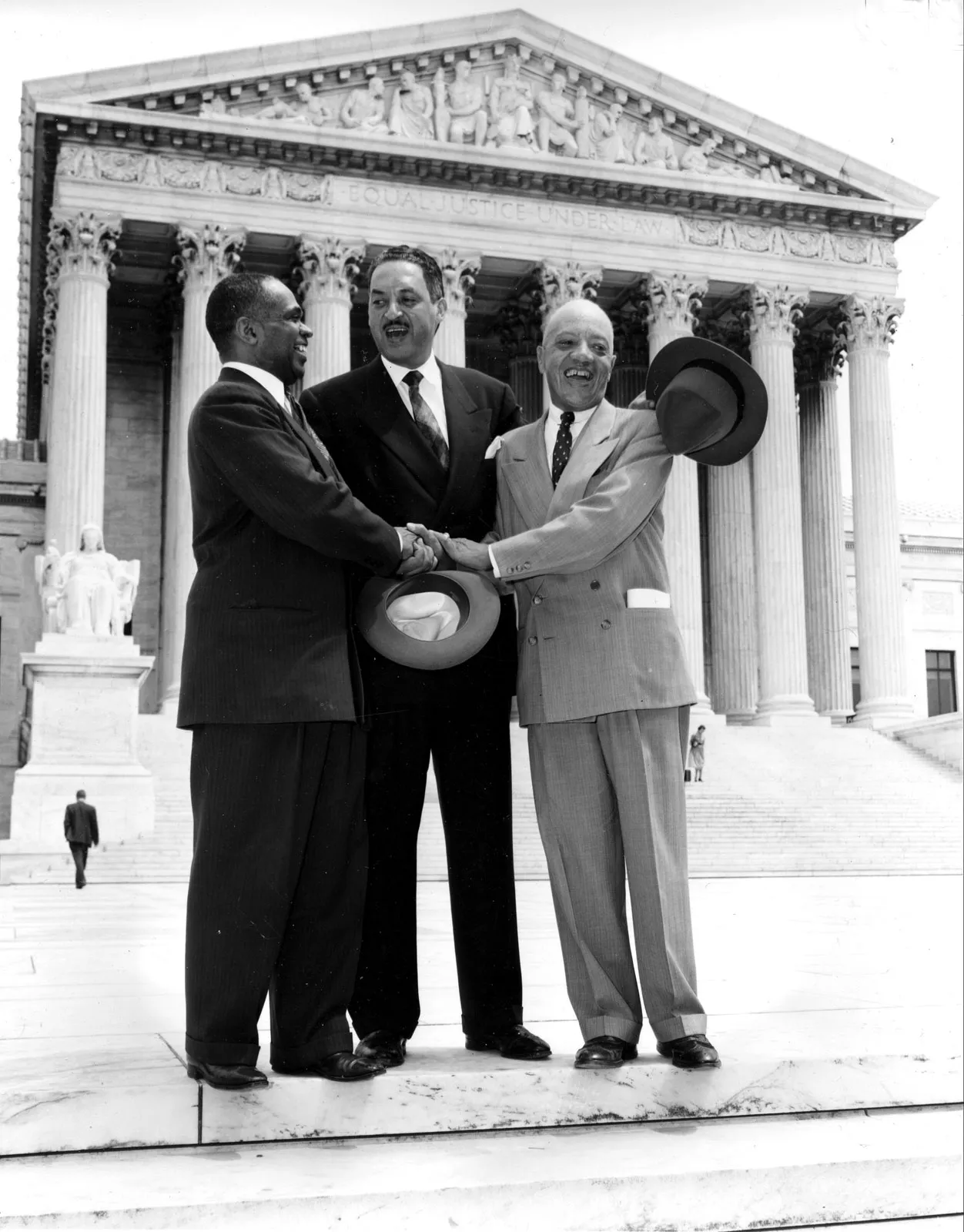
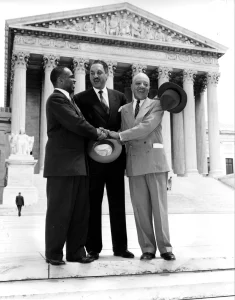
From left, lawyers George E. C. Hayes, Thurgood Marshall, and James M. Nabrit, Jr. at the Supreme Court following the Brown v. Board of Education ruling on May 17, 1954.
3,695 words
Jesse Merriam
How We Got Our Antiracist Constitution: Canonizing Brown v. Board of Education in Courts and Minds
Claremont Provocations Monograph Series, 2023“Congress shall make no law respecting an establishment of religion . . .” — First Amendment of the United States Constitution, 1791
“Equal opportunity is the bedrock of American democracy, and our diversity is one of our country’s greatest strengths… It is therefore the policy of my Administration that the Federal Government should pursue a comprehensive approach to advancing equity for all, including people of color and others who have been historically underserved, marginalized, and adversely affected by persistent poverty and inequality. (more…)
-
Carl Schmitt can illuminate American politics and jurisprudence by offering an outside perspective from continental Europe. First, his idea of the state of exception can help describe how the United States Constitution was rewritten in the Civil Rights era. And secondly, his description of the sovereign and of political theology explain in part why American conservatism has been a spectacular failure. (more…)
-
Part 4 of 4 (Part 1 here, Part 3 here)
Audio version: To listen in a player, use the one below or click here. To download the mp3, right-click here and choose “save link as” or “save target as.”
The School Experience
While working on and thinking about this piece over the last few years, I spoke with several white middle-school and high-school students and conducted informal interviews about their experiences. (more…)
-
3,358 words / 20:43
Part 3 of 4 (Part 1 here, Part 2 here, Part 4 here)
Audio version: To listen in a player, use the one below or click here. To download the mp3, right-click here and choose “save link as” or “save target as.”
Subsequent case law
Several education-related Supreme Court cases would follow over the years after Brown, coming from the Warren and then the Burger courts. Most people are not aware of the continued litigation that went on for decades in the post-Brown era. (more…)
-
1,908 words / 11:22
Part 2 of 4 (Part 1 here, Part 3 here)
Audio version: To listen in a player, use the one below or click here. To download the mp3, right-click here and choose “save link as” or “save target as.”
The legal regime
A handful of laws and Supreme Court cases have truly shaped and continue to shape the day-to-day lives of Americans and their children. Brown v. Board of Education of Topeka (1954) is one of those cases. Its consequences have been an unmitigated disaster for white children. (more…)
-
5,113 words
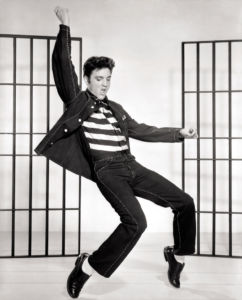
5,113 wordsThe recent movie on Elvis Presley[1] is exceptional in its acting, script, and production. For those interested in such matters, it is also excellent as cultural history.
The movie deals to a significant extent with the African influences on Presley’s music. As a little boy growing up in a poor, integrated neighborhood, he was fascinated by the rhythms and gyrations of the blacks, including black gospel music. (more…)
-
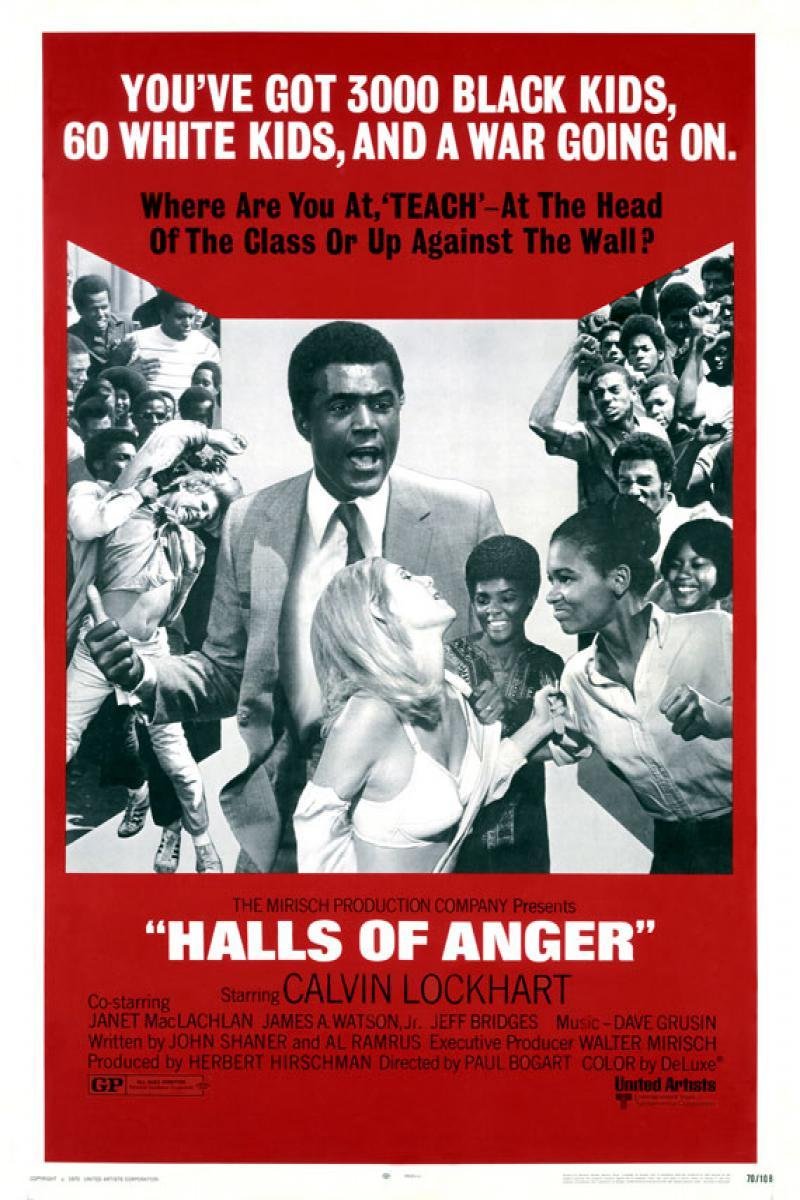
1970’s Halls of Anger is low-budget, tense, sensational, but real. Calvin Lockhart plays Quincy Davis, an ex-basketball star who’s happy teaching in a suburban high school until integration comes and he’s reassigned to a ghetto school, as are several white students. The principal, Boyd Wilkerson (John McLiam), couldn’t care less about his students; he wants more federal money (from integration) and a chance to get elected to the school board. (more…)