9,361 words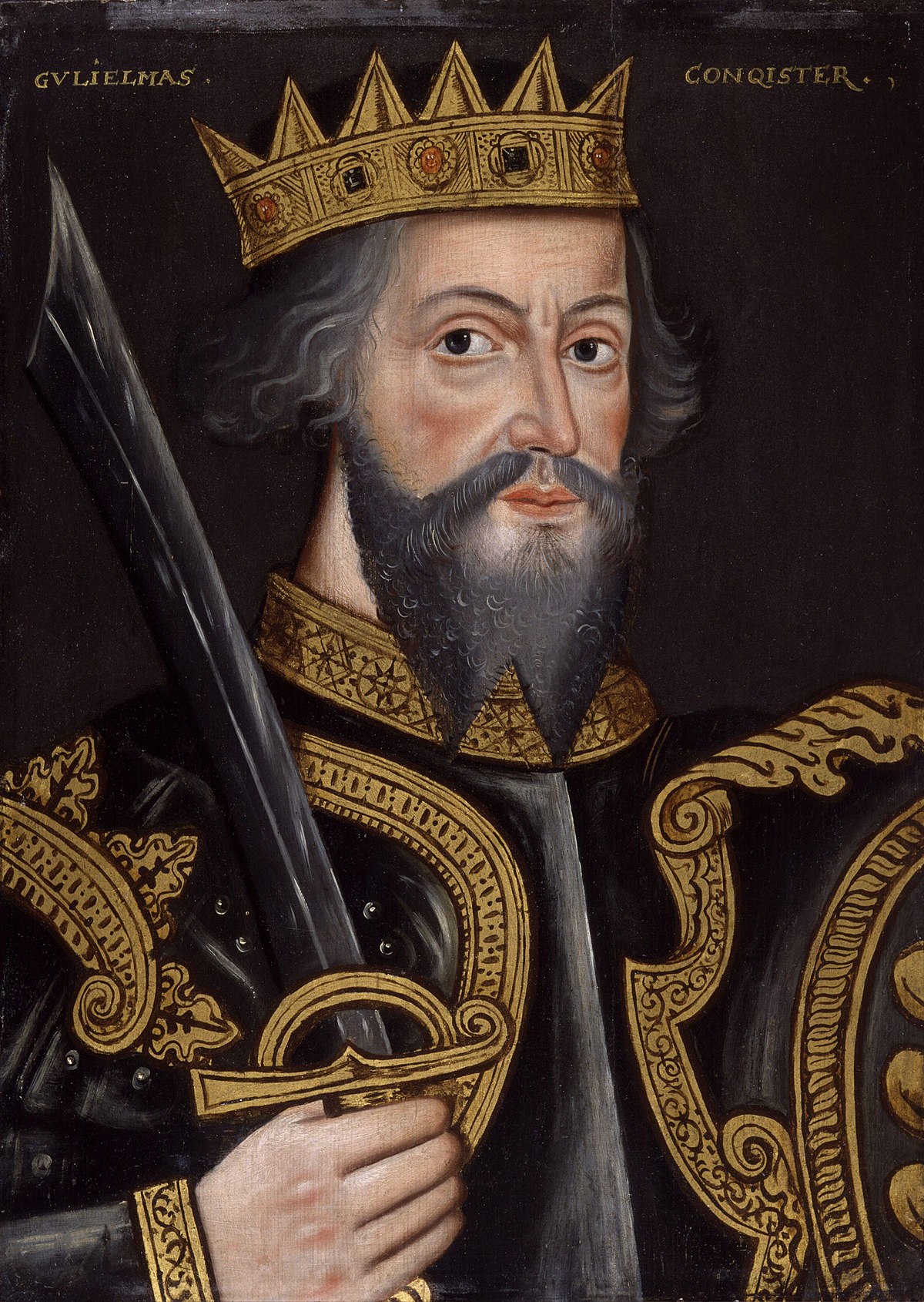
The Norman strain[…]seems to have been radically different in its mental makeup, and to some extent in its physical detail from the Saxons of England and also from their kindred in Scandinavia. The Normans appear to have been a “fine race,” to use a French idiom, and their descendants are often characterized by a tall, slender figure, much less bulky than the typical Teuton, of proud bearing and with clearly marked features of classic Greek regularity. The type is seldom extremely blond and is often dark. These Latinized Vikings were and are animated by a restless and nomadic energy and by a fierce aggressiveness.
-Madison Grant
***
The Anglo-Saxon Chronicle for the year 793 reads,
This year came dreadful fore-warnings over the land of the Northumbrians, terrifying the people most woefully: these were immense sheets of light rushing through the air, and whirlwinds, and fiery, dragons flying across the firmament. These tremendous tokens were soon followed by a great famine: and not long after, on the sixth day before the ides of January in the same year, the harrowing inroads of heathen men made lamentable havoc in the church of God in Holy-island, by rapine and slaughter.
The Viking Age in England began with a raid on the monastery at Lindisfarne, it ended at the Battle of Stamford Bridge on 25 September 1066, just four days before the Normans, themselves formerly Vikings, landed at Pevensey in 1066. From Pevensey, the Norman army went on to defeat King Harold of England and his force at Hastings and go on to conquer and reform the rest of England.
The Normans are a remarkable people, and a reason why people of English descent have come to dominate so many things is because the Normans conquered England in 1066. If you have English ancestry, chances are you have some Norman ancestry also. Commercial DNA testing firms include the region of Normandy in the DNA results-to-map-layout for those with ethnically English DNA. If one has any old stock Virginian ancestry, it is certain that one has Norman ancestry also.
The story of the Normans is important to know because they went from being a group of Viking pirate-raiders to law-giving kingdom builders across Europe and elsewhere. This article will illuminate the tools which the Normans used to become so dominant, describe the history of this uniquely successful European people, and explore the Normans’ significant contributions to Western Civilization.
The Collapse of Roman Imperial Authority in the West
The Roman Empire collapsed in Western Europe roughly a thousand years prior to the Turk-caused destruction of its second, eastern capital – at Constantinople – in 1453. For generations prior to Rome’s fall in the West, Imperial policy was to employ Germanic Northern Europeans in the military to guard the frontier. During the collapse, these armed Northerners swept southwards into the Roman imperial heartland and set up kingdoms which formed the basis of the nations of Western Europe today. Much of Italy became ruled by the Lombards, Gaul became ruled by the Franks, England became ruled by the Anglo–Saxons.
During the Anglo-Saxon settlement of Britain, many of the Roman Britons decided to leave. They settled in what is now called Brittany. There, as Christians, they continued their Roman and Celtic traditions and Brythonic language. As for the Franks, they adopted Christianity and repulsed the Islamic invaders at Tours in 732. Charlemagne, the grandson of Charles Martel, the Frankish leader who repulsed the Islamic forces, created an empire which covered the area that roughly matched the nations of Europe who initially joined the what became European Union just after World War II. Brittanny was not included in Charlemagne’s Empire, and the Bretons and the Franks did not get along.
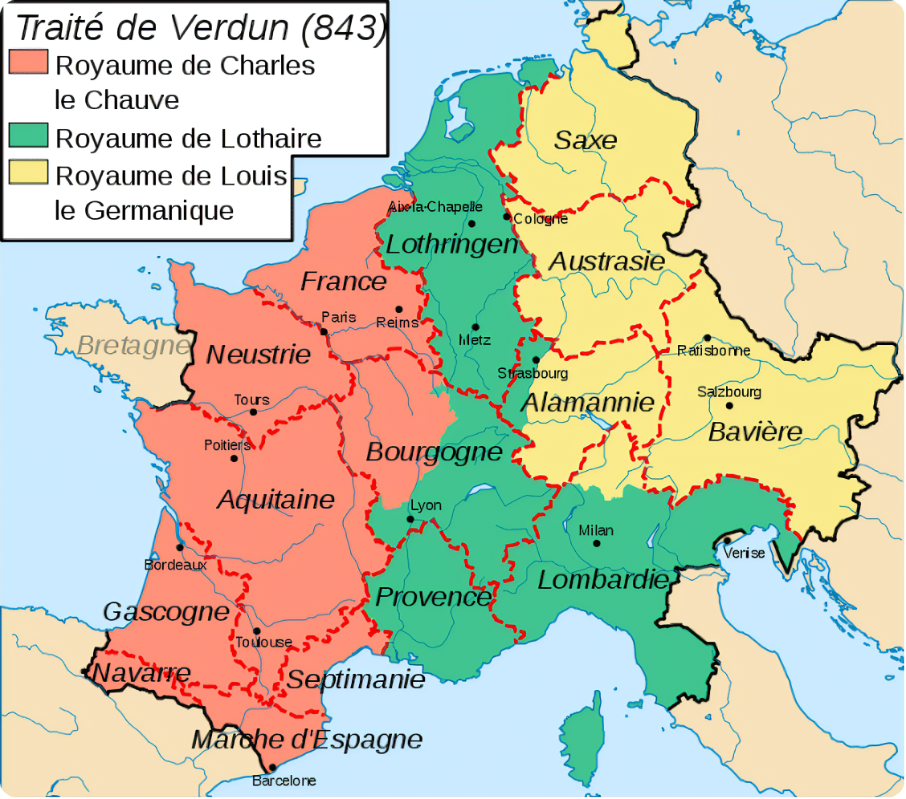
The Treaty of Verdun has affected the international politics of Western Europe right up to modern times. It forms the basis of the division between France and Germany.
Starting in 772, Charlemagne attacked the pagan Saxons. The purpose of the campaign was to expand the empire and Christianize the pagans. Charlemagne’s campaign against the Saxons lasted for thirty-two years and his aggression might have caused a Northern pagan reaction in the form of raids and attacks that became known as the Viking Age. Other factors include the development by the Northern Pagans – the “Norse” from Denmark and Scandinavia – of an effective technological package consisting of longships, navigational aids, and steel swords all of which were applied to military operations. They were also able to share intelligence, the Viking raiders were aware of political discord and local conditions in the areas which they raided. The Vikings were also aided by social disorder following Charlemagne’s death. The root cause of the disorders arose from the fact that Charlemagne’s empire was divided into three parts by his grandsons in the 843 Treaty of Verdun.
The Norse Settlement of the Coast of Neustria
What became the Duchy of Normandy was founded by Vikings. Eleanor Searle writes,
[…]the Viking incursions into Francia, distinguishes three phases. In the first they raided the shores of the sea and rivers. The Rhine, Scheldt, Somme, Seine, Loire, and Gironde were the wide entrances leading to unfortified cities and monasteries of the interior, and to smaller navigable rivers and on to still further prey. During this phase they not only raided from Scandinavia but established bases: for the land raids, as winter quarters, and as entrepôts for trading and slaving. The second phase was that of the Danegelds, when violence, or the threat of violence, was used to intimidate and force a region to pay them in the hope they would leave. The third…[phase] is that of “direct exploitation.” When the attacked territory was too disorganized by the ravaging Vikings for further resistance, actual settlement began and a Norse “state” was established. [1]
The first Viking incursions into France were repulsed by Charlemagne’s coastal defense militia, but after Charlemagne’s death the Franks divided and fought among themselves. The Frankish civil wars continued in the 830s which was a time when the Viking raids proved profitable indeed. The first Viking settlement in what became Normandy (but was then part of Neustria) took place in Rouen in 841. Initially these settlements were impermanent military bases which served as a staging ground for attacks on Paris or into the other areas of France.
Many of the Franks who were in the area that came to be called Normandy fled when the Vikings started to settle the area. There were however, not that many Franks or other people in the area in the first place. The Vikings could only set up a “Norse state” in what became Normandy because the area was underpopulated prior to their arrival. The coast of Neustria was a dangerous frontier zone between the Bretons and the Franks. It was also dangerous for the locals because of Viking raiders, so the Norse were also shaping the local demographic ecosystem.
The western part of what became Normandy – the Cotentin Peninsula – was settled by Norse who had lived in Ireland previously. The areas around eastern Normandy – Rouen and Pays de Caux – were settled by Norse from Denmark or Danes who’d lived in England and were influenced by Anglo-Saxon culture. The Scandinavian settlement of Normandy was described by two historians, Flodoard of Reims and Dudo of Saint-Quentin. The central figure in both histories is the Viking chieftain Hrólfr. The Latinized version of his name is Rollo, and he is called by that name in most histories.
Rollo has contradictory origin stories. Suffice to say he was a man from a prominent Norse family who left either Norway or Denmark because of discord there and he lived for a time in the Danish ruled part of England and befriended the King of the East Angles, Alstem (or Athelstan). Alstem was a convert to Christianity.
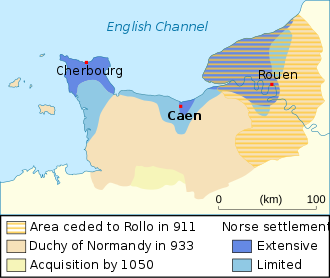
Scandinavian settlements in Normandy. Many of the Norse did not settle in Normandy directly from Norway and Denmark. Instead, they were Norse re-migrants who had first tried their luck in either England or Ireland and then migrated to Normandy as conditions improved in Normandy but deteriorated in the British Islands.
Around 876, Rollo seized Rouen – or arrived there armed and then built up the pre-existing Viking bases there after winning a battle or skirmish. Rouen was in a critical spot. It was on the Seine and downstream from Paris, so the King of the Franks had to control the area himself or be friends with whoever controlled it. In 911, Rollo came to an agreement with the Frankish King Charles the Simple to convert to Christianity and protect Paris from further Viking raids.
Rollo was inspired to convert after experiencing a dream in which he saw himself,
[…]placed upon a lofty mountain in the land of the Franks. On its summit was a spring clear and sweet-smelling, and in it he bathed and rid himself of a disease of leprosy…and, still remaining upon the mountain peak, [he saw] many thousands of birds of divers kinds, of various colors, yet all with red left wings…[who] sought the mountain’s spring and bathed…And all, anointed by its wonderful flow, then amiably fed side by side, each in a fitting place without regard of kind or species and without contentious dispute. And fetching twigs they built nests with rapid labor, and more, they willingly laid themselves down at the command of his glance. [2]
An imprisoned Christian explained to Rollo that the dream meant that Christian baptism would wash away Rollo’s sins. The birds represented Rollo’s red-shield carrying soldiers who would obey his orders and bring him victory. Many of Rollo’s Norse followers were baptized as many times as possible to get the more of white robes given by the Church to converts. The Normans adoption of Christianity is remarkable in that they were a victorious group of fighters who grew up in a thriving Norse pagan community and yet they converted to the religion of those whom they were fighting and enslaving.
King Charles the Simple was not doing anything unprecedented when he gave the area around Rouen to Rollo. Walchern and parts of Frisia had been given to Norse settlers by King Lothar of Middle Francia earlier. In each case, the Frankish leaders didn’t control the area anyway and they were in far greater danger from their rival Franks.
From Rollo to William
David Bates writes,
Normandy’s internal history before 1066 can be divided into three phases: one of peace and stability up until Richard II’s death in 1026, one of disorder during Robert I’s reign and the minority of William II [the Conqueror], and a third period dominated by the reimposition of order in the years after William’s victory at Val-es-Dunes in 1047. [3]
Rollo married Poppa of Bayeaux, whose lineage is not fully understood. She was probably the daughter of a local aristocrat of Gallo-Roman or Frankish heritage. This interpretation is reinforced by the fact that Bayeaux’s street-grid layout, set by the Romans, remained in place after the arrival of the Norse, so the town and its people seem to have been incorporated into the new order rather than destroyed. Rollo is also said to have married Gisla, the daughter of King Charles the Simple, but this marriage might only be legend invented to enhance Rollo’s reputation later.
Rollo and Poppa’s son William Longsword became Count of Rouen in 927. Longsword had children by his wife (married by Danish custom) Sprota who may have been a Breton. He also probably spoke French as his first language since there was a minor Norse rebellion to his rule in 933 on account of his Gallicization. Because of his support for King Raoul of France, he was given control of the Cotentin Peninsula and its surrounding region. This caused a war with the Bretons, which Longsword won. He was later ambushed and murdered upon the orders of the Count of Flanders in 941. William Longsword was killed because the Flemish felt he was a threat. Often when one is doing things right, one can make bitter enemies. William Longsword’s day-to-day policies in Normandy were making the Duchy powerful.
William Longsword was succeeded by his son Richard I (the Fearless), who was still a boy. For a time, young Richard was held as a captive by the Frankish King, but he was returned after an armed and disciplined group from Normandy besieged the King in his palace. He was also educated in the Norse language in Bayeux – where some Northern Pagans still lived in the 900s. Richard the Fearless ruled Normandy for 54 years and in his old age he was said to walk the streets of Rouen at night while wearing a cloak, like Odin.
Richard the Fearless married Emma, a Frankish woman, but had no known children with her. Richard I’s concubine was Gunnor, a woman from a prominent Norse family in Pays de Caux. Gunnor was an extraordinary woman. She lived long enough to possibly see William the Conqueror take his first steps. Through her and her siblings, nearly all the Norman political elite were interrelated.
Richard and Gunnor’s daughter Emma became Queen of England, first marrying King Æthelred the Unready and having many children with him. She later married King Cnut who conquered England and was crowned King. Cnut was also King of Denmark and Norway. Her sons by Æthelred were sent to Normandy for safety. Her son by Cnut, Harthacnut, became King, but died and he was replaced by Emma’s son by Æthelred, who became known as Edward the Confessor.
Richard I and Gunnor were the parents of Richard II, who was a child when his father died in 996. Richard II’s regent during his childhood was his uncle Rodulf of Ivry who was the son of Richard II’s grandmother Sprota. Richard II married Judith of Brittany who was probably related to Poppa. Richard II was the first true Duke of Normandy after the French King gave him that title. Their son, Richard III, succeeded Richard II in 1026, he went to war with his brother Robert who was Count of Exmes in a southwestern part of Normandy after Robert revolted.
Robert was defeated and swore an oath of fealty to his brother, but Richard III died shortly thereafter, so Robert became the next duke. Richard III’s sudden and unexpected death caused a slew of conspiracy theories, so Robert’s reign had the smell of illegitimacy. Normandy fell into disorder. Nonetheless, Robert was still able to repulse attacks by the Franks and he might have organized an invasion of England to support his kinsman Edward the Confessor in 1034 – when King Cnut was still occupying England with his Danish army. In 1035, Robert went on a pilgrimage to the Holy Land and died in Nicaea, making his son William his heir.
Robert wasn’t married in a Christian sense to William’s mother Herleva, she was married to him in the “Danish manner.” Her father was Fulbert, who was not an aristocrat. He is described as a tanner or an embalmer. There is considerable evidence, however, that Fulbert was a member of Robert’s household staff as the chamberlain. As such he would not have been of low social status.
Creating a Cohesive Norman Ethnostate & Civil Society
Eleanor Seale writes,
[…]Norman kinship [was not] dissimilar to that of the Scandinavians. There was in fact a kinship pattern common to all the Germanic peoples, closely related to rights over the property held by the unit defined as a family, and providing the building blocks for the social, political, and military arrangements of the medieval North. The essence of this Germanic kinship may be briefly characterized thus: a nuclear family was its basic “building block”; the wife brought to the marriage her own property and added it to the husband’s contribution as the material base of the new unit created by the marriage; the children all had a claim on that material base when they too came of age. The kin were reckoned bilaterally – the mother’s and the father’s natal family both being counted.[4]
Therefore, any Norman could count on the support of relations from four sets of grandparents. The most troublesome group for William the Conqueror were the men related to him along the entirely male line. Many would go on to be rebels throughout William’s youth. William’s most stalwart supporters were his cousins through the various female lines. Three of William’s top cousins were Roger of Beaumont, William fitzOsbern, and Roger II of Montgomery. All were related to William through Gunnor and her siblings.
The Normans also mastered the use of law. John Julius Norwich writes that,
[The Normans] saw the law, quite simply, as a magnificent and firmly rooted structure on which a state could be built, and which could be used as a bulwark to strengthen their position in any enterprise they might undertake. As such, it was not their master but their slave, and they sought to uphold it merely because a strong slave is more useful than a weak one. This attitude prevailed among all the Norman rulers, whether in the north or the south. It explains why even the most unscrupulous among them nearly always managed to produce some ingenious legal justification for everything they did; and why the greatest Norman architects of statehood, King Henry II of England and King Roger of Sicily, were to concentrate above all on building up a massive legal system throughout their realms. None of them ever looked upon the law that they created as an abstract ideal; still less did they make the mistake of confusing it with justice. [5]
So, in a time when might meant right and neighbor waged continual war against neighbor, and kings and other government officials oftentimes murdered their political rivals at feasts in pre-planned acts of treachery, the Normans could be relied upon to follow their own rules. If one entered a Norman castle one might be chastised, exiled, insulted, or fined, but one would not be held down and stabbed for sport.
The Norman embrace of a legal system helped bring about the concept of chivalry – not using violence for petty matters although one can do so. This turned out to be an enormous advantage. While still in Normandy, Duke William exiled his rivals rather than kill them. These exiles tended to do great things for Norman civilization elsewhere.
As Duke of Normandy, William ensured that only he and his army would be authorized to carry out organized violence. William’s men ended illegitimate “toll collectors” on Normandy’s roads who were like New York City’s “Squeegee Men” – giving an unneeded service for money, a barely legal form of theft. He also ensured his local lords kept the peace: hainfarum, ullac, rat, incendium, and bellum – housebreaking (burglary), outlawry, rape, house-burning, and private fighting were to be suppressed and bernagium – the provisioning of oats in an emergency was encouraged. Some of William’s close supporters had relatives who’d been involved in feuds with fatalities in the past, but they chose to not continue them – because private warfare was not tolerated.
One of the key problems in the Middle Ages was the temptation for a local lord to pay his warband followers in plunder captured during an event of local disorder. After William Werlenc, who held the castle of Mortain and was a male-line relative of William the Conqueror, promised his armed followers local plunder “in eighty days,” William summoned him and then banished him to Apulia in southern Italy, where the Normans were setting up a kingdom of their own.
Norman military activity in southern Italy is another reason why Normandy was an internally peaceful and coherent nation state especially when compared to its neighbors in Western Europe. The Norman elite was able to export any potentially dangerous element. Second sons with no chance to inherit and Normandy’s idle poor formed warbands and headed to Italy.
The Normans in Southern Italy
Italy at the start of the first millennium was ethnically divided between a Latin and Lombardic north and a Greek south. The island of Sicily was ruled by Islamic Saracens. The original homeland of the Romans was thus divided between three clashing civilizations – Latin-Christian aligned Western Civilization, Greek-centered Orthodox Civilization, and Islamic Civilization. It was the Normans who made all of Italy part of Western Civilization.
Norman involvement in Italy was started by a group of Norman tourists. In 1016, forty Normans on a religious pilgrimage to Monte Saint’Angelo of Apulia were approached by a man dressed in the Grecian style consisting of a flowing robe and bonnet. His name was Melus and he was a noble Lombard in exile who wanted to win south Italy from the Byzantine Empire. He figured that a combined Norman-Lombard army would be able to defeat the Byzantine Greeks. There is another legend which holds that in 999 Normans stopped in Salerno while returning from a pilgrimage in Palestine threw off an invasion of Saracen pirates, and the local elite collectively decided to hire Normans as soldiers then.
The first Norman to achieve considerable success in Italy was Rainulf Drengot. He’d been expelled from Normandy by Richard the Fearless. Drengot had 250 Norman followers, and they arrived in Italy around 1017. Once in Italy he was involved in the battles between the Lombards and the Greeks, and he eventually achieved considerable success in restoring order around Naples where was appointed the Count of Aversa. John Julius Norwich writes that after the appointment of Rainulf as a count,
[…the Normans] at last had a fief of their own. Henceforth they would no longer be a race of foreign mercenaries or vagabonds. The land they occupied was theirs by right, legally conferred upon them according to the age-old feudal tradition. They were tenants of their own freely-elected leader, one of their own kind yet now himself a member of the South Italian aristocracy, brother-in-law of the Duke of Naples. To a people so conscious of the form and legality, such an advance in status was of inestimable significance. It had little effect at first on their general behavior; the old activities continued-the playing of one side against another, the fomentation of discord among the squabbling Greek and Lombard barons, the selling of their swords to any who would buy. But they now had a clear long-term object in view-the acquisition of land for themselves in Italy. Many rootless groups of Normans still roamed the hills and the highways leading a life of freebooting and brigandage; yet more and more of their leaders would, after 1030, set themselves up in fixed and fortified settlements in imitation of Rainulf, and devote their energies to the carving out of a permanent territory of their own. From the moment that the Normans become landowners their whole attitude begins to change – not only towards their neighbors but towards the country itself. Italy is no longer just a battlefield and a bran-tub, no longer a land to be plundered and despoiled; but one to be appropriated, developed and enriched. It is, in fact, their home. [6]
Another notable Norman who made an impact in Italy was Tancred de Hauteville from Hauteville-la-Guichard. Aside from his hometown, Tancred’s origins are obscure. He headed to Italy with a company of Normans sometime after 1016. He had two sons with his second wife Fressenda, also a Norman, who became wildly successful. The first was Robert Guiscard, who married Alberada of Buonalbergo, a Norman woman and his two sons by her would go on to be rulers in the Crusader Kingdom of Antioch. The marriage with Alberada was annulled, and his second wife was a Lombard named Sikelgaita, who turned out to be an outstanding political helpmeet to him as well as the mother of many of his children.
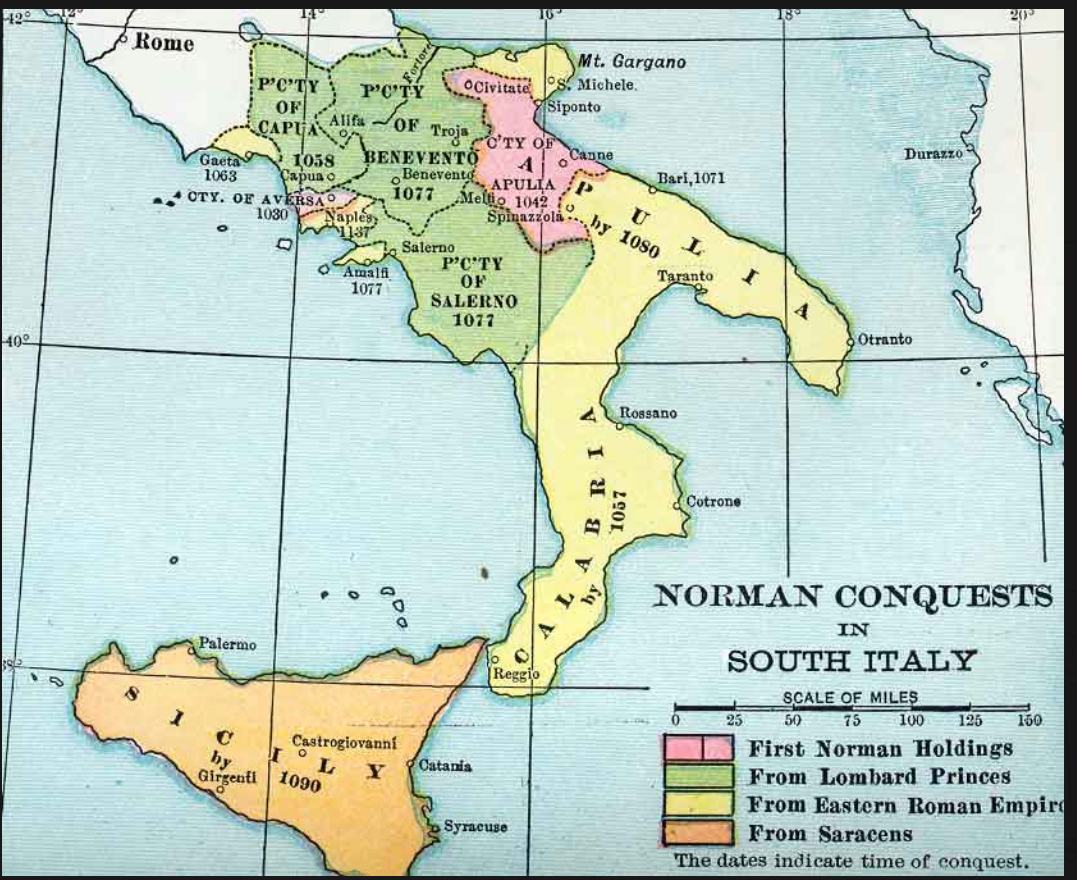
The Normans conquered and united southern Italy and Sicily.
The most significant accomplishment Robert Guiscard and his fellow Normans achieved was winning the 1053 Battle of Civitate. At the time Robert was working for his older brother Humphrey of Hauteville. Rainulf Drengot was also aligned with the Hauteville brothers. The battle was between the Normans and the Pope’s Army. The Normans swarming about in Italy had come to be resented by the Lombards, the Greeks, and the supporters of the Pope who were opposed to the local religious officials who the Normans liked. The Pope raised a diverse army to dislodge the Normans which included an elite battalion of Swabian horsemen. The Pope appealed to the Eastern Roman Empire for help, and a Byzantine Army was promised.
As the Norman and Papal armies moved into their respective fighting positions, the Pope met with Norman negotiators to stall for time – he was awaiting the arrival of the Byzantine Army. Additionally, the local, mostly Greek, population had brought the harvest into their fortified towns while the crops were still green to starve the Normans. The Normans recognized the delaying strategy of their foes and attacked first. Their victory was absolute, the Swabians were killed to the last man. The Pope was held prisoner by the Normans for several months.
The Normans won due to superior experience, training, and organization. The Papal forces had cavalry and infantry intermixed, so they had no advantage in combined arms operations. Many of the Pope’s troops were hastily recruited and had no training. The press of the Normans during their attack caused the flanks of the Papal forces to collapse which doomed the Pope and the Swabians in the center. The Pope’s army also didn’t have a clear chain of command, and its troops spoke different languages. It is also possible that the Normans had military equipment like mail armor and steel swords which they knew how to use, and their enemy army was less equipped – especially at the flanks. It is usually the case that lopsided victories come down to one side having the right gear and the other not having gear at all.
Throughout the Norman military operations in southern Italy, they made their own luck. The Normans had a solid ability to get into the respective minds of their enemies and understand and use technology. This was especially true when they fought Moslems. During a sea battle with the Saracens, the Moslems’ leader died while attempting to board a Norman ship – his jump was ill-timed, so he fell into the sea while wearing heavy armor. During one battle in Sicily, the Normans broke a siege by attacking the surrounding Saracens after they’d drunk themselves into a stupor. The Normans had been carefully watching the Saracens’ drinking habits in the weeks prior to the attack. In another naval incident, the Normans’ foes send away half their navy to proclaim victory, when the Normans press forward against their reduced foe, their rivals capsized their ships when the soldiers onboard rushed as a group to one side of the ship. The Normans also used Greek Fire – an early version of a flamethrower. In another battle with Byzantium, the Normans won by employing crossbowmen a technology which the Byzantines had no counter.
After the Battle of Civitate, the Latin Church headquartered in Rome made the final break from the Orthodox Church in Constantinople. The failure of the Greeks to come to the aid of the Pope was the final incident in a string of clashes which were purportedly over differences in theology but were really ethnically based – Latin/German vs. Greek. It was the start of a tragic civilizational breakup in which white Christendom divided irreparably. The Normans in southern Italy would continue to be involved in the internal politics surrounding the Pope, often fighting on both sides of the various battles, but their operations turned the lower half of the peninsula firmly towards Western Christian Civilization.
In Sicily, the Normans also shifted a land towards Western Civilization – Sicily. John Julius Norwich writes,
The island of Sicily is the largest in the Mediterranean. It has also proved, over the centuries, to be the most unhappy. The steppingstone between Europe and Africa, the gateway between the East and the West, the link between the Latin world and the Greek, at once a stronghold, observation-point and clearing-house, it has been fought over and occupied in turn by all the great powers that have at various times striven to extend their dominion across the Middle Sea. It has belonged to them all—and yet has properly been part of none; for the number and variety of its conquerors, while preventing the development of any strong national individuality of its own, have endowed it with a kaleidoscopic heritage of experience which can never allow it to become completely assimilated. Even today, despite the beauty of its landscape, the fertility of its fields and the perpetual benediction of its climate, there lingers everywhere some dark, brooding quality-some underlying sorrow of which poverty, Church influence, the Mafia and all the other popular modern scapegoats may be the manifestations but are certainly not the cause. It is the sorrow of long, unhappy experience, of opportunity lost and promise unfulfilled; the sorrow, perhaps, of a beautiful woman who has been raped too often and betrayed too often and is no longer fit for love or marriage. Phoenicians, Greeks, Carthaginians, Romans, Goths, Byzantines, Arabs, Normans, Germans, Spaniards, French – all have left their mark. [7]
Robert Guiscard’s brother Roger, more than any other man, made Sicily part of Western Civilization. In 1061, the island’s Islamic rulers were in disarray. One of the Emirs hired Roger and his Normans as mercenaries on his side, and from that toehold they proceeded to start to take over the island. It took 31 years to finally subdue the island, and the Normans were aided by steadily building effective castles at key points. When it finally came under Roger’s control, he officially allowed for religious toleration and controlled a peaceful, religiously diverse kingdom.
It wasn’t to last. The problems with the Muslims never went away. Islamic raiders used Sicily as a base to capture women in nunneries in southern Italy for their harems. Additionally, the battles between Christians and Moslems were take-no-prisoners affairs. In one engagement, the Normans killed their horses rather than allow them to fall into Saracen hands. Many Saracens left Sicily after the Normans arrived, never to return.
The Normans slowly strangled Islam in Sicily in 1199. The Pope declared Saracens a “hostile element” and within a century from that decree, they were all finally expelled. Meanwhile, the Normans sponsored Latin Christian institutions and ensured Western-leaning officials were appointed to high ecclesiastic offices. This shaped the religious life on the island. Little changes at the top offices often make big changes downstream.
England Before William
England was wealthy and had a functional and stable bureaucracy in the decades prior to the Norman Conquest, but it was not a perfect kingdom on an idyllic island. For centuries after the Anglo-Saxon invasions, what is now England was politically divided between several warring kingdoms. Then, in 865, an army of Danish Pagans conquered much of eastern England, setting up a Viking-ruled state called the Danelaw. The Kingdom of Wessex survived the Danish attack and pushed the Danelaw back year by year until the last Danish holdouts were defeated in northern England in 954.
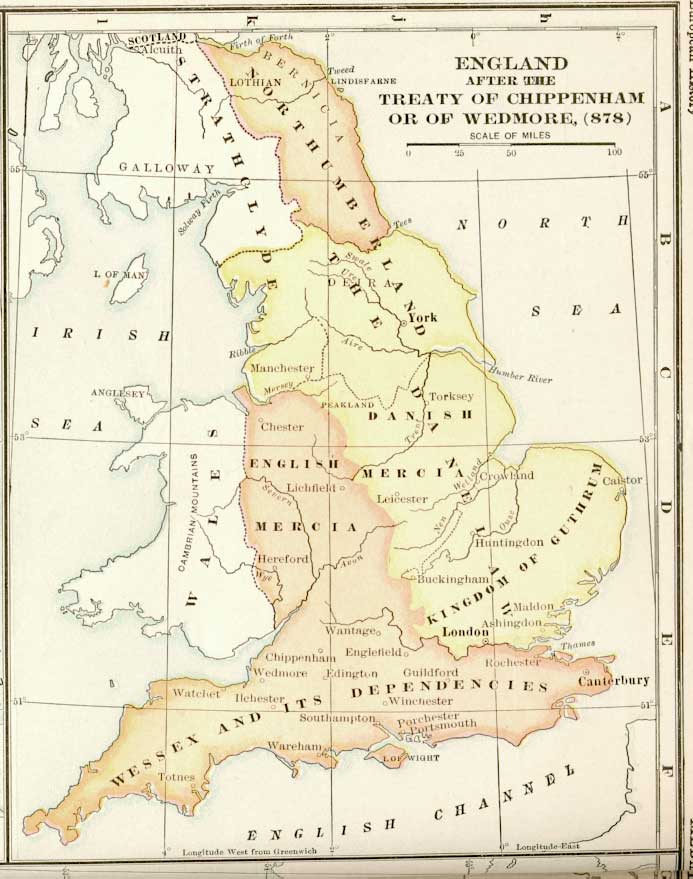
Areas of England conquered by the Danes.
England’s fight against the Danes is not unlike Spain’s fight against the Moors except the Anglo-Saxons and Danes had common ethnic origins which ultimately meant that any Dane could become an Englishman provided he converted to Christianity and started to speak English. The Spanish Christians did not have any real ethnic links to the Moors, and no Moor would convert. Regardless, the hatred between the English and the Danes was extreme, centuries after the Vikings were driven off, English churches continued to claim to have had “Daneskins” nailed to their doors.
The best place to start the story of the disorder in England which gave William a plausible claim to the crown is with King Edgar who was king from 959 – 975. He ruled a united England but after his death the throne became contested. His oldest son Edward, then still a boy, was crowned king in 975. Edward had many enemies, and he was killed by unknown assassins while hunting on his mother’s estate. The crown thus fell to Æthelred who became known to history as Æthelred the Unready.
The reason for this dubious title was that there was a renewed series of vicious Viking attacks, and Æthelred’s government had a very difficult time throwing back the raiders.
Æthelred had many problems besides that of the Vikings. His nobles and aristocrats wouldn’t, or couldn’t cooperate on any endeavor, and his army couldn’t get it together to beat the Vikings. When he raised taxes to pay for a navy, part of the fleet took off and turned to piracy. After the disastrous Battle of Malden in 991, Æthelred was forced to pay tribute – Danegeld – to the Vikings. This gave him relief, but not for long.
The Vikings returned in 997. They grabbed entire families to be sold into slavery, stole goods, and gang-raped women. In 1002, the Æthelred paid more Danegeld, but it is clear the King was tired of the raids. Part of Æthelred’s Viking problem was that there was still a large contingent of Danes in England whose loyalty was questionable at best. At worst, they were a genuine fifth column. Since the Vikings always seemed to have the advantage, it was not unreasonable to believe the Danes in England were a hostile minority. Æthelred sent word that on Saint Brice’s Day in 1002, the English were to rise as one people and kill the Danes.
The Saint Brice’s Day Massacre wasn’t a complete success, but it was something like the first time a small kid stands up to a schoolyard bully. For those who think that the English will suffer non-white and Islamic minorities who will rape and rob with impunity forever can remember Saint Brice’s Day 1002. Many of the Danes killed were high born and Sweyn Forkbeard, the King of Denmark and Norway, invaded England in response. Forkbeard’s actions are similar to the friction points of wars in current times, where one nation is drawn into conflict with another when the former nation’s diaspora is abused in the lands of the latter nation. Forkbeard was briefly King of England but died there in 1014.
Æthelred the Unready died in 1016 and son Edmund Ironside followed him as king, but he also died in 1016. Meanwhile, Cnute, King of the Norway and Denmark invaded in 1015. Cnute’s claim to the throne was based on the fact his father was Sweyn Folkbeard. Cnut’s forces landed in the south of England and harried – a form of warfare which focused on damaging civilian property as well as hunting down enemy groups – much of the West Country. Cnute’s most interesting reform while King of England was his creation of four earldoms – Wessex, Mercia, East Anglia, and Northumbria. Cnute’s Earldoms match the four English folkways found in the regions of the United States identified by historian David Hackett Fischer.
Cnute’s reign is viewed favorably by historians, but he was a foreign conquer who killed many Anglo-Saxon nobles in the course of his rule. The Viking raids did stop during his reign, but only because Cnute was King of the Vikings’ respective homelands in Norway and Denmark also. Additionally, the ugly political culture of Anglo-Saxon England continued. There were political murders throughout this time. Cnute had fallings out with his Earls and executed some of them. Cnute died in 1035, his two sons succeeded him in turn, but both died young. The crown passed to Edward the Confessor, who was married to Edith, the daughter of the Earl of Wessex. Edward was half-Norman, and his mother was William’s grand aunt.
Earl Godwin of Wessex and his family had a tense relationship with King Edward. The Earl had blinded Edward’s older brother after he kidnapped him, which caused him to die. Godwin had also collaborated with King Cnute and his Danes. Meanwhile, King Edward’s half-Norman heritage was part of a trend. Normans were starting to make in-roads into England prior to the Conquest. When several Norman merchants were killed in a brawl in Dover, Edward ordered the Earl of Wessex to harry Kent County. When the Earl refused, England was put on the edge of civil war – Kent was in Godwin’s Earldom. The Earl backed down and was temporarily exiled. King Edward has also appointed a Norman, Robert of Jumiegès, as the Archbishop of Canterbury, who Godwin opposed.
Harold Godwinson, the Earl’s heir, was also a problem to Edward the Confessor although they were brothers-in-law. Edward and his wife were unable to have children. The reason why is not knowable, but it is very possible that Edward was seeking to replace his queen to be able to have children and Harold ensured no divorce would happen, guaranteeing a crisis when Edward died. The Godwin family also backed Stigand, a corrupt church official for the Archbishop of Canterbury job.
In 1064, Harold was shipwrecked in Normandy and made an oath over holy relics to William of Normandy that he would back his claim to the throne of England when Edward the Confessor died. This oath might have been made under duress. Meanwhile, Harold’s family was unable to cooperate with the family of the Earl of Mercia, and Tostig, the brother of Harold, was enemies of both Harold and Edward the Confessor. All of this is putting the churn in English politics simply.
While the aristocrats feuded and sometimes collaborated with the Danes, a lively slave trade was ongoing in England. Approximately ten percent of the population of the Anglo-Saxons were slaves in England, and many more were transported by Vikings to be sold in the Islamic World.
As Edward the Confessor was dying, he said:
The extreme corruption and wickedness of the English nation has provoked the just anger of God. When malice shall have reached the fullness of its measure, God will, in his wrath, send to the English people wicked spirits, who will punish and afflict them with great severity, by separating the green tree from its parent stem the length of three furlongs. But at last this same tree, through the compassionate mercy of God, and without any national assistance, shall return to its original root, reflourish, and bear abundant fruit.
When Edward died, the Anglo-Saxon establishment formed the Witan – a group of bishops, earls, and other notables and they ultimately voted to make Harold Godwinson king, claiming that Edward the Confessor had named him his heir when he died. Harold didn’t have royal blood; he was only related to Edward by marriage. The only candidate with royal blood was a teenager with no following and the Witan recognized that an invasion from Scandinavia or Normandy was very likely.
Another part of the crisis was the fact that the English did not have a deep bench of talent. The Danish invasion that won Cnute the crown led to the death of many of the men in England’s royal family. The vicious politics had also meant that there wasn’t a collection of older nobles with military experience who could form an army with a teenage king as head and go out and fight. Harold’s brother Tostig, for example, was rebelling during this time. The only plausible English candidate was Harold.
William in Normandy
William the Conquer would later claim that he was brought up in arms from childhood. After his father died, rival barons were compelled to fight over control of young William. His tutor, who was sleeping in the same bed, was murdered next to him.
This disorder, however, was mostly Norman lords carrying out private fighting. William’s right to rule was not questioned until 1047, when a cousin, Guy of Burgundy, rebelled. William successfully defeated him in battle and Guy retreated to his castle, which William besieged for several years. When Guy surrendered – he was exiled. That same year at Alençon, William cut off the hands and feet of men who’d taunted his mother’s humble origins after he captured the town. The rebellion at Alençon was encouraged by Count of Anjou. It is still not certain why Guy fought against William.
William also repulsed an invasion from the French King in 1057. The French were turned back at the Battle of Mortimer. As the Normans headed to fight at Mortimer, the French Army was undisciplined and were scattered seeking plunder. The Normans attacked the French and used the boggy terrain to their advantage. The French were defeated. In 1063, William captured the French county of Maine, which is the region immediately south of Normandy.
When the English succession crisis started, William had plenty of combat experience dealing with rebellions and foreign invasions, but these challenges were not anywhere close to the problems which were facing those in England. The Normans had also picked up the lessons learned from their kinsmen in Italy. William’s army knew how to conduct combined arms operations and conduct an invasion by sea.
William Invades England
William also understood logistics, without which there are no successful military operations. Mark Morris writes,
[…]an American scholar named Bernard Bachrach wrote a paper looking at the logistics involved in keeping the Norman invasion force supplied during its month-long stay at Dives-sur-Mer. For unconvincing reasons (essentially, the testimony of an obscure contemporary chronicle) he assumed an army of 14,000 men, i.e. twice the generally accepted figure, but even if we halve his totals, they remain arresting. Supposing the men subsisted only on grain (highly unlikely, of course), it would have required fourteen tons a day to keep them fed, and a similar amount to feed an estimated 2,000 horses. Between them the men and their mounts would have also needed around 30,000 gallons of fresh water every day, and the horses, in addition, would have needed four to five tons of straw a day for their bedding. The resulting totals for a whole month are mammoth: thousands of tons of food and water, all of which had to be transported to the encampment, either ferried down the Dives or carted along rutted roads. Equal forethought, of course, had to be given to sanitation. That many men and horses would have produced a mountain of manure and a river of urine (2,000 tons and 700,000 gallons are Bachrach’s respective figures for the horses alone). Lastly, of course, they all required shelter: tents for the men, stalls for the horses. These, it bears repeating, are minimum requirements for keeping people alive for a month, more in keeping with a refugee camp than a volunteer army. To keep his men together, and to maintain their morale, William would have had to have found many more items – meat, fish, wine and ale – in similarly colossal quantities. [8]
Meanwhile, in England, Harold had to dismiss his levies guarding the southern coast because he could not feed the troops. Just as that occurred, Harold got word that an invasion fleet had landed the north. A large Viking Army led by Harold Hardrada and supported by Tostig Godwinson and his foreign mercenaries. Harold Godwinson attacked the Vikings by surprise, and they were nearly completely annihilated.
The northern winds which brought the Vikings to England kept William’s army in Normandy, but the winds shifted. The fleet landed at Pevensey where William’s army built a castle made from wood pre-cut in Normandy. From Pevensey, the Normans moved overland to Hastings where they built another prefabricated castle. Then Harold’s army arrived.
The English army was entirely made up of infantry, the Normans were a combined arms force of cavalry, infantry, archers, crossbowmen, and archers. They also had engineers who’d built the castles. Diplomatically, the English were isolated, while the Normans homeland was secure. Most importantly, William was involved in a reform movement within Western Christendom. It was led by radicals at the Vatican who claimed they first supported the Lord of the Pope. As such, he had received the Papal Banner and a blessing for his endeavor.
The entire campaign focused on the political as well as the tactical. William had to be present and brave and survive. Harold didn’t need to be present, he could have gone to London and raised multiple armies so that William would need to fight and win a string of battles, but this seems to have not been plausible for him. Regardless, it is possible that William had a detail of archers to finish off Harold once he was identified. Harold was killed by arrows.
After his victory, William waited for the Witan to send word he’d been made king, but the Witan had elected Edgar the Ætheling as the next king. To put it simply, William’s army marched to London, capturing key political areas including Canterbury and Winchester, which held the Royal Treasury. William also harried Kent and other parts of southern England, so London had a refugee crisis just as winter was approaching. The English surrendered. William was crowned King on Christmas Day in 1066.
It still took five years to stabilize the country. English aristocrats would rise up in rebellion and the Normans would take to the field and destroy them. The worst Norman-led incident was the Harrying of the North. William got word that the Danes and Scots were supporting a rebellion there. The Normans decided to respond to the threat by means of a scorched-earth campaign which destroyed the economy of northern England and depopulated large areas. The logic of this action was similar to the Union Army destroying the Shenandoah Valley in the Civil War as well as Sherman’s March to the Sea.
By the end of William’s life, England’s upper class had been completely replaced by Normans. William also Normanized the institutions of the Christian Church in England. He built enormous cathedrals and switched out abbots at monasteries. His biggest goal was recruiting Lanfranc, who was a top theologian and administrator, as the Archbishop of Canterbury.
William also secured the kingdom. The Norman Army fanned out across the country and set up motte-and-bailey castles to secure their garrisons. The castles didn’t just secure the garrisons, their presence – and the network of soldiers skilled in combined arms operations – deterred further Viking raids. They also made the kingdom more secure for ordinary people since the garrisons could also suppress crime. William also secured the Welsh border. He put his best men on estates there and gave them the freedom to build castles where they felt they were needed – the other castles were carefully emplaced strongpoints for to achieve the King’s political goals. After the arrival of the Normans, the Anglo-Saxons started to expand into the largely empty, but unsecure areas of eastern Wales.
The Normans Become English
William’s coronation was held in two languages, and when the English in the cathedral cheered him, the Norman troops outside thought he was being attacked, and they started to burn the town. This was an inauspicious start for a new upper class which was foreign to the English but would be far less predatory towards them in the long run. Ultimately, the men of William’s army became as English as those whom they had fought.
How then did the Normans become English? Unlike the more contentious relations between the English and the Scots or Welsh, the Norman – English War was a single spasm of violence which receded into the history books. The Norman upper class also cooperated, unlike the earlier Anglo-Saxon aristocracy – so there was less griding bloodshed that would have kept people apart. There were revolts of earls and barons after the Norman Conquest, but these events were entirely due to domestic political issues. None of the rebels wrote to a Viking prince somewhere offering an English county to plunder provided the rebels got a regiment of foreign supporters.
The Normans and the English also started to cooperate against foreign forces. It is clear from the record that by the time of the Battle of the Standard on 22 August 1138, the English and the Normans saw themselves as an allied and semi-related people. In his history of Britain, Alfred of Beverley described,
[…]the Britons being in Wales, the Picts and Scots in Scotland, and the Normans and English throughout mixtim [mixed]… [9]
It is not clear if Alfred of Beverley meant the two ethnic groups had combined by marriage or if they were merely living alongside each other. The two senses of mixtim aren’t mutually exclusive. It is certain that by the reign of King Stephen that the sources are silent on Norman-English ethnic conflict. By the 1180s, the green tree prophecy – which held that the tree would grow again – was interpreted to have been fulfilled since the English and Normans had so thoroughly joined together.
The Normans also joined with the English because English culture was strong prior to the Conquest, and the Normans had a history of assimilating with those whom they conquered, in both Normandy and in Italy. The Normans, however, couldn’t assimilate with anyone. They were not able to assimilate the Jews, and it is possible that the antisemitism they shared with the English helped merge the Normans and English faster. They also assimilated with the Irish to a significant degree, that situation is more complex than in England, however. Many proud Irish names, such as Burke and Walsh are Norman.
Norman Leadership
It remains striking how many people with Norman surnames are at the top in key events. Edmund Burke, the Irish political philosopher who pointed out that the French Revolution was a disaster before it made blood run in the streets, had a Norman name. Many current members of parliament also have ancestral ties to the men in William’s army. Gregory Clark, who did a study of surnames to social class over time, found that,
Norman surnames are also significantly overrepresented in English armies in the years 1369-1453, more than three hundred years (ten generations) after the Norman Conquest. This was the period of the Hundred Years War, the long struggle between the French and English crowns for control of the English-held territories in France…Norman surnames clearly still represented an elite. The higher the social status of the person in the army, the greater the share of Norman surnames. At the top level – earls, barons, and bishops-approximately a fifth of those recorded have Norman surnames, as opposed to less than 0.3 percent of the general population in England who bore such surnames. What is surprising, however, is the heavy concentration of Norman-derived surnames at all ranks of the armed forces. Even among the lowest ranks of the army, the archers, Norman surnames still show up at three or four times the frequency predicted by their population share. Archers were skilled workers, with wages comparable to artisans, but did not rank particularly high on the social scale. The preponderance of Norman surnames among them thus does not stem from the relatively high social status of these names: to the contrary, this should have led to Norman surnames’ being underrepresented in these ranks. Instead it seems to suggest that even ten generations after the conquest, the descendants of the Norman conquerors still had a taste and facility for organized violence. This hypothesis is supported by the share of knights and esquires in these armies with Norman surnames. This was 3-11 percent, much greater than the share of Norman surnames found in the more pacific realm of Oxford and Cambridge at the same time. [10]
During the English Civil War, which took place when New England was being settled by Puritan English, many of the Puritan ministers and parliamentarians in England claimed to be throwing off the “Norman Yoke.” However, they were merely weaving an ill-made propaganda narrative. Norman names are still represented among the Puritans, especially those involved in military activities. Connecticut, during King Philip’s War, fielded a battalion to attack a Narragansett Indian fortification in Rhode Island. With the exception of one man – Captain Thomas Watts – all the commanding officers from that battalion – Treat, Gallup, Seeley, Mason, and Avery had Norman surnames.
Norman names are even solidly represented among the governors of the two Dakotas, North Dakota 26.4% of that state’s former governors have a Norman surname and in South Dakota, 17% had family names of Norman origin although the percentage drops if one removes Governor Andrew Lee, whose family came from Norway and were not related to the Norman descended Lees of Virginia and Maryland.
Conclusion
The Normans have been very successful, describing their successes is a bit of a tautology – they are winners because they win – but some of what they do well can be enumerated. The Normans:
- Were able to unite with those whom they could unite. They completely merged with Lombards in Italy, the Gallo-Romans in Neustria, and the Anglo-Saxons in England. They semi-merged along a spectrum in other cases, merging with the Welsh, some merging with the Irish, and less merging with the Greeks and Bretons. They didn’t merge with people who were too different: the Saracens in Sicily or the sub-Saharans and Indians in North America.
- They mastered advanced military technology and acted decisively in battle. The Harrying of the North – a vicious and savage attack which brings an end to what could be a long-running war – has parallels to President Truman’s use of the atomic bomb to end the Pacific War. Truman (possibly) had a Norman name and since his ancestors came from Tidewater Virginia it is certain he had some Norman ancestry.
- They carefully shaped institutions to align with civilizational best practices. They followed their own laws. Their reforms of the Church in England put men of genuine faith in office. After William became king, he set up the laws so that any landholder who rebelled would lose his land, thus ending the continual feuds between earls which undercut Anglo-Saxon England’s stability. The Doomsday Book, a census which recorded much about England’s economy, gave William’s government knowledge of the workings of his kingdom and it served as a deterrent to further Viking raids since the King and his ministers knew immediately where resources could be found and shifted in the event of an attack.
- They made life better for those whom they ruled. After the Normans arrived, the Viking attacks stopped. Slavery ended. Crime went down due to the many castles that provided order. The border with Wales was made secure. Should the descendants of the Normans – and that’s nearly everyone of Anglo heritage – continue to rule or seek high office – making life better by ending criminal activities specialized by foreign entities be it Viking raids or Islamic grooming is critical.
Notes
[1] Eleanor Searle, Predatory Kinship and the Creation of Norman Power, 840 – 1066, (Berkeley, California, University of California Press, 1988) p. 16
[2] ibid. p. 65
[3] David Bates, Normandy Before 1066, (Harlow, Essex, UK, Longman Group Limited, 1982) p. 94
[4] Eleanor Searle, Predatory Kinship and the Creation of Norman Power, 840 – 1066, (Berkeley, California, University of California Press, 1988) p. 160
[5] John Julius Norwich, The Normans in the South 1016 – 1130, (London, Faber & Faber, 1967) p. 7
[6] ibid. p. 37
[7] ibid. p. 47
[8] Marc Morris, The Norman Conquest: The Battle of Hastings and the Fall of Anglo-Saxon England, (New York, Pegasus Books, 2014) p. 153
[9] Hugh M. Thomas, The English and the Normans: Ethnic Hostility, Assimilation, and Identity 1066 – c.1220, (Oxford, England, Oxford University Press, 2003) p. 64
[10] Gregory Clark, The Son Also Rises: Surnames and the History of Social Mobility, (Princeton, New Jersey, Princeton University Press, 2014) pp. 256/7
Bibliography
Max Adams, The Viking Wars: War and Peace in King Alfred’s Britain: 789 – 955, (New York, Pegasus Books, 2018)
Frank Barlow, The Life of King Edward who Rests at Westminster, (London, Thomas Nelson & Sons, Ltd. 1962)
David Bates, Normandy Before 1066, (Harlow, Essex, UK, Longman Group Limited, 1982)
Gregory Clark, The Son Also Rises: Surnames and the History of Social Mobility, (Princeton, New Jersey, Princeton University Press, 2014)
Paul Dalton, Conquest, Anarchy and Lordship: Yorkshire 1066 – 1154, New York, Cambridge University Press, 1994)
K. Lawson, The Battle of Hastings, 1066, (Stroud, England: Tempus Publishing, 2003)
Mark Morris, A Great and Terrible King: Edward I and the Forging of Britain (New York: Pegasus Books, 2009)
Marc Morris, The Norman Conquest: The Battle of Hastings and the Fall of Anglo-Saxon England, (New York, Pegasus Books, 2014)
John Julius Norwich, The Kingdom in the Sun 1130 – 1194, (London, Faber & Faber, 1970)
John Julius Norwich, The Normans in the South 1016 – 1130, (London, Faber & Faber, 1967)
Eleanor Searle, Predatory Kinship and the Creation of Norman Power, 840 – 1066, (Berkeley, California, University of California Press, 1988)
Hugh M. Thomas, The English and the Normans: Ethnic Hostility, Assimilation, and Identity 1066 – c.1220, (Oxford, England, Oxford University Press, 2003)
Colin Woodard, American Nations: A History of the Eleven Rival Regional Cultures of North America, (New York, Viking, 2011)
Patrick Woulfe, Irish Names and Surnames, (Dublin, Ireland, M. H. Gill & Son, 1922)
5 comments
A Roman Salute from us antique Whites somewhere in Calabria and Sicilia gone elsewhere long ago. By fire and sword may they slay all enemies, and countless shall be the sons of Normans.
I have read that General Robert E. Lee could trace his ancestry to William the Conqueror. 🙃
Take a look at the buildings at West Point to see an updated version of Norman building practices.
Constant Readers know that one of the reasons the Norman Conquest is so important is because it uniquely made English both a Germanic and a Latin Language. Wallace Stevens said English and French are the same language, that’s exaggerated but the point is taken.
It’s partly why English has so many more words than other languages as it has the two mighty tributaries streaming into it, and not just the one or the other like the other Indo-European languages.
You have your homespun cow and the la di da cured beef (boeuf) of the Court; you have the down-to-earth Saxon God (perfect for expletives) and the hifalutin Latin Deity (three fey syllables). Add a dollop of Tyndale and two (or more!) touches of Shakespeare, stir wisely, push play, and Voila!: you have the world’s current Lingua Franca.
Once could say the Normans…rock well.
This is a fascinating article about a fascinating people. Counter-Currents does such a good job of informing us of the history of our folk, as well as trying to fashion its future.
Comments are closed.
If you have a Subscriber access,
simply login first to see your comment auto-approved.
Note on comments privacy & moderation
Your email is never published nor shared.
Comments are moderated. If you don't see your comment, please be patient. If approved, it will appear here soon. Do not post your comment a second time.