 3,111 words
An oasis of horror in a desert of boredom. — Charles Baudelaire, epigraph to 2666
The British Prime Minister was asked during an interview to name his favorite novel, and the answer he gave was revealing. Sir Keir Starmer said he didn’t have a favorite novel. He didn’t have a favorite poem, either. This is a man who was the Director of Public Prosecutions, one of the highest appointments in the United Kingdom. I know that he had a good education because I was at school with him, although he evidently spent more time studying than I did. My preferred schoolboy modus operandi was showing off and acting the class clown, a subject in which I was more than proficient.
Thus, Starmer is not stupid in that sort of Somalian sense, and believe me when I say that there are politicians in the Mother of all Parliaments who are. Starmer just seems to lack any empathic resource, and his adenoidal voice doesn’t help the fact that he speaks as though he had swallowed a dictionary of Neuro-Linguistic Programming. He would never understand the appeal of reading a novel, it seeming to offer no prospect of personal gain or conventional ego-reinforcement. Also, Starmer has no spontaneity, and people who lack the ability to be spontaneous always make me deeply suspicious. He could have said in reply to the interviewer, “Well, I’m a bit of a Dickens man, but I have to admit I have read Harry Potter,” and it would have seemed natural and chatty. Viewers might have even taken to the most unpopular man in Britain. The PM could cure cancer, reduce inflation to negative digits, and captain the “English” football team to victory in the World Cup; his effigy will still be burned on bonfires throughout the country on November 5.
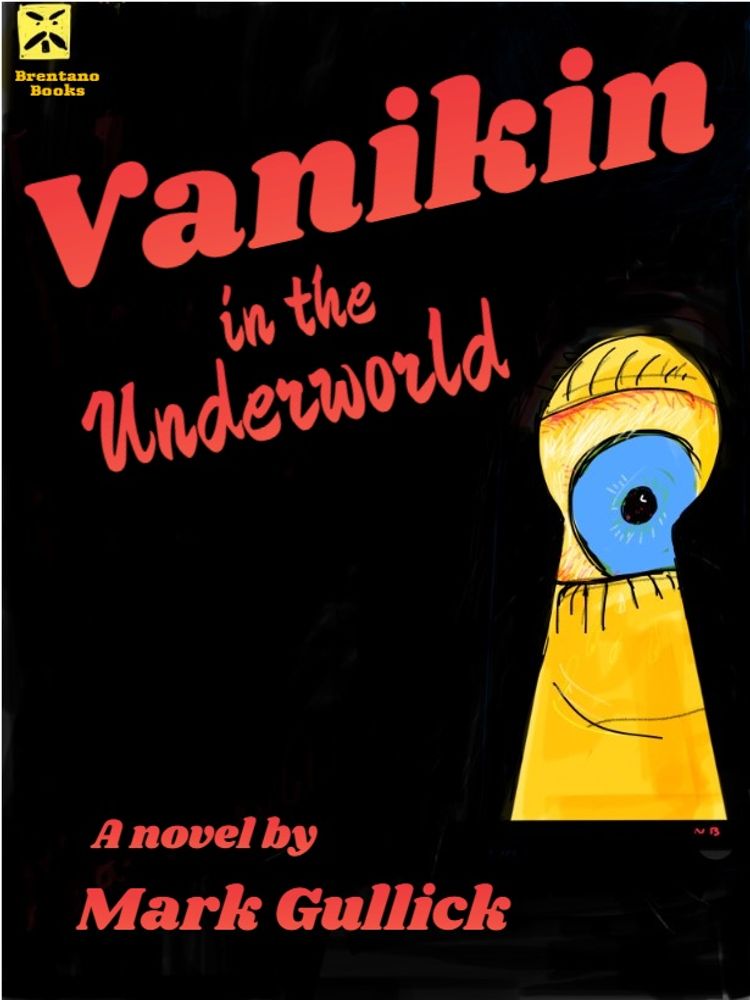
You can buy Mark Gullick’s Vanikin in the Underworld here.
Starmer has no capacity for that mode of consciousness which welcomes art as a friend and companion; he lacks the necessary data, the required processor. His is the managerial, technocratic, function-led type of personality. His behavior also comes across as very autistic. The fact that he relies on other people was illustrated by Donald Trump recently. Concerning the Iran offensive, the President asked Starmer for British support and the PM replied that “I have to ask my team.” “You’re the Prime Minister,” Trump said. “You don’t have to ask your team.” While not everyone approves of Trump’s current autocratic style of governance, and we are all perhaps hoping he doesn’t stop ruling as Augustus Caesar and go full Caligula, it shows that Starmer is a shell of a man, while Trump is at least recognizably manly. If the PM were revealed to be an artificial intelligence, I would not be in the least bit surprised.
I suspect Starmer does have at least one novel he enjoys, but his fear would be who he might alienate by revealing it. His choice would be circumscribed in any case. Desperate to keep the Muslim voting bloc he has carefully imported (and who are being stolen from him by the Greens), he would be unlikely to choose anything by Salman Rushdie, or Raspail’s Camp of the Saints. And Jewish novelists would be right out. This obsession with optics has led to absurdities in the past, with prime ministers occasionally trying to do that most absurd of things: looking “down with the kids.” Donald Trump looks quite cool in his MAGA baseball cap. William Hague, Conservative British Foreign Minister in 2010, did not.
When the dour Gordon Brown, a Scottish Presbyterian former PM, was asked what he was listening to on his headphones, he replied “The Arctic Monkeys.” This punkish pop band was popular at the time, but Brown did not seem to grasp that the likelihood of his grooving out to “I Bet You Look Good on the Dancefloor” was about as believable as Mother Theresa having a blast of “Never Mind the Bollocks, Here’s the Sex Pistols” on her Dr. Dre headphones.
Starmer’s refusal to name a favorite novel may be, of course, because he does not understand that they are not real. He certainly had a problem separating fact from fiction when he described the televised drama Adolescence as a “documentary” in the House of Commons on repeated occasions. It is more likely that he has no need for the novel in his life. Some intellects really are that arid. Some of the most enjoyable hours of my life have been spent with a novel in one hand and a pint in the other. Some books are more memorable than others, of course — and that extends to pints as well.
It’s no easier to arrange a league table of favorite novels than it is with favorite albums, bands, poetry, or any other artistic medium. There are so many novels to be fond of, and rereading is a totally different experience from the first time a book is read. I would probably still go with Thomas Mann’s The Magic Mountain (which Heidegger read with Hannah Arendt in the hot summer of 1924), and it is about due for me to read it for the fourth time. Although there are plenty of others on the radar. Joseph Conrad’s Nostromo, Mark Z. Danielewski’s House of Leaves — which I reviewed here at Counter-Currents — and Malcolm Lowry’s Under the Volcano all left a permanent mark in the memory. I love the great cyclical and familial series of novels by Zola and Balzac, Herman Hesse’s The Glass Bead Game, Thomas Hardy’s Far from the Madding Crowd, Don DeLillo’s The Names, and C. S. Lewis’ The Lion, the Witch, and the Wardrobe.
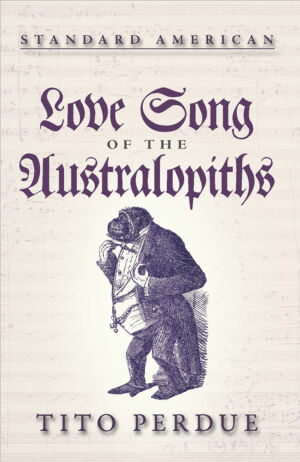
You can buy Tito Perdue’s Love Song of the Australopiths here.
At university 40 years ago, I went through a phase where I read everything by Alain Robbe-Grillet, the French writer of mysterious novels such as The Voyeur and In the Labyrinth, whose repetitive style alters the linear temporality usually found in novels. I grew up on Martin Amis and Virginia Woolf, admittedly strange bedfellows, but they marked my transition from sci-fi to more adult literature. Rather more recently I fought my way through two long and complex novels, Thomas Pynchon’s Gravity’s Rainbow and David Foster Wallace’s Infinite Jest. Both books have a Joycean experimentalism about them, and are almost too surreal and prolix to review.
In my late thirties, I went a year unemployed and couldn’t get arrested, let alone get a job. This was the start of the appearance of sentences on job vacancies saying: “People from ethnic minorities are particularly encouraged to apply for this position.” This translated as: “Whitey need not waste his time applying for this job.” So I spent the year reading three or four novels a week, including many classics: Moby Dick, Ulysses, Don Quixote — I ploughed steadily through the white, Western literary canon.
As for long reads, I finally got round to War and Peace a few years ago. As rewarding as it is, you do feel as though you have marched to Moscow yourself on completion. I like Raymond Chandler and P. G. Wodehouse (who were at the same school), Galsworthy and Bennett, Dostoevsky and Gogol. I recently went through the British realist writers of the 1950s and ‘60s, Alan Sillitoe and John Braine and Colin MacInnes. I have read every Flashman novel, The Lord of the Rings, and Proust’s Remembrance of Things Past. The only writers whose novels I started but was unable to finish were by Norman Mailer and Stephen King, and the only novel I ever finished and went back immediately to the first page to reread was Hunter S. Thompson’s Fear and Loathing in Las Vegas.
I am currently reading Tobias Smollett’s eighteenth-century satirical novel, Roderick Random, and I don’t think I have read anything modern for ten years, when I read Donna Tartt’s The Goldfinch. That is because of the rise of the “sensitivity reader”, an insidious form of modern censorship. Sensitivity readers are “hired to look for offensive content, stereotypes, and bias in a literary work, and to create a report for an author or publisher with suggested changes.” It is not difficult to imagine the ideological and cultural views such a person is likely to hold. The likely sensitivity reader will probably be a young, white, liberal woman. She will be trained in whichever branch of Grievance Studies she graduated in to seek out toxic masculinity, unconscious racism, and microaggressions. Whites, particularly the male characters, will be short on redeeming qualities, and protected minorities will play savior or victor roles, or of course that of the oppressed, who will always be with us.
Who would want to read literature which has been topiarized along ideological lines, especially given the type of ideology these maniacs tend to have? And they are not content to curate the present. Past books are being rewritten and purged of Wrongthink, and that list bizarrely includes 1984. I don’t want to read some Reader’s Digest-style abridged version of books with the toxic masculinity taken out. In many novels, the toxic masculinity is the best bit. Take it out of Crime and Punishment or American Pyscho, and you will be left with novellas at best.
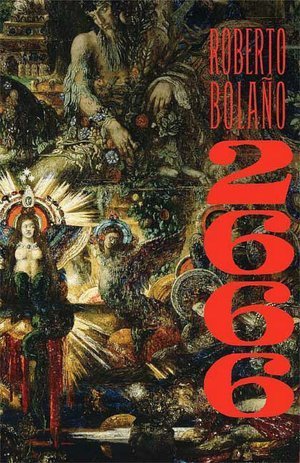
Which brings me to a book also coming up for its fourth reading on my part, and which has both toxic masculinity and an indefinable sense of mystery about it familiar to anyone who has read much Latin American literature. Roberto Bolaño was born in Santiago, Chile in 1953 but spent most of his adult life in Mexico and Spain, where he died in 2003. He came to prominence posthumously, with his first novel, The Savage Detectives, gaining international recognition a few years after his death. His magnum opus, 2666, was still being finalized when he died, and he had originally planned its five sections as separate novels. At 900 pages in the English translation, it is not a light read, but it repays every page.
2666 is largely set in Mexico, where it revolves around a huge chain of grisly murders of women, although its opening section concerns four literary academics and takes place between Europe and London. Pelletier, Espinoza, and British woman Liz Norton, along with a translator wheelchair-bound due to multiple sclerosis, are drawn together by a mutual fascination with the work of a mysterious German author known only as Archimboldi. They resolve to track down the elusive writer, and their companionship soon leads to a ménage à trois between the first three. They travel to various European symposiums on Archimboldi, including one in which they hear a Swabian writer lecture, and who claims to have met the German with the Italian name. He tells a strange tale, which sets the tone for 2666. It is a novel which, in a typically Latin American novelistic tradition, is composed of tales within tales.
Things between the three lovers become fraught. Pelletier and Espinoza, quite out of character, badly beat up a troublesome taxi driver in London. Morini’s health declines. Without wishing to issue any spoilers, the ménage à trois ends in the most surprising way possible. The academic colleagues pursue an artist across Europe because he claims to have known Archimboldi. The man is most famous for one particular work of art which features his painting hand, and which he amputated himself, suspended in front of a canvas. The mere presence of the mysterious writer of mysterious books in the lives of the students begins to bring in its wake chaos and disorder. And then, suddenly, we are in Santa Teresa, Mexico to see a man called Amalfitano.

You can buy Stephen Paul Foster’s novel When Harry Met Sally here.
Amalfitano is a 50-year-old Chilean professor of philosophy and, as with writers such as Conrad and Lawrence, although you never feel Bolaño presents a complete autobiographical sketch in the form of any of his characters, they still seem present as fragmented, aspects of themselves appearing amid the dramatis personae. Amalfitano, new to town, has a 17-year-old girlfriend, Rosa, whose mother Lola is scouring Europe looking for a poet with whom she once had a fling before locating him in an insane asylum. There is always the sense that 2666 will go off the rails into surreal farce — it is not, thankfully, of the genre known as magic realism — yet it maintains its equilibrium, like a very serious drunk. Also, once we are in Mexico, we begin to feel ourselves in the middle of that lazy, sensual, existential emptiness that provides the ground note for so much Latin American literature. It is not long before the murders begin, and this short section ends, replaced by a meditation on journalism.
All five sections are identically titled save for their subject matter: The Part about the Critics, The Part about Amalfitano, and so on. When I reached the third section, The Part about Fate, I was naturally expecting the grim visitor pounding on the door at the opening of Beethoven’s Fifth Symphony, but Oscar Fate turns out to be an American journalist sent, outside his usual brief, to cover a boxing match in Mexico when the boxing correspondent of his magazine is killed in a mob hit. “Oscar Fate” is not his real name, which is Quincy Williams. We are never told why.
Fate is told about the murders by another journalist, and contacts his editor to try to persuade him, unsuccessfully, to let him cover the story. This section is fulfilling not least because it revolves around race — Fate is black — without ever, unlike our brave new world of sensitivity readers and Black Lives Matter, descending into a screed about racism.
The Part about the Crimes lists, exhaustively and with a grisly rhythmic tempo, the slaughter of 112 women in and around Santa Teresa in the mid-1990s. The main sub-plot revolves around police inspector Jian de Dos Martinez who, having met the directress of a local sanitarium, Elvira Campo, who is older than him, begins a temperamental and passionate affair with her. Parallel to the ongoing serial killings, Martinez has to marshal his incompetent police force as they try to solve the regular incidents of urination and defecation on local church altars by an unknown criminal known as “The Penitent.”
At this point, with suspicion playing around the action like a desert dust storm that the mysterious novelist may be a suspect in the murders, a man with a German name held by Mexican police, spoilers would be inevitable with any more explanation of the narrative. Suffice to say that in the final section, The Part about Archimboldi, one of the tales within tales is an extended story of a German soldier on the Eastern Front during the Second World War, and proves that Bolaño as a novelist is just as much at home writing of this period as he is with the emptiness and moral nausea of 1990s Mexico. Each of the small sub-narratives is a masterpiece in itself, combining to form a novel all the more fascinating and compelling for its individual parts as for the sum.

You can buy Tito Perdue’s Materials for All Future Historians here.
2666 is no mere matryoshka doll of a novel, stories inside the story proper but each integral to the others. Instead, it is a patchwork quilt of small entropic episodes from disparate lives which may occasionally interleaf but in which the characters remain alone. It is a lonely novel, despite its vast cast. Decay, destruction, and death are the suns around which it orbits, and yet the galaxy it unfolds is vitally alive.
This is a very modern novel and yet its themes are ancient, as old as writing itself. The small chain of disasters each life unravels into somehow bolster the integrity of each of the characters as they pass on and off the central stage. 2666 is both desperate and strangely uplifting, a tale of what it is to live and die, of the central paradox of life as both vital and shot through with its own hearts of darkness. This is Daedalus’ labyrinth with no Ariadne’s thread, and in which each character is his or her own minotaur.
The novel should be one of the great weapons in the arsenal of the political Right. Jacques Derrida mourned the “death of the civilization of the book” in Of Grammatology, and although there are a record number of books in print, is anyone worth reading still alive? English author Ian McEwan was at my alma mater (a bit before me), and started writing to counter the apparent boredom of the Eng. Lit. curriculum. He made a good point, though. In a fundamentally troubled society, the novel should be troubled fundamentally.
I will let Bolaño himself, a man who for once we can honestly say died far too young, sign off this review. This is from a black pastor’s speech about reading in prison and, although lengthy, it is worth every word. It is from my favorite of the novellas that make up 2666 (and Bolaño originally wanted to publish 2666 as separate books). The Part About Fate, although I wasn’t desperate when I read it, nor did it save my life, was the high tide of this stylish and questioning novel. The book — which I have read three times and can’t wait until I have forgotten enough about it to make that four — made me think long and deep about that life. What else, in all conscience, can we ask from literature?
I was doing something useful. Something useful no matter how you look at it. Reading is like thinking, like praying, like talking to a friend, like expressing your ideas, like listening to other people’s ideas, like listening to music (oh yes), like looking at the view, like taking a walk on the beach. And you, who are so kind, now you must be asking: what did you read, Barry? I read everything. But I especially remember a certain book I read at one of the most desperate moments of my life and it brought me peace again. What book do I mean? What book do I mean? Well, it was a book called An Abridged Digest of the Complete Works of Voltaire, and I promise you that is one useful book, or at least it was of great use to me.
I feel much the same way about 2666. In a way, three of my favorite novels work literally on different levels. While The Magic Mountain takes place both at literal and philosophical height, and House of Leaves is all about descent into the darkness, 2666 is the flat and dusty Mexican plains, where dead women lie waiting to be found. Bolaño had a rather melancholy view of his art, but it does place reading as one of life’s great pleasures, the simple reading of a novel:
Reading is pleasure and happiness to be alive or sadness to be alive and above all its knowledge and questions. Writing, meanwhile, is almost always empty.
7 comments
Banville writes some decent thrillers. His new novel, Venetian Vespers, has its egoistical, rapist narrator talk about his desires to be a woman.
I enjoyed Christian Kracht’s Imperium (named, supposedly, after the Yockey tome) when I read it a few years back. About German sun worshippers, quite grotesque.
Though not a modern author, Gerard Reve’s recently translated the Evenings was a worthwhile read if you enjoy existential types pissing about. There needs to be a translation of The Fourth Man, his novel adapted into an early Verhoeven film. That, or I need to learn Dutch.
And while Will Self is insufferable, his novels are entertaining. My tastes are more towards the metaphysical style of writing than they are to pantomime of Dickens, Fielding or Pynchon, however.
Beckett ended the novel with his trilogy, and what came after has been information gathering for screenwriters.
You ever read Bottom’s Dream? You might enjoy.
Good review. I may read.
Thank you. I like suggestions, particularly ones I have never heard of. Will Self is even creepier in real life than he looks on the telly.
I’m gonna give House of Leaves another try, then. Years ago when I was stoned all the time I just didn’t get it. Kudos to DFW and Infinite Jest and though I hate tennis and see him as a talented writer more than storyteller I did enjoy the lunacy of the Incandenza family.
Great article! I have read the following novels three times, and I hope to read them at least two more times before I die. They are by Stephen R. Donaldson. 🙃
The Chronicles of Thomas Covenant
Lord Foul’s Bane (1977)
The Illearth War (1978)
The Power that Preserves (1979)
The Wounded Land (1980)
The One Tree (1982)
White Gold Wielder (1983)
The Runes of the Earth (2004)
Fatal Revenant (2007)
Against All Things Ending (2010)
The Last Dark (2013)
Sir Keir Starmer said he didn’t have a favorite novel.
Maybe he just likes non-fiction books only, like me?
Great review, and my obligatory Jack Vance plug.
Check out Hawksmoor by Peter Ackroyd. It is a very british novel
If you have a Subscriber access,
simply login first to see your comment auto-approved.
Note on comments privacy & moderation
Your email is never published nor shared.
Comments are moderated. If you don't see your comment, please be patient. If approved, it will appear here soon. Do not post your comment a second time.