1,333 words 
Part 1, Part 2, Part 3, Part 4
Like Neville’s Method, I’ve discussed the cut-up method before, and the reader will perhaps be glad that in this case as well, I won’t be going into great detail about it here.[1] I don’t think there’s any evidence that Bowden used this technique in his writings, and of course his speeches were entirely spontaneous. Bowden’s books do, however, resemble Burroughs’ so-called “cut up trilogy” – The Soft Machine, The Ticket that Exploded, and Nova Express – in being considered largely if not entirely unreadable.[2]
Together with Brion Gysin, a fellow experimental writer and artist, he conceived of the “cut up” technique, a way of stitching together various materials in a montage-like form in order to disrupt the hypnotic flow of language and unveil hidden meanings, thereby overcoming a system of control. [3]
Since the method entailed treating the printed page as if it were a canvas, whose material elements – words – could be cut up and recombined at “random,” it was natural that Burroughs would further see the possibilities of audio and visual recordings (his regard for Gysin, “the only man I ever respected,” likely kept him from painting until, as we’ll see, later in life, after Gysin’s death).
Burroughs was an early experimenter in the audio field; eventually, he would not merely appear on the cover of Sgt. Pepper (along with Aleister Crowley) but would continue his audio explorations in Ringo Starr’s flat, using equipment provided by Paul McCartney.
But how did this come about? Well, while in Paris, Burroughs had acquired a new boyfriend, Ian Sommerville, an audio engineer and early computer programmer. [4] When Sommerville returned to England, Burroughs followed; and although Sommerville had a new boyfriend, they continued to collaborate on audio recordings. Burroughs’ 1965 debut LP, Call Me Burroughs, was a hit with London hipsters, and “a personal favorite of Paul McCartney.” When he “lucked into” working as an engineer for the Beatles, McCartney rented space in Ringo’s flat in London and “personally paid for the equipment” Sommerville required to set up a studio there (including smoked glass mirrors and gray silk wallpaper).
Burroughs and McCartney would chat about cut-ups and computers making the music of tomorrow, as the future Knight of the Realm listened to Burroughs’ sonic experiments.
Or as McCartney put it in 1986, “I used to sit in a basement at Montagu Square with William Burroughs and a couple of gay guys he knew from Morocco doing little tapes, crazy stuff with guitar and cello.”
As Burroughs recalled later:
The three of us talked about the possibilities of the tape recorder. He’d just come in and work on his “Eleanor Rigby.” Ian recorded the rehearsals so I saw the song taking shape. Once again, not knowing much about music, I could see he knew what he was doing. He was very pleasant and prepossessing. Nice looking young man, fairly hardworking.
Rae sums up the results:
Burroughs inspired McCartney to cut in found sounds on Beatles recordings, including alarm clocks, automobile horns, and circus atmospherics. This, in turn, gave Brian Wilson… the gumption to add barking dogs and bicycle horns to his own masterpiece, Pet Sounds.[5]
Burroughs was doing all this audio experimentation in the old-fashioned way, cutting and splicing tape. Today, kids can set up audio studios in their bedrooms with the power to perform far more elaborate trickery, but this has only expanded the range of Burroughs’ acknowledged influences.
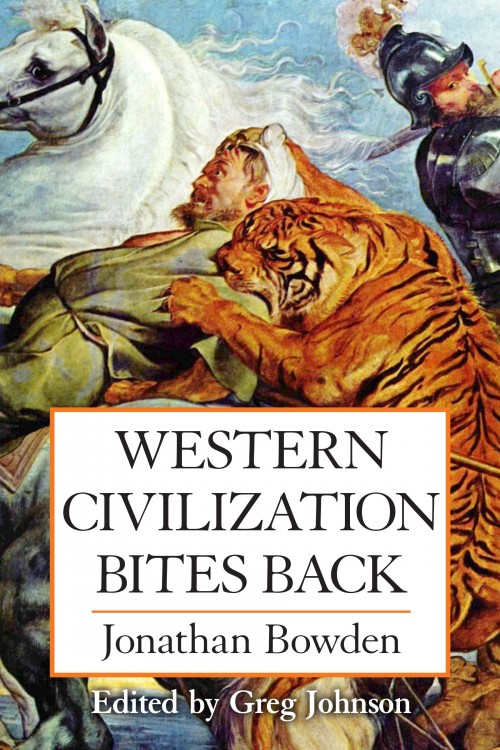
You can buy Jonathan Bowden’s Western Civilization Bites Back here.
It’s hard to imagine sample- and remix-based music without Burroughs, or at least without the artists he inspired—David Bowie, Throbbing Gristle, and Coil among them. Hip-hop and electronic acts like Michael Franti, DJ Spooky, and Justin Warfield embrace Burroughsian ideas in their work, and a few were lucky enough to have collaborated with him.
Genesis P-Orridge, Peter “Sleazy” Christopherson, Cosey Fanni Tutti, and Chris Carter invented an entirely new genre—industrial music—and their modus operandi owed everything to Burroughs. The band used tape reorders to play back abrasive noise alongside electric instruments in intensely jarring performances. They filtered the primal DIY energy of punk through the praxis of the occult, borrowing imagery from humanity’s history of mass violence and donning paramilitary outfits embossed with a menacing symbol of their own invention…. Bands like Skinny Puppy, Cabaret Voltaire, Joy Division, Ministry, and Nine Inch Nails appropriated Throbbing Gristle’s approach, including the use of sampled audio and aggressive mechanized rhythms.
Have we strayed from shamanism? Not at all:
One of the things Burroughs impressed on [Genesis] was the importance of using cutting-edge technology to maximize creative and or magical results. P-orridge suggests sampling is more than just a production technique; “it is an occult action straight from the Burroughs grimoire,” which has “helped unleash the ‘media virus’ known as memes.”
We’ll look at how the internet leaked out soon. As far as I know, Bowden’s relationship with audio was purely passive, allowing his lectures and speeches to be recorded. In this, he leaves Burroughs – who was certainly widely recorded but never used the audio/visual method as his primary method of getting the word out, as it were — but re-aligns with Neville.
Neville never copyrighted any of his books, and, uniquely and far-sightedly, encouraged taping and sharing his lectures: rows of big reel to reel recorders would be lined up on the stage, and a techie would turn them on before Neville stepped out. Such lectures would be handed around on tapes or transcribed by listeners.
Neville scholar Mitch Horowitz has compared this to the Grateful Dead,[6] but I would go further and compare it to Mystery Science Theater, which, in the early days of cable, when all people did not yet have access to the same channels, fans would record the broadcasts and the folks at Best Brains in Minneapolis would not only look the other way, but encourage them to “Keep Circulating the Tapes” at the end of each show’s credits; in this way, a huge fan base was created. With Neville, as with Bowden, it has allowed his ipsissima verba to not only survive but transition to a second life on the Internet, with YouTube channels and Kindle transcriptions proliferating at a mad pace, which, as we’ll see, brings them back to Burroughs, prophet of the internet.
Notes
[1] “Curses, Cut-Ups, & Contraptions: The ‘Disastrous Success’ of William Burroughs’ Magick,” here and reprinted in Mysticism After Modernism, op. cit.
[2] I attempted to review one of these – Axe – here. I tried to find some method in the madness – “What the reader needs to do with such writing as this, is to learn to notice and appreciate two things, form and content; the amusing, intriguing, or useful nature of this or that point along the way, and the way the author spirals back, returning to earlier points now seen in a new light.” — but concluded that Axe was “a challenging and provocative text, then, that more than repays the reader’s patient attention and thoughtful reflection. Of course, it only pays back as much as you can give it, and when some readers stare into the abyss of this text, they may only find the abyss staring back.”
[3] “The Cinematic Vision of William S. Burroughs,” A Rabbit’s Foot, December 10, 2024. Balanescu is on our wavelength: “For Burroughs, writing—as well as other art forms—possessed an almost shamanic capacity to ward off unwanted “ugly spirits” that would tamper with the mind.”
[4] Sommerville appears in Burroughs’ works as “The Subliminal Kid,” a tag later appropriated by DJ Spooky.
[5] Rae doesn’t make the point – but I will here – that, perhaps due to his marriage to “avant garde” artist Yoko Ono, John Lennon seems to be remembered as the “sophisticated” Beatle, whereas in actuality it was Paul who, despite his reputation as a writer of, as he parodied himself, “silly love songs,” was truly interested in and involved in the musical avant garde.
[6] Rae tells a charming story of Burroughs encountering Jerry Garcia in Amsterdam; Burroughs says he “always liked the name of your band… wonderful occult ring to that. Never heard your music, though.”
2 comments
Intriguing essay. Burroughs said that Language is a virus from outer space. He nicked that from John 1:1 who in turn nicked it from the Greek Logos Doctrine. Of course Burroughs would have said these iterations simply prove his point. Heidegger said it is Language that speaks, not man, but I’m sure he borrowed that from someone.
In the book How The Beatles Knew the author shows that McCartney got his “sophistication” by living at Jane Asher’s house. The father of the family was a psychiatrist who named Munchausen Syndrome. In addition to Burroughs he also befriended Ginsburg who brought a tape of Eleanor Rigby to Pound, who was rather impressed. But as you say Lennon was able to buffalo the public into thinking he was the deep one. The truth is that Lennon was mostly stoned out of his mind in the suburbs while the hardworking McCartney was the kerchiefed wonder boy of the London Avant Garde
Comments are closed.
If you have a Subscriber access,
simply login first to see your comment auto-approved.
Note on comments privacy & moderation
Your email is never published nor shared.
Comments are moderated. If you don't see your comment, please be patient. If approved, it will appear here soon. Do not post your comment a second time.