 2,881 words
James Howard Kunstler, whose blog Clusterfuck Nation covers both political and cultural events, published Young Man Blues last year, a fast-paced and enthralling memoir about his troubled adolescence. When he was released from a mental institution he called The Laughing Academy, he judged “My childhood was over and the statute of limitations on my childhood grievances was over, too.”
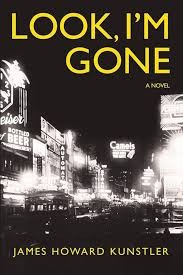
Kunstler, both in his memoir and in CFN, makes a strong argument for individual and national responsibility. He argues that many problems in America and the West come from how we have been conditioned to expect something for nothing, ranging from personal responsibility to government economics. Following up his absorbing memoir Young Man Blues, Kunstler’s novel Look, I’m Gone deals with historical and personal loss. It is November, 1963, and New Yorker Jeff Greenaway, a troubled twelve-year-old, is a student at Ponsonby Hall, a cloistered academy in New Hampshire. He respectfully describes that the Great Hall “. . . sported a variety of gables, bays, oriels, turrets and towers with pointy finials amid steep copper roofs aged perfectly to blue-green verdigris.”
Being in the middle of nowhere, it is a quaint and respectful holding cell for the 154 “scholars.” They are there because they are boys who in the genteel language of the official charter are “thriving indifferently,” which means they are screw-ups in one degree or another. Jeff is in the middle, having run away from home, trashed a party, and is unstable.
He joins a clandestine poker club among the boys and wins $160 in a lucky night. But where can he spend it in the middle of nowhere?
The next morning, he and his classmates are surprised at a sudden assembly where they are informed that President Kennedy has been shot. The boys go through various stages of shock and grief, from uncertain silence to stunned glares and crying, which is how I remember kids in my class behaved on that November day. The school, ready to send the boys home on their Thanksgiving break, decides to close early in lieu of the national tragedy. Jeff returns to New York and Bob and Evelyn, his semi-affluent parents.
They’re not bad people and in fact have a lot of insight, but perhaps are a little too wrapped up in themselves. Yet all three are caught up in the somber weekend of Kennedy’s assassination and the national mourning.
Up to a point. Jeff is antsy, and breaks out wandering the New York he had been sent away from.
He goes to a dance hall where taxi dancers dance with guys for a price. He does this with Yvonne, a breezy and convivial woman who teaches him to foxtrot, but a more profound offering comes when she gives him her copy of the book: J.D. Salinger’s The Catcher in the Rye. At Ponsonby all the boys have heard of it and passed it around. Jeff, now that he has a copy, dives into it, and is overwhelmed. He is Holden Caulfield, and goes out to have adventures since he has the money and maturity . . . as much as a twelve-year-old boy can muster, aided by a lucky poker hand and collection of mustaches he buys at a joke shop on Times Square.
Unlike the aimlessness of Holden’s dealings with New York, Kunstler takes Jeff on a series of initiations into adult life.
While Kunstler’s prose is concise and descriptive with flashes of impressionism, much of the book is straight pages of pared down dialogue recalling the taut style of Elmore Leonard, making these passages a catechism of learning and revelation.
Jeff, worshiping Salinger, goes to a Broadway show and sees The Wayward Family Singers, an obvious parody of The Sound of Music. Jeff is infatuated with Kathy Kaine, who plays one of the innocent singers, and by his audacity meets her in her dressing room. Kathy, on her own and happily escaping Wisconsin, is enthralled by Jeff. They go out, although Jeff is disheartened when she wears heels, making her two inches taller than him. They enjoy her celebrity at a fancy restaurant, and despite his overwhelming joy, is disturbed at all the booze she puts away . . . a lot for a thirteen-year-old who likes passing for seventeen.
Bob warns his son that Kathy is a little too fast, while in my youth we would say she’s thirteen going on thirty.

You can order Johnson’s Novel Takes: Essays on Literature, available for order here
Jeff’s impetuousness in seeking Kathy and her stage glitter is contrasted when a similar single-mindedness sends him to the Soviet mission, where he taunts the KGB guards because he believes the Russians used Lee Harvey Oswald as a tool to kill Kennedy. At first Jeff is rebuffed. But then Zorin, the Soviet ambassador to the U.N., calls Jeff to his side and, in a conversation that we writers call the improbably probable, Zorin enlightens Jeff on the assassination in a way that makes him look at things in a new, ambiguous, light. As podcaster Howie Carr says, a conspiracy theory is when the wrong person brings the right facts to light.
Out of infatuation and kindness, Jeff invites Kathy to his family’s Thanksgiving party, where she becomes a magnet for showbiz types and things end disastrously.
Jeff, angry at his impotence in keeping her away from these wolves, rages and that too, causes problems, all of this in a range of emotions and description that is, like the rest of the novel, full of journalistic description capped with wit and human insight.
Bob takes Kathy home and tucks her woozy, inebriated self into bed. The next day, Kathy accuses Bob of an indiscretion. Jeff is stunned, but recovers and confronts Kathy. In a dialogue passage that is more from Dragnet than a lover’s angst, he sees Kathy isn’t quite the darling he thought she was. Jeff sticks up for his father and carries this green, biting wisdom with him as he does the knowledge he got from Zorin. When Kathy asks him to leave so she can entertain an older caller, a baseball player for the (back then) hopeless New York Mets, Jeff is cold. “Look, I’m gone,” he says on his way out, implying that he is leaving the youthful illusions and hopes he must cast off in order to grow.
Yvonne’s description of the Holden Caulfield she read was dismissive: “All this kid does is complain and screw up.” Jeff, now disillusioned but still determined to be Holden Caulfield, does the necessary reconnaissance at the public library to find Salinger and meet him.
The vivid winter descriptions of rural New Hampshire and the effects of heavy snowfall on any kind of travel recalls John Updike’s The Centaur, where a boy has a mixed relationship with his father, a man at once competent and not. Jeff sees, from the window of his rail coach, the new suburban world being built up. It’s an invasion of land and values, but he’s not sure what to make of it as he begins to sense JFK’s death is opening doors he hadn’t imagined. The replacement of the noble and active Kennedy by a political hack like Johnson depresses even Jeff’s twelve-year-old mind.
Jeff’s meeting with Salinger recalls not master and pupil, but Dr. Frankenstein and his monster. The isolation of Salinger’s home and thick snowfall make Jeff a very unwelcome guest, but the ensuing dialogue/catechism is a high point of Kunstler’s story, and we see Salinger as gruff, brilliant, sarcastic, but also open to Jeff’s youthful drive.
It’s easy to see why Salinger once enjoyed hanging out with nearby kids, but the shadows of wartime trauma he endured keep popping up. He tells Jeff to go home. Jeff says he can’t:
Are you going to leave me out here in a goddamn snowstorm?
Might be good for you. You know how many nights I slept in a cold foxhole in the Hurtgen Forest?
I have no idea.
Plenty, that’s how. And look on the bright side. Nobody’s lobbing artillery rounds at you here.
Salinger reveals patches of himself to an exasperated Jeff. This is the guy he worships, a crank who eats peas for breakfast? But one who also shuts Jeff up when he asks what Salinger did in the war. A subtext to Salinger’s patterns and arguments is that much as he has a full plate of opinions and arguments that range from funny to insightful to rude, he backs off mentioning the war. Jeff, as with the musical Camelot and other facets of American life, is starting to see dark corners around the official portrait of the American Way. Salinger, like Jeff, is stunned by JFK’s assassination and in this case, man and boy debate as equals.
Kunstler implies that Salinger, while certainly at war with the phonies as is his alter ego Holden Caulfield, is also a damaged man from the war, where he served in combat and, as part of army intelligence interrogated Nazi POWs after the war. Salinger, while a soldier and writer, was prolific and courted fame, yet when it arrived with Catcher, it overwhelmed him. I sense, as I think Kunstler does in the book’s subtext, that a certain dishonesty about the war and the subsequent troubled peace made a mark on Salinger and many others, as Paul Fussell noted in his book Wartime, recalling how many men in the military lived with the dishonesty of mass military life, propaganda, and hiding from public view the essential terror and horror of modern war. Victory and the newly cobbled American Way of Life helped satiate any great criticism of the new postwar system, but in Vietnam there was no such triumph of public relations and coercion. Instead, a rot set in to erode the trust and optimism of the Kennedy years.
I’m reminded of graffiti scrawled on a wall at the end of the Vietnam War: “In Vietnam, America lost its virginity. And it also got a case of the clap.”
Jeff, dumped by Salinger (in his jeep) at a snow-covered Ponsonby Hall, finds a new rebellion when his roommate arrives bearing a prize that replaces the much-passed around copy of Catcher in the Rye his classmates savored and worshiped. The roommate has a Bob Dylan recording and, as a mysterious offering, a 45-rpm single of “I Want to Hold Your Hand” by a strange new group from England, The Beatles.
Jeff’s buddies are all over the new music. One even says Dylan is for real “not one of those phonies.” And thus is Salinger dethroned by the new spirit of music, a Dionysian revolt of emotions and sensory hopes that will define the sixties.
Jeff tells Salinger at their carping farewell “I’m sorry I read your goddam book.” He is resentful and speaks his mind, but we sense he isn’t going to become the endless complainer Yvonne found so unappealing. Jeff is back in school, ready to get on the rowing team, implying he has somewhere to go, as his detailed plans in seeking out Salinger proved.
Salinger, while brilliant and insightful, rejected the role of holy man for a generation of postwar youth and ranged between a hermit, crank, and vet who still sees a headless paratrooper dangling from tree limbs. He was probably a man who had nothing more to say, and when Salinger died, the long-awaited piles of unpublished manuscripts never materialized.
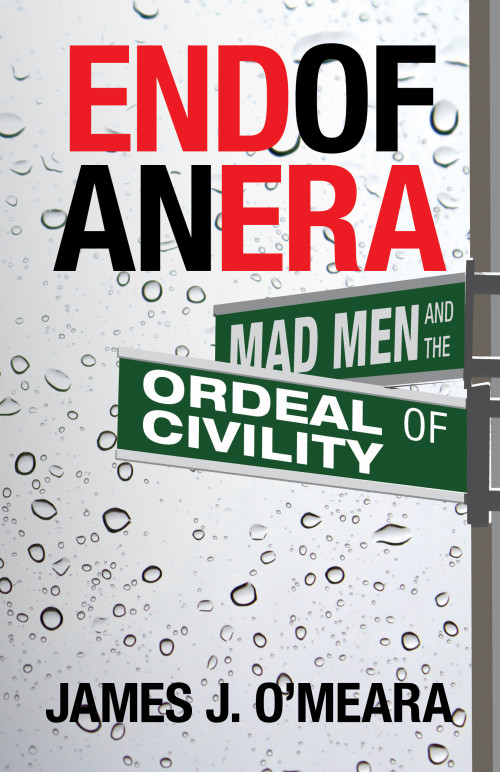
You can buy James O’Meara’s End of an Era here.
Jeff uses his newly found insight in assessing Salinger’s faraway look in his eyes. “To Jeff the author seemed inexpressibly sad, as from an old irreparable injury.”
As for Jeff and his world, the literary rebellion of Salinger will be replaced by the music of rebellion. Where will it lead? Jeff may hear how it’s all blowin’ in the wind, but unlike the damaged Holden, Jeff has learned a few things after the assassination. Not only of Kennedy, but of the dream of what we called the New Frontier . . . perhaps it is best to say illusion, for in any idealization there is always a need for some denial of reality.
Kunstler offers what is perhaps his most mature work of fiction, and while it is bathed in references to Salinger, also recalls a traditional if often under looked part of American literature, the questioning of American values and persona.
The Catcher in the Rye has often been called an updated Huckleberry Finn, where Holden repeats Huck’s adventures, although Huck does have a purpose . . . freeing the slave Jim.
The beginning of this struggle with American mores began with our sadly neglected first true writer, Charles Brockden Brown (1771-1813), who adapted the gothic style of fiction to America. His Edgar Huntly (1799) deals with a young man determined to find the murderer of his friend. While trying to unmask the gloomy, haunted, sleepwalker Clithero as the killer, Edgar becomes an American Oedipus as he discovers disturbing facts about his own psyche and subconscious. Like Holden, Edgar is haunted by a traumatic death from his past.
As in his breakthrough book The Geography of Nowhere, Kunstler noted Americans in the early romantic period adored the sunny, medieval fantasy world of Sir Walter Scott while ignoring the darker undercurrents in American life which Brown explored, later enhanced by Edgar Alan Poe and Nathaniel Hawthorne as they uncovered a swirl of shadowy emotions and patterns in antebellum America.
Americans were much happier with Scott and his imitator, James Fenimore Cooper, where noble savages and heroic frontiersmen clashed as the course of empire went westward. Many elements in Edgar Huntly were in fact borrowed by Cooper in The Last of the Mohicans to make the somber adventures of Edgar more palatable to America’s optimistic tastes. Much like how the darker undertones of Kennedy’s assassination Zorin reveals to Jeff by are contrasted with the happiness of The Wayward Family Singers, parodying the relentless good cheer and hopeful American intrusion into the world as presented by Rogers and Hammerstein, not to mention Lerner and Lowe’s Camelot.
Look, I’m Gone is a continuation studying the contrast of both youthful discovery and the discontent of the American psyche. Kunstler brilliantly continues this tradition, balancing it with a strong, likable protagonist and an honest view of his world and that of 1963, shocked and yet stepped in human error and continuity.
In his dispensing unpleasant truths Americans won’t accept, Zorin echoes the character of Sarsefield in Edgar Huntly, the youth’s former tutor who warns Edgar of his quest.
Meeting Salinger recalls the iconic film American Graffiti, where Curt, spending his last night in L.A. before going east to college, hunts the popular D.J. Wolfman Jack and finds him in a cinderblock radio station. His larger-than-life radio god is a normal guy who keeps denying he’s Wolfman, has to deal with a fridge of melting popsicles, and as Curt leaves the station, only sees a glimpse of the wild god of the airwaves at the mike.
Kunstler, like George Lucas, shows the power music will have in the sixties on American, and then world, youth.
Yet Kunstler also toys with the concept of time and space in regard to human and historical consciousness. In chapter thirteen, Jeff makes a stunning (to him) revelation; in Catcher in the Rye, there is no sense of time or history. You don’t know who the president is, nor if America is at war. Was it written during the Depression? You wouldn’t know it. Holden seems to end his life forever trapped on a November day in the 1930s. Jeff is very aware where he is; the death of Kennedy makes history inescapable for him. “Jeff realized, rather sharply, that he was in his own story now.”
This new consciousness confronts Salinger when Jeff meets him. Salinger seems timeless, caught hiding in a rural landscape. Salinger, almost a shadowing of his book when Mr. Antolini tries to urge wisdom on Holden, begins to inculcate Buddhism and its escape from human consciousness into nothingness and liberation. But Jeff is too young and enervated to listen. He has to advance, live, go back, and row on the team. Anyway, Jeff came to tell Salinger about Kennedy; that is, Salinger’s withdrawal from society faces Jeff’s demands of history. Or red-blooded Americanism. You face a problem or a foe, and you solve it or beat him. It is a dynamic worldview creating a line of folk heroes from Davy Crockett to Buster Keaton.
This contrasts with Edgar Huntly, who, like Holden and Salinger, ends his quest caught in a circular world resembling the subconscious brooding of Clithero’s “madness.” He solves the murder, but part of that crime is embedded in him.
Jeff does not have that psychological or spiritual burden. He learns, observes, and will deal with what comes his way. It’s optimistic and is a spiritual outgrowth of Young Man Blues. In Jeff’s America of 1963, there is still a clean slate, but it is going to run a race with the dark edges of Zorin’s warning. I finished reading this book wanting to see Jeff keep rowing, racing, and winning.
If there are any faults in Kunstler’s tale, it is when Yvonne describes herself as becoming a homemaker. In 1963, as I remember, women called themselves housewives, and the ugly name-calling of feminism had not yet sullied that honorable station.
Look, I’m Gone is to be savored and re-read, and is a good candidate for the classical American canon of literature.
4 comments
Great article! I reread Catcher In The Rye a couple of years ago, the second reading did not make an impression on me. I don’t think that Salinger can be compared to Twain or Catcher In The Rye to Huckleberry Finn—the idea is ludicrous. 🙃
I always found Catcher to be way overrated, but it must have struck a certain generation because they never stop talking about it. Interesting to compare Jeff’s linear history with Salinger’s cyclic retreat, though.
The cover of this book appears somewhat similar to the cover of City of Night by John Rechy. Maybe intentional?
Didn’t Kunstler attend an American Renaissance conference in the mid 2000’s? I thought I heard that on his Kunstlercast podcast with Duncan Carey. He stopped going because he thought some attendees were too hard on the Tribe.
Comments are closed.
If you have a Subscriber access,
simply login first to see your comment auto-approved.
Note on comments privacy & moderation
Your email is never published nor shared.
Comments are moderated. If you don't see your comment, please be patient. If approved, it will appear here soon. Do not post your comment a second time.