 2,944 words
Jim Kunstler, journalist and writer, is best known for his podcast Clusterf— Nation, where he questions Western society coping with lessening amounts of civil and societal order when technology and bureaucracy no longer offer magical solutions to problems of scarcity and mismanagement. (As he remarked in a recent panel show, “prepare for less Superman movies and more puppet shows”).
His books The Geography of Nowhere, Home From Nowhere and The Long Emergency offer detailed studies of the above. His many accomplishments in fiction were topped by his World Made by Hand, a provoking quartet of novels set in Union Grove, a town in upper New York state whose demoralized residents come to terms with no more oil or electricity as they remake their lives on the detritus of modern civilization, drowning in catastrophe until they revive and re-build.
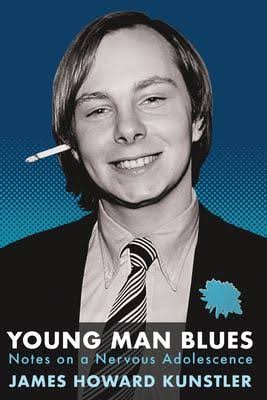
Young Man Blues is Kunstler’s 2023 memoir, but he claims it is something else:
This is no sob story. It’s a story about the difficulties of growing into manhood and my own particular struggle with disabling anxiety that came along with it, and how I managed to find my way.
Kunstler offers a compelling narrative of life at the height of the American empire and his coming to terms with developing as a responsible, mature man. It is a hard road. He begins this story not with a nostalgic episode of the golden, imperial fifties, but in an angst-ridden 1965 where he begins to lose his mind. From a simple joy of enjoying the glitter of Rockefeller Center at Christmas where joints of marijuana lead to wild confusion and feeding endless amounts of nickels into an automat, he recalls when high, how wonderfully absurd the world was.
Then a flashback to summer of that year. He was a camp counselor in New Hampshire, falling in love with the woods, fishing, a life totally different from his native New York City, which he was glad to escape. His drunkenness led to getting expelled. His life was a dichotomy between the great, simple pleasures of counseling boys in the camp to a discontent in his mind:
I was a simmering cauldron of inchoate grievances. …I had a dark view of the world, a sense of humor tinged with malice, and an extensive profane vocabulary. …The truth was, I didn’t know what I was doing with my life besides pretending to be tragic.
Flash forward back to New York and a party Jim and his friends crash (they were always crashing parties; everyone in New York crashed everyone else’s party). There was, of course, more marijuana, and sudden fear gripped him. While rock music pounds and voices rise in party chatter, Jim finds himself in a corner amidst the guests’ coats, clenched and almost hiding, fearing the world without while abandoned by his friends. He eventually unclenches, goes into the apartment and downs a vodka (his go-to hard beverage) and takes a cab back home to an empty apartment. His parents, as usual, were out somewhere.
Kunstler’s biggest struggle was to overcome his anxieties and impulses, and channel his experiences into a creative and mature life.
He deals with his family, who are alienated from him. A father frustrated at a life forced on him in the diamond business by his family, a mother who is bubbly and a businesswoman but can’t connect with him. They divorce, spouses come on the scene. They aren’t bad people by any means but, like many parents of that postwar generation, were caught in their own anxieties leading into a retreat to indifference and booze.
It is the typical mix of postwar parenting and gestation of the baby-boomers. Kunstler adored Bob Dylan, but I think his theme song might well have been Simon and Garfunkel’s The Only Living Boy in New York. This fits the globe of isolation that he said was his life then.
He finds an emotional reprieve of sorts when he attends college at SUNY in Brockport (“So far away from New York it seemed like Indiana”), and immediately shines to small town/college life in a campus seemingly stuck in the 1950s. He finds a new release in life when he becomes involved in theater, starring in The Crucible and then Spoon River Anthology. He is stage manager for Arthur Kopek’s Oh Dad, Poor Dad, Mamma’s Hung You in the Closet and I’m Feelin’ So Sad, where he sees similarities to Madame Rosepettle and his mother. If you haven’t seen or read the play, you can watch the 1967 film with Rosalind Russell, an example of sixties weirdness par excellence.
Theater becomes a yardstick to find direction in his life. Dave Hamilton, a theater director, becomes an older brother type in Kunstler’s life. In their production of Marat/Sade he plays Danton. Waiting for Godot finds him cast as Lucky, with only one line. . . that is three pages long.
Work in Brecht’s Threepenny Opera was upstaged by the 1960’s theater of Martin Luther King Jr.’s assassination. The quiet campus, like so many, exploded, and the play is performed to an almost empty house.
Theater, while offering a new dimension to the artistic needs of Kunstler, doesn’t totally keep down his anxieties and drinking sprees. He describes a Thanksgiving break where he refused to go home:
I bought a bottle of cheap gin and some wine and just hunkered down in my room, pretending to write short stories a la Scott Fitzgerald. It was weary, of course, and I suppose I felt a little sorry for myself, but that self-pity worked nicely with the tragic young writer persona I was still cultivating. The stories didn’t add up to much because I knew next to nothing about how things really worked in the world, but I gave the Smith-Corona a workout.
In a sudden, impulsive fit, Kunstler becomes involved in student government elections and in a twist both picaresque and ego trip, is elected president.
He immediately spends his $500 stipend on a twelve-string guitar. Kunstler drives to Chicago to witness the tumultuous 1968 convention. His tone is neither radical nor reactionary, but skeptical rotating in the eye of the storm:
It was exciting to watch history made, of course, but I was ambivalent as ever about what I saw of radical street politics, in the same way that I was dubious about hippiedom generally. As the movement grew, it seemed to attract more lowlifes who simply liked to get stoned and act out.
As it was, McCarthy and McGovern, the favorites of the mob, lost the nomination, which went, as Kunstler put it,“to the old cornball party hack Vice President Humphrey.”
I recall the musings of the cornball: “I’m just proud as punch to be here,” and his favorite phrase “the politics of joy, the politics of happiness”. . . as cops and kooks went at it in the streets outside the convention center.
Back at college, Kunstler’s own inattention to his post led to him being impeached. Allowed back in the theater, Kunstler shone as the Cherry Orchard’s Trofimov, a student revolutionary.
He kicked around for a while, brushed shoulders with history again as he delivered papers and avoided the nearby legendary Woodstock Festival, where Kunstler’s cynicism kept him from attending:
…the radio broadcasting endless tales of the mess that the Woodstock Festival had turned into, with its ten-mile-long traffic jams, lack of food, bad drugs circulating through the crowd, and frequent rainstorms that turned the venue into a giant mud puddle. I was glad I didn’t go.
Despite Kunstler’s probing, active life, the old phobias never quite left. As the country seemed to go into a nervous breakdown, Kunstler followed suit, and, set off by his father’s efforts to get his car re-insured and back in his possession after he’d lost it through an accident that Kunstler blamed on himself, he felt he “was a flop as a son and, increasingly, a flop as an adult.”
Kunstler fell apart with anxiety. Unlike America, he was able to get help and checked into the Payne Whitney Clinic in New York city, alias the Laughing Academy.
He needed the isolation to heal and calm down. Kunstler expresses a mature, detached view of this time, especially when his mother was allowed to visit. She refused to be blamed for his failures, and he admits he understood her anger. As he said, everyone on his ward had beefs with their parents, but released from the Laughing Academy, he was now twenty-one. “My childhood was over and the statute of limitations on my childhood grievances was over too.”
A motif in his life was, in the absence of a stable, consistent life with his parents was the need for an older brother type, and he was fortunate in finding such men, advisors, and fellow travelers who stood by him. One was Bob Denning, fellow theater worker who advised Kunstler that youth was a time to get a taste of failure, to show one has tried to accomplish something and to build from that.
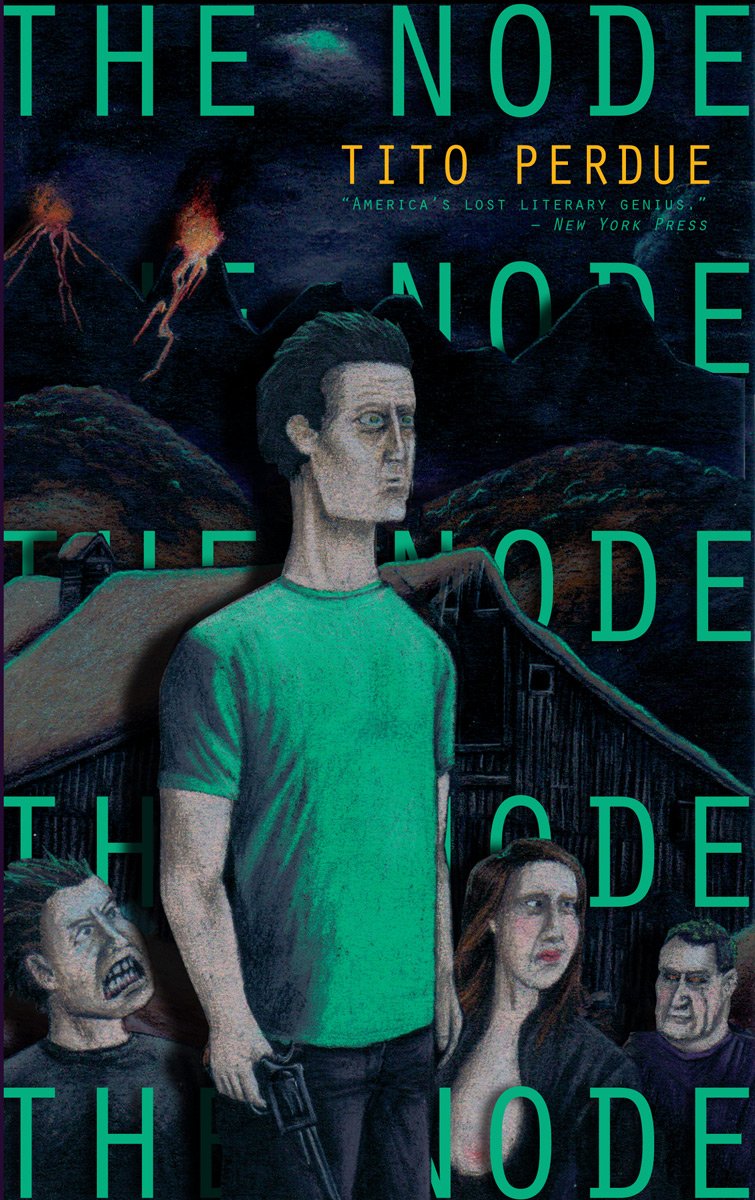
You can buy Tito Perdue’s novel The Node, here.
Kunstler went to Boston as a writer/reporter for BAD (Boston After Dark, later renamed the Boston Phoenix). While he enjoyed finding stories and going after subjects, he wasn’t enthusiastic about the “underground” press and its Leftist mindset. Underpaid, he briefly moonlighted for Term Papers Unlimited, a company that wrote term papers for hire. . . intellectually dishonest, Kunstler noted the staff “considered themselves knights of bullshit, heroically undermining “the system.” Three weeks of it was enough, and he sloughed back into the Phoenix, but was soon out as the paper’s politics reshuffled (or, more precisely, became more dogmatic), and he wasn’t considered “revolutionary” enough.
Kunstler returned to upper New York State, his comfort zone and a place of spiritual and psychological comfort. He landed a job on the Rochester Democrat and Chronicle, enjoying a stable time both in his reporting and the pleasures of fly fishing, exploring rural New York, and getting control of his life where, as always, small town life was far more appealing than life in an urban quagmire.
He was especially moved reading Harry Browne’s How I found Freedom in an Unfree World. The future Libertarian presidential candidate’s book impressed Kunstler in its insistence on personal responsibility and finding what was real in human relationships and avoiding what he called magical thinking.
Kunstler, free of seeking a therapist or big brother to explain and console him, expounded on Browne:
…At age twenty-four, I came upon him at exactly the time in my own life when the judgement reason of my brain was finally completing its long and painful development. (It happens surprisingly late in young men). Browne told him, told everyone, “There is a place for you if you seek it out.
Kunstler offered a favorite perception on life:
Out of every room of a hundred people, ninety-nine of them think that they’re the only one who doesn’t have their shit together. Just about everyone is secretly insecure, so don’t worry about what people might think about you; they’re probably preoccupied worrying about themselves. If you’re in that room, get out of your own head and find out what other people think and feel.
He moved on to the Knickerbocker News in Albany just as the oil crisis of 1973 happened, and Kunstler’s observations on its ways of crippling a population dependent on oil and cars, as well as the relentless suburbanization that webbed over the country made an impression he would store in his mind for later books on America’s urban crisis and energy dependence, symptoms of a spiritual crisis that was a cause of the magical thinking his mentor Browne condemned. He became, as he described it, a star writer in a bush league newspaper market. One of his stories involved him wrestling a bear (who pinned him in three seconds flat).
While he stored memories of the oil crisis in his mind, Kunstler landed the plum job of his career, working at Rolling Stone. . . albeit as its gossip columnist. He found life in San Francisco intriguing (although its 1960s glories of the hippie capital were past), and the city chugged along, waiting for the arrival of the computer revolution. Kunstler chaffed at the ultra-Left policy of Rolling Stone, noting the hoopla the magazine raised when its celebrity journalist Hunter Thompson appeared at the office. Kunstler thought Thompson more former than latter.
He noted that Thompson lived in Colorado, where he was able to play with guns, blow things up, and take every drug he could get his hands on. A disruptive meeting ended with Thompson and Kunstler’s senior editor chugging down Jack Daniels and hitting on nitrous oxide, a fashionable drug at the time. Thompson, already declining as a journalist, was incapable of doing most of his assignments. Kunstler observed, with good reason, that he could have done them better.
I noted that in the 1980s, Hunter Thompson had a syndicated column and I read some of them, or tried to; it was simply rows of gibberish, as pointless as the speech of Lucky in Waiting for Godot. Thompson, as Kunstler observed, had destroyed his gifts, or as I decided, had simply served his purpose to the system and could be cast away.
Jim Kunstler, while grateful to work and observe life at the Stone, was ready to move on; that is, go back to writing and giving heavy fiction a try, much like Tom Wolfe did when he dropped most of his journalistic work to create Bonfire of the Vanities.
All of his previous posturing as the wounded writer and poetic soul was purged and refined after years of experience. The showbiz part of his artistic hopes was over. He got down to work in Saratoga Springs, a town he grew to love.
Kunstler wrote several novels. I’ve read some, and I admire his narrative gifts as I do in Young Man Blues. He takes a journalistic and inquisitive style to his subjects, and there are many wonderful descriptive passages of upper New York State that evoke its calm and serenity, which have been such a balm to him.
Most of his books were, frankly, commercial failures despite their literary merits, which he admits, much as he wrote in his Home from Nowhere:
These old novels still turn up now and again in the discontinued merchandise bin at the Kmart. It’s like finding a beloved relative in the gutter clutching a bottle in a paper bag.
But as Kunstler told aspiring writers, perseverance counts more than talent. After many good and sad stories of life dealing with the vagaries of publishing, Kunstler’s own perseverance paid off when asked to do a story about real estate development in Vermont and fears of suburbanization. Kunstler did this and other articles, recalled past musings on the subject, and offered an article for the New York Times “Why is America So F—ing ugly?” It was rejected, but he remade it into a book that became The Geography of Nowhere. Sales were brisk, and he followed this urban and national concern with Home From Nowhere and The City in Mind.
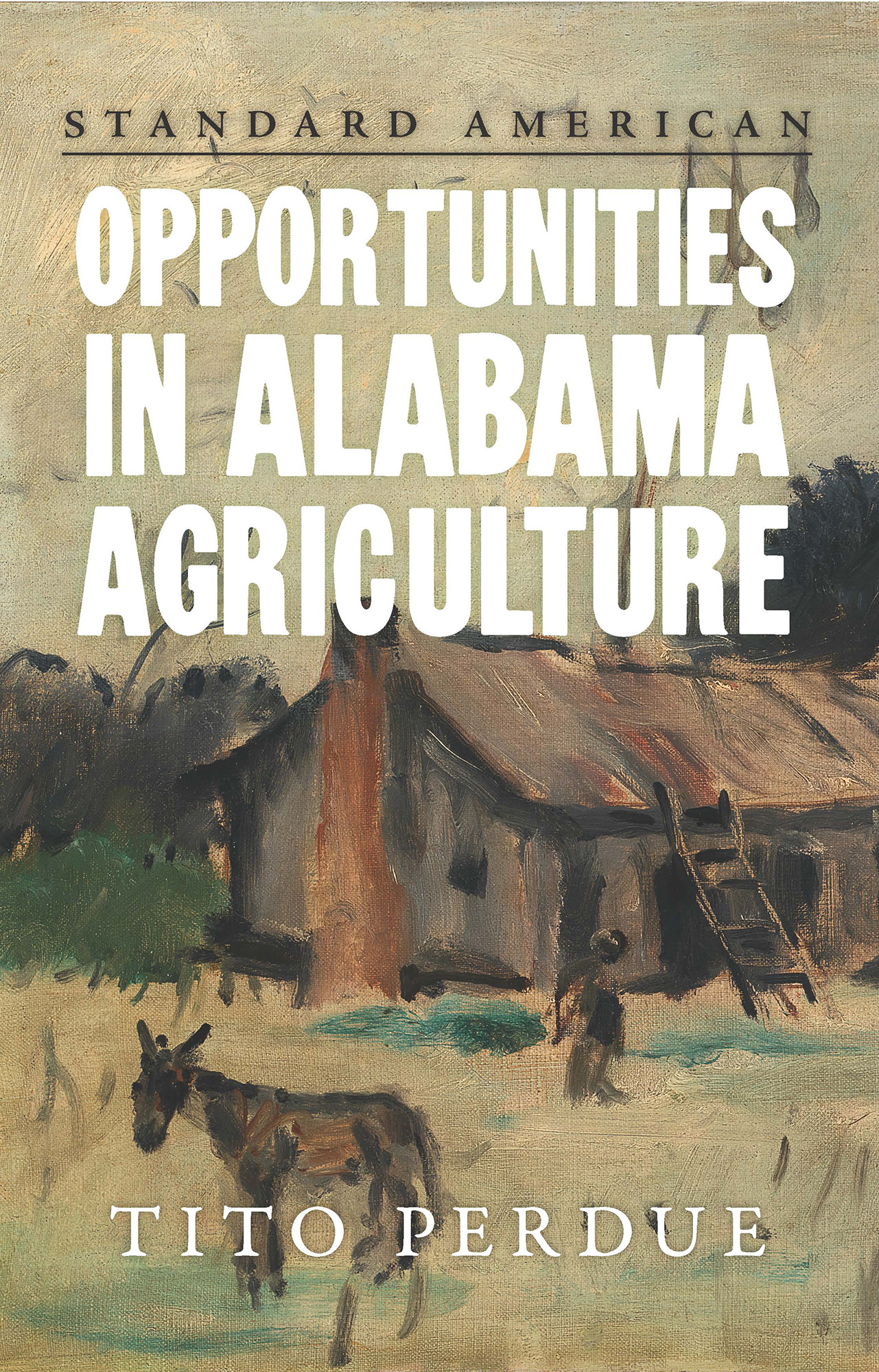
You can buy Tito Perdue’s novel Opportunities in Alabama Agriculture here.
His lecture career began, where a lifetime of theater experience paid off. Kunstler became well-off, and, as he wrote, “I could order anything I wanted from the L.L. Bean catalog, my chief marker of true success.”
From this came Clusterf— Nation, his website, as Jim sadly observed that books may well be a dying form of communication. His pessimism was backed up by Harold Covington, who lamented that young men today seem unable to wrap their heads around large blocks of print. Gore Vidal did remark that the novel may, in the end, be replaced as an art form by the interview.
Kunstler, undaunted, created his World Made by Hand series, and offers podcasts with a thoughtful, eclectic series of guests. Having learned to monetize his blog, Kunstler is satisfied. Adolescence is long gone.
In his Nowhere series, he concluded his books with a credo, defining what he lived for. Young Man Blues ends with a similar conclusion recalling his father’s death, having to bring his mother from New York to Saratoga Springs where she is buried with the inscription on her headstone furious no more.
The strength of this book is in Kunstler’s narrative skills. He offers memorable passages and an undiluted prose that is both journalistic and evocative, showing life in the sixties with the usual pop references as a backdrop, but his own psychological and familial stresses are always center stage. He offers a testament for his generation for I, like he, had similar waves of loneliness, adolescent isolation and parental conflicts spilling and festering. Like his family, mine cracked up. Like him, I am unmarried, childless, and his story remains a valuable catalog of the now fading Boomer generation, but it retains a wider significance defining the timeless growth from youth to maturity.
If libraries added Young Man Blues to their shelves next to Catcher in the Rye, Kunstler’s story would be a reasoned contrast to the swirling, cracked carousel of Holden Caulfield’s New York carnival. Kunstler’s quest for sanity and maturity is almost a spiritual emetic.
I would like to have seen more dialogue. Kunstler describes his family very well, but in Home From Nowhere, he mentions the Yiddish slang his family flung around (“That farbissener face!” “What a farkokteh idea!”).
But Kunstler doesn’t revel in his Jewishness. He admits his family were largely indifferent to their faith, that Judaism is more about human conduct than eschatology.
This is truly an American story about how one’s youth can be overcome and be a fulcrum to development. Kunstler recalls all the events, setbacks, friends and voices that completed his journey to somewhere.
1 comment
Is there anything to this guy but being yet another neurotic Jew.
Comments are closed.
If you have a Subscriber access,
simply login first to see your comment auto-approved.
Note on comments privacy & moderation
Your email is never published nor shared.
Comments are moderated. If you don't see your comment, please be patient. If approved, it will appear here soon. Do not post your comment a second time.