 2,276 words
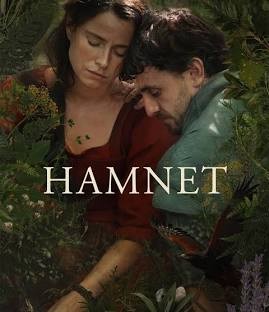
Chloe Zhao’s Hamnet, adapted from the novel by Maggie O’Farrell, is a stunning and introspective story about passages, transfiguration, and the tug of war between male and female spirituality. It begins in a forest, where Agnes Hathaway (Jessie Buckley) curls up at the base of a huge, primeval tree with a dark tunnel leading to the underworld, or so it seems. Agnes is a woman apart from nearby Stratford. She is apparently descended from a witch and more fairy queen than woman, but William Shakespeare (Paul Mescal) is smitten by her, whomever or whatever she is. He has dark, intensive looks with burning eyes demanding a dream to be fulfilled. Agnes has her own electricity, and while she shuns him at first, there is always a flirtatiousness in her refusal. They are lovers meant for each other. Unlike the “star-crossed” lovers of Romeo and Juliet, there is a cosmic union of Agnes and Shakespeare, the yin and yang of male sun and female moon.
While Agnes is happy in the open woods and calling forth her falcon, Will is a schoolmaster teaching Latin to slow learners. The windows of his classroom are cage-like bars compared to Agne’s free, semi-mysterious wood whose giant tree at the center recalls the Yggdrasil, the sacred tree of Norse mythology. Will stares out to her; he’s a frustrated man, full of knowledge, and ready to put it to use in places other than a provincial slop like Stratford-on-Avon.
The families of this Romeo and Juliet oppose their mating. This is not quite the historical world of the Shakespeare scholar and our historical perception. It is, in effect a dream world of female and male boundaries and needs. What Zhao (and O’Farrell, since it’s her book and she helped write the screenplay) shows is the conflict and eventual symbiosis of male and female sensibility.
Agnes’ folk took her in, and consider her an outsider except for her half-brother Bartholomew (Joe Alwyn), who befriends her.
Shakespeare rumbles with his family, especially his father John, who is determined to make his son into a glover. Shakespeare hates it to the point of throttling his father, but he approaches Agnes with a new gauntlet he made for her. She spurns it; the gauntlet she uses was given to her by her mother, a witch who offered her a world of knowledge competing with Shakespeare’s.
While he invests his life in visions from reading and imagination, Agnes has an encyclopedic knowledge of potions, spells, and medicinals easily plucked from the forest. But among the otherworldly knowledge she has comes a dark prophesy: that she will have three children, but only two will reach maturity.
In a quiet, intimate moment during their courtship, Shakespeare tells a curious Agnes about the legend of Orpheus and Eurydice, whom Orpheus failed to bring back from the dead.
She and Shakespeare marry, and their life blooms. She is a happy mother, and while he is devoted to her, Shakespeare struggles with an intensity that wakes her at night. He is bent over the table, papers scattered all around him as he writes, and is secretive about it. It is a world inside his head he can’t get rid of, one he must create.
Bursts of it come out with the children. We see an early three witches scene from an Ur-Macbeth performed by their children Susannah, Judith, and Hamnet. Shakespeare happily fences with young Hamnet, using sticks, a whimsical foreshadowing of what is rumbling in Shakespeare’s mind creating, as Anthony Burgess put it, the play the world could least do without.
The film only shows snippets and corners of this imaginative world of his, for he rides off to London where theater is strong, and Stratford is Agne’s world. She waits for him year after year, the children grow, especially blonde Hamnet, always in a sky-blue doublet. Susannah, the eldest, is a dutiful housemate and acolyte of her mother’s world. Judith and Hamnet are twins, and bond in many ways, but Hamnet is inquisitive and also open to Agne’s spiritual world. When the falcon dies, Hamnet and his sisters follow Agne’s rituals to release the bird’s spirit, blow into their hands and free it from death.
Shakespeare returns from his life in London. He is not a cold father, but he has an intellectual life there he can’t forsake. A house he has built will be the family home when he returns and has a title. Shakespeare, like Western man, like the male spirit of discovery, lives for the future, while Agnes is always in the here and now.
She is angry at the exclusivity of his writing and its hold on him. “You’re caught up in that place inside your head,” she complains.
Mescal captures a father and man trapped with something eternal inside him that must be played out. Mescal is at turns possessed and determined, yet always a husband and lover. He and Agnes are not enemies, but are in a spiritual wrestling match.
This match is broken by death. Pestilence comes to Stratford, and Judith is stricken. Hamnet bonds to her and breathes his life into Judith. She lives, but a now infected Hamnet dies.
Agnes is ripped apart, and Shakespeare returns, embraces her, asks where Hamnet is, then sees the boy covered in a winding sheet. Agnes denounces him for not being there, for living inside his head. He wasn’t here! Is her continual damnation. Shakespeare is shaken and those brilliant blue eyes register vivid pain, but he must return to London.
Later, Agnes sees people with playbills from London of a new play: Hamlet.nAgnes is incensed at what she considers sacrilege at the death of her son. She, accompanied by Bartholomew, journey to London to denounce her husband.

You can order Alain de Benoist’s Against Liberalism here
London is a huge city but strangely uncrowded as Zhao defines it as a place of passages and narrow entries and exits. Almost a world of tunnels. Agnes, accompanied by Bartholomew, join the flow of the crowd into the Globe Theater, the only open space we see; a temple, if you will. Indeed, the only other open space we see in London is by the Thames, when Shakespeare, in a black mood, contemplates jumping into the river and killing himself, muttering to be or not to be, matching Agne’s intuitive dread of water. While Shakespeare happily swims in it, flooding water streams into Agne’s room while she gives birth. The female element of water is ambivalent.
The stage is plain, the interior stark, only filled with the audience, whose attendance and expectation define its space.
The emptiness of the Globe recalls Jacques Louis David’s uncompleted painting The Tennis Court Oath, where the French people swear allegiance to the new republic. Much of the canvas is empty as we see the great ceiling with wind blowing into open windows. It isn’t empty, though; it’s filled with the spirit of freedom. Similarly, the Globe, while filled with an expectant crowd, is also the cranium of Shakespeare, and his mind invites all in to see and share.
Agnes almost walks in a trance to the bare stage defined by scenery of a painted wood with a single, central dark doorway. . . another tunnel. Agnes forces her way to the stage, and waits.
The painted scenery seems a mockery of the natural forest Agnes knows as her home and sanctuary, and she attacks the performance, shouting, gesticulating at the travesty that it is.
Shakespeare appears as the ghost of Hamlet’s father. Not, as the play describes, in royal dress and bearing (Zhao’s staging is inconsistent with what the play itself describes, but there’s a reason for it), Shakespeare’s face is smeared with paste. He wears a winding sheet recalling Hamnet’s death bed.
He is open-eyed and haunted, and when he confronts the actor Hamlet, he embraces him. Not as the royal dignitary we are used to in the play, but as a father, a poet, a man seeking redemption and unity in a performance and work honoring his drive to create and, through the theater, save the loss of his boy.
I won’t tell you the last fifteen minutes of Hamnet. It has a beauty and drive that is one of transfiguration and unity for Hamnet, Shakespeare, Agnes, and the cosmic drive of man and woman to unite. Mescal and Buckley offer a conclusion as visual and poetic as anything by Murnau or Dreyer’s Le Passion d’ Jeanne’d’Arc.
In a sense films are their strongest when they make myths and study myth making. Zhao has a great visual and poetic sense forging this cinematic canvas as a masterful explicator of sexual tension and commingling.
It’s curious to me how the Chinese seem better custodians of our culture then we are. Zhao creates a wonderful, absorbing story of Shakespeare and Agnes, much like the Film Ride With the Devil, probably one of the best Civil War films made in recent years, directed by Ang Lee. But then, like Zhao, Lee had excellent material in the script adapted from Daniel Woodrell’s novel Woe To Live On, and both directors respected the source material far more than a contemporary English or American director might have. In a disturbing way, the Chinese might be the only saviors of Western civilization.
The mix between fairy world and the reality of town life isn’t farfetched. The pagan world held on a lot longer in the rural areas, and at times lived side by side with the Christian world. The 1987 French film Sorceress deals with a witch who confronts a monk seeking heretics as he finds peasants worshipping St. Guinefort, who aids infants who were stolen by fairies or at risk of dying from childbirth. Guinefort, to the monk’s shock, is a dog.
The village priest is far more circumspect, and it’s true that for a very long time, pagan and Christian lived together in the rural areas. Certainly there is little mention of Christianity in Hamnet, the yin and yang of man and woman is a kind of symbiosis of two different faiths.
The life of Agnes and Shakespeare, especially when it becomes ruptured over the loss of Hamnet, recalls another play of Shakespeare’s, A Midsummer Night’s Dream, where the fairy king Oberon and his queen, Titania, quarrel over a little boy.
Robert Patrick’s play Kennedy’s Children, has a shattered 1960’s child mourn the loss of JFK and all the idealism it represented: “We are only what might have been.” Like Kennedy and the hopes wrapped in his presidency, Hamnet offered beauty and hope to Shakespeare and Agnes. They loved their son, and Hamnet was the male heir Shakespeare needed to pass on the name he had laboriously gotten a coat of arms for. This is not openly mentioned in Zhao’s film, but the continuation of a male line was a dominant facet of their world.
Hamnet, in a series of scenes, seems alive but in a dark room he is unable to get out of. He looks for a door, but there is none. The true passage to free Hamnet is Shakespeare’s creativity. He and Agnes are used by Zhao to depict the human condition in its weaving between Shakespeare’s manliness and Agne’s strong femininity. These souls shattered by grief come together in a mythic finale that commingles their essence.
I’m writing a memoir now, and as a writer I’ve lived the scene where Shakespeare is almost possessed to keep at the leaves of paper on his crabbed table, frantically cutting a new quill by candlelight while Agnes begs him to sleep. While she worships the spirit of a bird, Shakespeare uses a bird’s remains to build and create.
It is paradoxical how the people I knew now, on paper, assume a different life, almost richer than the common day-to-day people I remember. Am I deceived? Or do I falsely create who I knew, paper now their only reality? This is Shakespeare’s dilemma.
He re-creates Hamnet as Hamlet, partly to no doubt purge his suffering, but also to save Agnes from her grief. In being homo faber, man the creator, Shakespeare brings Agnes back to him in cosmic unity; begotten from loss, but brought back in renewal. Shakespeare becomes an Orpheus who doesn’t fail. An Oberon re-joined to Titania.
I enjoyed the mythical and human tug of war between Mescal and Buckley, making Shakespeare and Agnes exciting, engaging people as well as being cosmic representations. Mescal’s eyes are seductive, as is the tension in him to create and make new worlds and Buckley’s equal one to preserve the one of trees, tunnels, and the souls of Falcons.
I find this film a good contrast to other recent films about Shakespeare, from the Hollywood style romantic view of the 1998 Shakespeare in Love to 2011’s Anonymous, where he is depicted as a crass, opportunistic actor cashing in, to Jodi Picoult’s novel By Any Other Name, where poetess Emilia Lanier, is the true author of Shakespeare’s plays. He comes off as a businessman and a sort of producer managing her career.
I was also impressed by the traditional, white Elizabethan world portrayed. There are a couple of blacks in the Globe, but some of them in a large port like London is realistic.
Buckley and Mescal bring romance and struggle in an engaging and emphatic way. Zhao’s cinematography is mostly a world of clouds, subdued light, sun veiled by forests, all a kind of gray that is a canvas behind the primal power of their love, life, and family.
At its conclusion I heard sniffles from a moved audience, and that’s what films are all about. Making myths and tears. Do it right, and it’s good box office.
3 comments
Intriguing. I might check this one out myself.
This is timely, as a few days ago I visited Elsinore Castle. This is where Shakespeare set Hamlet, though he never visited Denmark personally. As you would expect it is a highly romantic Renaissance Castle, and its Great Hall was the largest of its day in Northern Europe and THE place to be if you could snag an invite. The king and queen had seven children, and grew rich collecting the Sound Dues from passing ships.
I’ll have to check out this film.
I saw this today, it was very slow and a real downer, if you want to watch a movie about Shakespeare or his Times go to Anonymous or All Is True.
Comments are closed.
If you have a Subscriber access,
simply login first to see your comment auto-approved.
Note on comments privacy & moderation
Your email is never published nor shared.
Comments are moderated. If you don't see your comment, please be patient. If approved, it will appear here soon. Do not post your comment a second time.