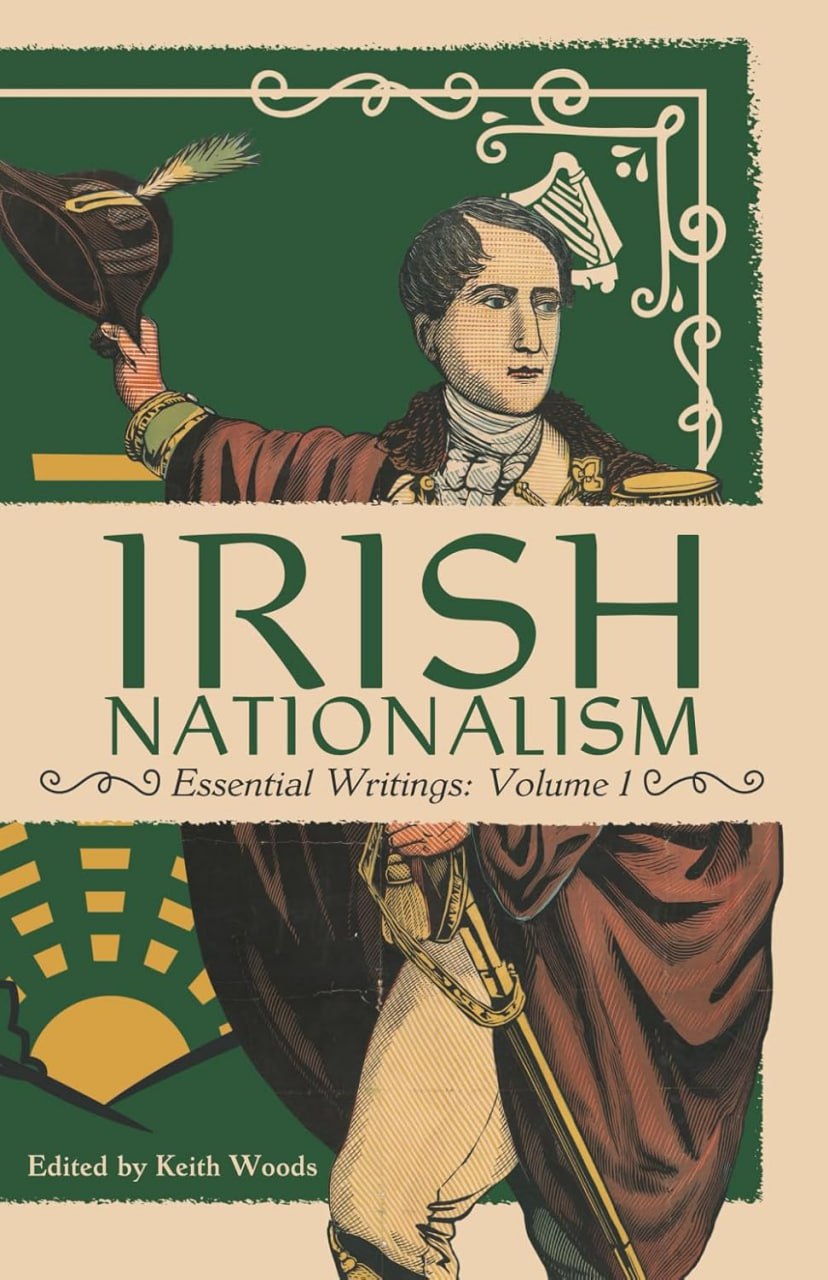
 3,135 words
Keith Woods, ed.
Irish Nationalism: Essential Writings: Volume 1
Cloverhill Publishing, 2025
Compiling and publishing a trove of lesser-known nationalist treatises is essentially a political act which bears a resonance for the modern day. Presentism inflects all our writing, no matter how much we try to think objectively about the past. Keith Woods, a prominent activist on the nationalist-Right scene, has decided to publish an anthology of Irish-centric writings drawn from the Long Nineteenth Century. Why?
The “Irish Nationalist Movement” (by which I mean the authentic nationalist Right in Ireland) has grown significantly in the last ten years. A decade ago, when I first joined this fledgling movement, it was a greenfield site. In the winter of 2016, I was invited to attend a private nationalist meeting in the rented boardroom of a rural hotel where I soon realized, I was not joining a professional mass-movement. I was ushered into a small boardroom dominated by a U-shaped table, where approximately ten of us sat. This was roughly the maximum expected turnout of the meeting, and so it proved to be. The movement remained small and unimpactful in wider politics. But a phalanx of young men in their twenties who had been politicized by international events and the impact of mass-immigration joined its ranks.
“Irish Nationalism” in its generic sense is the official ideology of the Irish State. It stands for the belief that Ireland should be independent from Britain, that we have our own distinct culture (including the minority-spoken Irish language), and for an aspiration that the entire territory of the island should one day be united into a single independent state.
The first article of the Irish Constitution affirms, on behalf of the Irish Nation, “its inalienable, indefeasible, and sovereign right to choose its own form of Government.” The third article speaks directly about the “will of the Irish nation, in harmony and friendship, to unite all the people who share the territory of the island of Ireland.” This is the generic understanding of Irish Nationalism, and it exists at all levels across Irish political culture. Bourgeois civil servants are socially expected to adhere to this idea that Ireland should be a free and united country; working-class Dublin youths believe the exact same thing. Armed republicans essentially shared the same vision for a United Ireland as the ruling elite who imprisoned them. Their methods simply differed.
But the new “Irish Nationalist Movement” represents a radical evolution (or even break) from this generic Irish Nationalist consensus, which is found across the full spectrum of Left to Right. The core area of disagreement was (and remains) the staunch rejection of mass-immigration and a recognition of the existential threat it poses to the nation. As such, I have no problem with describing the Right-wing movement in Ireland as essentially a New Nationalism. Similarly, during the nineteen twenties and thirties in Germany, Ernst Jünger was comfortable describing his circles as representing a “new nationalism” unlike the old imperial patriotism of Gott, Kaiser, Vaterland.
Woods’ book comes at an inflection point for New Nationalism in Ireland. It illuminates an internal soul-searching on the part of the movement. A foreign observer may innocently infer that perhaps Woods is simply brushing the dust off a set of obscure radical Right Irish intellectuals for a new, broader international audience. Maybe it could be imagined Woods is engaged in a similar process to the translation and dissemination of works by Julius Evola, whose popularity on the radical Right scene today extends far beyond his native Italy.
However, the primary source texts featured in Woods’ new book are not distinctly radical or even Right-wing. Some of them, like Wolfe Tone, are explicitly influenced by the French Revolution. Their political statements frequently do not extend far beyond Ireland. If wider lessons can be applied beyond the ambit of Irish history, then it is the duty of the essayist or editor to spell this out.
This book could be compared to an anthology of Hungarian Nationalism featuring figures like Lajos Kossuth and Ferenc Deák, as distinct from a collection of far-Right speeches or texts by figures associated with the Arrow Cross Party. Indeed, the latter would produce greater interest in the modern radical Right ecosystem. Why then has Keith Woods, an explicitly Right-wing nationalist figure, opted to publish an Irish book which prima facie appears to be insular or even “petty nationalist”? Part of the reason is related to Keith Woods’ own ideological journey, which is itself related to the development of Rightist politics in Ireland.
If we can bookend the New Nationalist Movement in Ireland between approximately 2016 to 2026, it can be further subdivided into the recent post-2020 history of the movement and BC (Before Covid). In the BC era, the Irish Nationalist Movement’s cadres (I include Keith Woods in this) were influenced by all manner of international Right-wing thought. They were following websites like Counter-Currents; they were reading books like For my Legionnaires by Codreanu; they were listening to the likes of TRS. But some within the movement felt there was an over focus on the “foreign” to the detriment of the “native.” Were we “Irish Nationalists” or were we just Right-wingers who happened to be Irish?
Recognizing there was an unhealthy dependence on international Right-wing terminology, a nationalist friend of mine introduced the neologism Gaelstát (Gaelic State). This was meant as a replacement for the term “ethnostate,” which was then in vogue. If we were to largely adopt the ideology of the global radical Right, we should at least have our own native lexicon! Or so the argument went. The term “Gaelstát” has gained greater currency with some sections of the Irish Nationalist Movement. It is further examined in an August 2025 article by the individual who coined it.
Parallel to the increasing popularity of the concept of a “Gaelstát” within the Irish Nationalist Movement was an uptick in interest in the primary source writings of historic figures—indeed, the kind of historical figures whom Woods included in this book. In a sense, the renewed focus on traditional nationalists was a reaction against the impression that our fledgling Movement risked becoming “generic” and simply the Irish section of a worldwide Nationalist International. Comparisons can be drawn with the “Gaelic Revival” at the beginning of the twentieth century which emerged in response to the fear that many good honest Irish people were being drawn into playing foreign sports (soccer and rugby) instead of Gaelic sports, that they were absorbing the culture of England but knew nothing of Irish mythology, and that the Irish language was in a terminal state (pp. 185-6).
Woods, whose audience is largely non-Irish, always represented something of a bridge between the Irish Nationalist Movement and the borderless, online Right-wing scene. Many of his earlier videos and essays were about topics common to anyone sympathetic to identitarian politics regardless of nationality. But in recent years, Keith Woods has been more outspoken on Irish-centric subjects, straddling the worlds between essayist, activist, commentator, and journalist. He can now firmly be placed within the faction of the Irish Nationalist Movement which is more identifiably concerned with preserving the authentically Irish character and basis of the movement. Partly for this reason, he has promoted the writings of historic Irish nationalists.
Woods is no longer just a figure of the global radical Right which focuses on certain causes (e.g. opposition to multiculturalism) universal to all white nations irrespective of their national character and story. Bridging an international followership with active engagement in Irish politics is a healthy development, as seen by his commendable (and successful) efforts to draw international attention to the Irish hate speech legislation.
***
The book itself surveys the writings of eight nationalist figures spanning the long nineteenth century. They are Theobald Wolfe Tone, Robert Emmet, Thomas Davis, John Mitchel, James Fintan Lalor, Charles Stewart Parnell, Douglas Hyde, and Michael Cusack. Notably, six of the eight are Irish Protestants. Many international readers may assume Irish Nationalism is largely reducible to a Catholic story: a “faith and fatherland” ideology which slowly germinated into a cultural-national struggle against Protestant aliens. But the picture is more complicated.
The writers whom Woods surveys promoted a type of Irish Nationalism which clearly owed much to the Protestant instincts of its authors. The Young Ireland movement (associated with the Protestant Thomas Davis and the Catholic George Gavan Duffy) simply oozed bourgeois values. It spoke for industry, sobriety, prosperity, thrift, and public duty. Such a joining of forces between young Catholic and Protestant radical nationalists was made possible by the fact that the nationalist movement was not a confessional one.
Even the tone of the writing included in this book is markedly different to the tone of the twentieth-century nationalists like Patrick Pearse (1879–1916), whom I presume will feature prominently in Volume II. Twentieth-century Irish nationalism is like Italian Opera: full of passion, emotion, and romance. But a figure like Pearse believed in linking the contemporary early twentieth-century Irish Nationalist Movement with the historic past, prompting him to write his essay Ghosts in December 1915. In it, he drew an explicit link between his own day and his forerunners: Tone, Davis, Lalor, Mitchel (and Parnell, as something of an afterthought). But the contents of their writing, when read independently (as Keith Woods allows his readers to do), clearly points to a different style of Irish Nationalism. Their arguments centered on injustice, particularly against the Catholic people of Ireland. But this was depicted as a rank contradiction of Britain’s claim to be an enlightened power: why should a first-rate European people like the Irish (Catholics) be denied basic liberties? As far as these (Protestant) nationalists were concerned, the past was the past. They did not draw upon the memory of past rebellions and dissensions, except to point out that Britain’s hypocrisy in Ireland was longstanding. (The history of Irish rebellions is surveyed by Keith Woods in pp. 8-11). But they raged against the brazen contradiction between the ostensibly enlightened ideas of Constitutional Liberty as practiced in England and the most retrograde oppression practiced by England in Ireland. Their solution was simple: Separation!
Patrick Pearse was a political activist, not a savant who republished old documents for his own satisfaction. He sought to marshal the past to serve the present, which is patently obvious from his panegyric at the graveside of the Fenian leader Jeremiah O’Donovan Rossa in August 1915: “Life springs from death; and from the graves of patriot men and women spring living nations.” In the same oration, he pithily summed up the ultimate ambition of Irish Nationalism (in his view): “[An Ireland] not free merely, but Gaelic as well; not Gaelic merely, but free as well.” This, he claimed, “is Tone’s definition, it is Mitchel’s definition, it is Rossa’s definition.” But did Tone, Mitchel, or Emmet dream of the same Gaelic, implicitly Catholic (although officially nondenominational) independent State which Pearse heralded as the fulfillment of the Irish Nationalist Movement?
Having been given the opportunity through this anthology to re-read some of the speeches of figures like Tone and Mitchel, it is not obvious to me that their aspiration was to reestablish “Gaelic Ireland.” They were not even “Gaels” ethnically. There are virtually no references to the native Irish language or to the “Gaelic” essence of Ireland in their output. Their primary objections to British rule in Ireland rested on a burning sense of transferred injustice towards the Catholic population (of which they were not). In Emmet’s 1803 speech from the dock, the judge makes much of the fact that Emmet should have enjoyed the elite life befitting his education and religion and voices his regret that Emmet’s “misguided” actions brought him to the gallows. But Emmet strongly rebukes this and responds that it was the hatred of injustice instilled in him from the knee of his father that animated his patriotic spirit and led him to armed rebellion (pp. 49-50).
Even after anti-Catholic discrimination was largely repealed in law by the Roman Catholic Relief Act of 1829, Mitchel still argued that Britain’s entire relationship with Ireland was parasitic and in bad faith. It existed to restrict the well-being and prosperity of Ireland. Mitchel praised the Irish Volunteers movement of the late-eighteenth century (p. 117), a volunteer paramilitary also mentioned in Woods’ introduction (p. 10) as a body that made moderate gains in securing legislative independence through the Constitution of 1782. This document granted parity between the Dublin and London parliaments—although the Dublin Parliament was exclusively composed of Anglicans, due to legal discrimination against Catholics.
Pearse, as the godfather of modern Irish Nationalism, interpreted the nineteenth-century nationalists for his own contemporary ends. Whilst he paid some tribute to their individuality, he also chipped away at it. They were channeled through a particular lens which depicted them as forefathers, a narrative that aligned with his own political mission of total Irish sovereignty and the concomitant Gaelic Revival (a Gaelstát, if you will). Illuminating this fact is not to criticize Pearse, but to commend his shrewdness as a propagandist.
As a master propagandist Patrick Pearse transformed “rebellion” into “revolution”; he bestowed a teleological character upon this reshaped notion of “revolution.” Pearse’s carefully crafted Proclamation of the Irish Republic in 1916 states “in every generation the Irish people have asserted their right to national freedom and sovereignty.” He did not invent the idea of a typology, but he masterfully reimagined and reshaped Irish Nationalism into the movement that emerged in the early twentieth century. Such typologies are common in theology. We see in the Old Testament, for example, themes and stories that “prefigure” New Testament revelations (e.g., the Binding of Isaac: a Father is prepared to make a sacrifice of his Son). And just as Tone and Emmet sacrificed their lives for Ireland, Pearse feels called upon to make his own sacrifice so that his Nation may live and be redeemed.
To understand Irish Nationalism, one must understand the importance of legitimacy and continuity as concepts. For example, one of our many breakaway republican paramilitaries adopted the prefix “Continuity” Irish Republican Army. This reflected that whilst they may not have the manpower of other armed groups, they at least were true to the “purest” form of Irish Nationalist ideology. In the New Nationalist movement, I have already transgressed some of its adherents by even denoting it as something new rather than simply the current phase of the centuries-long struggle of the Gael against the Gall (“Foreigner”). By publishing this book, it reflects a desire on the part of Woods to inject a more refined narrative and a sense of purpose within the somewhat rudderless New Nationalist Movement in Ireland by pointing towards our own rich history. It argues for a continuity between the struggle for national survival then and now.
In broad strokes, there are clear echoes between Patrick Pearse’s mythopoesis and what I believe Keith Woods is attempting to do with this book. Any individual approvingly cited by Keith Woods is likely to be seen as implicitly Right-wing, yet none of these figures (except Mitchel) are popularly regarded as “far-Right.” That is what makes the book peculiar and unique: Woods resisted the temptation to cherry-pick texts or quotations which would be more easily digestible by a Right-wing audience (for example the writings of Gearóid Ó Cuinneagáin, a fringe Irish fascist leader in the 1940s who is currently popular in some quarters of the New Nationalist Movement). A book aiming to chronicle explicitly far-Right political thought within the Irish Nationalist Movement would certainly be of interest, but it would inevitably be one-dimensional and unreflective of the wider movement for independence. But due to the nature of this book, readers are compelled to grapple with complicated, three-dimensional characters who generally do not fit neatly into a familiar far-Right mold.
Re-reading these classic Irish Nationalist texts has prompted a personal introspection about how it all fits together. But I infer that Keith Woods thinks there is an ideological (and racial) continuity to the Irish Nation: “From the Mesolithic hunter-gatherers who first tread its shores to the Gaelic-speaking Christians who resisted centuries of conquest, Ireland’s story is one of resilience” (p. 11). Framing the story of the Irish race as one of resilience to the foreign invader is undoubtedly conducive to the aims and priorities of the New Irish Nationalist Movement in the twenty-first century. But I fear this could result in the consequence of breeding an unhelpful insularity, a trend I have already noticed within the New Nationalist Movement. Whilst England may be regarded in popular Irish Nationalist sentiment as the “historic enemy,” I am equally pained to witness the impact of mass immigration in England.
Many of the nationalist figures surveyed in this book voiced their support for the ostensible liberty of the British Constitution but found its uneven application in Ireland to be a contemptible hypocrisy which made the separation of Ireland and Britain a necessity. I hope a recognition of this reality will dispel the wrongheaded notion that this anthology promotes the ideology of “petty nationalists” or Irish particularists or parochial extremists. They were European men grappling with the great problems that faced their country while taking inspiration from contemporary trends and developments in European philosophy and politics.
In Volume II, which I anticipate will encompass a selection of primary sources from twentieth-century (and perhaps even twenty-first-century?) Irish Nationalism, I would advise Keith Woods to do two things:
First, he should include more of his own words and original commentary. The existing author’s commentary in this volume, namely the Introduction and the brief contextualization given before each section, mostly offers a narrative precis of the historical events surrounding the selections. As a political activist and thinker in his own right, his readers would undoubtedly appreciate reading Woods’ own judgements and views on the selected texts.
Secondly, he should examine and explain how these various texts form a coherent whole, and particularly how they relate to the modern problems facing Ireland. It would be useful for Woods to flesh out the ideological underpinnings of the New Nationalist Movement, as distinct from the catch-all Irish Nationalist ideology that still exists as the official ideology of the State.
Woods has introduced an array of Irish figures to an audience that would not otherwise have happened across them. Patrick Pearse, in his day, successfully drew on historical prose to fit his modern ends. In so doing, he re-centered attention on the radical edge of figures like Wolfe Tone. He usurped the ability of the moderate Home Rule Party to posture as the successor to authentic Irish Nationalism. Pearse essentially asked the question: Would a fiery patriot like Mitchel have been pleased with the state of “Irish Nationalists” in the early twentieth century? That is, bourgeois, opportunist, corrupt, and reformist?
And today we ask: Would any Nationalist of the past two hundred years accept the ethnic displacement of the Irish people through mass immigration?
15 comments
This is going to be an unpopular take, but I’m going to give it anyway: I’ve always found most of what we would think of as “Irish nationalism” or “Irish republicanism” to be either, at least at this point in history, a) outright petty nationalism or b) at the very least adjacent to it. Geographically and demographically, the simple fact is that the British Isles consist of England, Scotland, Wales, and Ireland (both north and south), and the four indigenous peoples of those Isles are the English, Scottish, Welsh, and Irish. The indigenous peoples of the British Isles would be better off if they abolished the British monarchy and the current Parliament system (with the Houses of Lords and Commons) and the national government of the Republic of Ireland, and consolidated themselves into a decentralized, ethnocentric, Swiss-style confederation or commonwealth, each of the four peoples having their own local capital and government for almost all governmental affairs, and a very weak central national government based in London to handle military, national security, foreign policy, and other affairs that are of national importance. Nobody (especially not the Irish) would go for such an arrangement, but one can dream of a world that makes sense LOL. The indigenous peoples of the British Isles are far more similar to each other, especially culturally and historically, than they are even to other Northwestern Europeans.
This proposal simply ignores history. The Irish outside of Northern Ireland have no fond memories of being politically unified with the English and ruled from London.
Just because something would be the best arrangement in theory doesn’t mean people would go for it.
I think you’re conflating “petty nationalism” with nationalism itself. The idea of Ireland (or any nation) having a legitimate aspiration for independence is just national self-determination and nationalism. Petty nationalism is the unhealthy side of this – hating neighbouring European countries, wishing them ill, parading your own culture as superior to your neighbours’. All nationalisms can have unhealthy streaks in them which need to be cauterised. In Ireland, it’s an undercurrent of “third worldism” and performative anti-English sentiment. In England, it’s imperialist snobbery (anti-Irish sentiment and revanchism).
Your point about geography isn’t convincing. So because in the English language the orthodox term to describe Britain and Ireland (and some small islands) is “the British Isles”, we therefore need to surrender our claim to be a distinct nation and sovereign independence? In the Irish language the orthodox geographic term is “Éire agus an Bhreatain Mhór” (Ireland and Great Britain), the “British Isles” as a term is not used. So of course when speaking the English language there are plenty of implicit assumptions about geography that suit the nation which gave us that language.
Your idea of a decentralised British Republic including Ireland isn’t appealing at all – for reasons that should be obvious. So rather than repeat worn points, I’ll take issue with the very idea of decentralisation and the Swiss Direct Democracy system. Otto Strasser was keen on Swiss Cantons too. Weak, libertarian systems result in the worst instincts of people being allowed free reign. Direct democracy is a shambles and places far too much trust in the ordinary people, often resulting in absurd outcomes. Politics is complex business for intelligent, competent people – it requires expertise, hard decisions, and involves making choices that aren’t reducible down to simplistic binary referendums.
Northern and Southern Ireland should maintain partition and each have their own respective governments.
I regret that I didn’t get to spend any time with Mr. Woods when we were together in Slovenia back in May. It’s good that he has a relatively large social media following about Irish nationalism, but I still recall him from his essay on C-C: “Nationalism Doesn’t Need National Socialism” I just revisited that essay and the 150 comments under it, including splendid counter arguments by Wolf Stoner, Martin Kerr, etc. on March 8, 2025.
One of the best arguments against Woods’ claim was Daniel Zakal’s “Nationalism Without National Socialism Is a Hollow Shell” at nationalvanguard.org
Mr. Zakal’s excellent piece, a response to a deplorable article by Keith Woods recently republished on Counter-Currents, deserves wider readership… (Note that Mr. Zakal’s shop features items celebrating William Pierce and Cosmotheism.)
by Daniel Zakal
KEITH WOODS ARGUES that National Socialism is unnecessary for European nationalism today, claiming that nationalist movements can succeed without it. He suggests that Eastern European nationalist movements, Irish nationalism, and various other historical nationalist traditions prove that a positive view of National Socialism is not required. Yet his entire argument rests on an incomplete understanding of what National Socialism actually is — not just as a historical movement, but as the highest refinement of nationalist thought, rooted in a profound understanding of biological, cultural, and economic reality.
Woods believes he can strip nationalism down to a generic ethnonationalism, disconnected from the hard-earned lessons of the past century. But this is where his argument collapses. Nationalism without a unifying philosophical, moral, and economic framework is nothing more than a reactionary movement doomed to failure. National Socialism isn’t just nationalism — it’s the perfected form of it, aligning the state, people, and economy toward the highest goal: the preservation, strengthening, and flourishing of life….
National Socialism is indistinguishable from the NSDAP and the Hitler regime. If one wants to distinguish National Socialism from Hitler, then we’re just debating the essence of the sort of new nationalist thinking that emerged particularly in interwar Germany including Hitler and his opponents. If Hitler’s party is but just a single entity within “National Socialism”, then it should be possible to be an anti-Hitler National Socialist (as some people are).
I think Woods was more criticising Hitlerism. I personally am prepared to grant Hitler exclusive rights to the “brand” of National Socialism. It would be madness in 2026 to call yourself an anti-Hitler National Socialist, as instinctively everyone associates NS with Hitler. Maybe neo-Strasserist hobbyists would like to engage in splitting hairs over “NS vs. Hitler”, but I have no interest in that pointless endeavour.
But that article you’ve quoted from is not persuasive. I am doubtful of the idea that Hitler’s Germany made the sort of massive progress it alleges (in the realm of economics, culture, and so on). But even assuming it’s true: it doesn’t detract from the legitimate point that Hitler’s Government engaged in aggressive German expansionism at the expense of other white nations. The author says Hitler didn’t want war with the West but wanted to expand Eastwards and justifies this on the grounds of much needed German living space. Do eastern European nations just have to accept their own conquest and displacement?
As the leader of National Socialism, Hitler must carry the can for his actions – including the invasion of non-German lands and the killing of millions of whites in a war against the Soviet Union that he wanted and started (which he argued for while still a fringe figure in Landsberg Prison during the time of Lenin’s Government – so the idea that the invasion of the USSR was a preemptive attack/act of self-defence doesn’t stack up). A war against the USSR for anti-Communist reasons could be justified on nationalist grounds; but we all know Hitler wanted to invade and colonise the lands of Eastern Europe and replace them with German settlers.
Hitler didn’t invent being anti-Jewish or “noticing”. He didn’t invent the idea that the nation should come before economic profit. Anyway in power Hitler’s regime allied with the German Military-Industrial Complex which was not to the benefit of German workers. Preparing for and launching an aggressive war of revenge against the Allied Powers and then a war in the East against the Soviet Union was a shot in the arm for the German economy but it was all very temporary and unsustainable. The buck also has to land with Hitler here. I personally also find the sort of mass suppression of freedom and dissension in Germany under Hitler to have been an insult to an enlightened people. Plus all those rigged 99.9% referendums and elections are a further insult to the intelligence of Germans and the world.
Jack Hamill: January 8, 2026 National Socialism is indistinguishable from the NSDAP and the Hitler regime. If one wants to distinguish National Socialism from Hitler, then we’re just debating the essence of the sort of new nationalist thinking that emerged particularly in interwar Germany including Hitler and his opponents. If Hitler’s party is but just a single entity within “National Socialism”, then it should be possible to be an anti-Hitler National Socialist (as some people are).
I think Woods was more criticising Hitlerism…. Maybe neo-Strasserist hobbyists would like to engage in splitting hairs over “NS vs. Hitler”, but I have no interest in that pointless endeavour…We’re not going to get anywhere going the George Lincoln Rockwell route trying to resurrect the NSDAP.
—-
Granted. We can learn from Hitler without joining with the Jewish chorus that demonizes him. Leave that to Mr. Woods and others.
This is 2026, Jack. more than 100 years after Mr. Hitler wrote MK. But his MK successfully addressed race and the Jewish Question as no other, so we learn from that. I promote Dr. William Pierce’s National Alliance and his worldview. Though he got his start with GLR’s ANP 60 years ago, he did not try to resurrect the NSDAP, as he developed his own “Americanized” organization, based in part on some truths from Mr. Hitler’s movement — but without the swastika, Roman salute, uniforms and more that was associated with the Third Reich.
What’s Woods’ position on Christianity, for example? I don’t know. Pierce honestly addressed that issue for its impact on our race as other groups today do not, for fear of offending Christians. Hitler couldn’t do that until the end of his life was near. There is much to learn from Pierce’s teachings, like in this piece about Jewish media control from 25 years ago: “Mike Wallace’s Lesson” at nationalvanguard.org. Pierce does not mention either Hitler or NS.
… Mike Wallace and I talked about various things in last week’s interview. We talked about my music company, Resistance Records; we talked about the Oklahoma City bombing and who was responsible for it; we even talked about the role of the Jews in destroying American society; and of course, we agreed on nothing. I tried my best to be civil throughout the interview, however, and I believe that I succeeded in that. Looking at the interview objectively, I was polite, and I expressed myself in a reasonable and calm manner. The principal thing I expressed in last week’s interview was my concern about the increasing alienation of our young people, about the alienating influences in our society — influences such as MTV, which is part of the same Jewish media conglomerate for which Mike Wallace works. I pointed out that my own efforts were aimed at countering these alienating influences and helping our young people find their roots.
Mike Wallace’s reaction to me was that I was expressing “hatred” and that my “mouthings” are “vile” to him, as a Jew. To him my concern for my people, for their welfare and their survival, are “hatred” and are “vile.” I find it remarkable that he should express himself so forthrightly in front of the huge television audience that we had, that he should make so clear the profound difference between my aims, as a White American, and his aims, as a Jew — and in the interview last week he explicitly identified himself as a Jew. One might have expected him to say the things he said if the television audience were entirely or even mostly Jewish. But of course, it’s not. Jews make up only two and a half per cent of the U.S. population and probably about the same percentage of the people who were tuned to 60 Minutes II last week.
Mike Wallace is a Jew, with the very special biases and viewpoints Jews have, but he also is a very experienced showman. He has been doing 60 Minutes interviews for many years, and he certainly should be aware of the makeup of his audience. During both his interviews with me he was assuming that most Americans agree with him: that most Americans believe that to express concern for the alienation of our young people is “hatred.” He was assuming that any expression of disagreement with the policies of his boss, Sumner Redstone, who is using MTV to popularize “rap” and other elements of Black culture among young Whites and to encourage young White girls to have sex with Blacks — he was assuming that my expression of disagreement with these policies is “vile” to the American people, to the television audience. In fact, Mike Wallace went so far as to say that I’m insane for having the views that I have. In the interview five years ago he actually called me a “nut” on the air, and in last week’s interview he had one of his cohorts, Morris Dees of the Southern Poverty Law Center, come on the air and tell everyone that I’m crazy for believing what I believe….
I fail to see the relevance of most of that to the discussion at hand.
It’s absolutely valid for anyone to criticise Hitlerism, both in its historical context and its advocates today.
A problem I’ve noticed with today’s Hitlerists is that they believe everyone on the radical right is secretly pro-Hitler, and that their “countersignalling” of Hitler is simply about “optics”. For example a current meme on the online NS scene is that: “They killed Charlie Kirk, a moderate. So why bother being moderate?” Seems to miss the point that Charlie Kirk was actually a “moderate” and meant what he said.
Jack Hamill: January 12, 2026 at 3:41 pm I fail to see the relevance of most of that to the discussion at hand. It’s absolutely valid for anyone to criticise Hitlerism, both in its historical context and its advocates today.
A problem I’ve noticed with today’s Hitlerists is that they believe everyone on the radical right is secretly pro-Hitler, and that their “countersignalling” of Hitler is simply about “optics”. For example a current meme on the online NS scene is that: “They killed Charlie Kirk, a moderate. So why bother being moderate?” Seems to miss the point that Charlie Kirk was actually a “moderate” and meant what he said.
—
Thank you, Jack. You are free to promote your perception of defenders of our people and of National Socialism as “Hitlerists.” I don’t characterize myself that way, nor did William Pierce when 35 years ago he correctly compared Hitler to Stalin, Churchill and Roosevelt, here: “The Measure of Greatness” at nationalvanguard
You say Kirk was a moderate. Compared to Hitler, certainly. I still see him as a highly promoted, talented Christian Zionist evangelical, who was leading young Whites in the wrong direction.
Pierce’s interview with Mike Wallace, the popular and influential Hasidic Jew, is very revealing, even though edited down from over five and a half hours to not much more than five minutes. Our people need to read material like Pierce’s 60 Minutes interview with Wallace from Pierce’s point of view.
I am using the term “Hitlerists” to describe modern pro-Hitler National Socialists, as distinct from this idea promoted in some of your linked material that National Socialism is simply “the perfection of nationalism”, in which case National Socialism predates Hitler’s movement and exists outside it by definition.
National Socialism isn’t just nationalism — it’s the perfected form of it, aligning the state, people, and economy toward the highest goal: the preservation, strengthening, and flourishing of life…In Carlos Videla’s book he describes the purpose of NS as unifying the four pillars of selection, struggle, fertility, and inheritance to increase the hereditary value of biological traits towards evolutionary improvement of a people over time. Preserving generational genetic fitness that doesn’t let itself go or lose track through steroid overuse to maximize GDP.
Uncle Semantic: January 9, 2026 at 6:24 pm National Socialism isn’t just nationalism — it’s the perfected form of it…
—
“Liked” for truth, though a minority view. Thanks, Unc.
A recommended essay for the reader to better understand NS is this from our author of the top rank, Dr. Thomas Dalton, PhD, from five years ago: “National Socialism Today” at nationalvanguard.org :
THE MORAL, social, and philosophical bankruptcy of our modern political/economic ideologies is becoming more apparent by the day. Free-market capitalism, conventional socialism, democracy, and communism are all demonstrable failures. All fail to sustain and uplift humanity; they fail to acknowledge racial realities; and they fail to establish a balanced and sustainable relationship with Nature. Political corruption, widespread fraud, unprincipled spinelessness, moral and spiritual decay, and blatant self-enrichment mark the current systems of nearly all developed nations on Earth. All seemingly compete in a race to the bottom, to see which can achieve the most undignified and degrading form of social existence in the shortest period of time.
In the past 100 years, only one system has proven able to defy this trend: Adolf Hitler’s National Socialism (1933-1945). National Socialist (NS) Germany was able to achieve, in a period of less than 10 years, unprecedented and remarkable gains in economics, military power, social and cultural advancement, and national morale — and all amidst a global depression that was utterly crushing other advanced nations. Hitler’s system proved such a threat to the other world powers, and especially to the Jewish oligarchy that ruled in Europe and America, that they became determined to destroy it. And destroy it they did.
The threat from Hitler was never military — he never sought war with the West, and always only wanted to move east, in order to acquire badly-needed living space for his people, and to counter the looming Judeo-Bolshevist threat in the Soviet Union. Rather, the threat was Germany’s success: that Hitler might prove to the world that by driving out the Jewish element, by refocusing economies inward, and by promoting a non-materialistic worldview that extolled human character and spirit, that he would expose the many failings of Western Jewish-capitalist-materialistic society. This positive counter-example was something that the Western powers simply could not countenance, and so they conspired to destroy Hitler and his nascent society. In May of 1945, after five long years of fighting, with the entire industrial world arrayed against one nation, they prevailed.
The Allies defeated NS Germany, but not its ideas. Ideas, as they say, are bulletproof. They are eternal and immortal. Hitler’s vision still lives, and it has the power and potential to restore the world to a semblance of sanity, sustainability, and justice. This essay briefly outlines what National Socialism is, what a NS nation might look like today, and offers a few preliminary steps toward achieving such a vision….
Read more at the link about how NS addresses the vital issues of race and the JQ.
“and always only wanted to move east, in order to acquire badly-needed living space for his people,…”; in other words, conspire to wage, and then actually wage, aggressive war against fellow whites in Eastern Europe to displace them and confiscate their land for use my ethnic German settler-colonists. Buying Professor Dalton’s new English translation of “Mein Kampf” from Clemens & Blair and reading Adolf Hitler’s explanation of his worldview actually did more than anything else to convince me that embracing German National Socialism is a political, metapolitical, and social dead end. Volume II is actually the most instructive in this regard, since that volume is almost exclusively about worldview and policy. That’s why I simply cannot take Joel Davis, Tom Sewell, and the rest of the Australian NSN guys seriously. Working toward a benchmark wherein a critical mass of people have had a “come to Jesus moment” wherein they “let Hitler into their hearts” isn’t going to happen. Thomas Rousseau’s Patriot Front outfit and Martin Sellner’s identitarians do a far superior job, and accomplish much more, metapolitically speaking. White nationalists should simply view Hitler as a major historical figure of the white race, worthy of study in his own right. We’re not going to get anywhere going the George Lincoln Rockwell route trying to resurrect the NSDAP.
Comments are closed.
If you have a Subscriber access,
simply login first to see your comment auto-approved.
Note on comments privacy & moderation
Your email is never published nor shared.
Comments are moderated. If you don't see your comment, please be patient. If approved, it will appear here soon. Do not post your comment a second time.