 5,082 words
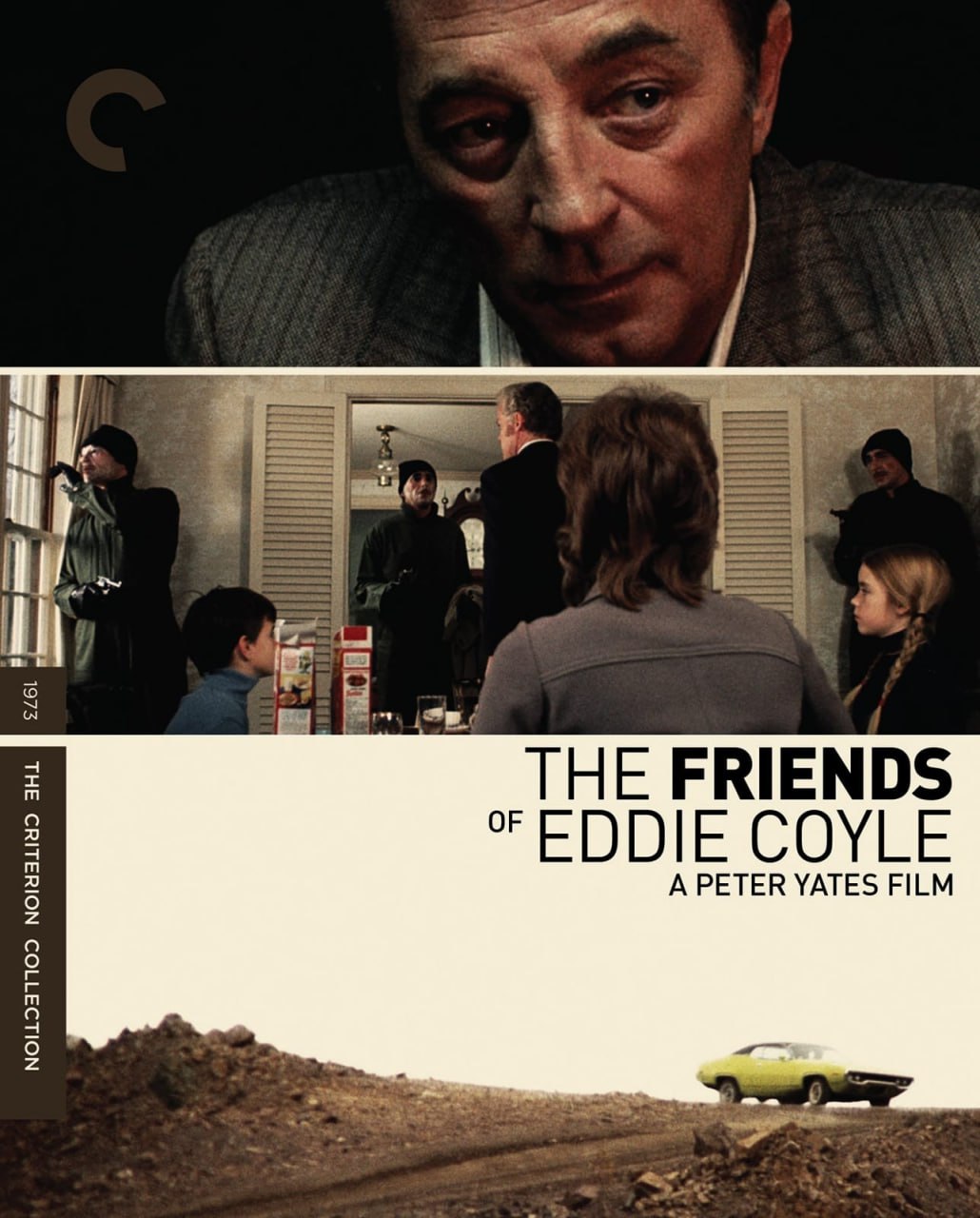
The Friends of Eddie Coyle
Peter Yates, 1973, 101 minutes
Robert Mitchum, Peter Boyle, Richard Jordan, Alex Rocco, Stephen Keats, Peter MacLean
Screenplay by Paul Monash; based on the novel by George V. Higgins
Music: Dave Grusin
“If I say you’re a friend of mine, that means you’re connected. If I say you’re a friend of ours, that means you’re a made guy.”—Lefty Ruggiero, Donnie Brasco
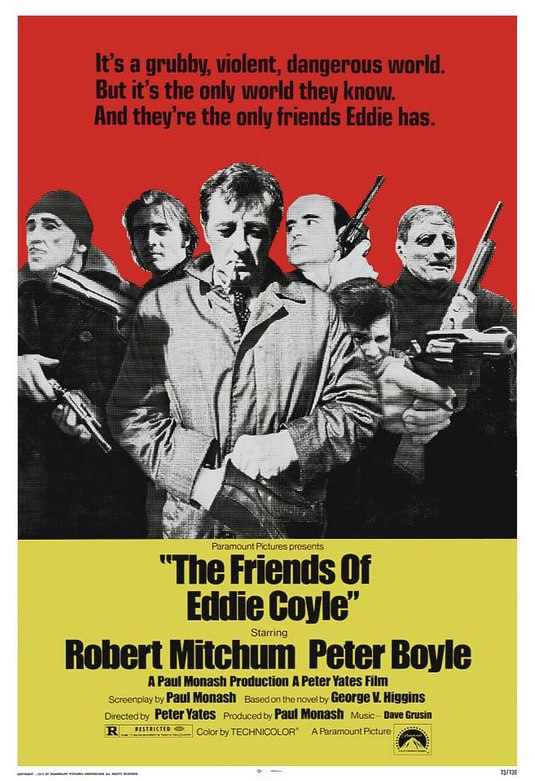
” It’s a grubby, violent, dangerous world. But it’s the only world they know. And they’re the only friends Eddie has.”—Movie poster
Before Dog Day Afternoon, before Goodfellas, before The Departed, before, yes, even before the Joker blagged his first mob bank in The Dark Knight,[1] there was The Friends of Eddie Coyle, which you probably never heard of. Even a Blu-ray release on Criterion ten years ago didn’t rescue it from the obscurity it fell into after release. But many of your favorite directors must have seen it and never forgot it. Or maybe it just epitomized the Zeitgeist of 1970s America so well that it helps us identify where it turned up in later American films.
Myself, I eschewed the Blu-ray to watch it on an Amazon stream to get as close to the 1970s grindhouse theater experience as possible. Despite 121 reviews at IMDB.com, no one has bothered to provide a synopsis there. The listing for the Criterion release gives us some details, though without proofreading:
In one of the best performances of his legendary career, Robert Mitchum (The Night of the Hunter) plays small-time gunrunner Eddie ‘Fingers’ Coyle in an adaptation by Peter Yates (Breaking Away) of George V. Higgins’s acclaimed novel The Friends of Eddie Coyle. World-weary and living hand to mouth, Coyle works on the sidelines of the seedy Boston underworld just to make ends meet. But when he finds himself facing a second stretch of hard time, he’s forced to weigh loyalty to his criminal colleagues against snitching to stay free. Directed with a sharp eye for it’s [sic] gritty locales and an open heart for it’s [sic] less-than-heroic characters, this is one of the true treasures of 1970’s Hollywood filmmaking—a suspenseful crime drama in stark, unforgiving daylight.
Here’s a punchier but equally grammar-challenged review from Amazon reviewer trolle:
The narrative shifts back and forth between set piece bank robberies or gun purchases and one on one conversations in which the protagonists alternately manipulate, flatter, wheedle, bluff, coerce or inform on one another — all filmed in a flat, clinical, procedural style strongly reminiscent jean-pierre melville’s “army of shadows” (1969). the whole is knit together by the fate of eddie coyle, embodied by robert mitchum in an unsentimental but nuanced performance, who attempts to balance the demands of treasury cops (who might help him in a forthcoming sentencing for smuggling liquor) and the needs of armed criminals (who provide eddie’s livelihood).
One reason it may be hard to synopsize (apparently a word, according to Word) is that the characters are almost non-existent, which is less the fault of the writers/director and more how they accurately portrait people with almost non-existent, well, characters.
As near as I can make out, Eddie is a dispatcher at a trucking company. He has a wife, who for some reason is Irish,[2] and two children who we see for a minute at most. In the fashion of the good old 1970s, he can support the lot of them in a run-down but large, two-story house, while young married adults today can barely afford a studio apartment.[3] However, the wife thinks she may need to get a job (which Eddie will not tolerate!) since he’s looking at five years in the Federal penitentiary. It’s the Bunker family (including a sweet narrow oak staircase with one of those pre-ADA sharp twists) if Archie had a prison record.
Perhaps he can afford that house since he also does little jobs for crooked friends of his or the mob, mostly selling guns or, like the last job he got busted for, driving trucks with stolen cargo. A stand-up guy, Eddie never squealed, but he’s now reconsidering it. The bust that the Feds keep hanging over Eddie’s head, driving a truck full of stolen liquor, recalls the mob’s glory days.[4]
***
 If, like your Humble Reviewer, you like to check in on what the Modern Audience is thinking by watching “reaction” videos on YT, you know that their complaints revolve around “too slow” and “too much talking.” Movies should apparently start off with some kind of CGI action apocalypse and then continue as they started. This then leads into their other complaint, “why do these old movies start with all these credits?” The blank screen of 2001 really gives them agita. This movie has all that old time stuff in spades; it’s excruciatingly slow and talky.[5] Despite all the guns being bought and sold, no one gets shot until the last couple minutes, and even then, there’s no “I shot Marvin in the face” shock/gore à la Tarantino.[6]
That this isn’t due to incompetence, but a deliberate strategy, is shown by how otherwise economical the direction is when it wants to be: for example, there’s plenty of phone calls made, but usually no time wasted on dialing, pleasantries,[7] and shooting the shit, just a quick cut to the meeting that was set up, and more talk.[8] Similarly, the bank robberies (committed by friends of Eddie who he might consider ratting on in return for leniency) are slowly executed, but no time is wasted showing the gang sitting around planning things out; viewers, like the bank employees, are expected to listen and understand in real time.
In broad strokes, I’d say the film mostly consists of long takes filled with:
- Bank robberies, meticulously explained in real time.
- Setting up and executing gun purchases.
- Offering or demanding information (aka being a rat).
- The climax, where Eddie meets up with his pal Dillon, they go to a hockey game, some time is spent on what a great future Bobby Orr will have, and Dillon shoots Eddie.
- Cars (see below).
The remaining run time is about two minutes with Eddie’s family and a brief discussion between the main Fed and his boss.
Now, about those cars. It being a Peter Yates film in the 1970s, there’s cars, plenty of cars, and unlike telephones, their use is lovingly detailed.[9] When there’s not a slow-motion bank robbery, a tense gun buy, or a Fed trying to squeeze information out of some mook, there’s cars. 1970s land yachts, mostly, but the young, flashy gun dealer drives a multi-colored muscle car. Cars drive to or from meets of some kind, and of course we get to see them parking, very carefully. Guns go into and are taken out of trunks. Cars are integral to the robberies, before and after, and when the Feds take down the gun dealer it’s a “logically complex parking-lot arrest.” The climax is a veritable fugue: Eddie gets driven around until even he falls asleep, then after he’s shot, we get more driving, parking, and a lecture on the proper way to dispose of a car with a dead guy in it. Tarantino was likely taking notes: “add lack of head.”
Boredom, existential poetry, parking, autistic emphasis on such technical matters as bank robbery tactics, size and caliber of guns and sales thereof . . . I began to think I was in the familiar territory of Coleman Francis. There’s plenty of coffee as well, and if there were only some small planes, we’d have a Coleman trifecta!
The difference is that here, Peter Yates is a great director, the rest of the cast, headed by the unbeatable Robert Mitchum, are great actors, the script is great, the photography is great, the music is great; while in a Coleman Francis movie, all these elements are replaced by a corresponding black hole.[10]
Cars also connect us to Scorsese. I can’t really say he was directly inspired by Eddie, since his breakout film—Mean Streets, reviewed by Trevor Lynch here and Mark Gullick here—was exactly contemporaneous (1973), so maybe it’s that Zeitgeist thing again. Anyway, Mean Streets explores the same territory, the crummy street life of the real Mafia, this time in New York. While Scorsese’s later work will be a lot flashier, in both color and editing, this is a drab look at the minutia of the life of small-time crooks. The takes are long, and talky.
In Scorsese’s film some of the tradition remains: “Uncle” is a real person, described by Lynch as “a consummate old-world gentleman,” and he tries to provide real guidance to the floundering Charlie; religion is also a real if ironic presence in Little Italy, something that seems entirely from Eddie’s Boston.
The cars, big 70s land yachts rather than Jackie’s muscle car, are there, from start, where Michael drives some kids around as part of what Lynch calls “a really petty con,” to the end, where the same Micheal drives around a hit man aiming to kill Johnny Boy (De Niro’s breakout role) just as Dillon whacks Eddie.
Scorsese at least gives us a car chase there, unlike Yates, where the hit takes place, once more, while parked. Scorsese can’t help himself, this is still a livelier film; there are parties and parades, and the long take of Johnny Boy’s barroom entrance is lit red, like Hell, and set to “Jumpin’ Jack Flash” (Scorsese is already using his trademark pop sound cues).
Goodfellas is the real anti-Eddie, loud, flashy, and full of jump cuts as well as long takes. Even before the credits we’re driving around in a land yacht with a body in the trunk, followed by a red-lit murder (modern audiences approve!); the credits that follow are set to the sound of whizzing cars and up-tempo Italianate pop music (“Another great Saul Bass credit sequence” as Mystery Science Theater would say); as the narrative starts, teenage protagonist Henry is already parking Cadillacs for the mob, and cars will be featured in the coke-fueled jump cuts of the “Henry Hill Gets Busted” sequence.
The matching long take here is Henry and Karen’s iconic entrance into the Copacabana, rather than a crummy bar, set to pop music from the same 60s girl-group genre that opens Mean Streets (we won’t get the Rolling Stones until another decade passes in the story) and ending with a rim shot and Henny Youngman’s stand-up routine; you could say it’s another kind of an entrance to Hell.
So Goodfellas can’t help but be a Scorsese film, with quick cuts, peppy music and bright lights; maybe it’s that Irish blood that keeps Henry and Jimmy (along with Eddie) out of the mob. Nevertheless, the film reveals the dour and deadly truth of mob life; above all, the phony friendship:
Your murderers come with smiles, they come as your friends, the people who’ve cared for you all of your life. And they always seem to come at a time that you’re at your weakest and most in need of their help.
This perfectly describes Dillon, the “friend” of Eddie’s who will buy him drinks, take him to a Blackhawks game, and put a .22 round in his head. As Tommy goes to his assassination, we get the ironic title drop:
You know, we always called each other goodfellas. Like, you’d say to somebody: “You’re gonna like this guy; he’s all right. He’s a goodfella. He’s one of us.”
People noted a shift in Scorsese’s interests with The Departed, from the Italian mob to the Irish mob, but this also marks a return to Eddie’s territory. Apart from the Boston setting, the theme of everyone on every side of the law being crooked and self-interested is ramped up to operatic proportions,[11] while religion is no longer a haven (every priest in the film is a pedophile).
That’s what they don’t tell you in the church. When I was your age they would say we can become cops, or criminals. Today, what I’m saying to you is this: when you’re facing a loaded gun, what’s the difference?
The final interaction between the fed and the rat—
Dave Foley: Screw. We been friends a long time now. I never asked a friend yet to do somethin’ he really couldn’t do, I knew he couldn’t do it.
—recalls Frank Costello’s penultimate words: “I . . . I never gave up anybody . . . who wasn’t going down anyway. Nobody knows nothin’.”
There’s few cars and mostly chases on foot. Also ramped up are the hits; Scorsese seems obsessed with explosive head-shots, to an almost comic point. Dillon would not have approved; here he calmly deals with the startled driver after shooting Eddie:
Driver: Jesus Christ, that was loud.
Dillon: That’s why I used a .22.
Driver: Yeah? That was loud enough.
Dillon: I ever let off a .38 two-incher in here, you’d go right off the road.
The Departed though has one very important connection to Eddie: both take inspiration from Boston’s Winter Hill mob, and particularly its leader, Whitey Bulger. Bulger was still in hiding when Nicholson was playing Frank Costello, but Mitchum was able (allegedly) to hang out with the gang itself, made easier, Mitchum pointed out, by his being a convicted criminal himself.
In any event, the two performances are quite different. Mitchum looks like a human rumpled suit with a bad haircut, while Nicholson, though even more disheveled, is strangely charismatic. His lack of grooming exudes more “fuck you” than failure, and his campy speeches are miles away from Mitchum’s Bukowski-esque noir poetry. As Kent Jones says at Criterion:
Mitchum mastered the exceptionally difficult Boston accent.[12] More importantly, he found the right loping rhythm, the right level of spiritual exhaustion, the right amount of cloaked malevolence. If Mitchum betrays anything of himself as Eddie, it’s his sense of poetry, which, for roughly three-fourths of his career as an actor, seems to have manifested itself off- and not on-screen. But when he rose to the occasion, he was one of the best actors in movies. Thinks like a poet, acts like a jazz musician, hitting on the perfect melancholy chord progression from his initial appearance and playing quietly dolorous variations right to the end.
Of course, he has Higgins’ great novel to work from. At random:
Eddie: No, I am not finished. Look, I’m gettin’ old, you hear? I spent most of my life hanging around crummy joints with a buncha punks drinkin’ the beer, eatin’ the hash and the hot dogs and watchin’ the other people go off to Florida while I’m sweatin’ out how I’m gonna pay the plumber. I done time and I stood up but I can’t take no more chances. Next time, it’s gonna be me goin’ to Florida. And listen: you’re still a kid. And you come out, you go around, you say “look, I’m a man, you can take what I say and it happens, I go through.” Well, you’re learning something too, my friend, and I advise you to learn it right now: when you say that, when you get me out there all by myself on what you say, you better be right there in back of me. Because when you say “it happens,” it’s gonna fuckin’ happen. If it don’t, you’ve got your thing caught in the zipper.[13]
Eddie goes on to describe what happens when your thing gets caught in the zipper, reminding us of the sadistic treatment handed out by Mike Hammer in Kiss Me, Deadly.[14]
[Coyle shows Jackie Brown his left hand]
Eddie ‘Fingers’ Coyle: Look at that. You know what that is?
Jackie Brown: Your hand.
Eddie: I hope you look closer at those guns than you did at that hand. Look at your own goddamn hand.
Jackie: Yeah?
Eddie: Count your fuckin’ knuckles.
Jackie: All of ’em?
Eddie: Count as many as you want. As many as you got, I got four more. You know how I got those? I bought some stuff from a man. I knew his name. The stuff was traced. The guy I bought it for, he’s at MCI Walpole for fifteen to twenty-five. Still in there. But he had some friends. I got an extra set of knuckles. They put your hand in a drawer then somebody kicks the drawer shut. Hurt like a bastard.
Jackie: Jesus. [15]
The difference between Eddie and Frank is like the difference between Brian Cox’s Hannibal Lecter and Anthony Hopkins’; one looks like someone who might strike up a conversation with you on the bus, the other is Count Dracula.
The only hard-working gangster/loser to match Mitchum’s Eddie in the years since is, ironically, Donnie Brasco’s Lefty Ruggiero, played by Al Pacino, who back in Eddie’s time period gave us Michael Corleone, the iconic mobster as Nietzschean Superman. In Brasco, however, Lefty and everyone else below The Man is simply a donkey breaking his ass to make a weekly payoff to someone higher up, based on two-bit rackets like stolen parking meters.[16] It’s like these “wiseguys” have all been suckered into a MML; not the “movie stars with muscle” of Goodfellas but Scientologists with guns. By contrast, the bank-robbers and gun-runners of Eddie seem like Bond villains. Everything has gotten crummier since 1973, but the treachery and distrust have only increased, among both the mob and the Feds.
By far the most “interesting” character, in the conventional sense, is Peter Boyle’s Dillon, apparently a bartender, in actuality a police informant, as well as a mob assassin (which the police may or may not know about). It’s a small part that becomes pivotal, and Boyle—pre-Joe, pre-Taxi Driver, pre-Young Frankenstein—is very subtly menacing as a best buddy who might have been paid to blow your head off. I wanted to know more about Dillon; what kind of guy works a menial 9-5 job as cover for his glamorous and lucrative life as an assassin? Are we supposed to identify with him, as the ultimate Walter Mitty fantasy?[17] A Godfather II style prequel/sequel would have been nice.
***
Even if such aesthetic matters are not of interest, consider the message they carry, over and above, or deep within. How else would you depict Eddie’s world—which is more than ever our world? As that Amazon review puts it, Friends is:
. . . in that peculiar variant of film noir where “good and evil” have been entirely extracted from the narrative dynamic, leaving only the tactical calculations of characters swimming a turbulent world of existentialist gray. it only gradually becomes clear that some of these low lifes are thieves, some are gun runners, and some are cops, or how exactly the thieves and gun runners are connected, or that acquaintances are hit men, and hit men will, for a price, take down even those they invite to enjoy a hockey game. . . . the film is a grim and tragic examination of human beings who must negotiate trust and threat as part of their daily survival, and where the winners are those who can do the most reliable service for “the man” (or for “uncle”); the weak are those who only have the weak to rely on.
Friends is the ultimate deconstruction—or to use Heidegger’s more extreme term, de-struction—of the gangster genre. The de-struction is carried out by removing one single, crucial element, like the last move in a game of Jenga. Here, there is no Gemeinschaft at all, only Gesellschaft.[18] While The Godfather was all about honor and respect, here the only question is: What have you done for me lately?[19]
Eddie ‘Fingers’ Coyle: I was thinkin’ in terms of you maybe talkin’ to the prosecutor up there, and havin’ him drop a word to the judge how I been helpin’ my Uncle like a bastard?
Dave Foley: Well, I would. But then again you haven’t been.
Eddie: What? I gave you a couple of calls.
Foley: Yeah, you give me some real stuff, too. You tell me about a guy that’s gonna get hit, 15 minutes later he gets hit. You tell me about some guys on a job, but you don’t tell me till they’re coming out the door with the money. That’s not helping Uncle, Eddie. You gotta put your whole soul into it. Hell, the way I hear it, you may be mixed up in somethin’ that’s goin’ on.
Eddie: Like what?
Foley: Oh, well, I wouldn’t wanna confront a man with somethin’ I heard. You know me better than that.
Eddie: Well, uh . . . suppose we was to talk about machine guns.
Foley: Just to change the subject?
Eddie: Well, suppose someone should put you on to somebody who was sellin’ machine guns. You wouldn’t want ’em to go to jail, would ya? I mean, somebody who was helpin’ ya like that, you wouldn’t want ’em to go to jail and embarrass his kids and all, would ya?
Foley: When’s this supposed to come off?
Eddie: How much ya interested?
Foley: Okay. We’ll do it your way. You call me when you get something, if you do. And if I get something, I’ll put it in front of the U.S. Attorney. If I don’t . . . all bets are off. Understood? [Coyle nods] Have a nice day. [Foley departs]
Or as our Amazon reviewer says,
Acquaintances are hit men, and hit men will, for a price, take down even those they invite to enjoy a hockey game.
Everyone and everything here is purely transactional, except perhaps for Eddie’s wife, who we don’t really see much of, and perhaps for that very reason; she and their children are the last flicker of the “big loving mob family” trope. Fed Foley’s habitual use of that vapid Americanism, “Have a nice day,” is really the perfect expression of his depersonalized character.
Among these cheap crooks and slimy Feds there is only one intrusion by the actual mob, but it sets Eddie’s final fate in motion. We know it’s the mob, because the messenger[20] requesting the hit is short, dark haired, wears an outfit with a somewhat gaudy tie but otherwise more formal than the rumpled suits and windbreakers of everyone else. He refers to his boss as “the Man”; here the language of “Godfather” and “The Don”[21] has withered away to “The Man” just as the Treasury agents refer to the government as a very un-avuncular “Uncle.”[22]
***
There may be other films, unknown to me, or perhaps sociological reasons or whatever, but The Friends of Eddie Coyle, released just one year after The Godfather, seems like the original de-construction of the Corleone myth, the progenitor of such better known and better regarded films as Goodfellas and The Departed.
And with that, I bid the reader to “Have a nice day.”
Notes
[1] Bullet Tooth Tony: “A bookie’s got blagged last night.”
Avi: “Blagged? Do me a favor, Tony, speak English. I thought this country spawned the f***ing language, and so far nobody seems to speak it.”—Snatch (Guy Ritchie, 2000).
[2] Yes, I know it’s Boston, but the only clue we are given about her character is an obvious Irish accent. What’s her story? How did she and Eddie meet, was she an immigrant or did he visit Ireland? Like all the characters, we are given basically no information, which is either lazy or brilliantly existentialist; again, the Coleman Dilemma.
[3] As part of the fascinating mise en scene, Eddie’s kitchen is leftover 40s or 50s, while one of his pals lives in trailer at a construction site that boasts a wonderfully echt-70s model, with lots of beige and avocado.
[4] Hyman Roth, the epitome of the Jewish transactional mobster, to Michael: “We were running molasses from Havana when you were a baby. The trucks were owned by your father.” In the next scene, as he alludes to Michael’s role in the murder of Moe Green, he reminisces about the old days with Moe: “Things were good. We made the most of it. During Prohibition, we ran molasses into Canada, made a fortune. Your father, too.” (The Godfather II).
[5] Eddie ‘Fingers’ Coyle: “One of the first things I learned is never to ask a man why he’s in a hurry.”
[6] After writing this I remembered that at the second robbery a bank manager gets shot and I suppose killed, and in a reasonably bloody manner, this just illustrates how little it interrupts the way the slow pace of the heavily scripted robbery captivates the viewer. Viewers seem divided over where the bank robbery scenes are too long or too brief. As one viewer of Better Call Saul said, he could watch nothing but surveillance footage of Mike going through his slow, meticulous preparations for some job or other; the slow, meticulous, complicated, but believable bank heists are fascinating in themselves, and surely influenced directors from as Sydney Lumet (Dog Day Afternoon, 1975) to Christopher Nolan (The Dark Knight, 2008).
[7] Eddie: “No, I don’t care to give my name. Stop farting around and give me Foley.”
[8] Burroughs began his writing career with the hard-boiled, taciturn Junky, and despite his subsequent reputation for logorrhea (unlocking his “Word Hoard”) he doled out words with a true Yankee reserve: “Why all this waste paper getting The People from one place to another? Perhaps to spare The Reader stress of sudden space shifts and keep him Gentle? And so a ticket is bought, a taxi called, a plane boarded. . .. I am not American Express . . . If one of my people is seen in New York walking around in citizen clothes and next sentence Timbuktu putting down lad talk on a gazelle-eyed youth, we may assume that he (the party non-resident of Timbuktu) transported himself there by the usual methods of communication . . .”
— Naked Lunch: The Restored Text, “Atrophied Preface.”
[9] Yates of course previously directed the police procedural classic Bullitt, with its iconic San Francisco car chase (Mustang vs. Charger). I discuss this film, in the context of Steve McQueen’s life and career, in “St. Steven of Le Mans: The Man Who Just Didn’t Care,” reprinted in Passing the Buck: Coleman Francis & Other Cinematic Metaphysicians (Melbourne, Australia: Manticore Press, 2021). There I quote a blogger whose remarks are relevant to Eddie as well: “Much of the joy of watching Bullitt comes from what it captures: San Francisco in the 1960s, Steve McQueen when he was young, action sequences which are believable, and a sense of space and stillness. The dialogue is kept to a minimum, the acting is understated, we observe the characters from a distance. This contrasts with the films they make today which are too busy, with too much going on, too many special effects, unreal action sequences, and with characters who display too much attitude and sarcasm. You can watch Bullitt 10 times and still find elements of the story you hadn’t noticed before, which usually provide some crucial insight into understanding the plot. . .. Understanding this film is an iterative process, a better detective story than the one embedded within the plot. It never gets boring.”
“An iterative process”—In short, exactly the kind of movie ripe for our paranoiac-critical method. But that will have to wait for another time.
[10] Which is not to say they can’t provide a great deal of enjoyment (perhaps of a bitter, Sartrean sort) and even convey some traditional wisdom, as I explore in “‘Coffee? I like coffee!’” reprinted in Passing the Buck, op. cit.
[11] On the other hand, Billy’s encounter with Frenchy is a classic example of the down side, shall we say, of the warm and snuggly old world of everyone-knows-everyone “Tradition,” as I outline here: “An Offer You Can’t Refuse: Mosca Explains the Mob.”
[12] In The Departed, note how Martin Sheen first says “cowp” (Boston) and in the next sentence “cahp” (Standard English). It’s fairly common for an actor to start off establishing an accent, and then slipping out of it, rather than making a big deal of it.
[13] “I don’t want my brother coming out of there with just his dick in his hand.”—Sonny, The Godfather.
[14] See “Mike Hammer, Occult Dick: Kiss Me Deadly as Lovecraftian Tale,” reprinted in The Eldritch Evola . . . & Others: Traditionalist Meditations on Literature, Art, & Culture (San Francisco: Counter-Currents, 2014)
[15] When Quentin Tarantino filmed Elmore Leonard’s novel Rum Punch he changed the protagonist’s name to the titular Jackie Brown. Although the credits reveal that’s also the name of the casting director, I can’t help but think Tarantino, maven of obscure little films, intended a slight homage to this character, also a dealer in illegal firearms like Samuel Jackson’s character.
[16] See Trevor Lynch’s review here.
[17] Perhaps another connection to The Dark Knight: Lucius Fox: [to Reese] “Let me get this straight, you think that your client, one of the wealthiest and most powerful men in the world, is secretly a vigilante, who spends his nights beating criminals to a pulp with his bare hands, and your plan is to blackmail this person? [Reese’s face falls and Fox smiles] Good luck.”
[18] See my use of these German sociological categories to the understanding of Gaetano Mosca’s classic application of Elite Theory to the analysis of the Sicilian Mafia, see my review: “An Offer You Can’t Refuse: Mosca Explains the Mob.”
[19] Eddie shares at least one actor with The Godfather, Alex Rocco, who gave us the unforgettable agent of the Jewish Gesellschaft, Moe Green. Unlike Mitchum, Rocco didn’t need to hang out with the Winter Hill gang for his Eddie role: he had been a member. “He came into this world as Alexander Petricone, Boston born and bred, and otherwise known as Bobo. Petricone worked on the fringes of the Winter Hill Gang and then skipped town for Los Angeles, where he took off weight, changed his name, converted to the Baha’i faith, and started a career in acting. The legend goes that Bulger and his crew never knew what had happened to Petricone until the night they went to see The Godfather.” Similarly, when Michael Francese, former Colombo capo, now YT celebrity, took his wife to see Goodfellas, she was stunned to see a character introduced on screen as “Michael Francese”—actually, his father, Michael Sr.
[20] “Or his Sicilian messenger boy, Johnny Ola.” Franky Five Angels, The Godfather II. Dillon, the bartending informant, says he’s “just a messenger boy.”
[21] “Godfather is a term that was used by his friends—one of affection, one of respect.” Michael Corleone, The Godfather II.
[22] The first time I heard one of the agents use the term with an informant, I thought he was really referring to his uncle, perhaps a mobster like the uncle in Mean Streets, or as a family member who could be threatened.
14 comments
Fantastic review of a great and forgotten film. Perhaps Mitchum’s finest flick, but I would argue that title belongs to His Kinda Woman, not because of Mitchum’s performance but rather Vincent Price’s. Peter Boyle is great as always, despite being a hardcore lefty. You may have erred because I think Boyle did Joe before this film. Thank you for the reminder. I’m sure to rewatch soon.
Every film with Robert Mitchum that I’ve seen is worth a watch for his performance, but Night Of The Hunter is hands down my favorite. One of the greatest movie villains of all time and easily in my top ten favorite films.
I just bought the Criterion Blu-ray of Eddie Coyle during their November sale. After reading this I look forward to revisiting this seldom mentioned minor classic.
Indeed, Vincent Price steals the show in that one.
Great article! I think you would like The Getaway (1972) starring the incomparable Steve McQueen, and Charley Varrick (1973) starring Walter Matthau–great memories from a better time. 🙃
“Friends is the ultimate deconstruction—or to use Heidegger’s more extreme term, de-struction—of the gangster genre.”
For more than one second after reading that, I thought you meant Friends the sitcom. Talk about deconstruction (a term I still dont understand).
I went back and forth abbreviating the title as Friends or Eddie but you are right, Friends does set up some cognitive dissonance.
A travesty that Mitchum was not nominated for best actor that year and, instead, Brando was nominated for his awful performance in trash film Last Tango in Paris
Toward the end of the movie, Dillon takes Eddie out for a night on the town before he kills him. He treats him to a few beers and a steak dinner, then he takes him to a hockey game, where he drinks more beer and becomes drunk. He passes out in the car later, which makes it easier to kill him. In a way, I thought that Dillion did this so Eddie could at least have a good time on his final night before he is killed. The young, illegal, gun dealer is ambitious and is completely taken by surprise when he is arrested and that Eddie informed on him. This emphasizes the point that you can’t trust anyone in that underworld. Something common during that time were radical leftist groups that existed, such as the Weather Underground. That is evident in the movie. I’m talking specifically about the young white, couple who inquire about purchasing illegal firearms. There really isn’t any background given about that couple, however, it’s obvious that they are radical leftists and want to purchase firearms for nefarious reasons. Another minor point about the movie is when Eddie discusses his conviction for smuggling untaxed, liquor with one of his associates. He complained that his lawyer wouldn’t let him take the stand during his trial. This seems common among some criminals when caught. The reality of the situation is that it wouldn’t have made a difference or could have made his conviction worse.
Several good points here. About the couple, I should have mentioned them, since they provide another vehicle, a weird old van they likely live in as well. It’s very much not a colorful hippie VW bus, and may also be rolling HQ for their operation. Yes, nothing is explained about them, which is another good example of how economical the film is: audiences would immediately associate them with the Weather Underground; the Patty Hearst kidnapping and bank robbery was in 1974, and perhaps the movie was still in theaters. Today that needs to be pointed out, and audiences might associate them with right-wing figures like The Order, the Unabomber, or perhaps Matt Heimbach’s mobile home.
I could watch Mitchum read the phone book, but Home From The Hill is my favorite.
Mitchum, always excellent. Two of my favourites: River of no Return, and Heaven Knows, Mr Allison.
Ah, an all too infrequent reference to Steven Keats. When I was in 6th grade a new kid moved in with a New York accent. We became friends and when he took me to his house it was a mini ranch with a couple of horses and a long driveway. I met his step father, Steven Keats, and his mother Reina who was a stage actress. Super friendly and fun parents in contrast to most other parents in the mid 70s. I mention the driveway because we could haul butt in his go kart and never leave the property.
He was a wonderful character actor and seemed to always pop up in anything New York based. Suicide was the last thing I could have imagined would be his cause of death. Maybe being an actor allowed him to hide whatever demons he was facing inside. Now I’ll have to watch this fabulous film once again. Thanks for the fine piece.
Interesting back story on the novel upon which this film, of the same name, was based. The Friends of Eddie Coyle (1970) was written by George V. Higgins (1939-1999) and adapted to a motion picture in 1973. Higgins was an American author, lawyer, newspaper columnist, raconteur and college professor. He authored more than thirty books, including Bomber’s Law, Trust, and Kennedy for the Defense, and is best known for his bestselling crime novels, including The Friends of Eddie Coyle, which established the Boston noir genre of gangster tales that spawned several popular films by followers in the late 20th and early 21st centuries. Born in Massachusetts, he got his law degree from Boston College in 1967.
He is best remembered for his bestselling 1970 novel The Friends of Eddie Coyle, which was adapted into a 1973 film starring Robert Mitchum and Peter Boyle. Higgins once wrote: “The success of The Friends of Eddie Coyle was termed ‘overnight’ in some quarters; that was one hell of a damned long night, lasting seventeen years…” During those 17 years, he had written 14 previous novels; he eventually destroyed them. Christopher Lehmann-Haupt called The Friends of Eddie Coyle “one of the best of its genre I have read since Hemingway’s The Killers.”
Of the 14 previous novels, The Friends was his debut novel to be published. How do you write 14 novels and throw them away? I couldn’t do it, but he did. He appears to have gotten the hang of it because his books sold well and several others were adapted to motion pictures.
I saw the movie when it came out and was both impressed and depressed by it. It was such a sad character, one of many sad characters living pointless, futile lives in the dog eat dog world of “organized” crime.
His best post Cape Fear film. A very good depiction of Boston underworld life in the 70s.
Comments are closed.
If you have a Subscriber access,
simply login first to see your comment auto-approved.
Note on comments privacy & moderation
Your email is never published nor shared.
Comments are moderated. If you don't see your comment, please be patient. If approved, it will appear here soon. Do not post your comment a second time.