Counter-Currents
  • Advertise
  • Private Events
  • T&C
  • About
  • Contact
  • RSS
    • Main feed
    • Podcast feed
    • Videos feed
    • Comments feed
  • Welcome
  • Webzine
  • Books
  • Merch
  • Podcasts
  • Videos
  • Donate
  • Patrons
  • Subscribe
  • Crypto

LEVEL2

Donate Now Mailing list
Upcoming podcasts
  • Rob Rundo on Counter-Currents Radio

    Rob Rundo on Counter-Currents Radio

    Counter-Currents Radio

    06/06/2026 — 3 pm EST / 9 pm CET
  • Daniel Tyrie on Counter-Currents Radio

    Daniel Tyrie on Counter-Currents Radio

    Counter-Currents Radio

    06/20/2026 — 3 pm EST / 9 pm CET
  • Welcome
  • Webzine
  • Books
  • Merch
  • Podcasts
  • Videos
  • Donate
  • Patrons
  • Subscribe
  • Crypto
    • The Killing of Henry Nowak

      Mark Gullick

      7

    • The Crisis of Chinese Technology Thieves

      Morris van de Camp

      1

    • The Strange World of Gender Bender Fiction:
      & What This Genre Tells Us About Autosexuality

      Dani Vypont

      3

    • Watching the Watchers:
      The Dark Triad Question

      David M. Zsutty

      5

    • The Remigration Movement Solidifies

      F. Roger Devlin

      1

    • Casting Aspersions:
      The Fatal Consequences of Race-Swapped Casting, From Helen of Troy to Henry of Southampton

      Steven Tucker

      12

    • The Murder of Henry Nowack

      Millennial Woes

      21

    • Don’t Forget to Vote in Our Writer & Article of the Month Poll

      Greg Johnson

    • The Robot Hotdog Stand

      Greg Johnson

      30

    • Laughing Our Way to Victory

      Dave Chambers

      4

    • The Zodiac Killer

      Mark Gullick

      11

    • Jared Taylor: What Rome Means to Me

      Jared Taylor

      1

    • An Interview with Endeavour:
      My Way of Life Is an Adventure!

      Ondrej Mann

      6

    • José Pedro Zúquete’s The Identitarians

      Greg Johnson

      3

    • Editor’s Update
      Fundraiser Update & How to Watch the Remigration Summit

      Greg Johnson

      5

    • The Bitter End of Western Metaphysics:
      Heidegger on Nietzsche, Part One

      Collin Cleary

      11

    • Berlin: City of Stones

      Spencer J. Quinn

      6

    • True Folk-Horror Is Horror of Your Own Folk:
      Mark Gatiss vs the Brexit Blind Dead  

      Steven Tucker

      4

    • Counter-Currents Radio Podcast No. 689
      Thomas Massie, the America 2050 Bust, the Need for Whites to Divest from America, the AI Economic Apocalypse, & Pro-White Project Pitches to Billionaires

      Counter-Currents Radio

      7

    • Nationalism This Week
      Remigration is Inevitable, Part 3

      Greg Johnson

      26

    • Why Billionaires Should Fund White Identity Politics

      Lipton Matthews

      8

    • How Cold War Two Came About

      Morris van de Camp

      5

    • Now Available for Pre-Order at a Special Price!
      Greg Johnson’s The Philosopher Is In

      Greg Johnson

    • David Zsutty’s Elevator Pitch to a Billionaire

      David M. Zsutty

      1

    • Headbanging Lite

      Mark Gullick

      5

    • White Advocacy Past and Present

      Peter Bradley

      13

    • The Lunch Wars

      David M. Zsutty

      47

    • The Russians are Coming/The Russians are Coming

      Steven Clark

      1

    • Peak Fatigue in Fort Wayne

      Gabriel Anderson

      24

    • Keith Woods’ Elevator Pitch to a Billionaire

      Keith Woods

    • The Cruelty of Kindness

      Morris van de Camp

      9

    • Predation Wearing the Mask of Civilization

      Jayant Bhandari

      13

    • The Mandalorian & Grogu

      Trevor Lynch

      24

    • Editor’s Update
      Fundraiser Update & a New $20,000 Matching Grant
      Greg Johnson & David Zsutty Discuss Thomas Massie on Counter-Currents Radio

      Greg Johnson

      2

    • How the Jews Defeated Thomas Massie—& Themselves

      David M. Zsutty

      24

    • Jared Taylor’s Elevator Pitch to a Billionaire

      Jared Taylor

      15

    • Nationalism This Week
      Remigration Is Inevitable, Part 2

      Greg Johnson

      8

    • Could Fascism Work?

      Mark Gullick

      40

    • Jonathan Bowden’s Deliverance
      Part 7

      Jonathan Bowden

    • China’s Quiet Hand:
      Influence, Infiltration, & the Western Blind Spot

      Lipton Matthews

      9

    • Counter-Currents Radio Podcast No. 688
      Tyler Dykes on Running for US Congress in South Carolina

      Counter-Currents Radio

      3

    • Lothrop Stoddard’s The Revolt Against Civilization

      Spencer J. Quinn

      14

    • Lewis Strauss Did Nothing Wrong:
      How the politics of the Atom Bomb during the early Cold War Apply to Artificial Intelligence Today

      Morris van de Camp

      14

    • The Ghost of the Confederacy

      Dave Chambers

      12

    • America’s Century of Humiliation has Begun

      Greg Johnson

      27

    • Prepare for Africans & Schizophrenics!
      Welcome to the New Canadian Military

      Gunnar Alfredsson

      7

    • Remembering Julius Evola:
      May 19, 1898–June 11, 1974

      Greg Johnson

    • About Film “From the Right”

      Karel Veliky

    • Nostalgia Ain’t What It Used To Be. . . Now It’s Racist

      Steven Tucker

      8

    • To Depose The King

      Mark Gullick

      7

    • Will Williams

      The Robot Hotdog Stand

      That was a very long comment I put up here yesterday, but thanks to Greg was at least allowed....

    • Chud

      Watching the Watchers:
      The Dark Triad Question

      I've always been skeptical of these personality disorders. It seems to be a repackaging of the...

    • Peter Quint

      The Killing of Henry Nowak

      Great article! I want to read an article about the little English girl whom said that,  “I feel...

    • Peter Quint

      The Crisis of Chinese Technology Thieves

      Great article! We should have let MacArthur invade China; he would have broke them from “sucking...

    • Stronza

      The Killing of Henry Nowak

      Mark, thanks for a really good article.  One little thing, though, where you wrote, "Henry Nowak was...

    • Peter Quint

      Watching the Watchers:
      The Dark Triad Question

      Even saying “From the river to the sea” will get you arrested in Australia. What does that mean,...

    • Peter Quint

      Watching the Watchers:
      The Dark Triad Question

      Great article! I bet that the jews as a race would test highest for “Dark Triad” traits. 🙃

    • Peter Quint

      The Strange World of Gender Bender Fiction:
      & What This Genre Tells Us About Autosexuality

      Great article! I have never wanted to be a woman, and I don’t understand it; I think what you are...

    • Beau Albrecht

      The Robot Hotdog Stand

      Here's some other information that the laissez-faire free market dervishes need to know: How to...

    • Glide Ratio 0:1

      The Robot Hotdog Stand

      Thank you for quoting this. This weekend that just past I was trying to explain this, with great...

    • Eric

      The Killing of Henry Nowak

      Justice for Henry Nowak. Justice for Britons. Justice for Occidentals.

    • CC reader

      Laughing Our Way to Victory

      It has as much political currency as a counterfeit twenty-dollar bill. This is not to say that a...

    • CC reader

      Laughing Our Way to Victory

      There is a round number chance the President cussed out Bibi, and that number is zero.

    • Will Williams

      The Zodiac Killer

      "Fragging" their White officers in Vietnam apparently wasn't enough for that era's hate-filled...

    • CC reader

      Jared Taylor: What Rome Means to Me

      Does anybody know if Jared has contact information available. I can't seem to find an email besides...

    • Connor McDowell

      The Killing of Henry Nowak

      “pokey pokey” trial involving a white victim is finally underway in Texas. Evidently there’s a big...

    • Hamlet's Ghost

      Watching the Watchers:
      The Dark Triad Question

      "We shouldn’t allow the Patrick Batemans of the world to declare Patrick Bateman a discrete and...

    • DarkPlato

      The Zodiac Killer

      Thanks for catching that.  There is a very good book called Rise of the Black Serial Killer...

    • Lugh

      The Murder of Henry Nowack

      Google the Kalergi Plan to blend Whites out of existence by favoring Afr0-Asiatic migrants. Baron...

    • Jeffrey A Freeman

      The Killing of Henry Nowak

      I can’t bear to watch the dreadful videos or listen to the apathetic police lines and while I knew...

    • Earth Day Special

      John Morgan

      12

    • A Robertson Roundup
      Remembering Wilmot Robertson
      (April 16, 1915 – July 8, 2005)

      Margot Metroland

      13

    • The Paranoid Style in White Nationalism

      Greg Johnson

      30

    • Join the Dance!

      Andrew Hamilton

      1

    • We Can’t Save the Earth Without Reducing African Birth Rates

      James Dunphy

      36

    • “I’m Not a Conspiracy Theorist, but . . .”:
      Jeffrey Epstein’s Death Gives New Life to “Conspiracy Theories”

      Greg Johnson

      22

    • Sylvia Plath: Stasis in Darkness

      Vic Olvir

      17

    • Vanguardism, Vantardism, & Mainstreaming

      Greg Johnson

      80

    • Aviation, Geography, & Race

      Charles Lindbergh

      3

    • Some Thoughts on Yule

      Collin Cleary

      4

    • Living in Truth:
      A Yuletide Homily

      Jef Costello

      7

    • John Kennedy Toole’s A Confederacy of Dunces

      Greg Johnson

      20

    • On Aleksandr Solzhenitsyn’s Warning to the West

      Spencer J. Quinn

      7

    • Elitism, British Modernism, & Wyndham Lewis

      Jonathan Bowden

      6

    • Philip K. Dick’s Do Androids Dream of Electric Sheep? as Anti-Semitic/Christian-Gnostic Allegory

      Greg Johnson

      20

    • “Conspiracy Theory” or Conspiracy?

      Andrew Hamilton

      21

    • Remembering H. P. Lovecraft
      (August 20, 1890–March 15, 1937)

      Greg Johnson

      3

    • Who Are We?
      Nordics, Aryans, & Whites

      Greg Johnson

      71

    • Remembering William Gayley Simpson
      (July 23, 1892–December 31, 1990)
      A Pleasant Afternoon with Harriet & Bill Simpson

      Margot Metroland

      18

    • Here are the Young Men
      Remembering Ian Curtis
      (July 15, 1956–May 18, 1980)

      Mark Gullick

      18

    • Percy Grainger
      Artist of the Right

      Alex Graham

      7

    • Remembering Revilo Oliver
      (July 7, 1908–August 20, 1994)

      Greg Johnson

      18

    • The Meaning of July 4th for the White Man

      Gregory Hood

      13

    • The Front National’s Evolution

      Bruno Mégret

    • Merwin K. Hart
      Forgotten American Hero & Man of the Right

      Morris van de Camp

      10

    • George Orwell’s Nineteen Eighty-Four

      Jonathan Bowden

      8

    • Carleton S. Coon
      Scientist & Reluctant White Advocate

      Morris van de Camp

      3

    • The Kwanzaa Absurdity Will Be Dwarfed by Juneteenth

      Robert Hampton

      10

    • Stravinsky

      Alex Graham

      7

    • Like the Roman:
      Remembering Enoch Powell (1912-1998)

      Mark Gullick

      23

    • Crosstown Traffic:
      Jimi Hendrix & The Post-War Rock ‘N’ Roll Revolution

      Mark Gullick

    • Slaves from the North:
      Finns & Karelians in the East European Slave Trade, 900–1600

      Lipton Matthews

      14

    • Neo-Fascism in Film
      Part 4

      Karel Veliky

      2

    • David Lean’s A Passage to India

      Spencer J. Quinn

      1

    • Elites are Essential to Development

      Lipton Matthews

      7

    • Jonathan Bowden’s Deliverance
      Part 4

      Jonathan Bowden

    • Neo-Fascism in Film
      Part 3

      Karel Veliky

      6

    • E. M. Forster’s A Passage to India & the Indian Mentality

      Spencer J. Quinn

      25

    • Jonathan Bowden’s Deliverance
      Part 3

      Jonathan Bowden

    • The Rest Is Silence
      Heidegger’s Quietism

      Mark Gullick

      2

    • Dispelling the Historical Fallacy of Indian Nationalism

      Lipton Matthews

      8

    • Neo-Fascism in Film
      Part 2

      Karel Veliky

      8

    • Jonathan Bowden’s Deliverance
      Part 2

      Jonathan Bowden

    • Life of a Klansman

      Mark Gullick

      8

    • Jonathan Bowden’s Deliverance, Part 1

      Jonathan Bowden

    • Decolonial Ideas are Holding Back Developing Countries

      Lipton Matthews

      8

    • Neo-fascism in Film, Part 1

      Karel Veliky

      21

    • Jonathan Bowden’s Onslaught, Part 8
      Divigations on Decadence

      Jonathan Bowden

    • Jonathan Bowden’s Onslaught, Part 7
      Intrigues in the National Front

      Jonathan Bowden

      1

    • Rotten to the Core

      Mark Gullick

      8

    • Strauss on Husserl’s “Philosophy as Rigorous Science”

      Greg Johnson

    • Jonathan Bowden’s Onslaught, Part 6
      Francis Bacon & Right-Wing Nihilism

      Jonathan Bowden

    • London After (& Before) Midnight:
      Aleister Crowley, The Landlord’s Worst Nightmare

      James J. O'Meara

      2

    • Jonathan Bowden’s Onslaught, Part 5
      The Post-War British Far Right

      Jonathan Bowden

    • No Rules: Rollerball

      Mark Gullick

      4

    • Jonathan Bowden’s Onslaught, Part 3
      Brett Easton Ellis’ American Psycho

      Jonathan Bowden

    • An Alternate History of the Harris Presidency

      Beau Albrecht

      5

    • The Origins of Mass Education:
      Augustina S. Paglayan’s Raised to Obey

      Francis Rockwell

      4

    • Jonathan Bowden’s Onslaught, Part 2
      Louis-Ferdinand Céline

      Jonathan Bowden

      1

    • The Four Philosophers of the Apocalypse

      Mark Gullick

      4

    • András László
    • Derek Hawthorne
    • Beau Albrecht
    • Alain de Benoist
    • Kerry Bolton
    • Jonathan Bowden
    • Collin Cleary
    • Jef Costello
    • Savitri Devi
    • Julius Evola
    • Jim Goad
    • Gregory Hood
    • Juleigh Howard-Hobson
    • Greg Johnson
    • Charles Krafft
    • Anthony M. Ludovici
    • Trevor Lynch
    • H. L. Mencken
    • J. A. Nicholl
    • James J. O’Meara
    • Christopher Pankhurst
    • Tito Perdue
    • Michael Polignano
    • Spencer J. Quinn
    • Fenek Solère
    • Irmin Vinson
    • Leo Yankevich
    • Francis Parker Yockey
    • Multiple authors
  • Editor-in-Chief

    • Greg Johnson, Ph.D.

    Featured Writers

    • Beau Albrecht
    • Gunnar Alfredsson
    • Collin Cleary, Ph.D.
    • Jef Costello
    • Morris V. de Camp
    • F. Roger Devlin, Ph.D.
    • Stephen Paul Foster, Ph.D.
    • Jim Goad
    • Alex Graham
    • Mark Gullick, Ph.D.
    • Greg Johnson, Ph.D.
    • Travis LeBlanc
    • Trevor Lynch
    • Margot Metroland
    • James J. O’Meara
    • Angelo Plume
    • Spencer J. Quinn
    • Fred Reed
    • Clarissa Schnabel
    • Michael Walker
    • David M. Zsutty

    Frequent Writers

    • Asier Abadroa
    • Aquilonius
    • Alain de Benoist
    • Kerry Bolton, Ph.D.
    • Dave Chambers
    • Steven Clark
    • James Dunphy
    • Endeavour
    • Richard Houck
    • Jason Kessler
    • Titus Livius
    • Ondrej Mann
    • Lipton Matthews
    • Mark Mazari
    • John Morgan
    • Jaroslav Ostrogniew
    • Kathryn S.
    • Christian Secor
    • Anne Wilson Smith
    • Thomas Steuben
    • William De Vere
    • Kenneth Vinther
    • Max West

    Classic Authors

    • Maurice Bardèche
    • Jonathan Bowden
    • Julius Evola
    • Guillaume Faye
    • Ernst Jünger
    • Kevin MacDonald, Ph.D.
    • D. H. Lawrence
    • Charles Lindbergh
    • Jack London
    • H. P. Lovecraft
    • Anthony M. Ludovici
    • Sir Oswald Mosley
    • National Vanguard
    • Friedrich Nietzsche
    • Revilo Oliver
    • William Pierce
    • Ezra Pound
    • Saint-Loup
    • Savitri Devi
    • Carl Schmitt
    • Miguel Serrano
    • Oswald Spengler
    • P. R. Stephensen
    • Jean Thiriart
    • John Tyndall
    • Dominique Venner
    • Leo Yankevich
    • Francis Parker Yockey

    Other Authors

    • Howe Abbott-Hiss
    • Michael Bell
    • Giles Corey
    • Jack Donovan
    • Richardo Duchesne, Ph.D.
    • Emile Durand
    • Guillaume Durocher
    • Mark Dyal
    • Tom Goodroch
    • Andrew Hamilton
    • Robert Hampton
    • Huntley Haverstock
    • Derek Hawthorne
    • Gregory Hood
    • Juleigh Howard-Hobson
    • Alexander Jacob
    • Ruuben Kaalep
    • Tobias Langdon
    • Julian Langness
    • Patrick Le Brun
    • G A Malvicini
    • John Michael McCloughlin
    • Millennial Woes
    • Michael O’Meara
    • Christopher Pankhurst
    • Michael Polignano
    • J. J. Przybylski
    • Quintilian
    • Edouard Rix
    • C. B. Robertson
    • C. F. Robinson
    • Herve Ryssen
    • Alan Smithee
    • Fenek Solere
    • Ann Sterzinger
    • Robert Steuckers
    • Tomislav Sunic
    • Donald Thoresen
    • Marian Van Court
    • Irmin Vinson
    • Book Reviews
    • Movie Reviews
    • TV Reviews
    • Music Reviews
    • Art Criticism
    • Graphic Novels & Comics
    • Video Game Reviews
    • Fiction
    • Poems
    • Interviews
    • Videos
    • English Translations
    • Other Languages
      • Arabic
      • Bulgarian
      • Croatian
      • Czech
      • Danish
      • Dutch
      • Estonian
      • Finnish
      • French
      • German
      • Greek
      • Hungarian
      • Italian
      • Lithuanian
      • Norwegian
      • Polish
      • Portuguese
      • Romanian
      • Russian
      • Slovak
      • Spanish
      • Swedish
      • Ukrainian
    • Commemorations
    • Why We Write
  • Archives
  • Top 100 Commenters
  • The Looney Bin
  • Advertise
  • Private Events
  • T&C
  • About
  • Contact
  • RSS
    • Main feed
    • Podcast feed
    • Videos feed
    • Comments feed
Sponsored Links
Europa.com Above Time Coffee Antelope Hill Publishing Paul Waggener IHR-Store Spencer J. Quinn American Renaissance Jim Goad The Occidental Observer
Print July 18, 2025 3 comments

Heidegger, Hegel, & the Completion of Western Metaphysics
Part 9

Collin Cleary

5,218 words

All parts here.

Introducing the Clearing

As we discussed last time, Heidegger’s major objection to Hegel is to identify his philosophy as “ontotheology.” In other words, Hegel confuses the “ontological difference,” the difference between being-as-such and beings, the things that have being. In the end, Hegel declares that the Absolute is being. But, Heidegger contends, Hegel clearly wants to claim that the Absolute is; in other words, he wants to claim that it has being. This means that the Absolute is a being; it is something that has being and thus cannot be being-as-such.

Hegel contends that the Absolute is the whole. It is the sum total of existence considered as an organic totality. This means that it contains all beings. For Heidegger, however, this makes no difference. Hegel claims that the whole, the Absolute, is. And he identifies it with God. He claims to present us with an ontology, an account of being, but what he actually gives us is a theology, an account of the highest of the things that has being. Hegel has thus “forgotten being.”

In our last installment, we discussed Heidegger’s account of being as presentation. But, as I pointed out near the end, Heidegger is not always consistent about how he uses the term “being.” In his later philosophy, by “being” (Sein) he frequently means what he calls elsewhere die Lichtung, which we translate as “the clearing.” Ultimately, what Heidegger really winds up arguing is that, at an even more fundamental level, what Hegel has forgotten is the clearing. If one accepts Heidegger’s premises, this allows him to raise a truly decisive objection against the Hegelian system.

To understand this objection requires us to negotiate some very deep and rather muddy waters. There are those who may argue that, for Heidegger, being is the clearing. I think that being and the clearing are, in fact, distinctly different. But one can easily see why Heidegger sometimes refers to the clearing as being, and it is because, as we shall see, the clearing is what “gives” being.

Heidegger identifies the clearing as the “truth” of “being.” For Heidegger, truth (in Greek: alētheia) means “unconcealment.” Therefore, the clearing, as the truth of being, is what discloses being. As a result, the clearing represents a deeper level of fundamentality than being itself. Because of this, I believe that there was a temptation for Heidegger to, in effect, identify the clearing as “true being” – hence the confusing way in he sometimes referred to it as “being.” Heidegger also sometimes refers to the clearing as alētheia, which implies that truth is more fundamental than being.[1]

Heidegger deals with the confusion created by his identification of the clearing with being by resurrecting an archaic German spelling of Sein: Seyn. Heidegger translators often render this, believe it or not, as “beyng.” When a Heidegger text refers to Seyn/beyng one can be sure that what is meant is the clearing. There is no getting around the fact that this is confusing nevertheless. In my own text, I will consistently refer to the clearing, and distinguish the clearing from being. Let us now try to make sense out of Heidegger’s concept of the clearing. I have discussed it in previous essays, but my readers may need a refresher.

It is absolutely vital in what follows to keep in mind at all times that Heidegger is a phenomenologist. His intention is purely to describe our experience of being and beings. We do have an experience of being, but it is not like our experience of a physical object; we do not detect being with the five senses. Yet it is as real to us as the color red. As a phenomenologist, Heidegger wants to be true to our actual experience, rather than interpreting our experience in light of concepts or theories that we otherwise might uncritically presuppose (e.g., “representationalism”). Further, as a phenomenologist, Heidegger does not make metaphysical commitments. Therefore, take care that you do not misinterpret him by reifying being or the clearing. These are not “things” or metaphysical entities like Hegel’s Absolute or Nietzsche’s will to power.

With that in mind, let us begin. Heidegger arrives at his concept of the clearing as an attempt to think being at a deeper level. We can approach this deeper level by asking a simple question: in virtue of what is being given to us? Consider the example used in the last installment. When the object on my doorstep presences itself to us in its being as an Amazon box, in virtue of what is this presentation possible? Heidegger phrases the issue in remarkably simple terms in his Nietzsche Lectures: “the question of what being in truth is must at the same time ask what the truth in which being is to be illumined itself is.”[2] Here, Heidegger is saying, in effect, that there is a deeper question than “what is being?”: what is it that illumines being, or in virtue of what does being present itself to us? His choice of words in this quotation is also very deliberate and exact. He refers to the truth “in which” being is illumined. This suggests a kind of containment: there is something “in which” being presences itself. This is the clearing.

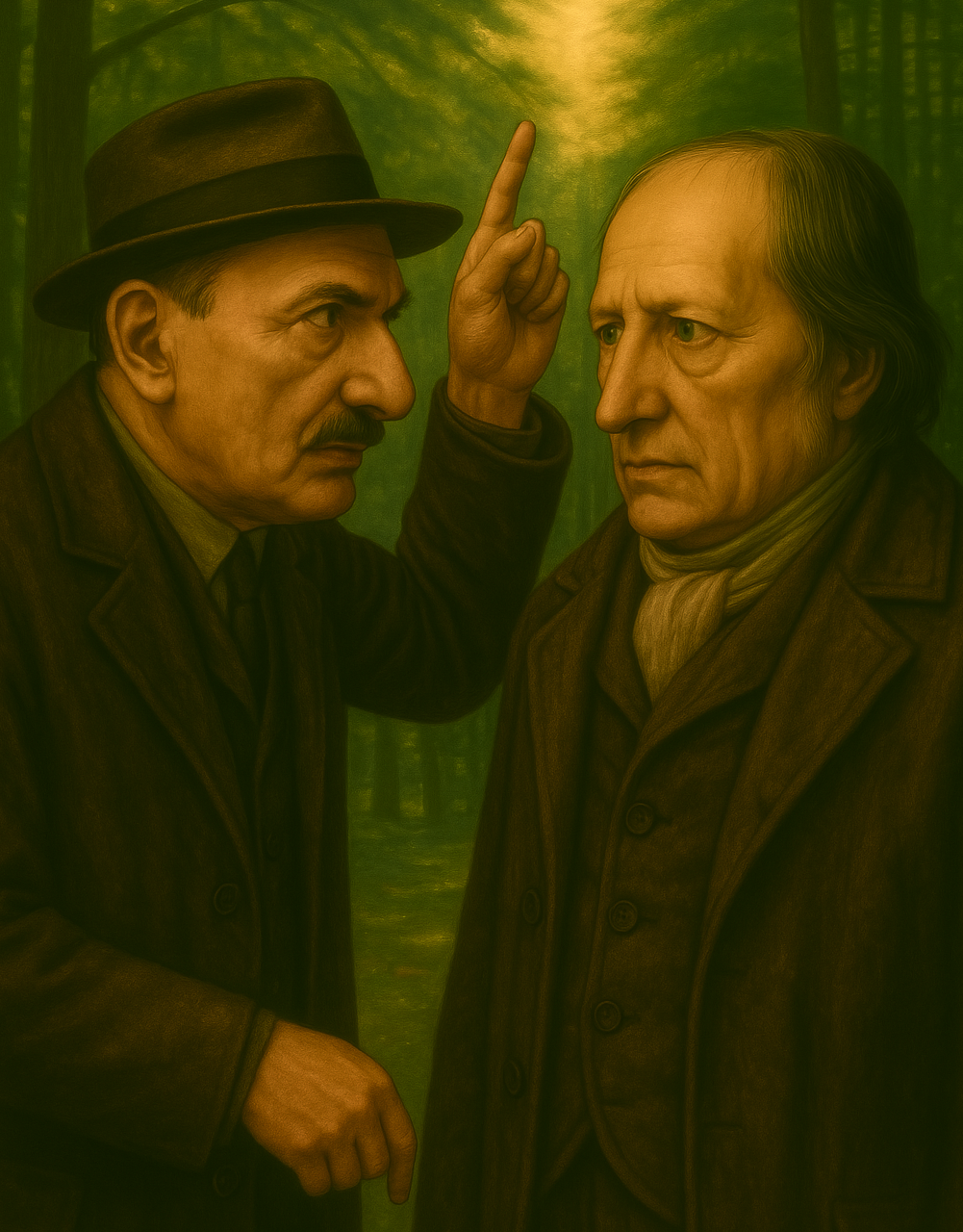
This metaphorical expression refers to a clearing in a forest, which allows light to enter in and illuminate what stands within the clearing. Thomas Sheehan describes Heidegger’s clearing as “the always already opened-up ‘space’ that makes the being of things (phenomenologically: the intelligibility of things) possible and necessary.”[3] The clearing is what “gives” being. Heidegger writes in “The End of Philosophy and the Task of Thinking” (1964):

The forest clearing is experienced in contrast to dense forest, called Dickung in our older language. The substantive “opening” [Lichtung] goes back to the verb “open” [lichten]. The adjective licht “open” is the same word as “light.” To open something means: to make something light, free and open, e.g., to make the forest free of trees at one place. The openness thus originating is the clearing. . . . Light can stream into the clearing, into its openness, and let brightness play with darkness in it. But light never first creates openness. Rather, light presupposes openness. However, the clearing, the opening, is not only free for brightness and darkness, but also for resonance and echo, for sounding and the diminishing of sound. The clearing is the open region for everything that becomes present and absent. . . . What the word [opening] designates in the connection we are now thinking, free openness, is a “primal phenomenon” [Urphänomenon], to use a word of Goethe’s.[4]

Here, “light” refers to being: when we experience things, their being “illuminates” them. I do not recognize the object immediately, but when I approach closer it is as if suddenly the being of the thing “comes forth” to meet me and to illuminate what the thing is: Eureka! It’s an Amazon box. In the moment that I realize that the object is an Amazon box, what has occurred is that the being of the object – what it is, what its meaning is – becomes present to me.

But, as Heidegger says, “light never first creates openness. Rather, light presupposes openness.” In order for the being of the object to become present to me, there must exist for me a certain special sort of openness, within which the being of something makes itself known, or makes itself apparent. In the quote above, Sheehan refers to is as a “space,” placing the word in quotation marks to indicate that he is speaking figuratively (just as “openness” is figurative). In addition to the measurable, physical space I experience myself as inhabiting, it is as if I also inhabit a “space” of being/meaning.

As I traverse the physical space between my bank and the mailbox at the end of the block, the being/meaning of the things my senses register comes forth to meet me. I pass a large, blue object to my left: “That is a truck” (it’s being or meaning is to be a truck). I look down: “That is a crack in the pavement.” Then I almost collide with something: “That is a sign.” My eyes light upon the second printed line on the sign. It says “CUIDADO.” What it means is “caution.” I do not speak aloud any of these registrations of being. They happen wordlessly. But they happen. And that is a necessary condition of functioning in this world at a basic level: I must register the being/meaning of things.

I arrive at another object: “This is a mailbox.” I lift what I hold in my right hand and glance at it. “This is a letter.” Then I put in the mailbox. We traverse a space of meaning all through daily life, and even in our dreams. We live, in other words, within a special openness that “gives” being/meaning. And, if we are true to our experience, this openness is as real to us as the physical space we inhabit. Heidegger writes, “When we go to the well, when we go through the woods, we are always already going through the word ‘well,’ through the word ‘woods,’ even if we do not speak the words and do not think of anything relating to language.”[5] Heidegger refers to language here and to going “through” words because, as he puts it elsewhere “language is the house of being.”[6]

The Intrinsic Hiddenness of the Clearing

But where is this openness, this “space”? Is it within me – is it “subjective” – or is it somehow in the world? We want to leap to the conclusion that this openness is “within me,” that it is “subjective,” because it does not show up as an “object” in the world. But Heidegger wants to entirely avoid a “subjective” treatment of the clearing as some sort of “faculty” or Kantian a priori structure that I bear “within me.” The reason is that this treatment of the clearing is phenomenologically untrue. I do not, in fact, experience the clearing as something “in me” that is “mine.” Still less do I experience it as something over which I have any kind of influence or control.

I experience myself and all else within the clearing, for it is only within the clearing that experience, the presencing of all that presences itself to me, is possible (even the ontological difference – the difference between being and beings – presences itself within the clearing). I do not “have” the clearing; it has me. There is thus no real basis for “subjectivizing” the clearing; for locating it “within the subject.” Indeed, Heidegger critiques the subject/object distinction prevailing in philosophy since Descartes, which locates certain “properties” as “within” a subject, as if this subject is a kind of cabinet in which we dwell, removed from an “external world.”[7]

The upshot of this is that, for Heidegger, it is possible to speak of something deeper or more ultimate than being itself (hence, he calls it an Urphänomenon): that which allows our encounter with the being of beings in the first place; the open clearing. When Heidegger famously refers to “the forgottenness of being” (Vergessenheit des Seins) he is really referring to the forgottenness of the clearing.[8] The clearing is forgotten in the sense that we have forgotten that in virtue of which being is given to us.

You can buy Collin Cleary’s Wagner’s Ring & the Germanic Tradition here.

What must also be noted, however, is that the clearing is easy to forget, for Heidegger holds that it is “intrinsically hidden.” For things to be present to us in their being, the clearing must be absent. As we have seen, the clearing is not a “thing” that we encounter. On my way from the bank to the mailbox, the clearing is most definitely not one of the things I meet. Yet the entire walk takes place within the clearing, for, again, it is only within the clearing that things show up to me as meaningful or as intelligible. On that walk, I am not occupied with the clearing but rather with the things that are illuminated within it. It is only on reflection, and phenomenological description, that I become aware that there is a clearing.

Bear in mind, however, that the clearing is a “space” or an “openness.” The clearing is effectively absent, except when we consider our experience and its conditions. It is precisely the non-appearing of the clearing, its absence or hiddenness, that allows everything within it to be present in its being. Thus, it is easy to be completely oblivious to the fact that there is a clearing. Heidegger holds that the Western metaphysical tradition, beginning with the Pre-Socratics, systematically forgets it.

He writes: “In fact, the history of Western thought begins, not by thinking what is most thought-provoking, but by letting it remain forgotten.”[9] The forgetting of the clearing is the forgetting of the primordial absence that allows being to be present. It leads directly to the position we have described as the metaphysics of presence, which insists that beings be constantly present and available to human knowledge and agency.

As absence, the clearing can be described as nothing. Heidegger, echoing the German mystical tradition, sometimes refers to it as “abyss” (Abgrund). As we mentioned earlier, one of Heidegger’s criticisms of Hegel is that he does not consider “the nothing” seriously enough. This may be surprising news to Hegelians, given the importance of negation or the negative in Hegel’s system. Heidegger contends, however, that whereas the dialectic makes use of negation, the topic of the nothing remains largely unthought in Hegel.

Again, nothing (Nichts) makes an appearance at the beginning of the Logic, when Hegel argues that being, as the most all-encompassing, category, is also the emptiest category and thus equivalent to nothing. From Heidegger’s perspective, this commits the double error of conceiving of being as a category (effectively as a set) that “contains” things, as well as treating nothing purely and simply as the negation of being.

Heidegger’s attempt to think the relation of being and nothing harks back to the very beginning of the Western philosophical tradition, especially to Parmenides. His conclusion, as we have seen, is that being and nothing enjoy a special kind of symbiosis. It is in virtue of the abyss, the nothing that is the clearing, that being is given. Like all metaphysicians, Hegel forgets or overlooks the clearing. This is an enormous problem for a philosophy that purports to be a complete speech of the whole.

The clearing is the condition for the possibility of all manifestation. Hegel attempts to give an account, in fundamental terms, of all that is manifest, and he believes that this can be said; that it can be expressed conceptually, and that nothing is left over or left out when he gives his complete speech. And he is correct, though not in the sense he would like: nothing is most definitely left out of Hegel’s system! Everything he speaks of, however, is only given to him within the nothing.

The Absolute “manifests” to Hegel in the sense that he knows it as an “object” of thought, whether as an actual existent (if Hegelianism is correct) or as a conceptual construct. It is intelligible and meaningful to him, thus it manifests within the clearing. And the same could be said of everything else Hegel deals with in his entire philosophy. Do not make the mistake of thinking, based on the examples given earlier, that it is only the being/meaning of perceptible objects that manifests within the clearing. All that which is meaningful or intelligible to us, even ideas, manifests within the clearing. When Hegel identifies human spirit as the telos of existence, that which makes existence itself meaningful, it “shows up” for him as the telos (regardless of whether he is correct, it still shows up to him in this way) in virtue of that special openness that allows human spirit to manifest itself to Hegel, and to us, in certain meaningful ways.

The Unintelligibility of the Clearing

The problem for Hegel is not just that he “forgets” the clearing; not just that he never arrives at the realization that this openness is a necessary condition for the world to manifest itself in a way that he can conceptualize.[10] The more serious problem is that even if Hegel had been aware of the clearing, he could not have conceptualized it – in other words, he could not have incorporated it into his system of philosophy. This is not due to some particular failing on Hegel’s part, it is because the clearing cannot be conceptualized.

Heidegger’s argument for this is simple and powerful. The clearing is the “space” within which things become manifest as meaningful or intelligible; it is the necessary condition of all meaningfulness and intelligibility. But this leads inexorably to the conclusion that the clearing itself forever remains unintelligible. There is no “second clearing” within which the clearing could appear and within which it would become intelligible and conceptually graspable. If we insisted that there were, we would soon realize that this generates an infinite regress. We would require a “third clearing” within which the second clearing becomes intelligible – and so forth. Each clearing within which a further clearing is supposed to become intelligible would remain unintelligible, thus all would be unintelligible.

This is a further reason why the clearing is intrinsically hidden. As noted earlier, the clearing is a kind of absence. It must absent itself for beings to be illuminated within it. If I’m considering the clearing (phenomenologically), the being/meaning of the object on my doorstep cannot presence itself to me. We can focus on one or the other, and the move from one to the other requires a kind of gestalt switch. But even when I “reflect” on the clearing (to use a deliberately vague word) I do not make it intelligible. The reader may balk at this. Afterall, haven’t I used quite a few words already in the attempt to describe the clearing, to make it intelligible?

But consider what has been said. The clearing is understood through a metaphor: the forest clearing. It has not been subsumed under some kind of concept or category, as in “that is a mailbox.” We explained the concept of the clearing first by explaining the metaphor. Then we resorted to further metaphorical (i.e., indirect) ways of approaching the idea: it is a “space” or an “openness” or an “abyss.” The most direct way it has been described is as “nothing” or as “an absence.” But what do these amount to? To say that the clearing is nothing is to say that it is no thing. This is correct, but it does not say what it is. To remind you, we cannot say what the clearing is, for being/meaning only shows up within the clearing.

We are tempted to say that Heidegger arrives at the clearing through a kind of “bastard reasoning” like that Plato refers to in the Timaeus. Except that Heidegger arrives at the clearing – he “recollects” it – through no sort of reasoning at all. The means for the recollection of the clearing is phenomenological description of our experience of the being/meaning of things. As we have said, being/meaning is only possible through the open “space” in which it is illuminated. Heidegger does not “infer” to the existence of the clearing; this is not an “inference to the best explanation” for our experience of being. Rather, we have an experience of dwelling within this space of meaning, as I have tried to indicate with the examples given earlier. Yet, what is experienced eludes our attempts to directly characterize it.

With apologies to Heidegger (who would probably object to this terminology), the clearing is the “ground” of being as well as the “ground” of our experience of the world as meaningful. This means that the meaningfulness and intelligibility of things is founded on something that is neither meaningful nor intelligible. It is an unfathomable mystery. It can be experienced, but not conceptualized. But this strikes right at the heart of Hegelianism, which claims, as we saw in the last installment, that “the universe . . . contains no power that could withstand the courage of cognition; it must open up before it and lay its riches and its depth before its eyes and offer them for its enjoyment.”[11]

Everything, for Hegel is conceptualizable; everything can be expressed in speech. For Heidegger, there is at least one major exception to this: the open clearing in which concept formation and judgment take place, and are given voice. Heidegger’s position has implications beyond Hegel, however. Essentially, Heidegger has argued that a complete speech of the whole is impossible – if this takes the form of an insistence on expressing the meaning of everything in direct language. This does not make philosophy impossible, merely totalizing philosophical systems. Heidegger’s philosophy is what he calls an “other beginning” (anderer Anfang) in the history of philosophy, occasioned by the “recollection” of the clearing. But if an “other beginning” is possible in philosophy, then Hegel’s claim to have completed philosophy is refuted.

Philosophy can approach the clearing in the manner we have indicated. But there is no getting around the fact that this approach has something decidedly “mystical” about it, as many commentators have noticed and as Heidegger himself recognized (the mystic he has foremost in mind is Meister Eckhart). Many mystical and mythological parallels to the clearing can be drawn, some more plausible than others. The clearing can be likened to chaos and the void, to Brahman, to Eckhart’s Abgrund, to Boehme’s Ungrund, to the zimzum of the Lurianic Kabbalah, and even to the Ginnungagap (yawning gap) of Norse mythology (a parallel about which I may write something someday).

Conclusion: Assessing Hegel

As we mentioned at the beginning of the last installment, Heidegger takes quite seriously Hegel’s claim to have completed philosophy. Ultimately, he affirms that Hegel has completed metaphysics only, where this essentially means that in Hegel’s philosophy the metaphysics of presence finds its most explicit expression.

In addition to this, it is readily apparent that Heidegger regards Hegel as one of the greatest philosophers. Indeed, one gets the impression that Heidegger was intimidated by Hegel – which is not an uncommon reaction. That Heidegger sees Hegel as the ultimate expression of a fundamentally wrongheaded intellectual tradition does not mean that Heidegger did not admire him, and gain insight from his philosophy. The ways in which Heidegger is genuinely indebted to Hegel would require an article unto itself (more likely, a book). I do not think that Heidegger scholars have explored this topic sufficiently.

There are a number of reasons why Hegel is intimidating. To state the most obvious reason, his writings are notoriously difficult. But then there is his claim to have completed philosophy, and to have “sublated” all other philosophical standpoints. This makes arguing against Hegel quite tricky. His followers will usually respond to objections by arguing (often with some plausibility) that the standpoint from which the objection is raised is one that has been overcome or superseded within the dialectic.

One eventually feels summoned to come to terms with Hegel by approaching his philosophy exactly as he wants us to: by beginning with nothing, with no determinate presuppositions; by beginning with the Logic and studying the entire system. To avoid doing so feels like cowardice. Here, after all, is a thinker who poses an enormous challenge to the student of philosophy – but who also promises a tremendous reward: the complete and total understanding of everything.

But as soon as one enters into Hegel’s system one is quickly seduced. As Eric Voegelin wrote of him, “Once you have entered the magic circle the sorcerer has drawn around himself, you are lost.”[12] One is swept along by Hegel’s dialectic. His system mixes profound insights with profoundly obscure prose, and more than a little sleight of hand when it comes to some of the dialectical transitions. One hesitates to raise criticisms, because there is always a strong possibility that, given the difficulty of the texts, one has simply misunderstood. One assumes that someone, somewhere has understood passages that seem completely impenetrable.

However, it is not just a matter of being intimidated into silence by Hegel’s bravura philosophical performance. There is such a beauty and grandeur to this system that one really wants it to be true. The central claim of Hegel’s philosophy, that it is through self-knowing spirit that the universe achieves its ultimate end, is enormously attractive. Given that the highest expression of spirit, according to Hegel, is philosophy, what he has really said is that philosophical thought is the purpose of the universe. For philosophers, this is a highly seductive claim.

Heidegger asks us to consider whether we may be attracted to this claim for all the wrong reasons. Essentially, Heidegger’s objection to Hegel is that he denies mystery. To make this claim stick, he has to prove that there is a mystery to be denied. That mystery, of course, is the clearing, which is intrinsically hidden, absent, an abyss, and nothing. It is only within the clearing that things show up as meaningful to Hegel and anyone else, yet Hegel “forgets” the clearing. And even if he “remembered” it, he could not incorporate it into his system of philosophy. As we have seen, this is a problem not just for Hegel, but for the entire history of Western metaphysics, which denies mystery and insists that what is be constantly present, and fully transparent to us.

It is important to understand that Heidegger’s position is profoundly conservative and anti-modern. Central to modernity is a “humanism” that makes human subjectivity absolute, and transfers to man the characteristics of God. It has become a cliché to say that in the modern period man makes himself into God, but like all clichés it is also true. Heidegger’s philosophy is a thorough-going anti-humanism – and fundamentally, I would argue, conservatism is just the same thing as anti-humanism. It insists that not everything can be made fully transparent to us; that our ability to make things intelligible has its origin in conditions that cannot be made intelligible, and are thus forever mysterious.

Heidegger’s philosophy is an uncompromising answer to modern hubris. Contrary to Hegel (who merely gives voice to the spirit of modernity) we are not radically free and self-determining. We are “thrown” into a world of meaning we did not create, over which we have no control, and which we cannot fully understand. We deny the darkness but we cannot banish it. The whole drift of the Enlightenment toward seeing ourselves as radically free and self-determining has actually made true human self-knowledge impossible. And Hegel’s anthropocentric thesis that subjectivity is the telos of existence winds up disconnecting us from nature, rather than connecting us, as Hegel believed. If I insist on seeing myself in nature, everywhere I look, then I set myself up to miss what is radically other.

Again, there is much of value in Hegel’s philosophy. One thing that is especially attractive is his “organicism”: his contention that everything in the universe is “internally related” to everything else. Thus, the universe is like an organism in which each part is connected to every other, and the whole forms a system. This “organicism” makes a great deal of sense, especially when one realizes that so much mischief in the modern world has resulted from thinking that the beings of our universe are separable pieces that make no difference to each other.

As a result, we moderns believe that we can change or destroy whatever we like without consequence to the whole. This is because, fundamentally, we do not even believe that the universe is a whole; we think it is merely a heap. This is the metaphysics underlying modernity, and here Hegel’s Philosophy of Nature dovetails with Heidegger’s analysis of modernity as das Gestell (the tendency to see all that exists as material to be exploited in the satisfaction of human desires). Das Gestell seems to involve an atomistic metaphysics; one that denies holism.

But the organic analogy is seriously flawed. In truth, the universe is really nothing like an organism. There is, and must be, something outside an organism to which it relates itself in various ways. These relationships define it. For example, organisms survive by feeding on other organisms. They have sensory apparatus geared primarily toward detecting and responding to things that are not them. Organisms also have locomotion, so as to move toward or away from other things. Hegel’s Absolute Organism (if we can call it that) has none of these characteristics, precisely because it is the whole; nothing is outside it. Any attempt to argue that it does have the characteristics of an organism will quickly fall into pure poeticizing.

But to dispense with organicism is not to dispense with relationality or the theory of internal relations. This is, in fact, the only really valuable aspect of the organic analogy. In his later philosophy, especially in his concept of “the fourfold” (das Geviert), Heidegger develops a concept of relationality as fundamental to the being of beings, and to our own “dwelling” (Wohnen) in the world.

This series has been ever so slightly misleading. The real truth is that Heidegger does not seem to be able to make his mind about who completed metaphysics, Hegel or Nietzsche. Sometimes he speaks as if they cooperated in completing it, though a case is to be made that Nietzsche attempts to overturn something Hegel completes, and in the process brings it to its end. In any case, it is to Nietzsche that we will turn next in our tour of Heidegger’s history of metaphysics.

Notes

[1] See, for example, Martin Heidegger, Pathmarks, ed. William McNeill (Cambridge: Cambridge University Press, 1998), 335. Essay translated by Robert Metcalf.

[2] Martin Heidegger, Nietzsche, Vol. 1, ed. and trans. David Farrell Krell (New York: Harper and Row, 1979), 68.

[3] Thomas Sheehan, Making Sense of Heidegger (Lanham: Rowman and Littlefield, 2015), 20.

[4] Martin Heidegger, Basic Writings, ed. David Farrell Krell (New York: Harper and Row, 1977), 384-385. This essay was translated by Joan Stambaugh; italics added.

[5] Martin Heidegger, Poetry, Language, Thought, trans. Albert Hofstadter (New York: Harper and Row, 1971), 132. Though he also says: “It is not that unconcealment is ‘dependent’ upon saying; rather, every saying already needs the realm of unconcealment.” See Heidegger, Pathmarks, 335.

[6] Heidegger, Basic Writings, 217. Being/meaning is inseparable from language, because otherwise it could not be conceptualized or expressed. To be sure, we can say that “La mesa es verde,” “Der Tisch ist grün,” and “The table is green” have the exact same meaning – a meaning irreducible to those sentences (or sentences in any language), but we cannot access that meaning without thinking it or expressing it in some particular language.

[7] See Heidegger, Being and Time, trans. Joan Stambaugh, rev. Dennis J. Schmidt (Albany, NY: State University of New York Press, 2010), 60-61.

[8] Generally speaking, this is correct. Unfortunately, Heidegger is inconsistent with his use of Sein/Seyn, sometimes referring to being, sometimes to the clearing that gives being.

[9] Martin Heidegger, What is Called Thinking?, trans. J. Glenn Gray (New York: Harper Perennial, 1968), 152.

[10] See, for example, Heidegger’s essay “Hegel and the Greeks,” Pathmarks, 332.

[11] Quoted in Martin Heidegger, Hegel, trans. Joseph Arel and Niels Feuerhahn (Bloomington, IN: Indian University Press, 2015), 55-56.

[12] Eric Voegelin, “On Hegel: A Study in Sorcery,” in The Collected Works of Eric Voegelin, Vol. 12, ed. Ellis Sandoz (Baton Rouge: Louisiana State University Press, 1990), 228.

Heidegger, Hegel, & the Completion of Western Metaphysics Part 9

Heidegger%2C%20Hegel%2C%20andamp%3B%20the%20Completion%20of%20Western%20Metaphysics%0APart%209%0A

Share

  • Gab

Enjoyed this article?

Be the first to leave a tip in the jar!

Instant Echeck GreenPay™

Related

  • Heidegger on Nietzsche, Part One

  • Finding Atlantis Part 4

  • Do You Want to Play a Game?

  • An Esoteric Commentary on the Volsung Saga – Part XXII

  • An Esoteric Commentary on the Volsung Saga, Part XXI:

  • Counter-Currents in Rome

  • What Rome Means to Me

  • The Rest Is Silence: Heidegger’s Quietism

Tags

Collin ClearyG. W. F. HegelHegel Heidegger SeriesMartin Heideggermetaphysicsphilosophy

Previous

« The Ghost of Jeffrey Epstein

Next

» Iron & Soil: Journey Through the Battle for Ukraine

3 comments

  1. Observer says:
    July 18, 2025 at 3:53 pm

    Fantastic article. Completely made my morning. I loved the ending as well, especially the retiring of organicism as an idol. A few observations:


    1. Keeping to your stricter separation between being and the clearing… if language is the house of being, then should we also recognize that the clearing is, in some way, prior to language? To lean on the rustic metaphor, one must “clear” parts of the forest to obtain the lumber out of which this “house of being” is to be constructed.


    2. To place our attention to the clearing, as opposed to the things intelligible within it, effectively place ourselves in a state of vorhandenheit, albeit with a vague yet somehow fundamental “object” (scare quotes since the clearing is not strictly a thing) of attention, no?


    3. With some of the examples that you have brought up, I get the impression that the clearing becoming prominent is like the experience one gets with semantic satiation, when a word no longer feels familiar or when one expresses astonishment that that word sounds like this, feels like this when articulated, is spelled a certain way, means this thing, etc.


    4. Great treatment of nothing as I have been bringing up. I greatly appreciate it. I wonder if it’s possible to go even further “nothing” than the nothing that is the clearing, which at least some kind of principle for intelligibility, which is more than nothing. I’ve spoken with some people who are fans of Parmenides who suggest that his path of “is not” is even more radical than das nichts. Philosopher David Albert [noteworthy for his takedown of and subsequent blacklisting by New Atheist physicist Lawrence (((Krauss)))] somewhat touches upon this idea in this short conversation: https://www.youtube.com/watch?v=0D7Pbh-6k7o, albeit perhaps Albert is right in that not only could it not be discussed or grasped, there would be simply “nothing for discussion” as there is no “there” there.


    5. Completely pre-empted my concern about comparing the clearing to the abgrund, to Schelling, to Plato’s khora, etc. Nothing to say here. Well-done!


    Looking forward to Nietzsche in the future! The will-to-will, will as willing business sends my head for a spin. Makes me forget what even is a will.


    0
    0
  2. Douglas Mercer says:
    July 19, 2025 at 2:15 am

    Collin: it seems like what you are saying is that for Heidegger Being presupposes the Clearing, that the latter is even more fundamental than the former, like some kind of interstitial space.   By analogy it reminds me that for the Greeks Moira was fate–the fate that even the Gods must obey, something more primal and more primordial.

    0
    0
  3. Tye says:
    July 20, 2025 at 5:55 am

    “And Hegel’s anthropocentric thesis that subjectivity is the telos of existence winds up disconnecting us from nature, rather than connecting us, as Hegel believed. If I insist on seeing myself in nature, everywhere I look, then I set myself up to miss what is radically other.” Yes. Make way for strangeness and lo! It fills the space.

    0
    0

Comments are closed.

If you have a Subscriber access,
simply login first to see your comment auto-approved.

Note on comments privacy & moderation

Your email is never published nor shared.

Comments are moderated. If you don't see your comment, please be patient. If approved, it will appear here soon. Do not post your comment a second time.

Upcoming podcasts
  • Rob Rundo on Counter-Currents Radio

    Rob Rundo on Counter-Currents Radio

    Counter-Currents Radio

    Sat, Jun 6th — 3 pm EST / 9 pm CET
  • Daniel Tyrie on Counter-Currents Radio

    Daniel Tyrie on Counter-Currents Radio

    Counter-Currents Radio

    Sat, Jun 20th — 3 pm EST / 9 pm CET
    • The Killing of Henry Nowak

      Mark Gullick

      7

    • The Crisis of Chinese Technology Thieves

      Morris van de Camp

      1

    • The Strange World of Gender Bender Fiction:
      & What This Genre Tells Us About Autosexuality

      Dani Vypont

      3

    • Watching the Watchers:
      The Dark Triad Question

      David M. Zsutty

      5

    • The Remigration Movement Solidifies

      F. Roger Devlin

      1

    • Casting Aspersions:
      The Fatal Consequences of Race-Swapped Casting, From Helen of Troy to Henry of Southampton

      Steven Tucker

      12

    • The Murder of Henry Nowack

      Millennial Woes

      21

    • Don’t Forget to Vote in Our Writer & Article of the Month Poll

      Greg Johnson

    • The Robot Hotdog Stand

      Greg Johnson

      30

    • Laughing Our Way to Victory

      Dave Chambers

      4

    • The Zodiac Killer

      Mark Gullick

      11

    • Jared Taylor: What Rome Means to Me

      Jared Taylor

      1

    • An Interview with Endeavour:
      My Way of Life Is an Adventure!

      Ondrej Mann

      6

    • José Pedro Zúquete’s The Identitarians

      Greg Johnson

      3

    • Editor’s Update
      Fundraiser Update & How to Watch the Remigration Summit

      Greg Johnson

      5

    • The Bitter End of Western Metaphysics:
      Heidegger on Nietzsche, Part One

      Collin Cleary

      11

    • Berlin: City of Stones

      Spencer J. Quinn

      6

    • True Folk-Horror Is Horror of Your Own Folk:
      Mark Gatiss vs the Brexit Blind Dead  

      Steven Tucker

      4

    • Counter-Currents Radio Podcast No. 689
      Thomas Massie, the America 2050 Bust, the Need for Whites to Divest from America, the AI Economic Apocalypse, & Pro-White Project Pitches to Billionaires

      Counter-Currents Radio

      7

    • Nationalism This Week
      Remigration is Inevitable, Part 3

      Greg Johnson

      26

    • Why Billionaires Should Fund White Identity Politics

      Lipton Matthews

      8

    • How Cold War Two Came About

      Morris van de Camp

      5

    • Now Available for Pre-Order at a Special Price!
      Greg Johnson’s The Philosopher Is In

      Greg Johnson

    • David Zsutty’s Elevator Pitch to a Billionaire

      David M. Zsutty

      1

    • Headbanging Lite

      Mark Gullick

      5

    • White Advocacy Past and Present

      Peter Bradley

      13

    • The Lunch Wars

      David M. Zsutty

      47

    • The Russians are Coming/The Russians are Coming

      Steven Clark

      1

    • Peak Fatigue in Fort Wayne

      Gabriel Anderson

      24

    • Keith Woods’ Elevator Pitch to a Billionaire

      Keith Woods

    • The Cruelty of Kindness

      Morris van de Camp

      9

    • Predation Wearing the Mask of Civilization

      Jayant Bhandari

      13

    • The Mandalorian & Grogu

      Trevor Lynch

      24

    • Editor’s Update
      Fundraiser Update & a New $20,000 Matching Grant
      Greg Johnson & David Zsutty Discuss Thomas Massie on Counter-Currents Radio

      Greg Johnson

      2

    • How the Jews Defeated Thomas Massie—& Themselves

      David M. Zsutty

      24

    • Jared Taylor’s Elevator Pitch to a Billionaire

      Jared Taylor

      15

    • Nationalism This Week
      Remigration Is Inevitable, Part 2

      Greg Johnson

      8

    • Could Fascism Work?

      Mark Gullick

      40

    • Jonathan Bowden’s Deliverance
      Part 7

      Jonathan Bowden

    • China’s Quiet Hand:
      Influence, Infiltration, & the Western Blind Spot

      Lipton Matthews

      9

    • Counter-Currents Radio Podcast No. 688
      Tyler Dykes on Running for US Congress in South Carolina

      Counter-Currents Radio

      3

    • Lothrop Stoddard’s The Revolt Against Civilization

      Spencer J. Quinn

      14

    • Lewis Strauss Did Nothing Wrong:
      How the politics of the Atom Bomb during the early Cold War Apply to Artificial Intelligence Today

      Morris van de Camp

      14

    • The Ghost of the Confederacy

      Dave Chambers

      12

    • America’s Century of Humiliation has Begun

      Greg Johnson

      27

    • Prepare for Africans & Schizophrenics!
      Welcome to the New Canadian Military

      Gunnar Alfredsson

      7

    • Remembering Julius Evola:
      May 19, 1898–June 11, 1974

      Greg Johnson

    • About Film “From the Right”

      Karel Veliky

    • Nostalgia Ain’t What It Used To Be. . . Now It’s Racist

      Steven Tucker

      8

    • To Depose The King

      Mark Gullick

      7

    • Will Williams

      The Robot Hotdog Stand

      That was a very long comment I put up here yesterday, but thanks to Greg was at least allowed....

    • Chud

      Watching the Watchers:
      The Dark Triad Question

      I've always been skeptical of these personality disorders. It seems to be a repackaging of the...

    • Peter Quint

      The Killing of Henry Nowak

      Great article! I want to read an article about the little English girl whom said that,  “I feel...

    • Peter Quint

      The Crisis of Chinese Technology Thieves

      Great article! We should have let MacArthur invade China; he would have broke them from “sucking...

    • Stronza

      The Killing of Henry Nowak

      Mark, thanks for a really good article.  One little thing, though, where you wrote, "Henry Nowak was...

    • Peter Quint

      Watching the Watchers:
      The Dark Triad Question

      Even saying “From the river to the sea” will get you arrested in Australia. What does that mean,...

    • Peter Quint

      Watching the Watchers:
      The Dark Triad Question

      Great article! I bet that the jews as a race would test highest for “Dark Triad” traits. 🙃

    • Peter Quint

      The Strange World of Gender Bender Fiction:
      & What This Genre Tells Us About Autosexuality

      Great article! I have never wanted to be a woman, and I don’t understand it; I think what you are...

    • Beau Albrecht

      The Robot Hotdog Stand

      Here's some other information that the laissez-faire free market dervishes need to know: How to...

    • Glide Ratio 0:1

      The Robot Hotdog Stand

      Thank you for quoting this. This weekend that just past I was trying to explain this, with great...

    • Eric

      The Killing of Henry Nowak

      Justice for Henry Nowak. Justice for Britons. Justice for Occidentals.

    • CC reader

      Laughing Our Way to Victory

      It has as much political currency as a counterfeit twenty-dollar bill. This is not to say that a...

    • CC reader

      Laughing Our Way to Victory

      There is a round number chance the President cussed out Bibi, and that number is zero.

    • Will Williams

      The Zodiac Killer

      "Fragging" their White officers in Vietnam apparently wasn't enough for that era's hate-filled...

    • CC reader

      Jared Taylor: What Rome Means to Me

      Does anybody know if Jared has contact information available. I can't seem to find an email besides...

    • Connor McDowell

      The Killing of Henry Nowak

      “pokey pokey” trial involving a white victim is finally underway in Texas. Evidently there’s a big...

    • Hamlet's Ghost

      Watching the Watchers:
      The Dark Triad Question

      "We shouldn’t allow the Patrick Batemans of the world to declare Patrick Bateman a discrete and...

    • DarkPlato

      The Zodiac Killer

      Thanks for catching that.  There is a very good book called Rise of the Black Serial Killer...

    • Lugh

      The Murder of Henry Nowack

      Google the Kalergi Plan to blend Whites out of existence by favoring Afr0-Asiatic migrants. Baron...

    • Jeffrey A Freeman

      The Killing of Henry Nowak

      I can’t bear to watch the dreadful videos or listen to the apathetic police lines and while I knew...

    • Earth Day Special

      John Morgan

      12

    • A Robertson Roundup
      Remembering Wilmot Robertson
      (April 16, 1915 – July 8, 2005)

      Margot Metroland

      13

    • The Paranoid Style in White Nationalism

      Greg Johnson

      30

    • Join the Dance!

      Andrew Hamilton

      1

    • We Can’t Save the Earth Without Reducing African Birth Rates

      James Dunphy

      36

    • “I’m Not a Conspiracy Theorist, but . . .”:
      Jeffrey Epstein’s Death Gives New Life to “Conspiracy Theories”

      Greg Johnson

      22

    • Sylvia Plath: Stasis in Darkness

      Vic Olvir

      17

    • Vanguardism, Vantardism, & Mainstreaming

      Greg Johnson

      80

    • Aviation, Geography, & Race

      Charles Lindbergh

      3

    • Some Thoughts on Yule

      Collin Cleary

      4

    • Living in Truth:
      A Yuletide Homily

      Jef Costello

      7

    • John Kennedy Toole’s A Confederacy of Dunces

      Greg Johnson

      20

    • On Aleksandr Solzhenitsyn’s Warning to the West

      Spencer J. Quinn

      7

    • Elitism, British Modernism, & Wyndham Lewis

      Jonathan Bowden

      6

    • Philip K. Dick’s Do Androids Dream of Electric Sheep? as Anti-Semitic/Christian-Gnostic Allegory

      Greg Johnson

      20

    • “Conspiracy Theory” or Conspiracy?

      Andrew Hamilton

      21

    • Remembering H. P. Lovecraft
      (August 20, 1890–March 15, 1937)

      Greg Johnson

      3

    • Who Are We?
      Nordics, Aryans, & Whites

      Greg Johnson

      71

    • Remembering William Gayley Simpson
      (July 23, 1892–December 31, 1990)
      A Pleasant Afternoon with Harriet & Bill Simpson

      Margot Metroland

      18

    • Here are the Young Men
      Remembering Ian Curtis
      (July 15, 1956–May 18, 1980)

      Mark Gullick

      18

    • Percy Grainger
      Artist of the Right

      Alex Graham

      7

    • Remembering Revilo Oliver
      (July 7, 1908–August 20, 1994)

      Greg Johnson

      18

    • The Meaning of July 4th for the White Man

      Gregory Hood

      13

    • The Front National’s Evolution

      Bruno Mégret

    • Merwin K. Hart
      Forgotten American Hero & Man of the Right

      Morris van de Camp

      10

    • George Orwell’s Nineteen Eighty-Four

      Jonathan Bowden

      8

    • Carleton S. Coon
      Scientist & Reluctant White Advocate

      Morris van de Camp

      3

    • The Kwanzaa Absurdity Will Be Dwarfed by Juneteenth

      Robert Hampton

      10

    • Stravinsky

      Alex Graham

      7

    • Like the Roman:
      Remembering Enoch Powell (1912-1998)

      Mark Gullick

      23

    • Crosstown Traffic:
      Jimi Hendrix & The Post-War Rock ‘N’ Roll Revolution

      Mark Gullick

    • Slaves from the North:
      Finns & Karelians in the East European Slave Trade, 900–1600

      Lipton Matthews

      14

    • Neo-Fascism in Film
      Part 4

      Karel Veliky

      2

    • David Lean’s A Passage to India

      Spencer J. Quinn

      1

    • Elites are Essential to Development

      Lipton Matthews

      7

    • Jonathan Bowden’s Deliverance
      Part 4

      Jonathan Bowden

    • Neo-Fascism in Film
      Part 3

      Karel Veliky

      6

    • E. M. Forster’s A Passage to India & the Indian Mentality

      Spencer J. Quinn

      25

    • Jonathan Bowden’s Deliverance
      Part 3

      Jonathan Bowden

    • The Rest Is Silence
      Heidegger’s Quietism

      Mark Gullick

      2

    • Dispelling the Historical Fallacy of Indian Nationalism

      Lipton Matthews

      8

    • Neo-Fascism in Film
      Part 2

      Karel Veliky

      8

    • Jonathan Bowden’s Deliverance
      Part 2

      Jonathan Bowden

    • Life of a Klansman

      Mark Gullick

      8

    • Jonathan Bowden’s Deliverance, Part 1

      Jonathan Bowden

    • Decolonial Ideas are Holding Back Developing Countries

      Lipton Matthews

      8

    • Neo-fascism in Film, Part 1

      Karel Veliky

      21

    • Jonathan Bowden’s Onslaught, Part 8
      Divigations on Decadence

      Jonathan Bowden

    • Jonathan Bowden’s Onslaught, Part 7
      Intrigues in the National Front

      Jonathan Bowden

      1

    • Rotten to the Core

      Mark Gullick

      8

    • Strauss on Husserl’s “Philosophy as Rigorous Science”

      Greg Johnson

    • Jonathan Bowden’s Onslaught, Part 6
      Francis Bacon & Right-Wing Nihilism

      Jonathan Bowden

    • London After (& Before) Midnight:
      Aleister Crowley, The Landlord’s Worst Nightmare

      James J. O'Meara

      2

    • Jonathan Bowden’s Onslaught, Part 5
      The Post-War British Far Right

      Jonathan Bowden

    • No Rules: Rollerball

      Mark Gullick

      4

    • Jonathan Bowden’s Onslaught, Part 3
      Brett Easton Ellis’ American Psycho

      Jonathan Bowden

    • An Alternate History of the Harris Presidency

      Beau Albrecht

      5

    • The Origins of Mass Education:
      Augustina S. Paglayan’s Raised to Obey

      Francis Rockwell

      4

    • Jonathan Bowden’s Onslaught, Part 2
      Louis-Ferdinand Céline

      Jonathan Bowden

      1

    • The Four Philosophers of the Apocalypse

      Mark Gullick

      4

    • András László
    • Derek Hawthorne
    • Beau Albrecht
    • Alain de Benoist
    • Kerry Bolton
    • Jonathan Bowden
    • Collin Cleary
    • Jef Costello
    • Savitri Devi
    • Julius Evola
    • Jim Goad
    • Gregory Hood
    • Juleigh Howard-Hobson
    • Greg Johnson
    • Charles Krafft
    • Anthony M. Ludovici
    • Trevor Lynch
    • H. L. Mencken
    • J. A. Nicholl
    • James J. O’Meara
    • Christopher Pankhurst
    • Tito Perdue
    • Michael Polignano
    • Spencer J. Quinn
    • Fenek Solère
    • Irmin Vinson
    • Leo Yankevich
    • Francis Parker Yockey
    • Multiple authors
  • Editor-in-Chief

    • Greg Johnson, Ph.D.

    Featured Writers

    • Beau Albrecht
    • Gunnar Alfredsson
    • Collin Cleary, Ph.D.
    • Jef Costello
    • Morris V. de Camp
    • F. Roger Devlin, Ph.D.
    • Stephen Paul Foster, Ph.D.
    • Jim Goad
    • Alex Graham
    • Mark Gullick, Ph.D.
    • Greg Johnson, Ph.D.
    • Travis LeBlanc
    • Trevor Lynch
    • Margot Metroland
    • James J. O’Meara
    • Angelo Plume
    • Spencer J. Quinn
    • Fred Reed
    • Clarissa Schnabel
    • Michael Walker
    • David M. Zsutty

    Frequent Writers

    • Asier Abadroa
    • Aquilonius
    • Alain de Benoist
    • Kerry Bolton, Ph.D.
    • Dave Chambers
    • Steven Clark
    • James Dunphy
    • Endeavour
    • Richard Houck
    • Jason Kessler
    • Titus Livius
    • Ondrej Mann
    • Lipton Matthews
    • Mark Mazari
    • John Morgan
    • Jaroslav Ostrogniew
    • Kathryn S.
    • Christian Secor
    • Anne Wilson Smith
    • Thomas Steuben
    • William De Vere
    • Kenneth Vinther
    • Max West

    Classic Authors

    • Maurice Bardèche
    • Jonathan Bowden
    • Julius Evola
    • Guillaume Faye
    • Ernst Jünger
    • Kevin MacDonald, Ph.D.
    • D. H. Lawrence
    • Charles Lindbergh
    • Jack London
    • H. P. Lovecraft
    • Anthony M. Ludovici
    • Sir Oswald Mosley
    • National Vanguard
    • Friedrich Nietzsche
    • Revilo Oliver
    • William Pierce
    • Ezra Pound
    • Saint-Loup
    • Savitri Devi
    • Carl Schmitt
    • Miguel Serrano
    • Oswald Spengler
    • P. R. Stephensen
    • Jean Thiriart
    • John Tyndall
    • Dominique Venner
    • Leo Yankevich
    • Francis Parker Yockey

    Other Authors

    • Howe Abbott-Hiss
    • Michael Bell
    • Giles Corey
    • Jack Donovan
    • Richardo Duchesne, Ph.D.
    • Emile Durand
    • Guillaume Durocher
    • Mark Dyal
    • Tom Goodroch
    • Andrew Hamilton
    • Robert Hampton
    • Huntley Haverstock
    • Derek Hawthorne
    • Gregory Hood
    • Juleigh Howard-Hobson
    • Alexander Jacob
    • Ruuben Kaalep
    • Tobias Langdon
    • Julian Langness
    • Patrick Le Brun
    • G A Malvicini
    • John Michael McCloughlin
    • Millennial Woes
    • Michael O’Meara
    • Christopher Pankhurst
    • Michael Polignano
    • J. J. Przybylski
    • Quintilian
    • Edouard Rix
    • C. B. Robertson
    • C. F. Robinson
    • Herve Ryssen
    • Alan Smithee
    • Fenek Solere
    • Ann Sterzinger
    • Robert Steuckers
    • Tomislav Sunic
    • Donald Thoresen
    • Marian Van Court
    • Irmin Vinson
    • Book Reviews
    • Movie Reviews
    • TV Reviews
    • Music Reviews
    • Art Criticism
    • Graphic Novels & Comics
    • Video Game Reviews
    • Fiction
    • Poems
    • Interviews
    • Videos
    • English Translations
    • Other Languages
      • Arabic
      • Bulgarian
      • Croatian
      • Czech
      • Danish
      • Dutch
      • Estonian
      • Finnish
      • French
      • German
      • Greek
      • Hungarian
      • Italian
      • Lithuanian
      • Norwegian
      • Polish
      • Portuguese
      • Romanian
      • Russian
      • Slovak
      • Spanish
      • Swedish
      • Ukrainian
    • Commemorations
    • Why We Write
  • Archives
  • Top 100 Commenters
  • The Looney Bin
Sponsored Links
Europa.com Above Time Coffee Antelope Hill Publishing Paul Waggener IHR-Store Spencer J. Quinn American Renaissance Jim Goad The Occidental Observer
Donate Now Mailing list
Books for sale
  • The Philosopher Is In
  • Sexual Utopia in Power (Expanded Edition)
  • In Defense of Prejudice
  • Loving Our Own
  • Tyranny & Wisdom
  • The Populist Moment
  • Is America Doomed?
  • To all books
Copyright © 2026 Counter-Currents Publishing, Ltd.

Paywall Access


Please enter your email address.

Lost your password?

Edit your comment

Writer & Article of the Month May 2026

Select a writer and one of their articles.

1 vote
2 votes
2 votes
2 votes
1 vote
2 votes
1 vote
1 vote
1 vote
2 votes
1 vote
1 vote