Counter-Currents
  • Advertise
  • Private Events
  • T&C
  • About
  • Contact
  • RSS
    • Main feed
    • Podcast feed
    • Videos feed
    • Comments feed
  • Welcome
  • Webzine
  • Books
  • Merch
  • Podcasts
  • Videos
  • Donate
  • Patrons
  • Subscribe
  • Crypto

LEVEL2

Donate Now Mailing list
Upcoming podcasts
  • Rob Rundo on Counter-Currents Radio

    Rob Rundo on Counter-Currents Radio

    Counter-Currents Radio

    06/06/2026 — 3 pm EST / 9 pm CET
  • Daniel Tyrie on Counter-Currents Radio

    Daniel Tyrie on Counter-Currents Radio

    Counter-Currents Radio

    06/20/2026 — 3 pm EST / 9 pm CET
  • Welcome
  • Webzine
  • Books
  • Merch
  • Podcasts
  • Videos
  • Donate
  • Patrons
  • Subscribe
  • Crypto
    • The Killing of Henry Nowak

      Mark Gullick

      15

    • The Crisis of Chinese Technology Thieves

      Morris van de Camp

      1

    • The Strange World of Gender Bender Fiction:
      & What This Genre Tells Us About Autosexuality

      Dani Vypont

      3

    • Watching the Watchers:
      The Dark Triad Question

      David M. Zsutty

      8

    • The Remigration Movement Solidifies

      F. Roger Devlin

      1

    • Casting Aspersions:
      The Fatal Consequences of Race-Swapped Casting, From Helen of Troy to Henry of Southampton

      Steven Tucker

      13

    • The Murder of Henry Nowak

      Millennial Woes

      21

    • Don’t Forget to Vote in Our Writer & Article of the Month Poll

      Greg Johnson

    • The Robot Hotdog Stand

      Greg Johnson

      31

    • Laughing Our Way to Victory

      Dave Chambers

      4

    • The Zodiac Killer

      Mark Gullick

      11

    • Jared Taylor: What Rome Means to Me

      Jared Taylor

      1

    • An Interview with Endeavour:
      My Way of Life Is an Adventure!

      Ondrej Mann

      6

    • José Pedro Zúquete’s The Identitarians

      Greg Johnson

      3

    • Editor’s Update
      Fundraiser Update & How to Watch the Remigration Summit

      Greg Johnson

      5

    • The Bitter End of Western Metaphysics:
      Heidegger on Nietzsche, Part One

      Collin Cleary

      11

    • Berlin: City of Stones

      Spencer J. Quinn

      6

    • True Folk-Horror Is Horror of Your Own Folk:
      Mark Gatiss vs the Brexit Blind Dead  

      Steven Tucker

      4

    • Counter-Currents Radio Podcast No. 689
      Thomas Massie, the America 2050 Bust, the Need for Whites to Divest from America, the AI Economic Apocalypse, & Pro-White Project Pitches to Billionaires

      Counter-Currents Radio

      7

    • Nationalism This Week
      Remigration is Inevitable, Part 3

      Greg Johnson

      26

    • Why Billionaires Should Fund White Identity Politics

      Lipton Matthews

      8

    • How Cold War Two Came About

      Morris van de Camp

      5

    • Now Available for Pre-Order at a Special Price!
      Greg Johnson’s The Philosopher Is In

      Greg Johnson

    • David Zsutty’s Elevator Pitch to a Billionaire

      David M. Zsutty

      1

    • Headbanging Lite

      Mark Gullick

      5

    • White Advocacy Past and Present

      Peter Bradley

      13

    • The Lunch Wars

      David M. Zsutty

      47

    • The Russians are Coming/The Russians are Coming

      Steven Clark

      1

    • Peak Fatigue in Fort Wayne

      Gabriel Anderson

      24

    • Keith Woods’ Elevator Pitch to a Billionaire

      Keith Woods

    • The Cruelty of Kindness

      Morris van de Camp

      9

    • Predation Wearing the Mask of Civilization

      Jayant Bhandari

      13

    • The Mandalorian & Grogu

      Trevor Lynch

      24

    • Editor’s Update
      Fundraiser Update & a New $20,000 Matching Grant
      Greg Johnson & David Zsutty Discuss Thomas Massie on Counter-Currents Radio

      Greg Johnson

      2

    • How the Jews Defeated Thomas Massie—& Themselves

      David M. Zsutty

      24

    • Jared Taylor’s Elevator Pitch to a Billionaire

      Jared Taylor

      15

    • Nationalism This Week
      Remigration Is Inevitable, Part 2

      Greg Johnson

      8

    • Could Fascism Work?

      Mark Gullick

      40

    • Jonathan Bowden’s Deliverance
      Part 7

      Jonathan Bowden

    • China’s Quiet Hand:
      Influence, Infiltration, & the Western Blind Spot

      Lipton Matthews

      9

    • Counter-Currents Radio Podcast No. 688
      Tyler Dykes on Running for US Congress in South Carolina

      Counter-Currents Radio

      3

    • Lothrop Stoddard’s The Revolt Against Civilization

      Spencer J. Quinn

      14

    • Lewis Strauss Did Nothing Wrong:
      How the politics of the Atom Bomb during the early Cold War Apply to Artificial Intelligence Today

      Morris van de Camp

      14

    • The Ghost of the Confederacy

      Dave Chambers

      12

    • America’s Century of Humiliation has Begun

      Greg Johnson

      27

    • Prepare for Africans & Schizophrenics!
      Welcome to the New Canadian Military

      Gunnar Alfredsson

      7

    • Remembering Julius Evola:
      May 19, 1898–June 11, 1974

      Greg Johnson

    • About Film “From the Right”

      Karel Veliky

    • Nostalgia Ain’t What It Used To Be. . . Now It’s Racist

      Steven Tucker

      8

    • To Depose The King

      Mark Gullick

      7

    • Greg Johnson

      Watching the Watchers

      Are cool headed people who are incapable of loyalty really useful in a war?

    • Julius Strange

      Watching the Watchers

      I agree. Richard Lynn talks about this in his books Eugenics: A reassessment in which he states that...

    • Francis XB

      The Killing of Henry Nowak

      Matt Walsh did a recent video showcasing the Nowak case. Walsh makes it clear the killing is part of...

    • Stronza

      The Killing of Henry Nowak

      I can't disagree with you.  He is an irritant and it's hard to pin him down.  But he has millions of...

    • Corday

      The Killing of Henry Nowak

      Tucker will do a great political video then follow it up interviewing somebody who unironically...

    • Glide Ratio 0:1

      Casting Aspersions

      I wouldn't count on it flopping. Just look at the movie 'Troy'. An utter desecration of the original...

    • Vagrant Rightist

      The Killing of Henry Nowak

      I have to agree, it's frustrating. And demons, and probably UFOs. It's this 'essential' slop,...

    • Will Williams

      Watching the Watchers

      Mr. Zsutty: …How many unsung Henry Nowaks have died because we have failed to watch the watchers?---...

    • YT

      The Killing of Henry Nowak

      Yeah, WN thinkers at places like CC need to start talking about future punishments for the race...

    • Malaparte

      The Killing of Henry Nowak

      My gripe with Tucker is that he swings between quasi-White nationalist takes and low-grade Bible-...

    • Glide Ratio 0:1

      The Killing of Henry Nowak

      Yes, because without jews Europeans would be blood drinking, blood smearing barbarians. Thank god...

    • Chud

      The Robot Hotdog Stand

      The Austrian economists have contended with this question and many begrudgingly admit that if you...

    • Deetron

      The Killing of Henry Nowak

      It would be easy to find 12 whites who would be eager to let Karmelo go. I could write the...

    • Stronza

      The Killing of Henry Nowak

      Tucker Carlson has a show about this, published yesterday on you tube.   His guest is Frank Wright,...

    • Will Williams

      The Robot Hotdog Stand

      That was a very long comment I put up here yesterday, but thanks to Greg was at least allowed....

    • John

      Prepare for Africans & Schizophrenics!

      Reference “white Canadians”: this is redundant as Canadians belong to the European Race, aka White...

    • Flel

      The Strange World of Gender Bender Fiction

      Nice piece. I’m glad to see change of pace articles here now and then. I’m reminded of a chat I had...

    • Vagrant Rightist

      The Killing of Henry Nowak

      Good piece. 'Institutional racism' should never have been a thing in that report. It was nothing...

    • Glide Ratio 0:1

      The Robot Hotdog Stand

      Excellent. I've got something to read on my late shift today, looking forward to it. Thank you...

    • Chud

      Watching the Watchers

      I've always been skeptical of these personality disorders. It seems to be a repackaging of the...

    • Earth Day Special

      John Morgan

      12

    • A Robertson Roundup
      Remembering Wilmot Robertson
      (April 16, 1915 – July 8, 2005)

      Margot Metroland

      13

    • The Paranoid Style in White Nationalism

      Greg Johnson

      30

    • Join the Dance!

      Andrew Hamilton

      1

    • We Can’t Save the Earth Without Reducing African Birth Rates

      James Dunphy

      36

    • “I’m Not a Conspiracy Theorist, but . . .”:
      Jeffrey Epstein’s Death Gives New Life to “Conspiracy Theories”

      Greg Johnson

      22

    • Sylvia Plath: Stasis in Darkness

      Vic Olvir

      17

    • Vanguardism, Vantardism, & Mainstreaming

      Greg Johnson

      80

    • Aviation, Geography, & Race

      Charles Lindbergh

      3

    • Some Thoughts on Yule

      Collin Cleary

      4

    • Living in Truth:
      A Yuletide Homily

      Jef Costello

      7

    • John Kennedy Toole’s A Confederacy of Dunces

      Greg Johnson

      20

    • On Aleksandr Solzhenitsyn’s Warning to the West

      Spencer J. Quinn

      7

    • Elitism, British Modernism, & Wyndham Lewis

      Jonathan Bowden

      6

    • Philip K. Dick’s Do Androids Dream of Electric Sheep? as Anti-Semitic/Christian-Gnostic Allegory

      Greg Johnson

      20

    • “Conspiracy Theory” or Conspiracy?

      Andrew Hamilton

      21

    • Remembering H. P. Lovecraft
      (August 20, 1890–March 15, 1937)

      Greg Johnson

      3

    • Who Are We?
      Nordics, Aryans, & Whites

      Greg Johnson

      71

    • Remembering William Gayley Simpson
      (July 23, 1892–December 31, 1990)
      A Pleasant Afternoon with Harriet & Bill Simpson

      Margot Metroland

      18

    • Here are the Young Men
      Remembering Ian Curtis
      (July 15, 1956–May 18, 1980)

      Mark Gullick

      18

    • Percy Grainger
      Artist of the Right

      Alex Graham

      7

    • Remembering Revilo Oliver
      (July 7, 1908–August 20, 1994)

      Greg Johnson

      18

    • The Meaning of July 4th for the White Man

      Gregory Hood

      13

    • The Front National’s Evolution

      Bruno Mégret

    • Merwin K. Hart
      Forgotten American Hero & Man of the Right

      Morris van de Camp

      10

    • George Orwell’s Nineteen Eighty-Four

      Jonathan Bowden

      8

    • Carleton S. Coon
      Scientist & Reluctant White Advocate

      Morris van de Camp

      3

    • The Kwanzaa Absurdity Will Be Dwarfed by Juneteenth

      Robert Hampton

      10

    • Stravinsky

      Alex Graham

      7

    • Like the Roman:
      Remembering Enoch Powell (1912-1998)

      Mark Gullick

      23

    • Jonathan Bowden’s Deliverance
      Part 5

      Jonathan Bowden

    • Crosstown Traffic:
      Jimi Hendrix & The Post-War Rock ‘N’ Roll Revolution

      Mark Gullick

    • Slaves from the North:
      Finns & Karelians in the East European Slave Trade, 900–1600

      Lipton Matthews

      14

    • Neo-Fascism in Film
      Part 4

      Karel Veliky

      2

    • David Lean’s A Passage to India

      Spencer J. Quinn

      1

    • Elites are Essential to Development

      Lipton Matthews

      7

    • Jonathan Bowden’s Deliverance
      Part 4

      Jonathan Bowden

    • Neo-Fascism in Film
      Part 3

      Karel Veliky

      6

    • E. M. Forster’s A Passage to India & the Indian Mentality

      Spencer J. Quinn

      25

    • Jonathan Bowden’s Deliverance
      Part 3

      Jonathan Bowden

    • The Rest Is Silence
      Heidegger’s Quietism

      Mark Gullick

      2

    • Dispelling the Historical Fallacy of Indian Nationalism

      Lipton Matthews

      8

    • Neo-Fascism in Film
      Part 2

      Karel Veliky

      8

    • Jonathan Bowden’s Deliverance
      Part 2

      Jonathan Bowden

    • Life of a Klansman

      Mark Gullick

      8

    • Jonathan Bowden’s Deliverance, Part 1

      Jonathan Bowden

    • Decolonial Ideas are Holding Back Developing Countries

      Lipton Matthews

      8

    • Neo-fascism in Film, Part 1

      Karel Veliky

      21

    • Jonathan Bowden’s Onslaught, Part 8
      Divigations on Decadence

      Jonathan Bowden

    • Jonathan Bowden’s Onslaught, Part 7
      Intrigues in the National Front

      Jonathan Bowden

      1

    • Rotten to the Core

      Mark Gullick

      8

    • Strauss on Husserl’s “Philosophy as Rigorous Science”

      Greg Johnson

    • Jonathan Bowden’s Onslaught, Part 6
      Francis Bacon & Right-Wing Nihilism

      Jonathan Bowden

    • London After (& Before) Midnight:
      Aleister Crowley, The Landlord’s Worst Nightmare

      James J. O'Meara

      2

    • Jonathan Bowden’s Onslaught, Part 5
      The Post-War British Far Right

      Jonathan Bowden

    • No Rules: Rollerball

      Mark Gullick

      4

    • Jonathan Bowden’s Onslaught, Part 3
      Brett Easton Ellis’ American Psycho

      Jonathan Bowden

    • An Alternate History of the Harris Presidency

      Beau Albrecht

      5

    • The Origins of Mass Education:
      Augustina S. Paglayan’s Raised to Obey

      Francis Rockwell

      4

    • Jonathan Bowden’s Onslaught, Part 2
      Louis-Ferdinand Céline

      Jonathan Bowden

      1

    • András László
    • Derek Hawthorne
    • Beau Albrecht
    • Alain de Benoist
    • Kerry Bolton
    • Jonathan Bowden
    • Collin Cleary
    • Jef Costello
    • Savitri Devi
    • Julius Evola
    • Jim Goad
    • Gregory Hood
    • Juleigh Howard-Hobson
    • Greg Johnson
    • Charles Krafft
    • Anthony M. Ludovici
    • Trevor Lynch
    • H. L. Mencken
    • J. A. Nicholl
    • James J. O’Meara
    • Christopher Pankhurst
    • Tito Perdue
    • Michael Polignano
    • Spencer J. Quinn
    • Fenek Solère
    • Irmin Vinson
    • Leo Yankevich
    • Francis Parker Yockey
    • Multiple authors
  • Editor-in-Chief

    • Greg Johnson, Ph.D.

    Featured Writers

    • Beau Albrecht
    • Gunnar Alfredsson
    • Collin Cleary, Ph.D.
    • Jef Costello
    • Morris V. de Camp
    • F. Roger Devlin, Ph.D.
    • Stephen Paul Foster, Ph.D.
    • Jim Goad
    • Alex Graham
    • Mark Gullick, Ph.D.
    • Greg Johnson, Ph.D.
    • Travis LeBlanc
    • Trevor Lynch
    • Margot Metroland
    • James J. O’Meara
    • Angelo Plume
    • Spencer J. Quinn
    • Fred Reed
    • Clarissa Schnabel
    • Michael Walker
    • David M. Zsutty

    Frequent Writers

    • Asier Abadroa
    • Aquilonius
    • Alain de Benoist
    • Kerry Bolton, Ph.D.
    • Dave Chambers
    • Steven Clark
    • James Dunphy
    • Endeavour
    • Richard Houck
    • Jason Kessler
    • Titus Livius
    • Ondrej Mann
    • Lipton Matthews
    • Mark Mazari
    • John Morgan
    • Jaroslav Ostrogniew
    • Kathryn S.
    • Christian Secor
    • Anne Wilson Smith
    • Thomas Steuben
    • William De Vere
    • Kenneth Vinther
    • Max West

    Classic Authors

    • Maurice Bardèche
    • Jonathan Bowden
    • Julius Evola
    • Guillaume Faye
    • Ernst Jünger
    • Kevin MacDonald, Ph.D.
    • D. H. Lawrence
    • Charles Lindbergh
    • Jack London
    • H. P. Lovecraft
    • Anthony M. Ludovici
    • Sir Oswald Mosley
    • National Vanguard
    • Friedrich Nietzsche
    • Revilo Oliver
    • William Pierce
    • Ezra Pound
    • Saint-Loup
    • Savitri Devi
    • Carl Schmitt
    • Miguel Serrano
    • Oswald Spengler
    • P. R. Stephensen
    • Jean Thiriart
    • John Tyndall
    • Dominique Venner
    • Leo Yankevich
    • Francis Parker Yockey

    Other Authors

    • Howe Abbott-Hiss
    • Michael Bell
    • Giles Corey
    • Jack Donovan
    • Richardo Duchesne, Ph.D.
    • Emile Durand
    • Guillaume Durocher
    • Mark Dyal
    • Tom Goodroch
    • Andrew Hamilton
    • Robert Hampton
    • Huntley Haverstock
    • Derek Hawthorne
    • Gregory Hood
    • Juleigh Howard-Hobson
    • Alexander Jacob
    • Ruuben Kaalep
    • Tobias Langdon
    • Julian Langness
    • Patrick Le Brun
    • G A Malvicini
    • John Michael McCloughlin
    • Millennial Woes
    • Michael O’Meara
    • Christopher Pankhurst
    • Michael Polignano
    • J. J. Przybylski
    • Quintilian
    • Edouard Rix
    • C. B. Robertson
    • C. F. Robinson
    • Herve Ryssen
    • Alan Smithee
    • Fenek Solere
    • Ann Sterzinger
    • Robert Steuckers
    • Tomislav Sunic
    • Donald Thoresen
    • Marian Van Court
    • Irmin Vinson
    • Book Reviews
    • Movie Reviews
    • TV Reviews
    • Music Reviews
    • Art Criticism
    • Graphic Novels & Comics
    • Video Game Reviews
    • Fiction
    • Poems
    • Interviews
    • Videos
    • English Translations
    • Other Languages
      • Arabic
      • Bulgarian
      • Croatian
      • Czech
      • Danish
      • Dutch
      • Estonian
      • Finnish
      • French
      • German
      • Greek
      • Hungarian
      • Italian
      • Lithuanian
      • Norwegian
      • Polish
      • Portuguese
      • Romanian
      • Russian
      • Slovak
      • Spanish
      • Swedish
      • Ukrainian
    • Commemorations
    • Why We Write
  • Archives
  • Top 100 Commenters
  • The Looney Bin
  • Advertise
  • Private Events
  • T&C
  • About
  • Contact
  • RSS
    • Main feed
    • Podcast feed
    • Videos feed
    • Comments feed
Sponsored Links
Europa.com Above Time Coffee Antelope Hill Publishing Paul Waggener IHR-Store Spencer J. Quinn American Renaissance Jim Goad The Occidental Observer
Print February 16, 2026

The Philosopher Is In
Idle Thoughts:
Aristotle on the Contemplative Life, Part 1

Greg Johnson

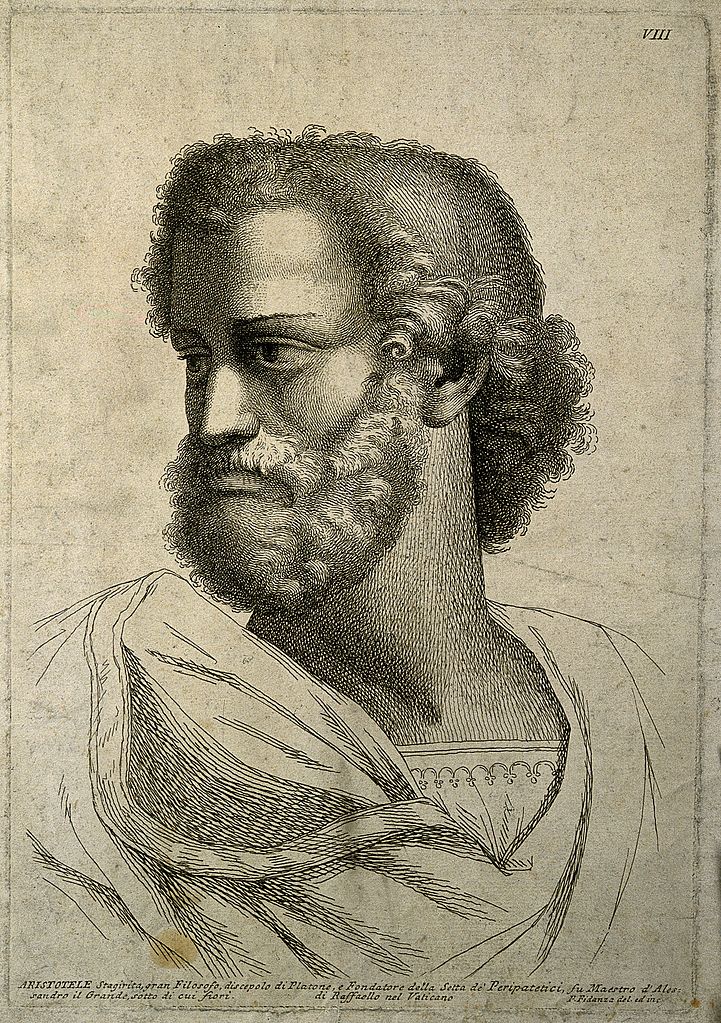
Aristotle, line engraving by P. Fidanza after Raphael Sanzio

3,077 words

Part 1 of 2

Plato and Aristotle are the twin peaks of Ancient Greek philosophy. Aristotle was Plato’s student. But in one way, Aristotle seems to backslide from Plato. Plato was interested in theoretical topics like mathematics and the philosophy of nature. But following Socrates, his conception of wisdom was primarily moral and practical. Aristotle, however, defends the superiority of the purely contemplative life over the practical life. This seems to be a return to pre-Socratic, theory-centered philosophy.

The earliest Greek philosophers were primarily interested in nature and were unconcerned with practical matters. This is nicely encapsulated by the story about Thales, the very first Greek philosopher, who was so fascinated with the heavens that he did not notice a well at his feet and thus fell into it.

When Socrates was young, he was fascinated with natural philosophy. But in middle age, he realized that his fascination with theories about nature had blinded him to the human realm: psychology, ethics, politics, the pursuit of happiness.[1] Thus, Socrates turned from theory to practice, from the cosmos to the polis, from science to the human things.

As Cicero put it, “Socrates . . . was the first to call philosophy down from the heavens and set her in the cities of men and bring her also into their homes and compel her to ask questions about life, morality, and things good and evil.”[2]

Socrates did not see wisdom as knowledge of the whole or knowledge of the ultimate causes of things. He denied knowing the things above the heavens and below the earth. He denied knowing the great and the small. These were the things that natural philosophers studied.

But Socrates did not deny knowledge of the middle-sized realm of humanity. He did not deny knowledge of human nature. In fact, knowledge of human nature became the basis for his essentially moral account of wisdom: the ability to make right use of all things to pursue human well-being.

Despite Socrates’ moral conception of wisdom and his skepticism about some forms of knowledge, he was still interested in metaphysical questions, including the nature of the soul, its ability to survive death, its postmortem prospects, and the ordering of the cosmos toward the good.

In fact, Socrates fused moral wisdom with metaphysical speculation. If it is imperative to care for the soul, then Socrates believed that entitled him to speculate about things above the heavens, below the earth, and after death if such speculations would help us better care for our souls in this life.[3]

Plato, in his “post-Socratic” dialogues, returned to and appropriated pre-Socratic ideas to create a speculative philosophy of nature.[4] Plato also took an active interest in the science of his day. But he remained wholly Socratic in his moral idea of wisdom and his skeptical sense of the limits of theoretical knowledge.

Aristotle was not just a philosopher. He was also a scientist. Fully a third of his surviving works deal with what we would today classify not as philosophy but as science, mostly biology. These studies were purely theoretical, pursued simply for the sake of knowledge. Thus it would be natural for Aristotle to defend the theoretical life.

But is defending the goodness of the theoretical life the same thing as defining wisdom as essentially theoretical? There’s no contradiction between having a Socratic moral idea of wisdom and defending the goodness of the theoretical life—the life of the scholar, scientist, or philosopher—unless one defines wisdom as simply theoretical knowledge.

Aristotle’s Protrepticus

You can order Greg Johnson’s Loving Our Own here

In Antiquity, Aristotle’s most famous work was his dialogue Protrepticus. A protreptic is an “exhortation,” a call to do something. Philosophical protreptics explain the nature of philosophy and why one should study it. Like all of Aristotle’s published writings, the Protrepticus was lost in the collapse of the Ancient world.

Fortunately, Iamblichus the Neoplatonist quoted extensively from Aristotle’s Protrepticus in two of his works, On the General Science of Mathematics and his own Protrepticus.[5] Based on Iamblichus’ quotations of surviving works by Plato, D. S. Hutchinson and Monte Ransome Johnson argue persuasively that Iamblichus’ practice was to accurately quote extensive blocs of text, adding only introductory sentences and transitions, and omitting only small dialogical exchanges (“Yes, Socrates.”) while accurately presenting the substance of the argument. In short, these books were anthologies.[6]

If Iamblichus treated Aristotle like he treated Plato, then we can reconstruct most of the argument of Aristotle’s Protrepticus from Iamblichus, as well as some papyrus fragments. The only things missing are an unknown number of pages from the beginning and some dialogical transitions. The dramatic details are a serious loss if Aristotle wrote dialogues like Plato did in which the overall meaning is not just in the speeches but also the dramatic events.

There are apparently four speakers in the Protrepticus: Isocrates, Heraclides of Pontus, an unnamed critic of philosophy as such, and Aristotle himself.

Isocrates (436–338 BCE) was an eminent Athenian teacher of rhetoric and the liberal arts who called himself a philosopher. Isocrates advocated a practical idea of wisdom as a tool for pursuing the good life. He was a critic of purely theoretical ideas of wisdom, regarding such studies at best as a kind of mental gymnastics to sharpen the mind for the practical tasks of life. Hutchinson and Johnson claim that Aristotle’s Protrepticus is a response to Isocrates’ protreptic in his Antidosis.

But Isocrates’ idea of wisdom in the Protrepticus better resembles the protreptic offered by Socrates (without the “I”) in Plato’s Euthydemus. This should come as no surprise, for Isocrates identified himself with Socrates. For instance, the Antidosis—which both defends Isocrates’ approach to philosophy and attacks Plato’s Academy—is modeled after Plato’s Apology of Socrates, with Isocrates playing the role of Socrates.

Heraclides of Pontus (c. 390–c. 310 BCE) was a student of Plato who almost became the head of the Academy after the death of Plato’s nephew Speusippus. Although Heraclides’ writings have perished, he was apparently the first person to argue that the Earth rotated on its axis. In the Protrepticus, Heraclides argues for the Pythagorean idea of philosophy, which held that the soul’s entanglement with the material world is a source of suffering, which can be combatted by separating the soul from the body through theoretical pursuits.

Isocrates was worldly, Heraclides unworldly, but they both subordinated pure theory to practical ends: living in or escaping from the world. By contrast, Aristotle argues for the intrinsic goodness of theoretical studies within the context of a worldly philosophy.

It should be noted, however, that although Aristotle differentiates his thinking from the views represented by Isocrates and Heraclides and offers criticisms of them, it appears that all three philosophers were primarily concerned with refuting the wholesale rejection of philosophy by the unnamed skeptic. Thus all three thinkers presented their positive cases for philosophy side by side. Naturally, Aristotle gives himself the last word.

My focus here is Aristotle’s reply to the I/Socratic concept of philosophy.

I/Socratic Wisdom in the Protrepticus
You can buy Greg Johnson’s The Trial of Socrates here.

Iamblichus did not anthologize all of Isocrates’ Socratic arguments from the Protrepticus. (Nor did he include Socrates’ protreptic from the Euthydemus, although he includes other protreptic arguments from Plato.) But some additional arguments from Isocrates have survived in papyrus fragments from Egypt. Since these fragments seem to be from the beginning of the Protrepticus, we will deal with them first.

In the Euthydemus, Socrates’ case for philosophy begins from the assumption that all men are pursuing happiness. Happiness requires certain goods. But it is not enough merely to have goods. One must use them. And it is not enough to use goods, for one must use them rightly. The standard of right and wrong is simply the promotion of the happiness we seek. Wisdom is the ability to make right use of all things.

Thus Socrates argues that all the good things we pray for—wealth, good looks, high birth, etc.—are not necessarily good for us. They are good only if used rightly, which presupposes that wisdom has come to reside in one’s soul. If used wrongly, the very same goods can be curses. Indeed, if a foolish man is rich, handsome, and well-connected, he simply has more resources with which to wreck his life.

Against this background, passages like this from Isocrates make sense:

[We should] consider success in life as in fact not consisting in the possession of lots of things as much as in the condition of the soul [i.e., the presence of practical wisdom]. For one would not say that a body is also successful by being adorned with splendid clothing, but rather by being healthy and in a good condition, even if none of the things just mentioned is present in it; rather and, in the same way, a soul too, if it has been educated, such a soul and such a man must be hailed as being successful, not if he is splendidly furnished with the externals but is himself worth nothing. . . . Apart from what’s been said, what happens to those who are worth nothing, when they do happen across wealth and the goods that come by fortune, is that their possessions are worth more than they are—the most disgraceful thing of all! For just as anybody who is inferior to his own servants would turn into a laughingstock, in the same way it turns out that those for whom their possessions are more important than their own nature should be considered pathetic.

And this is truly how it is; as the proverb says, “satisfaction begets insolence, and ignorance with power beget senselessness,” since for those whose condition is bad in those respects that concern the soul, neither wealth nor strength nor beauty is anything good; but rather, the more these bad conditions obtain to an excessive degree, the more greatly and the more often those things harm the man who possesses them, if he comes by them without intelligence. For the saying “no knife for a child” means “don’t hand the permit to the ones who are bad.” (pp. 2–3)

In another papyrus fragment, we find a similar argument, to wit that conventional assets are not actually good for us unless we have the virtue to use them rightly. Huchinson and Johnson speculate that this argument belongs to Heraclides, but it seems to me simply a continuation of Isocrates’ position.

. . . “For a man,” he said, “whose life is unprofitable and harmful, what is it useful for him to possess?” . . .  “So for a man,” he said, “whose life is bad, isn’t his life unprofitable and harmful?” “Unprofitable, certainly,” he said. “So then,” he said, “the life of everyone uneducated is bad, and so are his actions, right?” “Yes, indeed,” he said. “So what possession,” he said “would be profitable for such a person? In fact if someone examined them one by one,” he said, “wealth, reputation, strength, beauty—all these things are so to speak unprofitable to such a person. Yes, it’s pretty much just like ‘a knife to a child’ how any of such things turns out for an uneducated human. For if he has wealth his weak self-control gives him an impulse to self-indulgence and even gambling and women and the other [breaks off]. (p. 3)

If wisdom is simply the ability to make right use of all things in the pursuit of happiness, then purely theoretical knowledge of the whole or the ultimate causes of things does not constitute wisdom. This argument is not from Isocrates’ Antidosis, but it is consistent with Socrates’ protreptic in the Euthydemus. But it is important to recognize that this argument is not inconsistent with the Antidosis either.

Later in the Protrepticus, Isocrates offers a critique of theoretical philosophy that is consistent with the Antidosis. I will begin with two texts from the Antidosis, then we will look at some passages from the Protrepticus.

First, Isocrates defends a wholly practical concept of wisdom and philosophy: “I hold that man to be wise who was able by his powers of conjecture to arrive generally at the best course, and I hold that man to be a philosopher who occupies himself with the studies from which he will most quickly gain that kind of insight.”[7] Clearly, if philosophy pursues the quickest route to practical wisdom, it is unphilosophical to tarry with purely theoretical matters.

Second, Isocrates denies that theoretical topics like mathematics, astronomy, and the ultimate constituents of the material world are part of philosophy:

I do not, however, think it proper to apply the term “philosophy” to a training which is no help to us in the present either in our speech or in our actions, but rather I would call it a gymnastic of the mind and a preparation for philosophy. . . . I would, therefore, advise young men to spend some time on these disciplines, but not to allow their minds to be dried up by these barren subtleties, nor to be stranded on the speculations of the ancient wise men [including accounts of the ultimate elements of reality offered by Empedocles, Parmenides, and Gorgias]. I hold that men who want to do some good in the world must banish utterly from their interests all vain speculations and all activities which have no bearing on our lives.[8]

Aristotle pointedly responds to this sort of view in his portions of the Protrepticus.

In the Protrepticus, Isocrates speaks of purely theoretical and “useless” studies, including “knowledge of what is unjust and just and bad and good, a knowledge similar to geometry and the other sciences of that sort” (p. 14). This is surprising, for shouldn’t knowledge of justice and injustice, the bad and the good, have practical implications? Apparently not, though, if it is modeled on “geometry” and similar sciences. Could Isocrates be alluding here to Plato’s famous lecture “On the Good,” in which he discoursed entirely about numbers? He also mentions, “intelligence about nature as well as that sort of truth, the sort of intelligence that those around Anaxagoras and Parmenides proposed” (p. 14). Could this be an allusion to Anaxagoras’ purely mechanical conception of nous that disappointed the young Socrates because it did not aim at the good?

Isocrates continues:

So it should not be overlooked by someone who is going to scrutinize these subjects that everything that is good and beneficial for the life of humans consists in being used and put into action, and not in the mere knowledge. [This echoes the argument of Socrates in the Euthydemus that it is not enough to have goods to attain happiness. One must also use them.] For we are not healthy by being acquainted with what produces health, but rather by applying it to our bodies, nor are we wealthy by knowing about wealth, but by possessing a very substantial amount nor, most important of all, do we live well by knowing certain sorts of beings, but by acting well, for this is truly what being successful is. Hence it is appropriate for philosophy as well, if indeed it is beneficial, to be either a practice of good things or else useful for those sorts of practices. (p. 14)

Isocrates then goes on to argue that theoretical geometry is useless for surveying land, theoretical harmonics is useless for making music, and theoretical astronomy is useless for navigating the seas: “Hence for practical activities sciences like this will be entirely useless, and if among activities they miss out on the correct ones, the love of learning misses out on the greatest of goods” (p. 14).

Aristotle’s Concession to Isocrates
You can buy Greg Johnson’s From Plato to Postmodernism here

Aristotle opens his response to Isocrates with a disarming concession: Yes, right use is important. Thus, if theoretical geometry, harmonics, and astronomy are parts of the theoretical way of life, they too must be used rightly:

The things that support our way of life [I take these to be the aforementioned sciences, now recast as a way of life] support it just as certain tools do [These sciences are means to the theoretical life insofar as they are parts of the theoretical life], the use of which is risky, and fashions more harm than good for those who don’t use them as required. (p. 15)

If, as Isocrates says, these theoretical disciplines are not used rightly:

Well then, we must aspire to the knowledge [i.e., the aforementioned sciences], both to possess it and to use it appropriately, by means of which we will deploy all these things well. Hence we should do philosophy, if we are going to govern correctly and lead our own life beneficially. (p. 15)

In short, Aristotle seems to be conceding here that philosophy must seek the ability to make right use of all things, i.e., the Socratic concept of wisdom.

Aristotle goes on to distinguish between higher and lower forms of knowledge. Higher forms direct. Lower forms serve. It is in the higher, directing forms of knowledge that “the good in the strict sense exists, as if they were more commanding kinds of knowledge” (p. 15).

Philosophy is the most commanding knowledge, which can make right use of all things: “only the knowledge which is correct when judging, which makes use of reason, and which observes the whole good—which is philosophy—is capable of using everything and directing it according to nature” (p. 15). This being the case, “by all means one should do philosophy, since only philosophy contains in itself this correct judgment and this unerring directive intelligence” (p. 15).

This is basically the Socratic protreptic from the Euthydemus expressed in Aristotle’s more ponderous fashion. So where does Aristotle part ways with I/Socrates? As we will see, Aristotle simply wishes to incorporate theoretical pursuits within this essentially Socratic conception of philosophy. Theoretical knowledge is, at least for those so inclined, part of the good life that Socratic moral wisdom pursues.

Notes

[1] Plato, Phaedo, 96a–100a, esp. 97c and 98b.

[2] Cicero, Tusculan Disputations, trans. J. E. King (Cambridge, Mass.: Loeb Classical Library, 1971), book V, iv, p. 435.

[3] Greg Johnson, “The Myths of Plato,” From Plato to Postmodernism (San Francisco: Counter-Currents, 2019).

[4] Charles H. Kahn. Plato and The Post Socratic Dialogue: The Return to the Philosophy of Nature (Cambridge: Cambridge University Press, 2014).

[5] Aristotle, Protrepticus or Exhortation to Philosophy (Fragments, Quotations, Reports, and Other Evidence), edited and translated by D. S. Hutchinson and Monte Ransome Johnson. Online publication at protrepticus.info. Henceforth cited parenthetically in the text.

[6] D. S. Hutchinson and Monte Ransome Johnson, “Authenticating Aristotle’s Protrepticus,” Oxford Studies in Ancient Philosophy 29, pp. 193–294.

[7] Isocrates, Antidosis, 271, trans. George Norlin, Isocrates, vol. II (Cambridge, Mass.: Loeb Classical Library, 1929), p. 235.

[8] Isocrates, Antidosis, 266–69, pp. 333–35.


The Philosopher Is In Idle Thoughts: Aristotle on the Contemplative Life, Part 1

The%20Philosopher%20Is%20In%0AIdle%20Thoughts%3A%0AAristotle%20on%20the%20Contemplative%20Life%2C%20Part%201%0A

Share

  • Gab

Enjoyed this article?

Be the first to leave a tip in the jar!

Instant Echeck GreenPay™

Related

  • The Robot Hotdog Stand

  • José Pedro Zúquete’s The Identitarians

  • Counter-Currents Radio Podcast No. 689

  • Remigration is Inevitable Part 3

  • Why Billionaires Should Fund White Identity Politics

  • The Philosopher Is In Preorder

  • Remigration Is Inevitable

  • Counter-Currents Radio Podcast No. 688

Tags

AristotleGreg JohnsonIamblichusIsocratesnatural philosophyphilosophyPlatopractical wisdomProtrepticusPythagoreanismSocratesThe Philosopher is Intheoretical wisdomwisdom

Previous

« The Ex Files

Next

» Editor’s Note

If you have a Subscriber access,
simply login first to see your comment auto-approved.

Post a comment Cancel reply

Note on comments privacy & moderation

Your email is never published nor shared.

Comments are moderated. If you don't see your comment, please be patient. If approved, it will appear here soon. Do not post your comment a second time.

Upcoming podcasts
  • Rob Rundo on Counter-Currents Radio

    Rob Rundo on Counter-Currents Radio

    Counter-Currents Radio

    Sat, Jun 6th — 3 pm EST / 9 pm CET
  • Daniel Tyrie on Counter-Currents Radio

    Daniel Tyrie on Counter-Currents Radio

    Counter-Currents Radio

    Sat, Jun 20th — 3 pm EST / 9 pm CET
    • The Killing of Henry Nowak

      Mark Gullick

      15

    • The Crisis of Chinese Technology Thieves

      Morris van de Camp

      1

    • The Strange World of Gender Bender Fiction:
      & What This Genre Tells Us About Autosexuality

      Dani Vypont

      3

    • Watching the Watchers:
      The Dark Triad Question

      David M. Zsutty

      8

    • The Remigration Movement Solidifies

      F. Roger Devlin

      1

    • Casting Aspersions:
      The Fatal Consequences of Race-Swapped Casting, From Helen of Troy to Henry of Southampton

      Steven Tucker

      13

    • The Murder of Henry Nowak

      Millennial Woes

      21

    • Don’t Forget to Vote in Our Writer & Article of the Month Poll

      Greg Johnson

    • The Robot Hotdog Stand

      Greg Johnson

      31

    • Laughing Our Way to Victory

      Dave Chambers

      4

    • The Zodiac Killer

      Mark Gullick

      11

    • Jared Taylor: What Rome Means to Me

      Jared Taylor

      1

    • An Interview with Endeavour:
      My Way of Life Is an Adventure!

      Ondrej Mann

      6

    • José Pedro Zúquete’s The Identitarians

      Greg Johnson

      3

    • Editor’s Update
      Fundraiser Update & How to Watch the Remigration Summit

      Greg Johnson

      5

    • The Bitter End of Western Metaphysics:
      Heidegger on Nietzsche, Part One

      Collin Cleary

      11

    • Berlin: City of Stones

      Spencer J. Quinn

      6

    • True Folk-Horror Is Horror of Your Own Folk:
      Mark Gatiss vs the Brexit Blind Dead  

      Steven Tucker

      4

    • Counter-Currents Radio Podcast No. 689
      Thomas Massie, the America 2050 Bust, the Need for Whites to Divest from America, the AI Economic Apocalypse, & Pro-White Project Pitches to Billionaires

      Counter-Currents Radio

      7

    • Nationalism This Week
      Remigration is Inevitable, Part 3

      Greg Johnson

      26

    • Why Billionaires Should Fund White Identity Politics

      Lipton Matthews

      8

    • How Cold War Two Came About

      Morris van de Camp

      5

    • Now Available for Pre-Order at a Special Price!
      Greg Johnson’s The Philosopher Is In

      Greg Johnson

    • David Zsutty’s Elevator Pitch to a Billionaire

      David M. Zsutty

      1

    • Headbanging Lite

      Mark Gullick

      5

    • White Advocacy Past and Present

      Peter Bradley

      13

    • The Lunch Wars

      David M. Zsutty

      47

    • The Russians are Coming/The Russians are Coming

      Steven Clark

      1

    • Peak Fatigue in Fort Wayne

      Gabriel Anderson

      24

    • Keith Woods’ Elevator Pitch to a Billionaire

      Keith Woods

    • The Cruelty of Kindness

      Morris van de Camp

      9

    • Predation Wearing the Mask of Civilization

      Jayant Bhandari

      13

    • The Mandalorian & Grogu

      Trevor Lynch

      24

    • Editor’s Update
      Fundraiser Update & a New $20,000 Matching Grant
      Greg Johnson & David Zsutty Discuss Thomas Massie on Counter-Currents Radio

      Greg Johnson

      2

    • How the Jews Defeated Thomas Massie—& Themselves

      David M. Zsutty

      24

    • Jared Taylor’s Elevator Pitch to a Billionaire

      Jared Taylor

      15

    • Nationalism This Week
      Remigration Is Inevitable, Part 2

      Greg Johnson

      8

    • Could Fascism Work?

      Mark Gullick

      40

    • Jonathan Bowden’s Deliverance
      Part 7

      Jonathan Bowden

    • China’s Quiet Hand:
      Influence, Infiltration, & the Western Blind Spot

      Lipton Matthews

      9

    • Counter-Currents Radio Podcast No. 688
      Tyler Dykes on Running for US Congress in South Carolina

      Counter-Currents Radio

      3

    • Lothrop Stoddard’s The Revolt Against Civilization

      Spencer J. Quinn

      14

    • Lewis Strauss Did Nothing Wrong:
      How the politics of the Atom Bomb during the early Cold War Apply to Artificial Intelligence Today

      Morris van de Camp

      14

    • The Ghost of the Confederacy

      Dave Chambers

      12

    • America’s Century of Humiliation has Begun

      Greg Johnson

      27

    • Prepare for Africans & Schizophrenics!
      Welcome to the New Canadian Military

      Gunnar Alfredsson

      7

    • Remembering Julius Evola:
      May 19, 1898–June 11, 1974

      Greg Johnson

    • About Film “From the Right”

      Karel Veliky

    • Nostalgia Ain’t What It Used To Be. . . Now It’s Racist

      Steven Tucker

      8

    • To Depose The King

      Mark Gullick

      7

    • Greg Johnson

      Watching the Watchers

      Are cool headed people who are incapable of loyalty really useful in a war?

    • Julius Strange

      Watching the Watchers

      I agree. Richard Lynn talks about this in his books Eugenics: A reassessment in which he states that...

    • Francis XB

      The Killing of Henry Nowak

      Matt Walsh did a recent video showcasing the Nowak case. Walsh makes it clear the killing is part of...

    • Stronza

      The Killing of Henry Nowak

      I can't disagree with you.  He is an irritant and it's hard to pin him down.  But he has millions of...

    • Corday

      The Killing of Henry Nowak

      Tucker will do a great political video then follow it up interviewing somebody who unironically...

    • Glide Ratio 0:1

      Casting Aspersions

      I wouldn't count on it flopping. Just look at the movie 'Troy'. An utter desecration of the original...

    • Vagrant Rightist

      The Killing of Henry Nowak

      I have to agree, it's frustrating. And demons, and probably UFOs. It's this 'essential' slop,...

    • Will Williams

      Watching the Watchers

      Mr. Zsutty: …How many unsung Henry Nowaks have died because we have failed to watch the watchers?---...

    • YT

      The Killing of Henry Nowak

      Yeah, WN thinkers at places like CC need to start talking about future punishments for the race...

    • Malaparte

      The Killing of Henry Nowak

      My gripe with Tucker is that he swings between quasi-White nationalist takes and low-grade Bible-...

    • Glide Ratio 0:1

      The Killing of Henry Nowak

      Yes, because without jews Europeans would be blood drinking, blood smearing barbarians. Thank god...

    • Chud

      The Robot Hotdog Stand

      The Austrian economists have contended with this question and many begrudgingly admit that if you...

    • Deetron

      The Killing of Henry Nowak

      It would be easy to find 12 whites who would be eager to let Karmelo go. I could write the...

    • Stronza

      The Killing of Henry Nowak

      Tucker Carlson has a show about this, published yesterday on you tube.   His guest is Frank Wright,...

    • Will Williams

      The Robot Hotdog Stand

      That was a very long comment I put up here yesterday, but thanks to Greg was at least allowed....

    • John

      Prepare for Africans & Schizophrenics!

      Reference “white Canadians”: this is redundant as Canadians belong to the European Race, aka White...

    • Flel

      The Strange World of Gender Bender Fiction

      Nice piece. I’m glad to see change of pace articles here now and then. I’m reminded of a chat I had...

    • Vagrant Rightist

      The Killing of Henry Nowak

      Good piece. 'Institutional racism' should never have been a thing in that report. It was nothing...

    • Glide Ratio 0:1

      The Robot Hotdog Stand

      Excellent. I've got something to read on my late shift today, looking forward to it. Thank you...

    • Chud

      Watching the Watchers

      I've always been skeptical of these personality disorders. It seems to be a repackaging of the...

    • Earth Day Special

      John Morgan

      12

    • A Robertson Roundup
      Remembering Wilmot Robertson
      (April 16, 1915 – July 8, 2005)

      Margot Metroland

      13

    • The Paranoid Style in White Nationalism

      Greg Johnson

      30

    • Join the Dance!

      Andrew Hamilton

      1

    • We Can’t Save the Earth Without Reducing African Birth Rates

      James Dunphy

      36

    • “I’m Not a Conspiracy Theorist, but . . .”:
      Jeffrey Epstein’s Death Gives New Life to “Conspiracy Theories”

      Greg Johnson

      22

    • Sylvia Plath: Stasis in Darkness

      Vic Olvir

      17

    • Vanguardism, Vantardism, & Mainstreaming

      Greg Johnson

      80

    • Aviation, Geography, & Race

      Charles Lindbergh

      3

    • Some Thoughts on Yule

      Collin Cleary

      4

    • Living in Truth:
      A Yuletide Homily

      Jef Costello

      7

    • John Kennedy Toole’s A Confederacy of Dunces

      Greg Johnson

      20

    • On Aleksandr Solzhenitsyn’s Warning to the West

      Spencer J. Quinn

      7

    • Elitism, British Modernism, & Wyndham Lewis

      Jonathan Bowden

      6

    • Philip K. Dick’s Do Androids Dream of Electric Sheep? as Anti-Semitic/Christian-Gnostic Allegory

      Greg Johnson

      20

    • “Conspiracy Theory” or Conspiracy?

      Andrew Hamilton

      21

    • Remembering H. P. Lovecraft
      (August 20, 1890–March 15, 1937)

      Greg Johnson

      3

    • Who Are We?
      Nordics, Aryans, & Whites

      Greg Johnson

      71

    • Remembering William Gayley Simpson
      (July 23, 1892–December 31, 1990)
      A Pleasant Afternoon with Harriet & Bill Simpson

      Margot Metroland

      18

    • Here are the Young Men
      Remembering Ian Curtis
      (July 15, 1956–May 18, 1980)

      Mark Gullick

      18

    • Percy Grainger
      Artist of the Right

      Alex Graham

      7

    • Remembering Revilo Oliver
      (July 7, 1908–August 20, 1994)

      Greg Johnson

      18

    • The Meaning of July 4th for the White Man

      Gregory Hood

      13

    • The Front National’s Evolution

      Bruno Mégret

    • Merwin K. Hart
      Forgotten American Hero & Man of the Right

      Morris van de Camp

      10

    • George Orwell’s Nineteen Eighty-Four

      Jonathan Bowden

      8

    • Carleton S. Coon
      Scientist & Reluctant White Advocate

      Morris van de Camp

      3

    • The Kwanzaa Absurdity Will Be Dwarfed by Juneteenth

      Robert Hampton

      10

    • Stravinsky

      Alex Graham

      7

    • Like the Roman:
      Remembering Enoch Powell (1912-1998)

      Mark Gullick

      23

    • Jonathan Bowden’s Deliverance
      Part 5

      Jonathan Bowden

    • Crosstown Traffic:
      Jimi Hendrix & The Post-War Rock ‘N’ Roll Revolution

      Mark Gullick

    • Slaves from the North:
      Finns & Karelians in the East European Slave Trade, 900–1600

      Lipton Matthews

      14

    • Neo-Fascism in Film
      Part 4

      Karel Veliky

      2

    • David Lean’s A Passage to India

      Spencer J. Quinn

      1

    • Elites are Essential to Development

      Lipton Matthews

      7

    • Jonathan Bowden’s Deliverance
      Part 4

      Jonathan Bowden

    • Neo-Fascism in Film
      Part 3

      Karel Veliky

      6

    • E. M. Forster’s A Passage to India & the Indian Mentality

      Spencer J. Quinn

      25

    • Jonathan Bowden’s Deliverance
      Part 3

      Jonathan Bowden

    • The Rest Is Silence
      Heidegger’s Quietism

      Mark Gullick

      2

    • Dispelling the Historical Fallacy of Indian Nationalism

      Lipton Matthews

      8

    • Neo-Fascism in Film
      Part 2

      Karel Veliky

      8

    • Jonathan Bowden’s Deliverance
      Part 2

      Jonathan Bowden

    • Life of a Klansman

      Mark Gullick

      8

    • Jonathan Bowden’s Deliverance, Part 1

      Jonathan Bowden

    • Decolonial Ideas are Holding Back Developing Countries

      Lipton Matthews

      8

    • Neo-fascism in Film, Part 1

      Karel Veliky

      21

    • Jonathan Bowden’s Onslaught, Part 8
      Divigations on Decadence

      Jonathan Bowden

    • Jonathan Bowden’s Onslaught, Part 7
      Intrigues in the National Front

      Jonathan Bowden

      1

    • Rotten to the Core

      Mark Gullick

      8

    • Strauss on Husserl’s “Philosophy as Rigorous Science”

      Greg Johnson

    • Jonathan Bowden’s Onslaught, Part 6
      Francis Bacon & Right-Wing Nihilism

      Jonathan Bowden

    • London After (& Before) Midnight:
      Aleister Crowley, The Landlord’s Worst Nightmare

      James J. O'Meara

      2

    • Jonathan Bowden’s Onslaught, Part 5
      The Post-War British Far Right

      Jonathan Bowden

    • No Rules: Rollerball

      Mark Gullick

      4

    • Jonathan Bowden’s Onslaught, Part 3
      Brett Easton Ellis’ American Psycho

      Jonathan Bowden

    • An Alternate History of the Harris Presidency

      Beau Albrecht

      5

    • The Origins of Mass Education:
      Augustina S. Paglayan’s Raised to Obey

      Francis Rockwell

      4

    • Jonathan Bowden’s Onslaught, Part 2
      Louis-Ferdinand Céline

      Jonathan Bowden

      1

    • András László
    • Derek Hawthorne
    • Beau Albrecht
    • Alain de Benoist
    • Kerry Bolton
    • Jonathan Bowden
    • Collin Cleary
    • Jef Costello
    • Savitri Devi
    • Julius Evola
    • Jim Goad
    • Gregory Hood
    • Juleigh Howard-Hobson
    • Greg Johnson
    • Charles Krafft
    • Anthony M. Ludovici
    • Trevor Lynch
    • H. L. Mencken
    • J. A. Nicholl
    • James J. O’Meara
    • Christopher Pankhurst
    • Tito Perdue
    • Michael Polignano
    • Spencer J. Quinn
    • Fenek Solère
    • Irmin Vinson
    • Leo Yankevich
    • Francis Parker Yockey
    • Multiple authors
  • Editor-in-Chief

    • Greg Johnson, Ph.D.

    Featured Writers

    • Beau Albrecht
    • Gunnar Alfredsson
    • Collin Cleary, Ph.D.
    • Jef Costello
    • Morris V. de Camp
    • F. Roger Devlin, Ph.D.
    • Stephen Paul Foster, Ph.D.
    • Jim Goad
    • Alex Graham
    • Mark Gullick, Ph.D.
    • Greg Johnson, Ph.D.
    • Travis LeBlanc
    • Trevor Lynch
    • Margot Metroland
    • James J. O’Meara
    • Angelo Plume
    • Spencer J. Quinn
    • Fred Reed
    • Clarissa Schnabel
    • Michael Walker
    • David M. Zsutty

    Frequent Writers

    • Asier Abadroa
    • Aquilonius
    • Alain de Benoist
    • Kerry Bolton, Ph.D.
    • Dave Chambers
    • Steven Clark
    • James Dunphy
    • Endeavour
    • Richard Houck
    • Jason Kessler
    • Titus Livius
    • Ondrej Mann
    • Lipton Matthews
    • Mark Mazari
    • John Morgan
    • Jaroslav Ostrogniew
    • Kathryn S.
    • Christian Secor
    • Anne Wilson Smith
    • Thomas Steuben
    • William De Vere
    • Kenneth Vinther
    • Max West

    Classic Authors

    • Maurice Bardèche
    • Jonathan Bowden
    • Julius Evola
    • Guillaume Faye
    • Ernst Jünger
    • Kevin MacDonald, Ph.D.
    • D. H. Lawrence
    • Charles Lindbergh
    • Jack London
    • H. P. Lovecraft
    • Anthony M. Ludovici
    • Sir Oswald Mosley
    • National Vanguard
    • Friedrich Nietzsche
    • Revilo Oliver
    • William Pierce
    • Ezra Pound
    • Saint-Loup
    • Savitri Devi
    • Carl Schmitt
    • Miguel Serrano
    • Oswald Spengler
    • P. R. Stephensen
    • Jean Thiriart
    • John Tyndall
    • Dominique Venner
    • Leo Yankevich
    • Francis Parker Yockey

    Other Authors

    • Howe Abbott-Hiss
    • Michael Bell
    • Giles Corey
    • Jack Donovan
    • Richardo Duchesne, Ph.D.
    • Emile Durand
    • Guillaume Durocher
    • Mark Dyal
    • Tom Goodroch
    • Andrew Hamilton
    • Robert Hampton
    • Huntley Haverstock
    • Derek Hawthorne
    • Gregory Hood
    • Juleigh Howard-Hobson
    • Alexander Jacob
    • Ruuben Kaalep
    • Tobias Langdon
    • Julian Langness
    • Patrick Le Brun
    • G A Malvicini
    • John Michael McCloughlin
    • Millennial Woes
    • Michael O’Meara
    • Christopher Pankhurst
    • Michael Polignano
    • J. J. Przybylski
    • Quintilian
    • Edouard Rix
    • C. B. Robertson
    • C. F. Robinson
    • Herve Ryssen
    • Alan Smithee
    • Fenek Solere
    • Ann Sterzinger
    • Robert Steuckers
    • Tomislav Sunic
    • Donald Thoresen
    • Marian Van Court
    • Irmin Vinson
    • Book Reviews
    • Movie Reviews
    • TV Reviews
    • Music Reviews
    • Art Criticism
    • Graphic Novels & Comics
    • Video Game Reviews
    • Fiction
    • Poems
    • Interviews
    • Videos
    • English Translations
    • Other Languages
      • Arabic
      • Bulgarian
      • Croatian
      • Czech
      • Danish
      • Dutch
      • Estonian
      • Finnish
      • French
      • German
      • Greek
      • Hungarian
      • Italian
      • Lithuanian
      • Norwegian
      • Polish
      • Portuguese
      • Romanian
      • Russian
      • Slovak
      • Spanish
      • Swedish
      • Ukrainian
    • Commemorations
    • Why We Write
  • Archives
  • Top 100 Commenters
  • The Looney Bin
Sponsored Links
Europa.com Above Time Coffee Antelope Hill Publishing Paul Waggener IHR-Store Spencer J. Quinn American Renaissance Jim Goad The Occidental Observer
Donate Now Mailing list
Books for sale
  • The Philosopher Is In
  • Sexual Utopia in Power (Expanded Edition)
  • In Defense of Prejudice
  • Loving Our Own
  • Tyranny & Wisdom
  • The Populist Moment
  • Is America Doomed?
  • To all books
Copyright © 2026 Counter-Currents Publishing, Ltd.

Paywall Access


Please enter your email address.

Lost your password?

Edit your comment

Writer & Article of the Month May 2026

Select a writer and one of their articles.

1 vote
2 votes
2 votes
2 votes
1 vote
2 votes
1 vote
1 vote
1 vote
2 votes
1 vote
1 vote

Insert/edit link

Enter the destination URL

Or link to existing content

    No search term specified. Showing recent items. Search or use up and down arrow keys to select an item.