 2,017 words
Ronald Beiner
Radical Right Ideologues in the Age of Trump: Heralds of Nihilism
New York: Routledge, 2026
Ronald Beiner and I go way back. In 2018, Beiner published Dangerous Minds: Nietzsche, Heidegger, and the Return of the Far Right, which I reviewed at Counter-Currents.[1] Beiner’s book warns academics that it is dangerous to teach Nietzsche and Heidegger because they are profoundly illiberal thinkers who will corrupt the youth. As exhibits, he points to such Right-wing luminaries as Richard Spencer and Alexander Dugin.
Beiner’s solution, however, is to encourage academics not to whitewash Nietzsche and Heidegger but to expose the full measure of their anti-liberalism. He seems to think that illiberal ideas are self-evidently false. Thus professors simply need to point at their heresies and indignantly splutter about fascism.
I thought this very naïve. For one thing, how does Beiner explain people like Spencer and Dugin? They didn’t become who they are because they were reading whitewashed liberal accounts of Nietzsche and Heidegger. In fact, they were probably convinced by an earlier generation of Beiners, since there are quite a few such academic unmaskers: e.g., Geoff Waite, Domenico Losurdo, Richard Wolin, Emmanuel Faye. It is easy enough to ignore such moralizing and simply focus on the “dirt” they dig up.
Thus, even though I disagreed with Beiner’s agenda, I recommended Dangerous Minds as a creditable introduction to anti-liberal themes in Nietzsche and Heidegger. I thought Beiner could help create new Right-wing Nietzscheans and Heideggerians. Certainly if I had read it as an undergraduate it would have sped along my intellectual development.
When Beiner read my review, he seemed stung by it. Not by my criticisms, mind you, but by my praise: “the first off the mark in reviewing the book was a prominent radical-right intellectual named Greg Johnson. He wrote a long review of the book that was intellectually serious and also entirely upfront about his own repellent political commitments.”
My review wrung a reply from Beiner with the snarky title “When Neo-Nazis Love Your Book” in the Chronicle of Higher Education.[2] (Amusingly, it is still behind their paywall.) But did Beiner deal with my arguments? No, there was a bit of inconclusive handwringing—then he simply reprised his book to promote it to his fellow professors.
Eight years later, Radical Right Ideologues begins with a Preface: “Where the Author Lays Out his Anxieties about Publishing this Book.” There’s more handwringing but no more insight. “As goes without saying, the notion that anything that I write could help to recruit people into political tendencies that I abhor is almost a compelling reason to lay down my pen.” Yet he continues to write.
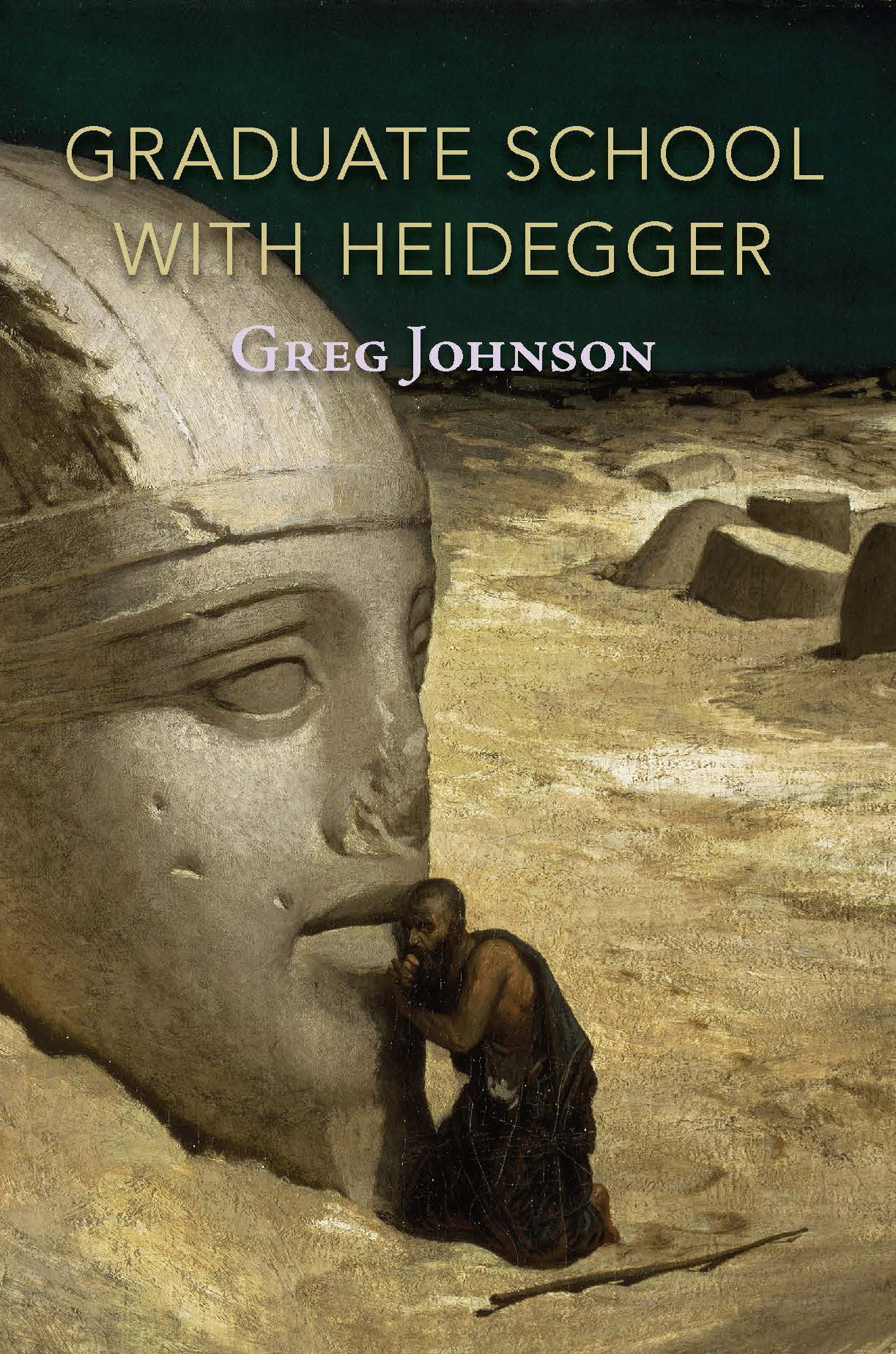
You can buy Greg Johnson’s Graduate School with Heidegger here
Does this mean that Beiner has a solution to the problem I raised? The solution is actually quite simple: to show that the radical Right is wrong. But that’s out of the question for Beiner. It would require actual intellectual dialogue, which would require civility, and that’s a bridge too far:
One can’t pretend that engaging with such figures is the same as engaging with other intellectual interlocutors. “Dialogue” with a Greg Johnson or an Alexander Dugin or a Bronze Age Pervert unavoidably helps to legitimize them, which is not only quite painful but politically perilous.
The real risk that Beiner cannot countenance is that genuine intellectual dialogue requires entertaining the possibility that one might change one’s own mind, i.e., the possibility that one might be wrong.
Since Beiner can’t actually engage his enemies, he must simply continue to point and splutter, with all the dangers that entails:
This yields a sobering reflection on the risks of engaging intellectually with the far right, since it has elements of a lose-lose proposition: we lose if we ignore the far right, because we leave their views unchallenged; and we lose if we engage with the far right, because we give them the attention that they so ardently crave.
Surely not every intellectual debate is a lose-lose proposition. Indeed, normal intellectual debates are win-win propositions, for if one “wins,” one is proven right, and if one “loses,” one still wins by discarding false ideas. Personally, I would be delighted to be proven wrong, as I was many years ago when I was freed from the delusions of classical liberalism.
Maybe Leftists can only lose because they are wrong and wish to cling to their delusions.
Given his terms, Beiner can’t rationally justify writing another book on the Right, so he simply admits to irrational motives:
In the end, how does one weigh up the pros and cons of writing about the people surveyed in my book, and hence giving them air time that might be to their advantage? I confess that I really don’t know. If I were to be fully honest about it, I would have to say that I have written these essays more as a kind of compulsive behaviour—because of my obsession with these figures—than as a fully reasoned-out calculation of good effects, since the possible bad effects are substantial, and quite possibly exceed the good effects. Hence engagement with the radical right entails real risks that cannot be circumvented. Extremists love attention, believing that it helps them win more recruits to their cause. They may well be right in thinking that. But what choice do we have?
Actually, Beiner does have the right to remain silent. He chooses not to exercise that right, basically, because he’s highly triggered by Trump.

You can order Greg Johnson’s Loving Our Own here
But that’s no argument. If Trump is every bit as bad as Beiner says, and Trumpism really is nourished by the radical Right (which it is), then merely repeating without refuting radical Right ideas can only make matters worse, from Beiner’s own point of view. Yet he continues to write, basically because he chooses to indulge his own obsessions.
I’m perfectly content if Typhoid Ronnie spreads our memes through academia. But it seems a waste of his considerable intellectual talents. Because, again, I would be delighted to be proved wrong.
The Nietzsche Question
Beiner’s book falls into two parts. The first is entitled “Nietzsche as an Essential Resource for the Radical Right.”
It begins with an expanded version of Beiner’s Chronicle article under the title “Can a Liberal Education Create Enemies of Liberalism?” which deals with Nietzsche among other things. (This is the third time it has been published, and it still refers to Counter-Currents as “Cross-Currents” in one spot.)
It is followed by two essays on Nietzsche: “What Contemporary Radical Rightists (Rightly) Draw from Nietzsche” and “Transversal Racialization: Losurdo’s Account of What Is and Isn’t Proto-Fascist in Nietzsche,” on Italian Marxist Domenico Losurdo’s monumental tome, Nietzsche, the Aristocratic Rebel: Intellectual Biography and Critical Balance-Sheet.[3]
These are the best chapters of the book.
First, Beiner argues that Nietzsche was deeply anti-democratic and anti-modern. Second, Beiner argues that Nietzsche’s proposed alternative was a return to a society of hereditary castes ruled over by warrior aristocrats who would not hesitate to exterminate vast numbers of inferior humans. Third, Beiner points out that Nietzsche was a “post-truth” thinker, meaning that he puts relativity above objectivity and myth above facts. Ultimately, he puts will above everything.
I find Nietzsche’s critique of modernity compelling. Basically, he holds that to flourish human beings need edifying, normative institutions, which in turn require a closed cultural horizon. Modernity leads to decadence by opening these horizons and replacing edifying institutions with freedom of choice.
For me, the solution is to return to classical philosophy, meaning: Socrates, Plato, and Aristotle. This does not appeal to Nietzsche because philosophically he is very much a modern who believes in the power of the will to create values, whereas Socrates, Plato, and Aristotle believed in an objective moral order.
Nietzsche’s solution is basically to go back to the Bronze Age. Frankly, I find this revolting. The worst parts of what I call the Old Right—basically, National Socialism and other interwar fascisms—come from the spirit of Nietzsche: a combination of Bronze Age archaism and the modern nominalist metaphysics of will, which gave rise to modern technocracy, including totalitarianism.
This is why we need a New Right, which is genuinely post-modern, post-technocratic, and post-totalitarian. At his best Nietzsche shows the problems with modernity. Heidegger, however, came to realize that Nietzsche was still imprisoned in modernity’s metaphysics of will. Heidegger offered a better way to return to the Greeks. Heidegger had issues with the metaphysics of presence in Plato and Aristotle, but for me their political thinking remains a valid alternative to modern liberalism.
A Gallery of Straw Men
The second part of Beiner’s book is entitled “Rogues Gallery.” It consists of polemics against Steve Bannon, Alexander Dugin, Jason Jorjani, and Bronze Age Pervert (Costin Alamariu).
I don’t take any of these figures seriously, particularly Bannon. To my surprise, however, Beiner ferreted out something I had forgotten I had said about Bannon:
Bannon is a civic nationalist. We’re racial nationalists. There are overlaps but disagreements on fundamental values. But Bannon is not stiffing us because his life is an experiment. He’s living as if the future he is fighting for has already arrived: a world where the Left has no power . . . Bannon wants to win and actually roll back the Left. That makes him a radical and revolutionary conservative.[4]
I still like that about Bannon. We should all live as if we don’t need to care about the opinions of Leftists. I also give Bannon a lot of credit for saying that support for Israel is no longer a litmus test for being on the American Right.
Why does Beiner focus on a gaggle of pseudo-intellectual buffoons? For the same reason he focuses on the worst aspects of Nietzsche and his legacy: this book is a smear job. His goal is to refute the Right by criticizing its weakest figures rather than its strongest ones. He’s torching straw men.
Several times, Beiner mentions my “Notes on Heidegger and Evola”[5] where I make the point that after his break with National Socialism, Heidegger created the template for what became the New Right. But it doesn’t suit his purposes to deal with the New Right. For instance, he only mentions Alain de Benoist in passing.
I am mentioned in passing throughout the book, seldom in a flattering light. Beiner likes to smear me as a “Nazi,” which is untrue. From his point of view, I might be even worse than a Nazi, because although I don’t agree with National Socialism and other forms of the Old Right, I at least regard it as a serious worldview, whereas I regard contemporary liberal democracy as a joke.
My colleague John Morgan is mentioned dismissively in passing. Michael Millerman, who has a good mind despite his baffling affection for Dugin, is mentioned several times, primarily because Beiner knew him personally. But the rest of the time, Beiner is content to focus on clowns.
I stand beside my positive review of Dangerous Minds. But I cannot recommend Radical Right Ideologues in the Age of Trump. It is shallow, shrill, and ridiculously overpriced: around $50 for a paperback of 160 pages.
Beiner’s subtitle declares radical Right ideologues “heralds of nihilism” because, like the Joker, we “simply want to watch the world burn.” But that’s not nihilism as I understand it.
Nihilism doesn’t refer to destruction or negation as such. It refers to the destruction of the highest values. Moreover, at least in Nietzsche’s view, the highest values of Christian civilization were not destroyed by people like Nietzsche. Instead, they destroyed themselves due to their own internal contradictions.
I feel the same way about the Left liberalism that Beiner defends. It is in the process of destroying itself because it is based on falsehoods. It is not nihilism to wish to dynamite the ruins, clear the ground, and build anew.
It isn’t nihilism if nothing deserves to survive.
Notes
[1] Greg Johnson, “Ronald Beiner’s Dangerous Minds,” Graduate School with Heidegger (San Francisco: Counter-Currents, 2020).
[2] Ronald Beiner, “When Neo-Nazis Love Your Book,” Chronicle of Higher Education, The Chronicle Review, July 6, 2018, pp. B4–B5.
[3] Domenico Losurdo, Nietzsche, the Aristocratic Rebel: Intellectual Biography and Critical Balance-Sheet (Chicago: Haymarket Books, 2021).
[4] Thomas J. Main, The Rise of the Alt-Right (Washington, DC: Brookings Institution Press, 2018), pp. 212–13.
[5] Greg Johnson, “Notes on Heidegger and Evola,” Graduate School with Heidegger.
20 comments
Pseudo-intellectual buffoons are the only so-called far right thinkers given oxygen in the mainstream–one has to search for AR, C-C, and so on, whereas the buffoons are everywhere. And Beiner’s choices are certainly buffoons; Bannon is a Zionist who wears several shirts like a homeless person, Dugin wants to merge Russia with Islam, Bronze Age Pervert is incoherent and Jewish, and Jorjani is a half-Iranian who makes Bronze Age Pervert seem totally coherent. Talk about the bar scene from Star Wars. Why didn’t Beiner include Nick Fuentes or Kooky Candace? Or even Kanye West? Sheesh.
This Beiner character seems to have very little confidence in his own arguments. What kind of writer begins a book by admitting that he is afraid that it will make readers agree with his opponents?
Exactly. He sure wrings his hands about giving us publicity, but our ideas are already getting around whether he likes it or not. Does it ever occur to him that we’re not all about being the center of attention, but instead want to save our society? What a weenie!
He seems to think that illiberal ideas are self-evidently false. Thus professors simply need to point at their heresies and indignantly splutter about fascism.
It’s always been jarring to me people live like this, in a bubble of their own rubbish protected with evasion, and claims to ‘self evidently true goods and evils’. It’s not an authentic politics or philosophy, it’s the pursuit of walls made of appeals to sensitivity. So there’s something indefensible behind that wall.
Then for him to then create a defense of this of this farce it’s not serious.
Greg Johnson can show polite and scholarly respect for people like this but I cannot.
I have met too many of them. They come puffed up with credentials and their sense that they are right about everything, and they know all about the right. You are ready to defend the classical thinking of Greg Johnson, and Kevin MacDonald’s theory of Darwinian group competition carried on by the construction of culture, so you ask them what they know and the answer will be something like MAGA “fascism” and J6, a drunken rant from Richard Spencer, and snippets of Andrew Anglin.
They think they have a complete and superior knowledge of the great minds of the radical right, and that is what they know. And for good measure …
“Get yourself an education!”
“Read a book!”
It must take a will of iron to be polite about these people, who deserve contempt and disgust.
Greg, I fully support you going to town on these utter buffoons and totally intellectually eviscerating them. You are about 6 million X more intelligent than these dullards- why is this dolt, who I haven’t even heard of, published by Routlege, and you are not ? – Why? Because he’s a yes-man for the current, sick, Post WW2, Jewish, left liberal, White genocidal regime.
Greg, I fully admit I don’t agree with you on every single point, but gosh darn it I want to see you utterly ruin these losers’ legitimacy. I give what I can to CC, and I believe you should be way bigger. I think CC should be a bastion of culture like Time or the NewYorker is. Again, in my view, you’re wrong on a few things here and there, but I’m willing to overlook those because you are the one person I could bank on to utterly defeat these charlatans.
This guy clearly isn’t clever. He isn’t brave. He isn’t even accurate, frankly..his understanding of the far right is worse than a 14 year old mouthbreather on Xbox Live. You say he depicts Richard Spencer and Dugin in order to discredit the White Right: I disagree. I think he’s so thick, he thinks these guys are the real, hard, cutting edge of the Far Right – the people he views in his pea sized Leftoid Jewish brain as THE people behind some dastardly idea to mass murder millions of people. He’s done some cursory research, but he doesn’t have a clue because he doesn’t want to. He lumps you in seemingly on some kind of grudging respect for your intellect –“oh YHWH, if only this jehova-darned Greg Johnson wasn’t quite so clever!”
Pathetic, contemptible. Take ’em to the cleaners, Greg. No mercy.
Thanks, I appreciate it. I have a stack of such books that I will be working through this year. I am calling the series The Battle of the Books.
There are secret agents in academia–I was one myself–who are engaging students on these topics, semester after semester. The instructor can see the lightbulbs go off over students’ heads when they realize there are other ways of looking at things than the ones they are usually presented with.
I know many such agents and love hearing from new ones. Glory to the Long March. May you flourish in your career.
To call Dugin “a Right thinker” is absolutely wrong, and everybody who read him, knows this.
I find Nietzsche’s critique of modernity compelling. Basically, he holds that to flourish human beings need edifying, normative institutions, which in turn require a closed cultural horizon.
I have only read Kaufmann’s “Portable Nietzsche”, and so maybe some parts of Nietzsche from elsewhere contradict what I write, but isn’t his view the exact opposite? Flourishing requires one to break institutions, the rules and traditions of the “herd” need to be broken by the ubermensch to make an individualistic edification. Isn’t his philosophy one of continual revolution against the old, and the creation of something new? A “closed cultural horizon” is the exact opposite of Nietzsche’s philosophy, as you say yourself, Nietzsche is the affirmation of the will par excellence.
Modernity leads to decadence by opening these horizons and replacing edifying institutions with freedom of choice.
If freedom of choice leads to decadence, the only man to blame is the individual himself for becoming decadent. There is no safety net in the herd anymore, and the majority will suffer for it, but this website itself proves there will always be minority that is capable of self-legislating, and becoming stronger by their fight against modernity. Still, the current version of modernity could be improved while also allowing sufficient freedom for that noble minority. How to restore that perfect balance, where herdlike leftists are kept to a safe worldview, and real intellectuals like Socrates and Nietzsche are allowed to go beyond “cultural horizons”, seems unknown.
For me, the solution is to return to classical philosophy, meaning: Socrates, Plato, and Aristotle. This does not appeal to Nietzsche because philosophically he is very much a modern who believes in the power of the will to create values, whereas Socrates, Plato, and Aristotle believed in an objective moral order.
While I agree that, despite being dissident, white nationalism is a more platonic than Nietzschean movement (as if any populist movement could be considered Nietzschean!), objective moral orders only apply to religion. There’s nothing wrong with our subjective view of morality as one which is based upon race, but the survival of the white race is not objectively valuable, only subjectively valuable to white people. If I’m not mistaken, Plato also resorts to divinity as his final justification for his values. Within the dialogues, and the memorabilia of Xenophon, Socrates makes constant reference to “The Gods” as the ultimate source, and one of the justifications for wisdom and virtue. While classical philosophy is focused on reason, is it only so because humanity can not comprehend the divine which justifies and gives man this reason, and dwelling upon matters of faith is fruitless. In my view, atheism, and therefore the philosophy of Nietzsche, inevitably leads to “life worship”, as man realizes he is nothing but an animal, and can never be other than what his nature as an animal is, he is left with a binary choice (if he wishes to be rational) to either negate through suicide, or affirm nature despite it’s brutality and unfairness. The choice is quite easy, and we are all predisposed to the latter. Affirmation of nature inevitably leads to ethnocentrism as well, which means Nietzsche is somewhat congruent with white nationalism, as he is with any enterprise showing a sincere desire to create in addition to negation. But this augmented philosophy of Nietzsche’s, this “life-worship”, is also similar to platonic philosophy, where virtue exists, and we must discover it using either our emotions or our reason, respectively. The only difference is the difficulty of affirming the chaos of random evolution, rather than discovering the ordered universe which the gods made for man. This is in contrast to Nietzsche, where virtue is yet to be made, and moral systems are more fragile and individualistic, thus meaningless. Obviously, a true Nietzschean is so individualistic that he will never be a white nationalist, and would probably run off into the mountains like Zarathustra. I would not discount Nietzsche wholesale (not saying you are), his philosophy is ultimately freeing, even if dangerous because of that freedom. Many students of his philosophy will use that freedom for life negating leftism, but many will also use it for the much more taboo, and life affirming, ethno-nationalism. With this regard, Beiner has a point. While coming to a more truthful position, even if losing an argument, is still a “win” for the loser in the long run, Nietzsche is the great “yes-sayer” to all political philosophies, and dissidence is the domain of white nationalism. Naturally, we benefit from this radical affirmation more than leftism does, which doesn’t need a crazy German’s “okay” for legitimacy. A Jew only stands to lose by the teaching of Nietzsche in modernity, but a white could still benefit by being rescued from leftism.
Thanks for this comment. I hope you will comment more here.
The place to begin to understand Nietzsche’s views on culture is the Untimely Meditation on The Advantage and Disadvantage of History for Life. I look at the Ubermensch doctrine in Zarathustra as basically a weaponization of modern nihilism, the aim of which is to overturn the modern age. But I don’t think it is a viable replacement for it.
For Plato and Socrates, the gods don’t justify anything. In fact, they argue that for gods to be divine, they must be good. Thus the gods themselves look to objective standards of the good, which are the same standards that human beings look to.
The place to begin to understand Nietzsche’s views on culture is the Untimely Meditation on The Advantage and Disadvantage of History for Life.
Thank you, I believe I have watched on lecture on this (https://www.youtube.com/watch?v=SCx2xgwUJ9s) but haven’t actually read it myself, so I’ll have to check it out.
I look at the Ubermensch doctrine in Zarathustra as basically a weaponization of modern nihilism, the aim of which is to overturn the modern age. But I don’t think it is a viable replacement for it.
I can see this, and it’s not actually an interpretation I have noticed before, so you’ve given me something interesting to think about. It most likely isn’t a viable replacement, it’s a little too individualistic and formless, but I suppose Nietzsche thought the ubermensch would be so far above the rest of humanity that he would just “figure it out”. In that sense, I think Nietzsche is more romantic than he his nihilistic. Will, or emotion, triumphs the basic common sense of “You can’t make strong values out of thin air”. Perhaps romanticism is just one bad day away from nihilism.
For Plato and Socrates, the gods don’t justify anything. In fact, they argue that for gods to be divine, they must be good. Thus the gods themselves look to objective standards of the good, which are the same standards that human beings look to.
I’m sorry, it’s like The Euthyphro completely skipped my mind, you’re right. I’ll have to read more Plato, for that is the question which has continually puzzled me about his philosophy. Do you have any recommendations that deal with this problem specifically?
And I’ve been lurking on here for some time, but I usually don’t contribute to online communities unless something really catches my eye. Thanks for the articles you write on here.
I did a show on Guide to Kulchur on the History for Life essay by Nietzsche. I will get a copy for CC.
I have a whole essay on the Euthyphro at CC. Also see my essay “The Myths of Plato.”
Looking forward to it, thanks.
I’m sorry if this may be too long, but I have been thinking more about subjective vs. objective morality, and want to write a defense of subjective morality. I neither think it is always nihilistic (valueless) nor is it incongruent with ethnonationalism. To the contrary, it is a source of it.
1. As without faith, only reason can judge reason*, the atheist cannot very easily escape reason. Emotions also follow a telos (the path of a superior way of life, described below) and this telos can be deduced through reason. Romanticism is a rational worldview with a tint of emotional charge, but in many ways is superior at safeguarding the function of reason, which is life. For what motivates men to die in war, inquiry or passion? Though they lead to the same end.
* ”Why should we be rational?” may be a good question, but it is only asked using the device it’s questioning, and therefore alternative frameworks to reason can’t directly challenge reason. Non-reason must ignore the question, and answer the challenge with animalistic violence. But all non-reason must be only emotional, and such emotions would end up killing the person, negating the ends to which these emotions want us to achieve (life). Nobody except the schizophrenic can really forgo reason entirely, and it would probably result in their death, because they lack the reason to justify basic habits and functions. Only a metaphysical entity, such as the form of the Good, or God, can interrogate reason from outside and provide a viable alternative. Note that reason cannot justify itself, that would be circular reasoning, only that those without faith are left with no better option. The ends, whatever the means, are usually the same nonetheless.
2. As reason, acting alone, cannot explain why things are good or bad, all moral philosophy without metaphysics is subjective to human experience. Value judgements are made by the way the sum of their actions make us feel in the present and future, it is for this reason that, while drug usage in the moment may feel good, its health consequences in the future make it bad. What determines the way we feel about different things? Evolution, or nature. For instance, why should justice be a virtue? Because it increases your reputation and standing with the tribe, and your tribe helps you survive. Humans without the impulse for just actions unto the tribe were inferior in environments where injustice was not tolerated, such as prehistoric tribes.* The humans that had justice lived, and those without justice died, removing unjust instincts. All of our virtues are things which serve life, by strengthening the community and ourselves, and not coincidentally, virtue gives us a sense of beauty, as does a river with drinkable water, and forests with edible game, give us that same beautiful feeling. “Good and bad” is determined by our nature, which is determined by our evolution, and is relative to what works best for our genes to survive. This is why parents gladly sacrifice themselves for their children, the ones which didn’t do that had their genes extinguished. That is not objectively morally superior or inferior. The value of life can only be evaluated through emotions which have evolved in us to safeguard life, and thus is a form of circular reasoning, and definitely irrational. Reason cannot esteem whether life in itself is good or bad, only emotion, and our emotions are disposed to the former. It is for this incapability of reason that Socrates died without fear.
*This would imply that, like is argued in the first book of the republic, that it’s “better to seem just than actually be just”. This is true so long as you’re a good actor, which many people aren’t, and cannot be so for multiple decades while they deceive their tribe.
3. If life is the summum bonum, while not rationally justifying what is virtuous, then at least being affected by everything called good or bad, how then can people have virtues they’re willing to die for? How can one die for honor? I mean, we all get that tingle of heroism, or that “warm feeling in the pancreas”, from witnessing such deeds, but it’s also negating our summum bonum. Although somewhat explained in the previous point, the security of the tribe’s life, and the probability that they continue on, is the real “life” I speak of*. And therefore, dying for virtue is the greatest affirmation of life. Disease and unhealthy habits decrease the probability of life continuing, and are therefore disgusting despite being less likely to cause death than faithful combat in war. Dulce et Decorum est is no old lie if the sacrifice was truly necessary. In other words, higher morality, the most noble qualities and actions, have as their ends service to the tribe.** Now, the only question left is “who is my tribe?”
*It’s probably better to say “in service to our genes”, rather than life, for that sounds like any life ought to be equally subjectively valuable to everybody, which is not my intention nor the decree of nature. In this way, dying for your children is dying for your genes, very reminiscent of Socrates’ / Diotima’s speech about immortality in the Symposium.
**The tribe could merely be a proxy for one’s own children. This would imply that those with children and strong ties to the tribe are more willing to die in war. For this reason, a society in which almost everybody has children must be the superior fighters in war, and more willing to participate for the good of the whole in general. I suspect this is why patriarchy and monogamy have gone hand in hand with the success of a civilization. They are like “sexual marxism”, where everybody has only one wife (and they’re sure that their wife is only having sex with them, unlike more tribal cultures), despite their resources and strength. This allows the same amount of children as polygamous and licentious cultures, but more devoted citizens.
3.1 It must be noted that music and architecture, which are beautiful beyond compare, despite not contributing towards life, are the only two exceptions I can think of. Literature gives knowledge and the depiction of personality, and knowledge in a general sense helps to survive, and the depiction of relatable personalities is like relating to another tribe member, so its enjoyment makes sense. Painting imitates beautiful landscapes, full of natural resources. Architecture can only fit into this system if we really stretch it, and say that love of the pantheon mimics the love of a large, warm cave. What’s even stranger, is the division between good and bad music. Why should harmony in Wagner be more beautiful than the lack of it in Schoenberg? This is the biggest critique of this naturalist system, and the greatest rational evidence for metaphysics. More likely, it’s a random byproduct from a different instinct, or a function which we don’t know yet.
4. By this definition of justice (“What’s good for my tribe”), wars against innocents for resources to help the tribe may be just, for justice (a virtue, which falls under the domain of morality) only makes sense to apply to intratribal conditions and not intertribal relations*. Going to war with the stronger tribe is immoral because it’s bad for your tribe, not because it harms the other. Dare we call going to war with the weaker tribe moral?
*Unless acting just towards a non-tribe member would help you survive better than war, such as in trading with foreigners, The whole system could then be abstracted to the family being the only tribe, and the larger “genetic community”, which moderns traditionally call “a tribe”, is also good to act just towards because they help protect your family. And are more familial than those genetically distinct.
5. And yet, we feel to kill an innocent child in war is unjust, immoral, and a disgrace, even though it might benefit your tribe in the future.
6. So then we really don’t have service to life as the only source of morality, we also have a sense of mercy. But virtue is determined by what serves the superior way of life for the tribe, and how could mercy here not be a virtue? So then some things which serve this superior way of life are still wrong?
We have in us two conflicting sources of “what is right”, the good feeling we get from serving the tribe, and the bad feelings we get from violating an intertribal rule, like not killing innocents. Could the latter not be a product of nurture, compared to the former’s natural source? Take, for instance, some Germanic warrior culture, could they not believe the slaughter of innocents was just and heroic? But we have no more way to call that wrong than proclaim ourselves right? We subjectively value their life, but is this value judgment of an action independent of the tribe the result of nature or nurture? I propose nature, for we have a natural disposition to not harm humanity* unless they threaten our tribe. This is why Jewish children could be killed in the holocaust without regret, for the Germans believed they threatened the German tribe, and in service to life it was moral to kill them. But it’s also why we can view the Palestinian genocide with disgust, for what have the Palestinians ever done to harm America?** Despite their foreign religion, Aren’t they human too?
Humanity, we must think, dissolves after 9/11.
*This instinct must be the same one which makes us feel bad to kill our tribe, our powers of rational observation must be the reason why we feel bad to kill an innocent vs threat to the tribe. But we haven’t evolved to be “neutral” to deaths which don’t affect the tribe, probably because prehistoric times didn’t have televisions, and one only knew events which occurred so close to the tribe that it was likely to affect them.
** Is this immoral? Such far off things do not harm our tribe, and yet we have a bad reaction to them. The justification for other such things is our instinctual reaction, shouldn’t this be the same? It seems that this implies a universal sense of morality, and in fairness, it does. Our nature is against human death until reason tells us it’s for the good of the tribe. Imagine now that these Palestinians are American, which implies a personal threat upon your family, then the reaction is much greater. Now imagine that these Palestinians were burning American flags before being killed, they don’t yet deserve to die, not until they’ve actually harmed our tribe, but we certainly feel less bad about their deaths. (For a conservative, a liberal would have to be offended by their transgression of gender equality, for they are less patriotic than conservatives). Because the proximity to the tribe modulates the feeling, and the feeling is the crude and emotional way whether we know if something serves life or not, morality as primarily but not exclusively intratribal still applies.
7. Our only question, then, is who is a part of our tribe? What group deserves not only our pity for the slaughter of their innocents, but our significant sacrifice to prevent it from happening? What is the definition of our tribe, or “ingroup”? And how is it that, without knowledge of their character, we should kill a dog to save a human, and not vice versa? Historically, race, religion, class, and ideology determined this question. And it is so that some white protestant American liberal may choose the salvation of a Muslim Palestinian, and allow a white protestant American conservative to die, because their “ingroup” is based upon an ideology of empathy for the oppressed. For all the Westerner’s talk of universalism and globalism, those which don’t abide by cultural Western standards are “othered”, and must adopt this subtle cultural imperialism. Patriarchal muslims, without gender equality, are despised because they don’t abide by the universal ingroup standards which Europeans, consulting only themselves, created. Race and religion, for most modern liberals and conservatives, makes little difference compared to ideology. Even a neighbor without the correct identity categories will become the “outgroup”. There is no empathy for political opponents, they are of a different tribe and threaten the interests of the ingroup. Tribalism is alive and well within the West, and no human group could be otherwise.
8. But the more the definition of ingroup comes to include different identities (race, religion, ideology, etc), the easier it is for competing definitions of the ingroup, based upon more specific categories, to arise and act like parasites upon the broader ingroup. Take an American conservative, American white nationalist, and an American member of the nation of Islam. The ingroup of the white nationalist are white people, the nation of Islam holds only black muslims to be the ingroup, but the conservatives holds them all as his ingroup. When they are all called to military service, the white nationalist and Muslim will dodge it, because they think it’s unfair to sacrifice for another race, or a people “that isn’t theirs”. The conservative, meanwhile, defends them both, but gains nothing from them in return. It is by this recognition of parasitism that he also will reduce his ingroup to a more precise definition. The interests of all three groups are now opposed, although they live in the same land and are competing for the same objects. As all feel that service to the group is service to their superior way of life, and life is the source of all virtue, all will be thinking themselves to be acting with virtue. Conflict, then, is inevitable, and diversity of identity was the source. Because language, culture, religion, ideology, and class can all change, race is the most salient category because it cannot. A country unified in the others may still be brought to civil war by the last. In addition to this reason, and as group conflicts are often proxies for the future welfare of one’s children (or genes), we must believe that race is the category with the most “pull”, for it protects genes of similarity directly, rather than indirectly.*
*Indirect protection of genes could be seen through a defense of Christianity, where all the Christians just so happen to be European. Conservatives often use culture and religion as euphemisms for race during immigration debates, because they correctly identify race as the most salient identity category, and open discussion of it would gape wide the gates of hell.
9. If the universal prosperity of all groups is to be desired, and the slaughter of innocents to be avoided, the ingroup is to be defined as narrowly as possible to avoid obvious future conflicts, but broad as possible to allow this ingroup a power great enough to resist unjust invasions, an ‘Aristotelian mean’, if you will.* This removes the chance for competing definitions of ingroup to arise (e.g, racial identity vs. national identity) and fight for what they both have come to believe in now “theirs”.
*As Aristotle notes in his Politics, some degrees of division are undesired. Why should we exclude the shoemakers from the city of shipbuilders? Here diversity is obviously a benefit, and their addition to the city makes the whole stronger. This is why we think of prehistoric warfare in terms of tribes rather than families, because a tribe is an example of beneficial diversity through sheer addition, not because it’s diverse, but because it’s numerous while still having a sufficient degree of unity to not easily fracture. As larger armies defeat smaller ones, this is a desirable object. But insofar as larger armies require the addition of multiple identities, take the Greco-Persian wars as an example, then size becomes worse than a small army united. In effect, diversity of opinions on the means, and diversity of capability, is to be desired. Diversity of identity and the ends should be avoided. Of course, diversity of identity up to a certain point cannot be avoided, so it is more likely that the probability of competing ingroup definitions becomes greater with the number and intensities of different identities. This is because the differences between people are highlighted once they live amongst each other, the only way to resolve this and restore a broader ingroup definition is through some identities perishing through religious and cultural conversion, or in the unfortunate cases, the genocide of a race.
10. Group competition results in cultural suppression, enslavement, genocide, and general violence. The best way to prevent group conflict is not through diversity, for that will only intensify it once the broader definition of the ingroup breaks down*, but national and geographic separation.
* Diversity hastens the end of the broad ingroup definition, and makes the battlefield of the former united country even more divided, and thus the fighting is more vicious. When each identity category, probably falling along the basis of race rather than the others, has their own country, they will not “fight like cornered animals”, and be more hesitant before deciding to engage in conflict. Whereas, in pluralistic societies, When the broader ingroup definition is finally torn apart, the severity of territorial claims and violent conflict will be greater than it would have been if they were separated, because it’s “life and death” for all of them. Although territorial disputes will still occur, they will be less likely because everybody is not breathing down each other’s neck, and the fighting will be less chaotic and not so close to civilian centers. War is the eternal condition of mankind, but some steps can be taken to mitigate and prepare for it.
11. Projects of imperialism may benefit the ingroup for a little bit, but the oppressed will come to despise the brutality required to maintain imperial projects, and cruelty will be met alike with cruelty. Empire, as Pericles notes, is bittersweet, and when possessed, the only way to let it go is through death. Compare this to just behavior towards a neighbor, not sacrificial behavior, but merely just and temperate. The just neighbor which is attacked is done so by the unjust, and the rest of the nations will see and stand by the victim if the aggressor will be made strong enough to invade them through their victory. As shown by Rome in men like the Gracchi brothers*, empire doesn’t help the “common man” either, it merely fills up the wealthy and elite with decadent luxury and vice. With this regard, Socrates may have a point, injustice will come to haunt the aggressor and hurt them more than the victim of their injustice. But sacrificing for the outgroup, like you would die for the ingroup, is a very large difference, and justice towards the outgroup takes a different form than justice for the ingroup.
* “The wild beasts that roam over Italy have every one of them a cave or lair to lurk in, but the men who fight and die for Italy enjoy the common air and light, indeed, but nothing else. Houseless and homeless, they wander about with their wives and children”. – Tiberius Gracchus
12. The atheist, then, may embrace nihilism, or affirm the values and instincts bestowed by nature. To embrace these instincts is to embrace race. Not necessarily to wage war on other races, for that might interfere in the welfare of your own, but it is to care for the welfare of your own.
I will have to glance at this when I have more time.
Greg, I believe this question is on-topic: what do you think about Stephen Hicks’ “Nietzsche and the Nazis” (video documentary in 2006, book in 2010)?
I saw the video when it first came out and found it well-reasoned and interesting.
I never saw the video, and I only glanced at the book, so I have no opinion.
It seems the reply limit has been reached on that comment, so I have to write a new one. Take your time on a reply, i just want to correct a strawman argument in point 11 that I made. It’s actually very easy to imagine imperialism where the benefit to the tribe outweighs the sacrifice. Imagine if Hitler had a button to kill everybody in eastern Europe immedietly, he would press it, then colonize eastern Europe with Germans. A benefit to his ingroup without cost to it, therefore moral under this framework. But this should still be unjust, no? Unless the Slavs were all directly threatening Germany, and therefore it’s just as self-defense for the ingroup, I cannot really call this immoral or moral. For that feeling of injustice, which nature has given us to affirm, is quite active despite the benefit. I still think our notions of justice are relative to benefit to the ingroup vs. cost to human life. But subjective morality, when trying to make sense of it using reason, and not acting purely on our emotional moral sense, can lead to that genocide which you said it would. Our desire to make sense of nature using reason, to make rules and universals, seems to contradict our natural instincts. When taken to it’s logical end, and not it’s emotional end, it seems that genocide in service of the ingroup is envitable. I certainly can no longer make ends or tails of it. Should we dispose of reason when it conflicts with emotion to remain moral? That seems ridiculous. But I am puzzled to how reason could ever tell us what is wrong or right without that emotional, instinctual base. Is life good or bad? Is health good or bad, and if so, why? For happiness? But why is this desirable? Reason is silent, it cannot esteem, but instinct is insufficient and self-contradictory. Neither reason nor instinct are alone enough, but become contradictory when together, itself an effront to reason, and reason is neccesary to sustain life. They negate each other and cannot yet exist without each other. I should think faith in divinity is now neccesary, but you seem to have overcome this problem, and so I await your response with great anticipation. Though I still cannot see how reason alone makes values.
If you have a Subscriber access,
simply login first to see your comment auto-approved.
Note on comments privacy & moderation
Your email is never published nor shared.
Comments are moderated. If you don't see your comment, please be patient. If approved, it will appear here soon. Do not post your comment a second time.