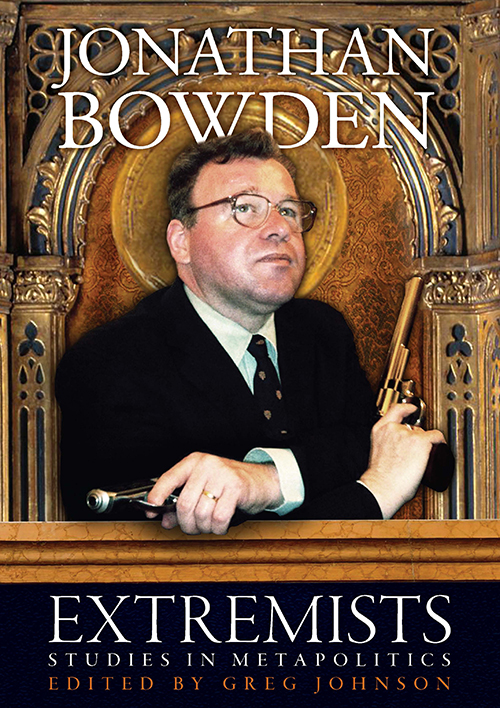
You can buy Jonathan Bowden’s Extremists: Studies in Metapolitics here.
3,202 words
Part 4 of 7
Edited by Greg Johnson and Peter Jacobi
In 1995, Jonathan Bowden self-published his Collected Works in 6 volumes (London: Avant-Garde, 1995), edited by Jürgen Schwartz, one of Bowden’s pen names. The six volumes comprise 27 distinct books, 12 of which had been previously published. Altogether, the Collected Works contain more than 2,600 pages of rare early Bowden.
Suck is the second book in volume 2. It was first published as a distinct book under Bowden’s pen name John Michael McCloughlin (London: Avant-Garde, 1994). We will publish it online in 7 installments. The titles are editorial.
Suck covers a wide range of political and cultural topics, interspersed with fictional narratives that may be loosely based on real people and events.
Eventually, a fully annotated version of Suck will appear at the Jonathan Bowden Archive. It will then be followed by similar editions of the rest of the Collected Works, plus a couple more early volumes that were not included. — Greg Johnson
Although this is not to say that there is no cross over between various forms of the New Age—at once feminist, weak-kneed, ecological, and humanist—and more traditional types of paganism, which appear to be healthy, muscular, and demotic. Nevertheless, there are certain weaknesses to Odinism and other types of native religiosity. Some of which I discovered when I attended the National Moot of the Odinic Rite (OR), the annual gathering of the main pagan group in Britain, which was held in a downstairs suite of the Bonnington Hotel on Southhampton Row, just up from Holborn in central London. All in all, it was a bizarre place to hold such a gathering. In that the Bonnington Hotel is best typified by pink fluorescent lighting, warm toilets, and the general sense of meaninglessness and hushed expectancy which characterises such places—particularly the lobbies of such luxurious and not so luxurious places, often punctuated by the rattling of tea trolleys—like in a hospital—and staff announcements on the intercom. The tickets or bill of fayre (if you will) which announced the gathering, the Moot, were a strange assortment of blue and white, azure, and alabaster. Upon which were engraven (in imitation of Gothic script) the time, place, and transport arrangements for these latter-day pagans. The proceedings themselves were overseen by the Court of Gothar, the ruling body of this Odinist High Temple in Britain, which consisted of several individuals sitting behind a trestle table. This was a mock dais, covered with white muslin upon which lay a scarlet banner, a helmet and sword, together with various other accoutrements—several horns or Viking cups for example, together with bottles of liquor—was it brandy-wine or was it mead (?)—and somewhat incongruously a bottle of lime juice in the middle of the table. However, the weaknesses of this type of paganism were also in evidence. In the first place this was an anti-Christian bias; a sort of historical grudge-match, if you will. While the second major weakness, on the other hand, was a sort of greater English nationalism, a surrogate opposition to the Celt. Whereas the most significant weakness of all was the absence of a tragic dimension, a sort of youthful, naïve, and innocent certainty; a type of barbaric phlegm, at once English and undignified, a type of muscular certainty; a hybrid irrelevancy, a type of Scandinavian jousting—something which was chthonic and yet unmarked by sin. In other words, a form of barbarism which was too innocent to be really profound.
Ultimately the Odinic Rite lacks a certain poise, a certain transcendence—what we might call a true dispensation of the High Gods which it affects to worship, and this has to do with its amateurishness; the fact that it is a movement in its infancy—“the roughness around the edges” of which its director spoke, but also because theologically it lacks a certain dourness, a certain pessimism, a type of deep and ironical joy. All of which has to do with the youthful vitality of this religion—despite the fact of its age—and the fact that it regards evil as an excrescence on the face of man; a carbuncle on the face of a beloved friend (to paraphrase Prince Charles). In that it sees evil as exterior to man; untrammelled by reason, and liable to steal upon him in moments of quietness and inadequacy. This is a very ancient myth, of course, and it has a considerable degree of truth to it. In fact, it amounts to little more than a pagan version of the Pelagian heresy—the myth that man is naturally good—which was condemned by the early Christian Church. Nevertheless, there is a real difference here, a cardinal split, between nativist or integral religiosity, on the one hand, and the myths of Judaeo-Christianity, on the other. Moreover, it cannot be presented as a simple dichotomy, a divergence, on the one hand, between a belief in original sin, and on the other, between the notion that man is initially born free and innocent in his wonder. It is much more complicated than that, because antimonies are rarely accurate, particularly in religious matters. In actual fact, it is much more a conflict which is concerned with degrees, degrees or demarcations of goodness and immorality. In that the Odinic view of man is profoundly Aryan (of the sign Aries in the astrological sense) because it deals with man in the morning. When his step is light and his countenance is untroubled, untroubled by the profounder and more unsettling experiences with which Christianity deals. It is almost as if Christianity is a religion which speaks from a greater depth of knowledge; in some respects, from a more humane and inevitably a more decadent position. In that it recognises that man is debased, even his glory is only a greater part of that putrefaction. In short, he is a being who can be exalted by the nature of his own pain. Yet at the same time this is not to say that humanity has to despoil itself, has to roll around in muck or filth as a testimony to its inadequacy, as in Beckett’s Comment C’est, for example. It merely declares that evil (or if you prefer) the nature of human destructiveness (many modern intellectuals are leery about the use of the term evil because it smacks of religion) is a part of humanity; is integral to humanity. It may indeed come from without, it may be a source of exterior manipulation, as the exorcists claim, but it only exists outside us because of the fact that it resided within us, as a result of our manifest destiny. Although Odinism—a sort of Viking or spectral lore—does accept the cruelty of nature, the remorselessness of its demands, the insatiability of its taste. It merely sees them as part of the natural plenitude of nature, without which there would be no true civility. All of which is very true. Yet this concern with the amorality of natural lore, inevitable and inherent to a barbarian people, nevertheless begins to pall with the decadence of cities, and the crowding of men and women into concentrated areas, like cities. It is almost as if Odinism, a Nordic and warrior code, eschews morality but not ethics (the theoretical consideration of morality) because it is young, fresh, and vital. It is a nature religion—if not a form of religion naturel; a type of faith which is muscular, chthonic, phlegmatic, and sincere. All in all, it exhibits a certain masculinity and toughness, a certain insouciance, an edge or ‘attitude’ (as it is called today) without malevolence. In short, it is innocent and manly, the theodicy of Conan the Barbarian. Yet the question we have to ask ourselves is: is this enough (?)—is the metaphysic (or if you prefer) the anti-metaphysic of a barbarian people sufficient for an understanding of what it is to be human. In short, is an existential catechism like this enough for the modern era, and the answer has to be ‘no,’ at least superficially, unless such an ideology of amoral resourcefulness is linked to the complexity of Nietzsche. When we remember that Nietzsche fashioned a new doctrine of the moral out of immorality; an understanding of self-restraint out of a doctrine of heedless force. This was a notion of the ego separated from faith and folk, which is capable of discipline, let alone stentorian excess. It is a type of pagan irrationalism which is decidedly rational, and not reducible to cards of blue and white, with the images of Thor and Odin stencilled across them. It is as if Nietzsche prophesied a time of new values; while the Odinists wish to return to the barbaric certainties of yesteryear. Yet Odinism or neo-paganism (call it what you will) has its strength, has its vitality and inner certainty. But it must develop a theology; an edifice of moral fact (not lore or liturgy) which enables it to deal with complex questions of death, life, and morality—particularly when we remember that this Viking belief system is a death cult for those who don’t fear death.

You can buy Jonathan Bowden’s Reactionary Modernism here.
Although these serious considerations should not distract from the humour inherent in such gatherings. As was the case with Ian Bolt[1] (Scalding Hulk), for instance, and he was a large, well-rounded Englishman with a curious smell, a natural stink, a Saxon heartiness. In that soap and water never troubled Holt unduly, and although he despised the French, being a true Englishman, there was always something Rabelaisian about him. He was also a man mountain, a mass of lard and blubber, who was restricted in the form of footwear and other clothing which he adopted. As a result, there was always something sweaty and dishevelled about his appearance—as if the rubicund expression, the scorbutic cheeks, and armoured flanks were sealed in, embossed, varnished, or embalmed with natural fluids, all of which would have to be burnt off. Bolt also had the disconcerting habit of jerking his head up suddenly—as if he was waiting for something in the middle distance, before plunging his head down again, and staring disconsolately at the floor. There was also a strange stink, a distinct malodour, a waft of stench, whenever he moved his anatomy—particularly his under-arms and crotch, as you inevitably do when seated. It was as if Bolt could release a miasma of B.O. from his anatomy at a moment’s notice, in whichever direction he desired.
Another of the truly hilarious incidents during this ‘conference’ concerned the recital of Gaulder (pronounced Gauder), which are forms of rhythmic chanting—a type of precognitive or pagan Plainsong. In Celtic terms, it is the cry of the banshee, which is heard before death, but in this case, that reverberates in a clearing which has recently heard the sound of an axe felling timber. And the individual giving the lecture, an over-anxious bank clerk, with a monkish face and a rather demotic prose style, proceeded to give examples of these Gauda to the assembled company. Several of the individuals in the room had to conceal a guffaw, an attempt to laugh out loud, when they first heard the sound, and this was due less to the singer’s or chanter’s lack of accomplishment, over the years he has improved his style according to Paul Steadman (Rod Roderick),[2] merely a sense of incongruity, together with some residual self-consciousness. This was a recognition of the fact that some people were thinking what would be the result if somebody entered the room by mistake—if somebody entered the Margaret’s Room in the basement of the Bonnington Hotel in search of a conference on “female depression,” for instance (the Margaret’s Room had held such a conference several days before). Another source of amusement was the feud which bedevilled Odinist ranks for a considerable period; and this was a disagreement which concerned personalities and property. When the property concerned was the Odinist prayer book, the Book of Blots, and the dispute was about who could lay claim to certain prayers, certain chants and incantations. In other words, who owned them (?). Ultimately it was a dispute about money, because copyright, as any author will tell you, is about ownership, is about deeds and entitlement, in many respects is about MONEY. But it would be wrong to reduce the entire dispute to money, because it also concerned the personality of one of the chief protagonists, Epicene Loki/Girlish Presentiment, and the fact that Loki is an effeminate homosexual. Indeed, one of the rival Odinist bulletins made much of Loki’s liking for tea and cakes (not particularly marked, according to Steadman), all of which seems to have been a subliminal attack on his sexuality—something which Loki certainly keeps to himself. So much so that he seems unaware of it, and as a consequence, he is as much asexual as homosexual. Although it is always invidious in ‘right-wing’ circles to hold someone like Loki in contempt. In that he is in no sense a liberationist, an advocate of Gay Liberation—a man who believes in the “right to cottage,” to engage in promiscuous acts of buggery in public toilets, and is instead a suppressed homosexual. He is a member of the Third Sex who is unaware of that particular category (à la Radclyffe Hall and Edward Carpenter); a suppressed homosexual (or if not suppressed) then certainly discreet. However, these matters are rarely straightforward, and Loki possesses a certain feminine intellect, a feminine element right the way through his personality, a capacity to see things in very general terms, if not in emotive terms, together with the ability to engage in sleight-of-hand, to fabricate, misinterpret and confuse. In short, he likes to engage in bitter feuds of a personal nature which are never forgiven or forgotten, feminine feuds in other words, which lack an element of masculine magnanimity. During the course of this dispute, he tended to call his opponents everything under the sun, an imprecise catalogue of vituperation. In that he called various members of the Court of Gothar liars, hypocrites, and cheats, and he accused them of being Hindus, Theosophists, false wizards, Greens, and Neo-Nazis (all at once), something which it would be pretty difficult to do.
Nevertheless one must have doubts about Odinism because of its innocence, its lack of natural grace, the fact that it has been going a very short time (despite its great age as the indigenous faith of these islands), and this has to do with its heartiness, its barren optimism, its absence of morbidity or a cathartic spirit. This is the fact that it is an unduly healthy type of religion; where God (or in this case Odin) is given out with the bran flakes. In the small pamphlet What is Odinism?, for instance, the entire religion seems to be defined in terms of a photographic negative in relation to Christianity. Indeed, the sourness and the glum-faced attitude associated with this is unnecessary. It is, if you like, a type of grudge-match, a sense of resentment against the religion which replaced it in these islands, and as Nietzsche remarked in many of his works, there is nothing worse than resentment, particularly a religion or anything else based on resentment, with the sole exception of guilt. Yet much of this has to do with the lack of maturity of this particular religion. This is its absence of a coherent past, and the fact that it has only been recently revived, and in the myth of Odin who hangs himself from a tree in order to experience mortality, for instance, we have a profound image of pain, suffering, and redemption, a glossary, as it were, on the nature of a pagan sacrifice, a pre-Christian crucifixion. While much of the criticism of Odinism, of native religiosity, and various strands of paganism associated with it is grossly misleading. It usually consists of the accusation that all such forms of paganism are conflated with Satanism or possibly the Occult (i.e., Satanism), or Wicca, white or black. When, in actual fact, these phenomena are disparate and should be kept apart. Luciferianism is an inversion of Christianity and relates to the Left-hand path within the Occult; Wicca is pagan and yet considered part of the Occult. It is a primitive laying-on of hands, a type of folk magic, of inner and outer resourcefulness. Whereas the Occult is not reducible to Satanism; and many fundamentalist Christians use these labels in an undiscriminating way in order to belittle their opponents. Indeed, I once met a Pentecostalist, a member of a church that is even more radically Protestant than the Presbyterians, who told me quite bluntly that fundamentalist Christians like himself regarded paganism as a danger and a distraction, a rival in the market place. It was something which had to be done away with, and the easiest way to deal with these types of religion was to call them forms of devil worship, practitioners of the demonic (whether it was true or not), particularly when you were dealing with the journalists of the popular press. When in actual fact a far more damaging charge could be levelled against Odinism, and this is that it is the spirituality, the religiosity, of the far right, and most of the individuals who were gathered at the National Moot were ex-members of the National Front or other fragments of the radical right. Indeed, a description of a heroic battle was given to the Moot by a remarkable individual, a sort of peasant Englishman in cut-off leather jerkin, replete with tattoos on both forearms (a sort of thuggish irrelevancy). When this individual was a Nordicist, a proto-Güntherite, without knowing what that meant, a member of Leicester BNP, the British National Party.
Although it is a remarkable thing that the alternative agenda today is provided by a radical form of tradition. It is as if traditionalism and radicalism are no longer antipodes. They are no longer poles apart, in that they are different versions of the same thing, and in many respects, radicalism was always a form of radical traditionalism, i.e., the use of the term radix (to return to the root of something). When in actual fact the young want certainty today, they wish to return to an ancient form of what has always existed. Hence the fact that the New Age (so-called) is actually a form of old age, if not a new form of ice age. Whereas a mere decade or so ago the main form of youth rebellion going was Punk rock. All of which is not to draw unnecessary distinctions between dissimilar things, merely to cast aspersions on the nature of ‘youth culture,’ then and now. If you like, the two phenomena are not disconnected, in that they both deal with energy, energy and abandonment, heedless force, the delirium tremens of a sick society. The one is a sick joke, the other a recognition of the disease. In a sense the one is integrative and reincarnatory; while the other is purely destructive—it fiddles while Rome burns.
Notes
[1] Ian Holt (trustee of the Odinist Fellowhip)?
[2] Stead Steadman.