 1,188 words
Martin Scorsese is best known for his gangster films: Goodfellas (1990), Casino (1995), Gangs of New York (2002), The Departed (2006), The Irishman (2019), and Killers of the Flower Moon (2023). Aside from Gangs of New York, these films unsparingly demythologize organized crime.
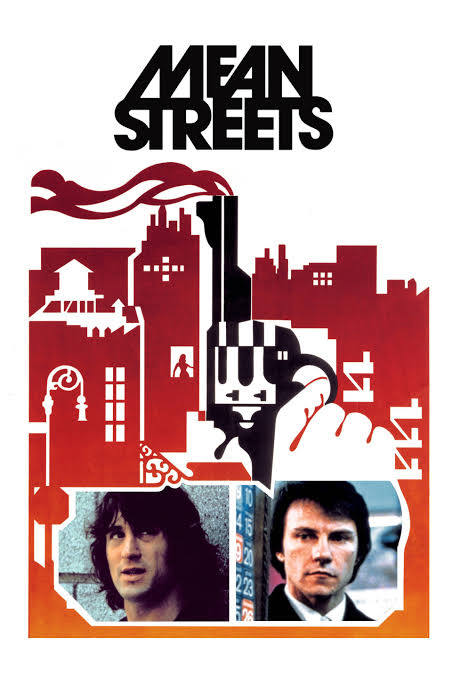
Thus Scorsese’s first foray into the mafia genre, 1973’s Mean Streets, is something of a surprise, for its depiction of New York’s Italian mafia may be on a much smaller canvas than Francis Ford Coppola’s The Godfather (1972), but in some ways it is even more romanticized.
The main character is Charlie Cappa (Harvey Keitel), a young Sicilian-American from Manhattan’s Little Italy. Charlie is an intelligent and sensitive young man of 25. He dresses very well. He reads authors like Hemingway, Hardy, and Dreiser. Charlie is also intensely Catholic but in a nearly blasphemous way. When he quotes Jesus, he sounds like he identifies with him a bit too much, like Charlie himself is the savior of mankind. He feels intense guilt because his family is involved in the mafia. But he rejects the Church’s path to redemption: confession and penance. Hence the voiceover that begins the film:
You don’t make up for your sins in church.
You do it in the streets. You do it at home.
The rest is bullshit, and you know it.
Charlie thinks he can redeem himself through acts of kindness, like Jesus ministering to the afflicted.
Charlie’s uncle, Giovanni Cappa (Cesare Danova), is a powerful mafioso who has taken Charlie under his wing. Giovanni’s criminal acts are all off screen. On screen, he is depicted as a consummate old-world gentleman. When a restauranteur who owes Giovanni money is behind on his payments, Giovanni’s advice is not to be impatient but simply to wait. When an impulsive young man shoots someone in order to ingratiate himself with the mob, Giovanni wants nothing to do with him and urges the lad’s father to send him to Miami until the heat dies down. When Charlie mentions that he was present at the shooting, his uncle tells him, “No you weren’t” and wants no further discussion.
Giovanni is also very protective of Charlie’s reputation. Thus he doesn’t approve of Charlie’s association with “Johnny Boy” Civello (Robert Deniro) and his cousin Teresa. The situation is delicate, however, and Giovanni is admirably sensitive to its moral complexities. First of all, Giovanni is “cumpari” with their family. Johnny Boy is even named after him. But he doesn’t want Charlie to associate with them because Johnny Boy is a bit crazy, and Teresa has epilepsy, which to Giovanni connotes madness. Second, Giovanni understands that Charlie feels sorry for them and wants to be nice. He even thinks this is to Charlie’s credit. Giovanni also knows they are neighbors, so Charlie can’t simply snub them. But still, he needs to disengage, because “Honorable men go with honorable men.”
The conflict of the film is that Charlie is already too involved with Johnny Boy and Teresa. Charlie is sleeping with Teresa, and he has vouched for Johnny Boy to Michael Longo, a loan shark. Like Giovanni, Michael is a patient man. But Johnny Boy has borrowed a lot of money from him and has been ducking his payments.
Johnny Boy Civello is a brilliant role for Robert Deniro. It is a compelling portrayal of an infantile parasite and con artist. He likes to gamble, whore around, and drink. But he doesn’t like to work. To fund his lifestyle, he cons people. Charlie has foolishly vouched for him, and when a mafioso vouches for a guy, that opens up a lot of loans. Maybe Charlie hoped Johnny Boy would turn his life around, but he’s basically an addict. He’ll drain everybody who associates with him of their money and reputations. The kinder they are, the more they will be victimized. When Johnny Boy runs out of people to con, he will turn to force. He’s already shown himself to be impulsively violent. Eventually, he’ll end up homeless, in jail, or dead, maybe all three.
Johnny Boy Civello is the first version of a character that turns up in other Scorsese films: Tommy De Vito in Goodfellas and Nicky Santoro in Casino, both played by Joe Pesci. All three characters are obnoxious, impulsive, sociopathic lowlifes who cause trouble for their friends, all of whom are sorely tempted to get rid of them. Both of Pesci’s characters end up getting killed by their long-suffering associates.
Johnny Boy’s most loathsome moment comes near the end of the film, when he blackmails Charlie by threatening to tell Giovanni just how entangled they are. Frankly, Charlie should have whacked him on the spot, with an extra bullet for the sheer moral obscenity.
Unfortunately, Charlie stays by Johnny Boy’s side until Michael the loan shark finally runs out of patience. When Johnny Boy threatens Michael with a gun, we learn that Michael isn’t quite the gentleman Giovanni is. He’s much younger, for one thing, and earlier we are treated to a really petty con, where he steals cash from a couple of kids from the suburbs who want to buy fireworks.
As Charlie and Teresa try to drive Johnny Boy out of town, Michael pulls alongside, and a gunman sprays their car with bullets. Johnny Boy is hit in the neck, Charlie in the arm. Teresa is injured when the car crashes. All three survive, though, and Johnny Boy scurries like a rat into an alleyway to an unknown fate. Things would be a lot simpler for everyone if he bled out amid the trash cans.
Charlie will clearly have some explaining to do to his uncle Giovanni. Charlie is lucky that his uncle is a patient man. Still, Charlie has created a beef between Giovanni and Michael Longo that may prove very costly to all parties, all because he did not follow his uncle’s advice. Let’s hope Charlie learns a lesson from this. I guess Scorsese’s message is that the mafia would be a nice gentlemanly business if you could just stay away from the impulsive psychotic lowlifes.
Mean Streets has a deeply conservative message. The authority figures are right about everything. Uncle Giovanni was right about not associating with Johnny Boy and Teresa. The church is right about keeping redemption within its walls, not in the streets. Charlie’s mistakes spring from his grandiose secularized Christianity. He’s a libtard, in short.
Charlie, Teresa, and Charlie’s friend Tony all have “first-generation college student” auras. They have inflated egos, identity crises, and are deaf to the wisdom of their elders.
Tony, like Charlie, has an uncle in the mafia. Tony manages one of his uncle’s bars, where he and Charlie hang out, drink and carouse, and exchange literary and musical allusions. Tony buys a panther as a pet, but he wishes he could buy a tiger like in the William Blake poem.
Their respective uncles were strong men who created good times. Charlie and Tony are the weak men created by good times (and college educations in the late 1960s). Mean Streets ends with the sort of hard times you’d expect from weak men, but I found myself really rooting for Charlie Cappa and everybody else who takes this cautionary tale to heart.
I highly recommend Mean Streets. Although it is Scorsese’s third feature film, it was his breakthrough, establishing all the classic Scorsese tropes and launching one of American cinema’s most distinguished and enduring careers.
17 comments
Great article! I have watched Mean Streets, I wasn’t impressed, now I understand it better. 🙃
Mean Streets is great, was able to catch it on the big screen at Tower theater in the late 90s. There are some interesting little comments on blacks and Jews sprinkled throughout the movie. Always appreciated Scorseses realism. Another good gangster movie was State of Grace. From an Irish perspective. Gary Oldman played a great psychopath. It came out in 1990 but kind of got overshadowed by Goodfellas.
I never heard of State of Grace, but I like Oldman, so I will add it to my list. Thank you
You are right, State Of Grace is a good movie, it would make an excellent article. Hard to believe it has been 35 years since it came out. 🙃
Great music from Morricone in that movie as well. A movie that’s strangely forgotten.
I’m not sure if the movie State of Grace was based on T.J. English’s book about the Irish Hells Kitchen gang The Westies, but it probably was. That was a good book, including that one of their sociopath captains was a Vietnam vet, and he capitalized on that to excuse himself, but English found he had been a “rear echelon motherfucker (REMF)” who served in an air-conditioned warehouse far from the front lines, and his war casualty was that when he was passed out drunk his buddies circumcised him as a “joke.”
The Westies, although a well written, entertaining book, seemed very sensationalzed by TJ English to sell his book. The Hells Kitchen “Irish Mob” was really just a small group of neighborhood tough guys, ex-cons, and drug addicts who were in the orbit of Jimmy Coonan, their leader. The Mafia could have squashed them like a bug but for some reason, rolled their eyes and tolerated them until they did what the Irish always do, self destruct. The closest thing to an “Irish mob” was the Winter Hill Organization based out of Boston. That was a hardcore organized crime group whose tentacles reached all over the country. The Mafia was very weary of them and didn’t fuck around with them. Whitey Bulger came out of that gang. State of Grace was loosely based on The Westies, but by the 80s , Hell’s kitchen was done. It had hung on as long as it could until the pressure from corporations and greedy developers transformed the area and it got buried in a tide of yuppies and dog shit.
“first-generation college students” indeed. I saw Mean Streets a long time ago and might not be right about the song they played, but I remember they had a late-night private party at their bar and the owner said “let’s play some of the old songs,” as he approached the jukebox. I was ready for some Italian folk or popular songs from the 1920s. Instead, he played “Bellbottom Blues” by Derek and the Dominos or something like that, maybe a recent song by The Band. Bizarre.
Thanks for this. There is a strong vibe of creeping “rootlessness” in this movie, and I am not sure the director is particularly enthusiastic about it. I could totally envision Charlie and Teresa a few years later as extras in Saturday Night Fever.
I like one of the early scenes, perhaps before the credits even, where Charlie is falling into his pillow, and the scene is broken up, with the song Be My Baby by the Ronettes starts playing.
One of my favorite mob films is Miller’s Crossing, by the Coen Brothers. CC can do a good piece on the unprincipled double crossing schmatta played to perfection by John Turturro.
https://counter-currents.com/2015/06/millers-crossing/
I’m now starting to wonder how many of my ideas are original or lifted from CC. If nothing else, good time for a re-read, thanks!
Another movie I am going to check out is Dementia 13 (1963). An early horror film written, and directed by Francis Ford Coppola, it has uneven, but interesting reviews. I wasn’t aware until I read the High-Def Digest review that Coppola also helped write Patton. 🙃
Fine article. Looking back at this one now, I don’t think I saw all the overtones unwrapped here when I saw long ago. I think I saw it because my wife at the time liked Gabriel Byrne. It was up to me to divulge deeper meanings and I skipped out on this one. I might give it another chance.
Any chance you will review Inglorious Basterds? I saw it the other day and found the fantasy entertaining for the most part. It’s pretty obvious who stole the show.
Just type the title in the search bar above, and behold.
Well I’ll be damned. Do we think he was being unintentionally funny in this film? The actress playing Shoshana looked so familiar, but I couldn’t place her and her bio didn’t help. I thought the negro character was overkill, especially when she called him a Frenchman. I guess they needed him as a foil for the Germans to find repulsive. I just saw a 100% white character film, Truth and Treason. A German perspective on the treatment of Jews and German civilians. I found it worthy of viewing.
You might like Kill The Irishman (2011). It is a true story about Danny Greene, an Irishman that challenged the Italian mafia in Cleveland. It has a strong cast, but I thought the script could have been better. 🙃
If you have a Subscriber access,
simply login first to see your comment auto-approved.
Note on comments privacy & moderation
Your email is never published nor shared.
Comments are moderated. If you don't see your comment, please be patient. If approved, it will appear here soon. Do not post your comment a second time.