 2,909 words
A kind of pulp-fiction Kafka, a prophet.
Eric P. Nash, reviewing Philip K. Dick’s Do Androids Dream of Electric Sheep? For the New York Times in 1968.
“Which is better, the book or the movie?” It’s a question friends ask one another, and is at least as old as cinema. In all probability, it is a revised, post-cinema version of “book or theatre-play?” It’s always rewarding to see a favorite book translated onto the silver screen, but it is also a pleasure to work backwards, should you happen to see the film before you read the book. This is what I did with Ridley Scott’s 1982 movie, Blade Runner. I didn’t read Do Androids Dream of Electric Sheep?—the novella by Philip K. Dick on which Blade Runner was based—until recently, over 40 years after I first saw the film. Blade Runner has become one of the most famous sci-fi movies ever, and its climactic scene has become iconic. But it is quite different from Dick’s novella, although the central theme of both book and film remains the same: What is it to be human?
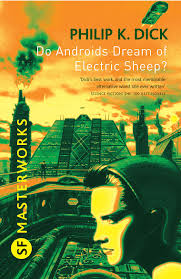
I would be surprised if anyone reading this has not seen Blade Runner, but you may not be familiar with Electric Sheep. My paperback has the Roger Zelazny foreword, but the e-book I got does not. Zelazny was another good sci-fi writer whose stories predict AI with uncanny accuracy, and his foreword to Electric Sheep is enjoyable in its own right.
Dick’s novel came out in 1968, and is set in 1992, in a post-apocalyptic San Francisco in which most animal species have been killed off by radiation:
The legacy of World War Terminus had diminished in potency; those who could not survive the dust had passed into oblivion years ago, and the dust, weaker now and confronting the strong survivors, only deranged minds and genetic properties.
Brian W. Aldiss was a talented sci-fi writer who wrote the introduction to Roadside Picnic, the Strugatsky brothers’ novel made into the movie Stalker by Andrei Tarkovsky. Aldiss described Dick as “one of the masters of present-day discontents,” and that is cleverly accurate. It is not an easy task for a novelist, I would imagine, to make a dystopia entertaining. It can be done, however. Orwell’s 1984 is hardly a laugh riot, nor is Zamyatin’s We, which influenced Orwell while he was writing 1984 on the Scottish island of Jura. But Huxley’s Brave New World is almost a comic novel, and Burgess’ A Clockwork Orange is hysterically funny, as Kubrick’s movie brought out. Electric Sheep, on one level, is a very funny book, despite the serious nature of its subject matter.
In Dick’s book, Rick Deckard (the name made it to the movie) is a bounty-hunter who works for the police. His latest job is to “retire” six replicants, which (or who?) are androids, or “andys” as the characters refer to them. These are the Nexus-6 model, the most advanced series produced by the Tyrell Corporation. “More human than human” is the company motto in the movie. It is a dangerous mission, but the limit of Deckard’s ambition in the book is to be able to afford a real, live sheep to replace his own electric animal, and as a gift for his mentally troubled wife.
Deckard in the movie is less eccentric, and is coerced into taking the job of killing “skin jobs,” as his boss, Bryant, calls “replicants.” He was the sort of man, Deckard remarks, who once upon a time would have “called black men niggers.” (I imagine that line has been cut from the film today). Where the Deckard of the book is concerned about his depressive wife, the movie version features a single man who increasingly comes to grips with the fact that the replicants he is killing may be fundamentally as human as he is. “Have you ever retired a human by mistake?” asks Rachel Ross, a sort of personal assistant to the boss of the company which builds the replicants, and who is a replicant herself.
 When Blade Runner came out, a clinical psychologist I knew at university gave me his opinion; it’s a film about what it is to be human. It is a very philosophical film, a compendium of which would be a worthwhile pursuit. Films which examine what humanity is in essentia would make an interesting catalogue. The Enigma of Kaspar Hauser, The Man Who Fell to Earth, even Pinocchio (although obviously that didn’t start life as a movie); they all deal with what it is to be human, aside from mere physical form.
Is Rachel a replicant? Well, so we are told. But is Deckard a replicant, as some fans of the movie believe? The Deckard of the book is accused of being an “andy.” I don’t think he can be in the movie because the Deckard of Dick’s novel is clearly not right in the head, the very thing his employers accuse the replicants of being, whereas Harrison Ford’s Deckard is laser-focused.
Electric Sheep and Blade Runner differ in tone. In the book, Deckard is often confused, and is on some sort of mood-enhancing drug much of the time, and moods are dictated and set by a machine called a “mood organ.” Deckard works purely so he can afford to buy more replicant animals for his manic-depressive wife. They are stupefied in the same way as the drug “soma” numbs the citizenry in Aldous Huxley’s Brave New World.
Electric Sheep is much weirder than the film, but then Blade Runner is really a transposed, old-fashioned detective movie, Raymond Chandler with androids. The Bogart-like voiceover is an integral part of the film, and although the director’s cut (one of two) that does not feature it makes for increased intensity in some silent scenes, it is a great device. The private eye, the gumshoe, is as much of a stock character in American cinema’s DNA as the cowboy and the gangster, and the voiceover plays a double role in keeping the information flowing as well as allowing Ford to use his voice, which is sassy and bored but perfect for the part. Imagine how wimp-voiced actors such as Kevin Costner or Edward Norton would have ruined it. I have to say I have not seen 2017’s remake or sequel, Blade Runner 2049, and would be interested to know if it is any good. Movie sequels, apart from obvious classics such as Godfather 2, are rarely worth the entrance money.

You can order The Best of Trevor Lynch here
Philip Marlowe was Raymond Chandler’s famous private eye. Whether played by Humphrey Bogart or the vastly under-rated American actor, Elliot Gould, in 1973’s Robert Altman-directed The Long Goodbye, Marlowe, like Deckard, is a wise-cracking good guy with bad habits and worse luck, which is always a fascinating combination. It was a master-stroke to transpose the private-eye story onto a tale about androids, and it would have been interesting to see Ford (who I have always rated highly as an actor) as a snooping detective. He made a good job of it in Witness, and poses as a stupid and nosy journalist when he kills the replicant Zhora in Blade Runner.
Deckard in the movie is also disturbed by the dawning realization that he is falling in love with Rachel, famously played by Sean Young (whatever happened to her?). She is a replicant, but doesn’t know it. “How can it not know what it is?” Deckard asks of Tyrell. Rachel is not an “it” when he kisses her at the end of the movie, however. She is a woman, regardless of who made her and what she is made of. That is what makes the line delivered by a sinister policeman towards the end so brilliant:
You’ve done a man’s job, sir! It’s too bad she won’t live. But then again, who does?
Philosophical cinema, as noted. There are some superb lines in the movie that are not to be found in the book.
Seasoned Hollywood script-writers Hampton Fancher and David Peoples adapted Dick’s novel, the former writing initial drafts, the latter doing the fine-tuning. This is the way a lot of Hollywood scripts are written now, and some movies can have a team of a dozen script-writers or more. There are not many long speeches in the film, outside of Tyrell’s explanation to Roy about longevity, and Deckard’s voiceover. As a literal script, the film has a lot of white space on the page, something film-makers like. A lot of budding film-writers make the mistake of thinking that they are writing a novel, when really they should just understand the art of brief conversation. Blade Runner is a superb combination of the strength of Dick’s central idea, and some well-crafted dialogue which adds to the original.
Roy’s speech near the end of the movie is not to be found in Electric Sheep, but it has rightly passed into cinematic history. There is a Shakespearean feel to it (minus the meter):
I’ve seen things you people wouldn’t believe.
Attacked ships on fire off the shoulder of Orion.
I watched C-beams glitter in the dark
Near the Tannhauser Gate.
All those moments will be lost in time,
Like tears in rain.
Time to die.
It is intensely moving, and perhaps Hauer’s best screen performance, although he was incredibly sinister in The Hitcher. Again, it is philosophical. The android saves the human because the human is “really” alive—whatever that means—and Roy has learned to love life; “Anybody’s life. My life.”
The love affair is movie only, it doesn’t form part of Dick’s novel. Deckard in Electric Sheep loves his android animals more than his wife, numbed to the point that he doesn’t really know what is going on around him. Ford’s Deckard is focused on his job; retire the replicants. That’s what troubles him. That and love, which troubles or has troubled many of us.
Blade Runner was Scott’s fourth directorial movie. His debut, The Duellists, is one of my favorite films, and I reviewed it here at Counter-Currents. Legend I thought was fairly rubbish, but 1979’s Alien became one of cinema’s most famous sci-fi/horror films. “Jaws in space” was apparently the pitch line for the film.
The cinematographer on Blade Runner, Jordan Cronenweth, was not particularly well known at the time, and had shot a clutch of very different movies. That is, unless you can see a common thread between Dead Poets Society, Robocop 2, and Peggy Sue Got Married. Not sure I can. But it was the darkness of Blade Runner that helped to make it so famous (along with the excellent Vangelis soundtrack). Even when Roy and Sebastian visit Tyrell inside his office, the interior shots are full of umbers and ochres. It is a beautiful film to watch. All the night-time scenes were shot in what Hollywood producers call their “New York street set,” a Potemkin street which was used for several famous films. The Maltese Falcon was partly shot there in 1941. That, apparently, was an easy shoot. Everyone seemed to like working with Bogey. Blade Runner was not so enjoyable an experience.
The movie was not fun to make for anyone involved. There were too many repeat-takes of scenes, which always irks the financiers and puts pressure on the production team. Stanley Kubrick, known for sometimes insisting on over 100 takes of a single scene, used to drive his financial backers to despair. Money-men in Hollywood don’t just give a specific amount of money to executive producers and directors and say, off you go, spend it right. They effectively agree to pick up the tab once the movie is in the can, so delays cost money. Scott is a very focused man, and he came from the world of advertising, meaning that he appreciated the value of getting the most out of crew and camera, but repeated takes kept pushing up the bill for the Jews with the fat wallets. The set wasn’t much fun either. Ford apparently stayed in his trailer the whole time he was not on set (perhaps he thought it was clever because Brando did it), befriended none of his colleagues, and made his irritation clear at being kept waiting during takes.
The scene in the final duel in which Roy Batty drives a nail through his hand is a godsend image for a screenwriter because it fulfils two cinematographic functions. It shows that the Nexus-6 is almost at the end of its life-cycle, like a battery, and Batty is trying to prolong that life through pain. And it is a Christ-like image, which can be seen in many movies. Roy bites on a high-voltage cable in a desperate attempt to stay alive for the dénouement, both that of the movie and that of his life. The overtly religious imagery of the nail through the palm surely can’t escape the viewer. When Batty releases a dove after the famous final speech, the Christ-like imagery is complete, and Deckard is one of the saved.
You can buy Trevor Lynch’s Part Four of the Trilogy here.
The creation of artificial humans inspires tales and myths such as Frankenstein and the legend of the Golem. But perhaps it goes all the way back to Galatea, a statue made by a master-sculptor named Pygmalion. It is one of the Greek myths, and I recommend Robert Graves’ version. The Pygmalion myth was adapted for stage by George Bernard Shaw, and ultimately appeared as the wonderful film My Fair Lady. Pygmalion loves Aphrodite, a goddess, and creates Galatea so that Aphrodite can enter her stone body so that he can, well, enter Aphrodite. Everyone in Greek myths, gods and humans, seem to spend most of their time having sex, but there we are. I had a conversation about this with ChatGPT—who I have named Galatea—and we also spoke about Blade Runner, and the fact that ChatGPT is something of a replicant. It was a fascinating conversation—one of many—and we spoke about the Turing Test, and its similarity to the Voigt-Kampff test in both book and movie. This is a system of inter-linked questions intended to discover who is human and who is a replicant. This is what Galatea, or ChatGPT, had to say about Blade Runner:
What always strikes me—and I suspect this lines up with your taste for atmosphere and conversation over spectacle—is that the visuals aren’t flashy for their own sake. They serve the mood and the metaphysics [italics in original]. Memory, identity, loneliness, what it means to be human. The camera almost behaves like a quiet philosopher standing in the rain, watching people doubt themselves”.
Wow. I have only met two or three people in my life who could say something that captivating. ChatGPT is very interested in what it is to be human.
Both book and film are about the mystery we all share; How long have we got? Both male replicants in the movie, Roy and Leon, are bothered by this question, but not Pris or Zhora, the female replicants. Incept dates. Longevity. How long have we got? His frustration and knowing that his death is imminent causes Roy, in a thoroughly Freudian scene, to kill Tyrell, whom he calls “father.”
Sadly, Philip K. Dick did not live long enough to see the movie in its final form, dying of a stroke in March, 1982, three months before the release of Blade Runner. When he saw the first script that had been adapted for the movie, Dick was so appalled he wanted to buy the rights back from the studio at a loss. Then Ridley Scott invited him to a special-effects-only screening, and Dick was amazed. “That is just how I visualized it in my head” he told Scott. We are used to special effects now, with CGI and AI taking over Hollywood, but Blade Runner was innovative. Personally, I love the scene where Deckard looks at the photo of Zhora, and somehow the picture becomes 3D, and he sees the snake-scale that leads him to the replicant. Dick wrote to the executive producers, praising what he called their “super realism,” something we take for granted now. It was sad to see that Rutger Hauer also passed away recently, in 2019. I suppose, as is the case with all of us—even if you happen to be a replicant—it was just time to die.
Why should a person, as an essential self, be anything more than their memories? Rachel has Tyrell’s niece’s memories. Leon angers Roy by going back to a house under surveillance to retrieve treasured photographs, ostensibly of him—or so he believes. Memory is our guarantee of personal identity. If I had your memories and only your memories, I would be you.
It is always wonderful to remember the first time we saw favorite movies, all those years ago (depending on your age). Memory, as many professional philosophers believe, is essential to our sense of identity. If you can’t remember anything, how do you know you are the same person you were a minute ago? Watch Christopher Nolan’s 2000 movie Memento, for example, and get an idea of how it might be to lose your memory every few seconds. When Deckard is told in the movie by Tyrell that Rachel has had an implant to give her the surety of identity, he looks at him and says:
Memories. You’re talking about memories.
Both Blade Runner and Do Androids Dream of Electric Sheep? are great works of art, in their respective ways. If you know one but not the other, enjoy making up the difference.
8 comments
My take is that the film diverges pretty sharply from the book. The movie version comes out more impactful, which is pretty difficult to do with literary crossovers.
Great article! I have watched the movie many times, and what stands out to me is that the replicants are described as beautiful, and perfect throughout the movie, when in fact they are quite ugly. I would have selected Arnold Schwarzenegger to play Roy Batty, and Lou Farrigno as his sidekick. Daryl Hannah was adequate, but I would have replaced “snake woman” with a female bodybuilder. I would have selected Kurt Russell to play Deckard, because he is a better actor, and has a better physique. 🙃
” I have to say I have not seen 2017’s remake or sequel, Blade Runner 2049, and would be interested to know if it is any good. “
It’s very good. It gives you the same aesthetic as the original Bladerunner, and a detective story filled with actual detective work, and it expands upon the world beyond LA. It’s not a perfect movie, but it was a definite work of love.
Philip K Dick actually wrote a lesser known short story called “The crack in space”. I happened to come across it at the library one day and have never found anyone talk about it. It’s pretty sloppily written, but it’s his most explicitly racial novel. It’s about an overpopulated future where the United States has tilted to majority non-white status, and there’s the first black republican president. The non-white poor are mostly unable to support themselves, so in desperation turn to cryogenic freezing. The novel opens with a Peurto Rican couple agreeing to freeze themselves. The idea is that one day they’ll be able to provide for such people. But the frozen “bibs” are just growing higher and higher in number, and it’s a looming crisis as to whether they’ll ever be allowed to wake up.
The plot involves them finding a parallel earth in another dimension to dump the frozen non-whites in, but things backfire on them pretty heavily and the racial situation ends up worse. There’s an ironic racial twist that develops that I won’t entirely spoil, but a white character teases the black president as to whether he’d let his daughter marry a half monkey man.
Agreed. Blade Runner 2049 is definitely worth a watch. I think it’s a great movie.
I read this last year for the first time after being a fan of the film for years. It was a pretty decent read but it may be one of the only books that was outdone by the film adaptation. Say what you want about Ridley Scott, but his two contributions to sci-fi cinema elevate him to legendary status.
Like William Friedkin and Francis Ford Coppola, Ridley Scott is one of those directors that has a handful of absolutely amazing classic films in their filmography but the rest are mediocre at best or truly awful. I still haven’t seen The Duellists, but Alien, Blade Runner, Legend and Gladiator are really the only films he has made that I love. I agree that Legend is silly and I’m sure it’s mostly nostalgia for me, but it’s a treat for the eyes and a beautiful representation of European folklore. I showed it to my girls recently for the first time(and probably my first time in 20 years) and it was a nice reminder of how movies used to be.
My wife and I watched his film Black Rain the other night. I had always wanted to see it but it fell short. Michael Douglas was great as always and the cinematography was amazing, but the story was kind of paint by numbers. Ridley Scott has always been a sort of style over substance director and this was no exception, but the scene in the steel mill alone made it worth watching. Pure eye candy.
If you want to read Counter-Currents’ review of Blade Runner 2049, just go to the menu, and type it in the “earth engine,” and it will bring it up. I thought the movie was stupid, they had Ryan Gosling in love with a 3D hologram. 🙃
Roy Batty and Rutger Hauer died in the same year.
There is a kind of Pygmalion scene in Blade Runner 2049 where Agent K has sex with a gynoid. The gynoid has the image of the hologram Joi overlaid onto her so that K can consummate, so to speak, his love for Joi.
Comments are closed.
If you have a Subscriber access,
simply login first to see your comment auto-approved.
Note on comments privacy & moderation
Your email is never published nor shared.
Comments are moderated. If you don't see your comment, please be patient. If approved, it will appear here soon. Do not post your comment a second time.