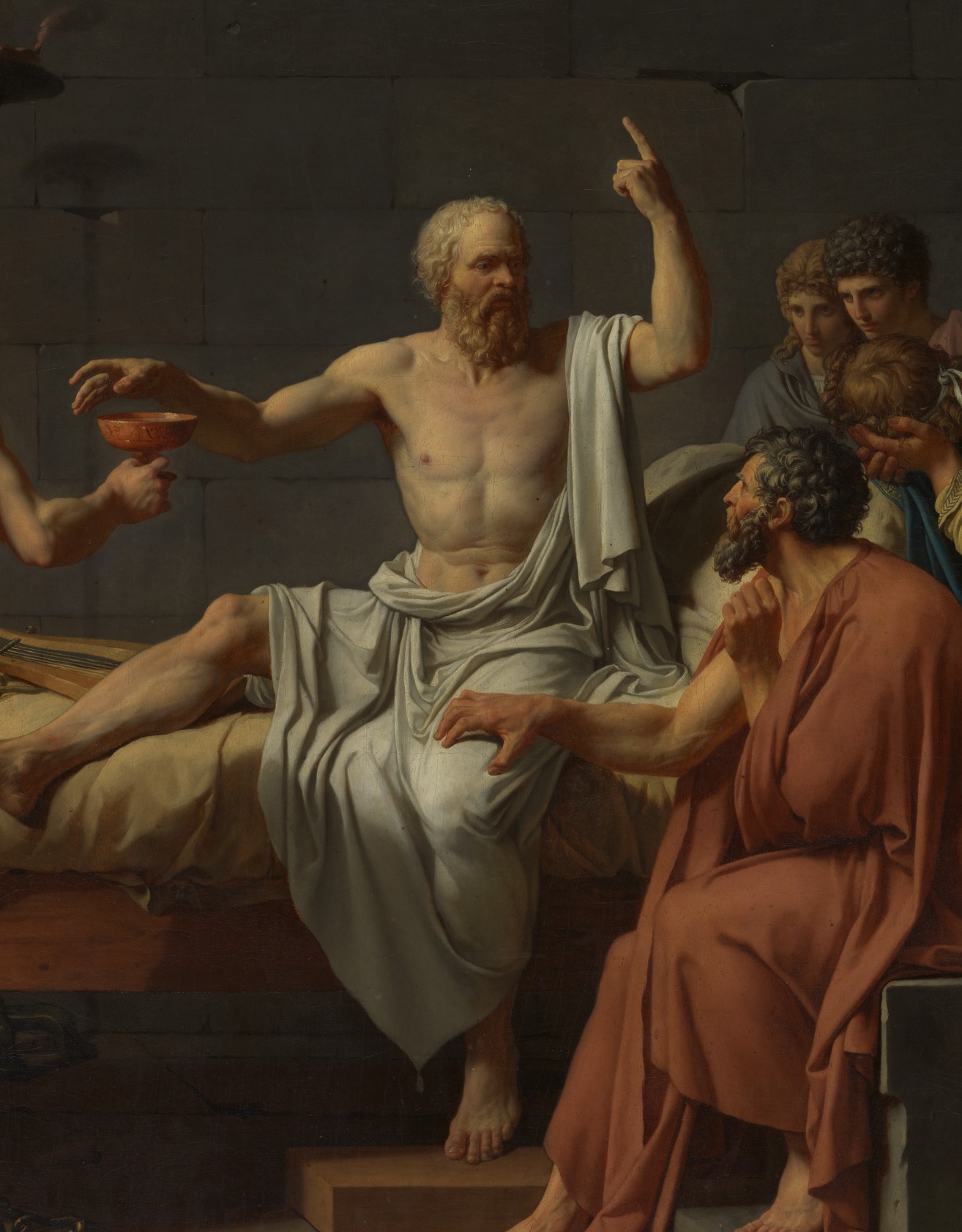
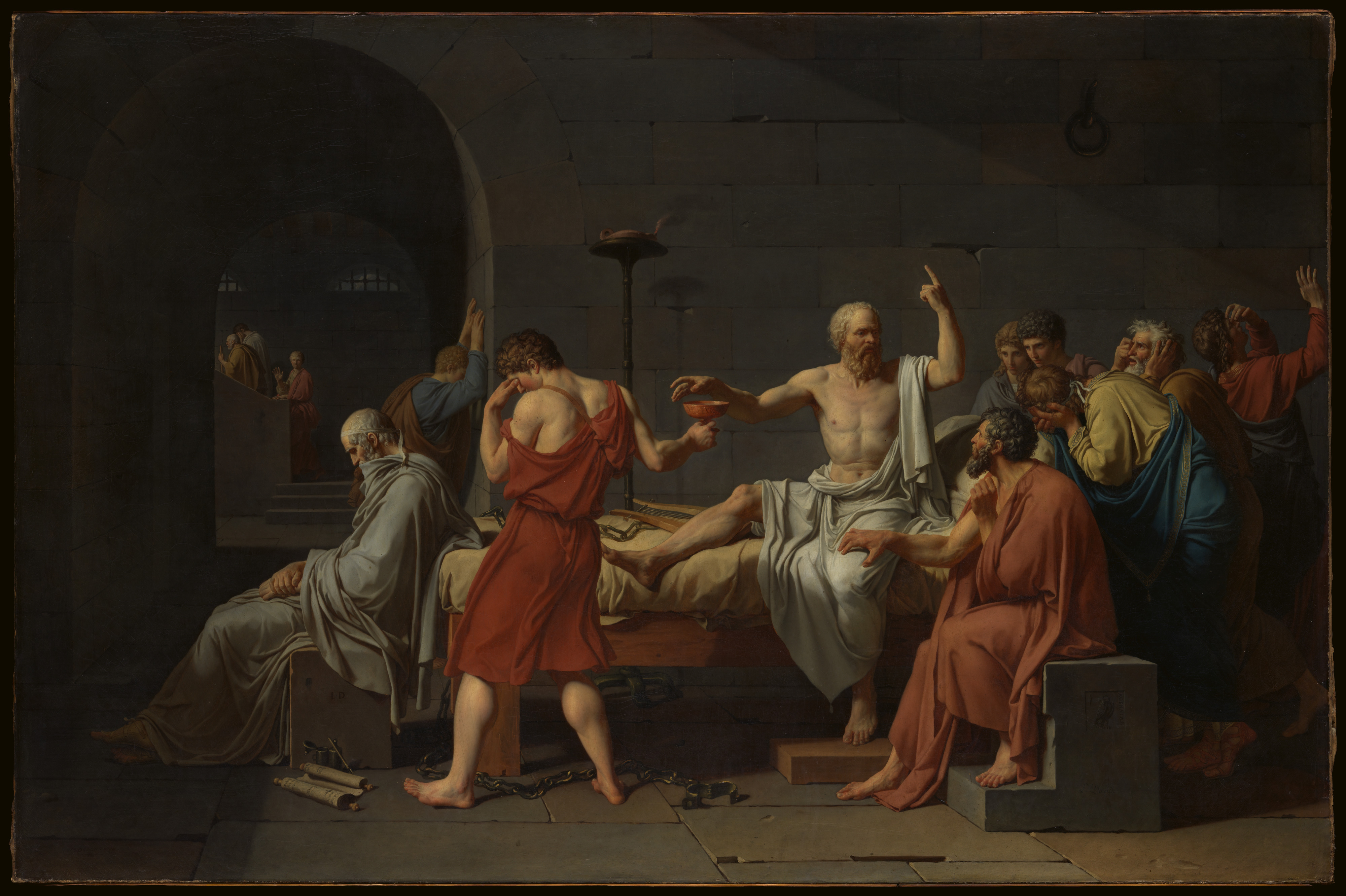
Detail of Jacques-Louis David, The Death of Socrates, 1787.
1,790 words
“Life is a tricky business. I’ve decided to spend it trying to understand it.”
—Arthur Schopenhauer, Remark made to Christoph Martin Wieland
I am a philosopher, drawn to philosophy from an early age, initially Plato’s Dialogues. I’ve also been rewarded with a long healthy life (I am 78 years old) which has been incalculably enriched by being able to read, write, teach and think about things philosophical. Some of the most intense, satisfying memories of my life are those comprised of recalling a particular book I had read that profoundly challenged or changed my way of thinking—Aristotle’s Nicomachean Ethics, Hume’s Dialogues on Natural Religion, Ortega y Gasset’s Revolt of the Masses.
Some months ago, I wrote a substack piece that informed the readers that I had been diagnosed with inoperable pancreatic cancer, which meant, of course, that the concept of death suddenly became not simply of conceptual interest as a philosophical “problem” to analyze, but a deeply personal preoccupation. The theme of death figures prominently in the history of philosophy. The most famous instance, perhaps, is of Socrates as Plato presents him in the Phaedo, a dialogue to show how a philosopher should prepare for death, philosophy itself being a preparation for death because of what it means for the soul. How also could I not mention the Roman philosopher-theologian Boethius and his Consolation of Philosophy, written as he awaited execution for the alleged crime of treason under the Ostrogothic King Theodoric the Great? Philosophy is the ultimate consolation for Boethius: “no man can ever truly be secure until he has been forsaken by Fortune.” Ponder the depth of those words. The mind, says Boethius, is the “one true good.” David Hume’s stoical equanimity in the approach of his death is compellingly documented in his Mine Own Life and in the witness of his friend Adam Smith. Fundamental in the philosophy of Martin Heidegger is his Sein-zum-Tode, “Being-toward-death.”
In Heidegger’s view, it is the encounter with death that most profoundly highlights the question of Being. “Only humanity has the distinction of standing and facing death, because the human being is earnest about Being (Seyn): death is the supreme testimony to Being (Seyn).” (Cambridge Core)
As a philosopher now contemplating his death in a personal way, I wish to relate some random thoughts on how the study of philosophy has fortified me since my I learned that I had fallen victim to this merciless, highly dreaded disease.
Before sharing these thoughts, I feel compelled to say a few things about cancer, now that I have a personal daily experience of it (“knowledge by acquaintance” as Bertrand Russell might characterize it) in ways I could never have imagined before I became its captive.
You can buy Greg Johnson’s The Trial of Socrates here.
Like no other disease, cancer, the second leading cause of death world-wide and in the U.S., seems to lend itself to the application of powerful anthropomorphic comparisons and imagery. Possessing some of the darkest, cruelest features of undistilled human malevolence, it resembles a serial killer, disguising himself in a normal functioning community (a healthy human body in this case), lurking and preparing to kill. Suddenly, randomly he selects his innocent victim—a child, a young mother, an aspiring artist, an athlete, an elderly scholar. And when he strikes, he may decide to kill you quickly, or let you die a slow, agonizing death. Or, he may retreat (cure/remission) and years later return to another part of your body to finish you off—“Thought you were whole? Ha, I’m back!”
Just the word “cancer” strikes terror because it threatens you the way a human terrorist threatens you. There is no defense against him. Even if you eat well and exercise, like me. He can be anywhere and strike whoever he chooses at his leisure when he is ready. The time of his choosing may be when you are feeling your best, perhaps planning your retirement, your daughter’s wedding, waiting the birth of your first grandchild. Your only protection is hope … hope it’s not you or your family and friends.
Currently, I am undergoing extremely aggressive bouts of chemo “therapy.” “Chemo,” I am tempted to speculate, was devised by some malevolent experimentalist to test the boundaries of the human will to withstand such mind-body shattering experiences as unrelenting nausea, pain like you’ve never felt before, spirit-sapping fatigue, and the cascade of fear of its worsening, as you contemplate raising the white flag of surrender—“I want out … before…!” Chemo may extend your life. In some cases, it can cure you, depending on the kind of cancer.
But for those like me, in the more advanced stages of an aggressive cancer like pancreatic, you find yourself willing to gamble on what the quality of day-to-day life will be in what is most likely a very limited number of your remaining days, as ruthlessly enumerated and confirmed by the actuarial tables of “progression-free survival.” With the infusions of poison, how much, you must ask yourself, are you willing to suffer today, tomorrow, this week with the fragile hope that there will be some days ahead when life is somewhat like it used to be before you got so sick and can temporarily put it aside? The odds in this particular game of chance are stacked heavily in favor of “the house,” the house being the disease that dealt you your initial crappy hand of sixes and sevens and is willing to deal you another hand as long as you are willing to suffer. Just when do you decide to “fold”?
Below are some famous philosophers who were felled by cancer:
David Hume—colorectal cancer (probably), age 65
José Ortega y Gasset—liver cancer, age 72
Robert Nozick—stomach cancer, age 63
Jacques Derrida—pancreatic cancer, age 74
Richard Rorty—pancreatic cancer, age 74
Saul Kripke—pancreatic cancer, age 81
Sir Roger Scruton—lung cancer, age 75
Hilary Putnam—mesothelioma, age 89
L. Austin—lung cancer, age 48
Ludwig Wittgenstein—prostate cancer, age 62
Aldous Huxley—oral cancer, age 69
As for philosophical fortification in the contemplation of one’s death, I would begin by saying that the most remarkable thing one might say about death is its profound mystery. Of course, I must add that there is nothing mysterious about death as a physical-biological event. But for human beings, we early on come to understand the inevitability of death. It lodges itself in the mind of each and every one of us at the beginning of life as a reminder of our finitude. The awareness of death is a life-long constant companion we do our best to ignore. Nevertheless, what to think about it, how to think about it, when to think about it are all questions that never cease to persist. But these questions can never be answered with confident satisfaction.
The quest of philosophy is to acquire knowledge. Thus, in contemplating the mystery of death there is a kind of philosophic helplessness that descends. This is because there are no syllogisms, no accumulations of empirical data to yield the knowledge that gives you the confidence to resolve the myriad questions surrounding death—its “meaning,” an “afterlife,” total annihilation, the fear of it and so on.
You can buy Greg Johnson’s Graduate School with Heidegger here
Yet, there are ways to grapple with these questions that enable one to move toward the end with a calm acceptance, less fear, and a quiet courage. One is the cultivation of a moral attitude of gratitude for the years you’ve been given. To exit bitter or angry is pointless and unbecoming. From Epictetus, a Greek Stoic philosopher born into slavery, I learned how to think about life and death:
Never say of anything, “I lost it,’ but say, “I gave it back.” Has your child died? It was given back. Has your wife died? She was given back… But you say, “He who took it from me is wicked.” What does it matter through whom the Giver asked it back? As long as he gives it to you, take care of it, but not as your own; treat it as passer-by treat an inn. (Enchiridion)
I have come to think of all the years of my life as something lent to me —“living on borrowed time”—not the stock phrase applied to those expected to die soon. The life of every human being runs on borrowed time. I’ve been lent more than most, and for that, feel an immense gratitude.
The equanimity of David Hume in his final days is also an inspiration to me. As he writes shortly before his death:
[N]ot withstanding the great decline of my person, [I have] never suffered a moment’s abatement of my spirits; insomuch, that were I to name the period of my life, which I should chose to pass over again, I might be tempted to point to this later period. I possess the same ardour as ever in study, and the same gaiety in company. I consider, besides, that a man of sixty-five, by dying, cuts off only a few years of infirmities…. (My Own Life)
How can one not admire such a resilience of spirit?
Arthur Schopenhauer has a lot to say about death, particularly why it makes no sense to fear it:
Every event of our life belongs only for a moment to the Is, then forever to the Was. Each evening we are poorer by one day. Perhaps we would go insane watching the brief span of our time running out, if not for a mysterious awareness lying deep at the bottom of our being that the never to be exhausted fountain of eternity belongs to us, in order to enable us to refresh the period of life forever. (On the Doctrine of the Nothingness of Existence)
A piece of Schopenhauer’s superb philosophical prose that captures his argument that the life of each and every human being is an “appearance” in time and space, a brief manifestation of the metaphysical “Will” from which we emerge and to which we return when the “Was” is complete. That “mysterious awareness” points to an ultimate reality beyond time and space in which we participate outside the constraints of human nature. Death is “a transfer of the appearance to the thing in itself.” (On the Indestructibility of our True Essence by Death)
A caustic quote from Samuel Johnson recently came to my mind: “Depend upon it, sir, when a man knows he is to be hanged in a fortnight, it concentrates his mind wonderfully.”
I can happily say that I do not expect to be “hanged in a fortnight.” But ever since I learned that I will soon face death, my mind has indeed been wonderfully “concentrated,” which makes my remaining time in the world of philosophy, reading, and reflecting on the wisdom of the world’s great minds even more exciting, intense, and rewarding than it was before.
15 comments
Even better the third time. Hang in there Stephen.
Stephen, I’ve enjoyed reading your articles on CC since I’ve discovered this website. I’ve also gained some knowledge on various topics by reading your articles. That should count for something. Counter Currents has been described as a right-wing university. Much of the knowledge gained here are things that you don’t get taught in college because of political correctness, sensitivity, and a competing agenda. Also, what you did learn in higher education gets refined here and many previous questions that have been unanswered finally get answered. That is one of the reasons that I support this website, which you are a part of. Chemotherapy is rough. It will be good if you come through it alive and give CC readers some more articles.
This was interesting and insightful. Thank you for writing it. I think it’s a great achievement to be able to write so well under such darkness as the imminent shadow of death. A “moral attitude of gratitude” sounds good but I just call that thanking God. Maybe pick up a Bible in the time you have left and apply that heavy intellect to the Word of God which has the power to save your soul.
You have a great consolation already, but I wish you all the best and a miraculous recovery.
Have you heard of fenbendazole (sp?). I have read that it has been an effective treatment for some types of cancer. Good luck to you, sir. Thank you for writing.
That’s terrible news. So sorry to hear it, although I don’t know much about Stephen apart from his books, a few of which I own, and great articles.
My expectation of death is that it’s like before you were born. Simply a not being. I don’t fear death exactly, but I don’t want for me or loved ones to be in pain. my perfect death would be to expire in one’s sleep without a knowing or expectation. I feel a poem coming on….
My expectation of death is that it’s like before you were born. That’s exactly how I feel and I understand how and why people feel death but then ask them where were you five years before being born and do you fear a return to that timeline before your conception? Reminding myself of such does make me feel better in the interim.
Well, I fear death, like if someone said you’re gonna be executed in one hour or something like that, that’s why I said I’d prefer not to see it coming. But the state of being dead does not terrify me much, I’m much more scared of certain in incremental things like stroke or something you know. I’m not trying to make myself sound brave or nothing.
I always appreciate your writings here, Stephen. To be so lucid at your age is fortunate, and as you say you are well positioned to absorb this grim news and to “make hay while the sun shines”. I am grateful for your perspective.
“initial crappy hand of sixes and sevens ” six seven heh
Praying for a miraculous recovery. I have appreciated your work and am glad I met you at an earlier conference.
Thank you for this. Montaigne’s essay, “That to Philosophize Is to Learn How to Die,” is also worth mentioning here. I do believe, with Nietzsche and Strauss and others, that the philosophers are, all of them, atheists and hence have no expectations for anything after this life other than perhaps to be remembered well. I hope you are remembered well.
Or is it the quality of those who remember you? We will remember him!
I hope for a quick recovery, sir! However, if you have children your evolutionary duty is fulfilled…
Thank you for this gift of an article. It exudes philosophical equanimity. I hope you beat that dread disease, but either way, I hope even more that you use the time remaining to you wisely, as you have reminded me to do. Godspeed to you.
Thank you!
Comments are closed.
If you have a Subscriber access,
simply login first to see your comment auto-approved.
Note on comments privacy & moderation
Your email is never published nor shared.
Comments are moderated. If you don't see your comment, please be patient. If approved, it will appear here soon. Do not post your comment a second time.