2,769 words
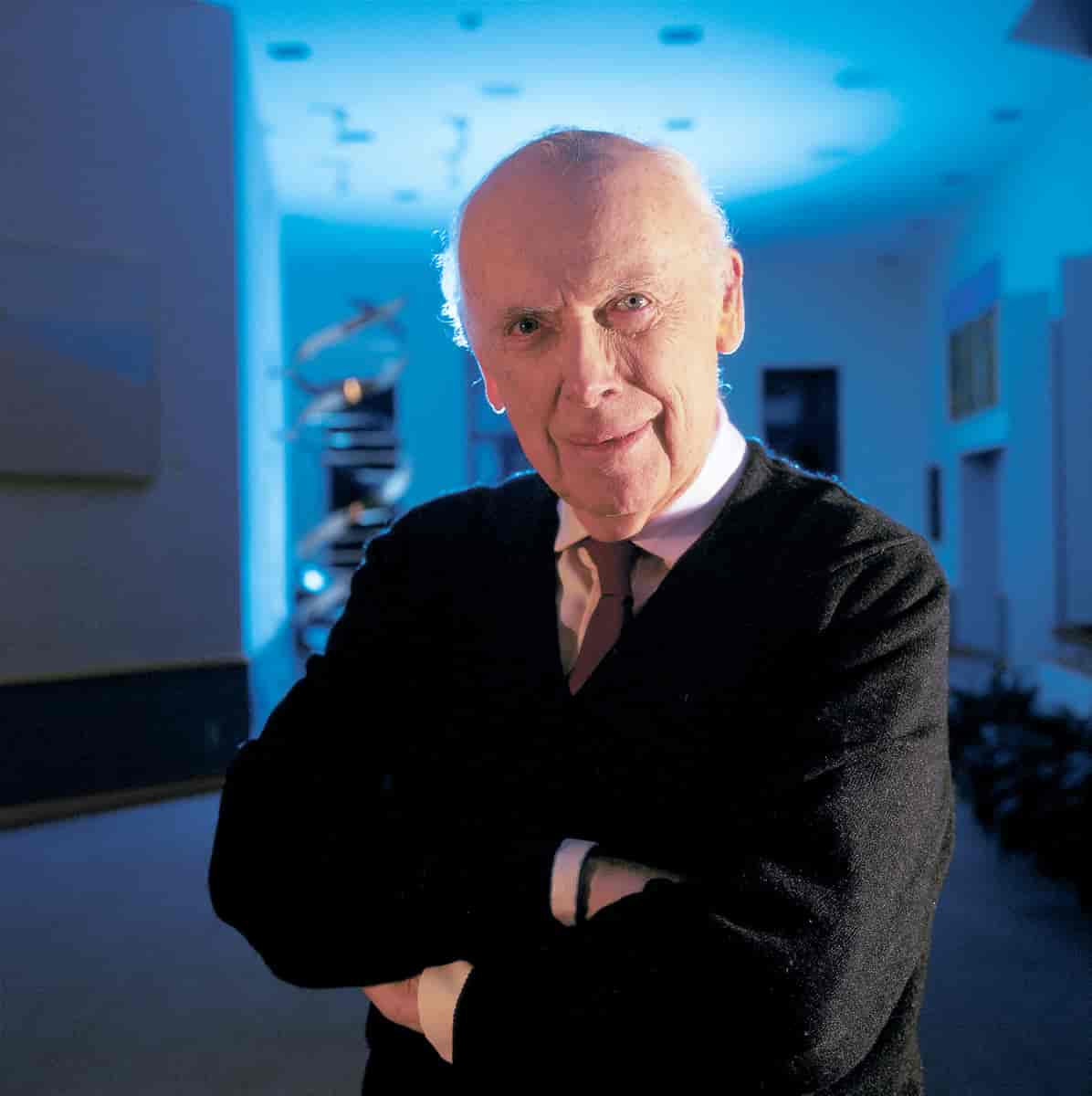
Nobel laureate Dr. James D. Watson, Chancellor, Cold Spring Harbor Laboratory.
Many of the people who joined in the attacks on Watson in 2007 must have known that what he said about racial differences was accurate. After all, if he had simply been unaware of all the studies demonstrating that racial IQ gaps are environmental in origin, these could easily and quietly have been brought to his attention. There would have been no need to impugn the man’s character publicly.
The difficulty, of course, is that no such studies exist. Most of Watson’s critics were aware of this, and admitted as much by focusing instead on the “offense” his remarks had caused. Woke ideology is more concerned with feelings than facts. Its advocates believe people simply mustn’t say what Watson said.
So what kind of person disregards everyone’s feelings and says what he thinks anyway? A person low in agreeableness and empathy, unable to understand or unwilling to care about the feelings of others, unmindful of social rules. And these are, as we have seen, traits likely to be found in a scientific genius. As Dutton puts it:
This is crucial to genius because genius involves coming up with and presenting a ground-breaking and highly original idea. True originality will always offend vested interests. [It] will also involve breaking the rules; thinking the unthinkable, contemplating something that is so “out there” that it would seem ludicrous to ordinary people. It would be unthinkable to those who are high in rule following.
It is not difficult to document Watson’s lack of concern for the sensibilities of others long before the scandal of 2007. In his 1968 memoir The Double Helix, e.g., he wrote that
Francis [Crick] did not worry about these skeptics. Many were cantankerous fools who unfailingly backed the wrong horses. One could not be a successful scientist without realizing that, in contrast to the popular conception supported by newspapers and mothers of scientists, a goodly number of scientists are not only narrow minded and dull, but also just stupid.
He also included some frank remarks about Rosalind Franklin: “The real problem, then, was Rosy. The thought could not be avoided that the best home for a feminist was in another person’s.” He also speculates on whether she might have improved her appearance with a better hairstyle or more attention to her clothes. It may have been for the best that she had died by the time the book was published.
The candor of what Watson published falls short, however, of what he originally wrote. After sending the manuscript off for colleagues to read and comment upon, he was persuaded to remove lines about someone practicing “screwy Chemistry” and “looking like an ass.” Crick and others were so appalled by the manuscript that they had a lawyer write to Watson saying his clients felt the book libeled them.
Watson’ biographer wrote of the savagely frank memoir: “How could a man of 40, of such transcendent achievement and influence, fail to exhibit mature judgment and kindness in describing the lightning strike of 1953? Would Jim ever grow up, and put aside the brutality of the young?” Elsewhere he wrote that Watson “spoke to students with such light-hearted and brutal frankness that one wondered if he mightn’t be the most indiscreet scientist in the 300-year history of modern science.”
Watson’s later memoir Avoid Boring People offers more evidence concerning these personality traits:
The year had exceeded even my highest hopes, since I was now in the thick of the quest to understand the gene. I became more than aware of the advantages of having attended the University of Chicago, where I had learned the need to be forthright and call crap crap. It was not that I was inherently brighter than my fellow graduate students; I was just much more comfortable challenging ideas and conventional wisdom, whether it concerned politics or science.
Dutton describes his thinking at the time of his great discovery as follows:
Watson has finally found his true calling: to understand the nature of the gene. Little else now matters. Young Watson hardly cares about occasional B-grades in dull, poorly taught classes. He is, in his own words, on a quest. It is a quest for the truth. Watson notes that academia “abounds in triviality” and this is to be ignored. The truth will only be reached by overcoming the vast majority of research—which is pointless, career-elevating tinkering and unnecessary, intellectually pretentious nuance—and fighting for the prize of a fundamental discovery. Vitally, “feelings” must not be a concern, nonsense must be called out as such, and the Midwit guardians of academic vested interests must be slain: dragon-like enemies of truth every last one of them, breathing the fire of intellectual cowardice. Watson experienced his fundamental breakthrough almost like a religious experience: “But now, to my delight and amazement, the answer was turning out to be profoundly interesting. For over two hours I happily lay awake with pairs of adenine residues whirling in front of my closed eyes.”
The most creative and original scientists tend to score unusually high on the personality trait of Openness. They have a very broad knowledge base due to their intellectual curiosity. This knowledge base permits them to make connections between different domains. Accordingly, such men often make their main contribution in a subject other than that in which they were formally trained. A good example would be American biologist Edward O. Wilson (1929-2022) using his knowledge of ants to understand humans and, so developing sociobiology, where human society is examined from a mainly biological perspective – which incrementalists, focused on their narrow area, simply don’t perceive.
As Dutton notes, this was also the case with Watson:
His passion was ornithology and his major subject as an undergraduate was Zoology, in which he received his degree. However, while he was still an undergraduate, as well as reading all manner of literature that was non-scientific as part of his idiosyncratic degree programme, he read Austrian physicist Erwin Schrödinger’s (1887-1961) What is Life? and became fascinated by genetics.
Similarly, the academic background of Watson’s partner in discovery Francis Crick was in physics. Watson himself commented on this as follows: “In every sense solving the double helix was a problem in chemistry. Alex Todd facetiously told me that Francis and I were good organic chemists, not wanting to admit that a major objective in chemistry had been solved by nonchemists.”
However, as Dutton notes, there is a fascinating flip-side to the extreme intellectual openness of the creative scientist. It may attract them to possibilities that other people would dismiss as manifestly ludicrous. Isaac Newton devoted much serious attention to alchemy and looking for hidden codes in the Bible. Hans Eysenck was prepared to entertain the possibility that there might be something to astrology. Some of these men will also be attracted to subjects beset with social or moral taboos, such as physicist William Shockley’s interest in eugenics.
Watson’s 2007 remarks were not the first time his candor and willingness to explore sensitive areas got him into trouble, although the reactions had previously been less extreme. In 1997 he stated that a woman should be allowed to have an abortion if it could be shown that the child would likely be homosexual and she was saddened by the prospect of not having grandchildren. “Gay rights” campaigners accused him of wanting to use genomic research to eliminate homosexuality.
Then, in November 2000 Watson gave a guest lecture at Berkeley entitled “The Pursuit of Happiness: Lessons from pom-C”. He explained to his audience of 200 students and academics that a certain protein, pom-C, helps create several different hormones: one determining skin color, another increasing a sense of well-being, and the third playing a role in fat metabolism. He wondered aloud why evolution should have linked these hormones, and speculated on whether they might interact with sunlight, as melanin does. He suggested there may be a relationship between skin color and sexual activity. “That’s why you have Latin lovers. You’ve never heard of an English lover.” He shared an anecdote about some men injected with melatonin developing “sustained and unprovoked erections.” Then he speculated on whether sunlight increases sex drive, showing slides of women in bikinis and contrasting them with veiled Muslim women. He also mused that thinness might correlate with ambition, displaying a slide of the English model Kate Moss looking sad to support his view that thin people are unhappy and therefore more ambitious. “Whenever you interview fat people, you feel bad, because you know you’re not going to hire them,” he observed.
These remarks upset a number of people in the audience, specifically women. Two female students told reporters how offended they were.
A biology lecturer called Susan Marqusee walked out of the lecture a third of the way through, presumably due to being unable to emotionally cope with listening to any more of it, congruous with a “stereotype,” or rather an empirical fact, that females are more “emotional” than males due to being higher in Neuroticism, feeling negative feelings, especially anxiety, induced, in particular, when their evolved desire for social conformity is interfered with. She explained to reporters: “I was kind of in shock most of the time. He took a lot of what I consider sexist and racist stereotypes and claimed a biochemical basis without presenting any data.”
But, of course, he had presented data, viz., the fact that hormones for all of these traits are produced by the same pom-C protein. Nevertheless, Watson’s “insensitive” remarks were reported in newspapers around the world and on ABC News. Dutton remarks:
The only question that should have been in these people’s minds, as genuine scientists, was, “Is what Watson is saying empirically accurate?” The answer is, “Yes.” Watson’s “offensive” conjectures that November day in the year 2000 were indeed empirically accurate. They may have been slight simplifications, but this is not necessarily a bad thing in terms of helping people to understand complicated issues.
Dutton devotes seven pages to summarizing the evidence for the general accuracy of the speculations contained in Watson’s lecture.
The sort of person most likely to lead the charge against such an original thinker is one we would now describe as “woke.” He—or more likely she—will typically be physically weak, fearful, and depressed, and may practice what biologists call “aposematism,” dying her hair unnatural colors or disfiguring herself with tattoos to evoke fear and disgust in others.
Watson, a lifelong progressive who supported the presidential ambitions of Barack Obama and Bernie Sanders, has himself commented unfavorably on the modern progressive activist as a human type. In a 2012 interview he described environmentalists as “whacko,” but added that they are “not as bad as vegans.” Dutton calls these remarks “congruent with the available evidence”:
Environmental activism, in a liberal society, involves believing you are morally superior. It is associated with Narcissistic Personality Disorder, as is leftism more generally. This is a serious personality disorder which involves delusions of grandeur and even of omnipotence, meaning sufferers can be colloquially termed “whacko.” There is some evidence that veganism is associated with suffering from depression. An analysis of the UK Biobank has found that unusual dietary preferences (including vegetarianism) are related to alleles that cause poor mental health.
Dutton believes the antisocial traits associated with the modern political left are a product of relaxed selection: the retention in the population of qualities that were regularly eliminated by child mortality before the rise of modern medicine and hygiene. He does not mince words about the sort of people who become dangerously common under such circumstances:
Supporting left-wing causes is associated with mental instability and especially with depression, with those on the far left being particularly mentally unstable. [Such people] are selfish, criminal, hateful of those who dare disagree with them, authoritarian, and dishonest.
Dutton also appeals to Jonathan Haidt’s moral foundations theory, which maintains that the modern political right values loyalty, authority, sanctity, compassion and fairness, whereas the left is concerned only with the last two: compassion and fairness. The difference is that loyalty, authority and sanctity are values which help groups (such as nations) flourish, whereas compassion and fairness are largely useful to individuals. The rise of the “woke” left can thus be seen as an increase in the number of people indifferent to the good of the group to which they belong. They may even form alliances with outsiders in order to gain advantage over others within their group; in other words, they are “born traitors.” Such people are the natural product of relaxed selection in the West for the qualities that make for strong groups that can successfully compete with outsiders.
James Watson’s birth in 1928 occurred at an especially favorable time for a man of genius. Selection for intelligence had peaked around 1870.
But the problem, from the perspective of the genius, was that the society was still strongly religious [a marker of group selection]. The English universities were dominated by the Anglican Church until 1871, so they were not conducive to a questioning disposition. Darwin, an independent scholar, heavily delayed publishing his research on evolution, fearing the massive offence it would cause to Christian sensibilities, to the group-oriented religion. It would follow that there would be an optimum period in which the group-oriented religion was in decline…
Yet the woke mind virus had not yet taken hold. During this temporal window, traditional religion no longer formed an obstacle to revolutionary new ideas, yet belief in the importance of the truth was still alive and well. Eventually society would lose even its concern for truth in its obsessive pursuit of the individualizing moral foundations of equality and harm-avoidance—the essence of woke thinking. “By 2007, society had tipped over to individually-oriented foundations and these substantially trumped empirical truth.” Francis Crick had shown the good sense to die in 2004, so it was left to the 79-year-old Watson to feel the full brunt of this social sea change.
Dutton sees the back-and-forth shift between nurturing and persecuting genius as a kind of natural cycle, which he calls “the priestly cycle.” The European universities were founded by intelligent autistics who just wanted to be left alone to debate Aristotle. But they fostered some truly brilliant minds, resulting in increasing prestige. At that point, universities began attracting
ambitious normal range high IQ people, who are socially conformist both due to their intelligence and Machiavellianism, so it will move from being focused on the unfettered exploration of ideas to being, in a sense, a branch of a society’s literal or de facto church.
By the eighteenth century, English universities like Oxford had become little more than a finishing school for the Anglican establishment. This changed in 1871, and the universities once again became meritocratic institutions attracting the best talent from all over, regaining prestige in the process. And so, once more, they began attracting ambitious people with many concerns more urgent than the pursuit of truth.
A new orthodoxy, woke ideology, eventually arose, and it was not an improvement over Anglicanism. One critical difference in this more recent phase of the priestly cycle is the abundant presence of women in the university:
Females may be highly intelligent but within the normal range. This kind of intelligence is associated with social conformity—norm-mapping and the effortful control necessary to force yourself to believe that which it is socially useful to believe, i.e., the dominant world-view. Females are also lower in the non-conformist personality traits associated with genius: psychopathy and autism. Neurotic females, but not males, tend to respond very negatively and punitively to socially dominant males who have transgressed in some way.
A university run by women will thus become hostile to genius, averse to risk, and centrally concerned about feelings and everyone getting along. In effect, women turn the university into a kind of nursery school, in accordance with their evolutionary adaptation to nurturing small children.
“Feelings” [are] put above the pursuit of truth, “equality” above academic standards, with people being let into university, or promoted within it, because of their place on the grievance hierarchy, not due to ability, because to do otherwise might hurt people’s feelings.
Eventually, you get grotesque spectacles like Claudine Gay put in charge of Harvard because she’s a black woman only to be quickly forced to resign due to incompetence and corruption—or the world’s greatest living scientific genius getting cancelled to appease blue-haired neurotics.
Dutton reports that researching this book was difficult. A few knowledgeable people spoke to him on condition of anonymity, but most refused even that. The entire scientific community is now riddled with fear of transgressing social taboos. If such a situation had prevailed in 1953, Watson would never have been hired to work at Cambridge University.
5 comments
The problem with Ed Dutton’s theory is that crazy blue-haired hysterics are only the most visible form of wokeists. If this ideology were only the domain of these mutants and neurotics, it could not have become so dominant. For various reasons, since the 1990s, this ideology has become useful to the elites, who have begun to push it onto the lower classes through blunt and violent manipulation. Thanks to the connection of this ideology with the elites, all sorts of careerists and conformists have also begun to espouse it.
I don’t know anything about Watson personally, but some people are just more geared towards an ideal of the truth, especially if they feel they have, or indeed have, a far better connection to what it actually is, or more potential to grasp what it even is without knowing what it is exactly – but know that they can grasp it, and then they also become very invested in it that truth. It’s something worked for, to uphold.
They aren’t interested in repeating platitudes anymore than chewing on bits of old Styrofoam.
Not that traits aren’t a thing, they are, but if one were to take Dutton at face value, one would form the impression of this all completely upside down, that the truth, or the achievement, is just a side quirk artifact resulting from a collection of traits ranked on a sliding scale, like psychopathy, autism, lack of agreeableness or whatever you want to pick that we can look at on a chart later.
That’s the wrong way round. Those traits, if they are meaningful at all in this context, may be a correlation, or part of some package maybe. They aren’t ‘The Truth’, or the achievement itself.
What Dutton is doing amounts to is explainology strongly targeted at hyper-normies or those types who cannot possibly imagine how someone could achieve something or have some status or recognition. It’s not as removed from reality as saying ‘it’s a hologram’, ‘it’s crisis actors’, but there’s a disbelief, and unease, that anyone can do something of any importance, so in this narrative this sliding scale of traits becomes the hero. There’s no agency, no decisions, no bravery, no taking a personal cost for some higher purpose, it’s just a trait.
He also included some frank remarks about Rosalind Franklin: “The real problem, then, was Rosy. The thought could not be avoided that the best home for a feminist was in another person’s.” He also speculates on whether she might have improved her appearance with a better hairstyle or more attention to her clothes. It may have been for the best that she had died by the time the book was published.
Which this article says he wrote in 1968. Such views were normal at the time.
as melanin does. He suggested there may be a relationship between skin color and sexual activity. “That’s why you have Latin lovers. You’ve never heard of an English lover.” He shared an anecdote about some men injected with melatonin developing “sustained and unprovoked erections.
Typo ? Gone from melanin to melatonin. Indeed there are peptide drugs today, that give you a tan, they have a sexual affect too.
jews. Hasn’t this redeemed or legitimated Fascism or National Socialism in that both would have allowed Watson, Crick, and Wilkins to flourish to their full potential without rabble rousers like ‘rosy’ and none of these bozo-haired freakazoids unworthy of carrying Watson’s luggage would’ve been allowed to rise to abnormal normalcy. Neither this junkyard ‘science’ of psychorigid equalitarianism (excepting straight White males) beshitted with inclusion groids.
I mixed up the movies, here’s the right one:
https://en.wikipedia.org/wiki/Trinity_Is_Still_My_Name
https://ok.ru/video/1258583952112
I don’t think it useful to talk about psychopathic traits in a positive light (aside from the rampant speculation). Better for Dutton to say that trailblazers prioritize their openness, ambition and truth seeking ABOVE agreeableness. So they can be brusque and a little narcissistic, but that is not the same as psychopathy. The modern left aspires to never hurt the feelings of the various segments of its diverse coalition. All of that nuance is instantly washed away by a neurotic leftist who will claim that the anti-woke right worships psychopathy.
The modern left is enriched with neurotics and depressives, but not all of them. Why is this? It is in part selection. The right prioritizes meritocracy. Neurotics frequently under-perform because they are excessively derailed by their emotional life. It is such individuals who seek affirmative action perks like equal representation and equal outcomes, that are classic totems of leftism.
Comments are closed.
If you have a Subscriber access,
simply login first to see your comment auto-approved.
Note on comments privacy & moderation
Your email is never published nor shared.
Comments are moderated. If you don't see your comment, please be patient. If approved, it will appear here soon. Do not post your comment a second time.