
Counter-Currents
  • Advertise
  • Private Events
  • T&C
  • About
  • Contact
  • RSS
    • Main feed
    • Podcast feed
    • Videos feed
    • Comments feed
  • Welcome
  • Webzine
  • Books
  • Merch
  • Podcasts
  • Videos
  • Donate
  • Patrons
  • Subscribe
  • Crypto

LEVEL2

Donate Now Mailing list
Upcoming podcasts
  • Rob Rundo on Counter-Currents Radio

    Rob Rundo on Counter-Currents Radio

    Counter-Currents Radio

    06/13/2026 — 3 pm EST / 9 pm CET
  • Daniel Tyrie on Counter-Currents Radio

    Daniel Tyrie on Counter-Currents Radio

    Counter-Currents Radio

    06/20/2026 — 3 pm EST / 9 pm CET

Writers of May

(2 votes) Morris van de Camp David M. Zsutty Derek Stark Jayant Bhandari Greg Johnson

Articles of May

The Lunch Wars by David M. Zsutty Heidegger on Nietzsche, Part One by Collin Cleary 2 votes
  • Welcome
  • Webzine
  • Books
  • Merch
  • Podcasts
  • Videos
  • Donate
  • Patrons
  • Subscribe
  • Crypto
    • Editor’s Update
      Rob Rundo Rescheduled to Next Week on Counter-Currents Radio;
      Tonight Greg Johnson & David Zsutty Answer Your Questions;
      Fundraiser Update & a New $20,000 Matching Grant

      Greg Johnson

    • The Counter-Currents 2026 Fundraiser
      Lifetime Subscriber Welcome Packages Extended

      Greg Johnson

    • Nationalism This Week
      Who’s Looking Back?

      Greg Johnson

      21

    • China’s Threat to American Security:
      Food, Farmland, Foreign Control, & Energy Policy

      Lipton Matthews

      1

    • The Bitter End of Western Metaphysics:
      Heidegger on Nietzsche, Part Two

      Collin Cleary

      11

    • The Killing of Henry Nowak

      Mark Gullick

      28

    • The Crisis of Chinese Technology Thieves

      Morris van de Camp

      1

    • The Strange World of Gender Bender Fiction:
      & What This Genre Tells Us About Autosexuality

      Dani Vypont

      3

    • Watching the Watchers:
      The Dark Triad Question

      David M. Zsutty

      14

    • The Remigration Movement Solidifies

      F. Roger Devlin

      1

    • Casting Aspersions:
      The Fatal Consequences of Race-Swapped Casting, From Helen of Troy to Henry of Southampton

      Steven Tucker

      20

    • The Murder of Henry Nowak

      Millennial Woes

      23

    • Don’t Forget to Vote in Our Writer & Article of the Month Poll

      Greg Johnson

    • The Robot Hotdog Stand

      Greg Johnson

      35

    • Laughing Our Way to Victory

      Dave Chambers

      7

    • The Zodiac Killer

      Mark Gullick

      11

    • Jared Taylor: What Rome Means to Me

      Jared Taylor

      1

    • An Interview with Endeavour:
      My Way of Life Is an Adventure!

      Ondrej Mann

      6

    • José Pedro Zúquete’s The Identitarians

      Greg Johnson

      3

    • Editor’s Update
      Fundraiser Update & How to Watch the Remigration Summit

      Greg Johnson

      5

    • The Bitter End of Western Metaphysics:
      Heidegger on Nietzsche, Part One

      Collin Cleary

      11

    • Berlin: City of Stones

      Spencer J. Quinn

      6

    • True Folk-Horror Is Horror of Your Own Folk:
      Mark Gatiss vs the Brexit Blind Dead  

      Steven Tucker

      4

    • Counter-Currents Radio Podcast No. 689
      Thomas Massie, the America 2050 Bust, the Need for Whites to Divest from America, the AI Economic Apocalypse, & Pro-White Project Pitches to Billionaires

      Counter-Currents Radio

      7

    • Nationalism This Week
      Remigration is Inevitable, Part 3

      Greg Johnson

      27

    • Why Billionaires Should Fund White Identity Politics

      Lipton Matthews

      8

    • How Cold War Two Came About

      Morris van de Camp

      5

    • Now Available for Pre-Order at a Special Price!
      Greg Johnson’s The Philosopher Is In

      Greg Johnson

    • David Zsutty’s Elevator Pitch to a Billionaire

      David M. Zsutty

      1

    • Headbanging Lite

      Mark Gullick

      5

    • White Advocacy Past and Present

      Peter Bradley

      13

    • The Lunch Wars

      David M. Zsutty

      47

    • The Russians are Coming/The Russians are Coming

      Steven Clark

      1

    • Peak Fatigue in Fort Wayne

      Gabriel Anderson

      24

    • Keith Woods’ Elevator Pitch to a Billionaire

      Keith Woods

    • The Cruelty of Kindness

      Morris van de Camp

      9

    • Predation Wearing the Mask of Civilization

      Jayant Bhandari

      13

    • The Mandalorian & Grogu

      Trevor Lynch

      24

    • Editor’s Update
      Fundraiser Update & a New $20,000 Matching Grant
      Greg Johnson & David Zsutty Discuss Thomas Massie on Counter-Currents Radio

      Greg Johnson

      2

    • How the Jews Defeated Thomas Massie—& Themselves

      David M. Zsutty

      25

    • Jared Taylor’s Elevator Pitch to a Billionaire

      Jared Taylor

      15

    • Nationalism This Week
      Remigration Is Inevitable, Part 2

      Greg Johnson

      8

    • Could Fascism Work?

      Mark Gullick

      40

    • Jonathan Bowden’s Deliverance
      Part 7

      Jonathan Bowden

    • China’s Quiet Hand:
      Influence, Infiltration, & the Western Blind Spot

      Lipton Matthews

      9

    • Counter-Currents Radio Podcast No. 688
      Tyler Dykes on Running for US Congress in South Carolina

      Counter-Currents Radio

      3

    • Lothrop Stoddard’s The Revolt Against Civilization

      Spencer J. Quinn

      14

    • Lewis Strauss Did Nothing Wrong:
      How the politics of the Atom Bomb during the early Cold War Apply to Artificial Intelligence Today

      Morris van de Camp

      14

    • The Ghost of the Confederacy

      Dave Chambers

      12

    • America’s Century of Humiliation has Begun

      Greg Johnson

      27

    • AdamMil

      Nationalism This Week
      Who’s Looking Back?

      Massive hardware. To run something like Grok you'd need terabytes of GPU memory. That said, for...

    • AdamMil

      Nationalism This Week
      Who’s Looking Back?

      Don’t be too sure. There have already been multiple experiments showing that modern AIs may turn on...

    • Hi-ya!

      Nationalism This Week
      Who’s Looking Back?

      I use the following commands if I feel ai is getting to wound up, yes I got it from ai but it’s...

    • Collin Cleary

      The Bitter End of Western Metaphysics:
      Heidegger on Nietzsche, Part Two

      Oh no, not so. For the Overman, truth is entirely relative and subjective. Remember: he gets to...

    • Connor McDowell

      Nationalism This Week
      Who’s Looking Back?

      HAL9000 in 2001 was never truly “sentient”. “His” programming had a conflict that couldn’t be...

    • Will Williams

      Nationalism This Week
      Victory First

      There are several C-C essays that mention Gaza, but this appears to be the only one where comments...

    • Observer

      The Bitter End of Western Metaphysics:
      Heidegger on Nietzsche, Part Two

      In Platonism, we find the insistence that being, true being, is identical with “the forms.” The...

    • JBP

      The Bitter End of Western Metaphysics:
      Heidegger on Nietzsche, Part Two

      Thanks. Unfortunately I must fall into the 95% that Jane refers to. My brain is not putting the...

    • Will Williams

      Nationalism This Week
      Who’s Looking Back?

      Vauquelin: June 7, 2026 ...You must judge AI/LLM based on those who control it. With the likes of...

    • Hi-ya!

      The Bitter End of Western Metaphysics:
      Heidegger on Nietzsche, Part Two

      Love to engage in this with more attention ; I’ve never seen “clearing” in presocratics and my hot...

    • Vauquelin

      Nationalism This Week
      Who’s Looking Back?

      You must judge AI/LLM based on those who control it. With the likes of Sam Altman and Alex Karp...

    • Chud

      Nationalism This Week
      Who’s Looking Back?

      There's another dangerous option where homebrew AI models scale up and the consumers get their...

    • Gabe

      Nationalism This Week
      Who’s Looking Back?

      Boom. Nailed it.

    • Joe Gould

      The Killing of Henry Nowak

      This is a good article. The only thing I want to add is, above all we must guard ourselves against...

    • Greg Johnson

      Nationalism This Week
      Who’s Looking Back?

      Thank you I also wonder if these AI bots are being used to gather intelligence on influential...

    • E_Perez

      The Bitter End of Western Metaphysics:
      Heidegger on Nietzsche, Part Two

      "Philosophy helps Western man understand how we got to where we are, and where things went wrong...

    • Chud

      Nationalism This Week
      Who’s Looking Back?

      I'll try to give a rundown. AI is a language learning model (LLM) that uses floating point...

    • Will Williams

      How the Jews Defeated Thomas Massie—& Themselves

      Massie to Honor USS Liberty Crew on House Floor [email protected]  June 6, 2026  thomas...

    • JBP

      Editor’s Update
      Saturday: Greg Johnson & David Zsutty Discuss the Epstein Bomb on Counter-Currents Radio

      Sorry but... Wrong, wrong wrong and wrong. The current momentum of history will not change with a...

    • Will Williams

      Nationalism This Week
      The SPLC Indictment

      The indictment of the Southern Poverty Law Center by the Department of Justice on 21 April is...

    • Earth Day Special

      John Morgan

      12

    • A Robertson Roundup
      Remembering Wilmot Robertson
      (April 16, 1915 – July 8, 2005)

      Margot Metroland

      13

    • The Paranoid Style in White Nationalism

      Greg Johnson

      30

    • Join the Dance!

      Andrew Hamilton

      1

    • We Can’t Save the Earth Without Reducing African Birth Rates

      James Dunphy

      36

    • “I’m Not a Conspiracy Theorist, but . . .”:
      Jeffrey Epstein’s Death Gives New Life to “Conspiracy Theories”

      Greg Johnson

      22

    • Sylvia Plath: Stasis in Darkness

      Vic Olvir

      17

    • Vanguardism, Vantardism, & Mainstreaming

      Greg Johnson

      80

    • Aviation, Geography, & Race

      Charles Lindbergh

      3

    • Some Thoughts on Yule

      Collin Cleary

      4

    • Living in Truth:
      A Yuletide Homily

      Jef Costello

      7

    • John Kennedy Toole’s A Confederacy of Dunces

      Greg Johnson

      20

    • On Aleksandr Solzhenitsyn’s Warning to the West

      Spencer J. Quinn

      7

    • Elitism, British Modernism, & Wyndham Lewis

      Jonathan Bowden

      6

    • Philip K. Dick’s Do Androids Dream of Electric Sheep? as Anti-Semitic/Christian-Gnostic Allegory

      Greg Johnson

      20

    • “Conspiracy Theory” or Conspiracy?

      Andrew Hamilton

      21

    • Remembering H. P. Lovecraft
      (August 20, 1890–March 15, 1937)

      Greg Johnson

      3

    • Who Are We?
      Nordics, Aryans, & Whites

      Greg Johnson

      71

    • Remembering William Gayley Simpson
      (July 23, 1892–December 31, 1990)
      A Pleasant Afternoon with Harriet & Bill Simpson

      Margot Metroland

      18

    • Here are the Young Men
      Remembering Ian Curtis
      (July 15, 1956–May 18, 1980)

      Mark Gullick

      18

    • Percy Grainger
      Artist of the Right

      Alex Graham

      7

    • Remembering Revilo Oliver
      (July 7, 1908–August 20, 1994)

      Greg Johnson

      18

    • The Meaning of July 4th for the White Man

      Gregory Hood

      13

    • The Front National’s Evolution

      Bruno Mégret

    • Merwin K. Hart
      Forgotten American Hero & Man of the Right

      Morris van de Camp

      10

    • George Orwell’s Nineteen Eighty-Four

      Jonathan Bowden

      8

    • Carleton S. Coon
      Scientist & Reluctant White Advocate

      Morris van de Camp

      3

    • The Kwanzaa Absurdity Will Be Dwarfed by Juneteenth

      Robert Hampton

      10

    • Stravinsky

      Alex Graham

      7

    • Like the Roman:
      Remembering Enoch Powell (1912-1998)

      Mark Gullick

      23

    • Neo-Fascism in Film
      Part 5

      Karel Veliky

      15

    • The Game of Tarot

      Mark Gullick

      1

    • Institutions Cannot Be Transplanted

      Jayant Bhandari

      5

    • Jonathan Bowden’s Deliverance
      Part 5

      Jonathan Bowden

    • Crosstown Traffic:
      Jimi Hendrix & The Post-War Rock ‘N’ Roll Revolution

      Mark Gullick

      1

    • Slaves from the North:
      Finns & Karelians in the East European Slave Trade, 900–1600

      Lipton Matthews

      14

    • Neo-Fascism in Film
      Part 4

      Karel Veliky

      2

    • David Lean’s A Passage to India

      Spencer J. Quinn

      1

    • Elites are Essential to Development

      Lipton Matthews

      7

    • Jonathan Bowden’s Deliverance
      Part 4

      Jonathan Bowden

    • Neo-Fascism in Film
      Part 3

      Karel Veliky

      6

    • E. M. Forster’s A Passage to India & the Indian Mentality

      Spencer J. Quinn

      25

    • Jonathan Bowden’s Deliverance
      Part 3

      Jonathan Bowden

    • The Rest Is Silence
      Heidegger’s Quietism

      Mark Gullick

      2

    • Dispelling the Historical Fallacy of Indian Nationalism

      Lipton Matthews

      8

    • Neo-Fascism in Film
      Part 2

      Karel Veliky

      8

    • Jonathan Bowden’s Deliverance
      Part 2

      Jonathan Bowden

    • Life of a Klansman

      Mark Gullick

      8

    • Jonathan Bowden’s Deliverance, Part 1

      Jonathan Bowden

    • Decolonial Ideas are Holding Back Developing Countries

      Lipton Matthews

      8

    • Neo-fascism in Film, Part 1

      Karel Veliky

      21

    • Jonathan Bowden’s Onslaught, Part 8
      Divigations on Decadence

      Jonathan Bowden

    • Jonathan Bowden’s Onslaught, Part 7
      Intrigues in the National Front

      Jonathan Bowden

      1

    • Rotten to the Core

      Mark Gullick

      8

    • Strauss on Husserl’s “Philosophy as Rigorous Science”

      Greg Johnson

    • Jonathan Bowden’s Onslaught, Part 6
      Francis Bacon & Right-Wing Nihilism

      Jonathan Bowden

    • London After (& Before) Midnight:
      Aleister Crowley, The Landlord’s Worst Nightmare

      James J. O'Meara

      2

    • Jonathan Bowden’s Onslaught, Part 5
      The Post-War British Far Right

      Jonathan Bowden

    • No Rules: Rollerball

      Mark Gullick

      4

    • Jonathan Bowden’s Onslaught, Part 3
      Brett Easton Ellis’ American Psycho

      Jonathan Bowden

    • András László
    • Derek Hawthorne
    • Beau Albrecht
    • Alain de Benoist
    • Kerry Bolton
    • Jonathan Bowden
    • Collin Cleary
    • Jef Costello
    • Savitri Devi
    • Julius Evola
    • Jim Goad
    • Gregory Hood
    • Juleigh Howard-Hobson
    • Greg Johnson
    • Charles Krafft
    • Anthony M. Ludovici
    • Trevor Lynch
    • H. L. Mencken
    • J. A. Nicholl
    • James J. O’Meara
    • Christopher Pankhurst
    • Tito Perdue
    • Michael Polignano
    • Spencer J. Quinn
    • Fenek Solère
    • Irmin Vinson
    • Leo Yankevich
    • Francis Parker Yockey
    • Multiple authors
  • Editor-in-Chief

    • Greg Johnson, Ph.D.

    Featured Writers

    • Beau Albrecht
    • Gunnar Alfredsson
    • Collin Cleary, Ph.D.
    • Jef Costello
    • Morris V. de Camp
    • F. Roger Devlin, Ph.D.
    • Stephen Paul Foster, Ph.D.
    • Jim Goad
    • Alex Graham
    • Mark Gullick, Ph.D.
    • Greg Johnson, Ph.D.
    • Travis LeBlanc
    • Trevor Lynch
    • Margot Metroland
    • James J. O’Meara
    • Angelo Plume
    • Spencer J. Quinn
    • Fred Reed
    • Clarissa Schnabel
    • Michael Walker
    • David M. Zsutty

    Frequent Writers

    • Asier Abadroa
    • Aquilonius
    • Alain de Benoist
    • Kerry Bolton, Ph.D.
    • Dave Chambers
    • Steven Clark
    • James Dunphy
    • Endeavour
    • Richard Houck
    • Jason Kessler
    • Titus Livius
    • Ondrej Mann
    • Lipton Matthews
    • Mark Mazari
    • John Morgan
    • Jaroslav Ostrogniew
    • Kathryn S.
    • Christian Secor
    • Anne Wilson Smith
    • Thomas Steuben
    • William De Vere
    • Kenneth Vinther
    • Max West

    Classic Authors

    • Maurice Bardèche
    • Jonathan Bowden
    • Julius Evola
    • Guillaume Faye
    • Ernst Jünger
    • Kevin MacDonald, Ph.D.
    • D. H. Lawrence
    • Charles Lindbergh
    • Jack London
    • H. P. Lovecraft
    • Anthony M. Ludovici
    • Sir Oswald Mosley
    • National Vanguard
    • Friedrich Nietzsche
    • Revilo Oliver
    • William Pierce
    • Ezra Pound
    • Saint-Loup
    • Savitri Devi
    • Carl Schmitt
    • Miguel Serrano
    • Oswald Spengler
    • P. R. Stephensen
    • Jean Thiriart
    • John Tyndall
    • Dominique Venner
    • Leo Yankevich
    • Francis Parker Yockey

    Other Authors

    • Howe Abbott-Hiss
    • Michael Bell
    • Giles Corey
    • Jack Donovan
    • Richardo Duchesne, Ph.D.
    • Emile Durand
    • Guillaume Durocher
    • Mark Dyal
    • Tom Goodroch
    • Andrew Hamilton
    • Robert Hampton
    • Huntley Haverstock
    • Derek Hawthorne
    • Gregory Hood
    • Juleigh Howard-Hobson
    • Alexander Jacob
    • Ruuben Kaalep
    • Tobias Langdon
    • Julian Langness
    • Patrick Le Brun
    • G A Malvicini
    • John Michael McCloughlin
    • Millennial Woes
    • Michael O’Meara
    • Christopher Pankhurst
    • Michael Polignano
    • J. J. Przybylski
    • Quintilian
    • Edouard Rix
    • C. B. Robertson
    • C. F. Robinson
    • Herve Ryssen
    • Alan Smithee
    • Fenek Solere
    • Ann Sterzinger
    • Robert Steuckers
    • Tomislav Sunic
    • Donald Thoresen
    • Marian Van Court
    • Irmin Vinson
    • Book Reviews
    • Movie Reviews
    • TV Reviews
    • Music Reviews
    • Art Criticism
    • Graphic Novels & Comics
    • Video Game Reviews
    • Fiction
    • Poems
    • Interviews
    • Videos
    • English Translations
    • Other Languages
      • Arabic
      • Bulgarian
      • Croatian
      • Czech
      • Danish
      • Dutch
      • Estonian
      • Finnish
      • French
      • German
      • Greek
      • Hungarian
      • Italian
      • Lithuanian
      • Norwegian
      • Polish
      • Portuguese
      • Romanian
      • Russian
      • Slovak
      • Spanish
      • Swedish
      • Ukrainian
    • Commemorations
    • Why We Write
  • Archives
  • Top 100 Commenters
  • The Looney Bin
  • Advertise
  • Private Events
  • T&C
  • About
  • Contact
  • RSS
    • Main feed
    • Podcast feed
    • Videos feed
    • Comments feed
Sponsored Links
Europa.com Above Time Coffee Antelope Hill Publishing Paul Waggener IHR-Store Spencer J. Quinn American Renaissance Jim Goad The Occidental Observer
Print May 17, 2023 3 comments

Liberal Anti-Democracy, Chapter 5, Part 2:
Democracy Against the People

Kenneth Vinther

The National Guard imposes racial integration at gunpoint in Arkansas, 1957.

3,973 words

Part 7 of 9 (Chapter 1 here, Chapter 5 Part 1 here, Chapter 6 Part 1 here)

The other most recent example of the progressive top-down technocratic elite transformation of society is the LGBT agenda. As the LGBT scholar Gary Mucciaroni explains, “sexual politics” in America is “a narrative about a heterosexist majority that has used religion and ideology to maintain its cultural and legal privileges.” The literature of the LGBT movement has always self-consciously identified itself as an elite, minoritarian revolution against this heterosexual majority.

Harvard legal scholar Michael Klarman reveals that elites effectively see progressive social agendas as a large-scale, top-down social engineering exercise, remarking that “educating” the public about concepts such as “diversity” and “representation” is particularly important to the LGBT movement “because over time it forces the majority to understand how gays and lesbians are already completely normal.”[1]

Klarman notes that because a “decisive majority of Americans [have] remained strongly opposed” to the legalization of gay marriage and the intrusion of the LGBT movement into public life, the courts have consequently had to play an important role in the battle for normalization by circumventing the presence of democratic majorities. As legal activist Martha Nussbaum explains, the gay rights movement has traditionally relied on the courts and the legal industry to promote normalization, because “democratic majorities can’t yet be trusted to put aside bigotry.”[2]

Prior to 2012, gay marriage had been repudiated in more than 31 referenda “despite the vastly superior economic resources and lobbying networks that pro-gay forces drew on.” One of the greatest examples was Proposition 8, the California Marriage Protection Act referendum of 2008, which sought to ban gay marriage by adding a provision to the California Constitution affirming that “only marriage between a man and a woman is valid or recognized in California.” In the most liberal state in the country, the majority of voters voted “yes.” However, the will of millions of Californians was later discarded as “unconstitutional” by the seven justices of the Supreme Court of California. In his dissent, Justice Moreno argued that the law would violate the state’s “equal protection principles,” which cannot be overturned by “the will of the majority . . . for it is the will of the majority against which the equal protection clause is designed to protect.”[3]
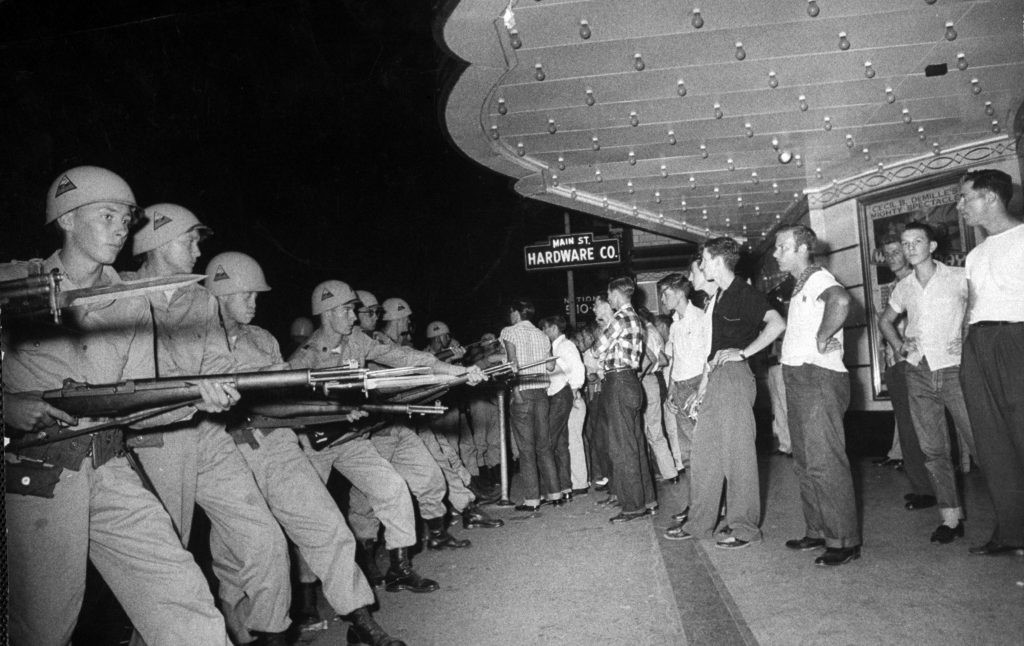
The National Guard imposes racial integration at gunpoint in Arkansas, 1957.

Note that this pattern has been followed in other countries, such as Slovenia. Slovenians rejected provisions for introducing gay marriage rights in numerous referenda, including in 2012 and 2015, until the national courts overturned the will of the people and introduced gay marriage rights via judicial fiat.

Just as the Roe v. Wade ruling, when “nine unelected officials imposed a uniform policy on the entire country” and legalized abortion, major steps in the progressive agenda have been imposed through the court system precisely because progressive elites could not achieve these goals through democratic politics. Criticizing the Windsor and Obergefell rulings, Justice Scalia attacked the judges for circumventing popular majorities:

The unrepresentative character of the body voting on today’s social upheaval would be irrelevant if they were functioning as judges, answering the legal question whether the American people had ever ratified a constitutional provision that was understood to proscribe the traditional definition of marriage. But of course the Justices in today’s majority are not voting on that basis; they say they are not.[4]

“[A] system of government that makes the People subordinate to a committee of nine unelected lawyers does not deserve to be called a democracy,” stated Scalia. Instead, he described “the decision[s] [as] an upper-class ‘putsch.’”[5]

You can buy Greg Johnson’s Truth, Justice, & a Nice White Country here

While many states throughout the country have tried to introduce similar Defense of Marriage acts, these “democratically passed state constitutional marriage amendments” have been challenged by the largest law firms in the country and defended by none of them. Noting that the Human Rights Campaign’s Corporate Equality Index gave 89% of the country’s law firms perfect scores on their attitudes towards LGBT legalization, Reuters remarked that the legal industry has reached a moment where “dissent on the question of the normalization of homosexuality would no longer be tolerated.” As Christopher Caldwell summarizes, rather than try to convince the majority through debate, “the civil rights approach to politics meant using lawsuits, shaming, and street power to overrule democratic politics . . .  [and] organize against the wider society to defend their interests.” Sasha Issenberg of the New York Times reminds us: “Cancel Culture Works. We Wouldn’t Have Marriage Equality Without It.”[6]

Another recent example can be found in the various bipartisan anti-transgender bills recently tabled in dozens of deep Republican states around the country, which — after being ratified by overwhelming majorities in both the House and Senate — were vetoed by their governors. South Dakota Republican Governor Kristi Noem vetoed House Bill 1217, which sought to “promote continued fairness in women’s sports” by prohibiting biological men from playing in girls’ sports leagues. This decision was so unpopular with her conservative electoral base that commentators described it as career suicide, calling it “the veto that could undo Kristi Noem’s presidential ambitions.” One month later, Arkansas Republican Governor Asa Hutchinson vetoed House Bill 1570, the Save Adolescents From Experimentation (SAFE) Act, which aimed to prohibit gender reassignment surgeries and the use of hormone blockers for minors.[7]

Recently, citizens of the small Idaho town of Coeur d’Alene were able to force anti-white propaganda out of their local college’s curriculum by influencing the college’s Board of Directors. Since then, the college has had its credit score attacked by Moody’s, national organizations are threatening to take away the school’s accreditation, district judges have tried to overturn election results, and the New York Times is publishing articles complaining about how “local voters” were able to drive the change.[8]

The National Guard imposes racial integration at gunpoint in Arkansas, 1957.

“Not only is the political class more extreme in its positions,” writes the political scientist John G. Matsusaka, “but its priorities do not mirror those of the larger public.” There is massive divergence between the preferences of policy elites and their voting constituents. In 2016, Donald Trump shattered GOP records by bringing in the largest proportion of small donations from working-class people and truck drivers. On the other hand, the overwhelming majority of individual donations from journalists, federal government employees, and college professors went to Hillary Clinton. Years earlier, 96% of donations from Ivy League professors similarly went to presidential candidate Barack Obama, illustrating that institutional elites tend to have heavily-biased preferences. These elites “have a combined sense of intellectual superiority, moral arrogance, and existential insecurity, often involving fear of ‘natural groups,’” which causes them to harbor a deep-seated and implacable distrust of popular democratic politics. Cloaking their liberal class-politics under the guise of value-neutral empiricism, they reflect the “naked and unapologetic elitism” of men such as Edward Bernays and Walter Lippmann by insisting that “if only responsible elites could be left alone, if only political issues could be kept from the people, the elites would make wise decisions.”[9]

Elite intellectual discourse is regularly plastered with rhetoric such as “[t]he people are ignorant,” “[t]he people can’t be trusted,” and “[w]e need to build institutions to protect us from the people.” Writing for a Trilateral Commission study in the 1970s, Samuel Huntington famously warned about the problem of “too much democracy,” warning elite policy circles that “the strength of democracy poses a problem for the governability of democracy.” The neoconservative Bill Kristol complains that Republicans show

almost too much concern and attention for, quote, the people — that is, the people’s will, their prejudices and their foolish opinions. And in a certain sense, we’re all paying the price for that now . . . after all, we conservatives are on the side of the lords and barons.

The CFR flagship Foreign Policy mocks the concept of the “will of the people,” dismissing it as a rhetorical “trope” for anti-immigration politicians.[10]

From the Left, Alain Minc describes populism as a blight, calling it the victory “of ill-educated people over the well-educated.” Daniel Cohn-Bendit — a member of the European Parliament who bragged about molesting five-year-olds in an anarchist “anti-authoritarian kindergarten” in the 1960s — proclaims: “I’m sick of the people!”[11]

After Donald Trump’s election, Jason Brennan argued for replacing democracy with an “epistocracy” where political rights are based on the knowledge and education level of voters. Joel Stein calls for replacing democracy with “a government of the nerds, by the nerds, and for the nerds.”[12]

As the Yellow Vest riots raged through the Champs-Élysées and tens of thousands of protestors lit fires and fought with riot police, the French Prime Minister announced the government’s refusal to back down: “our course is the right one, and we’re not going to change it just because the wind is blowing.”

Surveys of legislators and administrative officials in the United States have shown “that two-thirds or more of government officials doubted that the public was sufficiently informed, long-sighted, and emotionally detached to provide sound guidance for government decisions.” In another survey, government officials were asked if ordinary voters “know enough about issues to form wise opinions about what should be done.” 47% of Members of Congress responded “no.” 81% of civil servants responded “no.” Elite commentators and pundits regularly claim that the

mass public is prone to contradiction, misinformation, and wild fluctuation as it is whipped along by winds of “passion,” as Madison puts it. By contrast, [they insist that] elites are better able to reach consistent decisions based on objective knowledge regarding the most effective means for furthering the country’s well-being.[13]

In American elite discourse, “the independence of political leaders is extolled in both domestic and foreign policy,” and regularly reifies the elite liberal consensus that “safeguarding our freedom and our form of government requires us to protect the Constitution against . . . pandering to public opinion.” They believe that “[s]ociety suffers when polls inhibit leaders from independent thinking, from anticipating change, or from preparing the public for change.” They maintain that “[v]oters possess neither the knowledge nor the expertise to understand and evaluate the measures on which they are voting,” and aggressively “insist that elected representatives act in accordance with their good judgement of the ‘broader community interest’ and ‘good public policy’ and exercise independence from their constituents.” They urge elected officials to exercise their judgement independently, instead of “doing what the public . . . want[s] . . . [or] yielding to instant public opinion,” which they refer to pejoratively as “pandering” to public opinion.[14]

These attitudes were also apparent in European elites’ hostile reaction to the Brexit referendum and towards direct democratic mechanisms such as referenda, and primary elections generally. After Brexit, the media spewed dozens of caustic headlines such as “Referendums Are Dangerous for Democracy,” “After Brexit, should referendums be banned?”, and “Are Referendums Like Brexit a Disgrace to Democracy?” “This isn’t democracy; it is Russian roulette for republics,” wrote London School of Economics fellow Alexandre Cirone and Harvard Professor Kenneth Rogoff:

Brexiteers did not invent this game; there is ample precedent, including Scotland in 2014 and Quebec in 1995. But, until now, the gun’s cylinder never stopped on the bullet. Now that it has, it is time to rethink the rules of the game.[15]

The National Guard imposes racial integration at gunpoint in Arkansas, 1957.

This antipathy towards referenda predates Brexit. In 1945, the British Prime Minister Clement Attlee called referenda “alien to all our traditions” and an “instrument of Nazism.” Prime Minister Harold Wilson called them “contrary to our traditions” and “not a way in which we can do business,” fearing that frequent elections might undermine the government by eliminating the income tax. Margaret Thatcher famously called the referendum “a device of dictators and demagogues” and a danger to minorities. Prime Minister Theresa May called referenda a “a gross betrayal of our democracy” that “undermines the whole principle of democracy in this country.[16]

The same goes for America. As the political scientist Matthew Qvortup notes, American elites have opposed the concept since the late nineteenth and early twentieth century, when the People’s Party fought for direct democratic initiatives. They did so because “[d]irect democracy, as well as the reforms that would be prompted via initiative and referendum, were a threat to the autonomy of these traditional parties, and to the economic interests that influenced them.” The concept is still regarded with hostility, as recent books attacking the concept have been published “with apocalyptic titles such as Democracy Derailed, Dangerous Democracy and Democratic Delusions.” In the academic literature, referenda have been criticized as “alien,” “an import,” and “subver[sive to] the American system of government.”[17]

You can buy Greg Johnson’s The Year America Died here.

According to Richard Wyn Jones and Roger Scully, the referendum is a device that “takes power of decision over a specific question back from the elected representatives and returns it to the people who decide a matter directly.” Yet, this most democratic of all devices is reviled by Western political theorists. Historically, while liberals, social democrats, and even Marxists have been skeptical at best, if not outright opposed to referenda, “it is also interesting that this impeccably ‘democratic’ and ‘authoritative’ device is deployed as often in regimes that are manifestly undemocratic as in those that strive to meet high standards of democratic practice.”[18]

Obviously, Western political elites are nervous about referenda because they are uncontrollable and unpredictable. While “political parties often spend millions on altering the voters’ perceptions and to get them to change their minds,” there is little evidence that any of these efforts successfully sway the preference of the population one way or the other. The political scientist Thomas Stratmann notes that “overall the academic literature has found little evidence that special interest groups can purchase their preferred policies” during referenda, in the same way that they can do so by purchasing legislators and lobbyists. American billionaires such as Tom Steyer and George Soros regularly pour hundreds of millions of dollars into swaying ballot measures, including advertising, public opinion polling, and astroturfing activists and bussing voters to polling stations. “Several tech and entertainment industry billionaires and philanthropists were major donors to California’s 2008 $64 million campaign against a measure (Prop. 8) to ban same-sex marriage,” and yet despite their overwhelming monetary advantage, they still lost the campaign in one of the most liberal states in the country.[19]

Referenda are problematic for elites because they tend to have conservative outcomes that contradict the power elite’s liberal policy objectives. Scholars regularly point to Swiss referenda on women’s suffrage, “the darkest stain in the history of Swiss democratization,” as evidence of the problematic tendencies of referenda. Despite having the most democratic political system in the world with their system of semi-direct democracy in which voters are regularly consulted on policy via referendum, Switzerland was one of the last Western countries to introduce women’s suffrage. Swiss voters regularly rejected proposals for it even after the right was approved by both chambers of the Swiss parliament. Women’s suffrage only succeeded nationally in Switzerland in 1971, and even then there were cantonal holdouts. For example, the canton of “Appenzell Innerrhoden resisted implementation until 1990, when finally the Federal Court made it clear that the new norm had to be accepted and enacted.”[20]

Western elites regularly criticize the practice of referenda, because they contradict the idea of policymaking by a supposedly impartial and objective class of “experts.” Derrick Bell argues that

[t]he emotionally charged atmosphere often surrounding referenda and initiatives . . . can reduce the care with which voters consider the matters before them. Tumultuous, media-oriented campaigns such as the ones successfully used to repeal ordinances recognizing the rights of homosexuals in Dade County, Florida, St Paul, Minnesota, and Eugene, Oregon, are not conducive to careful thinking and voting. Appeals to prejudice, oversimplification of the issues, and exploitation of legitimate concerns by promising simplistic solutions to complex problems often characterize referendum and initiative campaigns.[21]

The liberal economist Joseph Schumpeter complained that “the typical citizen drops down to a lower level of mental performance as soon as he enters the political field. He argues and analyzes in a way which he would readily recognize as infantile within the sphere of his real interests.” Western scholars have continued to criticize direct democracy on psychological grounds. Ordinary people tend to approach politics as a tribal phenomenon and adopt policy preferences based on core identities and values. Politics becomes a conflict between factions that serve as expressions of these core identities, rather than a neutral evaluation of policy issues based on pure economic calculation. Consequently, Western elites are nervous about direct and democratic expressions of the popular will because they excite “irrational” instincts and tribal passions that circumvent dominant liberal norms and represent a potential threat to liberalism at large.[22]

But most importantly, as the Russian Communist Party member Vadim Solov’ëv explained to Matthew Qvortup, elites hate referenda because they do “‘not get the result that they need’”:

According to the constitution, a referendum — like elections — is the supreme form of popular power. On its results, like it or not, corresponding laws have to be adopted. But who needs that? The majority of decisions that are now taken at the top contradict the overwhelming mood in society and are adopted in the interests of some narrow group. It is well known that, if referendums are frequently conducted in a country . . . the authorities only strengthen their position, since they carry out the will of the majority. But if the state constantly foists the interests of narrow groups on society, in the end it all ends in tears, both for ordinary people and for the authorities themselves.

As Alain de Benoist similarly observes, “it is quite likely that a popular poll would lead to the re-establishment of the death penalty and the adoption of strict measures to curb immigration — and this is probably the reason why those in power make sure not to consult public opinion on such subjects.”[23]

In 2005 the President of the European Commission, José Manuel Barroso, “criticized the use of referendums in the wake of the defeat of the European Constitution in France and the Netherlands . . .  [stating that they] should be avoided because they ‘undermine the Europe we are trying to build by simplifying important and complex subjects.’” This was repeated in 2015 with Brexit, which illustrated how devastating referenda can be for liberal elites. In a similar vein, the first Soviet referenda were also its last, when various republics voted for independence and precipitated the dissolution of the Soviet Union. These referenda, encouraged by Gorbachev, illustrate how they can “backfire” on elites.[24]

British and international elites lambasted David Cameron for allowing the Brexit referendum in 2015, arguing that the results vindicated the American Founding Father’s fears about what Edmund Burke called the “swinish multitude,” proving that they were correct to argue that it is “necessary to leave the public in the dark during important political deliberations.” Agreeing with Madison and Burke, who championed counter-majoritarian mechanisms to lessen the influence of the “the swinish multitude,” Franz-Stefan Gady writes that

the Brexit referendum illustrates as much the failure of the experts and elected politicians as it shows that relying on the masses and populism can lead to suspect and potentially damaging decisions. In that sense, we have to guard ourselves against direct democracy being hijacked by demagogues and populists lest we have to endure the ‘tyranny of the majority’ at the expense of wiser policies.[25]

European Union minister Vera Jourová recently stated, “We have seen too many examples of the risks stemming from the digital realm . . . like the Brexit referendum.” The EU Commission has made moves to change political campaign laws to make initiating independence referenda more difficult. Combined with stricter ad regulation and online censorship, they intend to render similar outcomes more difficult in the future.[26]

Former Goldman Sachs banker, UN Special Representative for International Migration, and European Commissioner for Competition Peter Sutherland complained that “mainstream politicians, held hostage by xenophobic parties, adopt anti-immigrant rhetoric to win over fearful publics,” which is “leading to the growth of movements like UKIP, Le Pen and Geert Wilders and so on across Europe.” For this reason, he urged for migration policy to be transferred to unelected policymaking bodies such as the EU Commission, so that issues like immigration policy would be put outside of the national political debate.[27]

Some European countries have already solved this problem. Alternative for Germany (AfD) in Germany suggested holding a “Dexit” referendum on German EU membership after Brexit. But the referendum never happened, because referenda are banned by law in Germany under the Constitution of 1949. This is because majoritarian popular votes are seen as violating the important liberal principle of pluralism, and have been used by majoritarian nationalist political leaders such as Hitler and Franco to circumvent parliamentary elites and the checks and balances of liberal constitutionalism.  The French President Charles de Gaulle similarly “resolved the Algerian crisis by going against the political elite and consulting the people over Algeria in 1961.”

Liberal elites are consequently skeptical about referenda because they weaken the foundational liberal principle of parliamentary sovereignty and, in the words of Samuel Finer, “‘invite parliament to become its own executioner.’” Populist politics and referenda are incompatible with the independence of the political class and the technocratic liberal rule of the “experts.” They undermine the monopoly of liberal institutions over the political discourse, because under referenda “the voice of ordinary citizens is regarded as the only ‘genuine’ form of democratic governance even when at odds with expert judgements — including those of elected representatives and judges, scientists, and scholars, journalists and commentators.”[28]

* * *

Like all journals of dissident ideas, Counter-Currents depends on the support of readers like you. Help us compete with the censors of the Left and the violent accelerationists of the Right with a donation today. (The easiest way to help is with an e-check donation. All you need is your checkbook.)

GreenPay™ by Green Payment

Select donation type

Select or enter an amount to give

Select or enter an amount to give monthly

For other ways to donate, click here.

Notes

[1] Darel E. Paul, From Tolerance to Equality: How Elites Brought America to Same-sex Marriage (Baylor University Press: 2018), 10.

[2] Michael Klarman, From the Closet to the Altar: Courts, Backlash, and the Struggle for Same-Sex Marriage (Oxford University Press: 2013). Quoted in Darel E. Paul, “Culture War as Class War: How Gay Rights Reinforce Elite Power,” First Things, 2018.

[3] Christopher Caldwell, 220.

[4] John G. Matsusaka, Let the People Rule: How Direct Democracy Can Meet the Populist Challenge (Princeton University Press: 2022), 8.

[5] Christopher Caldwell, 228.

[6] Darel E. Paul, 36; Christopher Caldwell, 232; and Sasha Issenberg, “Cancel Culture Works. We Wouldn’t Have Marriage Equality Without It,” The New York Times, 2021.

[7] See Kenneth Vinther, “Scott Howard’s The Transgender-Industrial Complex,” Counter-Currents, 2021.

[8] Charles Homans, “The MAGA-fication of North Idaho College,” The New York Times, 2023.

[9] John G. Matsusaka, 11; Curt Mills, “Journalists Donate Far More To Clinton,” U.S. News & World Report, 2016; Jonathan Swan, “Government workers shun Trump, give big money to Clinton,” The Hill, 2016; Tania Diaz Bazan, “Donation Preferences: Republicans Outnumbered in Academia,” Promarket, 2016; Michelle Conlin, “Trump scores with small money, lags with big donors,” Reuters, 2016; Shane Goldmacher, “Trump shatters GOP records with small donors,” Politico, 2016; Perry Chiaramonte, “96 percent of Ivy League professors’ donations went to Obama,” Fox News, 2016; and Michael Rogin quoted in Thomas Frank, 167.

[10] Lawrence Lessig, They Don’t Represent Us: Reclaiming Our Democracy (Harper Collins: 2019), 220, quoted in Thomas Frank, 215; and Florian Bieber, “How Europe’s Nationalists Became Internationalists,” Foreign Policy, 2019.

[11] Quoted in Greg Johnson, “In Defense of Populism,” Counter-Currents, 2020.

[12] See Lawrence Lessig, 18; quoted in Frank, 230.

[13] John G. Matsusaka, 11; Jacobs and Shapiro, 300.

[14] Quoted in Neema Parvini, 117; Jacobs and Shapiro, 301; and John G. Matsusaka, 169.

[15] Uri Friedman, “Should the Brexit Vote Have Happened at All?”, The Atlantic, 2016.

[16] Robert Saunders, “How Britain embraced referendums, the tool of dictators and demagogues,” The Economist, 2019.

[17] Matthew Qvortrup, Referendums Around the World (Springer International Publishing: 2017), 149, 161; John G. Matsusaka, 61.

[18] Quoted in Matthew Qvortrup, 3.

[19] Matthew Qvortrup, 37, 39, 59, 135.

[20] Matthew Qvortrup, 172.

[21] Quoted in Matthew Qvortrup, 4.

[22] Quoted in Gilens, 15; Matthew Yglesias, “This is the best book to help you understand the wild 2016 campaign,” Vox, 2016; and Christopher Achen & Larry M. Bartels, “It Feels Like We’re Thinking: The Rationalizing Voter and Electoral,” 2006.

[23] Quoted in Matthew Qvortrup, 142; Alain de Benoist, The Problem of Democracy (Arktos: 2011), 56.

[24] Matthew Qvortrup, 113.

[25] Franz-Stefan Gady, “Brexit: The American Founding Fathers Had it Right: Direct Democracy Is a Dead Duck,” The Diplomat, 2016.

[26] Leigh Evans, “Never again! EU makes move to stop another Brexit-style referendum in bloc,” Express, 2021.

[27] Peter D Sutherland & Cecilia Malmstrom, “Europe’s immigration challenge,” The Guardian, 2012.

[28] Richard Wheatstone, “Far-right German party demands ‘Dexit’ vote — but can’t get national referendum because of HITLER,” Mirror, 2016; Ben Knight, “New direct democracy campaign launched in Germany,” DW, 2016; quoted in Matthew Qvortrup, 33-35.

Liberal Anti-Democracy, Chapter 5, Part 2: Democracy Against the People

Liberal%20Anti-Democracy%2C%20Chapter%205%2C%20Part%202%3A%0ADemocracy%20Against%20the%20People%0A

Share

  • Gab

Enjoyed this article?

Be the first to leave a tip in the jar!

Instant Echeck GreenPay™

Related

  • The Strange World of Gender Bender Fiction

  • True Folk-Horror Is Horror of Your Own Folk

  • Keith Wood’s Elevator Pitch to a Billionaire

  • Remigration Is Inevitable

  • Trump vs. Transgenderism

  • Gayatollah Sodomhei

  • Goodbye, Mr. Orbán

  • Matt’s Negative Gloss: Matt Goodwin’s Suicide of a Nation, Part Two

Tags

Alternative for Germanyanti-democracyanti-white propagandaAppenzell Innerrhodenbreakup of the Soviet UnionBrexitCaliforniaCalifornia Marriage Protection ActCoeur d'AlenecourtsDefense of Marriage actsdemocracyDexitdirect democracyelitismepistocracygay marriageHouse Bill 1750integrationKenneth VintherKristi NoemLGBT ideologyLGBTQLiberal Anti-Democracyliberal democracypopulismProposition 8racial integrationreferendaSAFE ActSave Adolescents From Experimentation ActSloveniastate legislaturesSwitzerlandthe elitethe European Unionthe peoplethe will of the peopletransgender equalitytransgenderismUS Supreme Courtwomen's suffrage

3 comments

  1. Mr. IG says:
    May 17, 2023 at 11:30 am

    Grandiose. The ‘Wokening’ Manifesto from the true Right side.


    While the rest, unfortunately, are discussing derivative problems.

    0
    0
  2. Josephus Cato says:
    May 19, 2023 at 6:38 am

    In the bottom picture, where are they being marched to?  Are they being forced to go to the black school?  How about the guy all bloodied up?  It’s very unsettling to me that this angle of racial integration literally being forced at gunpoint wasn’t presented to me in US history class, let alone AP US history class which is all about seeing historical perspectives from ALL angles.  I remember vexed by questions on the practice AP US history tests where pretty much all the answers were right but one of them more right than the others.

    0
    0
  3. Crux Cismarina says:
    June 7, 2023 at 3:00 pm

    I’m caught between a rock and a hard place. In principle, I am not opposed to elected aristocracy. I’m not against the best and brightest having a disproportionate degree of influence over policy. However, a key qualifier is that the elite be historically, culturally and genetically related to its lower classes. How can the elite justify mass immigration and morally degenerate social policy? It’s obvious that the policies being implemented  are suicidal. And yet the “elites” are pushing them anyways. Representative democracy is supposed to do what’s best for the people. Even if the peoples wishes go against their best interest. And yet it’s clear that the peoples best interest are not being respected. And thus our elites have forfeited their right to govern and must be replaced.

    0
    0

Comments are closed.

If you have a Subscriber access,
simply login first to see your comment auto-approved.

Note on comments privacy & moderation

Your email is never published nor shared.

Comments are moderated. If you don't see your comment, please be patient. If approved, it will appear here soon. Do not post your comment a second time.

Upcoming podcasts
  • Rob Rundo on Counter-Currents Radio

    Rob Rundo on Counter-Currents Radio

    Counter-Currents Radio

    Sat, Jun 13th — 3 pm EST / 9 pm CET
  • Daniel Tyrie on Counter-Currents Radio

    Daniel Tyrie on Counter-Currents Radio

    Counter-Currents Radio

    Sat, Jun 20th — 3 pm EST / 9 pm CET

Writers of May

(2 votes) Morris van de Camp David M. Zsutty Derek Stark Jayant Bhandari Greg Johnson

Articles of May

The Lunch Wars by David M. Zsutty Heidegger on Nietzsche, Part One by Collin Cleary 2 votes
    • Editor’s Update
      Rob Rundo Rescheduled to Next Week on Counter-Currents Radio;
      Tonight Greg Johnson & David Zsutty Answer Your Questions;
      Fundraiser Update & a New $20,000 Matching Grant

      Greg Johnson

    • The Counter-Currents 2026 Fundraiser
      Lifetime Subscriber Welcome Packages Extended

      Greg Johnson

    • Nationalism This Week
      Who’s Looking Back?

      Greg Johnson

      21

    • China’s Threat to American Security:
      Food, Farmland, Foreign Control, & Energy Policy

      Lipton Matthews

      1

    • The Bitter End of Western Metaphysics:
      Heidegger on Nietzsche, Part Two

      Collin Cleary

      11

    • The Killing of Henry Nowak

      Mark Gullick

      28

    • The Crisis of Chinese Technology Thieves

      Morris van de Camp

      1

    • The Strange World of Gender Bender Fiction:
      & What This Genre Tells Us About Autosexuality

      Dani Vypont

      3

    • Watching the Watchers:
      The Dark Triad Question

      David M. Zsutty

      14

    • The Remigration Movement Solidifies

      F. Roger Devlin

      1

    • Casting Aspersions:
      The Fatal Consequences of Race-Swapped Casting, From Helen of Troy to Henry of Southampton

      Steven Tucker

      20

    • The Murder of Henry Nowak

      Millennial Woes

      23

    • Don’t Forget to Vote in Our Writer & Article of the Month Poll

      Greg Johnson

    • The Robot Hotdog Stand

      Greg Johnson

      35

    • Laughing Our Way to Victory

      Dave Chambers

      7

    • The Zodiac Killer

      Mark Gullick

      11

    • Jared Taylor: What Rome Means to Me

      Jared Taylor

      1

    • An Interview with Endeavour:
      My Way of Life Is an Adventure!

      Ondrej Mann

      6

    • José Pedro Zúquete’s The Identitarians

      Greg Johnson

      3

    • Editor’s Update
      Fundraiser Update & How to Watch the Remigration Summit

      Greg Johnson

      5

    • The Bitter End of Western Metaphysics:
      Heidegger on Nietzsche, Part One

      Collin Cleary

      11

    • Berlin: City of Stones

      Spencer J. Quinn

      6

    • True Folk-Horror Is Horror of Your Own Folk:
      Mark Gatiss vs the Brexit Blind Dead  

      Steven Tucker

      4

    • Counter-Currents Radio Podcast No. 689
      Thomas Massie, the America 2050 Bust, the Need for Whites to Divest from America, the AI Economic Apocalypse, & Pro-White Project Pitches to Billionaires

      Counter-Currents Radio

      7

    • Nationalism This Week
      Remigration is Inevitable, Part 3

      Greg Johnson

      27

    • Why Billionaires Should Fund White Identity Politics

      Lipton Matthews

      8

    • How Cold War Two Came About

      Morris van de Camp

      5

    • Now Available for Pre-Order at a Special Price!
      Greg Johnson’s The Philosopher Is In

      Greg Johnson

    • David Zsutty’s Elevator Pitch to a Billionaire

      David M. Zsutty

      1

    • Headbanging Lite

      Mark Gullick

      5

    • White Advocacy Past and Present

      Peter Bradley

      13

    • The Lunch Wars

      David M. Zsutty

      47

    • The Russians are Coming/The Russians are Coming

      Steven Clark

      1

    • Peak Fatigue in Fort Wayne

      Gabriel Anderson

      24

    • Keith Woods’ Elevator Pitch to a Billionaire

      Keith Woods

    • The Cruelty of Kindness

      Morris van de Camp

      9

    • Predation Wearing the Mask of Civilization

      Jayant Bhandari

      13

    • The Mandalorian & Grogu

      Trevor Lynch

      24

    • Editor’s Update
      Fundraiser Update & a New $20,000 Matching Grant
      Greg Johnson & David Zsutty Discuss Thomas Massie on Counter-Currents Radio

      Greg Johnson

      2

    • How the Jews Defeated Thomas Massie—& Themselves

      David M. Zsutty

      25

    • Jared Taylor’s Elevator Pitch to a Billionaire

      Jared Taylor

      15

    • Nationalism This Week
      Remigration Is Inevitable, Part 2

      Greg Johnson

      8

    • Could Fascism Work?

      Mark Gullick

      40

    • Jonathan Bowden’s Deliverance
      Part 7

      Jonathan Bowden

    • China’s Quiet Hand:
      Influence, Infiltration, & the Western Blind Spot

      Lipton Matthews

      9

    • Counter-Currents Radio Podcast No. 688
      Tyler Dykes on Running for US Congress in South Carolina

      Counter-Currents Radio

      3

    • Lothrop Stoddard’s The Revolt Against Civilization

      Spencer J. Quinn

      14

    • Lewis Strauss Did Nothing Wrong:
      How the politics of the Atom Bomb during the early Cold War Apply to Artificial Intelligence Today

      Morris van de Camp

      14

    • The Ghost of the Confederacy

      Dave Chambers

      12

    • America’s Century of Humiliation has Begun

      Greg Johnson

      27

    • AdamMil

      Nationalism This Week
      Who’s Looking Back?

      Massive hardware. To run something like Grok you'd need terabytes of GPU memory. That said, for...

    • AdamMil

      Nationalism This Week
      Who’s Looking Back?

      Don’t be too sure. There have already been multiple experiments showing that modern AIs may turn on...

    • Hi-ya!

      Nationalism This Week
      Who’s Looking Back?

      I use the following commands if I feel ai is getting to wound up, yes I got it from ai but it’s...

    • Collin Cleary

      The Bitter End of Western Metaphysics:
      Heidegger on Nietzsche, Part Two

      Oh no, not so. For the Overman, truth is entirely relative and subjective. Remember: he gets to...

    • Connor McDowell

      Nationalism This Week
      Who’s Looking Back?

      HAL9000 in 2001 was never truly “sentient”. “His” programming had a conflict that couldn’t be...

    • Will Williams

      Nationalism This Week
      Victory First

      There are several C-C essays that mention Gaza, but this appears to be the only one where comments...

    • Observer

      The Bitter End of Western Metaphysics:
      Heidegger on Nietzsche, Part Two

      In Platonism, we find the insistence that being, true being, is identical with “the forms.” The...

    • JBP

      The Bitter End of Western Metaphysics:
      Heidegger on Nietzsche, Part Two

      Thanks. Unfortunately I must fall into the 95% that Jane refers to. My brain is not putting the...

    • Will Williams

      Nationalism This Week
      Who’s Looking Back?

      Vauquelin: June 7, 2026 ...You must judge AI/LLM based on those who control it. With the likes of...

    • Hi-ya!

      The Bitter End of Western Metaphysics:
      Heidegger on Nietzsche, Part Two

      Love to engage in this with more attention ; I’ve never seen “clearing” in presocratics and my hot...

    • Vauquelin

      Nationalism This Week
      Who’s Looking Back?

      You must judge AI/LLM based on those who control it. With the likes of Sam Altman and Alex Karp...

    • Chud

      Nationalism This Week
      Who’s Looking Back?

      There's another dangerous option where homebrew AI models scale up and the consumers get their...

    • Gabe

      Nationalism This Week
      Who’s Looking Back?

      Boom. Nailed it.

    • Joe Gould

      The Killing of Henry Nowak

      This is a good article. The only thing I want to add is, above all we must guard ourselves against...

    • Greg Johnson

      Nationalism This Week
      Who’s Looking Back?

      Thank you I also wonder if these AI bots are being used to gather intelligence on influential...

    • E_Perez

      The Bitter End of Western Metaphysics:
      Heidegger on Nietzsche, Part Two

      "Philosophy helps Western man understand how we got to where we are, and where things went wrong...

    • Chud

      Nationalism This Week
      Who’s Looking Back?

      I'll try to give a rundown. AI is a language learning model (LLM) that uses floating point...

    • Will Williams

      How the Jews Defeated Thomas Massie—& Themselves

      Massie to Honor USS Liberty Crew on House Floor [email protected]  June 6, 2026  thomas...

    • JBP

      Editor’s Update
      Saturday: Greg Johnson & David Zsutty Discuss the Epstein Bomb on Counter-Currents Radio

      Sorry but... Wrong, wrong wrong and wrong. The current momentum of history will not change with a...

    • Will Williams

      Nationalism This Week
      The SPLC Indictment

      The indictment of the Southern Poverty Law Center by the Department of Justice on 21 April is...

    • Earth Day Special

      John Morgan

      12

    • A Robertson Roundup
      Remembering Wilmot Robertson
      (April 16, 1915 – July 8, 2005)

      Margot Metroland

      13

    • The Paranoid Style in White Nationalism

      Greg Johnson

      30

    • Join the Dance!

      Andrew Hamilton

      1

    • We Can’t Save the Earth Without Reducing African Birth Rates

      James Dunphy

      36

    • “I’m Not a Conspiracy Theorist, but . . .”:
      Jeffrey Epstein’s Death Gives New Life to “Conspiracy Theories”

      Greg Johnson

      22

    • Sylvia Plath: Stasis in Darkness

      Vic Olvir

      17

    • Vanguardism, Vantardism, & Mainstreaming

      Greg Johnson

      80

    • Aviation, Geography, & Race

      Charles Lindbergh

      3

    • Some Thoughts on Yule

      Collin Cleary

      4

    • Living in Truth:
      A Yuletide Homily

      Jef Costello

      7

    • John Kennedy Toole’s A Confederacy of Dunces

      Greg Johnson

      20

    • On Aleksandr Solzhenitsyn’s Warning to the West

      Spencer J. Quinn

      7

    • Elitism, British Modernism, & Wyndham Lewis

      Jonathan Bowden

      6

    • Philip K. Dick’s Do Androids Dream of Electric Sheep? as Anti-Semitic/Christian-Gnostic Allegory

      Greg Johnson

      20

    • “Conspiracy Theory” or Conspiracy?

      Andrew Hamilton

      21

    • Remembering H. P. Lovecraft
      (August 20, 1890–March 15, 1937)

      Greg Johnson

      3

    • Who Are We?
      Nordics, Aryans, & Whites

      Greg Johnson

      71

    • Remembering William Gayley Simpson
      (July 23, 1892–December 31, 1990)
      A Pleasant Afternoon with Harriet & Bill Simpson

      Margot Metroland

      18

    • Here are the Young Men
      Remembering Ian Curtis
      (July 15, 1956–May 18, 1980)

      Mark Gullick

      18

    • Percy Grainger
      Artist of the Right

      Alex Graham

      7

    • Remembering Revilo Oliver
      (July 7, 1908–August 20, 1994)

      Greg Johnson

      18

    • The Meaning of July 4th for the White Man

      Gregory Hood

      13

    • The Front National’s Evolution

      Bruno Mégret

    • Merwin K. Hart
      Forgotten American Hero & Man of the Right

      Morris van de Camp

      10

    • George Orwell’s Nineteen Eighty-Four

      Jonathan Bowden

      8

    • Carleton S. Coon
      Scientist & Reluctant White Advocate

      Morris van de Camp

      3

    • The Kwanzaa Absurdity Will Be Dwarfed by Juneteenth

      Robert Hampton

      10

    • Stravinsky

      Alex Graham

      7

    • Like the Roman:
      Remembering Enoch Powell (1912-1998)

      Mark Gullick

      23

    • Neo-Fascism in Film
      Part 5

      Karel Veliky

      15

    • The Game of Tarot

      Mark Gullick

      1

    • Institutions Cannot Be Transplanted

      Jayant Bhandari

      5

    • Jonathan Bowden’s Deliverance
      Part 5

      Jonathan Bowden

    • Crosstown Traffic:
      Jimi Hendrix & The Post-War Rock ‘N’ Roll Revolution

      Mark Gullick

      1

    • Slaves from the North:
      Finns & Karelians in the East European Slave Trade, 900–1600

      Lipton Matthews

      14

    • Neo-Fascism in Film
      Part 4

      Karel Veliky

      2

    • David Lean’s A Passage to India

      Spencer J. Quinn

      1

    • Elites are Essential to Development

      Lipton Matthews

      7

    • Jonathan Bowden’s Deliverance
      Part 4

      Jonathan Bowden

    • Neo-Fascism in Film
      Part 3

      Karel Veliky

      6

    • E. M. Forster’s A Passage to India & the Indian Mentality

      Spencer J. Quinn

      25

    • Jonathan Bowden’s Deliverance
      Part 3

      Jonathan Bowden

    • The Rest Is Silence
      Heidegger’s Quietism

      Mark Gullick

      2

    • Dispelling the Historical Fallacy of Indian Nationalism

      Lipton Matthews

      8

    • Neo-Fascism in Film
      Part 2

      Karel Veliky

      8

    • Jonathan Bowden’s Deliverance
      Part 2

      Jonathan Bowden

    • Life of a Klansman

      Mark Gullick

      8

    • Jonathan Bowden’s Deliverance, Part 1

      Jonathan Bowden

    • Decolonial Ideas are Holding Back Developing Countries

      Lipton Matthews

      8

    • Neo-fascism in Film, Part 1

      Karel Veliky

      21

    • Jonathan Bowden’s Onslaught, Part 8
      Divigations on Decadence

      Jonathan Bowden

    • Jonathan Bowden’s Onslaught, Part 7
      Intrigues in the National Front

      Jonathan Bowden

      1

    • Rotten to the Core

      Mark Gullick

      8

    • Strauss on Husserl’s “Philosophy as Rigorous Science”

      Greg Johnson

    • Jonathan Bowden’s Onslaught, Part 6
      Francis Bacon & Right-Wing Nihilism

      Jonathan Bowden

    • London After (& Before) Midnight:
      Aleister Crowley, The Landlord’s Worst Nightmare

      James J. O'Meara

      2

    • Jonathan Bowden’s Onslaught, Part 5
      The Post-War British Far Right

      Jonathan Bowden

    • No Rules: Rollerball

      Mark Gullick

      4

    • Jonathan Bowden’s Onslaught, Part 3
      Brett Easton Ellis’ American Psycho

      Jonathan Bowden

    • András László
    • Derek Hawthorne
    • Beau Albrecht
    • Alain de Benoist
    • Kerry Bolton
    • Jonathan Bowden
    • Collin Cleary
    • Jef Costello
    • Savitri Devi
    • Julius Evola
    • Jim Goad
    • Gregory Hood
    • Juleigh Howard-Hobson
    • Greg Johnson
    • Charles Krafft
    • Anthony M. Ludovici
    • Trevor Lynch
    • H. L. Mencken
    • J. A. Nicholl
    • James J. O’Meara
    • Christopher Pankhurst
    • Tito Perdue
    • Michael Polignano
    • Spencer J. Quinn
    • Fenek Solère
    • Irmin Vinson
    • Leo Yankevich
    • Francis Parker Yockey
    • Multiple authors
  • Editor-in-Chief

    • Greg Johnson, Ph.D.

    Featured Writers

    • Beau Albrecht
    • Gunnar Alfredsson
    • Collin Cleary, Ph.D.
    • Jef Costello
    • Morris V. de Camp
    • F. Roger Devlin, Ph.D.
    • Stephen Paul Foster, Ph.D.
    • Jim Goad
    • Alex Graham
    • Mark Gullick, Ph.D.
    • Greg Johnson, Ph.D.
    • Travis LeBlanc
    • Trevor Lynch
    • Margot Metroland
    • James J. O’Meara
    • Angelo Plume
    • Spencer J. Quinn
    • Fred Reed
    • Clarissa Schnabel
    • Michael Walker
    • David M. Zsutty

    Frequent Writers

    • Asier Abadroa
    • Aquilonius
    • Alain de Benoist
    • Kerry Bolton, Ph.D.
    • Dave Chambers
    • Steven Clark
    • James Dunphy
    • Endeavour
    • Richard Houck
    • Jason Kessler
    • Titus Livius
    • Ondrej Mann
    • Lipton Matthews
    • Mark Mazari
    • John Morgan
    • Jaroslav Ostrogniew
    • Kathryn S.
    • Christian Secor
    • Anne Wilson Smith
    • Thomas Steuben
    • William De Vere
    • Kenneth Vinther
    • Max West

    Classic Authors

    • Maurice Bardèche
    • Jonathan Bowden
    • Julius Evola
    • Guillaume Faye
    • Ernst Jünger
    • Kevin MacDonald, Ph.D.
    • D. H. Lawrence
    • Charles Lindbergh
    • Jack London
    • H. P. Lovecraft
    • Anthony M. Ludovici
    • Sir Oswald Mosley
    • National Vanguard
    • Friedrich Nietzsche
    • Revilo Oliver
    • William Pierce
    • Ezra Pound
    • Saint-Loup
    • Savitri Devi
    • Carl Schmitt
    • Miguel Serrano
    • Oswald Spengler
    • P. R. Stephensen
    • Jean Thiriart
    • John Tyndall
    • Dominique Venner
    • Leo Yankevich
    • Francis Parker Yockey

    Other Authors

    • Howe Abbott-Hiss
    • Michael Bell
    • Giles Corey
    • Jack Donovan
    • Richardo Duchesne, Ph.D.
    • Emile Durand
    • Guillaume Durocher
    • Mark Dyal
    • Tom Goodroch
    • Andrew Hamilton
    • Robert Hampton
    • Huntley Haverstock
    • Derek Hawthorne
    • Gregory Hood
    • Juleigh Howard-Hobson
    • Alexander Jacob
    • Ruuben Kaalep
    • Tobias Langdon
    • Julian Langness
    • Patrick Le Brun
    • G A Malvicini
    • John Michael McCloughlin
    • Millennial Woes
    • Michael O’Meara
    • Christopher Pankhurst
    • Michael Polignano
    • J. J. Przybylski
    • Quintilian
    • Edouard Rix
    • C. B. Robertson
    • C. F. Robinson
    • Herve Ryssen
    • Alan Smithee
    • Fenek Solere
    • Ann Sterzinger
    • Robert Steuckers
    • Tomislav Sunic
    • Donald Thoresen
    • Marian Van Court
    • Irmin Vinson
    • Book Reviews
    • Movie Reviews
    • TV Reviews
    • Music Reviews
    • Art Criticism
    • Graphic Novels & Comics
    • Video Game Reviews
    • Fiction
    • Poems
    • Interviews
    • Videos
    • English Translations
    • Other Languages
      • Arabic
      • Bulgarian
      • Croatian
      • Czech
      • Danish
      • Dutch
      • Estonian
      • Finnish
      • French
      • German
      • Greek
      • Hungarian
      • Italian
      • Lithuanian
      • Norwegian
      • Polish
      • Portuguese
      • Romanian
      • Russian
      • Slovak
      • Spanish
      • Swedish
      • Ukrainian
    • Commemorations
    • Why We Write
  • Archives
  • Top 100 Commenters
  • The Looney Bin
Sponsored Links
Europa.com Above Time Coffee Antelope Hill Publishing Paul Waggener IHR-Store Spencer J. Quinn American Renaissance Jim Goad The Occidental Observer
Donate Now Mailing list
Books for sale
  • The Philosopher Is In
  • Sexual Utopia in Power (Expanded Edition)
  • In Defense of Prejudice
  • Loving Our Own
  • Tyranny & Wisdom
  • The Populist Moment
  • Is America Doomed?
  • To all books
Copyright © 2026 Counter-Currents Publishing, Ltd.

Paywall Access


Please enter your email address.

Lost your password?

Edit your comment

Writer & Article of the Month May 2026

Voting for this month has concluded. Here are the final results!

Top Writers

  • #1 Morris van de Camp 2 votes
  • #2 David M. Zsutty 2 votes
  • #3 Derek Stark 2 votes
  • #4 Jayant Bhandari 2 votes
  • #5 Greg Johnson 2 votes
  • #6 Jared Taylor 1 vote
  • #7 Collin Cleary 1 vote
  • #8 Spencer J. Quinn 1 vote
  • #9 Mark Gullick 1 vote
  • #10 Lipton Matthews 1 vote
  • #11 Keith Woods 1 vote
  • #12 Steven Tucker 1 vote

Top Articles

  • #1 The Lunch Wars 2 votes
  • #2 Heidegger on Nietzsche, Part One 2 votes
  • #3 Could Fascism Work? 1 vote
  • #4 Jared Taylor's Elevator Pitch to a Billionaire 1 vote
  • #5 Predation Wearing the Mask of Civilization 1 vote
  • #6 Peak Fatigue in Fort Wayne 1 vote
  • #7 Keith Wood's Elevator Pitch to a Billionaire 1 vote
  • #8 Do You Want to Play a Game? 1 vote
  • #9 Why Billionaires Should Fund White Identity Politics 1 vote
  • #10 The 1970s: The Golden Age of Hijacking 1 vote
  • #11 True Folk-Horror Is Horror of Your Own Folk 1 vote
  • #12 Finding Atlantis Part 4 1 vote
  • #13 Berlin: City of Stones 1 vote
  • #14 The Ghost of the Confederacy 1 vote
  • #15 Lothrop Stoddard’s The Revolt Against Civilization 1 vote

Total votes cast: 17