
Counter-Currents
  • Advertise
  • Private Events
  • T&C
  • About
  • Contact
  • RSS
    • Main feed
    • Podcast feed
    • Videos feed
    • Comments feed
  • Welcome
  • Webzine
  • Books
  • Merch
  • Podcasts
  • Videos
  • Donate
  • Patrons
  • Subscribe
  • Crypto

LEVEL2

Donate Now Mailing list
Upcoming podcasts
  • Rob Rundo on Counter-Currents Radio

    Rob Rundo on Counter-Currents Radio

    Counter-Currents Radio

    06/13/2026 — 3 pm EST / 9 pm CET
  • Daniel Tyrie on Counter-Currents Radio

    Daniel Tyrie on Counter-Currents Radio

    Counter-Currents Radio

    06/20/2026 — 3 pm EST / 9 pm CET

Writers of May

(2 votes) Morris van de Camp David M. Zsutty Derek Stark Jayant Bhandari Greg Johnson

Articles of May

The Lunch Wars by David M. Zsutty Heidegger on Nietzsche, Part One by Collin Cleary 2 votes
  • Welcome
  • Webzine
  • Books
  • Merch
  • Podcasts
  • Videos
  • Donate
  • Patrons
  • Subscribe
  • Crypto
    • The Union Jackal, June 2026

      Mark Gullick

      2

    • The Inferiority Behind Immigrant Superiority

      Jayant Bhandari

    • Counter-Currents Radio Podcast No. 690
      Greg Johnson & David Zsutty Discuss Current Things: AI, Henry Nowak, the Iran Crisis, & More

      Counter-Currents Radio

      1

    • Collin Cleary: What Rome Means to Me

      Collin Cleary

      2

    • Paul Krugman: Closet Bolshevik

      Spencer J. Quinn

      12

    • Fugue of Ideas:
      Ibram X. Kendi’s Chain of Ideas

      Greg Johnson

      14

    • Based Blacks

      Lipton Matthews

      6

    • Black Intellectual Fatigue

      Derek Stark

      30

    • Why White Advocates Should Avoid “Based Blacks”

      Dani Vypont

      20

    • Nietzsche & Race

      Mark Gullick

    • Editor’s Update
      Rob Rundo Rescheduled to Next Week on Counter-Currents Radio;
      Tonight Greg Johnson & David Zsutty Answer Your Questions;
      Fundraiser Update & a New $20,000 Matching Grant

      Greg Johnson

    • The Counter-Currents 2026 Fundraiser
      Lifetime Subscriber Welcome Packages Extended

      Greg Johnson

    • Nationalism This Week
      Who’s Looking Back?

      Greg Johnson

      29

    • China’s Threat to American Security:
      Food, Farmland, Foreign Control, & Energy Policy

      Lipton Matthews

      5

    • The Bitter End of Western Metaphysics:
      Heidegger on Nietzsche, Part Two

      Collin Cleary

      15

    • The Killing of Henry Nowak

      Mark Gullick

      38

    • The Crisis of Chinese Technology Thieves

      Morris van de Camp

      1

    • The Strange World of Gender Bender Fiction:
      & What This Genre Tells Us About Autosexuality

      Dani Vypont

      3

    • Watching the Watchers:
      The Dark Triad Question

      David M. Zsutty

      14

    • The Remigration Movement Solidifies

      F. Roger Devlin

      1

    • Casting Aspersions:
      The Fatal Consequences of Race-Swapped Casting, From Helen of Troy to Henry of Southampton

      Steven Tucker

      20

    • The Murder of Henry Nowak

      Millennial Woes

      23

    • Don’t Forget to Vote in Our Writer & Article of the Month Poll

      Greg Johnson

    • The Robot Hotdog Stand

      Greg Johnson

      37

    • Laughing Our Way to Victory

      Dave Chambers

      7

    • The Zodiac Killer

      Mark Gullick

      11

    • Jared Taylor: What Rome Means to Me

      Jared Taylor

      1

    • An Interview with Endeavour:
      My Way of Life Is an Adventure!

      Ondrej Mann

      6

    • José Pedro Zúquete’s The Identitarians

      Greg Johnson

      3

    • Editor’s Update
      Fundraiser Update & How to Watch the Remigration Summit

      Greg Johnson

      5

    • The Bitter End of Western Metaphysics:
      Heidegger on Nietzsche, Part One

      Collin Cleary

      11

    • Berlin: City of Stones

      Spencer J. Quinn

      6

    • True Folk-Horror Is Horror of Your Own Folk:
      Mark Gatiss vs the Brexit Blind Dead  

      Steven Tucker

      4

    • Counter-Currents Radio Podcast No. 689
      Thomas Massie, the America 2050 Bust, the Need for Whites to Divest from America, the AI Economic Apocalypse, & Pro-White Project Pitches to Billionaires

      Counter-Currents Radio

      7

    • Nationalism This Week
      Remigration is Inevitable, Part 3

      Greg Johnson

      27

    • Why Billionaires Should Fund White Identity Politics

      Lipton Matthews

      8

    • How Cold War Two Came About

      Morris van de Camp

      5

    • Now Available for Pre-Order at a Special Price!
      Greg Johnson’s The Philosopher Is In

      Greg Johnson

    • David Zsutty’s Elevator Pitch to a Billionaire

      David M. Zsutty

      1

    • Headbanging Lite

      Mark Gullick

      5

    • White Advocacy Past and Present

      Peter Bradley

      13

    • The Lunch Wars

      David M. Zsutty

      47

    • The Russians are Coming/The Russians are Coming

      Steven Clark

      1

    • Peak Fatigue in Fort Wayne

      Gabriel Anderson

      24

    • Keith Woods’ Elevator Pitch to a Billionaire

      Keith Woods

    • The Cruelty of Kindness

      Morris van de Camp

      9

    • Predation Wearing the Mask of Civilization

      Jayant Bhandari

      13

    • The Mandalorian & Grogu

      Trevor Lynch

      24

    • Editor’s Update
      Fundraiser Update & a New $20,000 Matching Grant
      Greg Johnson & David Zsutty Discuss Thomas Massie on Counter-Currents Radio

      Greg Johnson

      2

    • How the Jews Defeated Thomas Massie—& Themselves

      David M. Zsutty

      27

    • Greg Johnson

      The Robot Hotdog Stand

      Do tell

    • Hdkbdd

      The Robot Hotdog Stand

      Marxist philosophy does offer a theoretical solution.

    • Moss

      The Union Jackal, June 2026

      Excellent summary of the state of the UK and Ireland this week. Invader atrocities committed...

    • Chud

      Counter-Currents Radio Podcast No. 690

      "If it's not radically new, why are they branding it as artificial intelligence" When...

    • Collin Cleary

      Collin Cleary: What Rome Means to Me

      Thank you!

    • countenance

      Fugue of Ideas: Ibram X. Kendi’s Chain of Ideas

      Kendi (or whoever wrote this for him, and I'll get to that) mentioned the Potsdam meeting in late...

    • Anon

      The Union Jackal, June 2026

      I think Rupert Lowe needs to stand down in Makerfield. I'm basing this off the analysis from Mark...

    • Beau Albrecht

      Paul Krugman: Closet Bolshevik

      If he had any power, he might well be up to tremendous mischief.  It's true that his bluster has a...

    • Beau Albrecht

      Fugue of Ideas: Ibram X. Kendi’s Chain of Ideas

      His shtick is about stitching together Ivory Tower leftist talking points into a Grand Unified...

    • Chud

      Fugue of Ideas: Ibram X. Kendi’s Chain of Ideas

      But typically, paranoids don’t churn out massive tomes. Is Ibram X. Kendi a new category of lunatic...

    • Bigfoot

      Fugue of Ideas: Ibram X. Kendi’s Chain of Ideas

      It’s obvious that this is lazy scholarship and black hyperbole, however, I doubt that he encountered...

    • Bigfoot

      Black Intellectual Fatigue

      She is a Jew. I didn't mention it because I had any sympathy for her. And I certainly didn't think...

    • Glide Ratio 0:1

      The Killing of Henry Nowak

      Any one know what happened to Finnish, Kai Murros? He made an excellent essay on the benefits of...

    • Glide Ratio 0:1

      Why White Advocates Should Avoid “Based Blacks”

      My experience with conservatives is actually worse than "light" liberals (leftists). I've had more...

    • Peter Quint

      Black Intellectual Fatigue

      With a name like Mary Leftkowitz, she has got to be a jewess, can’t feel sorry for her. 🙃

    • kolokol

      Paul Krugman: Closet Bolshevik

      Trump is the most pro-Jewish president in American history. Therefore, very few Jews hate Trump now...

    • Will Williams

      The SPLC Indictment

      I didn’t watch the entire hearing of the House Judiciary Committee’s grilling the current, not-so-...

    • Bigfoot

      Black Intellectual Fatigue

      Back in 1996, a book was published by female academic, Mary Leftkowitz, called Not out of Africa. It...

    • Bigfoot

      Black Intellectual Fatigue

      I can't help but wonder if many white, academics get frustrated with some of their black students in...

    • Stronza

      Black Intellectual Fatigue

      Defense gives closing arguments in punishment phase: Texas defines sudden passion as passion that...

    • Earth Day Special

      John Morgan

      12

    • A Robertson Roundup
      Remembering Wilmot Robertson
      (April 16, 1915 – July 8, 2005)

      Margot Metroland

      13

    • The Paranoid Style in White Nationalism

      Greg Johnson

      30

    • Join the Dance!

      Andrew Hamilton

      1

    • We Can’t Save the Earth Without Reducing African Birth Rates

      James Dunphy

      36

    • “I’m Not a Conspiracy Theorist, but . . .”:
      Jeffrey Epstein’s Death Gives New Life to “Conspiracy Theories”

      Greg Johnson

      22

    • Sylvia Plath: Stasis in Darkness

      Vic Olvir

      17

    • Vanguardism, Vantardism, & Mainstreaming

      Greg Johnson

      80

    • Aviation, Geography, & Race

      Charles Lindbergh

      3

    • Some Thoughts on Yule

      Collin Cleary

      4

    • Living in Truth:
      A Yuletide Homily

      Jef Costello

      7

    • John Kennedy Toole’s A Confederacy of Dunces

      Greg Johnson

      20

    • On Aleksandr Solzhenitsyn’s Warning to the West

      Spencer J. Quinn

      7

    • Elitism, British Modernism, & Wyndham Lewis

      Jonathan Bowden

      6

    • Philip K. Dick’s Do Androids Dream of Electric Sheep? as Anti-Semitic/Christian-Gnostic Allegory

      Greg Johnson

      20

    • “Conspiracy Theory” or Conspiracy?

      Andrew Hamilton

      21

    • Remembering H. P. Lovecraft
      (August 20, 1890–March 15, 1937)

      Greg Johnson

      3

    • Who Are We?
      Nordics, Aryans, & Whites

      Greg Johnson

      71

    • Remembering William Gayley Simpson
      (July 23, 1892–December 31, 1990)
      A Pleasant Afternoon with Harriet & Bill Simpson

      Margot Metroland

      18

    • Here are the Young Men
      Remembering Ian Curtis
      (July 15, 1956–May 18, 1980)

      Mark Gullick

      18

    • Percy Grainger
      Artist of the Right

      Alex Graham

      7

    • Remembering Revilo Oliver
      (July 7, 1908–August 20, 1994)

      Greg Johnson

      18

    • The Meaning of July 4th for the White Man

      Gregory Hood

      13

    • The Front National’s Evolution

      Bruno Mégret

    • Merwin K. Hart
      Forgotten American Hero & Man of the Right

      Morris van de Camp

      10

    • George Orwell’s Nineteen Eighty-Four

      Jonathan Bowden

      8

    • Carleton S. Coon
      Scientist & Reluctant White Advocate

      Morris van de Camp

      3

    • The Kwanzaa Absurdity Will Be Dwarfed by Juneteenth

      Robert Hampton

      10

    • Stravinsky

      Alex Graham

      7

    • Like the Roman:
      Remembering Enoch Powell (1912-1998)

      Mark Gullick

      23

    • Neo-Fascism in Film
      Part 5

      Karel Veliky

      15

    • The Game of Tarot

      Mark Gullick

      2

    • Institutions Cannot Be Transplanted

      Jayant Bhandari

      5

    • Jonathan Bowden’s Deliverance
      Part 5

      Jonathan Bowden

    • Crosstown Traffic:
      Jimi Hendrix & The Post-War Rock ‘N’ Roll Revolution

      Mark Gullick

      1

    • Slaves from the North:
      Finns & Karelians in the East European Slave Trade, 900–1600

      Lipton Matthews

      14

    • Neo-Fascism in Film
      Part 4

      Karel Veliky

      2

    • David Lean’s A Passage to India

      Spencer J. Quinn

      1

    • Elites are Essential to Development

      Lipton Matthews

      7

    • Jonathan Bowden’s Deliverance
      Part 4

      Jonathan Bowden

    • Neo-Fascism in Film
      Part 3

      Karel Veliky

      6

    • E. M. Forster’s A Passage to India & the Indian Mentality

      Spencer J. Quinn

      25

    • Jonathan Bowden’s Deliverance
      Part 3

      Jonathan Bowden

    • The Rest Is Silence
      Heidegger’s Quietism

      Mark Gullick

      2

    • Dispelling the Historical Fallacy of Indian Nationalism

      Lipton Matthews

      8

    • Neo-Fascism in Film
      Part 2

      Karel Veliky

      8

    • Jonathan Bowden’s Deliverance
      Part 2

      Jonathan Bowden

    • Life of a Klansman

      Mark Gullick

      8

    • Jonathan Bowden’s Deliverance, Part 1

      Jonathan Bowden

    • Decolonial Ideas are Holding Back Developing Countries

      Lipton Matthews

      8

    • Neo-fascism in Film, Part 1

      Karel Veliky

      21

    • Jonathan Bowden’s Onslaught, Part 8
      Divigations on Decadence

      Jonathan Bowden

    • Jonathan Bowden’s Onslaught, Part 7
      Intrigues in the National Front

      Jonathan Bowden

      1

    • Rotten to the Core

      Mark Gullick

      8

    • Strauss on Husserl’s “Philosophy as Rigorous Science”

      Greg Johnson

    • Jonathan Bowden’s Onslaught, Part 6
      Francis Bacon & Right-Wing Nihilism

      Jonathan Bowden

    • London After (& Before) Midnight:
      Aleister Crowley, The Landlord’s Worst Nightmare

      James J. O'Meara

      2

    • Jonathan Bowden’s Onslaught, Part 5
      The Post-War British Far Right

      Jonathan Bowden

    • No Rules: Rollerball

      Mark Gullick

      4

    • Jonathan Bowden’s Onslaught, Part 3
      Brett Easton Ellis’ American Psycho

      Jonathan Bowden

    • András László
    • Derek Hawthorne
    • Beau Albrecht
    • Alain de Benoist
    • Kerry Bolton
    • Jonathan Bowden
    • Collin Cleary
    • Jef Costello
    • Savitri Devi
    • Julius Evola
    • Jim Goad
    • Gregory Hood
    • Juleigh Howard-Hobson
    • Greg Johnson
    • Charles Krafft
    • Anthony M. Ludovici
    • Trevor Lynch
    • H. L. Mencken
    • J. A. Nicholl
    • James J. O’Meara
    • Christopher Pankhurst
    • Tito Perdue
    • Michael Polignano
    • Spencer J. Quinn
    • Fenek Solère
    • Irmin Vinson
    • Leo Yankevich
    • Francis Parker Yockey
    • Multiple authors
  • Editor-in-Chief

    • Greg Johnson, Ph.D.

    Featured Writers

    • Beau Albrecht
    • Gunnar Alfredsson
    • Collin Cleary, Ph.D.
    • Jef Costello
    • Morris V. de Camp
    • F. Roger Devlin, Ph.D.
    • Stephen Paul Foster, Ph.D.
    • Jim Goad
    • Alex Graham
    • Mark Gullick, Ph.D.
    • Greg Johnson, Ph.D.
    • Travis LeBlanc
    • Trevor Lynch
    • Margot Metroland
    • James J. O’Meara
    • Angelo Plume
    • Spencer J. Quinn
    • Fred Reed
    • Clarissa Schnabel
    • Michael Walker
    • David M. Zsutty

    Frequent Writers

    • Asier Abadroa
    • Aquilonius
    • Alain de Benoist
    • Kerry Bolton, Ph.D.
    • Dave Chambers
    • Steven Clark
    • James Dunphy
    • Endeavour
    • Richard Houck
    • Jason Kessler
    • Titus Livius
    • Ondrej Mann
    • Lipton Matthews
    • Mark Mazari
    • John Morgan
    • Jaroslav Ostrogniew
    • Kathryn S.
    • Christian Secor
    • Anne Wilson Smith
    • Thomas Steuben
    • William De Vere
    • Kenneth Vinther
    • Max West

    Classic Authors

    • Maurice Bardèche
    • Jonathan Bowden
    • Julius Evola
    • Guillaume Faye
    • Ernst Jünger
    • Kevin MacDonald, Ph.D.
    • D. H. Lawrence
    • Charles Lindbergh
    • Jack London
    • H. P. Lovecraft
    • Anthony M. Ludovici
    • Sir Oswald Mosley
    • National Vanguard
    • Friedrich Nietzsche
    • Revilo Oliver
    • William Pierce
    • Ezra Pound
    • Saint-Loup
    • Savitri Devi
    • Carl Schmitt
    • Miguel Serrano
    • Oswald Spengler
    • P. R. Stephensen
    • Jean Thiriart
    • John Tyndall
    • Dominique Venner
    • Leo Yankevich
    • Francis Parker Yockey

    Other Authors

    • Howe Abbott-Hiss
    • Michael Bell
    • Giles Corey
    • Jack Donovan
    • Richardo Duchesne, Ph.D.
    • Emile Durand
    • Guillaume Durocher
    • Mark Dyal
    • Tom Goodroch
    • Andrew Hamilton
    • Robert Hampton
    • Huntley Haverstock
    • Derek Hawthorne
    • Gregory Hood
    • Juleigh Howard-Hobson
    • Alexander Jacob
    • Ruuben Kaalep
    • Tobias Langdon
    • Julian Langness
    • Patrick Le Brun
    • G A Malvicini
    • John Michael McCloughlin
    • Millennial Woes
    • Michael O’Meara
    • Christopher Pankhurst
    • Michael Polignano
    • J. J. Przybylski
    • Quintilian
    • Edouard Rix
    • C. B. Robertson
    • C. F. Robinson
    • Herve Ryssen
    • Alan Smithee
    • Fenek Solere
    • Ann Sterzinger
    • Robert Steuckers
    • Tomislav Sunic
    • Donald Thoresen
    • Marian Van Court
    • Irmin Vinson
    • Book Reviews
    • Movie Reviews
    • TV Reviews
    • Music Reviews
    • Art Criticism
    • Graphic Novels & Comics
    • Video Game Reviews
    • Fiction
    • Poems
    • Interviews
    • Videos
    • English Translations
    • Other Languages
      • Arabic
      • Bulgarian
      • Croatian
      • Czech
      • Danish
      • Dutch
      • Estonian
      • Finnish
      • French
      • German
      • Greek
      • Hungarian
      • Italian
      • Lithuanian
      • Norwegian
      • Polish
      • Portuguese
      • Romanian
      • Russian
      • Slovak
      • Spanish
      • Swedish
      • Ukrainian
    • Commemorations
    • Why We Write
  • Archives
  • Top 100 Commenters
  • The Looney Bin
  • Advertise
  • Private Events
  • T&C
  • About
  • Contact
  • RSS
    • Main feed
    • Podcast feed
    • Videos feed
    • Comments feed
Sponsored Links
Europa.com Above Time Coffee Antelope Hill Publishing Paul Waggener IHR-Store Spencer J. Quinn American Renaissance Jim Goad The Occidental Observer
Print April 25, 2024 27 comments

Get to Know Your Friendly Neighborhood Habsburg

Angelo Plume

Eduard Karl Joseph Michael Marcus Antonius Koloman Volkhold Maria Habsburg-Lothringen (photo from his Twitter/X account).

1,652 words

Eduard Habsburg
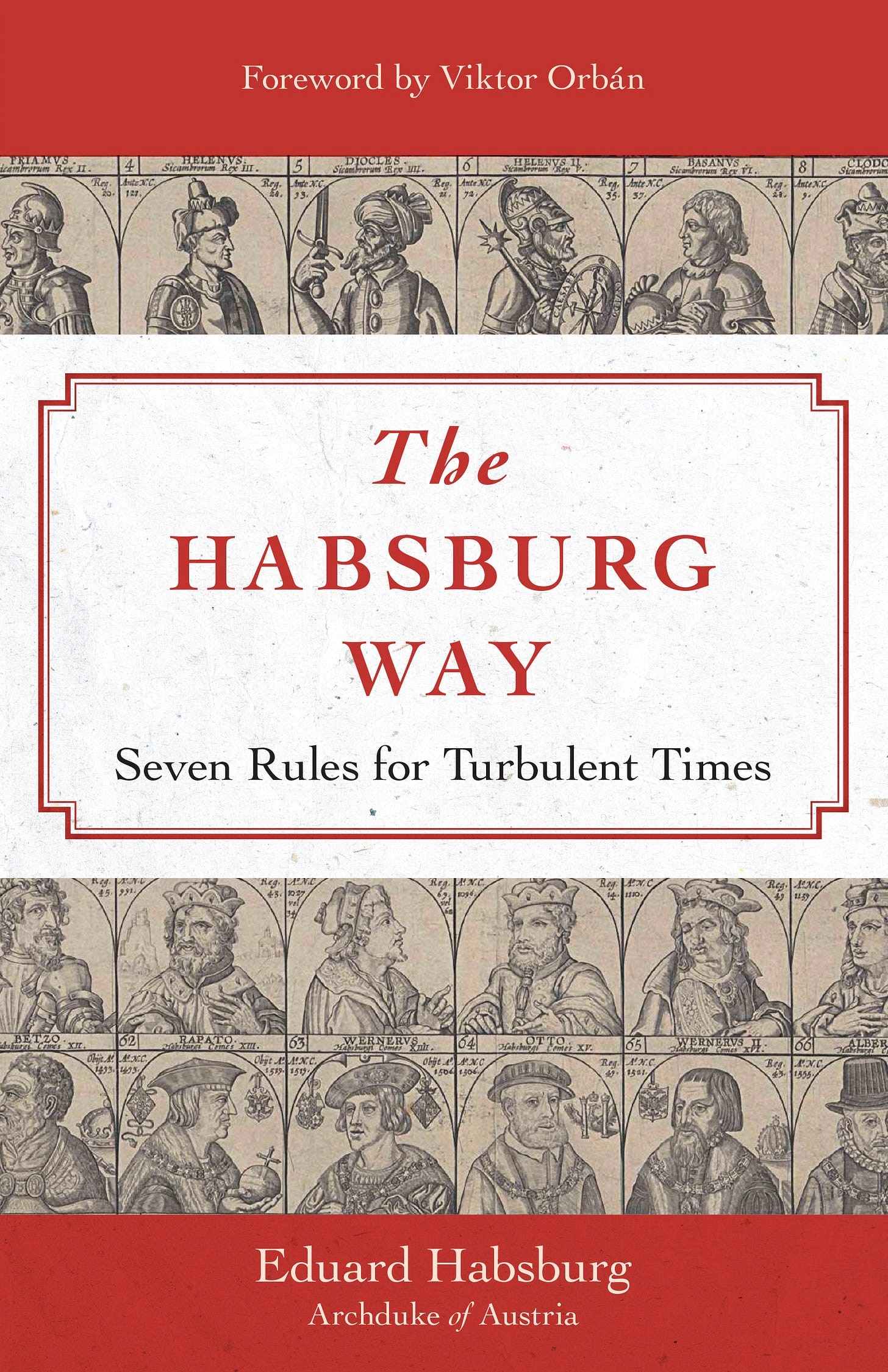
The Habsburg Way: Seven Rules for Turbulent Times
Manchester, N. H.: Sophia Institute Press, 2023

Unless you’re one of those people who reads the gossipy autobiographies of the British royal family, chances are it’s not often that you hold in your hands a book written by actual nobility. Thanks to Eduard Habsburg, Archduke of Austria and Ambassador of Hungary to the Holy See, that privilege can be yours! Last year, His Imperial and Royal Highness — Wikipedia informs me that this is the appropriate way to address a Habsburg Archduke — wrote The Habsburg Way: Seven Rules for Turbulent Times.

It’s a pleasant little read. Right from the introduction, the Archduke displays a confident forthrightness, love and admiration towards his forebears, and an almost paternalistic demeanor. He makes it very clear that he is proud to be a Habsburg and that his book is not going to indulge the modern reader with lazy and tired criticisms of his family — a family that we’re supposed to deem out-of-place in today’s world, a useless relic from a bygone era. No, for Eduard Habsburg his lineage is not just a list of vaguely familiar names. His ancestors are not merely long-chinned men clad in armor, forever frozen in time on painted canvas. His family is a living, breathing thing that exists today in his beating heart and the hearts of his children and relatives. And he has a thing or two to say about the current state of Western civilization.

Them’s The Rules

There are plenty of books which attempt to impart wisdom and instruction by laying down a set of rules. Jordan Peterson gave the world his 12 Rules for Life in 2018. In 1998, Robert Greene revealed that there were no more and no fewer than The 48 Laws of Power. That same year John Maxwell wrote his 21 Irrefutable Laws of Leadership. Eduard Habsburg’s list of rules is considerably shorter. I won’t spoil all of them for you, but there are a few which are worth mentioning.
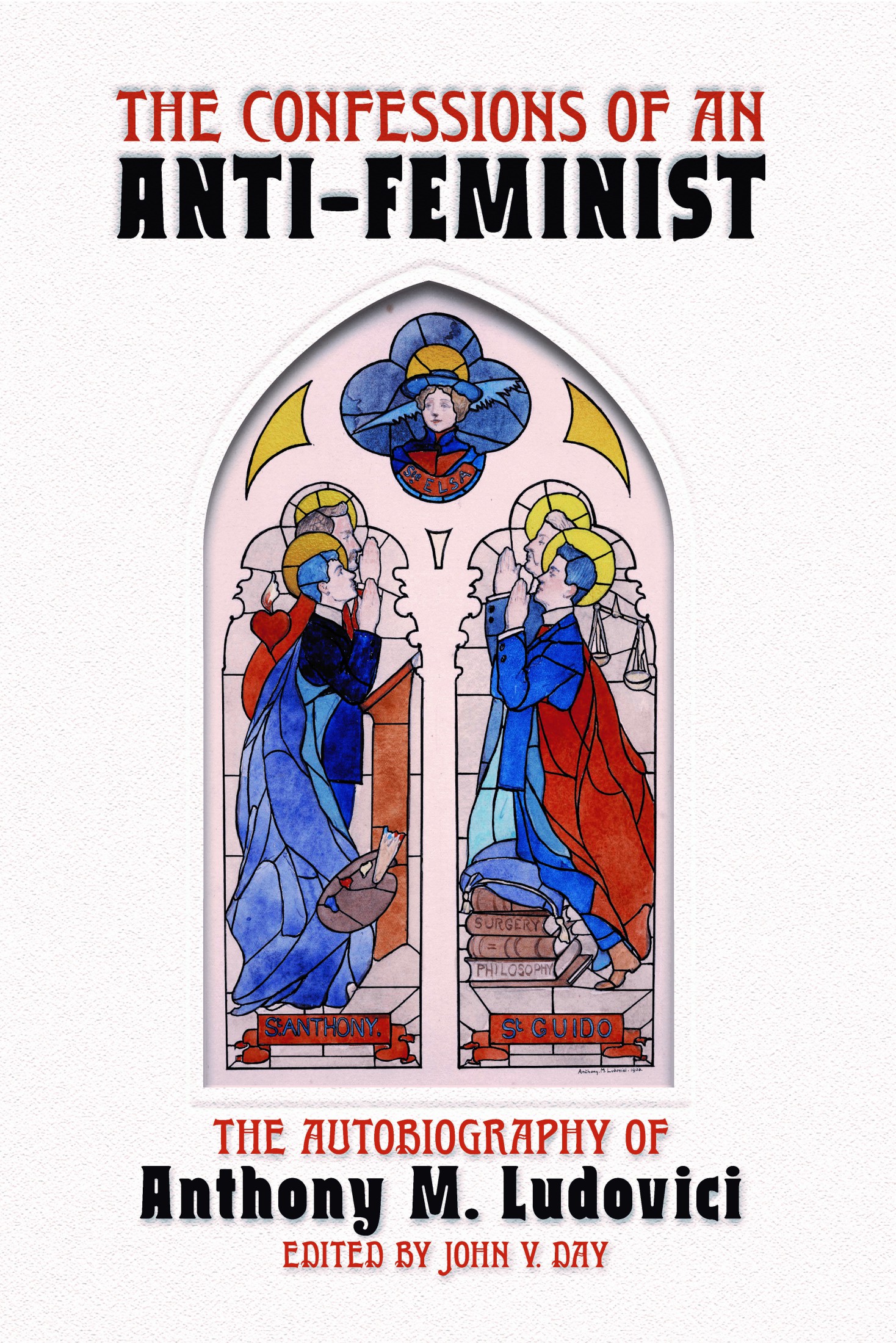
You can buy Anthony M. Ludovici’s Confessions of an Anti-Feminist here.

The very first rule is “Get Married and Have Lots of Children.” In this chapter, the Archduke shares with us the remarkable love story of Emperor Maximilian and Mary of Burgundy. When the two were 18 and 19 years old respectively, their parents arranged for them to wed. We often think that young people placed into an arranged marriage were unhappy and dreaded the day of their nuptials, but Maximilian and Mary seemed to fall in love immediately, even if at first they only knew each other through the exchange of yearningful letters.

Then Mary’s father, Charles the Duke of Burgundy, was killed in battle, and this left Mary alone and vulnerable to the machinations of King Louis XI. He mustered his army and marched on Burgundy, intending to make the territory his and make Mary a wife for his own son. Mary sent a letter to Maximilian pleading for him to save her from this fate. Charismatic young Max would raise a small army, but one which grew bigger and bigger as supporters joined him on his way to Ghent, where his betrothed was waiting desperately. Maximilian arrived just in time, wearing a golden suit of armor, and he and Mary got married before the French could do anything about it.

Eduard Habsburg uses this truly chivalric tale as a springboard to impart lessons on the importance of love, marriage, and procreation. He shares anecdotes about the relationship between Maximilian and Mary which makes them more relatable to us moderns. It’s a very strong opening for the book.

Another worthy rule is “Stand for Law and Justice.” Here, the Archduke makes the case that aristocratic families such as his were not out-of-touch bourgeois hedonists, and are not useless relics now. They were effective rulers in their time and we can learn valuable lessons from them. I think Mr. Habsburg gets a lot of things right in this chapter. He points out how so much of modern culture is a hollow fantasy centered on fighting injustice and inequality, and this is in large part due to the global influence of the American foundational myth and so many Hollywood films in which there is an evil empire or tyrant king. Because of this, he writes:

It may take effort for my American readers to accommodate their thinking to the idea that the very purpose of monarchies was to stand for law, justice, and peace for your people. Monarchs may not always have achieved this goal . . . but, nevertheless, it was the goal.

He goes on to say:

[Americans] haven’t seen, or considered, how future monarchs were raised; how they took their first responsibilities and finally took over from their parents; how they then raised children of their own. All they imagine is an oppressive tyrant, sitting on a faraway throne. But the populations in countries with active monarchs, who witness royalty directly or are raised to consider the history of royalty throughout the generations, benefit from a completely different perspective, and this creates a close social bond.

The Archduke argues that the royal families of Europe were raised first and foremost to serve and to fulfill the duties of their station. Throughout this chapter, he cites examples of how the Habsburgs had to get to know the nooks and crannies of their domain and the people they ruled, and understand in great depth the threats to them, as well as how they were trained to learn several languages and taught the examples of their forebears. While admitting that he may have a rose-tinted view, he says that he has firsthand experience of seeing these rigorous standards still being applied to the members of Europe’s royal families today.

To reinforce the point about the bond between monarch and subject, Habsburg tells of an encounter between Joseph II and a traveler stranded on the road. Joseph offered the traveler a place in his carriage, and the traveler, not knowing with whom he was now riding, began telling jokes and sharing stories with the Emperor, at one point even slapping the Emperor’s leg amidst cackles of laughter. When the traveler finally realized who he was speaking to, he was horrified by his vulgar behavior, but Joseph merely laughed and said, “I knew who I was, you didn’t. Nothing has changed. Let’s roll on!”
Earlier this month I wrote a review of another piece of pro-monarchy material from 2023, the French film Vaincre ou Mourir. As in my review, Habsburg implores us to consider what life would be like in a society governed by responsible individuals trained from birth on the art and craft of leadership. He recounts numerous examples of Habsburg rulers acting as intermediaries between disgruntled factions and as a check against all manner of the degeneracies that can afflict a nation. Even into the early twentieth century, when Habsburg rule was no longer as important as it once was, the Emperor Franz Joseph still maintained that the purpose of his office was “to protect my peoples from their politicians.” Habsburg ends this chapter by asking a question similar to the one I posed in my review of Vaincre ou Mourir: Despite all the flaws that one might accuse monarchy of having, who protects us from politicians today?

The book’s other rules are mostly focused on the importance of being Catholic. Obviously, this is a matter close to home for the Hungarian Ambassador to the Holy See and descendant of a long line of Catholics. If you’re into that sort of thing, you’ll enjoy those chapters. I found them the least interesting, and also betraying the inherent Catholic tendency towards universalism and, ultimately, the liberalism to which Eduard Habsburg thinks he and his family represent an opposition.

This universalist tendency is also on display in a chapter which I did find very interesting, the one entitled “Believe in the Empire and in Subsidiarity.” This rule is perhaps the most politically-centered. I found it compelling and enjoyable because of the Archduke’s not-so-subtle winks and nods telling the reader, “Look, I’m unironically saying that monarchy is based and you’d love it.”

He puts forth trenchant criticisms of the European Union and the current trend of centralizing policy and lawmaking to higher and higher levels of power which are farther and farther away from the people who will live under these policies and laws. At the same time, he also sings from a rather liberal hymn sheet when he praises the Habsburg realm for essentially being a multicultural state done right. Still, I can forgive him for this. While being a hopeless romantic pining for the days of aristocracy and empire, he is also trying to be a realist and a pragmatist. The world is ever more connected and, in the case of Europe particularly, many nations do live under one flag: the blue and star-spangled banner of the EU.

The lesson to be learned from the Habsburg way of doing things is found in the concept of subsidiarity. We might not restore the monarchies or the Holy Roman Empire, but we might be able to restore some of their values and ideas regarding proper governance. At the very least, the bureaucrats in Brussels could learn to respect the lower levels of government (nation-states, regions, provinces, and townships) and understand the importance of empowering them. None of this seems likely to happen without the current ruling class being made to learn this lesson the hard way.

Eduard Habsburg’s book couldn’t have come out at a better time. He has noticed and seized upon the growing discontent of people all across the liberal democracies of the West. It’s hard to read The Habsburg Way and not come away with a sense of admiration for this famous family and a hint of longing for a ruling class more like them. So, mission accomplished, Your Imperial and Royal Highness.


Get to Know Your Friendly Neighborhood Habsburg

Get%20to%20Know%20Your%20Friendly%20Neighborhood%20Habsburg

Share

  • Gab

Enjoyed this article?

Be the first to leave a tip in the jar!

Instant Echeck GreenPay™

*  *  *

Counter-Currents has extended special privileges to those who donate at least $10/month or $120/year.

  1. Donors will have immediate access to all Counter-Currents posts. Everyone else will find that one post a day, five posts a week will be behind a “paywall” and will be available to the general public after 30 days. Naturally, we do not grant permission to other websites to repost paywall content before 30 days have passed.
  2. Paywall member comments will appear immediately instead of waiting in a moderation queue. (People who abuse this privilege will lose it.)
  3. Paywall members have the option of editing their comments.
  4. Paywall members get an Badge badge on their comments.
  5. Paywall members can “like” comments.
  6. Paywall members can “commission” a yearly article from Counter-Currents. Just send a question that you’d like to have discussed to [email protected]. (Obviously, the topics must be suitable to Counter-Currents and its broader project, as well as the interests and expertise of our writers.)

To get full access to all content behind the paywall, please visit our redesigned Paywall page. 

Related

  • Barbara Will’s Unlikely Collaboration

  • A Novel Approach: Roberto Bolaño’s 2666

  • Restoring American Deterrence through Innovation and Industry

  • E. M. Forster’s A Passage to India & the Indian Mentality

  • The Theology Behind Ruby Ridge

  • The Rest Is Silence: Heidegger’s Quietism

  • Matt’s Negative Gloss: Matt Goodwin’s Suicide of a Nation, Part Two

  • Matt GPT? Matt Goodwin’s Suicide of a Nation, Part One

Tags

Angelo Plumebook reviewsCatholicismEduard HabsburgHabsburgsHapsburgsJoseph IImonarchysubsidiaritythe European UnionThe Habsburg Way

27 comments

  1. AdamMil says:
    April 25, 2024 at 10:48 pm

    It sounds like a good read, but I as a commoner can’t help but feel that having a name like “Eduard Karl Joseph Michael Marcus Antonius Koloman Volkhold Maria Habsburg-Lothringen” is utterly ostentatious, or maybe even conceited, but I guess if you wear a regular-looking suit and tie you have to distinguish yourself as nobility some other way…

    Unfortunately, as our aristocracy loses its sanction to rule I suspect it will eventually lose the ability. Many of them almost certainly are just feckless pretenders these days. Still, I agree that we probably need a return to aristocracy, because few politicians even pretend to have real worth.

    0
    0
  2. Michael says:
    April 26, 2024 at 1:29 am

    Human nature being what it is, much of the aristocracy became corrupted, unfortunately.  But even at their worst, they didn’t bring in boatloads of foreigners to replace their people. Even Ireland, ruled by an English king, remained genetically Irish for the hundreds of years under English rule. Under corrupt politicians,  Ireland is becoming a mongrel nation. Unless something changes soon, mongrelization will be the fate of many more White nations.

    1
    1
    • Dr ExCathedra
    1. Dr ExCathedra says:
      April 27, 2024 at 3:53 pm

      People forget, however, that the Northern Irish are actually mostly Scots, imported into the north of the Island because they were Protestants. A Great Replacement of one White ethnos by another.

      0
      0
      1. Margot Metroland says:
        May 2, 2024 at 8:43 am

        Heavily, but not mostly, or you wouldn’t have all those O’Neills, Kellys, Quinns in Antrim. Ireland and Scotland are only about 20 miles from each other, and the Scots largely came from Ireland to begin with, so they’re hardly foreign peoples with a Great Replacement.

        0
        0
        1. Dr ExCathedra says:
          May 9, 2024 at 2:55 am

          I’m sure that the Irish Catholics who were being expelled and replaced by the Protestant Scots might have a somewhat different POV.

          0
          0
  3. Dr ExCathedra says:
    April 26, 2024 at 3:57 am

    I recently had the pleasure of spending a few days in Budapest, where the architectural legacy of the Hapsburgs is a real pleasure to experience*, rebuilding the city after they managed to drive out generations of the life-sucking Turkish Muslims who were doing their ancient imperialist jihad routine. High marks to the Hapsburgs for both victory and aesthetics.

    However, as is the usual case in this sublunary world, the Hapsburg treatment of Hungary and the Hungarians left very much to be desired. The native Hungarian aristocracy were just as bad. Here is one element, about the 18th century, which sounds painfully recognizable:

    Centuries of Ottoman occupation and war had reduced Hungary’s population drastically, and large parts of the country’s southern half were almost deserted. A labor shortage developed as landowners restored their estates. In response, the Habsburgs began to colonize Hungary with large numbers of peasants from all over Europe, especially Slovaks, Serbs, Croatians, and Germans. Many Jews also immigrated from Vienna and the empire’s Polish lands near the end of the 18th century. Hungary’s population more than tripled to 8 million between 1720 and 1787. However, only 39 percent of its people were Magyars, who lived mainly in the center of the country.

    *To say nothing about the happy shock of the city being so demographically very European. I know of no large American cities, and few Western Europeans ones, which are so delightfully White.

    0
    0
    1. Kök Böri says:
      April 26, 2024 at 10:09 am

      Warszawa is not less white, and Riga is, and Vilnius is, and Tallinn is. But they are, of course, “not real Europeans”.

      0
      0
      1. Dr ExCathedra says:
        April 26, 2024 at 3:17 pm

        “not real Europeans”.

        I don’t know who you are quoting, but that’s certainly not the attitude around here.

        0
        0
        1. Kök Böri says:
          April 26, 2024 at 4:47 pm

          That’s the typical attitude in France and Germany where they do not consider s0-called “Middle and Eastern Europeans” as real Europeans.

          0
          0
          1. Dr ExCathedra says:
            April 27, 2024 at 4:12 am

            Reminds me of the time I lived in Rome years ago. The Romans said they were the only real Italians. They considered everyone north of them to be Germans and everyone south of them to be Arabs.

            I know of no human group, no matter how homogeneous they seem to an outsider,  which does not quickly develop internal divisions. Hell, I know few individual humans without them!

            0
            0
  4. Kök Böri says:
    April 26, 2024 at 10:06 am

    Das Habsburger Reich unter dem Kaiser Franz Josef I und der Kaiserin Elisabeth von Bayern war die beste Staatlichkeitsform für alle Völker des Mittel- und Osteuropas. Alles, was danach kam und was auch jetzt da existiert, ist bedeutend schlechter.

    0
    0
    1. AdamMil says:
      April 26, 2024 at 5:41 pm

      Google Translate: The Habsburg Empire under Emperor Franz Josef I and Empress Elisabeth of Bavaria was the best form of statehood for all the peoples of Central and Eastern Europe. Everything that came after and that exists now is significantly worse.

      0
      0
  5. Peter says:
    April 26, 2024 at 12:57 pm

    “At the same time, he also sings from a rather liberal hymn sheet when he praises the Habsburg realm for essentially being a multicultural state done right.” It was a different type of multiculturalism. There were no Africans or middle eastern Muslims involved. The groups were different European ethnic groups, or nationalities, living together in one empire. Multiculturalism, which has been championed for the last five or six decades by those in power, has been greatly praised, or severely criticized, depending on the time period, and that praise or criticism had little to do with justice. It was a means to accomplish something entirely different.

    At the end of WW I, the victorious allies wanted to weaken the two German states, Germany, and Austria-Hungary (previously known as the Austrian Empire for centuries).  They broke up both countries to weaken them. They championed what they called “self determination”, claiming they would create separate states so each ethnic group would rule themselves. This was their claim to being moral. But “self-determination” only applied to Germany and Austria-Hungary, and not the British or French Empires. The British and French had no intention of freeing India, Algeria or the vast territories they held in Asia and Africa, and in fact, greatly added to their empires after WW I. They also broke up the Ottoman Empire and added much of the middle east to their countries. After WW II, they claimed the opposite was good. Now multiculturalism was good, where all different groups should live together. Now, this is claimed to be moral, and “self determination” is racist, unless your Israel. Notice, also, how Viktor Orban and Hungary are now treated for being Hungarians, and not Europeans.

    There are also differences in how empires are run. In Austria-Hungary, each language group had representation in the country’s parliament. Indians, Algerians and others did not have representation in the French or British parliaments.

    The victorious allies created a real mess after WW I with their jealousy of the Germans. Germany was not a multicultural country. It was one of the most homogeneous countries in the world, but it had a small population of minorities. No country is 100% homogeneous.

    The allies claimed Alsatians were not German. They like to say they have their own language, “Alsatian”, because it’s a dialect of German. But all of Germany had different dialects. Before Germany became a unified country, there were many dialects spoken and some unintelligible to different Germans. The same as Swiss-German. Someone from Germany can’t understand that language. So Hochdeutsch (High-German), the Prussian dialect, is used so all German speakers can understand each other, including those in Alsace and Switzerland. It is not uncommon for a language to have different dialects that are unintelligible to other speakers of that language. Italy had the same situation before they became a unified country.

    In Germany there were some ethnic Poles, and where there was a higher concentration, they took that land from Germany and gave it to Poland. In the northeast, Germany had bordered the Russian Empire until 1919, and they took the Memelland, where some Lithuanians lived, and made it a so called “free city”, until Lithuania attacked and took over the territory in 1923, and the allies said nothing. When there was a vote held in the Memelland, the vote revealed many ethnic Lithuanians felt German and wanted to be part of Germany. The results were a strong victory for re-unification with Germany. They even took the Saarland and wanted to make it French. When a vote was held on which country they wanted to belong too, 98% of them voted for re-unification with Germany. They were all Germans.

    Austria-Hungary was different. They had many nationalities. After WW I they took a chunk of land from Austria and created a country that had never existed before – Czechoslovakia. With that name, they concealed, that Germans (actually Austrians) were the second largest ethnic group in the country, after the Czechs. Germans made up about 23% of the country. Slovaks were also a sizable population, but Czechs were the largest group. But, none of these groups were asked if they wanted to be be torn from the empire they had always belonged to. 3.5 million Germans in the Sudetenland didn’t want to be part of a new country and demanded the right to unify with Germany, which they did. Slovaks, then also demanded independence, which they got, and they allied with Germany in WW II. For their trouble, at the end of WW II, the 3 million plus Germans had their homes and everything else stolen from them, and they were driven off of their lands. Czechs moved into their homes.

    Czechoslovakia was reconstituted until it broke up for good in 1992, when Slovaks demanded independence again. It was the country nobody wanted.

    Yugoslavia was another fiasco the jealous allies forced on people. They took lands of Croatia, Slovenia and other lands from Austria, combined them with Serbia, and formed the new country of Yugoslavia, another disaster, the French, British and Americans have never been made to pay for. Croats and Slovenes had good relations with Austrians and Germans, and fought on the German side in WW II. There was bitter fighting in the war. After WW II, the country was reconstituted after many more were killed at the end of the war. Forty five years later, in 1990, fighting broke out again, and Yugoslavia broke up for good this time.

    2
    2
    • AdamMil
    • Scott
    1. Kök Böri says:
      April 26, 2024 at 4:51 pm

      The Russian imperialists instigated the separatism among Slav peoples of Austria-Hungary with this stupid Panslavism, and also American Intelligence, using Czech emigree traitors, tried to break this state down.

      0
      0
      1. Paul says:
        April 26, 2024 at 10:54 pm

        That state was already crumbling long ago because of the greed of the Germans and Hungarians. Czechs only dethroned the Habsburgs from the throne of the Czech kingdom and occupied Slovakia, where a very similar language was spoken. Slovaks wanted to be part of Czechoslovakia initially and only later wanted more autonomy. They definitely didnt want to stay in Hungary. Russians did not need to send any agents to get the Czechs to reject the Habsburgs.

        0
        0
    2. Paul says:
      April 26, 2024 at 5:29 pm

      That’s Pangerman nonsense. A country called Czechoslovakia may not have existed until 1918, but the Czech state has always been there and has never ceased to exist. The Habsburg Empire was in fact a union of several independent monarchies with Czech kingdom of Bohemia (the Bohemian Crown) at its core. If Czechs had not elected a Habsburg prince called Ferdinand I as their king in 1526 in order to fight off the Turks, the Austrian Empire would not have existed at all. Czechs merely dethroned the Habsburgs in 1918 and annexed areas of Slovakia where a very similar language is spoken. It is not true that Slovaks did not want a common state with Czechs at that time.

      Germans in Bohemia were descendants of settlers from various Germanic speaking regions who were settled by the Bohemian nobility in the less fertile areas of the kingdom in the 13th century. They were always subjects of the Bohemian state and the territory where they lived never had any legal personality. Their identity as Sudeten Germans did not emerge until the early 20th century. In fact, they inhabited a number of disconnected territories on the outskirts of the country. These areas could not be geographically separated from the rest of the Czech state without making Czechia a non-viable rump state. The expulsion of these Germans after 1945 was a consequence of their disloyal and hostile behaviour and in retaliation for the destruction of Czechoslovakia and also for its occupation by the Third Reich. Before that Germans had all imaginable political rights in Czechoslovakia as any other citizen. But they thought they could lord over Czechs (with the help of the Reich Germans) and it backfired on them badly.

      But that is all a history long past. Today’s Czechs and Germans have no problem with each other. From a WN viewpoint if the Sudetenland belonged to Germany today, the German government would certainly send Muslim refugees in large numbers there, which will probably happen anyway.


      0
      0
      1. Kök Böri says:
        April 27, 2024 at 3:39 am

        From a WN viewpoint if the Sudetenland belonged to Germany today, the German government would certainly send Muslim refugees in large numbers there, which will probably happen anyway.


        That’s surely correct. The same could be said also about Schlesien and Ostpreussen, which now belongs to Poland. When hypothetically Russia agrees with Germany to change the Polish borders, i.e. to give to the Poles former Polish lands of the Western Ukraine back and demands for this from the Poles to give former German lands back to the FRG, also, to restore the borders of the August, 1939, then you could suggest that in Schlesien and Ostpreussen would the refugees from Sham (Syria) be settled. So it is better when these lands stay Polish.


        0
        0
      2. Peter says:
        April 27, 2024 at 5:40 am

        No, the Germans, nor the Slovaks didn’t have the same rights under the nationalistic Czechs that were put in charge of the country. That’s why they both demanded independence from it. Maybe the Czechs that went along with the WW I victors to steal a large peace of land from Austria-Hungary and create a new state were traitors. The Germans in the Sudetenland and the Slovaks did not want to be a part of that bastard country. Czechs weren’t asked either, but the allies put the most nationalistic Czechs in charge. The “legal personality” of the Germans that lived in Bohemia and Moravia was the same as any other German that was part of the Austrian Empire, later the Austro-Hungarian Empire.

        When the famous university in Prague was founded in 1348, the faculty was predominantly German, and German was the language used at the university. In other words, the famous university in Prague was founded by Germans. Until the 1800s, German was the predominant language in Prague, Prague’s history is just as much German, as it is Czech.


        https://www.youtube.com/watch?v=21wpBoISoco&t=572s


        The Czechs were not asked if they wanted to be part of a separate country either, when Czechoslovakia was created. The WW I allies that created the new state made sure to never hold a plebiscite (vote) to ask the population if they wanted to be part of the new state, because the population would have rejected it. The country’s short history shows that. Many Czechs were not German hating bigots, but WW II lies have affected the hearts of people’s all across eastern Europe that welcomed German troops as liberators from Judeo-Bolshevism. Since 1991 eastern Europe got a new dose of anti-German propaganda, when the Holocaust hoax was introduced to them, and the lies have become part of the school curriculum in eastern European countries to spread more false history.  Czechs and Germans intermarried too. I met a beautiful Czech in the US once. She was 1/4 German. A Czech actress married the German boxer Max Schmelling in the 1930s. This was not unusual.

        “At a mass meeting in Prague, 200,000 Czechs pledge loyalty to their homeland and to the German Reich. This rally in Wenceslas Square, near the historic statute of St. Wenceslas, is on July 3, 1942 — four weeks after the murder of Reinhard Heydrich, SS General and Deputy Reich Protector of Bohemia-Moravia.

        Emanuel Moravec, Czech Minister of Education and National Enlightenment, addresses the crowd. He concludes with an expression of confidence in a better future for the Czech people, and of appreciation for the “new Europe,” the “National Socialist revolution,” “our leader, Adolf Hitler,” and “our state president, Dr. Hacha.”

        Emil Hacha, Czech State President, is present, along with the Mayor of Prague and the mayors of many other cities and towns of the Protectorate of Bohemia-Moravia. The meeting concludes with the vast crowd singing the Czech national hymn. From a Czech newsreel report, July 1942. In Czech. No subtitles.”


        https://www.youtube.com/watch?v=9wiB1fwR6Tw

        0
        0
        1. Kök Böri says:
          April 27, 2024 at 11:39 am

          A Czech actress

          was a lover of Dr. Goebbels.

          1
          1
          • Scott
          1. Peter says:
            April 27, 2024 at 12:10 pm

            Thanks.

            0
            0
          2. Paul says:
            April 27, 2024 at 1:59 pm

            You’re mixing things up. Czechs had an ambivalent relationship with the Habsburg Empire. The Austrian Habsburgs were descendants of the former Czech royal families by female line. They were legitimate Czech rulers thanks to the royal succession and the election by the Bohemian Diet. A number of Habsburg emperors enjoyed great popularity among the Czechs. For example, Joseph II is still very popular in the Czech Republic as an enlightened monarch.

            Problems arose mainly after 1867 and 1871. Austria became a constitutional monarchy and was actually divided into two parts – Austria-Hungary. The Czechs came up empty handed in this power division despite their loyality to the Habsburgs in the War against Prussia in 1866. This made the Czechs very angry and they began to distrust Vienna. In addition to that Germans in Austria and Bohemia began to yearn more and more for a unification with the new German Reich. Gradually they started to see their capital in Berlin. This was not acceptable to the Czechs and they began to think about secession from Austria as it became more pro German.

            The final break came during the First World War, when Viennese politicians established a military dictatorship in Bohemia and began to oppress the Czechs. It was clear that if the Central Powers won, Austria (and Bohemia) would essentially merge with Germany. Czech soldiers asked themselves why they should support such a thing. Many of them crossed to the other side of the front and gradually formed the Czechoslovak Legion. Thanks to this, Czechoslovakia had the status of a minor Entete power with its own army and could set its own conditions during peace negotiations in 1919.

            In October 1918, no Czechs wanted to remain in the monarchy, among other reasons, because it had collapsed of its own. After the defeats in Italy it was the Hungarians who were the first to break away and the Hungarian regiments were leaving the front for home. The Czechs declared an independent Czechoslovak Republic in Prague on 28 October and dethroned the Habsburgs. Later, the leader of the foreign Czechs, the philosopher Masaryk, returned from American exile and became president of the new state. Some Germans in the Sudetenland didn’t like it. They caused unrest and wanted to join German-speaking Austria. But the Czech army quickly pacified these areas. Similarly, the Czechs occupied Slovakia and defended it against Béla Kun. The Poles also wanted to conquer the county of Těšín from the Czechs, but they were repulsed and the matter ended in the division of the region. As for the behaviour of some collaborators during the Second World War, it does not indicate any sympathy of the majority of Czechs with the German occupation.

            0
            0
          3. Kök Böri says:
            April 28, 2024 at 3:39 am

            Lida Baarova

            She died only 24 years ago, when she was 86 years old.

            https://en.wikipedia.org/wiki/L%C3%ADda_Baarov%C3%A1

            1
            1
            • Scott
    3. Antipodean says:
      April 27, 2024 at 3:51 am

      The partition of monarchichal empires was conducted in three main phases, that of the Spanish Empire from 1810-1898, China and the Central Powers including the Ottoman Empire in the 1910s and that of the Japanese, British, French, Dutch, Belgian, Portuguese and residual Spanish, Italian and German Empires from 1944 to ca 1975. Whatever the objectives of the states which broke up these empires there was an overarching objective of a world of interdependent liberal democratic states reliant on international finance and a prohibition on territorial gains by said states, Israel excepted of course.

      Once this was largely achieved, demographic destruction of the White race was commenced in earnest. It seems most likely that there has been a guiding entity behind this sequence of events which is in some sense supranational. That so many elite Europeans in Europe and America seem to be involved at a fairly senior level I find perplexing. Is it a case of “they know not what they do” or do they imagine themselves to be like Hugo Drax’s space colonists (Moonraker 1977) who plan to repopulate the Earth, perhaps on the proviso they marry into Jewry in accordance with Coudenhove-Kalergi’s doctrines? It’s only a theory of course and how do they plan to deal with China, their somewhat renegade golem?

      1
      1
      • Scott
  6. Al Dante says:
    April 26, 2024 at 4:21 pm

    There was a bond of sorts between the peasant class of the Kingdom of the Two Sicilies and the ruling Bourbons. As an indicator, children of peasants were often named after the king.

    It was the peasant class that supported the monarchy when the Piedmontese from Northern Italy and their foreign allies invaded the South during the time of the American Civil war. Peasants formed various and separate outlaw bands to resist the occupation. Support for the invasion came from the Southern merchant and educated classes.

    There is something to be said for monarchy. One knows who to blame if things go south.

    0
    0
  7. Scott says:
    April 29, 2024 at 8:01 am

    Francis Parker Yockey made the point ─ usually lost in our age where Marxist and extreme-Libertarian interpretations of the U.S. Constitution are the norm ─ that the Federalists were motivated not by greed, as the socialist Columbia University History Professor Charles A. Beard argued, but instead by the ancient virtues of noblesse oblige, the rule of law, and the eternal love for State and Nation (and Race as I would argue). Yockey singles out Alexander Hamilton for praise, the apprentice of General Washington himself.

    This sense of Nationalist virtue is outlined fairly well in the Preamble of the Constitution, and with the possible exception of the word Liberty then in vogue, might have been written for the benefit of an ancient Republic ─

    “We the People of the United States, in Order to form a more perfect Union, establish Justice, insure domestic Tranquility, provide for the common defence, promote the general Welfare, and secure the Blessings of Liberty to ourselves and our Posterity, do ordain and establish this Constitution for the United States of America.”

    Some strongly diasgreed with the idea of a unified Nation-State and wanted thirteen “Switzerlands,” each provincial and weak, and probably utlimately too tempting for foreign powers despite the buffer of a great ocean and an enormous and nearly-empty continent full of land and resources.

    In the end, although the Constitution was ratified, it was too weak to overcome the inevitable factionalism that would come.

    And the document failed to put into black-letter law what was already understood at the time, that citizens were to be “free White people of good character,” as spelled out in the Naturalization Act of 1790.

    On the other hand, there is no vaccine against subversion hundreds of years in the making save for daily vigilance.

    Many proclaim the French Revolution and the Enlightenment as the origins of this subversion. There is some truth to this; we all know where (((radical))) egalitarianism leads, even though we have hardly even begun to plumb those sordid depths.

    Nevertheless, I find this common WN view overly simplistic.

    The American Nazi Party Commander George Lincoln Rockwell once wrote that had he been born over a hundred years earlier, he would have sat on the Left ideological side of the Assembly during the French Revolutionary times.

    That means that he would have been in opposition to the corruption and dogmatism of the three Estates: the Monarchy, the Clergy, and the Bourgeoisie.

    But once systemic reforms had been made, Rockwell would have returned as a man of the Right and in support of Authority, Law & Order and traditional virtues, and against the Jacobins and Jews who were out-of-control totalitarians who thought that all ideology should be fine-tuned by the guillotine.

    I don’t want to give too much credit to the Freemasons, but their opposition to the Latin Church was vital for change. It was an organization that allowed Protestant businessmen to network ─ and so long as sordid criminal secrets were not kept, probably harmless.

    The lodges did not permit atheists, not that someone like myself would be interested in joining, but this was an effective counterweight to Papal machinations, the same universalistic values that are turning Ireland today into a race-mixing hellhole.

    In the 1980s, I wondered how Nïgger-loving Irish activists like the Rock music group U2’s Bono, who thought that Apartheid (or Apart-Hate as he said it) was like gassing the Jews, got to that stunted mentality. Obviously it is not okay to be White.

    In any case, the First Amendment is notable for not elevating any particular sect ─ and at least giving voice to protect the rights of nonbelievers like myself.

    I’m old enough to remember when the Ku Klux Klan did not allow Catholics but changed that policy after Vatican II when the Pope lost his divine infallibility, and politially after John F. Kennedy thoughtfully declared that he believed in the separation of Church and State, declaring that he believed that this arrangement was the best for our society (and Western societies in general as I would argue). The Thirty Years War is finally over.

    Rockwell said that he was an atheist or agnostic but that White people had earned the right to freedom of conscience with their blood and brains, and that of those that came before them. So he supported Whites being Christians if that is what they wanted and for as long as they wanted to be.

    I don’t agree with throwing out the good things of the Enlightenment and the Constitution along with purging the toxic bathwater that threatens the health and future of our Race.

    The Constitution purported to create a Aristocracy of Merit. How well the Founding Fathers succeed in this is a matter of debate. We certainly have nothing of the sort today because our elites have utterly failed us; they are corrupt at best and subversive or treasonous at worst.

    We have lost our way as a people and race and we do not even know what Meritocracy means, nor how we could define it objectively. It is not a spreadsheet drawn up by a nappy-haired DEI administrator somewhere, of course.

    Thanks for this thought-provoking review of Herr Hapsburg.

    More thoughts later …

    🙂

    0
    0
    1. Kök Böri says:
      April 29, 2024 at 9:23 am

      Seen from the historical point of view, there is no reason to say that left-wing politicians cannot also be nationalists and patriots. If we take the European political left during the revolutions of 1848, so those Leftists were both leftist and nationalist, while the Right represented then a feudal-Catholic reaction whose time had passed. The French of 1789 were unambiguously nationalists. The Italians Garibaldi and Mazzini were both Left and nationalists. The Pole Pilsudski was a socialist, and at the same time he was an ardent fighter for the independence of Poland. The Türk Atatürk was a man of leftist views, and the current Kemalist party CHP in Turkey is considered as social democratic, which does not prevent it from being completely nationalist. The Ukrainian Petlyura in 1917-1920 was a socialist and a nationalist at the same time, and Mussolini was also initially a socialist and a nationalist.

      For the nineteenth and first half of the twentieth century, being a leftist and a socialist meant defending the rights and interests of the working masses of one’s own nation, not of a some foreign one. Only much later, somewhere in the 1960s, when the European and American workers received enough rights and enough material benefits, the left forces gradually lost their national-progressive character and switched (or were deliberately switched) to the defense of various kinds of strange outsiders – national and sexual minorities, for example, which is why the modern Left has lost its nationalistic character, turning into accomplices of the world’s globalist elites. But the modern Right is also mainly supporters of globalist ideology, and differs from the Left only in tactics. Thus, the modern political split is not between left and right, but between globalists and anti-globalists.

      1
      1
      • Scott
  8. Margot Metroland says:
    May 2, 2024 at 8:50 am

    Eduard is one my favorite tweeple and we’ve exchanged a word now and again. I might have bought this book a while back but when he first showed it off on Twitter he was sitting there having tea with the (soon to be exiting) Henry Kissinger. If ever you sort through the thickets of his family tree you’ll find he’s not going to be Kaiser anytime soon. He’s of the same main branch (Habsburg-Lorraine) as the last Austrian emperors but at a remove of two or three centuries.

    0
    0

Comments are closed.

If you have a Subscriber access,
simply login first to see your comment auto-approved.

Note on comments privacy & moderation

Your email is never published nor shared.

Comments are moderated. If you don't see your comment, please be patient. If approved, it will appear here soon. Do not post your comment a second time.

Upcoming podcasts
  • Rob Rundo on Counter-Currents Radio

    Rob Rundo on Counter-Currents Radio

    Counter-Currents Radio

    Sat, Jun 13th — 3 pm EST / 9 pm CET
  • Daniel Tyrie on Counter-Currents Radio

    Daniel Tyrie on Counter-Currents Radio

    Counter-Currents Radio

    Sat, Jun 20th — 3 pm EST / 9 pm CET

Writers of May

(2 votes) Morris van de Camp David M. Zsutty Derek Stark Jayant Bhandari Greg Johnson

Articles of May

The Lunch Wars by David M. Zsutty Heidegger on Nietzsche, Part One by Collin Cleary 2 votes
    • The Union Jackal, June 2026

      Mark Gullick

      2

    • The Inferiority Behind Immigrant Superiority

      Jayant Bhandari

    • Counter-Currents Radio Podcast No. 690
      Greg Johnson & David Zsutty Discuss Current Things: AI, Henry Nowak, the Iran Crisis, & More

      Counter-Currents Radio

      1

    • Collin Cleary: What Rome Means to Me

      Collin Cleary

      2

    • Paul Krugman: Closet Bolshevik

      Spencer J. Quinn

      12

    • Fugue of Ideas:
      Ibram X. Kendi’s Chain of Ideas

      Greg Johnson

      14

    • Based Blacks

      Lipton Matthews

      6

    • Black Intellectual Fatigue

      Derek Stark

      30

    • Why White Advocates Should Avoid “Based Blacks”

      Dani Vypont

      20

    • Nietzsche & Race

      Mark Gullick

    • Editor’s Update
      Rob Rundo Rescheduled to Next Week on Counter-Currents Radio;
      Tonight Greg Johnson & David Zsutty Answer Your Questions;
      Fundraiser Update & a New $20,000 Matching Grant

      Greg Johnson

    • The Counter-Currents 2026 Fundraiser
      Lifetime Subscriber Welcome Packages Extended

      Greg Johnson

    • Nationalism This Week
      Who’s Looking Back?

      Greg Johnson

      29

    • China’s Threat to American Security:
      Food, Farmland, Foreign Control, & Energy Policy

      Lipton Matthews

      5

    • The Bitter End of Western Metaphysics:
      Heidegger on Nietzsche, Part Two

      Collin Cleary

      15

    • The Killing of Henry Nowak

      Mark Gullick

      38

    • The Crisis of Chinese Technology Thieves

      Morris van de Camp

      1

    • The Strange World of Gender Bender Fiction:
      & What This Genre Tells Us About Autosexuality

      Dani Vypont

      3

    • Watching the Watchers:
      The Dark Triad Question

      David M. Zsutty

      14

    • The Remigration Movement Solidifies

      F. Roger Devlin

      1

    • Casting Aspersions:
      The Fatal Consequences of Race-Swapped Casting, From Helen of Troy to Henry of Southampton

      Steven Tucker

      20

    • The Murder of Henry Nowak

      Millennial Woes

      23

    • Don’t Forget to Vote in Our Writer & Article of the Month Poll

      Greg Johnson

    • The Robot Hotdog Stand

      Greg Johnson

      37

    • Laughing Our Way to Victory

      Dave Chambers

      7

    • The Zodiac Killer

      Mark Gullick

      11

    • Jared Taylor: What Rome Means to Me

      Jared Taylor

      1

    • An Interview with Endeavour:
      My Way of Life Is an Adventure!

      Ondrej Mann

      6

    • José Pedro Zúquete’s The Identitarians

      Greg Johnson

      3

    • Editor’s Update
      Fundraiser Update & How to Watch the Remigration Summit

      Greg Johnson

      5

    • The Bitter End of Western Metaphysics:
      Heidegger on Nietzsche, Part One

      Collin Cleary

      11

    • Berlin: City of Stones

      Spencer J. Quinn

      6

    • True Folk-Horror Is Horror of Your Own Folk:
      Mark Gatiss vs the Brexit Blind Dead  

      Steven Tucker

      4

    • Counter-Currents Radio Podcast No. 689
      Thomas Massie, the America 2050 Bust, the Need for Whites to Divest from America, the AI Economic Apocalypse, & Pro-White Project Pitches to Billionaires

      Counter-Currents Radio

      7

    • Nationalism This Week
      Remigration is Inevitable, Part 3

      Greg Johnson

      27

    • Why Billionaires Should Fund White Identity Politics

      Lipton Matthews

      8

    • How Cold War Two Came About

      Morris van de Camp

      5

    • Now Available for Pre-Order at a Special Price!
      Greg Johnson’s The Philosopher Is In

      Greg Johnson

    • David Zsutty’s Elevator Pitch to a Billionaire

      David M. Zsutty

      1

    • Headbanging Lite

      Mark Gullick

      5

    • White Advocacy Past and Present

      Peter Bradley

      13

    • The Lunch Wars

      David M. Zsutty

      47

    • The Russians are Coming/The Russians are Coming

      Steven Clark

      1

    • Peak Fatigue in Fort Wayne

      Gabriel Anderson

      24

    • Keith Woods’ Elevator Pitch to a Billionaire

      Keith Woods

    • The Cruelty of Kindness

      Morris van de Camp

      9

    • Predation Wearing the Mask of Civilization

      Jayant Bhandari

      13

    • The Mandalorian & Grogu

      Trevor Lynch

      24

    • Editor’s Update
      Fundraiser Update & a New $20,000 Matching Grant
      Greg Johnson & David Zsutty Discuss Thomas Massie on Counter-Currents Radio

      Greg Johnson

      2

    • How the Jews Defeated Thomas Massie—& Themselves

      David M. Zsutty

      27

    • Greg Johnson

      The Robot Hotdog Stand

      Do tell

    • Hdkbdd

      The Robot Hotdog Stand

      Marxist philosophy does offer a theoretical solution.

    • Moss

      The Union Jackal, June 2026

      Excellent summary of the state of the UK and Ireland this week. Invader atrocities committed...

    • Chud

      Counter-Currents Radio Podcast No. 690

      "If it's not radically new, why are they branding it as artificial intelligence" When...

    • Collin Cleary

      Collin Cleary: What Rome Means to Me

      Thank you!

    • countenance

      Fugue of Ideas: Ibram X. Kendi’s Chain of Ideas

      Kendi (or whoever wrote this for him, and I'll get to that) mentioned the Potsdam meeting in late...

    • Anon

      The Union Jackal, June 2026

      I think Rupert Lowe needs to stand down in Makerfield. I'm basing this off the analysis from Mark...

    • Beau Albrecht

      Paul Krugman: Closet Bolshevik

      If he had any power, he might well be up to tremendous mischief.  It's true that his bluster has a...

    • Beau Albrecht

      Fugue of Ideas: Ibram X. Kendi’s Chain of Ideas

      His shtick is about stitching together Ivory Tower leftist talking points into a Grand Unified...

    • Chud

      Fugue of Ideas: Ibram X. Kendi’s Chain of Ideas

      But typically, paranoids don’t churn out massive tomes. Is Ibram X. Kendi a new category of lunatic...

    • Bigfoot

      Fugue of Ideas: Ibram X. Kendi’s Chain of Ideas

      It’s obvious that this is lazy scholarship and black hyperbole, however, I doubt that he encountered...

    • Bigfoot

      Black Intellectual Fatigue

      She is a Jew. I didn't mention it because I had any sympathy for her. And I certainly didn't think...

    • Glide Ratio 0:1

      The Killing of Henry Nowak

      Any one know what happened to Finnish, Kai Murros? He made an excellent essay on the benefits of...

    • Glide Ratio 0:1

      Why White Advocates Should Avoid “Based Blacks”

      My experience with conservatives is actually worse than "light" liberals (leftists). I've had more...

    • Peter Quint

      Black Intellectual Fatigue

      With a name like Mary Leftkowitz, she has got to be a jewess, can’t feel sorry for her. 🙃

    • kolokol

      Paul Krugman: Closet Bolshevik

      Trump is the most pro-Jewish president in American history. Therefore, very few Jews hate Trump now...

    • Will Williams

      The SPLC Indictment

      I didn’t watch the entire hearing of the House Judiciary Committee’s grilling the current, not-so-...

    • Bigfoot

      Black Intellectual Fatigue

      Back in 1996, a book was published by female academic, Mary Leftkowitz, called Not out of Africa. It...

    • Bigfoot

      Black Intellectual Fatigue

      I can't help but wonder if many white, academics get frustrated with some of their black students in...

    • Stronza

      Black Intellectual Fatigue

      Defense gives closing arguments in punishment phase: Texas defines sudden passion as passion that...

    • Earth Day Special

      John Morgan

      12

    • A Robertson Roundup
      Remembering Wilmot Robertson
      (April 16, 1915 – July 8, 2005)

      Margot Metroland

      13

    • The Paranoid Style in White Nationalism

      Greg Johnson

      30

    • Join the Dance!

      Andrew Hamilton

      1

    • We Can’t Save the Earth Without Reducing African Birth Rates

      James Dunphy

      36

    • “I’m Not a Conspiracy Theorist, but . . .”:
      Jeffrey Epstein’s Death Gives New Life to “Conspiracy Theories”

      Greg Johnson

      22

    • Sylvia Plath: Stasis in Darkness

      Vic Olvir

      17

    • Vanguardism, Vantardism, & Mainstreaming

      Greg Johnson

      80

    • Aviation, Geography, & Race

      Charles Lindbergh

      3

    • Some Thoughts on Yule

      Collin Cleary

      4

    • Living in Truth:
      A Yuletide Homily

      Jef Costello

      7

    • John Kennedy Toole’s A Confederacy of Dunces

      Greg Johnson

      20

    • On Aleksandr Solzhenitsyn’s Warning to the West

      Spencer J. Quinn

      7

    • Elitism, British Modernism, & Wyndham Lewis

      Jonathan Bowden

      6

    • Philip K. Dick’s Do Androids Dream of Electric Sheep? as Anti-Semitic/Christian-Gnostic Allegory

      Greg Johnson

      20

    • “Conspiracy Theory” or Conspiracy?

      Andrew Hamilton

      21

    • Remembering H. P. Lovecraft
      (August 20, 1890–March 15, 1937)

      Greg Johnson

      3

    • Who Are We?
      Nordics, Aryans, & Whites

      Greg Johnson

      71

    • Remembering William Gayley Simpson
      (July 23, 1892–December 31, 1990)
      A Pleasant Afternoon with Harriet & Bill Simpson

      Margot Metroland

      18

    • Here are the Young Men
      Remembering Ian Curtis
      (July 15, 1956–May 18, 1980)

      Mark Gullick

      18

    • Percy Grainger
      Artist of the Right

      Alex Graham

      7

    • Remembering Revilo Oliver
      (July 7, 1908–August 20, 1994)

      Greg Johnson

      18

    • The Meaning of July 4th for the White Man

      Gregory Hood

      13

    • The Front National’s Evolution

      Bruno Mégret

    • Merwin K. Hart
      Forgotten American Hero & Man of the Right

      Morris van de Camp

      10

    • George Orwell’s Nineteen Eighty-Four

      Jonathan Bowden

      8

    • Carleton S. Coon
      Scientist & Reluctant White Advocate

      Morris van de Camp

      3

    • The Kwanzaa Absurdity Will Be Dwarfed by Juneteenth

      Robert Hampton

      10

    • Stravinsky

      Alex Graham

      7

    • Like the Roman:
      Remembering Enoch Powell (1912-1998)

      Mark Gullick

      23

    • Neo-Fascism in Film
      Part 5

      Karel Veliky

      15

    • The Game of Tarot

      Mark Gullick

      2

    • Institutions Cannot Be Transplanted

      Jayant Bhandari

      5

    • Jonathan Bowden’s Deliverance
      Part 5

      Jonathan Bowden

    • Crosstown Traffic:
      Jimi Hendrix & The Post-War Rock ‘N’ Roll Revolution

      Mark Gullick

      1

    • Slaves from the North:
      Finns & Karelians in the East European Slave Trade, 900–1600

      Lipton Matthews

      14

    • Neo-Fascism in Film
      Part 4

      Karel Veliky

      2

    • David Lean’s A Passage to India

      Spencer J. Quinn

      1

    • Elites are Essential to Development

      Lipton Matthews

      7

    • Jonathan Bowden’s Deliverance
      Part 4

      Jonathan Bowden

    • Neo-Fascism in Film
      Part 3

      Karel Veliky

      6

    • E. M. Forster’s A Passage to India & the Indian Mentality

      Spencer J. Quinn

      25

    • Jonathan Bowden’s Deliverance
      Part 3

      Jonathan Bowden

    • The Rest Is Silence
      Heidegger’s Quietism

      Mark Gullick

      2

    • Dispelling the Historical Fallacy of Indian Nationalism

      Lipton Matthews

      8

    • Neo-Fascism in Film
      Part 2

      Karel Veliky

      8

    • Jonathan Bowden’s Deliverance
      Part 2

      Jonathan Bowden

    • Life of a Klansman

      Mark Gullick

      8

    • Jonathan Bowden’s Deliverance, Part 1

      Jonathan Bowden

    • Decolonial Ideas are Holding Back Developing Countries

      Lipton Matthews

      8

    • Neo-fascism in Film, Part 1

      Karel Veliky

      21

    • Jonathan Bowden’s Onslaught, Part 8
      Divigations on Decadence

      Jonathan Bowden

    • Jonathan Bowden’s Onslaught, Part 7
      Intrigues in the National Front

      Jonathan Bowden

      1

    • Rotten to the Core

      Mark Gullick

      8

    • Strauss on Husserl’s “Philosophy as Rigorous Science”

      Greg Johnson

    • Jonathan Bowden’s Onslaught, Part 6
      Francis Bacon & Right-Wing Nihilism

      Jonathan Bowden

    • London After (& Before) Midnight:
      Aleister Crowley, The Landlord’s Worst Nightmare

      James J. O'Meara

      2

    • Jonathan Bowden’s Onslaught, Part 5
      The Post-War British Far Right

      Jonathan Bowden

    • No Rules: Rollerball

      Mark Gullick

      4

    • Jonathan Bowden’s Onslaught, Part 3
      Brett Easton Ellis’ American Psycho

      Jonathan Bowden

    • András László
    • Derek Hawthorne
    • Beau Albrecht
    • Alain de Benoist
    • Kerry Bolton
    • Jonathan Bowden
    • Collin Cleary
    • Jef Costello
    • Savitri Devi
    • Julius Evola
    • Jim Goad
    • Gregory Hood
    • Juleigh Howard-Hobson
    • Greg Johnson
    • Charles Krafft
    • Anthony M. Ludovici
    • Trevor Lynch
    • H. L. Mencken
    • J. A. Nicholl
    • James J. O’Meara
    • Christopher Pankhurst
    • Tito Perdue
    • Michael Polignano
    • Spencer J. Quinn
    • Fenek Solère
    • Irmin Vinson
    • Leo Yankevich
    • Francis Parker Yockey
    • Multiple authors
  • Editor-in-Chief

    • Greg Johnson, Ph.D.

    Featured Writers

    • Beau Albrecht
    • Gunnar Alfredsson
    • Collin Cleary, Ph.D.
    • Jef Costello
    • Morris V. de Camp
    • F. Roger Devlin, Ph.D.
    • Stephen Paul Foster, Ph.D.
    • Jim Goad
    • Alex Graham
    • Mark Gullick, Ph.D.
    • Greg Johnson, Ph.D.
    • Travis LeBlanc
    • Trevor Lynch
    • Margot Metroland
    • James J. O’Meara
    • Angelo Plume
    • Spencer J. Quinn
    • Fred Reed
    • Clarissa Schnabel
    • Michael Walker
    • David M. Zsutty

    Frequent Writers

    • Asier Abadroa
    • Aquilonius
    • Alain de Benoist
    • Kerry Bolton, Ph.D.
    • Dave Chambers
    • Steven Clark
    • James Dunphy
    • Endeavour
    • Richard Houck
    • Jason Kessler
    • Titus Livius
    • Ondrej Mann
    • Lipton Matthews
    • Mark Mazari
    • John Morgan
    • Jaroslav Ostrogniew
    • Kathryn S.
    • Christian Secor
    • Anne Wilson Smith
    • Thomas Steuben
    • William De Vere
    • Kenneth Vinther
    • Max West

    Classic Authors

    • Maurice Bardèche
    • Jonathan Bowden
    • Julius Evola
    • Guillaume Faye
    • Ernst Jünger
    • Kevin MacDonald, Ph.D.
    • D. H. Lawrence
    • Charles Lindbergh
    • Jack London
    • H. P. Lovecraft
    • Anthony M. Ludovici
    • Sir Oswald Mosley
    • National Vanguard
    • Friedrich Nietzsche
    • Revilo Oliver
    • William Pierce
    • Ezra Pound
    • Saint-Loup
    • Savitri Devi
    • Carl Schmitt
    • Miguel Serrano
    • Oswald Spengler
    • P. R. Stephensen
    • Jean Thiriart
    • John Tyndall
    • Dominique Venner
    • Leo Yankevich
    • Francis Parker Yockey

    Other Authors

    • Howe Abbott-Hiss
    • Michael Bell
    • Giles Corey
    • Jack Donovan
    • Richardo Duchesne, Ph.D.
    • Emile Durand
    • Guillaume Durocher
    • Mark Dyal
    • Tom Goodroch
    • Andrew Hamilton
    • Robert Hampton
    • Huntley Haverstock
    • Derek Hawthorne
    • Gregory Hood
    • Juleigh Howard-Hobson
    • Alexander Jacob
    • Ruuben Kaalep
    • Tobias Langdon
    • Julian Langness
    • Patrick Le Brun
    • G A Malvicini
    • John Michael McCloughlin
    • Millennial Woes
    • Michael O’Meara
    • Christopher Pankhurst
    • Michael Polignano
    • J. J. Przybylski
    • Quintilian
    • Edouard Rix
    • C. B. Robertson
    • C. F. Robinson
    • Herve Ryssen
    • Alan Smithee
    • Fenek Solere
    • Ann Sterzinger
    • Robert Steuckers
    • Tomislav Sunic
    • Donald Thoresen
    • Marian Van Court
    • Irmin Vinson
    • Book Reviews
    • Movie Reviews
    • TV Reviews
    • Music Reviews
    • Art Criticism
    • Graphic Novels & Comics
    • Video Game Reviews
    • Fiction
    • Poems
    • Interviews
    • Videos
    • English Translations
    • Other Languages
      • Arabic
      • Bulgarian
      • Croatian
      • Czech
      • Danish
      • Dutch
      • Estonian
      • Finnish
      • French
      • German
      • Greek
      • Hungarian
      • Italian
      • Lithuanian
      • Norwegian
      • Polish
      • Portuguese
      • Romanian
      • Russian
      • Slovak
      • Spanish
      • Swedish
      • Ukrainian
    • Commemorations
    • Why We Write
  • Archives
  • Top 100 Commenters
  • The Looney Bin
Sponsored Links
Europa.com Above Time Coffee Antelope Hill Publishing Paul Waggener IHR-Store Spencer J. Quinn American Renaissance Jim Goad The Occidental Observer
Donate Now Mailing list
Books for sale
  • The Philosopher Is In
  • Sexual Utopia in Power (Expanded Edition)
  • In Defense of Prejudice
  • Loving Our Own
  • Tyranny & Wisdom
  • The Populist Moment
  • Is America Doomed?
  • To all books
Copyright © 2026 Counter-Currents Publishing, Ltd.

Paywall Access


Please enter your email address.

Lost your password?

Edit your comment

Writer & Article of the Month May 2026

Voting for this month has concluded. Here are the final results!

Top Writers

  • #1 Morris van de Camp 2 votes
  • #2 David M. Zsutty 2 votes
  • #3 Derek Stark 2 votes
  • #4 Jayant Bhandari 2 votes
  • #5 Greg Johnson 2 votes
  • #6 Jared Taylor 1 vote
  • #7 Collin Cleary 1 vote
  • #8 Spencer J. Quinn 1 vote
  • #9 Mark Gullick 1 vote
  • #10 Lipton Matthews 1 vote
  • #11 Keith Woods 1 vote
  • #12 Steven Tucker 1 vote

Top Articles

  • #1 The Lunch Wars 2 votes
  • #2 Heidegger on Nietzsche, Part One 2 votes
  • #3 Predation Wearing the Mask of Civilization 1 vote
  • #4 Peak Fatigue in Fort Wayne 1 vote
  • #5 Keith Wood's Elevator Pitch to a Billionaire 1 vote
  • #6 Do You Want to Play a Game? 1 vote
  • #7 Why Billionaires Should Fund White Identity Politics 1 vote
  • #8 The 1970s: The Golden Age of Hijacking 1 vote
  • #9 True Folk-Horror Is Horror of Your Own Folk 1 vote
  • #10 Finding Atlantis Part 4 1 vote
  • #11 Berlin: City of Stones 1 vote
  • #12 The Ghost of the Confederacy 1 vote
  • #13 Lothrop Stoddard’s The Revolt Against Civilization 1 vote
  • #14 Could Fascism Work? 1 vote
  • #15 Jared Taylor's Elevator Pitch to a Billionaire 1 vote

Total votes cast: 17