
Illustration of a firebird by Kay Nielsen in Hansel and Gretel & Other Stories (1925)
6,744 words
Yet more and greater ills by land remain.
The coast, so long desir’d . . .
Thy troops shall reach, but, having reach’d, repent.
Wars, horrid wars, I view a field of blood,
And Tiber rolling with a purple flood.
— The Æneid [1]
I hope Counter-Currents readers are enjoying the first flush of spring and continue to find moments of happiness despite all the petty Javerts in our midst. Every day the city-run road sign flashes new and “cutesy” commands at me: “mask up, buckle up!” At Christmas time, it ran the following and troubling line: “Don’t kill your little elf — use a car seat!” It’s not necessarily the messages that I object to, but the kindergarten-teacher tone that I imagine it uses. It may seem strange to recount it, but I had a dream the other night, and in that dream, I was passing the same sign, which now read, “Exit now, and enter.” Every car descended from the highway to the feeder road below. The sky began to color a rosy hue, pleasant. But the concrete wavered as if alive, and it continued to darken overhead to a terrible black-wine. What place had I entered? I awoke and couldn’t move, though I wanted desperately to escape the bloodied ceiling that I felt had followed me into consciousness. Now when I see the billboard, I shudder. I hope the sign was no sign at all. It did, however, provide inspiration for this essay, an article about portents, prophets, and the kings throughout history who have tried to harness them.
Even taking into account our high crime rates and (partly hysteria-driven) pandemic, the physical dangers we face on a daily basis are nothing compared to those faced by our ancestors (the threat to us is more spiritual and profound, one of Survival rather than survival). Most of us would struggle to imagine a world in which nearly half our children died before reaching adulthood (and a significant percentage of those survivors were dead by age forty). People, and especially kings, were much more concerned with maintaining their bloodlines, and this preoccupation with dynasty and Fortune’s Wheel made them susceptible to seeing “signs” and “omens” in everyday life. Many of our superstitions originated in the Classical and medieval periods. The number thirteen was considered bad luck in ancient Roman, Viking, and medieval cultures (the last because it was associated with Judas, the thirteenth apostle); breaking expensive mirrors was a no-no in ancient Greece; the imperative to answer a sneeze with a “bless you!” began in the plague-ridden Middle Ages.
The prophet has worn many guises, appearing as sage elder, mountain oracle and priestess, “wizards” and “witches,” blind men and ecstatic women. Then, of course, there was the philosopher, the mirror of the prophet (or a variant of him), whose career was made by contemplating men amidst his ruins, rather than contemplating the stars and predicting the ruins yet to come. But behold how easily this distinction vanishes. Was the speaker in Percy Shelley’s “Ozymandias” a philosopher or a prophet when he described
Two vast and trunkless legs of stone
Stand[ing] in the desert. . . .
[while] Near them . . .
Half sunk a shattered visage lies . . .
And on the pedestal, these words appear:
“My name is Ozymandias, King of Kings;
Look on my Works, ye Mighty, and despair!”
Nothing beside remains.
Round the decay
Of that colossal Wreck, boundless and bare
The lone and level sands stretch far away[?] [2]
A philosophical meditation on the past, a poetic contemplation on transience, and like many poems, a prophecy of doom that promised to “sink” the narrator’s own civilization into oblivion. Here, philosophy and prophecy, past and future were one.
And just as prophets and kings were bound to one another, so, too was the tragic. In Aristotle’s Poetics, the Athenian philosopher defined tragedy in opposition to comedy, arguing that the genre existed on a superior plane. [3] Tragedies featured hero-protagonists of importance, and their narratives used an elevated tone/language, while their dramas climaxed with the hero’s downfall (usually by way of hubris), and ended finally with his catharsis. Certainly, most dramas that met Aristotle’s criteria did not conclude “happily ever after,” but he did not define tragedy by its “sad” endings (most attribute this additional rule to Geoffrey Chaucer). By the time of the Renaissance, tragedies had become darker, more violent, and their plots often included complex revenge schemes and ghostly apparitions. Modern philosophers have since done away with the requirement that tragedies necessarily involve the fall of “great men,” and have simply posited that tragedy occurs when reason or rightness fails. [4] Myself, I’m partial to the original Aristotelian definition, but like Renaissance writers, I prefer my tragedies to have elements of the macabre and fantastic.
This essay blends works of literature and true stories that told of the mysteries and magic Westerners sought to exploit and to know, and thus use to control their destinies, for prophecies themselves were works of literature — poems, songs, almanacs, and even holy books. Prophecy was a live event that communicated through these different media, and their messages were inextricably tied to kingship. Thus, it also explores the long tradition of the glory and tragedy that forever followed one of the oldest pillars of European structure and society: the monarch.
1. The King Suffers: Greek Tragedy
O, King, your wilful temper ails the State,
For all our shrines and altars are profaned
By what has filled the maw of dogs and crows,
The flesh of Oedipus’ unburied son.
Therefore the angry gods abominate
Our litanies and our burnt offerings;
Therefore no birds trill out a happy note,
Gorged with the carnival of human gore.
— Antigone [5]
Several accounts of the Roman sack of Carthage (146 BC), led by General Scipio “Africanus,” described the commander watching the city go up in flames. The red glow caught and glistened the tears that Scipio, its destroyer, shed while he contemplated from afar the death agonies of a once-mighty empire. To those near his side, he quoted Hector’s prophecy from the Iliad: “A day will come when holy Troy will perish, and Priam and the people of Priam.” Of course, “Scipio liken[ed] the fall of the city before him to that of Troy, but his thoughts also turn[ed] to his own city. ‘When . . . asked what he meant by the words, they say that without any concealment [Scipio] named his own country, for which he feared when he reflected on the nature of all things human.’” [6] It was a curious and poignant moment — that the defeat of an ancient enemy should both inaugurate the age ruled by the most glorious city the world has ever seen, and also to begin again the cycle that could only end in that city’s ruins, its champion having just reduced his competitor to the crush of Fortune’s Wheel (it becomes even more comprehensible when one remembers that Rome, according to Virgil’s Æneid, was sired by the refugees of Troy — “the people of Priam”). Glory and doom, victory and tragedy have thus always been tied. Scipio stood at the beginning of the Roman era, but with a prophet’s eyes he beheld in time the awful vision of its collapse many centuries hence, and in some ways, knew he was its author. A terrible knowledge. Should the hardened warrior have had to turn away from the sight with smoke-burnt eyes, even if only for a moment, was it any wonder?
A riddle, readers, if I may: what is that which is always invaluable to have and often unwanted to behold? [7] Indeed, there was always potential for friction between the prophet and the king, for the former’s interest was (supposed to be) truth-telling, and the latter’s was power-keeping. After reading enough Classical literature, one begins to notice patterns of conflict that emerged over and again: the ancient Greeks were constantly angering their gods, and prophets were constantly angering their kings. It was due to a self-conscious ephemerality, to the knowledge that the mightiest of dynasties must fall, that kings sought the counsel of their seers. And as most of us realize, probing the sore of a powerful man’s insecurity is more dangerous than pulling on a tiger’s tail. The job of king’s seer was a precarious one, for he could choose one of three options:
- Tell his majesty the truth of his visions
- Lie, or invent a prophecy out of whole cloth to flatter his majesty
- Refuse to divulge to his majesty his secrets at all.
Any one of these choices might have aroused the royal wrath, a truth ironically explained by the “dissembler” in Rudyard Kipling’s poem about a young man who made the mistake of relaying to his king the rumor of imminent invasion. “Is it meet or wise,” the narrator asked, “To warn a King of his enemies? / We know what Heaven or Hell may bring, / But no man knoweth the mind of the King.” [8]
It was hardly appreciated when a priest informed Agamemnon that he needed to sacrifice his beloved daughter in order to appease Apollo’s “awaken’d fury . . . [lest] plagues . . . spread, and funeral fires increase” throughout the kingdom. [9] Poor Tireisius incurred Oedipus’ wrath when the Theban soothsayer refused to divulge his awful revelations, and then again when he finally confessed to the king, “Thou art the man, / Thou the accursed polluter of this land.” [10] And for his part, King Priam deemed the premonitions of Cassandra to be the ravings of a madwoman. Then, he ordered her locked away in a tower, for such was her curse “by the god’s decree, / All heard, and none believ’d [her] prophecy.” [11] Bad luck continued to follow those around her. It was due to the outrages committed against Cassandra during the sack of Troy as the princess/prophetess sought refuge at Athena’s shrine that the goddess’ usual favor toward the Achæans turned to angst. And so at the beginning of Homer’s Odyssey, “evil days came on [the Greeks], and she who had been angered, / Zeus’s dangerous grey-eyed daughter, did it, / starting a fight between the sons of Atreus.” [12] Inauspicious winds launched them on their long journeys back to Greece.

Kay Nielsen’s draft of a shipwreck, ca. 1940 [13]
In truth, I count no man happy until his death, for no man can know what the gods may have in store for him. He who unites the greatest number of advantages, and retaining them to the day of his death, then dies peaceably, that man alone, sire, is in my judgment entitled to bear the name of “happy.” But in every matter it behooves us to mark well the end: for oftentimes God gives men a gleam of happiness, and then plunges them into ruin. [14]
Here, then, was a summation (and a warning) of the ancient Greek attitude toward fate and the gods, destiny and kings. The man who managed to win glory, or to “make a profit,” to tally at the instant of death more moments of pleasure than the Fates could wring him of misery — only this man could claim satisfaction. But the king of Lydia scoffed at this answer and declared Solon undeserving of renown.
As it happened, Croesus soon decided that he would be a truly happy man if he could remove the threat of Cyrus’ nearby Persian domain. He sent a small party of messengers to inquire of the Oracle at Delphi whether or not he should attack the Persians. The messengers dutifully brought back the oracle’s reply: “If Croesus goes to war, he will destroy a great empire.” Hearing this, the king enthusiastically readied his allies and armies to attack his southern neighbor. Disappointingly for him, the ensuing Battle of Pteria (547 BC) ended in stalemate, and, as was customary, Croesus withdrew his forces back to his capital for the winter. Cyrus had other ideas and pressed his advantage, massacring Lydia’s cavalry before the walls of Sardis. Croesus’ wife committed suicide, and Croesus himself was brought in chains to prostrate himself at the feet of the conquering Persian emperor. For daring to challenge his authority, Cyrus commanded that the defeated king be thrown atop a pyre and burned alive, along with fourteen Lydian youths. [15] At that moment, Croesus finally understood that the “great empire” he had destroyed was his own. [16]
The opacity and unpredictability of the Great Predictor at Delphi was one of the most entertaining features of Herodotus’ Histories. In riddling hexameter Delphi often rebuffed the powerful men who sought its wisdom, or provided advice completely unrelated to the question put to its interpreters. Battus of Thera, for example, journeyed to Delphi to inquire about a possible cure for a stutter that afflicted his speech. Instead, the Pythia (high priestess) answered him, “Phoebus Apollo / Bids thee establish a city in Libya, abounding in fleeces.” When Battus expressed annoyance and incredulity — “an impossible thing! What powers have I? What followers?” — he repeated his original question. To no avail. Thus “he spake, but he did not persuade the Pythoness to give him any other response; so, when he found that she persisted in her former answer, he left her speaking, and set out on his return to Thera.” [17] Only through many misunderstandings and longer sufferings did Battus and his progeny establish a flourishing colony in Cyrene (a Greek settlement in North Africa).
Decades later, prophecy’s enigmatic verse had changed to read as straightforward lines in Thucydides’ Peloponnesian War — and its limits the author laid bare in pitiless and disturbing prose. During the Melian Dialogue representatives of the city of Melos remonstrated with those of Athens and attempted to reason with the invading Atheniens, seeking to save their liberty, honor, and neutrality. They appealed to things like “hope” and “justice.” Indifferent to these pretty ideals, the Athenians warned the sons of Melos:
An incitement to danger, hope does not destroy, although it may damage, the richly endowed who resort to it, but for those risking everything they have (and it [hope] is intrinsically extravagant) it is recognized at the moment they fail . . . Since you are weak and depend on a single turn of the scale, do not choose to undergo this fate nor emulate the common run of men who, when human means of saving themselves are still available, in times when tangible hopes desert them in their afflictions turn to intangible ones, to prophecy, oracles, and whatever else of this sort combines with hope to bring ruin. [18]
Alas, the Melians belonged to the age of Herodotus. They countered that though they understood the odds and the strength of Athenian arms, still the noble could best the mighty, for “we [Melains] have faith that we will not go without our share of fortune from the gods, as righteous men who stand in opposition to unjust ones . . .” [19] The romantic store the Melians placed in their oracles ended in their mass murder and enslavement, proving the Thucydidean lesson that first must come power, and only second, faith and the hopes and moral scruples that it brings.
For their part, the Persians also ran afoul of fate, not because of bad or hubristic misinterpretation, but because of altogether bad prophets. The so-called “Dynastic Prophecy,” (first translated and published in 1975), was a collection of Mesopotamian writings that spanned the neo-Assyrian through the Hellenistic Periods. Perhaps the most interesting part of its text was a report “that after having suffered an initial setback, Darius III returned to repulse Alexander the Great and then instituted a glorious period in Babylon.” [20] Of course, no such thing occurred, and the evidence indicated that unredacted versions of the “Dynastic Prophecy” were composed of predictions given by soothsayers hired to foretell future victories and ordain the reigns of young rulers. [21] In truth, the old Persian Empire never recovered from its bout with Alexander of Macedonia.
In the ancient world then, the courting of fortune-tellers rarely brought its royal seekers fortune at all, but resulted rather in tragedy — in the repeated episodes of misunderstanding, suffering, and false hope of the kind that glittered so brightly and briefly in Scipio’s tears.
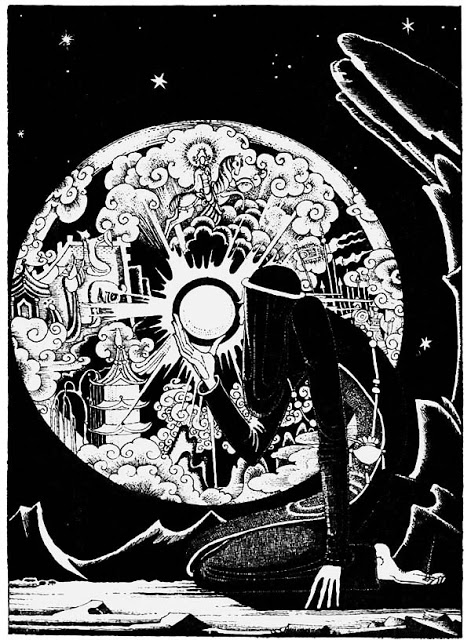
Kay Nielsen’s “Crystal Ball” illustration in Red Magic (1930)
2. The Prophet Burns: Medieval Tragedy
When priestes failen in their saws,
And lordes turne Godde’s laws
Against the right;
And lechery is holden as privy solace,
And robbery as free purchase,
Beware then of ill!
Then shall the Land of Albion
Turne to confusion . . .
— “Chaucer’s Prophecy” [22]
Fortune gazing was just as popular in medieval Europe as it had been in Antiquity, despite the advent of the Christian era. It was both an age of wonders and prophecies, alchemy and divination — but also one fearful of witchcraft and implacable toward heresy (though the major witch crazes occurred in later centuries). Two of the most widely known prophetic texts in northern Europe during the millennium between the Fall of Rome and the Early Modern Era (ca. 400-1500 AD) were the Norse Edda’s “Spæwife’s Prophecy” (Vǫluspá in Icelandic) and the so-called “Prophecies of Merlin,” first translated into Middle English by Geoffrey of Monmouth during the 1130s. I could devote an entire essay to the comparison between these two pagan pieces of apocalyptic literature, but suffice to say that both Spæwife and Wizard foretold dark days ahead for the Saxon sons of Europa. The former addressed Odin, the All-Father, but also the “children of Heimdall,” as she sang of a contradictory end-of-days:
[C]ornfields will flourish
that never were sown,
all ills will be mended,
Baldr will return.
Höd and Baldr will dwell in the walls of Valhalla. . .
Fairer than the sun
[I see] a hall,
thatched with gold it stands at Gimlé.
There shall the righteous dwell forever,
blessed all their lives with lasting joy. [23]
Like many pagan folk tales and epics, the “Spæwife” acquired Christian elements and imagery over time. The speaker here alluded to Psalm 27:4 (“One thing have I desired of the Lord . . . that I may dwell in the house of the Lord all the days of my life . . .”), a vision of heavenly paradise and salvation. Only read further and readers will find this disquieting prophecy as well: “The fetter will break and the wolf run free. / [I] hold dark knowledge: I see far forward / to the doom of the war gods, Ragnarök . . . Then comes the dragon flying darkly, / glimmering serpent from moonless mountains. / Over the battle-field Spite-Dealer flies, / wings heavy with corpses. Now [I sink] down.” [24] “Forever,” it seems, was too hasty, and the Norse sensibility, too cold and bleak to fully accept the idea of eternal bliss.
“Merlin’s Prophecy,” meanwhile, was a rambling and riddling disquisition on the rise and fall of “Red” and “White Dragons,” as well as the ultimate fate of the mortal world. Like the “Spæwife,” the narrator spoke of “Cornfields,” but “dryed up,” the “dew of heaven . . . [having been] denied them . . . The malice of Saturn shall be poured down grievously, and with his crooked Sythe shall he destroy mankind . . . In the twinckling of an eye shall the Seas arise, and the Ashes of the dead shall be renewed. The Winds shall contend with a terrible sufflation, and shall terminate their sound amongst the stars.” [25] These were not simply concerned with the fall of a certain people, city, or ruler — but with the fall of all: a morbid millenarianism. At the time of their fulfillment, none would live to see and weep their tears over the world in flame.
Societal stress (war, famine, plague) often precipitated or renewed interest in prophecies such as these, and they were at times accompanied by “miraculous” events that included: visions, stigmata, bleeding Hosts, and ageless corpses. The common understanding of the material world — the “stuffness” of things — was different during the days of Æthelfrith and Wenceslas. To the medieval mind, inanimate objects were much more organic, and their universe was filled with “living matter” that could shift like the phases of water by divine or demonic touch. [26] Both Church and king tended to regard warily such popular manifestations of the supernatural, the former because its institution jealously guarded its role as spiritual interpreter and intercessory (miracles needed to be authenticated); and the latter for equally obvious reasons. What king in his right mind wanted a homegrown cult of zealots stirring public passions within his realm?
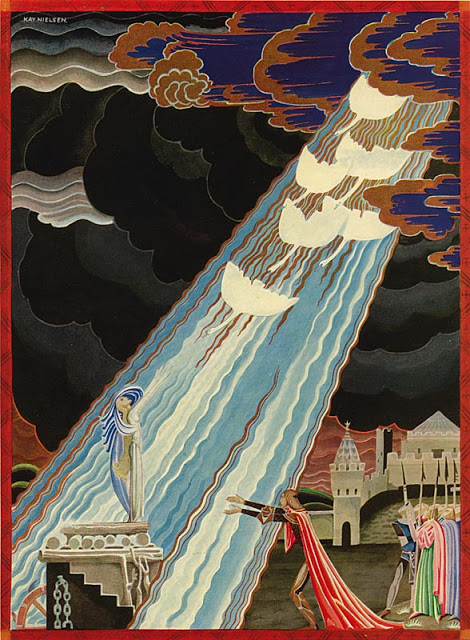
Kay Nielsen’s illustration of a prophetess and her king in Hansel and Gretel (1925)
A dual obsession with rooting out heresy and taking various prophecies seriously revealed not only how fluid medieval law and doctrine could be, but how blurry were the boundaries that separated pagan belief from Christian faith. St. Bridget of Sweden (d. 1373) enjoyed enormous popularity during her lifetime and beyond when she received and communicated urgent revelations about the need to heal the Catholic Schism, “return the papacy to Rome, reform the Church, and convert the infidel.” [27] Others spoke of Charles V of the Holy Roman Empire as the “second Charlemagne,” the man who would renew the Dream of Rome’s spiritual and temporal rule. [28] Though still focused on kings and empires, medieval prophets were unlike ancient oracles, for they often directly appealed to populist sentiments and criticized their betters. This made them more dangerous. The tragedies that befell Catholic visionaries/prophets Jeanne d’Arc, Florence’s Savonarola, and England’s Jack Cade attested to the continued and troubled relationship prophetic figures had with their princes.
Jack Cade, for instance, was a commoner, and he led the most serious popular revolt against royal authority in fifteenth-century England, using excerpts from both “Merlin’s Prophecy” and those of “the maiden Sybille,” which foretold that “many mo’ there will be a ‘man of mykill might / That in his thradam was full roo’ . . . and the realm of France will ‘Disseyvere on syndere’ in the year 1450 and moo.” [29] The “man of mykill might” was thought to be Richard of York, acknowledged as the rival claimant to Henry VI’s throne, and someone who shared Cade’s deep shame at losing almost all of England’s French territory during the last decades of the Hundred Years’ War (1337-1453). The text continued, “Then shall troy untrew tremble at dayes, ffor drede of a dede man when ey here hym speke . . . He that is ded and buryed in sight, Shall ryse agayn, and lyve in lond . . .” [30] With a band of followers incensed at royal malfeasance and this loss of English prestige, Cade marched on and then took over the city of London. It is unclear whether or not he intended to support an outright coup that would have replaced one king for another (at that time, Richard of York still played the role of loyal subject), but it all came to naught when his followers began to pillage the city and lost the earlier sympathies they once enjoyed with the populace. Dying from his battle wounds, Cade did not live (nor did he “ryse agayn”) to see “the maiden Sybille’s” prophecy fulfilled and the White Rose of York crowned king of the Britons.
Across the Channel, another commoner and Cade’s contemporary Jeane d’Arc claimed to hear saints’ voices. And following their guidance, she did manage to help deliver a crown to the French king, inspiring a wave of adulation across the countryside. But that same king neglected to ransom her from the Duke of Burgundy, who then turned her over to the English. Decades later, Savanorola made a nuisance of himself to the Italian princes of Church and state when he began making fiery sermons about his “divine mandate” to instruct the people and purify Rome. The coming of the French invader, Charles VIII, he claimed, would inaugurate a New Age, for Charles “was the instrument of God, come to punish the corrupt Church and the sinful Italians, [then] to institute a universal reform.” [31] Pestilence, floods, and this “new Cryus” from the north would redeem the land. Neither the ruling Medici family of Florence nor Pope Alexander VI were amused. Though hardly as “rich as Croesus,” like that of the Lydian ruler who suffered at the hands of “Cyrus, the old,” both Jeanne and Savanorola paid their angry kings for their visions in embers and in ash.
3. The King Is Cursed: Shakespearean Tragedy
There is no sure foundation set on blood . . .
— King John [32]
In Shakespeare’s Henry IV, Henry “Hotspur” (Henry Percy) mocked others’ conviction in the prophecies that purportedly foretold his triumph: “Sometime [they anger] me / With telling me of the moldwarp and the ant, / Of the dreamer Merlin and his prophecies, [. . .] / And such a deal of skimble-skamble stuff / As puts me from my faith.” [33] But in no corpus of literature since the Greek plays of Antiquity had prophecies been used as plot devices as often as they were in the Renaissance dramas of William Shakespeare.
But even if the playwright shared Hotspur’s disdain, still he knew that his audience understood the power and appeal of the oracle. Along with Merlin, Sybille, and Chaucer, a new prophetess called “Mother Shipton” foretold that in northern Europe “state and state [will fall] in fierce strife / Will seek each other’s life. / But when the North shall divide the South, / An eagle shall build in the lion’s mouth. Then tax and blood and cruel war / Shall come to every humble door.” [34] With the advent of the printing press and increasing emphasis on the vernacular, prophecies reached wide audiences and enjoyed an enthusiastic market (the interpretation of prophecy might have been among the first examples of literary criticism). In the era between the medieval and modern ages (ca. 1500-1900), prophecies began to assume an ironic tone, yes. But they fixated on the serious early modern problems of usurper-kings, madness, and metamorphosis. The prophets, meanwhile, often arrived in the guise of spectral vision or monster — the dead come to haunt the living, the witch cursing the wicked, the monster presaging the fall of Rome.
One of the Bard’s most disturbing plays chronicled the descent into madness of King Lear, a foolish old man who had allowed flattery to rob him of both his kingdom and his favorite daughter. As Lear railed against his fate and commanded the heavens to end the world, to “Blow winds and crack your cheeks! . . . You cataracts and hurricanoes, spout . . . / You sulph’rous and thought-executing fires . . . of oak-cleaving thunderbolts, / Singe my white head. And thou, all-shaking thunder, / Strike flat the thick rotundity o’ th’ [earth],” his Fool looked on with a cynical eye. [35] Using the same trope of End Times, the Fool made perhaps the most un-prophetic prophecy in the history of English literature. Only
When priests are more in word than matter,
When brewers mar their malt with water . . .
When every case in law is right,
No squire in debt, nor no poor knight;
When slanders do not live in tongues . . .
Then shall the realm of Albion
Come to great confusion . . . [36]
Much editorial angst and “confusion” has been wasted in the interpretation of the passage above, but it seems obvious to me that Shakespeare’s Fool was alluding to “Chaucer’s Prophecy” so to make an ironic commentary about the “realm of Albion” in both King Lear and in Shakespeare’s Jacobean England. Each of these dystopian “when” pronouncements had, of course, already come to pass, and Albion too had long “come to great confusion.” Shakespeare himself lived during the interregnum between two catastrophic civil wars that proved how “hollow” was the crown of which he so often wrote. The true irony of the Fool’s prophecy was that not only had its words already been fulfilled, but they would come true again in every succeeding generation of man (though the Fool probably had no idea how “confused” Albion would be in the present age).
Macbeth returned to the “verbal trap” motif of riddles and prophecies like those set for the kings of Classical Greece. [37] As he committed regicide, Macbeth chanted the witches’ prophecy that he would become king of Scotland; then, he repeated their words that “none of woman born” could harm him, as if casting a dark spell of protection upon his person. Of course, he and his confederates were protected from nothing, but suffered madness and death in their ambitious quest for power. On the night before the Battle of Bosworth Field, Richard III began Act V with the eponymous king visited in his dreams by the ghosts of his victims. One by one, each accused Richard of betrayal, then prophesied, “Let me sit heavy on thy soul to-morrow! . . . [Aye], To-morrow in the battle think on me, / And fall thy edgeless sword: despair, and die! –” Awakening, his confidence shaken, the doomed king repeated the “threat” from “the souls of all that [he] had murder’d,” and thus made true the portent that “To-morrow’s vengeance [would fall] on the head of Richard.” [38] These were the cursed kings of early modern imagination.
Other prophecies of this era were paired with marvels of metamorphosis just as arguments over Catholicism and transubstantiation reached a fever pitch. Demon births and werewolf shape-shifters like that of The 1512 Monster of Ravenna foreshadowed military and religious disasters. One Roman chronicler wrote a breathless account of the Monster “born to a nun and friar . . . [with] a big head . . . a horn on its forehead and a large mouth; on its chest three letters: XYV, and three tufts [of hairs] . . . one leg hairy with a devil’s hoof, the other a man’s leg with an eye in the middle . . . Never in the memory of man has there been anything like this.” [39] A description that today calls to mind the ugly transmogrified beasts of Lovecraftian lore! The next month of April 1512, the pontifical army suffered a calamitous defeat against the French. The consensus was that the Monster of Ravenna had prefigured the demise of the Roman papacy. Confusion had indeed cursed the land. Tragedies mounted.

Kay Nielsen’s illustration of a usurper-king in Powder and Crinoline (1913)
4. The King Is Dead: The Death of Tragedy
All manner of thing shall be well
When the tongues of flame are in-folded
Into the crowned knot of fire
And the fire and the rose are one.
— T.S. Eliot, Little Gidding
This essay has so far argued that prophecy has been one of, if not the, primary modes of depicting and understanding tragedy in Western culture — and that kings and their empires have been one of, if not the, primary subjects of prophecy. An illiberal world where even the most “populist” prophets looked to their lords for deliverance. And in a world without (meaningful) kings? Tragedy simply cannot survive, and prophecy is declared “insane.” Would it be overwrought if I said that throne and altar, prophecy and king, all died finally in a Yekaterinburg basement on the 17th of July, the infamous crime against White Russia and all whites, past and future (the prophet Rasputin certainly hadn’t helped to avoid this final tragedy)? The two weak kings, Tsar and Kaiser, made the mistake of assuming that they mustered their troops to fight an old war of emperors, unable to read the prophetic signs in the wind that preceded the storm of modernity.
Of the massive amounts of analysis written to untie the seemingly inscrutable knot of QAnon, few have interpreted the phenomenon through the historical lens of prophecy. Its anonymous leader focused on the rise, fall, and rise again of a leader (a god-emperor, even) who would restore the true people to their heritage and redeem the land from wickedness. The attraction to millenarianism runs deeper than we realize, and a few hundred years of “Enlightenment” rationality could hardly have done away with the human desire for authority, mysticism, and revelation. Beyond a wish to know the future, this desire invests dark times and monotonous days with purpose. Few people enjoy suffering, but fewer still can tolerate the thought that their suffering might be for no reason. Even those who fight “when all is lost” take solace in a sense of brotherhood and in the expectation that songs will be sung in their honor, glasses raised in their memory. This is the essence of tragedy, for the tragic must be doom, yes, but it must also be glorious and meaningful. Without those last and essential elements, suffering and decline is no tragedy, but mere travesty.
And this brings me to some parting thoughts. The discerning reader will have noticed that I have neglected to discuss a major genre of prophetic literature: the promise that the King will come again. And when he does, he shall be a Cæsar who joins king and prophet, ruler and wise man, throne and altar, into one, ending the dysfunction between these two interests and reversing the decline it so often brought upon their people. Many famous Right-wing thinkers have dreamt of a “once and future king,” or an emperor who will inaugurate the Imperium, the one who renews the Dream of Augustus, who turns Scipio’s tears of sorrow to those of joy. While the Left imagines their utopias of radical equality — a world that would render everyone a faceless lump in a mass of humanity — the Right envisions a philosopher-king. [40]
Examples abound. According to Christian scripture, when the Son of Man fulfills His covenant on the Last Day, He will come again in glory to judge the living and the dead, world without end. The Middle-Earth epic of J. R. R. Tolkien was filled with prophecies like the speech recited by Bilbo, the Hobbit, at Rivendell: “Renewed shall be blade that was broken: / The crownless again shall be king.” And Aragorn, the hero of Lord of the Rings and “Isildur’s heir, [would ride] out of the Paths of the Dead, borne upon a wind from the Sea to the kingdom of Gondor; and the mirth of the” warriors would sound “a torrent of laughter and a flashing of swords, and the joy and wonder of the City . . . a music of trumpets and a ringing of bells.” The king had returned! Arthur, the great unifier of the Britons “shall resorte as lord and sovereyne Out of fayrye” land and Avalon, thereby “[reigning] in Breteyne” as the Summer King — a shield between his people and the darkness. And all will hail as one ecstatic voice the wishful prophecy, “Ave Cæsar! Long live the King!”
Fantasy, perhaps. But of a beautiful and nourishing kind. Savor the myths, read the classics, readers. They belong to us.
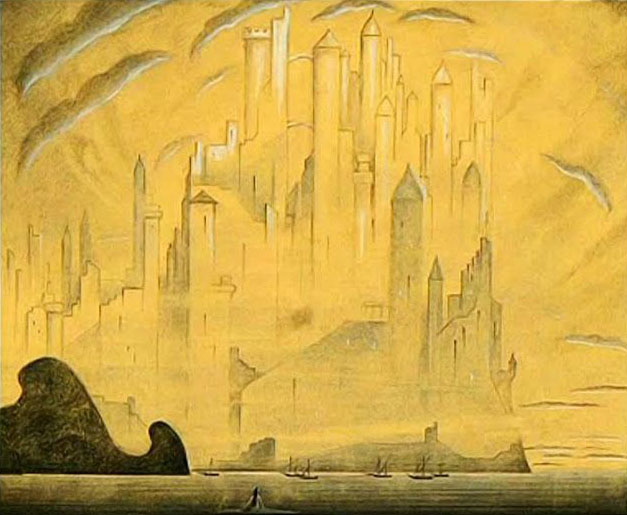
Kay Nielsen’s fabulous kingdom by the sea (1940)
If you want to support Counter-Currents, please send us a donation by going to our Entropy page and selecting “send paid chat.” Entropy allows you to donate any amount from $3 and up. All comments will be read and discussed in the next episode of Counter-Currents Radio, which airs every weekend on DLive.
Don’t forget to sign up for the weekly email Counter-Currents Newsletter for exclusive content, offers, and news.
Notes
[1] Virgil, The Æneid, trans. John Dryden (The Internet Classics Archive), Book 6, 130-134. Virgil completed the poem ca. 30 BC.
[2] Percy Bysshe Shelley, “Ozymandias,” (The Poetry Foundation). Shelley published this poem in January 1818.
[3] See Aristotle, Poetics, trans. S. H. Butcher, (Project Gutenberg, 2008), first written ca. 335 BC.
[4] Freidrich Nietzsche in The Birth of Tragedy (1872) viewed the genre as having come into being when the Greeks began performing on stage the human and worldly struggle against meaninglessness — a brave attempt at confronting despair while reconciling the Dionysian and Apollonian elements of man. According to the German philosopher, tragedy “died” after the ancient Greeks and especially during the Christian era in the West, focused as it was, not on human affairs, but the afterlife.
[5] Sophocles, Antigone, E. E. Garbin, ed., trans. F. Storr (Loeb Classical Library, 2013), 1016-1023. These and Sophocles’ other Theban plays were performed ca. 430 BC.
[6] Catherine Edwards, “Imagining Ruins in Ancient Rome” in the European Review of History, 18, nos. 5-6 (October-December 2011), pp. 645-661, 646.
[7] The truth.
[8] Rudyard Kipling, “The Ballad of the King’s Jest,” (Kipling Society). The poem was originally published in 1890.
[9] Homer’s Iliad, (Project Gutenberg, 2006), Book I, 107-110. Scholars believe that the Iliad was first composed some time after the historical fall of Troy (ca. 1180 BC), but at least several centuries before Golden Age Greece (ca. 500 BC).
[10] Sophocles, The Oedipus Plays of Sophocles, trans. Paul Roche (New York: Meridian, 1996), 20.
[11] The Æneid, Book 2, 235-236.
[12] Homer’s Odyssey, trans. Robert Fagles, in The Ancient World (New York: Macmillan, 2001), Book I, 143-44.
[13] Each of the illustrations are those by the Danish artist Kay Nielsen (1886-1957); Nielsen was best known for his book illustrations, the brilliance of which placed him in the same celebrated cohort of Edmund Dulac, Arthur Rackham, and Aubrey Beardsley. This particular draft was intended as a concept piece for Disney’s The Little Mermaid, though the actual film was made decades after his death, and his work went unused.
[14] Joshua J. Mark, “Croesus,” published in World History Encyclopedia (September 6, 2009).
[15] Ibid.
[16] Croesus’ fate is disputed. Some accounts related that the captured king called out to Solon and Apollo, and the god of truth rescued him and his family. Others claimed that Cyrus, hearing his story, took pity on him and allowed him to live at his court where he became a valued advisor. I leave it to my readers to decide which end the most likely.
[17] Herodotus’ Histories, trans. George Rawlinson (Roman Roads Media: Moscow, Idaho, 2013), 301-02. Originally written ca. 430 BC.
[18] Thucydides’ History of the Peloponnesian War, trans. Stephen Lattimore (Hackett: Indianapolis, 1998), Book 5, 297. Thucydides’ incomplete masterpiece was written over several decades, from 431-404 BC. Emphasis mine.
[19] Ibid., 297.
[20] See Matthew Neujahr’s “When Darius Defeated Alexander: Composition and Redaction in the Dynastic Prophecy,” in Journal of Near Eastern Studies 64, no. 2 (2005), pp. 101-108, 101.
[21] I hesitate to call them propagandists or something similarly cynical, though they were certainly meant to bolster the monarch’s legitimacy. These were probably authentic attempts by priests to bless their kings with future success.
[22] These lines are known as “Chaucer’s Prophecy,” often attributed to the medieval author in Shakespeare’s time.
[23] See Judith Woolfe’s “The Spæwife’s Prophecy: A Verse Translation of the Norse Poem Vǫluspá” in Scandinavian-Canadian Studies Journal / Études scandinaves au Canada 24 (2017), 40–88.
[24] Ibid.
[25] Charles Bowie Millican, “The First English Translation of ‘The Prophecies of Merlin,’” in Studies in Philology 28, no. 4 (October 1931), pp. 188-97, 197. Emphasis not mine.
[26] See Caroline Walker Bynum’s Christian Materiality (New York: Zone Books, 2011).
[27] Jacques le Goff, Medieval Callings, trans. Lydia G. Cochrane (University of Chicago Press, 1990), 239.
[28] Ibid., 20.
[29] Lesley A. Coote, Prophecy and Public Affairs in Later Medieval England (York, UK: Boydell & Brewer, 2003), 196.
[30] Ibid., 199.
[31] Donald Weinstein, “Savonarola, Florence, and the Millenarian Tradition” in Church History 27, no. 4 (December 1958), pp. 291-305, 291.
[32] William Shakespeare, King John, Barbara A. Mowat and Paul Westine, eds. (Folger Shakespeare Library), 4.2, 106.
[33] William Shakespeare, Henry IV (Folger Shakespeare Library), 3.1, 143-145.
[34] Tim Thornton, Prophecy, Politics and the People in Early Modern England (York, UK: Boydell & Brewer, 2006), 57.
[35] William Shakespeare, King Lear (Folger Shakespeare Library), 3.2, 1-9. For some the confusion of the Fool’s prophecy was a “poetic triumph.” G.K. Chesterton gushed, “I imagine that the great imaginative invention of the English, the thing called Nonsense, never rose to such a height and sublimity of unreason and horror.”
[36] Ibid., 3.2, 88-99.
[37] See John Kerrigan, Shakespeare’s Binding Language (Oxford University Press, 2013).
[38] William Shakespeare, Richard III (Folger Shakespeare Library), 5.3, 139-143, 216-218.
[39] Ottavia Niccoli, Prophecy and People in Renaissance Italy, trans. Lydia G. Cochrane (Princeton University Press, 1990), 35.
[40] The “philosopher-king,” the ruler content to live simply, virtuously, a lover of wisdom and all things “real” is described in Book V of Plato’s Republic (375 BC) thusly: “Until philosophers are kings, or the kings and princes of this world have the spirit and power of philosophy, and political greatness and wisdom meet in one, and those commoner natures who pursue either to the exclusion of the other are compelled to stand aside, cities will never have rest from their evils — no, nor the human race, as I believe — and then only will this our State have a possibility of life and behold the light of day.”
28 comments
The martyrs of old were cut to pieces, torn to bits, put into boiling cauldrons, beheaded with blunt axes, … Today, there is nothing to see, the pressure and torture of the modern martyrs have to do with the spiritual, with what goes on in the mind, far worse some say.
You make a good point. Faith was certainly more immediate when it meant physical danger or bloodshed. I imagine such danger can be searing and can sharply focus one’s resolve, whereas today faith can sometimes feel like staring into space. People in the middle ages had a worldview that was both cyclical and apocalyptic, which contributed to a unique sense of meaning and destiny.
This is a good point, analogous to the difference between ancient and modern warfare. The sheer terror of seeing your enemies face to face for a few hours of ultraviolence, or the drip drip drip of days, to months, to years of sustained stress, never knowing when the next shell will fall or when the sniper’s bullet will find you.
This is a magnificent essay which I am only one-quarter through reading, and will return to when my chores are done — alas, the work of women. You certainly excel in History and Literature, and the ability to philosophize about them in the modern context we are all pondering during our current epic tragedy and comedy now besetting us. I have nowhere near the proper education (because I was schooled in American K-12), so I shall have a wonderful time tracking down the many references. You’re a blessing on this site.
Alexandra,
Thank you, and I always love reading your comments as well. I hope you had a productive day and that you enjoyed the rest of the piece. If you want a link to a certain reference, just let me know.
Katie
Re “Most of us would struggle to imagine a world in which nearly half our children died before reaching adulthood” : Mishima seems to have struggled. He wrote : “The average age for a man in the Bronze Age was 18, in the Roman era, 22. Heaven must have been beautiful then.”
So a young man, expecting he’s likely only got one, maybe two, decades left – and surrounded by a superfluity of other young adults! – would find his experience of life more intense and precious. But our Japanese author made a common error when reading stats : not realizing that up to half of all Roman children died before the age of ten. If a Roman survived into his twenties – and avoided military service! – he’d have excellent chances of a long life.
Fortunately, Mishima never worked for the Pacific All Risk insurance company.
Shame he topped himself. He would have loved Ridley Scott’s ‘Gladiator’.
Yes, Right_On, and thank you for commenting. One should always pair data/statistics with other evidence for clarifying purposes. A simple visit to an older cemetery reveals how many children, from infancy to adolescence, died. Old family plots with six or seven little headstones clustered around a few adults is a common sight. And half are unnamed. A poignant view into the past.
I see your point, but I would’nt put Jeanne d’Arc and Savonarole in the same basket. Jeanne d’Arc odyssey is long and complex, and constantly in resonnance with faith and God. She was made a saint of the Catholic church – the same one that condemned her to death. Savonarole is another kettle of fish altogether.
Hi, Philippe,
Neither do I believe they are “the same,” but they were both figures who appealed to the commons (or aroused a lot of emotion in the people) and had complicated relationships with their Catholic and secular rulers. And of course, they were both condemned to burn for heresy. But the Catholic Church got it right when they canonized Joan of Arc and not someone like Savonarola.
Looking for order, an order that would reach once again the one that existed before the Fall. Orphans are grasping into the night, who could blame them.
“People, and especially kings, were much more concerned with maintaining their bloodlines, and this preoccupation with dynasty and Fortune’s Wheel made them susceptible to seeing “signs” and “omens” in everyday life.”
This is one reason why I defend Henry VIII in his conflict with Rome. England and his own father had suffered through the bloody, dynastic Wars of the Roses, and he was faced with another looming crisis over royal succession. Those who claim that he was only pursuing his lust need to study a lot further.
His life also might be a form of tragedy. As a young man he showed a lot of skill and promise.
Sorry for the tangent. Thank you for another very interesting essay.
Thanks again for reading/commenting, Traddles.
Well, I can’t say that Henry VIII is my favorite monarch, but yes, his uppermost motives were those of dynasty and power consolidation. His personality did seem to become darker, crueler over time. Whether that was due to the burden of kingship, chronic pain, or accumulated jousting blows to the head, I don’t know (the Thomas More episode has always been particularly eyebrow-raising for me). I don’t have much faith that the new miniseries coming out and starring a black actress in the role of Anne Boleyn will add much to this interesting discussion.
Henry was lerger than life and he wished to avoid a civil war over succession. However by the time he gets around the the sixth wife the nation isn’t a medieval state on the edge of the world map. It’s the Island at the center of the world. Ambitious English could just get on a ship and built colonies and empires of their own. It greatly assisted the people avoid bloodbaths like Barnet, Towton, Tewkesbury and Bosworth field that you could begin to jump on a ship instead and raid a galleon or think about a future in the Americas.
You won’t get any disagreement from me that Henry VIII was a very large man. In all seriousness, yes, there is a reason the Tudors have attracted the most attention than any other English dynasty. They presided over a kind of “golden age” during which the Renaissance reached the Merrie Olde Island and inaugurated the beginning of the English/British Empire. I will say that in the sixteenth century, England shared the “center of the world” description with Spain.
I’m with Thucydides on this one. Power precedes prophecy.
Every warrior and/or king worth his salt should be a Thucydidean.
Speaking of Jeanne d’Arc, the famous nineteenth century French historian Jules Michelet, staunch socialist and atheist, wrote a biography of the saint (a good book by the way). In the course of his researches on the life of Jeanne d’Arc, he discovered many things which he did not suspect existed. This troubled him immensely, and made him consider all things he had to deal with in a different light; the tenor of his work thereafter changed drastically.
The same thing happened to another, more recent, left-wing French historian, Emmanuel Leroy-Ladurie, who, after writing a biography of king Saint Louis, almost converted to Catholicism.
You’ve knocked it out of the park yet again Kat, these always seem so timely. I had just been pondering tragedy these last few weeks, specifically how the sheer popularity of “happily ever after” seems to be a late modern phenomenon by and large. I’m setting the return of the king mythic formula aside for now.
Besides Dune, I’m having a hard time coming up with popular 20th century fiction in the vein of Greek or Shakespearean drama, where neither the tragedy OR the comedy is a total, Hollywood victory of the hero over the villain. Granted, I’m not that well read in the classics but maybe there’s something to this.
Thank you, Arminius. Interesting thoughts, as usual. The first thing that came to mind after I read “popular 20th century fiction” was Stephen King. His “Dark Tower” series was of that kind of epic quest/drama. I haven’t read all of the books in Dark Tower (there are eight, I think), but I somehow doubt that its ending would fit the typical Hollywood format. It’s more like a weird Dante re-telling.
As for other pop lit, it seems like YA has taken over a lot of the fiction industry, and most of it is junk that all looks the same and follows the same formula. And many of the authors in this industry are truly some of the worst human beings that I have ever come across. Imagine a sorority of 30 year-old cat ladies and frustrated gender studies majors. Nest of vipers.
I’ve never read King (beyond the opening lines of that very series) but that sounds like something I’ll need to try soon. I’ll keep my fingers crossed that the ending is true to the rest of the narrative.
As for the YA lit crowd, it sounds like you’re speaking from personal experience! I’ve been writing more and more this last year and I’ve seen a lot of these types during my research into traditional publishing, ESPECIALLY in the literary agent class. Would be happy to discuss the industry more with you as a sidebar.
Fortunately, I don’t speak from an experience that is *too* extensive. I’ve met a few of these people through my relatively short library stint. But I also had a friend who went into publishing after grad school, and I attended a couple of dinner parties that she threw a few years ago. A bunch of YA types showed up. The level of cattiness that this group of women (and concerning one of their own number) expressed was atrocious. I have to think that this kind of world — the relatively insular one of authors and publishers — must be like stepping back into high school. And, of course, most YA novels transpose the high school experience onto some other fantasy/sci-fi setting. A lot of the jockeying that went on seemed to be about “exposing” what another YA author wrote that might have been problematic or insensitive. Maybe I drew too broad a conclusion from just a few interactions with those folks, but that was enough for me After leaving Virginia, I’ve had nothing to do with them.
I bet you have even more interesting stories than I do, since you’re going into the profession/taking classes. It would make a great CC article . . .
There is an article on vulture.com called “The Toxic Drama of YA Twitter” that sums up this bunch. It all sounds like the ninth circle of hell.
I’m still taking my first steps into the profession as such, so I’ve yet to rub shoulders with any of them — any classes I’ve taken are one-way streets and online, with no engagement with the lecturer on my part. So no CC article yet, need to build up my chops!
But from your dinner-party experience and the Vulture article… this quote sums it up the best:
>One author and former diversity advocate described why she no longer takes part: “I have never seen social interaction this f***ed up,” she wrote in an email. “And I’ve been in prison.”
Excellent essay, as usual.
Thank you for reading, Archie!
I suspect I am not reading this essay rightly even though I admire the thoroughness of its historical review. <>
This seems to be the point of the essay, that as men through the centuries became convinced of the fragility of their lives and their nations, essentially the randomness and meaninglessness of life itself, they looked to prophets and such visionaries for assurance that higher and wiser powers we’re ordering fate. The struggles and sacrifices needed for a people to defend itself would be “blessed” by these powers if the people had virtue. All conflict was meaningful even if individual soldiers were to die and never see the final victory. But, all such prophecies were, in effect, delusions.
Here at C-C we hope to bring about a White ethno-state. At the moment the power of the globalists is immense, the wealth and power of central governments in every Western nation, the influence of the global financial system and all the transnational corporations are see against us.
The National Socialists of the 1930s believed that the Aryan component of the German people gave the good possibility of victory over the world-wide Marxist threat. The thousand year Reich.
The leading lights here at C-C, being the materialists that they are, believe in the genetic endowment of the White inheritance will allow us to prevail. This seems strange to me, since surely 85% of Whites in the USA either gate their Whiteness, or in the case of civic nationalists, are indifferent to preserving the race. Yet we all supposedly share the same “salvational” genes that is to bring victory in the end.
The essay effectively erases any confidence in a transcendental order and the lack of unified purposeful direction of White genes makes me conclude that the struggle for WN is just a Las Vegas crap shoot.
Some here may advocate that it is individual’s personal honor and moral integrity that shall will him to carry on the fight. But the concept “individual” and “individualism” are at C-C are considered deceptive aberrations that stand in the way of a communitarian mentality. At best they are epiphenomenae of our genes.
In my prior post, the relevant quote was dropped. In between the brackets it should read:
Thucydidean lesson that first must come power, and only second, faith and the hopes and moral scruples that it brings.
Hi, mcmurphy. First, let me thank you for reading and commenting.
Hmm, I think I know what you’re getting at, but I don’t want to put words in your mouth. I wouldn’t say that you misinterpreted anything, and to be honest this is one of my least argumentative essays. In other words, not your fault. I consider it to be more of a “thought-piece” (irritating term, but whatever) on the ancient relationship between monarchs and prophets, in some ways the long dialectic between church and state that has been going on now in the West for thousands of years. Monarchs are inherently anxious beings, and that anxiety did lead to the seeking out of diviners in order to maybe rest easier, and certainly to boost their credibility among their subjects. But again, this same anxiety *also* led to their attacks against such persons. On this, I tend to side with the monarchs, because prophets were obviously charlatans (excepting Joan of Arc, who was very earnest).
I’m guessing the white ethnostate that you have in mind is pan-European, a Pax Europa of sorts, yes? It’s a beautiful dream that we cannot know will or won’t eventually emerge. This doesn’t mean that we should sit on our hands and wait for Napoleon, back and better than ever, to fall from the sky, but it does require a sober look at the past and the fractiousness among the different groups indigenous to the European peninsula. That said, I am also convinced that a form of white unity is inevitable, because there has always come a time when targeted people — whites — have decided, “enough.” Leftists (for lack of a better term) keep getting weirder and more delusional. Many of these cretins are actually insane. And insane people eventually have an epic meltdown. As for a “transcendental order,” I’m something of a monarchist and a Catholic. On the whole, I think kings did a better job of maintaining order and cohesiveness than liberal democracy has, for the latter has empowered the wrong people. Liberal democracy has created with each succeeding generation a new crop of petty Janissary-bureaucrats who mindlessly attack their own people. Creatures of the state. In the future, history will remember us chiefly as the fools who managed the impressive feat of having found the worst possible way to run a country (excluding, perhaps some abysmal communist regimes). Unity, a shared purpose between whites, is coming, and it is desirable. I’m just unsure whether or not it will manifest in one giant ethnostate.
Well, there I go making my own prophecy. How about that.
Comments are closed.
If you have a Subscriber access,
simply login first to see your comment auto-approved.
Note on comments privacy & moderation
Your email is never published nor shared.
Comments are moderated. If you don't see your comment, please be patient. If approved, it will appear here soon. Do not post your comment a second time.