 2,068 words
Eric read Ayn Rand’s Atlas Shrugged at the age of sixteen and decided that Rand was right. So he resolved to live his life by the ethics of rational self-interest. This meant that he only did things that served his self.
From that point forward, Eric cut a straight line through life. He knew what he wanted. He chose a career that felt right for him. He only studied things that advanced his goals. He only listened to music, read books, and watched movies that suited him. He associated with people who made him feel good about himself and avoided people who made him feel bad about himself.
Thirty years later, Eric celebrated his forty-sixth birthday. Looking back on his life, he had no regrets. Thanks to Ayn Rand, he had arrived at middle age with the values, tastes, and ambitions of a sixteen-year-old fully intact.
Is Eric a winner?
That depends on whether he was fully mature at the age of sixteen. Were you fully mature at sixteen? Would you like to go through life with your sixteen-year-old self fully intact?
Eric’s story raises a question: What sort of ethics and politics best foster human self-actualization?
Self-actualization is essential to your happiness. If you lead a life in accord with your nature, you will be happy. If you lead a life against your nature, you will be unhappy.
But we must be selective about which potentialities we actualize. After all, we have the potential for evil as well as good, vice as well as virtue, mediocrity as well as excellence. This is why Aristotle defined happiness as the actualization of our good potentialities only.
Aristotle combined an ethics of self-actualization with an illiberal political philosophy in which a central function of the state is the moral education of the citizens. It makes sense. Aristotle believed there were two vices for every virtue. In short, there are a lot more bad potentialities than good ones. Thus human beings need moral education to be happy.
For Aristotle, this meant a paternalistic state that sometimes knows better than we do what’s in our interests. In such a society, every stage of human development is aided by authoritative institutions. The authority derives from superior knowledge. As we enter each stage of our lives, other people have already gone through them. They know what’s coming, what can go wrong, and the right path forward. They know better than us, because they’ve already experienced what we only look forward to. From their point of view, we are ignorant and immature. From our point of view, they are mature and authoritative. We should feel inferior by comparison. But that’s okay, because such institutions are there to help us become better, i.e., to overcome our immaturity and ignorance and negotiate the next stage of life’s way.
Today, however, the idea of self-actualization is often packaged with Romantic individualism and classical liberalism. Oddly enough, some of the chief advocates of this synthesis call themselves Aristotelians, principally Ayn Rand and some of her followers.[1] I wish to argue, however, that liberal individualism impedes self-actualization.
My first proposition is:
Who you are (your identity) is not the same as who you happen to be at any given time.
Self-actualization is a process that unfolds over time. Genetically, you are the same person you were at the moment of conception. But a lot has changed since then, and more changes are to come.

You can order Greg Johnson’s Loving Our Own here
The real you is not who you happen to be at sixteen. Therefore, when Eric decided at sixteen that his current self was good enough, he was not actualizing himself. He was closing off (further) self-actualization.
For the butterfly to be born, the caterpillar and the cocoon must be left behind. As snakes grow, they get too big for their skins, so they must slough them off.
Eric’s sixteen-year-old self was merely a cocoon from which his true self should have emerged. It was merely a dead skin that should have been left behind. Thus any moral and political philosophy that encourages us to identify with merely one stage in our development, then freeze there for the rest of our lives, is an enemy of self-actualization.
Eric would have been better off if at sixteen his self-esteem were lower, meaning that he felt that he wasn’t good enough, that there was room for improvement. He would have been better off if he had not been able to arrange his life to exclude anything that challenged his sixteen-year-old self and its values, tastes, and goals. At sixteen, Eric could not imagine being any different at twenty-six or forty-six, and there was nobody in his life with the authority to tell him that a better version of himself was possible—if he weren’t so damned smug. He could only know that through experience. And without experience, he would just need to trust the authority of people who had already been there. In short, Eric would have been better off living in a society in which authoritative institutions existed to guide him through a life-long process of self-actualization.
My second proposition is:
Most self-actualization is not self-directed.
The most dramatic changes in human life take place between conception and birth during which time an individual is completely dependent on his mother for survival. From birth to adulthood, we are also dependent on our families. At first, we are totally dependent, but gradually we become more capable of acting, including taking care of ourselves.
Given these facts, Aristotle’s paternalistic model of self-actualization makes sense. But what about adults? Doesn’t paternalism belong at home with our parents? Once we leave home, shouldn’t we enter a classical liberal world where we make our own decisions and are responsible for our own lives? To understand why paternalism makes sense, even with adults, let’s examine a third proposition, which derives from Plato’s Gorgias:
What you really want (happiness) is not necessarily what you think you want at any given time.[2]
All of us want the same thing: happiness. So many of us fail to achieve happiness because we are mistaken about what leads to it. The best example of a mistaken route to happiness is drug addiction. Since we all want the same thing, however, and since other people can know better how to get it, we are more likely to get what we want if we are prevented from making bad choices, for instance by laws that ban addictive substances. The liberal model presupposes that adults are always the best judges of what is good for us. But that simply isn’t true. Sometimes adults are as stupid as children, and we need paternalism to save us.
Socrates argues that this isn’t even a violation of our freedom. The libertarian thinks that freedom means acting on what we think we want at any given moment. He identifies our freedom with superficial and often erroneous choices. Socrates claims, however, that true freedom is doing what we really want, which is to attain happiness. Thus if a paternalistic state forcibly prevents us from sabotaging our happiness with drug addiction, it is actually making us freer. We can be forced to be free. Ideally, though, once we have attained happiness, we will be grateful to the people who said “no” to us when we were ignorant, immature, or in the grip of emotions.
Now let’s focus on a fourth proposition:
We’re all individuals, but most self-actualization is not of unique individual traits but of traits we share in common with everybody else.
The basic stages of human life are the same for all of us. The biggest difference is between men and women, so different educational tracks make sense. But all men basically develop the same as other men, and all women basically develop the same as other women. Thus a society does not need to understand every nuance of our individuality to create institutions that support life-long self-actualization.
But what about our unique individual traits? What sort of system best develops individual excellence: liberal individualism or a more paternalistic society like Aristotle envisioned? The question is hard to answer, because even the most liberal and individualist societies have elements of paternalism, particularly in their educational systems.
But if that is true, then at least we can be confident that all the great individual accomplishments of history were not prevented by state paternalism. Beyond that, many of history’s great geniuses were fostered by state institutions: schools, universities, public festivals, prize competitions, state patronage, etc. States that throttle excellence and creativity are bad. But states can promote excellence and creativity, and have done so throughout recorded history.
There’s a Romantic strand of individualism that holds that the road to happiness is to plumb the depths of our subjectivity for an individual self and its longings, then to devote our lives to actualizing them, preferably in a “career” or “calling.” This Romantic individualism sets itself in opposition to the authoritative educational institutions of society. It depicts life for such souls as a hard, heroic struggle. One of the most famous depictions of Romantic individualism is Ayn Rand’s novel The Fountainhead.
Romantic individualism makes sense for outliers, especially neurologically atypical outliers whom institutions have trouble accommodating. Fortunately, though, self-actualization is a lot easier for most people, because most people’s needs are pretty much the same.
Unfortunately Romantic individualism has become mainstreamed. Perfectly ordinary people now think they are beautiful souls and frustrated geniuses. A call for authenticity has become a script for play-acting. Thus we have traded many a good mother for a mediocre poet, many a happy family man for a frustrated tycoon.
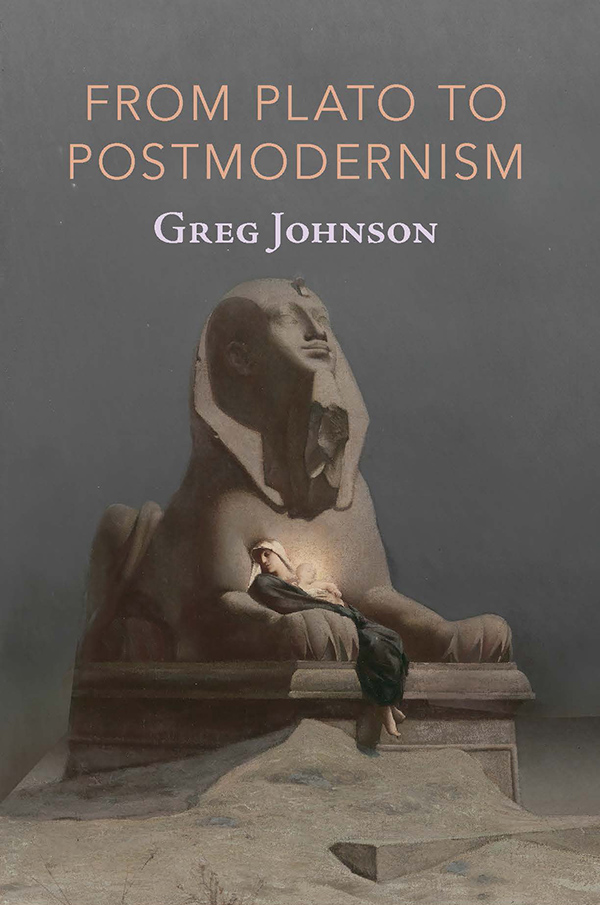
You can buy Greg Johnson’s From Plato to Postmodernism here
One way to understand how liberal individualism undermines self-actualization is to contrast the model liberal institution, the marketplace, with edifying institutions like those envisioned by Aristotle.
In essence, the market is about catering to one’s “given preferences,” i.e., one’s existing values and tastes. If you have the typical preferences of a sixteen-year-old, there are merchants who will cater to those preferences for the rest of your life, as long as you can pay.
Edifying institutions, by contrast, are all about improving your preferences. These institutions include all forms of education, the institutions of marriage and the family, and the civic duties of one’s homeland.
When you approach these institutions, you do so with humility, on the assumption that you are not yet good enough for them. The purpose of education is to make you better. As for the family and the state: you must better yourself to sustain them. But you do so gladly, because you become a better person in the process.
Whereas edifying institutions tell you that you have room for improvement, the marketplace tells you that you are fine just the way you are. By telling you what you need to hear, edifying institutions are friends. By telling you what you want to hear, the market is a mere flatterer.
But doesn’t the market also create new preferences? This is true, but there are three ways to create new demand: to better cater to given tastes, to lower given tastes, or to raise given tastes.
Deepening your values and raising your tastes, however, make you a bad consumer, because a man with values won’t do just anything, and a man with taste can’t enjoy just anything. It is always easier to lower standards than to raise them.
Thus if profit is your sole motive, we would not expect the market to create demand by raising standards. Indeed, capitalism has a built-in incentive to lower the public’s values and tastes, so we are willing to consume new things. To counteract this, we need edifying institutions to uphold moral and cultural standards. These institutions should be state-subsidized to free them from the debasing incentives of economic competition.
There are many enemies of self-perfection: ignorance, fear, sloth, dissipation, and self-satisfaction. In traditional societies, edifying institutions help us overcome these barriers. Liberal individualism sabotages self-actualization by replacing these institutions with freedom of choice. Modern Westerners don’t live stunted lives because we are oppressed. We are miserable because we are free.
Notes
[1] See Douglas B. Rasmussen and Douglas J. Den Uyl, Liberty and Nature: An Aristotelian Defense of Liberal Order (Chicago: Open Court, 1991).
[2] See Greg Johnson, Tyranny & Wisdom: Plato’s Greater Alcibiades & Gorgias (San Francisco: Counter-Currents, 2025), pp. 135–38.
4 comments
Greek teleology pairs well with genetics.
Thank you very much for this outstanding piece! I’ve just discussed similar topics with one of my kids and couldn’t get quite through this, now I can and will update that conversation. Viewing this from a German perspective I notice how the German people in general and as a whole quite like these ideas and the German state was always and currently is setup to be somewhat paternalistic. The problem being: the voters elected petulant and spiteful children to run this paternalistic state. Which brings us to the problem of having this kind of democracy in the first place.
When I was twenty-four years old, I slowly came to terms with the fact that I had an unstoppable urge to leave behind the life I had built for myself. I quit my job that paid well and where I liked all of my coworkers, packed what I had into my truck and started driving with no destination. I set up camp wherever I could find space along the road and fell asleep under the moonlight. I forced myself to sit with my impulse from the deep South to the Pacific Northwest. At first I hated myself for giving up everything I was supposed to want to chase nothing along the highway. I felt like I was self destructing for no reason and throwing away what I had been raised to believe was the good life. Even when I returned back home, I wasn’t sure that it had been worth it. But now, looking back, it was one of the best decisions that I ever made. I feel now as if the ‘good job’ I had was being a mostly useless person at some unfeeling company, and if I had continued I would reach middle age facing the real possibility that I would be outsourced or replaced with AI. The values I held at the time were the simple values of someone raised in prosperity who had never known the winter – a thesis without an antithesis. I have more drive and appreciation for greatness now than I did at that time – a respect for the fact that things that I took for granted must be created or protected by capable, inspired men. I feel as if the guidance that I received from my elders was well-intentioned but not adapted for the world I lived in – the confusing mess that is the Information Age. I feel as if my youthful arrogance and selfishness drove me to a more mature perspective. I feel more willing to admit that this might still be youthful arrogance – I am only thirty now and hope my perspective will continue to develop. I feel an urge to help the younger generation develop in a different way than my parents did it – more like an invisible hand guiding or curling than a noticeably paternalistic method. And I feel grateful that my younger self felt the need to pursue my self-interest, and grateful that I no longer feel this way.
Yes, it’s exactly the same theme as in the movie Into the Wild. I recommend this movie.
If you have a Subscriber access,
simply login first to see your comment auto-approved.
Note on comments privacy & moderation
Your email is never published nor shared.
Comments are moderated. If you don't see your comment, please be patient. If approved, it will appear here soon. Do not post your comment a second time.