 1,645 words
One of the people whom I interviewed for my biography of Jonathan Bowden was Nick Griffin, the former leader of the British National Party. Griffin appointed Bowden, its most popular orator, as the party’s Cultural Officer. Griffin remarked something to the effect of how a lot of people kind of worship Bowden, and if you write his biography — if you present the Bowden of History, not the Bowden of Faith — then you will upset these kinds of people. I was later amazed by how prescient Griffin had been.
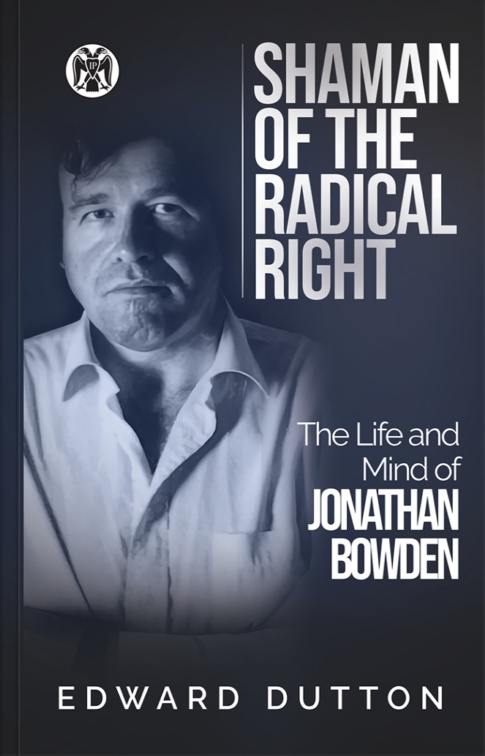
In my biography Shaman of the Radical Right: The Life and Mind of Jonathan Bowden, I interviewed as many people who knew him as I could in an attempt to create a narrative of his life, and to make sense of his psychology based on the available evidence. This involved applying — in the broadest sense of the term — the scientific method to an individual’s life and mind. In publishing the book, I found — as Griffin predicted — that some of its readers didn’t think that a biography should do that, at least not in relation to Bowden. They wanted a hagiography in which the subject’s flaws (inevitable in a person of extreme talent; such people are always lopsided, as Bowden himself noted) were suppressed, and the supposed ineffable and incomprehensible uniqueness of Bowden and his thought were revered. This way of thinking — reflected in Henry Sinica’s article “Bowden Contra Dutton: The Legacy of Bowden after Dutton’s Biography” — is anathema to science.
Mr. Sinica’s first issue with my biography is that I “stand above” the subject, “revel in his flaws” and, apparently, feel myself “superior” to him. With regard to the first point, from the scientific perspective you are supposed to objectively examine the object of study, in this case Jonathan Bowden, based on the available evidence. Therefore you must, of course, stand above your subject in order to properly examine it. As for his other observations, Mr. Sinica cannot possibly know whether or not I “revel in his flaws” or feel myself “superior,” because he has no evidence for this. In reality, I interviewed people and drew upon other available evidence. These indicated — according to a shared vantage point — both positive and negative traits in Bowden, as we would find in any subject. As far as I can see, this has induced cognitive dissonance in Mr. Sinica, so he has dealt with this by attacking the author with fallacious arguments: appeal to motive and appeal to insult, claiming that I “sneer” at the world that I am simply trying to make sense of using the empirical method.

You can buy Jonathan Bowden’s Pulp Fascism here.
Mr. Sinica then argues that the biography “rarely bothers to engage with Bowden’s thought on its own terms” and that instead I subject Bowden to “biological determinism.” The latter point is inaccurate. I look, for example, in depth at the likely effect that Bowden’s mother’s early death would have had on him, as well as the impact of stress brought on by Bowden’s political engagement, so this is a “straw man” argument.
Mr. Sinica writes that, “Dutton errs in believing that he has fully understood his subject matter by reducing him to some key genetic factor or mental disorder.” However, I never claim to have somehow “fully understood” Bowden. Rather, based on the available evidence, I look at the most likely ways that we can make sense of Bowden’s behavior, and indeed, changes in his thinking. One may throw around that scientific insult of “speculation,” but this is highly subjective and can be thrown at most empirical assertions that one doesn’t like. Psychological analyses, such as those by psychiatrist Anthony Storr, have been accepted with far less evidence that I had at hand. I suspect that Mr. Sinica’s claim that I rarely bother to “engage with Bowden’s thought on its own terms,” really means that he doesn’t think I should explore why people think what they do. What he is effectively saying is, “Don’t fully examine the psychology of a person I really like. Assume such a person is not subject to nature and nurture.” Twin studies show us that people’s views develop due to a combination of genetics and environment, and Bowden was as human as anyone else.
Mr. Sinica then claims that I have incorrectly assessed Bowden’s philosophy, and he earlier quotes another critic who asserted that I didn’t dedicate enough space to Bowden’s intellectual orientation nor his place in philosophical and political movements. That critic, Tom Jones, obviously didn’t read the book properly, as I was actually criticized elsewhere for having a large early chapter in the book which looked in depth at Bowden’s place in political and philosophical movements. Jones also criticized me for focusing on Bowden’s psychology over his “intellectual orientation,” but, as far as I can see, Bowden was not an original thinker. He is famous because he was a brilliant orator; an inspiring Weberian Charismatic. Hence, the central issue is his psychology and how it has developed, not the various ideas –developed by other people — which Bowden so eloquently presented and sewed together. These deserve far less space than does Bowden’s psychology.
As for incorrectly assessing Bowden’s worldview (specifically his worldview in later life), what Bowden claimed he believed is not necessarily the same as what he actually believed if you assess the kinds of things he said. As far as I can see, he was broadly advocating something like Traditionalism, though I noted that there were nuances in this regard. He may have asserted that he was a “Nietzschean,” as Mr. Sinica points out, but he also asserted that he was a “pagan.” Perhaps I should have made this contradiction, as Mr. Sinica might see it, clearer.
Finally, Mr. Sinica claims that I present my view as
unassailable and Bowden’s . . . as driving from a nexus of psychological quirks and dysfunctions. This lack of respect makes the intellectual differences in the biography more jarring. Dutton’s obsession for the mean, the statistical average, and the quantitative bristles against Bowden’s equal obsession for the avant-garde, the exceptional, the qualitative.
To the extent that my book explores Bowden’s psychology, it draws upon the scientific method. The scientific method is a hierarchy of disciplines. Every assertion in psychology must make sense in terms of biology, every assertion in biology must make sense in terms of chemistry, and so on. Hence, sometimes I moved from individual differences psychology to evolutionary psychology. Mr. Sinica claims this is “reductionist.” Yes, it is. Reductionism is the purpose of science and those who object to this, and use “reductionist” as an insult, in effect object to science or object to it when it reaches conclusions they find uncomfortable.
Mr. Sinica seems to suggest that science is my personal worldview and that this is somehow equal — in terms of reaching objective truth — to Bowden’s personal worldview. This is just cultural relativism. Scientific analysis allows correct predictions to be made with great precision. The “qualitative” method does not, to the same extent. Science is, indeed, “unassailable” in this sense, and if Mr. Sinica doesn’t agree with it, then let him use an aeroplane that has been built using the “qualitative” method. Science is not my personal worldview; it is a tested means of making sense of things. I have a personal worldview — as we all do — and I am sure it is as much a product of genetics and environment as Bowden’s. In conducting analysis, one must try to put one’s feelings aside in pursuit of objective truth. I would also add that Mr. Sinica creates a false dichotomy, as Bowden provided evidence that he accepted the scientific method (Mr. Sinica concedes this elsewhere), and that method can often be “avant-garde” and “exceptional.”

You can buy Jonathan Bowden’s Western Civilization Bites Back here.
When I first read Mr. Sinica’s article I was left asking, “What do you want a biography to be?” From my perspective, a biography should research its subject in as much depth as possible and tell the reader everything remotely interesting about him as part of a narrative of his life. I want to understand the subject’s psychological development, his family background, his worldview and how and why it developed, but I also want the emphasis to be on the causes of this person’s prominence in terms of what is “remotely interesting.”
A certain kind of psychology nevertheless does not want that at all with certain subjects; Charismatics such as Bowden. A certain kind of psychology effectively worships Bowden as a messiah figure. These types of people have an insecure need to feel “superior” and “deep” (which they, of course, project on to others), and they feel this because they have experienced Bowden and mystically “understood” his wisdom. Present Bowden as a real person, including his “human, all too human” flaws, and you undermine that which makes them feel “superior.” Hence, they do not want a biography; they want a hagiography. Bowden is not a mere man; he is their “shaman” who makes their cold world feel warm.
I, however, set out to write an actual biography, one which looked at the subject “warts and all,” and I should add in that regard that since I wrote it, evidence has come to light of Bowden’s extreme disloyalty to (generous) family and friends in his obscure books. Bowden had flaws; we all do, but he also inspired people and continues to inspire them, as Greg Johnson noted in his Foreword to my book.
What do you want? Do you want a biography of a real person, or a hagiography of someone whom you see as special and salient to your sense of self? In fact, perhaps this raises a deeper question. Can we scientifically make sense of something and still, somehow, be transported to the heights of transcendence by it? Can we know the truth about a poet’s life and still reach catharsis via his poetry? Is it possible to understand too much?
10 comments
Agreed. We shouldn’t be surprised if extraordinary people find it hard to lead ordinary lives. Whether or not one applauds the investigation of their private selves, it does not detract from their public achievements.
“Can we scientifically make sense of something and still, somehow, be transported to the heights of transcendence by it?”
Worth pondering this question. In Unweaving the Rainbow Richard Dawkins argues for profundity surviving closer examination and even being further amplified by it. But not everybody feels this way.
Wordworth said “we murder to dissect.”
That’s the most succinct summary of the downside of left-brained thinking I’ve ever seen. Thanks!
Clearly they want a hagiography, it reminds me of a quote by Flaubert: we should not mistreat our idols because the gilt comes off on our hands
To be fair it is a bit odd to have a biographer say he is applying the scientific method to his subject. After all biography is an art, not a science.
I haven’t read the book, have seen enough commentary about it, but I think it’s questionable to characterize this particular endeavor as just the noble pursuit of science, over it just being a bit of an unforced faux pas.
People can wield science – utilizing exactly the reasons described in this article, to advance anti-social behavior, to advance their own grievances, and move discussions of a topic to where they are more comfortable and feel more in control. It’s not necessarily sufficient to make a claim to science.
I also notice Ed Dutton seeks a monopoly on motives. He knows his critics motives, but they can’t possibly know his. This isn’t science, it’s the language of trolls. And – again although I haven’t read the book, I don’t accept Dutton’s new commentary on this topic myself as enlightening.
Science to me is letting things fall where they may, rather than constantly coating the subject in patterns, traits and extrapolations to get an end point.
But I’m not saying people can’t have an opinion either, they can, and I’m not saying all Dutton’s ideas about everything are wrong, I don’t think that’s true, but where we are talking about science, Dutton himself isn’t an expert in these fields his writing about. He’s got a BA in theology and a PhD in religious studies. I didn’t know that actually. I assumed he had some formal background in something a bit harder, but I don’t know how the halls of academia work.
Great article! We want an unscientific biography, not a hagiography. 🙃
After having read the Dutton bio I find Bowden much more interesting than I did before.
It is simply a fact that the people who speak out publicly and act as activists on our behalf are very often individuals with various eccentric personality traits. A person with a normal disposition would not be able to withstand the constant scandal-mongering and other forms of persecution directed at them.
If you have a Subscriber access,
simply login first to see your comment auto-approved.
Note on comments privacy & moderation
Your email is never published nor shared.
Comments are moderated. If you don't see your comment, please be patient. If approved, it will appear here soon. Do not post your comment a second time.