 3,540 words
Edward Dutton
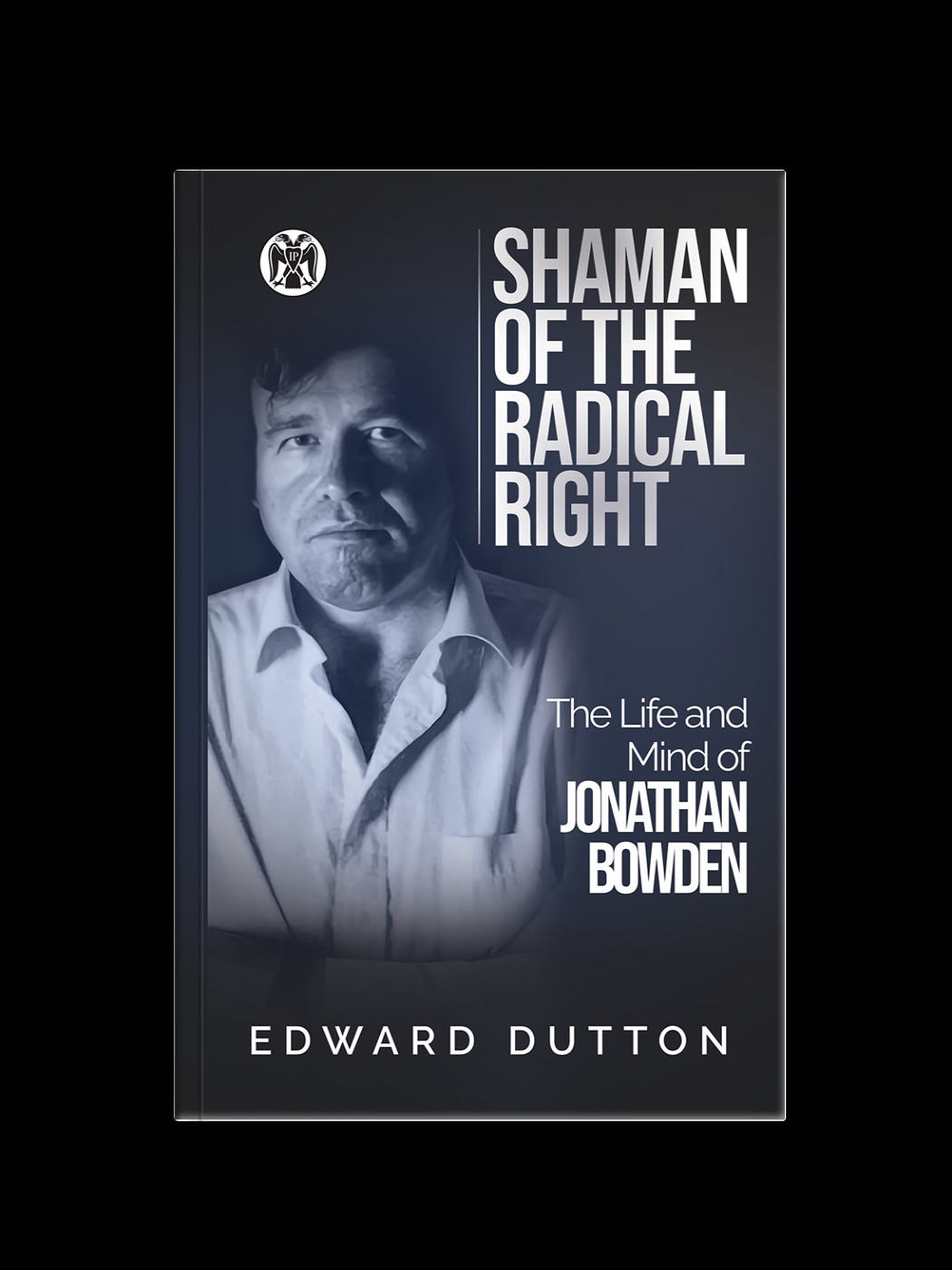
Shaman of the Radical Right: The Life and Mind of Jonathan Bowden
Imperium Press, 2025
It has just over one year since the publication of Edward Dutton’s biography of orator and activist Jonathon Bowden. As of March 29th, it has now been exactly 14 years since its subject matter passed away at the tragic age of 49, an event that Dutton’s well-researched biography sheds new light on.[1] The book itself was a timely affair. Bowden has progressively morphed into an online cult figure who, like many of his heroes, obtained greater fame posthumously than while alive; his distinctive bellow haunts the dissident internet with riveting soundbites taken from numerous intense and spellbinding lectures. Indeed, his love for the unbridled passion and devil-may-care attitude typical of youth means he’d be proud to see his imago ricocheting across youth-dominated platforms such as Telegram and TikTok. Bowden was among the first to wager that the Right’s most obvious path to success is dominating the online space where counter-hegemonic ideas and art-forms have greater freedom to circulate and that younger people would lead the way—overburdened with institutionally mandated self-hatred as they are.
Bowden has a timeless aspect. Despite the fast pace of our postmodern hyperreality, trawling back through many of Bowden’s old lectures, one feels as if many could have been recorded today. For instance, in a talk from 2009, Bowden discusses Nigel Farage surging in the British electoral space and an imminent war with Iran. Eerie. In fact, Bowden often brought up with Iran, signaling concern that a war on behalf of Israel might be imminent. Eventually, he was proven right. In general, Bowden seems to transcend his own pocket of time and speak directly to anybody who has ever lived under the neoliberal regime by refusing to take its sacred cows seriously and providing an intellectual parallel universe. One of the worst aspects of our system is its totalizing nature coupled with a denial of being so. Its strange ontology dominates media, academia, entertainment, art, economics, and all forms of political discourse.
Bowden was skilled at relativizing the system’s all-encompassing ideological hegemony by always reminding us that things were once different and could indeed be different once again. Bowden was most unique—nobody today has taken up this task—at dragging up great icons of our cultural past and allowing us to meet them once again. He was apt at exposing the lack of cultural horizons on the Right, and the brutal irony that the Left is far more than conversant in the culture of “dead straight white men” despite ostensibly trying to suffocate it. Perhaps one day they will be.
But Dutton’s biography has proven controversial. Tom Jones, writing for The Critic points out “In addressing Bowden’s mind, Dutton focuses heavily on his psychological state more than his intellectual orientation….The analysis is rigorous in form but, given the considerable gaps in available information, ultimately feels speculative”. This weakness is compounded by not doing “enough to contextualise Bowden’s work and life within broader political and philosophical movements.” By contrast, Gregory Hood, who attended some of Bowden’s talks has a positive appraisal of the text writes in American Renaissance that Dutton was successfully able to dispel myths about Bowden without descending into a hit piece, and enjoyed Dutton’s functionalist connection between Traditionalist philosophy and biology.
Below, I will focus on the positive and negative aspects of Dutton’s biography before placing Dutton and Bowden into dialogue.
What Dutton Got Right
Dutton is a careful and thorough researcher which benefits the book as a chronological recounting of Bowden’s life. He provides abundant information on his familial and educational background, interviewing some of Bowden’s classmates. Dutton’s demonstrates his skills as a researcher by tracing Bowden’s genealogy and assessing the veracity of Bowden’s various confabulations about his life. In crafting the setting of Bowden’s unconventional life, Dutton paints a riveting picture of the British political landscape in the early 1990s and 2000s. An eccentric cast of characters is introduced, including artists, activists, famous politicians and even a quasi-cultish group dedicated to wearing late Victorian dress with lesbian sadomasochistic tendencies, which may have been led by a woman or more likely an “extremely convincing” transvestite. Quite the contrast with Right-wing nationalists and skinheads that often made-up Bowden’s audiences. Bowden kept interesting and varied company and this book explores his self-proclaimed “bohemian side” for the first time.
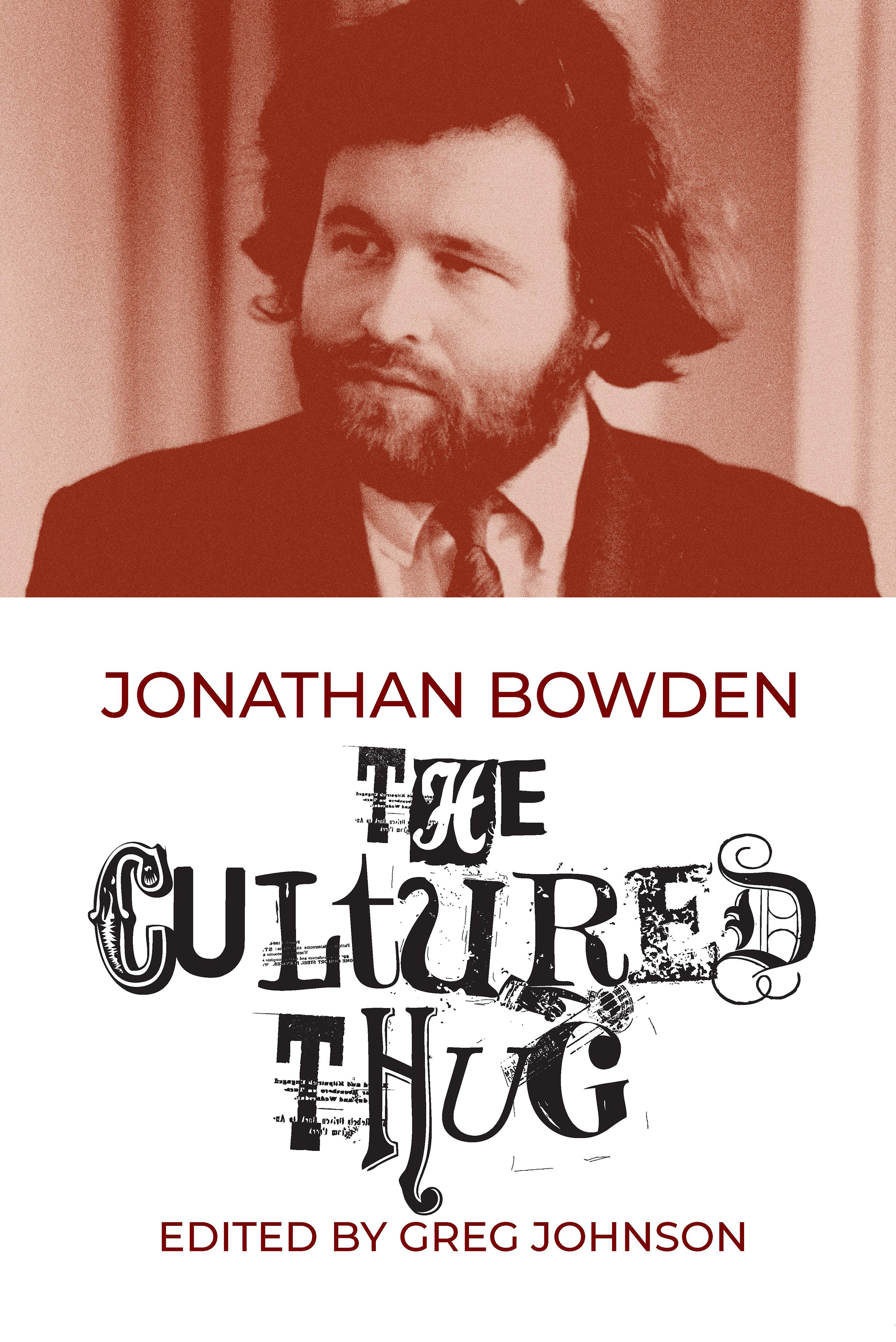
You can order Jonathan Bowden’s The Cultured Thug here.
Towards the end of the book, Dutton reconstructs Bowden’s mental illness and eventual death. Dutton writes well and is skilled at crafting a coherent and readable narrative for this period which is a pay-off for prior discussions of Bowden’s psychological profile. We hear from those who were closest to Bowden about he’s descent into psychosis: frantic phone-calls, delusions of people hiding in the bushes—culminating in a half-naked romp around town with a samurai sword. This stint resulted in admission to a psychiatric hospital and a diagnosis of paranoid schizophrenia. “Like Nietzsche” a semi-defiant, semi-crushed Bowden is reported to have said. Dutton even plays the role of clinical biographer, where his attention to detail has chance to shine. He notes that risperidone, the antipsychotic drug that Bowden was prescribed, should not be taken by those with heart problems (which Bowden had) and thus almost certainly contributed to his untimely death. This revelation is quite the contribution, since controversy and conspiracy have swirled around Bowden’s demise for some time, including (likely untrue) accusations of murder by the state. However, it does seem to be his psychiatric medicine that caused or contributed to his demise.
The idea that Dutton wrote a hit piece is partially because Dutton reveals some striking contradictions between the views Bowden espoused and his personal life. Would Bowden thrive or even survive in the kind of ultra-disciplined, pitiless, and masculine society that he often lauded? Bowden dropped out of University due to mental health issues, was physically unfit and poor, never worked a real job or learned to drive and was financially dependent upon his father. For even many Fox News or Daily Mail-tier conservatives, merely studying the humanities warrants scorn and punishment; dropping out due to “mental health issues” is beyond the pale. Bowden often railed against the lazy, the unproductive, the mentally weak, albeit from a Nietzschean position of “tough love.” Yet Bowden himself fell very short of any idea of an Übermensch or even a regular contributor to society.
All this it to say that, for those wishing to understand the nuances of Bowden’s biographical details and the impression that he left on his contemporaries, one cannot go wrong with this text. Dutton’s forays into clinical and evolutionary psychology can tilt towards the intrusive but this at least provides a novel angle. Dutton is not generous to Bowden, but Bowden did not advocate for generosity. However, Dutton’s approach deserves criticism also.
What Dutton Got Wrong
Broadly, I agree with many critical accounts of Dutton’s text even if he produced excellent research in many other ways. Most importantly, the ways in which Dutton gets Bowden wrong are informative for examining the soul of the contemporary non-establishment Right. Principally this is because I think that the type of Right-wing spirit Bowden represented is criminally absent in today’s landscape. This cannot quite be said for the number-crunching, materialist, IQ-driven nationalism of Dutton. Where, then, does Dutton go wrong in the biography? Why has it enraged so many Bowden fans? Below, I will attempt to do this systematically by outlining 4 major flaws with the biography.
1. Relationship to the Subject
A pervasive problem with Dutton’s work is his apparently perpetual need to stand above his subject matter. While it was important that the work be scholarly and not mere hero-worship, Dutton seems to revel in Bowden’s flaws in a way that many of his fans—the main audience for this text—found disconcerting. Dutton may be unaware of how obvious this need is to the audience. To playfully replicate Dutton’s own approach, Dutton appears to subject to a psychological drive to feel himself superior to others coupled with an autistic need to place people into neat categories, which seeps into and often overpowers the intellectual thrust of his work.
2. Lack of Engagement with Intellectual Content
As others have noted, Dutton rarely bothers to engage with Bowden’s thought on its own terms. He instead endeavors to locate a key psychobiological variable at the heart of Bowden to explain away the content of his thought. As I saw one Tweet wryly note, they did not find out so much about Bowden as they did about X variable being correlated with Y disposition, which may explain Bowden’s statement about Z. Thus a powerful biological determinism grinds against a text about a man who was passionate about Western literature, philosophy, and art. Dutton has little ability to comment on any of these themes.
Nonetheless, for Bowden also, humans absolutely have a partly biological nature that shape their thought. But for Bowden, the emphasis remains on the final product, not the biological substrate. Dutton errs in believing that he has fully understood his subject matter by reducing him to some key genetic factor or mental disorder. This steps over the things that Bowden actually said, which deserve commentary and analysis. In this way, the author again fails to do justice to his subject matter.
3. Incorrect Assessment of Bowden’s Philosophy
As others have noted, Dutton incorrectly categorized Bowden in philosophical terms as a Perennialist. Bowden had great respect for Perennialist thought, especially Julius Evola, but Bowden himself noted that he did not believe that there is necessarily one Tradition that we can “return” to. It is therefore not the optimal philosophical label to attribute to him. Despite this, Dutton compares this philosophy with post-modernism and opines that Traditionalist philosophers are “often opaque and verbose, as though they are a conservative version of post-modernism, presumably to wrap their ideas in quasi-religious profundity” (p.32). If one must categorize Bowden, we should pay heed to the several instances where he called himself a Right-wing Nietzschean. Like Nietzsche, Bowden advocated a certain degree of moral and epistemological relativism in his worldview, but this relativism is narrowed by an adherence to the conservative’s hard truths. Again, this returns us to biology since Nietzsche, like Bowden (and Dutton), viewed human thought as tethered to the biological substrate that enables it. I will deal with this in greater detail below.
4. Fundamental Intellectual Differences
This final factor needs qualification; it is certainly no prerequisite for a biographer to share their subject matter’s philosophical or political views. But Dutton surreptitiously positions his own neo-Darwinist viewpoint as unassailable and Bowden’s, as discussed above, as driving from a nexus of psychological quirks and dysfunctions. This lack of respect makes the intellectual differences in the biography more jarring. Dutton’s obsession for the mean, the statistical average, and the quantitative bristles against Bowden’s equal obsession for the avant-garde, the exceptional, the qualitative. One way of reading this difference is a diverging interpretation of Darwinism. Quite predictably, Dutton situates Bowden’s thought itself in relation to evolutionary theory, arguing that its supposed verbosity has value insofar as it promotes in-group confidence. But here another subtle difference appears. For Dutton, all value derives exclusively from its evolutionary advantage. On one hand, Bowden agrees that nature is a cardinal reality, and evolution is part of it shaping this reality; on the other, following Nietzsche, he refuses to believe that biological adaptation is where the buck stops.
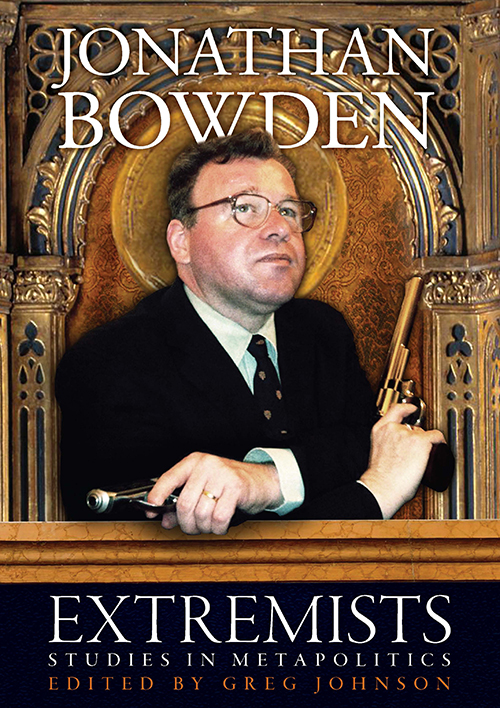
You can buy Jonathan Bowden’s Extremists: Studies in Metapolitics here.
Dutton is essentially “racist Richard Dawkins” who has been criticised even by his fellow biologists for his excessively reductive approach. As a Nietzschean, Bowden took Darwin very seriously. But like Nietzsche, he opined that mere survival and reproduction was not the point of life. The point of life was to self-actualize, to create great works to simulate the intellectual and aesthetic part of our nature. It is to make the world in one’s image, to the extent that one can. Mere survival is not enough. The cockroach may be more adept at survival than the human being but that does not mean it is superior. Our biological nature should achieve full expression in the cultural triumphs of the human species. To instrumentalize higher human culture to how incrementally it may facilitate group cohesion rather misses the point. And since Dutton’s ideology is very present in his work, this mismatch can also leave the readership disappointed.
This brings us to the last section of this essay where we will delve into these differences in greater detail and consider their implications for us today.
Which Way, Right-wing Thinker? Between Dutton and Bowden.
Finally, I want to show how comparing the spirit and work of Dutton and Bowden is imperative for us to chart a path going forward.
First glances show striking commonalities between the two men. Both are (or were in Bowden’s case) British, middle-aged men fighting for the cause of British nationalism and White advocacy. Our generic image of the British Right-wing intellectual matches that of Dutton: rigid, conservative, and comfortably self-satisfied. But this need not be the case. Our movement, if it is to flourish, needs more Bowdens (even if it absolutely needs Duttons also). Dutton and Bowden present two radically different ways of being an intellectual dissident.
Regarding a materialist and reductionist disposition, Dutton is certainly not alone on the Right, especially in the Anglosphere. High culture and theory, as Bowden noted, are usually treated superficially and with suspicion or disdain. The “British empiricist” approach that Dutton exemplifies looks downward, seeking as if by instinct to situate the higher in the lower. This approach is essentially the inverse of the teleological tradition of philosophy inaugurated by Aristotle. Here we sharpen the distinction between these two thinkers: Bowden implores us to always look upwards while Dutton soberly advises us to look downwards. The former thinks we should mobilize our collective efforts to achieve greater heights while the latter wishes to remind us of our harsh Darwinian past. For me and many others, however, Bowden wins out because he synthesizes both aspects in quite a unique way, highlighting the biological basis of man and the tribal nature of white people, but ceaselessly imploring us to look to the most precious forms of output our group that has created as a torch to guide us in an otherwise dark and desolate global-cultural landscape.
We can further draw out these differences by considering the case of “individual genius.” As a functionalist, for Dutton the true meaning of genius is in how the genius benefits the group: the masses become the justification for the genius, who uses his intelligence to help his group prosper. But according to the Nietzschean and Evolian orientation that inspired Bowden, to place mere adaptation as humanity’s final goal would be a vulgar limitation and dilution of human potential. To Bowden, the masses are the bedrock from which individual genius emerges. Genius itself is the essential factor and correct point of emphasis. However, contra individualistic liberalism, the genius is neither acultural nor aracial: he is a towering tree grown from a culturally specific soil. This is why the genius is uniquely able to give voice to the specific group from which he originates. This is why Dostoevsky, Shakespeare, and Dante are seen as inextricable from Russian, English and Italian cultures, respectively. Their work embodies a people and becomes symbolic of their collective consciousness.

You can buy Jonathan Bowden’s Pulp Fascism here.
For Bowden, genius is genius in its own right; it opens up new horizons of conceivable reality to paraphrase Continental philosopher Martin Heidegger. Within this framework, there is even a certain relativism; one can cognitively accept ways of being outside of one’s own group while still struggling for cultural dominance in one’s territory. But most importantly, the works of cultural geniuses are worthwhile in their own terms, independent of any instrumental function they might have. Following Bowden, we can venture that what is most important is ascending to new heights—in improving rather than adapting ourselves. This optimistic, open-ended impulse is something frequently missing from today’s dissident Right.
However, one should not overstate the differences between Bowden and Dutton, even outside of their politics. As a Nietzschean, Bowden took a keen interest in personality, eccentricity, genetics, conformism, biology, individuality, madness, and genius, and how these factors impact upon one’s philosophy. Nietzsche also cautioned us not to forget the psychobiological basis of even our most abstract and “spiritual” ponderings. This aligns him somewhat with Dutton’s perspective. Since there is a strong evolutionary and psychological streak throughout both Nietzsche’s and Bowden’s thought, there is thus a certain karma in Bowden being subject to Dutton’s Darwinian psychologizing. Furthermore, what brings together Nietzsche, Dutton, Bowden and Right-wing thought more generally – and separates them from Left-wing postmodernism—is the former’s acceptance of biological influences as an inescapable dimension of human reality. Bowden frequently emphasized that human culture’s biological substrate is ignored at society’s great peril. A culture that gives equal prestige to homosexual cottaging and prepubescent sex change surgery as to heterosexual romance and child rearing will not remain healthy or stable for long. Civilization is that which brings biological drives and impulses to a higher stratum of reality.
At the heart of Bowden’s philosophy sits an antidote against modern nihilism and the soullessness of multicultural, multigender neoliberalism. Bowden remains important because he provides an alternative to a modernity that has already contaminated a great deal of Right-wing thought: it is materialistic, anti-elitist, and amputated from European high culture. Like few others, Bowden was able to articulate the nihilist despair endemic in liberal societies and its instinctive push to sterilize evermore cultural territory. Before pulling down statues was trendy, Bowden noted how it deleteriously effects one’s morale and will to flourish when one’s heroes and past glory are stripped away and tarnished, all while it is made socially unacceptable or even illegal to argue back. This means something more than just reducing one’s group fitness (though it does that too): it has metaphysical and psycho-spiritual consequences, against which intellectuals must provide a counterstrike. It is this core idea that Dutton struggles to grasp and opens a gulf between him and a man like Jonathan Bowden.
If life was all about “shopping and fornicating” as Bowden once put it (note: two things that promote survival and reproduction), there would be little meaning to life and the human experiment more generally. Life is more than a Darwinian impulse to acquire resources and survive by clutching onto them. A secular form of contemporary spirituality that aims ahead yet is grounded in European philosophy and tradition (and remains largely compatible with science) is thus essential going forward. To quote Bowden on this topic, who can put things better than I can:
Increasingly, many individuals in this society do not have an overall or an individual meaning. That’s why they live moment-to-moment and day-to-day in relation to contingency and consumption. The point of great civilization, as expressed in great art, is to raise people out of that particular trough and get them—if only momentarily—looking upwards, looking upwards towards the sky. Looking upwards towards higher forms. Looking upwards towards the prospect of archetypal forms. Looking upwards towards the religions of the past, the present, and the future.
Conclusion:
Bowden’s legacy is his provision of a variety of resources that bring an aristocratic spiritualism into post-modernity. This contribution constantly finds renewed significance in relation to new contexts and technologies long after the man’s physical death. How can we summarize it? Bowden’s philosophy is pragmatically compatible with science yet highly artistic. Bowden’s thought was highly flexible and open-minded yet without shying away from some of the most radical of harsh conclusions of ultraconservative positions. It is reality-focused but allows for significant lee ways of interpretation and creativity that prevent ideological dogmatism and societal stagnation—two major threats to Right-wing thought and culture. For these reasons, his body of work deserves to be taken seriously today.
Ed Dutton wrote an important and revelatory text on Bowden—yet his temperament made him fundamentally misunderstand why Bowden remains popular. I have tried to avoid polemic regarding Dutton: we need Duttons and Bowdens together. While the latter helps us reach to new heights, the former helps remind us to keep our feet planted on the ground.
What does that mean for out movement going forward? Optimally, we should seek to discipline our minds in a way that Bowden arguably failed to. But at the same time, we should not search out any opportunity to look down upon the world and sneer upon it as Dutton tends to do. Rather, we must always search for the inspiration to look upwards. On this matter, I concur with Bowden: looking upwards is the only way we will muster the courage, strength, and creativity to remake our chaotic world according to our image, instead of that of our adversaries. In doing so, we build a new kind of reality that goes beyond the obsession with haplogroups and quantifiable metrics. Nevertheless, to avoid the path of madness and confabulation that seemed to consume Bowden, we should endeavor to achieve this with our feet planted firmly on the ground. We inherit Bowden’s legacy as something to build upon going forwards.
Thank you very much!
Notes
[1] The day before this article’s publishing was the anniversary of Jonathan Bowden’s death.
6 comments
Dutton has no mystical capacity.
Those with such a deficiency should learn to be humble before those who do not.
Have given my thoughts on this before. But as no one else as commented.
Let me retract a spergy comment I made here one time. I think it was on one of Mark Gullick’s articles. It’s fine to psych-audit our enemies. It’s necessary.
And it’s ok to disagree with, assess and reflect on, or seek to understand our own activists, call them out if they making mistakes and so on. But if someone treats significant figures on our own side as rats in a laboratory being dissected after an experiment, and this wasn’t the only time, it’s not going to be perceived as some brave scientific analysis. It’s likely to be perceived as resentment of the person in question.
It feels like there’s an exploration of an antisocial tendency here, a not-entirely-adapted person trying to do something to compensate. There’s a profound misunderstanding somewhere about “what it’s all about”.
Under this person’s model, the world is actually about a bunch of dead rats in the lab waiting to be dissected by this lab technician.
It feels like we’re looking at someone’s escape hatch from the difficulties and unpredictability of life and this is their way to do this. And we’re being asked to applaud it.
It’s not winning the war we’re in that matters, and that inevitably means figures appearing that take on significance, are interesting to others, have inspiring things to say – whatever their personal flaws, it’s this exercise in this one person’s laboratory that matters, and actually the answers all lie there.
Maybe it’s just me, but I don’t feel that’s something to applaud. It’s something to identify where it occurs and isolate as an issue.
revel in Bowden’s flaws in a way
It’s very easy to assemble a list of contradictions and failings and quirks after someone has passed and you can read it back to yourself and it all seems so clever. But you’re not necessarily making sense of that life. You’re explaining it in a way that suits your own world.
I have read almost every book Professor Dutton has ever written. To be perfectly honest, I don’t feel that it would be too far of a stretch to say that, of all of the Dissident Right books and authors that I have read in the last 10 years, Dutton has had an outsize impact on a lot of my thoughts on everything from the nature of genius, how evolutionary biology influences human behavior (read his book “The Naked Classroom”), to how it is that Islam, a stupid ignorant religion seemingly tailor made for stupid ignorant races, can become so powerful in the West, which brought forth, among other things, the Scientific Revolution and representative government, etc. Needless to say, I am a Dutton fan, and I will read his biography of Bowden, but I am very, very familiar with Dutton’s writing and conversational style, and most of the author’s criticisms seem like they would be valid given that style.
This is one the finest essays I’ve read on counter-currents! And that’s saying a lot! Yeah, sometimes Dutton seems to me like an non-evil version of Saruman, as Treebeard describes him: a man with “a mind of metal and wheels” who “does not care for growing things, except as they serve him for the moment.”
I loathe EvoPsych types like Dutton. Their amoral, nihilistic, deterministic materialism renders life utterly meaningless. Fortunately, it isn’t true. There is a supernatural reality, despite what reductionistic nihilists like Dutton say. It infuriates me that they attack others for saying life is meaningless, calling them “spiteful mutants” but fail to realize that if their ideology were true (and it isn’t) life WOULD BE meaningless. If we live in the meaningless materialistic universe that Dutton believes we do, why in fact should I care about my race or indeed about anything other than my own comfort and pleasure? There is absolutely no reason that I should, because even if I extend the life of my group for a time, it will all end in dead nothingness anyway. Besides, many great thinkers, writers, and artists have thought that life is meaningless (H.P. Lovecraft comes to mind) and though wrong, have produced works of great value and are still worthy of respect. Lovecraft faces the truth about a meaningless universe more honestly than Dutton ever has.
Another thing I can’t stand about these EvoPsych types is that they act as though every idea we have in our heads is just something we’re genetically programmed to have. The concept that I might believe something because I find the evidence for it compelling seems utterly alien to them. Someone doesn’t believe in ghosts because they’ve actually seen one, no, they believe it because they have defective genes. Utter crap. I strongly advise everyone on the Right to ignore these ugly-minded creeps. Their way leads only to emptiness and ruin.
A very well-written review of a rather unusual book. You should keep writing reviews.
If you have a Subscriber access,
simply login first to see your comment auto-approved.
Note on comments privacy & moderation
Your email is never published nor shared.
Comments are moderated. If you don't see your comment, please be patient. If approved, it will appear here soon. Do not post your comment a second time.