 10,883 words
Frédéric Saenen
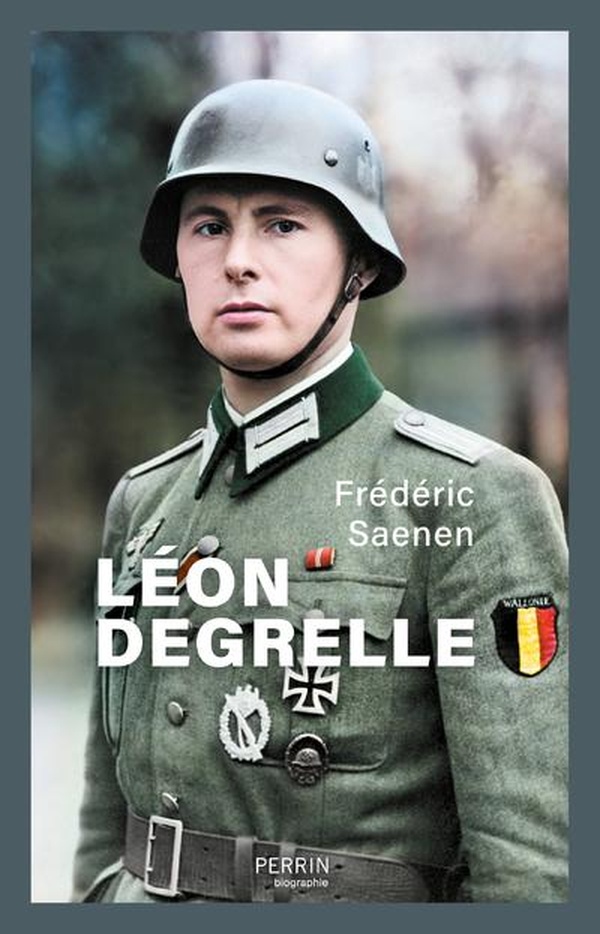
Léon Degrelle
Paris: Perrin, 2025
Years ago, in the pages of his own publication, Spearhead, John Tyndall, then leader of Britain’s National Front, wrote approvingly that in Europe in the 1930’s “strong men came forward” to restore authority and a sense of purpose to their respective nations. It was a euphemistic but accurate characterization of the nationalist leaders after the Great War who radically opposed both Western parliamentary democracy and Bolshevism and who are loosely classified as fascists. Léon Degrelle was by far the most famous Belgian representative of those “strong men,” and Frédéric Saenen’s new biography provides a reasonably objective, even detached, account of Degrelle’s exuberant and controversial life; it is an account without strong bias but also without the least empathy.
This low-key, occasionally ironic but never passionate biography is in marked contrast to the personality and career of its subject. Degrelle was fanatical, committed, passionate, violent and demonstrative, ambitious, extreme, and seething with energy. Saenen describes Degrelle and his life with detachment, as though he is summarizing a film scenario (which arguably in a sense he is), and complements his account with an abundance of footnotes and chapter notes. The former are marked by asterisks, which mostly indicate the clarification of a word or statement, while the numbered chapter notes provide the majority of source references.
The book has a prologue, subtitled The Man and his Masks. Here are its opening lines:
The man is sitting in a chair at an angle to the camera, legs crossed. On the wall behind him two banners-white crossed with sword toothed batons: the emblem of Greater Burgundy in the fifteenth century. The elegantly dressed septuagenarian makes a good impression. His hair, still jet black, is combed to the back of his head, dark eyes set under arched eyebrows; sunken features show signs that the face was once a rounded one. He has a tremendous screen presence. In a self-assured manner he listens to an unseen interlocutor addressing him deferentially about his political views and his military past. Hardly has a question been asked and Degrelle’s gravely voice starts off, a little husky at the high notes, booming at the base. His response is a barrage of denigration and anecdotes which make him chortle. He passes through every conceivable stage of indignation. His face lights up, his cheeks swollen, the eyelids folded, then his arms are thrust forward or are abruptly pulled back to his chest. After the eruption, he falls silent again, staring ahead, lips pinched, already awaiting the next assault… He knows that on film he is addressing posterity. (p.7)
This highly evocative piece of writing is not typical of the book. Saenen is too young to have known his subject personally and so he repeatedly must have recourse to accounts given by people who did.
Saenen does not reveal what scene his opening paragraph describes, but it reads very like a depiction of Degrelle in front of the camera in J.M. Charlier’s sympathetic documentary of 1978, Leon Degrelle: Autoportrait of a Fascist.
Léon Degrelle, Léon Joseph Marie Ignace Degrelle, to give him his full name, (Ignace was a tribute to the founder of the Jesuit Order, Ignatius Loyala) was born the fifth of eight children in Bouillon, a town in the Ardennes in Wallonia, French speaking Belgium. The Ardennes had belonged to the Kingdom of France and the Duchy of Burgundy at different times in its history, and uncertainty as to the boundaries or even name of his homeland was to play a role in Degrelle’s political life. Bouillon was and still is dominated by The Castle of Bouillon, which had once belonged to the legendary Godfrey de Bouillon. Many may recognize the name from reading The Holy Blood and the Holy Grail or The Da Vinci Code. Sir Godfrey de Bouillon became the first prince (“Advocate of the Holy Sepulcher” as he called himself) of Jerusalem after the First Crusade conquered it in1099. In 1830, the newly created Kingdom of Belgium adopted Godfrey de Bouillon, a descendant of Charlemagne on his mother’s side, as a legendary national figure intended to appeal to both French speaking and Flemish speaking Belgians. His imposing equestrian statue still stands in the Place Royale in Brussels.
Degrelle’s father was a prosperous businessman and local councilor. Both Degrelle’s parents were devout Roman Catholics and his was a very religious family. By all accounts, his childhood was a happy one, and in his accounts of it he recalls a simple carefree natural and untroubled time, a time remembered with great affection. The Degrelles lived in an elegant and spacious house (demolished in the 1950s to make way for a civil administration building, Saenen grimly informs the reader) and in healthy rural surroundings:
His life then? Simple and happy, a life interspersed by occasional outings to go swimming in the River Semois and long walks through the woods around the house. The child enjoyed a healthy diet based on vegetables from the garden and other fresh produce. (pp 24-25)
Saenen quotes Degrelle himself (from a television interview given in 1985) to describe his religious upbringing. The account of Sunday service and the wine cellar is taken from a book called Léon Degrelle et le Réxisme by P. Daye:
We were imbued to our very marrows with a notion of the divine.
Saenen then continues:
At Sunday service, at which he sometimes served as acolyte, the child would receive the host with fervor, the host which contained mystically part of the body of Jesus Christ. The Saint Peter and Paul Church, situated at the high part of the city, impressed him with its neo-classic style. He always glanced up at the decorated ceiling. Simple but imposing, it depicted the departure of Sir Godfrey for the Holy Land. Every evening he would kneel at the foot of his bed and piously recite his prayers. On certain Sundays the master brewer who was his father would receive the bishop in style, whenever that dignitary honored the area with a visit, and the bishop used to lavish praise on the sumptuous wine cellar with its six thousand or more bottles. (p.25).
Early in the book, an encounter is described between Degrelle as a young boy and “the hero of Verdun,” Marshal Petain. Petain was visiting Degrelle’s hometown of Bouillon. Saenen writes:
The young Leon, in the uniform of a boy scout, had the privilege of going hand in hand with the old soldier during his visit, assuming that is, that this story too was not embellished (p. 28).
Saenen’s source for this anecdote is a book by W. Dannau called Ainsi parla Léon Degrelle (Thus Spoke Leon Degrelle.) But is it Degrelle or Dannau who may have, or may not have, “embellished” the account? Since Saenen goes to the trouble of providing abundant references, it is puzzling that he did not put in the extra mile and provide answers to such simple questions when they arise.
A well-known story related by Degrelle himself in Autoportrait of a Fascist concerns his encounter with Adolf Hitler in 1943, when he was decorated with the Ritterkreuz by the Führer in person. A well-known photograph of the scene shows the two men gazing at one another, Hitler clasping Degrelle’s hand. According to Degrelle, it was at that moment that Hitler said, “if I had a son, I would wish him to be like you.” Saenen writes that it is “unlikely” that Hitler said so. But why? Colorful anecdotes of this kind, some very plausible, some less so, abound in this biography. Legend, hyperbole, mystique: these belong to the story of famous men and women, accentuated in the case of Degrelle’s by the man’s own love of storytelling, legend, drama, and exaggeration.
Obfuscation is unavoidable in a biography of a man like Degrelle and Saenen has invested a huge amount of work in furnishing this biography with multifarious sources and references. However, he could and should have done a better job in differentiating between what was written and published by Degrelle, statements Degrelle made that are captured on film, what people claim that Degrelle wrote or told them and whether supported by witnesses or not, and finally what are reasonable assumptions and what is merely conjecture. After all, a pervading question which arises when reviewing Degrelle’s life is: what part is showmanship and what part is sincerity? And what is exaggerated? Saenen himself writes of Degrelle’s “irrepressible urge to exaggerate.” Degrelle himself would probably have been unfazed by the persistent opacity of this biography.

You can buy Francis Parker Yockey’s The Enemy of Europe here.
Any Degrelle biography will inevitably throw up questions besides those relating to authenticity: questions relating to the substance of religion, ideology, nationalism, economic justice, conviction and delusion, the warrior ethic, and not least, race. Saenen discusses none of these, although they are paradigm questions when considering the careers of Tyndall’s “strong men” and their legacy. In a biography of Léon Degrelle, for reasons of both the man’s personality and the events in his life, those questions are especially likely to attract attention.
Degrelle was born early in the century (1906) and died close to the end of it (1994). He put his hand to various very different activities during his life. Militant fascists of the time were likely to be either journalists, book authors, politicians, or soldiers. Degrelle excelled in all four roles throughout his life. He wrote prolifically: essays, articles, reports, history books, memoirs, even poetry. Between the wars he was the leader of Rex, a successful and influential political party, (Degrelle preferred the word “movement” to party), and he became a soldier in the “crusade against Bolshevism,” first in the Wehrmacht and later in the Waffen SS.
The first World War ended when Degrelle was just twelve years old. Saeden writes:
Life seemed to recover, but boredom loomed in the life of the hyperactive adolescent…he showed no interest in mathematics or Flemish, but his teachers noticed his passion for History and the fact that he wrote well. He composed his first novel when he was twelve years old: Le Vieux Pont (The Old Bridge) in which he stigmatized the construction of factories in the region and contrasted the virtue of living an open air life with the toxicity of industrial civilization…..During his holidays the young boy set out for adventure on long bicycle tours, heading for Germany or the North Sea. He was also active in the boy scouts, where he became sergeant major and standard bearer. A passionate reader of French literature, he devoured the coruscant polemics of the Catholic writer Léon Bloy and the repetitive hammering prose of …Charles Péguy. Degrelle tried his hand at writing poetry and drama (pp 29-30).
From an early age, there were clearly two very different aspects to his character. On the one hand, a sense of adventure, a leaning towards romanticism and individualism; on the other hand a devotion to order, community, and to the Catholic faith, and even what one may call his faith in faith, a sense of the need for faith to make sense of life and give life a purpose.
In 1918, Degrelle expressed many of his passionate commitments in his Meditation on Louis Boumal. Boumal was a literary figure from Degrelle’s own hometown of Bouillon, a writer sympathetic to Charles Maurras, leader of the French ultra-conservative movement Action française. Charles Maurras had an ambivalent relationship with the Catholic Church; he was a royalist and deeply conservative, yet the Catholic hierarchy distrusted him because of his strong leanings towards classical Paganism, and the Vatican placed Maurras’ works on the Index in 1926. The Meditation, writes Saenen, reveals the nature of a young man “in love with order, discipline and method.” Bournal’s influence is also present in Degrelle’s first collection of poems, dedicated to his mother and bearing the same title as that of a poem written in 1945 by the French collaborationist writer, Robert Brasillach: Mon pays me fait mal (My Country hurts me). Narvaez, the Duchess of Valence in her account of Degrelle, Degrelle m’a dit, (Degrelle told me) recalls Degrelle saying:
For us young people there is nothing more moving than the wrinkles and gray hair of the woman who gave us life and suffered physically for doing so, who renews that gift through incessant affectionate sacrifice.
Saenen comments:
Those words point up two themes omnipresent in Degrelle: youth and sacrifice. There is only value in the first if it is capable of the second.
Narvaez recalls Degrelle saying:
Life is only of value to the extent to which we master it and the sacrifices we are prepared to demand from it (p.34).
Degrelle himself wrote in Les Grandes Forces (The Great Strengths) of the ideal of comradeship which guided him in his life: “Everything clear, everything fresh, all loyal. No jiggering, no financial interests, no political rivalries, just the friendship of brothers” (p. 34).
Degrelle abandoned his legal studies at the University of Namur, where he nevertheless gained notoriety by organizing a kind of referendum on writers with the question: “among the writers of the last quarter of a century, which do you look up to the most?” The results were published in the publication Les Cahiers de la jeunesse catholique (Catholic Youth Notebooks). The clear winner of Degrelle’s “referendum” was Charles Maurras.
Not daunted by his failure as a law student, Degrelle subsequently entered the university of Leuven to study philosophy, where he founded a student newspaper called L’Avant-Garde, (not to be confused with many French language publications with the same or a similar name). He graduated from Leuven in Philosophy and Literature in 1927. Early on in his life it was clear that Degrelle was vehemently anti-communist, leaned towards radical uncompromising solutions, and did not balk at extreme provocation and incitement to violence to serve his ends, or less cynically expressed, in service to the causes in which he believed. The first record which Saenen gives of Degrelle’s physical engagement in a political cause was the ransacking of a pro-Soviet exhibition in Brussels. Degrelle himself referred to the ransacking as a quasi-military operation. It was certainly organized with military precision. In 2 minutes, 32 seconds exactly (!) a hundred militant Catholic, anti-communist students caused havoc in the exhibition rooms, windows were smashed, and a bust of Lenin was pulverized. The trashing of the exhibition made headline news. Left-wing parliamentarians protested.
Romantic, nostalgic, reactionary: such character traits tend to make a person withdrawn, embittered, misanthropic, they may turn someone into a recluse. This was not the case at all with Degrelle. From his earliest years he was adept at what is today called “networking.” He was a friend of a priest called Abbé Picard who believed in an evangelical crusade for Belgium and who realized the importance of the press in any kind of missionary campaign. Picard proved very useful to Degrelle in his journalistic and political life. Picard had founded the ACJB (Catholic Action of Belgian Youth) in 1921 on the same lines as the equivalent French ACJF, which was led by the Catholic social reformer, Albert de Mun. Saenen, probably correctly, draws direct parallels between de Mun’s style of campaigning in France, with its reformist, socially radical tone, and Degrelle’s own appeal to the masses in Belgium eleven years later: the conjuring of apocalyptic images, ad hominem denunciations of “banksters” and exploiters. De Mun’s radicalism broke with the respectable church establishment, not least in the expression of a radical, socialist leaning sympathy with the cause of the humble wage earner. Saenen quotes Carton de Wiart writing on de Mun:
He stigmatized the horror of thirteen, fourteen, even sometimes sixteen hour working days, the scandal of children and women replacing men in workshops, factories and even down in the mines…he denounced the filth and hideous promiscuity of the slums, the degradation of drink and immorality, human labor being worth nothing but the price it fetched on the labor market. (p.39)
Saenen adds to this that de Mun’s slogan “Go to the People!” prefigured an imperative of Degrelle’s own political campaigning.
Saenen tells the reader that it was on the strength of Picard’s recommendations that Degrelle obtained work on a freelance basis for Norbert Wallez’s (another priest!) Le Vingtième Siècle (The Twentieth Century) in 1928. Norbert Wallez had already given Georges Remi (Hergé) a job, drawing cartoons of Tintin for the paper’s youth supplement, Le Petit Vingtième.
You can order the Centennial Edition of Francis Parker Yockey’s Imperium here.
Degrelle claimed in his book Tintin, mon copain (My pal Tintin) that he had been a close friend of Hergé, and that Hergé had used him as a model for his famous cartoon character. The latter claim has been strongly contested, and like so much of what Degrelle said, it is impossible to conclusively confirm or refute it. What is certain is that the world of Tintin highlights many concerns which were also Degrelle’s: comradeship, notably in all the books between Tintin and his loyal fox terrier, Snowy; the uncompromising anti-Bolshevism, (Tintin in the Land of the Soviets); the portrayal of a powerful behind-the-scenes financier, “bankster” (The Shooting Star); even the nefarious activities of a secret society of drug smugglers who may be free-masons (The Cigars of the Pharaohs). Tintin too was a “young reporter.”
Saenen describes Degrelle cutting his own teeth as a journalist by:
Crisscrossing a Belgium marked by misery, mapping out the alleys, the mining villages, the shacks and hovels…He forcibly and vividly depicted the humidity, the darkness, the promiscuity, the contaminated air and the putrid smells… (p.46)
Interestingly, Saenen writes on Degrelle’s report on the Jewish ghetto at Anvers that it was “emblazoned with stereotypes” but that “there is not a trace of anti-Semitism to be found in it.” One assignment for the paper took Degrelle to fascist Italy, which impressed him, not least its leader, who “was pursuing a steady course” unaffected either by praise or outside condemnation by “lowly politicians.”
Degrelle was not one to seek balance or qualify what he wrote. His essays were polemical and sometimes violent. Writing in L’Avant-Garde on the political upheavals taking place in Mexico at that time, he praised León de Toral, the Catholic assassin of the anti-clerical president Alvaro Obragon. Toral had been captured, tortured and then executed. Degrelle wrote:
Since the head of one president is not enough, aim at the next president! These bandits have forfeited the right to live. Killing them is an act of justice and charity. Aim well! Don’t miss! For each new Toral, we shall write again from the bottom of our heart -bravo! (p. 48).
According to Daenen, this blatant exhortation to murder was roundly condemned in the Belgian press.
Saenen mentions that de Toral was tortured. That makes Degrelle’s outburst less gratuitously bloodthirsty than it would otherwise seem and it is an example among many of Saenen’s efforts to write a relatively unbiased biography. The Degrelle biography by Arnaud de la Croix which precedes Saenen’s, does not mention de Toral’s fate, and gives the impression that Degrelle was delighting in the murder of a progressive politician and wanted to see more murdered. In Saenen’s account the impression is rather that Degrelle believed himself to be a champion of a holy cause writing in praise of a martyr, in a style which inevitably calls to mind the Catholic cult of martyrdom. Nevertheless, there is no denying that Degrelle was unscrupulous in inciting to violence, even to murder.
Was Degrelle, and like him the other “strong men” of anti-Bolshevism, acting out of a deep conviction that he was fighting for “the Good,” or on the contrary, was he acting out of a craving for power for the sake of power, or yearning for success for the sake of success? Saenen ignores such questions. What Daenen’s biography does show clearly, however, is that Léon Degrelle could never have been content with a quiet, humble, or inactive life.
Degrelle did not just write about events in Mexico. He traveled there as a war correspondent for Le Vingtième. Saenen states that (so far as he is aware, he adds cautiously) Degrelle and a socialist correspondent called Louis Piérard were the only two Belgian journalists to report on the Mexican war on the spot. It is not clear how Degrelle got into Mexico, since his application for a visa was initially rejected. “How he prepared for his trip remains obscure” writes Saenen. One report is of a faked identity, another is that Hergé’s future wife was somehow able to exercise influence on staff in the Mexican embassy to enable Degrelle to obtain a visa. Both Le Vingtième Siècle and an Italian paper called L’Avvenire d’Italia (The Future of Italy) helped to finance the trip.
Like de la Croix before him, Saenen in this biography is skeptical of the quality of Degrelle’s seventeen dispatches from Mexico. Saenen notes that in striking contrast to Degrelle’s reports on the slums of Belgium, none of the reports from Mexico gives a realistically vivid portrayal of events on the spot. Saenen hints (very plausibly) that the young Degrelle might have prioritized interests other than the Mexican war while he was in Mexico. Whatever the reason, according to Saenen, Degrelle’s dispatches did not at all match expectations:
His articles were nothing but stodgy comparisons between the Mexican and Bolshevik revolutions, compilation of statistics of workers’ salaries, arable land mass, petrol prices, cereal and textile production) extracts from the Mexican Labor Code or a revolutionary educational periodical, ponderous historical references, all punctuated with cheap exoticism. There was no need for anyone to travel to the country itself to write or just copy material like that. (p.50)
One might be tempted to ascribe this negative assessment to a bias on Saenen’s part, but he had written favorably of Degrelle’s work as a journalist when reporting on labor conditions in Belgium, and Saenen’s writing is generally much less hostile than most published writing on Degrelle today.
In his chapter, bluntly, perhaps ironically, titled The Phenomenon, Daenen relates how Degrelle moved from being a journalist and businessman working in alliance with the ACJB (which appointed him manager of a Catholic publishing house called Christus Rex) to a campaigner for the Parti Catholique (Catholic Party) whose success in the general election of 1932 can be attributed to a greater or lesser extent, depending on one’s opinion, to the campaigning efforts and organizational skills of one Léon Degrelle.
Saenen’s account of Degrelle’s transformation, if it can be called that, from radical Catholic journalist to the leader of a fascist movement, is somewhat confused. What is very clear, however, is that Degrelle’s frequent successes as journalist, book author and politician could not be put down principally to luck. It resulted rather from his abilities and qualities: phenomenal energy, propaganda skills, dexterity in communication and networking, a flair for organization, an often cynically remorseless exploitation of the weaknesses of others, an ability to see how people could be useful and to use them accordingly, good looks (people inevitably began to talk of “Rex appeal”), ambition, a willingness to take risks, and through it all considerable physical courage.
Such a person might have been expected to become a successful financier or public relations manager, were there not something else in Degrelle’s character, namely the conviction that there must be a higher purpose to life than mere self-aggrandizement. A spiritual sense of mission pulled Degrelle in a different direction from the pragmatism which was a core part, but not the only part, of his character. Although a pragmatist and a realist, and ambitious for himself, he was also prepared voluntarily to suffer grief, anguish, and loss of comfort and wealth and risk his very life in the service of a non-material cause in which he believed.
Degrelle’s relation to matters of morality and materialism was enigmatic. On the one hand, he continued throughout the 1930s to hold to very conservative tenets of Catholic faith, for example that divorce and abortion should be illegal in all situations, without attenuating circumstances. A cynic would of course note that it was opportune for him to be very religious, even devout, in the deeply Catholic country that Belgium then was and was a requirement in garnering support from influential and powerful Catholics. Against that as the sole explanation of his religious faith is the fact that Degrelle attended Sunday church service throughout his life. He only married his future second wife after his first wife had died (his divorce from her was secular but not recognized by the Church). He was very proud that his platoon of the Waffen SS had a Catholic priest.
Although he stressed asceticism and sacrifice, Degrelle was no stranger to sybaritic indulgence and theatrical effect, as evidenced by Saenen’s account of an event organized by Degrelle, called innocuously “The Congress of Youth Publishing,” at Charleroi in 1934. Daenen cites an anonymous journalist reporting on the event: Five hundred guests, over a mile of tables, 10,000 cuts of ham, 75,000 liters of beer, 30,000 toffees, 75,000 apricots…more than 30 attractions, refreshment bars, popular Wallonian games, Roman chariot and other races on a 400 meter track” and in another account “shortly before 4.30 p.m., mounted on a tribune high above among resplendent flags, Degrelle in the spotlights, harangued the huge crowd.” (p. 74)
The ambiguity, paradox, hypocrisy, call it what one will, Saenen identifies and summarizes succinctly:
Degrelle’s relation to money was particularly ambiguous. On the one hand, the public persona was happy to express his disdain, Savonarola style, for material vanities, claiming that the only real human wealth lay in the soul. However, Degrelle loved luxury, beautiful cars, stylish suits and was certainly not averse to appearing in a dinner jacket….From 1942 to September 1944 Degrelle was able to requisition for himself the use of the Fougeraie chateau which stood near to his own villa. Also known as Chateau Wittouck, this sumptuous eighteenth-century residence is surrounded by French gardens and covers an area of 17 hectares (42 acres). (p.107)
An admixture of asceticism and love of luxury is not uncommon among moral preachers, be they priests or politicians. Degrelle is no exception, but he seems to have gone to extremes in both respects: very puritanical, very fond of good living, a champion of hearth and home and traditional family values, but well aware that he was attractive to women and unscrupulous in exploiting that attraction.
In 1930, by virtue of his good connections and popularity, Degrelle was appointed director of the Catholic Christus Rex publishing house. Two years later he started a journal called Rex, first as a monthly, later as a weekly publication. Rex served him as a springboard from which in 1935 to launch his Rexist movement. It acted as an alternative to both the traditional Catholic establishment and to secular socialism and Bolshevism.
As Saenen describes it, Degrelle’s shift from very conservative Catholic agitator and journalist to fascist leader was for the most part a gradual one, yet marked by a number of small decisive events which pushed Degrelle sharply in the one direction. It is left to the reader to decide in reading this and other accounts to what extent Degrelle planned his political career and to what extent events took him in the direction he was to go. Two interpretations of the rise of the Rex movement seem equally plausible, one that he used the Catholic church to achieve his political ends, the other that he developed his views to become ever more politically committed, more fascist, less religious, as his life and his character adapted and developed.
Whatever it was that took him into radical political agitation, Degrelle was ruthless and violent, in this and other accounts intoxicated by his huge popularity and his success in organizing and expanding the movement which he led, fueled by a series of scandals which he adroitly and pitilessly exploited, with ad hominem attacks and violent language being an integral part of his campaign style. By 1934, Degrelle’s former promoters and patrons, notably the ACJB, had broken with him. He was too like Maurras or even Hitler, and the Church no longer had him under its control.
One of the events which moved Degrelle away from the Church establishment (or the consequences of which he used as a pretext to move away) was what the Rexists called “the Courtrai coup.” Courtrai, or Kortrijk in Flemish, has symbolic significance for Flemish nationalists because it was the site of the battle of that name, also known as the Battle of the Golden Spurs, in 1302, when King Philip le Bel of France was defeated by the Flemish. It was there that the FAAC, The Catholic Associations Federation, “a powerful institution which Degrelle sought to control” (p.78) and close to the Catholic Party, held its annual gatherings. Degrelle and his followers disrupted the 1937 gathering, taking over the podium. Degrelle poured insults upon the main speaker, and demanded that the “living excrement which existed in the party make way for the young.” Not surprisingly, following this provocation, the Catholic Church in Belgium forbade its priests, and the Catholic party forbade its members, from taking part in any Rexist event. Degrelle then took a step which would seem insignificant today but was momentous at the time: he declared that non-believers would be welcome to join Rex, “so long as they are honest folk” (p.79).

You can buy The World in Flames: The Shorter Writings of Francis Parker Yockey here.
Saenen does not comment on another aspect of “the Courtrai coup,” the question of Flemish nationalism. Remarkably, Degrelle never learned to speak Flemish, so his appeal in the Flemish part of Belgium, which in any case had its own fascist movement, was small. Belgium itself had only become a nation state in 1830, essentially the revolt of the Catholic south against the Calvinist north (the Netherlands). The north of Belgium is Flemish speaking, the south of Belgium French speaking. Today, and much more in Degrelle’s time, the language divide highlighted a divide between a south linguistically and culturally inclined to France, and a North linguistically and culturally inclined to the Netherlands or Germany. Saenen writes about a bias in the German towards the Flemish at the expense of Walloon nationalists, for reasons not only of culture and language but of race too. The Flemish were seen as more “Nordic” than the “Latin” Walloons. Degrelle strove to combat this bias during the years of German occupation, insisting that the Walloons were as “Nordic” as the Flemish. Degrelle’s own patriotism seemed to shift over the years from Belgium to Wallonia, and thereafter to Burgundy, an ancient dream, displayed by the spectacle of the Burgundian battle flags which were carried on the Eastern Front and which he used to decorate his home during the later years of his life.
Saenen examines the Rexist program in some detail. It combined an extremely conservative appeal to order, discipline, and patriotism with very progressive views on social reform. Allegiance to the Church was something which Rex could not afford to dispense with, notes Saenen (p.74). But it would be unfair to suggest the Rex’s association with the Church was merely opportunistic. Saenen paints an image of Degrelle as a sort of priest politician, one conscious of ritual but also aware of the need not to appear like one of “yesterday’s men.” Saenen writes in what appears to be his own and untypically emotional language:
It was more than communication, Degrelle had a sense of communion. The postures followed each other in deliberate succession: gravity, taking offense, anger, jocularity, conviction, exaltation in the course of an address meant for everyone and in resolutely modern language….Degrelle did not captivate, he captured .
Saenen cites the journalist and Rex member Pierre Daye’s description of Degrelle speaking:
Not a tremor in his voice. Words spoken to everyone, but uttered with a harsh expression, ironic word, a strong metallic voice, a voice so powerful in fact that once, when the loud speakers had been sabotaged, the cables severed, Degrelle just continued speaking for an entire hour and everyone, even those at the very back, heard every syllable he uttered…
He explained that circled like the hunting bird over chickens, an expression used in the Ardennes to describe the sparrowhawk. “I saw around and then in a flash I plunge into the crowd.” (pp 81-82)
Saenen gives his reference for the comparison with the hawk: J. Frerotte Degrelle the last Fascist. But why does Saenen refers the reader to yet another book? Degrelle used that same striking image, implicitly cynical, comparing his style of oratory and its effect on the crowd to a sparrowhawk plunging onto chickens, in the aforementioned documentary film: Leon Degrelle: Autoportrait of a Fascist, which can still be viewed on YouTube.
Saenen does an adequate job of describing Degrelle’s political rise leading to Rex’s gains (twenty-one seats) in the general election of 1936 followed by Degrelle’s decisive defeat in the presidential elections the following year.
However, Saenen describes but does not analyze Rexist ideology, and he does not discuss whether the Rexist movement constituted a truly ideological movement or was closer to being a vehicle to fulfill Degrelle’s personal ambitions, as many commentators have argued. Saenen does not consider Degrelle or the Rexist movement from the point of view of the sincerity or otherwise of the ideas it promoted, and so Saenen’s presentation is opaque. He writes that:
The Rexist program did nothing more than repackage the propositions put forward in 1921 by Father Georges Rutten, advocate of a law which denied married women access to factory, workshop, road or office employment. (p.85)
But he writes on the very same page that:
The priority was to create an electoral pool which would demand full electoral suffrage for women, something for which Rex had always campaigned.
So was the Rexist movement simultaneously in favor of restricting women’s employment rights and in favor of women having the same voting rights as men (which in Belgium they were only to be given after the Second World War)? If so, how did Rexism square such a circle? This is even more pertinent in view of the fact that Degrelle himself was viscerally anti-communist and at the same time, so far as one can judge, deeply concerned with social injustices. Daenen’s depiction seems to incline to the cynical view that Degrelle’s politics were politics of style with little if any sincere content, utilized to curry approbation and gain power, devoid of consistency or authenticity. Saenen quotes Daye quoting Degrelle again:
To anyone who reproached him with a lack of substance in his program, Degrelle would respond “That can be done later.” It reminds me of people writing about love who have no experience of women.
Saenen writes of Rexist policies:
The economic program was based on a virulent critique of both capitalism and Marxism.
To fight what it called the monstrous egoism of individuals, classes and professions, Rex lauded “total solidarity” by way of brotherhood, charity, the ennoblement of the family hearth, return to virtuousness, a love of life in a clean atmosphere…Rexism rejected the concepts of reason born of the French Revolution, of race as preached by national socialism, of class as preached by socialists and instead urged moral values inherited by Christianity. At the center of all is the family, which should be large and secure from which the aim of outlawing divorce. The defense of the family entailed a moral crusade, a fight against pornography, prostitution…The army was singled out for particular praise in the Rexist program with its discipline, its hierarchy.
Some points in the program as described by Saenen sound like proposals put forward by socialists at the time and are likely to be ignored by those hostile to Degrelle today:
Social reform was based on ad hoc initiatives such as free medical consultations, free financial and legal consultations. Rex proposed a program for the children of disadvantaged families that they could be sent for holidays to the North Sea or the Ardennes not in state run holiday camps but to be guests in well to do families. (p. 86)
This provides insight into socialist aspects of Degrelle’s political vision, and ad hoc or not, the proposed initiatives Saenen names were and indeed remain “Left” proposals to reform society.
Saenen expresses his view that the Rexist movement was unrealistic, which does not sound cynical or opportunistic at all: “An idealism directly descended from the apostolic crusades, far from all Realpoltik. (p.87).
Was Degrelle concealing ruthless intentions? In March 1936, in the run up the general election of that year, Degrelle met with Philippe Henriot, a French Right-wing parliamentarian, later collaborator (murdered by the French Resistance in 1944). Somehow, the conversation was overheard by someone and published in the press (Journal de Charelroi).
I’ll have twenty people elected to parliament and I’ll have absolute control over them because they will give me a signed copy of their resignation, and I’ll make immediate use of that if they don’t toe the line. My group will absolutely refuse to cooperate and instead organize systematic obstruction: we will make it impossible to govern. …When I have power I’ll exercise terror; sometimes you have to allow popular anger to take its course. That’s what I will do and heads will roll. Propaganda and terror, that’s the way to go. I am terrorizing people already (p.88).
One might be well inclined to suspect a mendacious smear campaign by the press but for two things. One is that the words sound like Degrelle’s. The organization, the ruthlessness, the need for military discipline, the cynicism and also the overestimation, or overoptimism, of the chances of success, these can be found in Degrelle’s writing and speeches throughout his life. He was an over-reacher, as audacious people are by nature, if not by definition. The second reason for giving credence to the account is that Degrelle expressed anger at the leak but did not deny the report outright. He simply commented ambiguously that he had made a “bit of a gaffe” which “only a sucker would take seriously.” The statement reminds us of yet one more character trait of Degrelle: an impish humor. Léon Degrelle, the man of passion and action, the hero of the Eastern Front, sounded very much at times like a prankster.
In the elections of 1936, the Rexist movement was the fourth strongest party, winning twenty-one seats in the Chamber of Deputies and eight in the Senate. Degrelle’s projection of twenty seats thus proved an underestimate. The achievement was even more remarkable given the weakness of Rex in the Flemish speaking half of Belgium. There the Vlaamisch National Verbond (The Flemish National League) filled the role played by Rex in Wallonia.
Usually Degrelle’s character, inclined to military discipline and realism, coupled with a pragmatic business sense, enabled him to make an accurate forecast of political and military events, with a wary knowledge of the dangers of over-optimism. However, Degrelle’s usual calculating realism was at times clouded by a delusional optimism, probably brought about, as extreme optimism in politics often is, by arrogance clouding caution and sense. An example of that is his attempt to imitate Mussolini with a “march on Brussels” to which far fewer followers appeared than expected. The low numbers for the “march” proved to be a show not of strength but of weakness for the Rexists. This was followed by Degrelle’s very rash gamble to win a parliamentary seat in a by-election forced by Rex. A Rexist deputy, apparently on Degrelle’s orders and in accordance with his demand for absolute obedience, was compelled to step down, forcing a by-election with Léon Degrelle as the Rexist candidate.
The reaction of the establishment wrong-footed Degrelle. Paul van Zeeland, the Prime Minister of Belgium and leader of the Catholic Party, decided to oppose Degrelle in person. To give van Zeeland a clear run, no other anti-Rexist party put forward a candidate, turning the by-election into a kind of mini-referendum on Rexism. All the parties except the Flemish nationalists and the Rexists supported van Zeeland. Both candidates in their style, appearance, and views embodied two worlds: “business as usual” versus “the strong man.” Van Zeeland quiet, demure, almost middle-aged, slow and sporting an old-fashioned top hat, opposed to the revolutionary younger Degrelle, militaristic, sleek, and flamboyant. Degrelle was decisively defeated, garnering only 19% of the vote and Rexism went into an immediate decline. Even the Flemish nationalists abandoned Degrelle.
In the years leading up to the war, despite a now low level of support, from which it was never to recover, Degrelle kept the flame of Rex alive, remained undisputed leader of the movement, was finally elected to parliament and met with Mussolini, Goebbels, and Hitler. It seems almost certain that he sought and received funding from fascist states, although he always denied having done so. Saenen quotes Goebbels’ enthusiastic comment on Degrelle in his Diaries, an enthusiasm tempered with caution when it came to money:
He makes a fabulous impression, very impressed. He wants money or at the least paper for his publications. I shall provide paper. He deserves it and will know how to make good use of it. We parted as friends. (p.111)
However, by May 1939, following electoral disaster for the Rexists in the 1939 general election, Goebbels’ tone had changed. He now wrote in his diary that politically Degrelle was “completely finished.” (p.112).
Saenen comments on Degrelle’s and thus Rexism’s growing similarity to National Socialism in the years leading up to the war, and quotes editorials in Le Pays Réel in which Degrelle wrote “Hordes of Jewish adventurers, Marxists, free-masons are stirring up hostilities, endangering Europe and the entire West” (p.137).
Saenen suggests that this was part of a cynically pragmatic streak in Degrelle’s character. After the outbreak of war, the Rexist press had called for the upholding of Belgian neutrality, and even condemned Belgians who collaborated with Germany (p.137). The insistence on Belgian neutrality launched in the language of an idealistic love of peace contrasts dramatically with the call to arms against the Soviet Union in 1941. Degrelle was also not always prescient. He wrote early in 1940 that there would be “no war in the spring” because Belgium was “not interesting enough for the Third Reich” (p.138). Poor analysis, or possibly casuistry to mislead the Belgian government into a false sense of security? Léon Degrelle a Grima Wormtongue? Saenen leaves it for his readers to decide.
On May 10, 1940, the day of the German invasion of Belgium, Degrelle was arrested by the police at 7 a.m. in his Brussels villa The arresting officers were not coming for a political discussion. Saenen quotes from the memories of the arresting officer, who was told by his superior:
Raoul, don’t get tied up in excuses or stories and you don’t have to wear kid gloves! If he makes the slightest move to resist, beat the sh*t out of him! (p.139)
Degrelle offered no resistance. He was later transported to France where he very narrowly escaped execution. He was thought to have been among a number of Belgian fascists summarily shot. Degrelle suffered greatly, being moved from one internment camp to another before being finally released, thanks to the good offices of influential friends and admirers, including the Spanish ambassador to France. Daenen writes at length about Degrelle’s subsequent machinations to reestablish himself in political life in Belgium. Ever the energetic pragmatist, a few days after his return to Brussels he successfully applied for back payment of three month’s salary as a member of the Belgian parliament.
In occupied Belgium in 1940 and into 1941, Degrelle and his Rexist movement strove to maneuver between Flemish fascists, the Crown, and those elements which sought to make of Belgium little more than one more German Gau. On June 22, 1941 the choice became stark for all combatants: fight Bolshevism or be allied to it.
Saenen remarks of Operation Barbarossa that “it marked a technical and ideological turning point in the war. The conflict attained continental proportions.” Of the leaders of the many French collaborationist groups, only one, Jacques Doriot, volunteered to serve in what came to be called “the crusade against Bolshevism” (pp 158-159). Would Degrelle also just cheer from the sidelines? Daenen cites an account by the collaborationist writer Robert Poulet of how Degrelle made up his mind. He did so during what Poulet called a “lively discussion.” Poulet opined that “It was contemptible to urge young men to go to their likely death without risking one’s own life.” According to Poulet, provoked by those words, Degrelle immediately leapt up and declared that he would enlist (p.163). Degrelle was as true as his word. He volunteered as a simple soldier in the recruiting offices of the Wehrmacht in Brussels and was accepted into its Walloon contingent. He sought no position of privilege. He was a simple soldier among 850 others on the day he joined the colors. He was a journalist and a politician, not a soldier. At thirty-five years of age, he had had no military training or experience whatsoever. Eddy De Bruyne quoted by Saenen writes that Degrelle reminisced that there was a racial aspect to the struggle, saying:
For us, Walloons, a French speaking Germanic people, of the same racial branch as our brothers of the North and East, this great gathering had a special significance. We were joining Europe, and more specially the great community of the Germanic tribe, the community of our original blood, which gave us in the fifteenth and sixteenth centuries at the time of the glory of Germania inferior our most magnificent and resplendent days (p.165).
Germania inferior was the Roman province on the West bank of the Rhine corresponding to Burgundy and Middle Francia. Increasingly for Degrelle, a Burgundian identity and a racial identity superseded any sense of nationhood, certainly Belgian nationhood. The post-war Belgian government was to condemn Degrelle to death in absentia for treason, but Degrelle had by then abandoned belief in the very legitimacy of a Belgian nation.
Saenen writes: “Degrelle’s life had undergone a seismic change. The man of the pen and the verb had enlisted, although he had never served in any army” (p. 167).
What country did Degrelle represent? Belgium, Wallonia, Burgundy, Germany? The unit in which he fought is usually referred to as the Walloon Legion (its official name changed several times—Corp Franc Wallonie, 373 Infantry Batallion, 100th Gebirgsjäger-Division, 5th SS-Sturmbrigade Wallonien, and finally 28th SS-Panzergrenadier-Division Wallonien). The soldiers were French speaking Belgians, or towards the end of the war, Belgian and Spanish. Was the “crusade against Bolshevism” just a way of describing Hitler’s invasion of Russia or was it something more? Degrelle wrote and spoke of a “Burgundian” identity, which had, it seems, been fermenting in him for years:
For many a partisan of the New Order, the Dukes of Burgundy represented a high point of civilization. The sobriquet “Burgundians” to refer to the Walloon Legion was used ever more frequently from the summer of 1942 onward and appeared in the legionary’ songs: “If we fight like the Burgundians of old it is to bring the land of our fathers to life again.”… This grandiose dream had been an obsession of Degrelle’s since the mid 1930’s when he idealized and instrumentalized it in his rhetoric a time of self-assurance and opulence… (p.176)
Degrelle argued strongly and strove to prove that the Wallonians were as Germanic as the Flemish. Saenen relates Degrelle’s efforts without entering the debate about what it meant to be Nordic or non-Nordic (Mediterranean?) Were Nordics whiter than say the Spanish? From the point of view of appearance, looks, language, and temperament, Degrelle seemed more like a Latin than a Nordic, but during the war years at least, he took every opportunity to plead the case that Walloons and Flemish were of the same racial stock.
Degrelle showed his courage and dedication time and time again. The Wallonian division was mentioned in dispatches. Degrelle was determined to prove himself and to show that the Wallonians were the equals of the Flemish, who had been incorporated into the Waffen SS, a privilege at first denied to the French speaking Wallonians. He rose in the ranks, ultimately becoming Standartenführer (lieutenant). He was awarded the Iron Cross second class, first class, and finally the Ritterkreuz. In 1943, the Walloon battalion finally joined the Waffen SS.
Anyone who has read Degrelle’s own account of the Russian campaigns will be underwhelmed by Saenen’s pedestrian report. There is little of the experience of Degrelle as a soldier. There is no citation at all from Degrelle’s own gripping but horrific account of the war in the East, La Campagne de Russe (The Russian Campaign). It is indeed a major failing of this biography that despite his many sources and references, Saenen directly quotes Degrelle relatively rarely and always briefly. By not stressing the details of military operations, by not quoting The Russian Campaign, Saenen plays down by omission the harrowing experiences of the soldiers on the Eastern Front.
Apart from the vivid depiction of an especially horrific war, Degrelle’s account is important for the light it throws on a persistent adherence to religious faith. Intriguingly, Degrelle paints a picture of the relationship of the Waffen SS to the peasants of the Soviet Union entirely at odds with the usual account of the Herrenrasse treating all Slavs as Untermenschen. What is the truth? Or are competing narratives both possible, with treatment of Russian peasants varying wildly depending on place and time?
According to Degrelle’s account, and there is no evidence of which this reviewer is aware of that contradicts it, he did not waver in his Catholic faith. There is the famous photograph of Degrelle receiving the host on the Eastern Front. There is the fact that he insisted on a Roman Catholic priest accompanying the Walloon Legion even when it became part of the Waffen SS. There are his observations about the lack of churches in Russia, observations which untypically for Degrelle, sound naive and recall the romantic notion of the “lost domain,” the vision of a better world. The following are extracts from Degrelle’s The Russian Campaign translated by the reviewer:
The peasants sometimes showed us a row of plane trees or of birch trees and the vestiges of a country estate. But of erstwhile mansion itself there would be nothing left, nothing, not a plank, not a stone, not even the foundations. Everything destroyed, leveled to the ground, returned to weeds. It was the same with nearly all the churches. There were still just a few, desecrated, polluted serving as barns, as storage rooms, meeting halls, stables, electrical power plants… but even these were rare. We could count on our fingers the churches we saw on the way, all of them desecrated, without distinction.
The native populations greeted us with evident relief. …These fine people took out their icons from old hiding places and placed them on their walls again with demonstrations of joy and tears in their eyes. There was nothing they were more happy to receive than a picture of Hitler which they would often put up next to their icons, or among photographs of their boys, wearing Soviet military uniform.
The strictest orders had been given to be friendly with the population. In 1941, the Germans had thought that every Russian was a Bolshevik. Experience had taught them that the mouijiks, who had been pillaged and ransomed by the Soviets, had not been infected by them… They were the least offensive people imaginable, laborers who wanted nothing better than to work for their families and help the public good. In the end, those in highest office came to grasp the difference between the peasants of European Russia, so deprived and so naive, and the Bolshevik and police mafia of Moscow… Whatever the fighting of the previous night had been, I would attend the Orthodox service every Sunday morning, among old peasants with bushy beards and louse ridden urchins. After hours and hours of prayers by the priest, our chaplain would then direct the Catholic service. Not one person would leave. These folk hungered for the religious life and were visibly impressed would kneel while we took Holy Communion. …Helping the old man back to the isba, for he had lost a leg in the last war, I returned to my post covered with vermin but moved by the admirable moral simplicity and by the faith of those peasants.
Saenen reminds the reader that the courageous soldier ready to risk everything is also the man who on leave could retire to a “magnificent villa” equipped with a library bursting with books. It was in Degrelle’s affluent surroundings that his estranged but not separated wife “succumbed to the charms,” as Saenen puts it, of a Sonderführer in the Luftwaffe named Helmut Pessl. Saenen does mention that Degrelle had multiple ephemeral extra-marital affairs himself (here untypically providing no references). His wife, who was pregnant with Pessl’s child, told Degrelle about the affair when he was in Belgium on leave. Degrelle, in good Renaissance romantic style, challenged Pessl to a duel. It is not clear how Pessl reacted to the challenge. Saenen notes that had the affair become general knowledge, it would have been prejudicial to the morale of Wallonian volunteers at the front, since it would have reinforced a slumbering anxiety among them that the Germans might be seducing their wives while they were at the front. One night, Degrelle telephoned authorities to report that he had “discovered” a dead body a few yards from his villa. It was Pessl’s. He had been shot (p.195).
The matter was hushed up, the more easily because of the confused and increasingly violent situation in Belgium at the time. Reprisals and counter reprisals between Allied and Axis sympathizers in Belgium were becoming increasingly common as the war dragged on beyond the projected but ever elusive Endsieg and as German fortunes waned. Saenen writes at length of various tit for tat killings, politics sometimes serving as a pretext for the settling of personal scores. Degrelle’s own brother was murdered simply for being his brother. Enraged, Degrelle demanded that the Occupation authorities exercise ruthless reprisals. So far as Pessl’s murder was concerned, Degrelle’s wife never forgave or forgot. All his children visited him in his years of exile in Spain, but his wife never did.
It is unclear how long Degrelle continued to believe that the Axis powers could win the war. Did he continue fighting into 1945 in the hope of a final victory or out of duty alone? Saenen writes that Degrelle assured his men that they “would suffer no adverse consequences” when they returned to Belgium. If Saenen’s report is correct, Degrelle was either lying or utterly delusional. In Belgium as the war reached its final stages, the Rexist movement degenerated and became more like a band of pillagers and robbers than a political movement. In the final months every collaborator had to fear for his or her life. Those who had served in the Wehrmacht or Waffen SS were regarded as “traitors to Belgium.” Saenen describes Rexism’s decline in the late stages of the war as a “moral liquidation,” one swiftly followed by the official dissolution of Rex in September 1944, when the Allies entered the Belgian capital.
Did Degrelle exploit his position to amass wealth? Saenen recounts that he is alleged to have profited from the sequestration of Jewish property, acquiring some fine antiques and a plot of land near Cannes. On the one hand, this sounds plausible, given the fact that Degrelle liked to indulge in luxury, exercised his influence to acquire very comfortable accommodation throughout the war years, collected antiques, and that his voice had joined the chorus of anti-Semitism before the outbreak of the war. On the other hand, Saenen’s source, La Cité nouvelle, was not at all impartial. It was a post-war center-Left publication, and Saenen does not tell the reader the source of the paper’s claims. Saenen even alleges that Degrelle’s art collection included a portrait of Napoleon by Jacques-Louis David (p. 225). The source for the latter information is still less convincing than the other: the very anti-Rexist La Dernier Heure.
In December 1944, Degrelle joined a detachment which hoped (Optimism? Tenacity? Delusion?) to set up a new administration in Belgium after the planned recapture of Belgium during Operation Wacht am Rhein (the Battle of the Bulge). Degrelle left Belgium for the last time in January, 1945, after Operation Wacht am Rhein had failed. He returned to the Eastern Front in early 1945, although Saenen states that Degrelle himself did little actual fighting in the last months, if any: “The leader did not expose himself on the front but spent his time posing for propaganda photographs” (p.232). The source in this case is Theo Verlaine, who produced a book of images on the Wallonian Legion and may be considered reasonably unprejudiced.
In May 1945, in an adventure worthy of his pal Tintin, Degrelle fled to Denmark and then to Norway, where he boarded a Heinkel II which once served Albert Speer, to fly to Spain. (Degrelle could draw on the influence and assistance of “friends in high places” most of his life). With the petrol tank empty, the Heinkel just managed to clear the Spanish frontier, crash landing on the beach of Saint Sebastian on the same day as the capitulation of the Reich: May 8, 1945. Several passengers were badly injured, including Degrelle. His hospitalization ironically saved him from immediate extradition, and he was subsequently aided by friends to move from one place of refuge in Spain to another. Demands for his extradition were met with prevarication and even denial of his presence in Spain by Spanish authorities and Degrelle was able to spend the rest of his life in Spanish exile, evading three attempts to kidnap him over the years.

You can buy Alain de Benoist’s Ernst Jünger between the Gods and the Titans here.
In Spain, Degrelle had after the first years of tribulation a comfortable life. He was active as a writer and enjoyed reuniting with family members, old friends, and comrades till his death at the age of eighty-seven. His tone was very much in the spirit of one of the most famous of French songs, which given Degrelle’s mischievous humor, he may have been consciously parodying: Je ne regrette rien (I have nothing to regret). Not even the horrors of war were included among things he would have wished to have been different, if his own words are anything to go by. Very few people in modern times have ever been through the maelstrom of war and recalled their experiences in a positive light: Ernst Jünger and Eduard Limonov come to mind, and… Léon Degrelle. In an interview with Van dem Bemden he had this to say, in characteristically poetic, idealistic, enigmatic, provocative words:
To start out on a great undertaking one must be unencumbered as in the beginnings of the world. That is why I tell you and I repeat that war is a marvelous adventure. It frees millions of young people from the throes of money, enslavement to women, from the quotidian, and demands that they be prepared to sacrifice their lives for a cause greater than themselves. Ask my old comrades: those were the best years of their lives! We were as happy as kings, incomparably happier than young Europeans today, satiated, safe and careful, chasing pleasure (p. 271).
He was not only unapologetic about the choices he had made in his life and especially about his service in the Waffen SS, he also disputed the existence of what came to be known as the Holocaust. Saenen devotes an entire chapter to this, titled The Negationist.
There are two aspects to this extremely contentious historical revisionism, one is the existence or otherwise of a mass extermination program and the other concerns a person’s view of such a program in the case that it did indeed take place. According to Sanenen, Degrelle was inconsistent on both points. Concerning the existence of gas chambers, Saenen describes Degrelle as asserting that had he known of such a terrible thing, he would have confronted Hitler personally with it, clearly implying but not directly avowing, that the program did exist, but that he had known nothing about it and that it was shocking. Over time, Degrelle seemed to change his views, or at least his statements on the subject became more skeptical and contentious, culminating in outright denial that mass extermination by gassing had taken place at all.
This indignation mixed with doubt may seem surprising at first, but the disgust and skepticism soon switched to denial pure and simple (p. 276).
So far as the morality of such a program is concerned, Saenen quotes from Historama magazine, apparently quoting Degrelle to the effect that assuming the event took place, it may have been justifiable:
Yes, Hitler wanted to exterminate the Jews. I am not going to say he was right. I am not going to say he was wrong…It would have been, I know it is horrible to use the term, an act of disinfestation… Suddenly the decision is made-there should be no more rats in Paris. Steps are taken and there you are, the rats have been destroyed…” (p.277).
Degrelle famously wrote an open letter to the Pope when he visited Auschwitz, available in English online, in which he asserts that mass gassing of human beings by the National Socialists never took place at all, it was “a legend.”
The last book which Degrelle wrote was Tintin mon copain-my pal Tintin. According to some witnesses, the manuscript was on the night table of the hospital room where Degrelle died in March 1994. In an interview in 1991, he had declared that he was working on the finishing touches of the book. Saenen recounts, without apparently finding the facts amusing, that the book was published in 2000 by The Golden Pelican Press out of Klow, Syldavia.
Aficionados of Tintin will immediately recognize the Order of the Golden Pelican, Klow, and Syldavia from King Ottokar’s Scepter, in which Tintin thwarts the machinations of the political agitator Müsstler to overthrow Syldavia’s legitimate king. Saenen surmises that Degrelle was envious of Hergé’s fame. The statement about Degrelle’s last book reminds the reader that Saenen offers his readers no chance to judge Degrelle’s writing. The fact is that Degrelle’s many books sold well. Royalties provided a welcome source of income in his years of exile. Degrelle’s own writings continue to offer a different perspective to that offered by contemporary commentators and biographers.
Degrelle was famous in his own right, so it seems unlikely that he would resent Hergé’s fame, possibly however he resented Hergé’s accommodation with the post-war Belgian administration, which Daenen more plausibly suggests. Degrelle’s obituary in the British daily The Independent refers to “a man of easy sincerities, irrepressible self-confidence and ruthless opportunism.” His critics begrudge the man his courage and his faith. Degrelle was ruthless yes, opportunistic yes, he was a restless troublemaker, a prankster, a man of obvious contradictions, but he was fearless, often generous, a man with a deep concern for holding faith with a supreme meaning to life, in short, a man whose virtues and faults alike were written very large. He was never mediocre. Looking back on a long and eventful life, he has only one regret, he avers at the end of Autoportrait of a Fascist. Here is Degrelle in his own words:
Sometimes I committed huge mistakes, but what is a mistake in politics? Looking back I have only one feeling, a feeling of immense regret, the regret that we had not succeeded, that we were not able to create that European world that would have become eternal master of the universe, which would have given the white race, the first among the races, the rule of the spirit. When we look at what is facing us today, what thirty years of the rule of the other side has given has given, the anarchy in the world, the unraveling of the white world, the desertion across the universe, see in our own countries the breakdown of morals, the fall of the homeland, the fall of the family, the fall of social order, the appetite for material goods which has succeeded the flame of the great ideal which inspired us, then truly between the two we chose the right side! The miserable little Europe with its petty community of today, that is not something which can bring happiness. We dreamed of something marvelous and we yearn that such a spirit be reborn, and for so long as I exist I shall fight for that! That one day martyrdom may become resurrection.
3 comments
Great article! I was worried that articles were becoming too short. I want to see more articles in the 10,000 to 50,000 word range. 🙃
50,000?!?! I think books are available in the bookstore. Amazing final paragraph. Magna Europe est Patria Nostra. Rest in Power, Leon Degrelle. What antiWhite leftist puke of modernity has been as inspiring for the enemy’s side? Not obama by a long shot.
Many thanks to the author for this splendid article!
I recently acquired “Leon Degrelle In Exile’; I’ll put it next on my reading list.
By the way, he does look a bit like Tintin.
Comments are closed.
If you have a Subscriber access,
simply login first to see your comment auto-approved.
Note on comments privacy & moderation
Your email is never published nor shared.
Comments are moderated. If you don't see your comment, please be patient. If approved, it will appear here soon. Do not post your comment a second time.