3,722 words 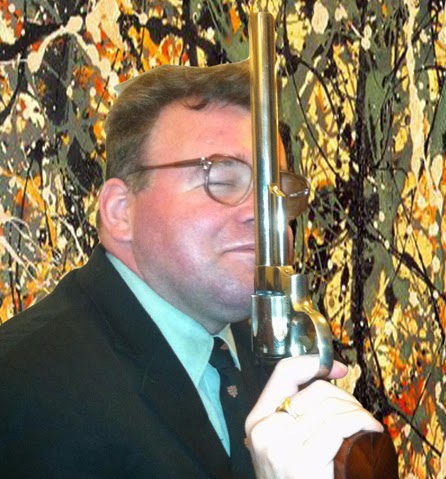
Talk of accents reminds me of another Bowden doppelganger, William S. Burroughs. As an American from the upper-middle class strata of the Midwest, Burroughs escaped some of this kind of regional bigotry.[1] Burroughs eventually developed his own now-legendary voice, a flat, nasal sneer that really “sold” his works when reading them live or on recordings.
Burroughs was remarkably different from Bowden in many other ways. His career as an author was overwhelmingly though improbably successful, from the moment in 1962 when Norman Mailer proclaimed him “the only American writer who may be conceivably possessed by genius” to late in life when he was inducted into the American Academy of Arts and Letters and designated a Commandeur of the French (of course) Ordre des Arts et des Lettres (he was buried with the pin, along with his favorite gun). As for the books themselves, none were actually “best sellers” and probably few were read, but Naked Lunch was at least infamous and became a sort of meme or signal of one’s hipness; literally “banned in Boston,” the resulting obscenity trial put an end to literary censorship in the USA. By the 80s he seemed to be everywhere: public readings eventually led to the man himself becoming a signal of hipness in movies, music videos and even network TV shows. As Casey Rae says, “Once you start looking, Burroughs is everywhere.” [2]
So, let’s look at Burroughs. Like Neville he would grow up to be tall but, like Bowden, not a matinee idol, though he was scrawny rather than portly.[3] He would never forget how friends of his parents would say things like “That boy is not healthy, he looks like a sheep-killing dog” or “He looks like a walking corpse.”[4]
His concerned parents send him to the John Burroughs (no relation) School in Los Alamos, New Mexico – a sort of Teddy Roosevelt-style boarding school /dude ranch for toughening up the sons of the upper classes who seemed destined to become pansies.[5] Needless to say, this did not transform Burroughs into a good member of the upper class, healthy in body and mind; he hated the school, what it stood for, and everyone in it (expect for a few boys he formed doomed attachments to).
However, it was at that school that his connection to New Thought, if not to Neville himself, is clear. Burroughs had already decided to become a writer, a decision he later described in a way that makes clear his ability to form an image of success and endow it with emotional warmth:
As a young child I wanted to be a writer because writers were rich and famous. They lounged around Singapore and Rangoon smoking opium in a yellow pongee silk suit. They sniffed cocaine in Mayfair and they penetrated forbidden swamps with a faithful native boy and lived in the native quarter of Tangier smoking hashish and languidly caressing a pet gazelle.[6]
One of his very first writing attempts was a contribution to the school literary journal: a parody of a review of a New Thought book, titled “Personal Magnetism,” in which he admits “I would like to control others at a glance (especially my Latin teacher).” This “desire to control others stemmed from an inability to fit in.”[7]
Much later, after developing the “cut up” technique, which often involved the works of others, from Kafka’s Trial to The International Hearld Tribune, Burroughs would assert that when two work together, a “third mind” arises. Burroughs acknowledged appropriating the idea of The Third Mind from popular New Thought writer Napoleon Hill, who in Think and Grow Rich described the Mastermind principle as: “No two minds ever come together without thereby creating a third, invisible intangible force, which may be likened to a third mind.” [8]
Becoming a writer and “fitting in” were related: rather than conform to society, Burroughs would craft a new identity for himself, even if it involved being a drug addict and sex tourist.[9]
In addition to the killing of [his wife, Jane] Vollmer, Burroughs’ criminal history included prescription forgery, petty theft, possession of narcotics, and simply being a gay man in America decades before Lawrence v. Texas, the landmark 2003 Supreme Court ruling that struck down the nation’s last remaining sodomy laws. In some ways his behavior can be seen as an attempt to transform himself into something other than an upper-middle-class nobody, even if the attention received was negative. [10]
It may or may not be surprising, but becoming a writer and crafting a new identity eventually merged in his mind.
Burroughs himself imagined growing up to be an author who lived in exotic locations and indulged strange vices. He claimed that the purpose of writing is “to make it happen,” and for him, it did.
Writing for Burroughs was essentially a form of magick, not unlike Neville’s method. This is easier to understand, if not accept, if we back up in order to consider the big picture. Casey Rae gives us a good synopsis of “the Burroughs worldview”:
In the Burroughs worldview, language is a mechanism of what the author called Control with a capital C: an insidious force that limits human freedom and potential.
Burroughs chafed at any restrictions on his personal desires, which he seems to have magnified into a paranoiac vision of absolute control. Burroughs gave this form in a recurring dream of a cop who would break into his room “when I was about to take a shot or go to bed with a boy” (Junky, p109). He was basically a Libertarian avant le lettre: pro-gun, pro-drug and pro-sodomy, anti-government – any government.[11] As he hopped from country to country in Europe or the Third World, his letters would start off ingenuously praising his new homeland for its hands-off approach and citizens who “mind their own business,” then, when they grew tired of tolerating the ex-pat and became increasingly intrusive and threatening (even the French tried to send him to jail on trumped-up drug smuggling charges), he would begin to denounce them as suddenly being “fascist” hellholes.
Bowden, of course, like anyone on the Right (unless one insists on classifying Libertarians as such) would have condemned all this as a perverse cultivation of personal weaknesses that are debilitating to the culture as a whole; [12] yet Bowden was able to study and make use of far worse people, such as Sade. What is valuable to the Right in Burroughs’ work is his analysis of the methods of Control, and how to evade or undo them. By generalizing his personal kinks into a somewhat paranoid rebellion against a vast, literally alien system of Control, his work became relevant to the rest of us and arguably is more relevant today than ever before.[13]
Additionally, this could also be an instance of what Dutton calls a “counter-intuitive” aspect of charisma or gaining a following: having an identifiable flaw – perhaps scrawny heroin addict or sex tourist – “allows ordinary people[14] to identify better with you and so bond more strongly with you.” From another angle, Dutton might place him among those who are seen to have “sacrificed the worldly so that he could dedicate himself to his research, his art and to promulgate his ideas.”
Anyway, language was the secret, as Neville taught that feeling was the secret. Since words – or The Word – is the virus of Control, by manipulating The Word the script can be re-written.
Burroughs saw reality as hostile, [but also] malleable, and [thus] possessed of hidden potential that could be actualized through a kind of occult media arts.
Words produce mental triggers that we can sometimes intuit but never entirely comprehend, making us highly susceptible to influence. But there’s an upside: language can also be used to liberate by short-circuiting preprogrammed ideas and associations. Burroughs believed humanity is held back by constraints imposed by hostile external forces that express themselves in our reality as various aspects of the Establishment. Using fragments of word, sound, and image, reordered and weaponized, Burroughs sought to dismantle Control and its systems.
There was a detour, though; Burroughs had recorded his passionate (unrequited) attachment to a fellow Los Alamos student, and panicked when he was sent home but left the diary behind. When it finally arrived home, unmolested, he swore off writing forever.
Ironically, this part of Burroughs life is heavy with another Bowden trait, biographical finagling – albeit mostly swallowed whole by his fans and biographers.[15] Say what you will about Miles Mathis, he does ask some pertinent questions about what we might call the “Early Life” section of the Burroughs Bio:
Burroughs’ bio is full of red flags…. We are told Burroughs was turned down by the Office of Strategic Services and the Navy in 1942, which means he applied to them both. Since he was a trust-fund boy, he didn’t need to be applying to either. The OSS is of course the precursor to the CIA. Notice that it doesn’t say he was turned down by all the Intelligence agencies he applied to in 1942. Say he applied to three and was turned down by two, his bio would read the same, wouldn’t it? To cover this, we get an absurd story. We are told Burroughs enlisted in 1942, was classified 1A, infantry not an officer, and that his mother then got him out by claiming mental instability. That would be terrible if it were true, since it would mean rich mothers can get their sons out of service at will, even after enlistment. But we know it isn’t true. The army doesn’t work like that. The more likely story is that Burroughs didn’t need to enlist because he had been accepted by some agency in Intelligence. He was probably on local assignment in 1943, doing set-up for some big project. He was stationed in New York, near Columbia, and worked as the recruiter there, we must assume. In 1944 he was already 30, so he was 8 years older than Kerouac and 11 years older than Ginsberg. He wasn’t a student at that time, being only a project coordinator. Yes, it looks very much like Burroughs was the Intelligence liaison in the beginning. He only got involved on the creative side later, when he saw how easy it was. That much is admitted in his bio, where they tell us that Kerouac and Ginsberg encouraged him to write, and seeing their methods, he realized it didn’t take much in the way of creativity or effort. You should also look skeptically at the amount of drugs he claimed to have done. Since he lived to 83, it is impossible that he was a heroin addict for more than fifty years. This is just one more indication that the drug use was a pose, to help sell drugs.[16]
Rae observes that the Lexington, KY clinic where Burroughs went through drug rehab in 1948 (as recounted in his first book, Junky) was a “top secret CIA facility” engaged in the now famous experiments with LSD. He takes Burroughs’ word that he wasn’t involved, so why mention it? Was Burroughs dosed, or was he doing the dosing? Or was that where he was first recruited? And what’s with his studying medicine in Vienna [17]and anthropology in Mexico[18]?
Yeah, I know Miles Mathis thinks everyone is an intel agent, but his take on Burroughs – who liked to write himself into his books as “Agent Lee”– as a (real) agent is at least worth considering.[19] But it’s more likely that Burroughs, like Bowden, just felt the need to create a more “interesting” persona than “guy living off an allowance from sorta rich parents.”
Being, or at least perceiving himself as, homely and uninteresting,[20] Burroughs needed to work on what we might call today his “game,” which he called “routines.” This genre is now so well known that it even has its own TVTropes entry:
Burroughs’s “routines”, as he called them, are the literary equivalent to a depraved vaudeville act, or by modern sensibility, a raunchy sketch show. Utilizing over-the-top characterization and hilariously opaque scenarios, [routines] can change scenes at the drop of the hat, jumping from short, punchy hilarity to weird sex back to short, punchy hilarity.
Rae fills in more of the theoretical and personal background, saying that routines are:
[…]a form of playacting that often featured characters and situations that would later turn up in his work. He was obsessed with capturing these routines, which he saw as a potent means of making things happen in the real world. They were a way to record his fantasies, obsessions, and animosities —the cornerstones of his work—when no other means were available. Also, they were great fun. [21]
And, he adds, Burroughs “liked to rope his friends into routines,” since, though not above making use of rent boys, he continued to obsess over men who were straight or otherwise simply not interested. Allen Ginsberg was one of the latter, and while discussing Ginsberg’s (ultimately futile) attempts to sell what would appear in 1985 as the novella Queer, his discusses the origin of two of the routines in the book:
He told Allen, “The Oil-Man and Slave Trader routines are not intended as inverted parody sketches […] but as a means to make contact with Allerton and to interest him. The Slave Trader routine came to me like dictated. It was the turning point where my partial success was assured. If I had not achieved the reckless gaiety that charges this fantasy, Marker would have refused to go with me to S.A. The point is these fantasies are a vital part of the whole set-up.”[22]
Originating as IRL seduction props, Burroughs eventually began including them in correspondence, seductive or not, and – when he began writing again, at the encouragement of his new young friends, Allen Ginsberg and Jack Kerouac – they formed the backbone of his fiction.
By the late 1950s, literary magazines were much on Burroughs’ mind. He was no longer satisfied with publishing his numerous routines in letters to Allen Ginsberg. Naked Lunch began to take shape as a novel and Burroughs sought a larger audience. [23]
Routines provide some of the funniest and most remembered sections of Naked Lunch; perhaps the most famous/infamous being the various adventures of the incompetent and irrepressible Dr. Benway, and “The Talking Asshole.”[24]
Interestingly, Oliver Harris suggests that the latter routine is itself a meta-routine, illustrating the shamanic dimension of Burroughs’ compositional methods:
As the original epistolary context makes clear, the routine had instead to do with Burroughs’ control over his own writing. In his letter of February 7 1955 (curiously, Burroughs misdated it 1954), the routine is framed first by Burroughs’ description of how he “smokes some tea” and sits down “and out it comes all in one piece like a glob of spit” — note the echoes of Kerouac’s account in Desolation Angels — and afterwards by the commentary: “It’s almost like automatic writing produced by a hostile, independent entity.”
In any event, these oral performances are the closest analog to Bowden’s stage performances, and they also resemble Neville’s Method – imagining a scene and imbuing it with emotion (in this case, sexual interest). However, Burroughs’ later books would reflect a more formal or mechanical Simple Method for Changing the Future: the cut-up technique.
Burroughs gives a simple explanation of the method: “[The] cut-up method consists of cutting up pages of text and re-arranging them in montage combinations.”[25]
Notes
[1] Although he attended Harvard and majored in English Literature, he later disparaged it as “a fake English set up taken over by the graduates of fake English public schools” (Junky, Prologue) and although living in London for some years, described it, on moving to New York, as “dead.”
[2] Casey Rae, William S. Burroughs and the Cult of Rock ‘N’ Roll (University of Texas Press 2019), p.6. Rae documents Burroughs incredible influence on just about every genre of popular (and unpopular) music (despite being himself a “jazz age relic” who listened to 78s on a windup victrola). He also notes how many artists and musicians have mentioned reading Naked Lunch as teenagers, even in some cases being given the book by a schoolteacher or therapist. For a rare critical trashing of the book and its influence on youth see Stefan Beck, “The Immortal Awfulness of ‘Naked Lunch’.”
[3] Burroughs has been lucky in his cinematic versions, being played by Peter Weller in Naked Lunch (Cronenberg, 1991) and more recently Daniel Craig in Queer (Guadagnino, 2024).
[4] Years later, hearing of the woman’s death, he sneered “Well, not every corpse can walk.” You can hear the whole “routine” (as we’ll soon discuss) here. The “conventional middle class” parents of schoolboy Bowden’s best friend were similarly appalled when meeting him, but clearly for good reasons, as Dutton tells the story on pp.116-17: he “had no manners” and “was just rude” as his friend recalls.
[5] The school was later requisitioned by the US War Department and became the site of the Manhattan Project, which Burroughs thought appropriate.
[6] “The Name is Burroughs” in The Adding Machine: Selected Essays (Calder, 1990) reprinted in Word Virus: The William S. Burroughs Reader (Grove/Atlantic, 2007), p.16.
[7] Rae, op. cit., p.54.
[8] See Mitch Horowitz, The Power of the Master Mind (New York: G & L Media, 2019).
[9] “Billy hates his own identity, you see, and he thinks that makes him a transsexual. But his pathology
is a thousand times more savage and more terrifying.” Silence of the Lambs (Demme, 1991).
[10] Rae, op. cit., p39.
[11] “Like Rousseau, there is inherently in Burroughs work a romantic historicism that years for an ideal past, a Garden of Eden where man was once free and innocent and did naturally all those things that are called sinful, immoral or illegal.” John Calder, A William Burroughs Reader (Picador, 1982, p201). All? Dutton quotes Eric Galati, a fellow member of the Spinning Top Club, to show that even as late as the early 2000s Bowden was “essentially a Libertarian” except for his dislike of homosexuality, where he parts from Burroughs again. In Naked Lunch, citizens demand the death penalty for various offenses, including “death for the psychopath who offends the cowed and graceless flesh with broken animal innocence of lithe movement,”
[12] And of course, the individual himself. “Burroughs did not have a happy life,” Miles writes, and he quotes from the author’s Last Words: “You never loved anybody except your cats, your Ruski and Spooner and Calico…. Mother, Dad, Mort, Billy—I failed them all.” Nesbitt adds: “Burroughs acknowledges failing his mother, father, brother and son, but not [his wife] Joan. He places more emotional emphasis on and directs more feelings of regret to a cat he gave away than to the wife he shot and killed. … By not acknowledging Joan, he does not bring her into being on the page. He strikes her from the record and coverts her from death to non-existence and erases her.” (“William S. Burroughs and the Shooting of Joan Vollmer: Burroughs as Performance,” in Beat Drama: Playwrights and Performances of the ‘Howl’ Generation [Bloomsbury Methuen Drama, 2016]).
[13] Dutton postulates a “genius strategy” in which “the group, by brooking genius, can come to dominate more ethnocentric groups…. Armed with their inventions, the genius-strategy group can dominate them, as long as its level of eccentricity does not fall too low.” Rae’s book might suggest that Burroughs’ influence is too vast; given the number of musicians and writers who brag about reading Naked Lunch as teenagers, something might be said for the “obscenity” laws it did so much to cancel.
[14] The chapter entitled “ordinary men and women” [sic] in Naked Lunch indicates that Burroughs had precious little interest in such.
[15] Stefan Beck describes Barry Miles’ huge and hopefully definitive biography as “hilariously credulous.”
[16] Rae quotes Bowie marveling how “you can’t meet an ostensibly healthier, fitter older guy.”
[17] Rae simply tells us “He decided to enroll in medical school … even though he had none of the traditional prerequisites.” As one does. A page later, he quits, because he was “doing terribly” (quelle surprise!) and wanted to return home, bringing “a hip Jewish woman” with him, marrying her to allow her to emigrate to the USA; as one does.
[18] One of the instructors at Mexico City College was Robert Barlow, Lovecraft’s pen-pal and executor, who was driven out of the weird fiction world by rivals August Derleth and Donald Wandrei, the empresarios behind Arkham House and took up anthropology. Paul La Farge wonders if the telepathic Mayan priests in Burroughs’ book came from weird writer-Mayan scholar Barlow, but all Burroughs said about him is in a letter to Ginsberg: “A queer Professor from K.C., Mo., head of the Anthropology dept. here at M.C.C. where I collect my $75 per month, knocked himself off a few days ago with overdose of goof balls. Vomit all over the bed…. I can’t see this suicide kick.” La Farge seems to think the monthly payment came from the GI Bill, but that must have been his allowance, since, as we saw, Burroughs was never in the Army. I discuss this in Part Three of “A Nice Place to Visit: Lovecraft as the Original Midnight Rambler.”
[19] Burroughs is explicitly portrayed as an agent of some sort in Cronenberg’s Naked Lunch, and in Queer he’s portrayed by 007 himself, Daniel Craig.
[20] “Sick people disgust me already. When some citizen start telling me about his cancer of the prostate or his rotting septum make with that purulent discharge I tell him: ‘You think I am innarested to hear about your horrible old condition? I am not innarested at all.’” NL, 50th Anniversary: The Restored Text, ed. James Grauerholz and Barry Miles (London: Fourth Estate, 2009), p. 103.
[21] Routines would, in a Naked Lunch– kinda way, mutate into Hunter Thompson’s “Gonzo” journalism. Wills writes about Thompson: “Although he seldom mentioned Burroughs, one can easily see the influence of Naked Lunch in his writing from the sixties onwards. Burroughs’ disturbing ‘routines’ morphed into Thompson’s oddball flights of fancy — sudden rushes of violent but hilarious action and dialogue that went very much over the heads of most readers.” And again: “Like William S. Burroughs, he could concoct almost unimaginable scenes and present the grisliest details with a dry, black humor.” See Part Two of my review, here.
[22] Barry Miles, Call Me Burroughs: A Life (Twelve, 2015).
[23] Jed Birmingham Reports on Burroughs Collecting.”
[24] Here’s Frank Zappa, filling in for Keith Richards, reading this routine at the Nova Convention in 1978; here’s Steve Buscemi doing it in 2014.
[25] “The Fall of Art”, in The Adding Machine, op. cit., p.61
5 comments
When he was beginning to explore the Avant Garde Paul McCartney befriended Burroughs who taught him about the occult, Aleister Crowley, backmasking, and sound collage. To return the favor Paul put him the cover of Sgt Peppers.
No fair, you read ahead of the class!
Burroughs lifted his oratorical stylings from W. C. Fields. Just compare them and you’ll see.
In his novella Franny and Zooey JD Salinger refers to WC Fields as a “holy man.” Fields also made it on the cover of Sgt Peppers, between Stockhausen and Jung.
BTW: what do the oratorical stylings of Burroughs and Fields consist of? I am familiar with neither.
Comments are closed.
If you have a Subscriber access,
simply login first to see your comment auto-approved.
Note on comments privacy & moderation
Your email is never published nor shared.
Comments are moderated. If you don't see your comment, please be patient. If approved, it will appear here soon. Do not post your comment a second time.