3,356 words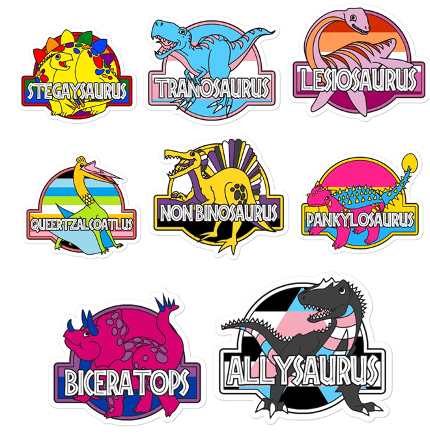
Annual “Turn Everyone Gay” month has returned once again to colonize our entire public sphere and turn it queer, with everything from giraffes to the moon now being acclaimed as being spuriously homosexual somehow, a process with no apparent outer limits. Noticing that 1 June marked not only the beginning of Pride Month, but also the date of an equally made-up international occasion of supposed public celebration called “Dinosaur Day“, I was led to wonder: are dinosaurs gay now too? Indeed they are. Alarmingly so, in fact. As queers can’t breed, maybe that’s the real reason they went extinct in the first place?
Jurassic Has an Ass In It
England’s Jurassic Coast, whose chalky cliffs revealed numerous prehistoric fossils to nineteenth-century hunters of natural curiosities, was where the whole business of scientific dinosaur knowledge first truly began in the first place. One of the seaside towns which lies along its path is Exmouth, where a “Dinosaur Trail“ has today been created to attract tourists and their children, full of life-size model saurians and other such appealing novelties.
Yet Exmouth is also the natural habitat of an equally queer species known as “homosexuals”, who organize annual Queer Trails of their own throughout the Holy Month of June, under the banner of “Exmouth Pride”. For 2025, the organizers have adopted a new, kid-friendly and locally relevant gay mascot for their event in the shape of a sauropod dinosaur polluted with the colors of the Pride Flag, inviting infant attendees to enter a competition to name the beast. I’d suggest “Trannysaurus Rex”, but T-Rex was not a sauropod, and anyway there is already a “real” exhibit of a skeletal transgender T-Rex called Sue in a museum in Chicago (see my article here).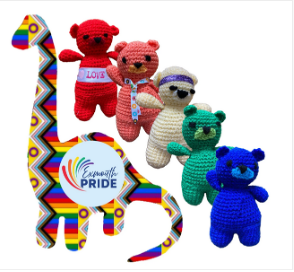 Other potential options for christening the bent brontosaur may include the following, now available as fashionable pin-badges and t-shirt logos from the online Pridosaurs company:
Strictly speaking, plesiosaurs and pterosaurs like Plesiosaurus and Quetzalcoatlus aren’t actually dinosaurs at all, but that probably isn’t the most biologically inaccurate aspect of this whole thing.
This summer also sees the return of the long-running Jurassic Park franchise, with Jurassic World: Rebirth hitting cinema screens soon. No word as of yet as to whether the “Rebirth” of the title specifically refers to a male Stegaysuarus transitioning into becoming a female Nonbinosuarus, but this may in fact be possible. Viewers of the original film in the interminable franchise (you know, the actual good one) may recall that all the dinosaurs locked inside the island theme-park were genetically engineered to be female, but that the Velociraptors spontaneously switched sex, like certain reptiles (but not humans!) can genuinely do in real-life, thus allowing them to reproduce without the knowledge of their zoo-keepers. This, says the Gay Internet, makes them trans icons: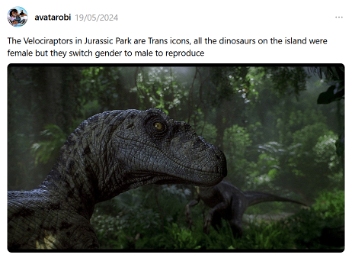
Perhaps it is no surprise that the Netflix Jurassic Franchise spin-off kids” cartoon Camp Cretaceous featured a storyline about an interracial lesbian relationship back in 2022. I await Netflix’s next queered kids” series The Flintstones: Stabba-Stabba-Poo! with appalled anticipation. (The show’s old theme tune did famously promise viewers would “have a gay old time”.)
Even the actual website of the Smithsonian Museum now features an image of what appears to be gay dinosaurs bumming one another, taken from a display in a Spanish museum.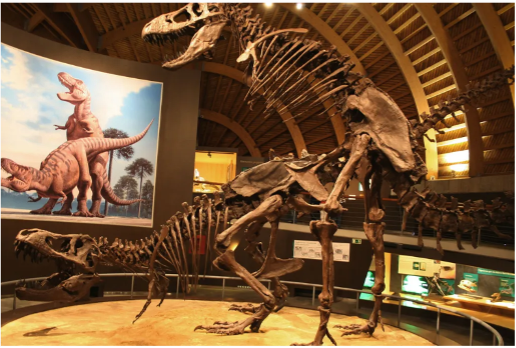
Dinosaurs have now quite definitely been adopted as outright queer icons amongst the LGBTQ faction. Bizarre, dino-related t-shirts and postcards like the following are easily available as Pride presents for the fanatical rainbow-cultist in YOUR life: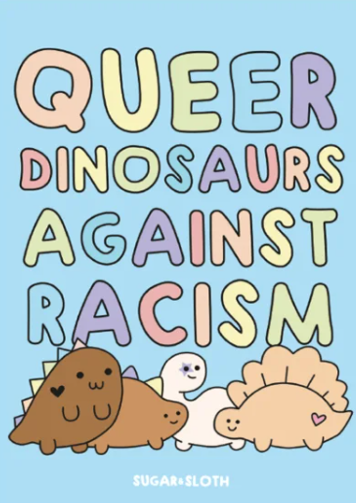
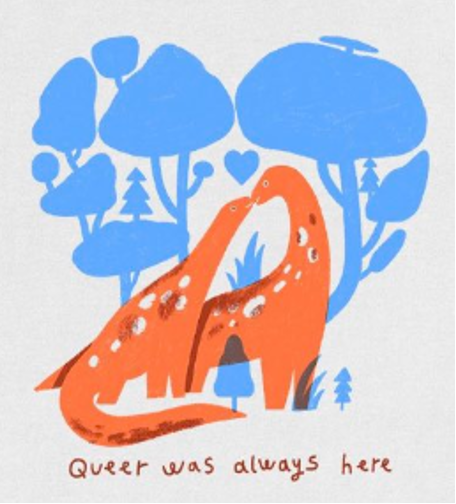
Sore-Arse-Saurus
Where did this all this stuff come from? One possible answer lies in an event from September 2001, when left-wing UK Labour Party politician David Lammy called those members of his own party and the general British public who didn’t support trans rights quite as much as he did “dinosaurs” (Lammy is so anatomically unaware, he once famously claimed it was possible for men to grow a cervix – he’s thinking of fictional CGI-animated Velociraptors).
Rather than being offended by this, trans-skeptics in the UK began dressing in inflatable dinosaur costumes at their rallies, and appending dinosaur emojis to their tweets and social media profiles, embracing Lammy’s insult as an emblem of their own proudly old-fashioned views on the subject of what men and women really were – the truth, they implied, would never become extinct or go out of date, no matter what cervix-confused cretins like Lammy said.
Irritated, online pro-trans voices now began pretending that dinosaurs had always been theirs, not that of the gender-critical “TERFs” (“Trans-Exclusionary Radical Feminists”, i.e., normal women), and that dinosaurs were somehow inherently gay. They had evolved into birds, for example, which was analogous to men evolving into women, thus making intermediate dinosaur-bird hybrids like archaeopteryx the transgender Dylan Mulvaneys of the queer dinosaur world. Hence, stickers like these now started appearing: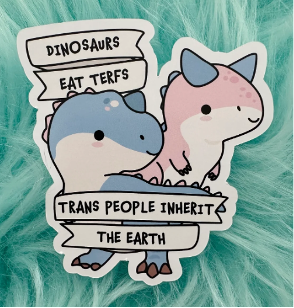
Things got so pathetic that the woman who had first successfully proposed the creation of dinosaur emojis, a writer of historical chick-lit romance novels called Courtney Milan, now suddenly announced that, as she had “invented” the relevant symbols, she got to determine the dinosaurs” gender. And, in her expert opinion, they were all trannies, thus making the TERFs who used them online wrong. Courtney made no mention of this idea in her original submission to have the emojis officially registered, but that was what she was saying now: and, just like when a queer woman says she is magically now a queer man, even though she never was one before, Courtney’s altered perception had automatically to pass as being the final truth upon the matter. Dinosaurs were now inherently queer. Emojis said so.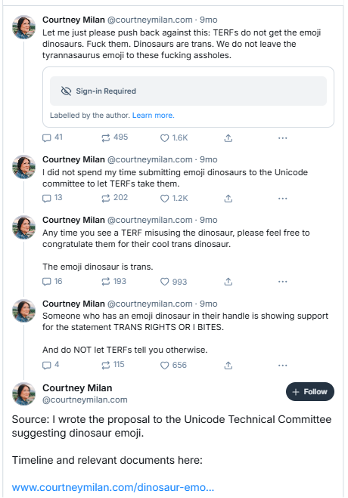
At least Courtney Milan was just a romance novel author, though. Rather more academically qualified to pronounce that dinosaurs are queer is a prominent paleontologist with a blooming media career called Riley Black – or Brian Switek to use his “dead name”, for Riley is a male-to-female transsexual, with all the necessary hormone prescriptions and medical certificates to prove it, though not necessarily the actual genitalia yet.
“Dinosaurs are ours,” Riley has proclaimed, and has spent much of the past five or so years trying his or her best to prove it. Disturbingly, esteemed and prominent scientific organizations like the Smithsonian Institute and Science magazine have been falling over themselves to help Riley out in this queer quest. Maybe they just want to be seen as being good Allysauruses too?
The Life of Riley
Riley was employed as the on-set “resident paleontologist” for the 2015 film Jurassic World, and, under one name or another, is the author of books aimed at a general mass-market, like The Last Days of the Dinosaurs, which is probably about how the creatures all died out from HIV-AIDS 150 million years ago (a genuine fringe scientific theory), and My Beloved Brontosaurus, which I can only assume is about how they all caught it in the first place. Yet, after coming out as trans, Riley has also begun self-publishing online essays of a more overtly pink and social justice-related kind, with titles like “Yes It’s Wrong to Tell Trans People You Don’t Want to Sleep With Them Because of Their Genitals“, “If You’re Going to Try Anal, Don’t Rush It“, “Riley Tries Sex Stuff: She’s Nervous About Blowjobs“ and “Riley Tries Sex Stuff: She’s Nervous About Pup Play“.
The real problem is, these same broad queer-related subjects seem to have begun to inevitably bleed into the more formal papers Black gets published in proper scientific journals and magazines. If Professor Richard Dawkins submitted an article to Nature called “Why I Love Big Tits: The Evolutionary Pressures Driving Increased Female Breast Size and How They Make Me Very Happy”, do you think they”d let him publish it?
Black is a genuine, fully certified bone-handler, who does write articles about wholly normal paleontology-related topics. But, alongside all these, you also get volumes of stuff like “We Finally Know What a Dinosaur”s Butthole Looks Like”. Here, we learn that, “For the entirety of my career as a journalist covering paleontology, I”ve been wanting to know: What does a dinosaur’s butthole look like?” There then follows a report of some legitimate academic findings that dinosaurs “had buttholes like those of crocodiles” resembling a “blackish mottled ovoid area”, which were essentially cloacas; fused combinations of the genitals and anus through which urine, feces and sperm/eggs are voided or processed.
Yet, Riley is eager to point out, in crocodiles, the cloaca seems a little … well, transgender in nature: “the penis in this setup extends out of the [cloacal] butthole during mating … In crocodiles the female’s clitoris is so large and pronounced that the pink, tapering organs can easily be confused for the male’s penis.” Is the setup similar for Riley himself, one may be led to wonder? For Black, the whole issue is a wonderful mystery to be celebrated: “For all the CGI renderings, toys, and even erotic imaginings of dinosaurs, [a reference to dinosaur porn online] so much of their basic biology – from body-temperature to differences between dinosaur sexes and even what sounds they made – remains unknown.”
But why do such things remain still unknown? Probably because most paleontologists who historically studied dinosaurs were really pale-eontologists: white, heterosexual, cisgender males, who abused their privilege to ignore the probable truth about transgender dinosaurs. Consider Riley’s essay “Why Did Scientists Wait So Long to Study the Snake Clitoris?“, published in no less a (sexual) organ than The Smithsonian Magazine in 2023, which bemoaned how “Female and intersex animals are understudied compared with their male counterparts”, because of rampant white cisheteronormative bigotry. Female humans often complain men cannot find their clitorises, and if you happen to be a female or female-identifying snake, it turns out the situation is even worse, with said item only having been discovered as late as 2022 by a team led by a sexually open-minded lady snake-handler.
The idea snakes can’t be transgender is only part of a wider spectrum of homophobic scientific ignorance, and “Human biology isn”t immune from such misapprehensions either”, as “Many ideas about our own bodies that are treated as common knowledge actually have more to do with sexist cultural projections than reality”. Therefore, “Mistakes and misunderstandings about the lives of other species are often reflections of what we don’t yet comprehend about ourselves.”
This leads to an inevitable call for more trannies, queers, blacks, Muslims, etc, to be allowed into pale-eontology, on the grounds that “The greater the diversity of scientists, the better society en masse can ascertain whether something is real or a mirage.” And the biggest mirage of all, of course, is that of biological sex. “Stop Using “Female” as a Synonym for Woman“, runs the title of one of Riley’s articles. “Stop Trying to Out-Science Transphobes“, orders the title of another. “Trans rights are not a scientific issue,” Black argues here. “They are a human rights issue.” The first sentence there is certainly correct.
Yet another piece, “Creatures of Possibility“, talks about fish and crocodiles changing sex, Jurassic Park-style, concluding that “Perhaps penis and vagina will always be treated as sex-based opposites in pop-culture, but biologically they are really different arrangements of the same parts.” Just let that statement sink in: penises and vaginas are only different “in pop-culture”. And all this, just to remind you, is coming from someone who purports to be a scientist.
T-Rex Goes T-Sex
Diversity is now all that truly matters about the paleontology of the future. There have been recent calls from the queer lobby for Indiana Jones to be reimagined as a homo, and in his piece “It”s Time for the Heroic Male Paleontologist Trope to Go Extinct“, Riley would seem to agree. Whilst conceding that “there’s nothing wrong with a little Indiana Jones cosplay”, the image of a lone, male, hyper-hetero bone-excavating genius modelled after Indy is “demonstrably false” and “underscores paleontology’s deeply rooted problem with male privilege”, as “The image of who a paleontologist is has long been definitively male, pale, and dust-coated, never without his trusty broad-brimmed hat”, though Black may well like his bondage-whip.
Even the dinosaurs that straight white scientists discovered were problematically straight, white and male too, rather than black and lesbian, as argued in Black’s 2022 article “Give T-Rex a Rest!“. In Black’s world, the man who really should have discovered T-Rex was Marc Bolan, great fan as he was of prancing around wearing make-up and glitter, but unfortunately in reality it was discovered by “The notoriously cantankerous and racist paleontologist Henry Fairfield Osborn” in 1905, an evil white man who believed in the progressive evolution of both dinosaurs and the different human races. Historically, pale, male, stale Nazis like Osborn falsely pushed the image of dinosaurs like T-Rex to us as walking prehistoric embodiments of toxic masculinity, an image which could well be totally wrong. Just as male scientists lied to us that snakes didn’t have clits, how do we know that they didn’t lie to us about T-Rex not being shy and sensitive too? Argues Riley:
In both the commercial market and paleontology, whether academically backed or self-styled, it”s primarily white cisgender men who sell T-Rex to us. The dinosaur, even when carrying nonbinary pronouns … inevitably bears a masculine gloss, thanks to so many decades of fearsome pop-culture portrayals and the fact that it”s almost always men who step forward as the prime interpreters of T-Rex biology. In a sense, T-Rex is a symbol of toxic masculinity—a dinosaur molded by over a century of male-dominated interpretation with an emphasis on bone-crushing bites and wild power, one that edges out so many other interpretations of what it meant to be a dinosaur. To discover, name, buy, or sell T-Rex is about displaying power, exerting control over an animal that—we are breathlessly told—could gobble us up in a few bites.
That’s precisely the kind of penetrating, queer perception which dictates that the halls of academe must be opened up to more diverse outlooks like those of Riley post-haste.
And, in his capacity as a book-reviewer, woe betide any author who decides to write a book about dinosaurs which is actually about dinosaurs, as opposed to lesbian Muslims or something. In 2021, Black was asked to review a new popular science book by the knowledgeable white male pale-eontologist Darren Naish, called Dinopedia, for one of world’s most prestigious journals, Science. Here, Riley admitted all the content about dinosaurs was actually pretty good, but this kind of trivia no longer really mattered. Instead, the review (illustrated by Science with a close-up photo of a lovely brown woman in a hijab polishing a bone) focused upon more important matters like these:
Dinosaurs garner esteem that is often reflected onto the people who search for, excavate and study them, and therein lies a fundamental problem with the ever-increasing number of popular tomes about the “terrible lizards” hitting bookshelves. Even as the field of vertebrate paleontology pushes to become more inclusive, personages from decades past remain the only experts many members of the public encounter. Although there is a trove of dinosaurian information to recommend paleontologist Darren Naish’s short encyclopedia Dinopedia, it does little to correct this antiquated view of who is, or can be, a paleontologist … the book offers a view of modern dinosaur scientists that is practically petrified … Naish includes profiles of a handful of paleontologists: Robert Bakker, Jack Horner, Halszka Osmólska, John Ostrom, Richard Owen, Greg Paul, and Paul Sereno. These figures were indeed pivotal in the dinosaur debates and discussions of the late 20th century, but Naish’s decision to focus on them, rather than on contemporary paleontologists, makes the book feel decades out of date rather than representative of modern dinosaur studies. Aside from the gender imbalance, non-white scientists and researchers from the Global South are given short shrift.
The rough translation of all that would seem to be “How disappointing! This book is all about dinosaurs, not diversity!” If most of the early running in the field was performed by white men (Turok the Dinosaur-Hunter and the nineteenth-century female English fossil-collector Mary Anning apart – although she’s now a lesbian, apparently, at least according to a dubious recent movie) what was Naish supposed to do, precisely? Lie, and say Robert Mugabe discovered Triceratops?
Geological Periods
A handy guide to what kind of content Riley is really looking for in future books provided for review can be found in his piece “5 Books on Queer Nature“, where Joan Roughgarden’s text Evolution’s Rainbow: Diversity, Gender and Sexuality in Nature and People wins praise for demonstrating how, like the queer Velociraptors in Jurassic Park, some reptiles possess a sexual dimorphism which “is dependent on temperature rather than genes”, whilst Aisha Sabatini Sloan, writing as a queer black Alaskan, is commended for her profound insights into what happens when “the overlays of race, gender, orientation, and other facets of identity” are placed upon inanimate glacial landscape features.
Even better, “Callum Angus’s fantastical story collection, A Natural History of Transition, uses fiction to explore the depth and sweep of change over scales that go far beyond gender, ranging from the seasonal to the geological. If bodily transition can alter our biological sex, as Angus explores in “Rock Jenny”, what would it be like to transition further into a rock, a mountain, or a moon?” If that’s the kind of thing you want, why not just read Ovid’s Metamorphoses? Probably because it doesn’t feature words like “genderqueer”.
In his 2023 piece “Unearthing Queer Joy“, Black projects such fictional techniques directly onto the field of factual nature, trying to “strip away the traditionally cisgender and straight overlays [science has placed] on nature” by “bringing our whole bodies to the endeavor”. In practice, this seems to mean pretending the Earth is a giant tranny too, whilst out in the field digging for skeletons:
The desert is the place where I learned that even stone changes, given enough time; the Earth reworked through transition just as I have been. When I see a wall of sandstone slowly being buffed by the wind or a hillside of broken, lichen-covered boulders that fell before I was even born, I can’t help but happily ask “What will you become?” My blood, sweat, and tears have all spattered the stone, but I keep returning because of the lively vibration between my body and the ever-changing rock.
What a load of coprolites. What must it be like to actually go out on a field-dig with such a person? A complete nightmare, it sounds like.
In a 2021 account of “misgendering in the backcountry”, “Don’t Let Them See You Cry“, whilst out on a scientific expedition “among the rainbow colored rocks I had come to love”, Riley writes heart-wrenchingly about having being moved to tears by being misgendered as a man by several insensitive cisgender male members of the expedition, “especially when I did anything like lift a heavy object”, finding solace in the fact that at least the passing cattle, unlike the more prejudiced humans, “were silent and incapable, so far as science can tell, of transphobia.”
What was wrong with Riley here? Why was he feeling so vulnerable and teary and in love with wandering cows all of a sudden? Abruptly, the horrible truth hit home: “I wasn’t just upset, I realized, but I’d been having my first period in a place where half the expedition didn’t even see me as a woman.” Once again, I would just like to emphasize: this is supposed to be a scientist talking here.
Everything ended happily ever after for Riley in the end, though, as it turned out there were plenty of other real women present on-site too, who broke out the tampons and welcomed Black into their pheromone-soaked fold, where they all “talked and laughed about periods, pregnancy and the sorts of feminine discourse often deemed impolite in mixed company.” Did you not all talk about dinosaurs and trilobites, then, as may have been expected of scientists engaged in what was supposed to be a field-expedition in search of the ancient remains of such creatures?
It appears this is what the study of dinosaurs has now become for some of the more obsessive elements of today’s queer crowd: in-depth studies not of dinosaurs, but of themselves.
14 comments
This identification of dinosaurs with the LGBTQ agenda is a meta-cultural tactic. Kids love dinosaurs. Re-signifying them with ideological weight creates an emotional Trojan horse. But the maneuver is so obvious, it risks incurring cultural blowback, as even the oblivious may sense the manipulation. To borrow from clandestine parlance: the operation risks exposure.
That’s exactly what I was thinking, especially with the cutesy cartoons. Even so, they’re not trying too hard to hide their intentions these days.
They are leaning into a stereotype a little too heavily. Rip Taylor once did that on late night tv and he was genuinely funny. He never proselytized.
We get it: Same sex attraction exists in nature for some reason. Maybe as a check on overpopulation. Did the socially repressive force that once existed maintain the eco-balance?
Great article. Simultaneously hilarious and sickening.
I had to scroll up to check that I wasn’t reading Jim Goad. Very witty article!
Very witty & hilarious. Thank you for making me laugh at all the froot loopiness.
There are some very sick puppies out there; I made it half way through, and had to stop. 🙃
I agree, Pete. How the bloody hell do you make dinosaurs homo?
As my old man used to say, ‘Christallbloodymighty!’.
Noticing that 1 June marked not only the beginning of Pride Month, but also the date of an equally made-up international occasion of supposed public celebration called “Dinosaur Day“, I was led to wonder: are dinosaurs gay now too? Indeed they are. Alarmingly so, in fact.
The LGBT movement has coopted a lot of cute, innocent symbols. Frogs are a popular icon in the community and there are even, “gay frog coloring books.” This was partially a response to Alex Jones’s viral video about frogs “turning gay” due to pesticides.
Irritated, online pro-trans voices now began pretending that dinosaurs had always been theirs, not that of the gender-critical “TERFs” (“Trans-Exclusionary Radical Feminists”, i.e., normal women), and that dinosaurs were somehow inherently gay.
Terfs are the boogeyman of transwomen, for a whole host of reasons. Most transwomen are “transbians” or “bisexuals,” and Terfs (who are often lesbians) refuse to have anything to do with them. They resent that. There’s also a strong tendency towards severe narcissism among autosexuals. The book You Told Me You Were Different contains multiple examples of extremely selfish and unhinged MTFs:
https://archive.org/details/kitty-robinson-you-told-me-you-were-different-an-anthology-of-harm-ugly-truths-p?
Sometimes similarly selfish behaviors pop up in biological women with autosexual tendencies.
Autosexuals often have more symptoms of narcissism and porn addiction than the dysmorphia-like feelings that most associate with gender dysphoria (those feelings are a real phenomenon, but most AGPs and autohomoerotic types just really want to be the opposite sex for erotic reasons – hence the creation of terms like ‘gender euphoria’ and the demand that other people play along).
What was wrong with Riley here? Why was he feeling so vulnerable and teary and in love with wandering cows all of a sudden? Abruptly, the horrible truth hit home: “I wasn’t just upset, I realized, but I’d been having my first period in a place where half the expedition didn’t even see me as a woman.” Once again, I would just like to emphasize: this is supposed to be a scientist talking here.
AGPs love to pretend they have periods. Some have erotic fantasies about it:
Blanchard observed autogynephilic natal male individuals who were aroused, for example, at the ideas of using a tampon for menses
https://alicedreger.com/autogyn/
There’s a whole host of evidence autosexuals tend to have multiple paraphilias.
No Megasaurass?
“Load of coprolites” – good one!
Anyway, giraffes have been gay since 1950.
My head hurts. There is not one fucking thing they can’t leave alone and not corrupt. Not one goddamn thing…
Years later, I find that that Perry Bible Fellowship comic WASN’T from his twisted mind…
https://pbfcomics.com/comics/one-time-thing/
Thanks, I guess.
And don’t forget cats! A certain brand of cat treats (Temptations) last year put out an entire display for, as the author phrases it, the “Holy Month of June”. It had the typical rainbows, along with festive, winged, cartoon cats dressed in pink tutus, soaring about the display, advertising a special “rainbow” pouch of treats for the occasion. The messaging urged: “Pride”, “Celebration”, “Joy”, and of course, “Love is Love”. While preaching tolerance to kitties hooked on cat treats (and their human slaves who purchase them), the display also darkly suggested that the goal of all this is to (actual words) “eradicate hate”. As I now longer go inside of WalMart to shop, I don’t know if it was used again this year. Maybe it got some negative pushback.
Comments are closed.
If you have a Subscriber access,
simply login first to see your comment auto-approved.
Note on comments privacy & moderation
Your email is never published nor shared.
Comments are moderated. If you don't see your comment, please be patient. If approved, it will appear here soon. Do not post your comment a second time.