2,374 words 
In Part 1 we discussed the goals of true protectionists; now our task becomes defining true protectionism and proving that it is a correct means to those ends. With that mind, let me start out by answering the question what is true protectionism and how does it work? To answer both parts at once, true protectionism is an economic nationalist policy designed to maximize capital accumulation (and thus wealth) per capita by using tariffs to equalize labor costs between the economies of your country and those you trade with.
First, we ought to ask, what is an economy?
To put it briefly, it is nothing more and nothing less than the sum of the activities of those who engage in or otherwise effect (for good or ill) economic activity at any level–hence, you can talk about the local economy, the state economy, the national economy, or the world economy.
What determines the strength or prosperity of an economy at any level? Basically, three things: the amount of natural resources commanded by those who make up the economy; the amount of economically useful capital per capita (that is, the amount of useful machines, tools etc., that make labor more productive which are available for workers in the economy to use) that they command; and the state of technology. I say command rather than own, as an imperial economy (such as that of Ancient Rome) or quasi-imperial one (such as, unfortunately, the US under the petrodollar, if not earlier) can strengthen itself by making other economic zones (be those nations, tribal areas, or other types) offers they can’t refuse. I specify economically useful since an asset may not always be a positive economic contribution: for example, an old steam shovel might increase a person’s productivity relative to using a spade, but if it uses three times as much fuel to move one-fourth the earth as a newer model that’s readily available for about the same price as it would cost to keep the old model running, it’s not an asset to the economy; and I say the state of technology since technology can be an economic force multiplier, allowing for superior capital designs that allow the same amount of resources to be made even more productive.
The last two, in turn, are heavily dependent on three more factors, those being the economy’s rate of savings, its level of human capital, and its cultural institutions: that is, how many resources (including human labor) its participants are willing to forgo as consumers’ goods so that they can be transferred to the production of producers’ goods (i.e., capital); the average intelligence, drive, sociability, and conscientiousness of those participants (for which average IQ/STEM numbers per capita can serve as a proxy); and the cultural, legal, and political institutions and the degree to which they allow the population to unleash its natural potential or hamper it from doing so. So, other things being equal, the smarter and more honest and frugal a nation’s population is, the more powerful its economy is going to be, especially if it has beneficial barriers to keep it from diluting that power by harmfully mixing with another, lesser economy.
I know that sounds a bit odd so let me explain. At any level of economic activity there are greater and lesser degrees of integration of that economy’s parts, be those natural resources, human capital, or technology, with prices of things which economic actors consider the same usually converging to some degree. The degree of convergence, in turn, depends on the barriers or obstacles to such convergence: these can be anything from natural barriers born of nature or human nature (so physical distance and hard-to-cross terrain, or the imperfect nature of human knowledge) to man-made barriers such as borders, tariffs, laws, etc.
When two economies that had been separated for whatever reason have the barriers separating them removed, they begin to fuse as if they are one and their prices begin to converge. In some cases, this can be to the detriment of one of those economies. To see how, let me give you a concrete and realistic example of how this works. Say you have two formerly separate economies of two countries that begin to engage in free trade after being separated for some time. Let’s examine what will begin to happen on the micro level once trade is established or done trade barrier free for the first time and then pull back and see what kinds of macro trends occur as a result. Our example will contain two countries of roughly the same size, one with post-WWII conditions, i.e., large amounts of capital per capita, a high standard of living, and high labor costs; the other will be modeled on China at the beginning of its reform period when it first began opening itself up to major trade and started courting industries from abroad. To eliminate complications, we will assume that both countries are the same size and have the same sets of natural resources, as well as the same average IQ levels and rate of savings. Furthermore, we’re going to assume that the countries stand right next to each other such that transport costs are not a factor. Let us just assume, for the sake of convenience, that all other production costs are identical for the countries so that any difference in making a particular product in the first vs the second country is due solely to the difference in labor costs.
With that in mind, let’s take a look at the situation from a micro perspective. The question is, once the two economies fuse, what will come to the notice of the entrepreneurs, who in their quest for profits are one of two primary groups making changes to the economy’s structure of production—that is, the particular arrangement of all resources within it (including human capital) at any given time—in light of recent or anticipated changes in the natural world, in consumers’ buying patterns, and/or changes in governmental activity that impacts the economy (government being the other group making, sometimes for good but usually for ill, changes to the economy). Basically, our entrepreneurs will see a huge pool of cheap labor available and will begin shifting capital from the richer country to the poorer one to take advantage of it, as illustrated by the following graphic which shows the cost of producing the same product in either country.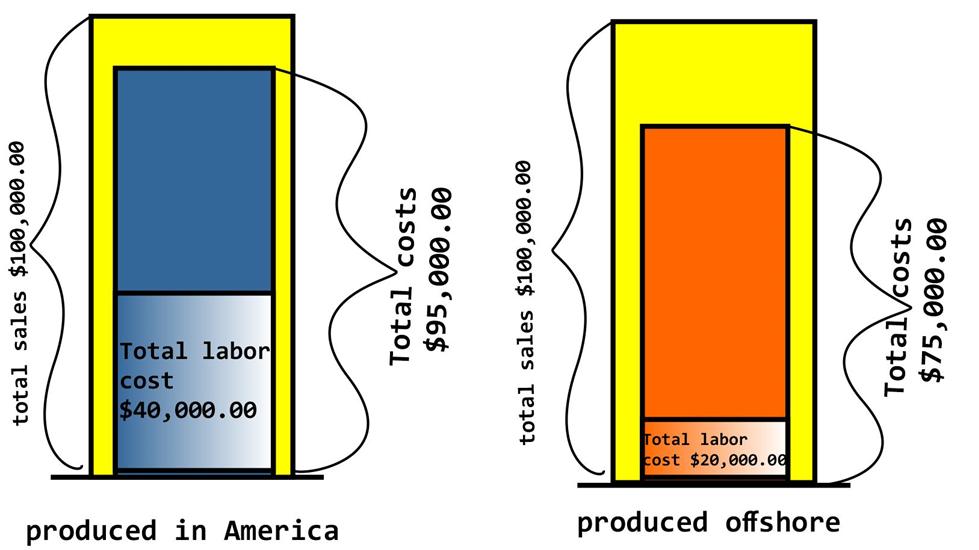
As you can see, profits to be had are much higher in the more capital-poor country, to which the first country’s entrepreneurs begin offshoring their production facilities. How long this process will go on depends on many factors, but they all boil down to what parts of both economies are considered interchangeable by the market participants and thus will have their prices begin to converge, and what barriers exist to stop their convergence. This process of course includes real wages of workers in the two countries, and by examining them we can see the limits of the offshoring process; as I explain in another essay:
Of course, for that [profit] differential [between producing it in one country vs the other] to work, the company needs its [home country] buyers to have the same real income. The reason the company loves those third worlders as workers is the same reason it hates them as customers: unless we’re talking about food and maybe something like a cell phone, there’s no way the man who puts in an entire day to earn what an American worker would make in an hour is going to buy the company’s product for the same price. But as offshoring continues apace and throws more and more American workers out of their manufacturing jobs and into wage competition with other US workers, both real and nominal incomes decline and those workers’ inability to buy the offshoring companies’ products reduces its sales and hence their profit margins from above at the same time that rising real wages of the third world workers begin to reduce those profits from below. This will keep going until it seems as if the two economies fuse and all things interchangeable, including labor and incomes, are mixed and evened out, [in some cases] to the great detriment of the West’s middle and working classes.
Such an outcome is not the case in our above example, at least not in the long-run, since it assumes that both countries have equal average IQs, resources, etc. But consider an example where the first economy is the same as in the example above but the one it’s merging with is something like that of a sub-Saharan African nation or Haiti: in other words, an economy made up of people with such low average IQ that the exceptions are too few to be statistically significant, an entire population made up of what in an industrial economy would be considered unskilled or menial labor:
List of characteristics:
Country A:
Total population: 120,000 (100,000 working; 20,000 nonworking)
Total income: 100,000,000.00
Workers:
20,000 STEM-types (they earn collectively, 30,000,000.00)
30,000 semiskilled-types (they earn collectively 30,000,000.00)
50,000 unskilled (they earn collectively 40,000,000.00)
Country B:
Total population: 120, 000 (100,000 working; 20,000 nonworking)
Total income: 10,000,000.00
Workers:
100,000 unskilled (they earn collectively 10,000,000.00)
Country A-B fused economy:
Total population: 240,000 (200,000 working; 40,000 nonworking)
Total income: 110,000,000.00
Workers:
20,000 STEM-types (they earn collectively, 30,000,000.00)
30,000 semiskilled-types (they earn collectively 30,000,000.00)
150,000 unskilled (they earn collectively 50,000,000.00)
Prefusion per capita earnings:
Country A:
STEM-type: $1,500.00
Semiskilled: $1,000.00
Unskilled: $800.00
Postfusion per capita earnings:
Country A:
STEM-type: $1,500.00
Semiskilled: $1,000.00
Unskilled: $333.33
*This is example is also taken from my Occidental Observer essay, which I now notice contains an embarrassing math mistake: the semiskilled workers’ per capital earnings should be $1,000.00 (not the $1,500.00 shown).
As you can see, in the long run as well as the short run such a union of opposite economies is a match made in hell for the US working and middle classes, who see their real wages decimated by being forced into competition with such low-tier human capital.
But the devastation goes even beyond that, given that, as I show in my other paper, while economic prosperity (whether absolute or relative) tends to fuel greater savings and capital formation among the white middle and, to a lesser extent, working classes, among the denizens of third world, it tends to fuel a population boom, meaning that in the future the white working classes will have even lower wages as they compete with even greater numbers of third worlders.
However, the problem goes even deeper and the future it portends becomes even darker still when you take into account the effect of such a transfer of real wealth on the absolute number of STEM types in the world as a whole. This problem (which I hope to elaborate on in a future essay) is one which virtually the entire economics profession has either missed or ignored on purpose, but one with the greatest import for the future of world living standards, to say nothing of the living standard in the Western nations. The problem goes to the heart of genetics, specifically to the nature of dominant and recessive genes. Imagine two groups of rabbits, one in which half the population have black stripes in their fur that are missing in the phenotypes of the other half, and another group in which the black stripes occur in only about 1/100th of the population. Given the frequency of the stripes in such a high percentage of the first population as a whole, it is far, far more likely that the stripe-less members of the first group will have offspring with blacks stripes than it is that the stripe-less members of the second group will (that is, far greater numbers in the first groups are likely to have recessive genes that could contribute to producing the stripes than are members of the second group).
Now apply this to humans. High intelligence is so biologically complicated that scientists do not believe that any single gene or even small set of genes will be soon identified that could be thought to lead to it, at least not by themselves. While high (or low) intelligence is highly hereditary, it’s not entirely so, and as Richard Lynn shows in his book Dysgenics: Genetic Deterioration in Modern Populations, about one-third of children leave the social class of their parents, either rising or falling from it.[1] When your trade policies result in a loss of real income for whites and a gain for races with far lower average IQ scores, you are reducing the number of children likely to have high IQs, and thus you are indirectly lowering the average IQ score of the entire earth! This is true even if the workers of both races have the same IQ rates as individuals since even a low-IQ white is more likely to possess the recessive genes that in the next generation could lead to high intelligence than is a black or brown with the same individual IQ. To see how this must be the case, consider how much more likely higher-IQ blacks are to become involved in criminal activity than whites of the same IQ: while a black with an IQ of 100 is equal to the average white in that respect, he’s likely far closer to the black average in terms of temperament, impulse control, and future orientation. IQ is not the center of a genetic universe which all other genes revolve around and calibrate themselves by, but rather one part of a potential package that is more likely to resemble the average of its race in more ways than not.
And since world living standards per capita are largely the product of the total amount of capital in the world, and since the amount of capital worldwide is highly dependent on the number of STEM workers relative to the world population, the higher the percentage of the world total that whites and East Asians make up, the higher world living standards will be, even for the non-white, non-East Asian nations. Hence economic nationalist policies by the white and yellow nations are at once self-protective and altruistic—the best of both worlds, for the entire world.
In Part 3, we’ll go into how to put such an economic nationalism system in place in some detail.
Notes
[1] Lynn, Richard. Dysgenics: Genetic Deterioration in Modern Populations. Second Revised ed., Ulster Institute for Social Research, 1930, 190, 193.