Courtesy of Wikimedia Commons
923 words
Mansa Musa is often described as the richest man in history, a figure whose legendary wealth has become almost mythical in global historical memory. His fame rests primarily on his famous pilgrimage to Mecca between 1324 and 1325, an event that transformed him from a powerful regional ruler into an internationally recognized symbol of wealth. Contemporary accounts describe an enormous caravan consisting of thousands of attendants, soldiers, servants, and enslaved people, along with camels carrying vast quantities of gold. The scale of gold distribution during this journey was so large that it helped destabilize the gold market in Cairo, contributing to price distortions that lasted for more than a decade. This event cemented Musa’s reputation globally, but it also highlights an important distinction between visible wealth and productive economic strength.
Although Mansa Musa is associated with Mali’s golden age, historians caution against equating his reign with the empire’s absolute peak of power or wealth. Much of what is known about Mali comes from written accounts produced during or after his pilgrimage, which has the effect of magnifying his historical visibility relative to earlier rulers who may have governed during periods of greater territorial or economic strength. In other words, Musa ruled during a period of prosperity, but it is not necessarily accurate to say Mali reached its apogee under his leadership. Instead, his reign represents the best documented period of Malian history rather than the moment of its greatest structural power. This distinction matters because it separates historical fame from underlying institutional or economic performance.
The Mali Empire itself was built not through technological or commercial innovation in the modern sense, but through military expansion, political subordination of neighboring regions, and control over key trans-Saharan trade routes. Musa himself is reported as having conquered twenty-four cities and surrounding territories, demonstrating that military expansion remained central to Malian state formation. Control over cities such as Timbuktu and Gao allowed Mali to dominate gold, salt, and slave trade networks that linked West Africa to North Africa and the Mediterranean world. The empire’s wealth therefore depended heavily on controlling geographic choke points in trade networks rather than on generating new forms of economic productivity.
Courtesy of Wikimedia Commons
From a modern economic perspective, Mali would likely be classified as an extractive political economy. State revenue came primarily from taxing merchant goods, collecting tribute from conquered territories, and extracting value from natural resources such as gold deposits and slave labor. Wealth flowed upward to the ruling elite, who then redistributed it strategically to maintain loyalty and political stability.
Unlike industrial era wealth creators such as Rockefeller or Vanderbilt, who built systems that expanded production and transportation capacity, Musa presided over a system that concentrated wealth through control and taxation rather than through innovation or productivity gains. In modern development economics, such systems are often associated with weaker long-term growth outcomes because they prioritize elite accumulation over broad-based economic expansion.
The moral dimension of Musa’s rule is also more complicated than many popular narratives suggest. In modern discourse, the American Founding Fathers are often criticized for slave ownership. Yet Mansa Musa ruled over a society deeply integrated into slave trading systems and slave ownership practices. Slaves were major commodities in the long-distance trans-Saharan trade and were deeply embedded in the economic structure of the Malian state.
In many precolonial political systems, rulers exercised near absolute authority over subjects, including control over labor, marriage, and personal freedom. Some historical interpretations also suggest that Musa traveled with enslaved women during his pilgrimage, reportedly including slave girls for his personal use, which would have been consistent with broader patterns of elite slave ownership in medieval Sahelian societies.
The economic consequences of Musa’s famous pilgrimage provide perhaps the clearest example of the difference between symbolic prestige and economic rationality. During the journey, Musa distributed massive quantities of gold across North Africa and the Middle East, contributing to monetary instability and price distortions that took more than a decade to correct. More critically, other accounts suggest that his spending was so extreme that he exhausted available resources and was forced to borrow money at very high interest rates simply to finance his return journey to Mali. In a modern context, this would likely be interpreted as severe fiscal mismanagement, equivalent to a state leader exporting massive financial resources for prestige while leaving domestic finances strained.
Modern political leaders are expected to justify foreign spending in terms of national interest, economic return, or strategic security. By contrast, Musa’s pilgrimage appears to have been driven primarily by religious devotion, prestige signaling, and diplomatic visibility. While these goals had symbolic value, they did not necessarily strengthen Mali’s productive capacity or economic resilience. The fact that borrowing at high interest rates may have been necessary to return home suggests that the pilgrimage functioned as a massive prestige expenditure rather than a rational economic investment.
Ultimately, Mansa Musa represents a historical paradox. He was one of the most famous and globally recognized rulers of medieval Africa and helped elevate Mali’s international prestige in lasting ways. However, the economic system he presided over relied heavily on extraction, tribute, and trade taxation rather than productive expansion. His most famous achievement, the pilgrimage, may have simultaneously enhanced Mali’s global reputation while weakening short-term monetary stability and straining state finances. If evaluated using modern standards of economic governance, Musa would likely be viewed less as a model wealth creator and more as a ruler presiding over an extractive system who engaged in spectacular but economically questionable displays of power.
14 comments
Interesting article. Some references would be nice. I had not heard of Musa. His seems not unlike other ancient economies, or those outside Europe until quite recently. Only European societies create economies based on innovation and economic expansion rather than extractive political economies as the author describes. This was not a peculiar fault of Mali.
The story of Mansa Musa nicely illustrates the charm of studying history in detail. If we take a closer look at the Mali Empire, we find that it was a civilization on the material and spiritual level of European prehistory, perhaps comparable to the early Bronze Age in Europe. And this was at a time when white people were building cathedrals. Real history thus shows the exact opposite of what liberals are trying to prove by constantly referring to Mali’s alleged amazing development.
The estimated global GDP in 1500 was around $400 billion in current dollars, and around 5% of that was African GDP. Claiming that a continent that had a total GDP of $20 billion was home to the wealthiest man in history always seemed like a stretch to me, but leftists love this sort of pro-African narrative.
So in other words, “nigger rich”?
I’ve never heard of this character and I’d refer all blacks seeking reparations to call on Mali for relief.
By “enslaved people,” do you mean ‘”slaves”?
Yes, it’s all the PC fashion now to substitute “slave” with “enslaved person,” to increase the pathos we are all supposed to feel and feel bad about.
You could re-write thousands of attendants, soldiers, servants, and enslaved people as thousands of attending people, military people, serving people and enslaved people.
Reminds me of pregnant people.
However, later on he does just use the perfectly adequate word “slaves.”
But the endless web of leftoid “re-imagining” the lexicon continues.
Er, is he the fellow that was supposed to have the biggest fleet of ships in history? Then they all disappeared?
As my Irish friend used to say…”Bunch of Arse”
I’ve always been fascinated by Timbuktu. Apparently the most impressive building at the time was the grand mosque, which leads me to wonder how much of Mali’s wealth and infrastructure was built by Arabians and Berbers.
Have you seen what Timbuktu looks like? It’s a cluster of mud huts—similar to the buildings of the Pueblo Indians in America. It’s most similar to the buildings constructed by the first farmers in what is now Turkey (the Catal Huyuck site) or the later culture of prehistoric farmers known as “Cucutenni Tripolye” in what is now Romania (Google it). Timbuktu was famous because it was the only major settlement in the middle of nowhere.
There was a strong Semitic / Berber influence in the Sahel. Timbuktu was founded by Tuareg people (whose modern descendants range from being predominantly North African / Berber to predominantly Black) and its first mosque is said to have been built by an Arab:
https://en.wikipedia.org/wiki/Al-Sahili
Modern historians insist this is a myth and that it was designed by locals.
Well… if we’re going to debunk some of the Afrocentric tall tales surrounding Mansa Musa…
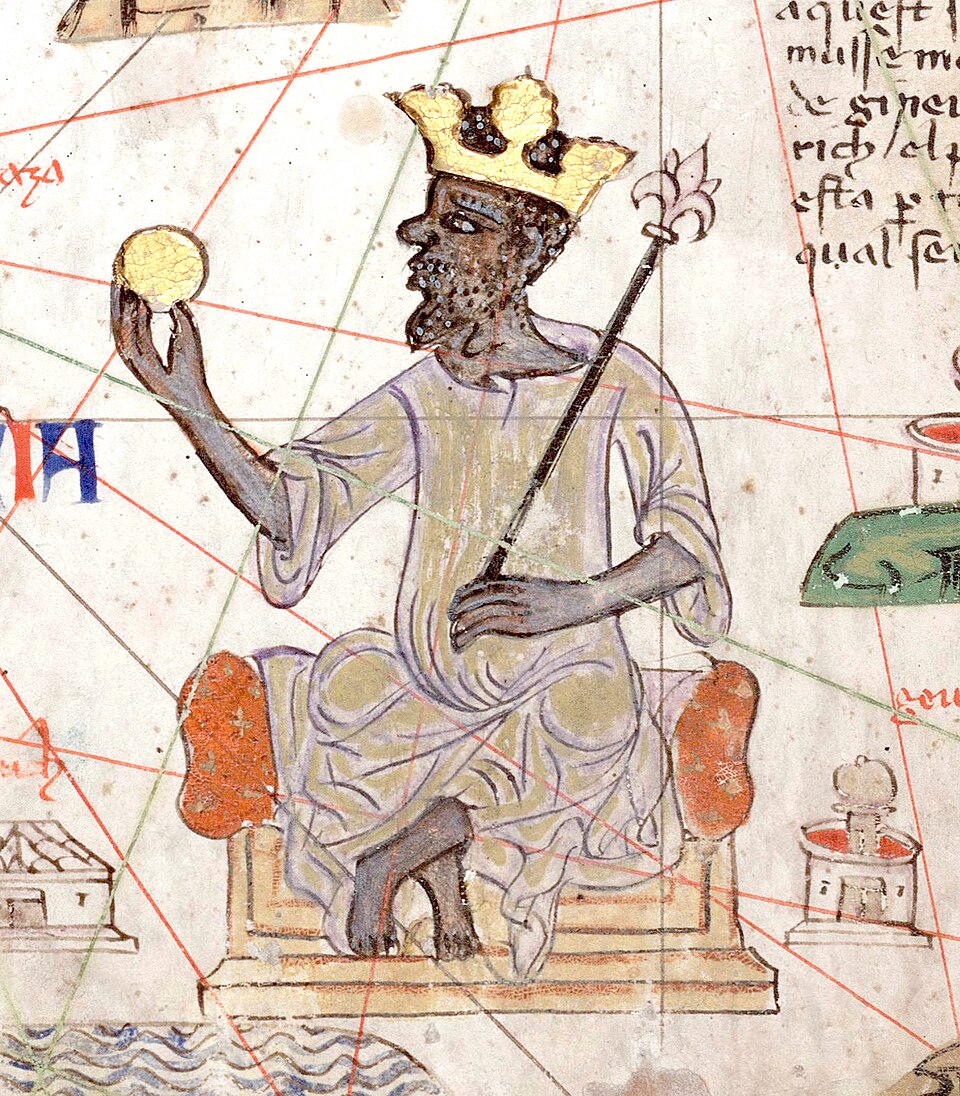
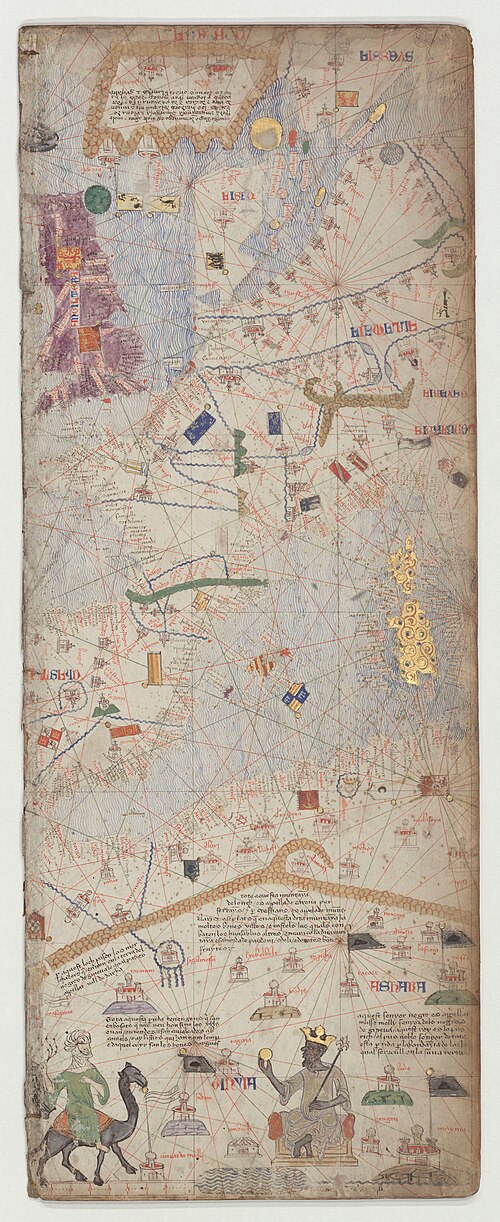
The drawing of Mansa Musa, shown above, comes from the Catalan Atlas of 1375. It was produced several decades after Musa’s death by Cresques Abraham (a Jewish mapmaker living in Spain – who never visited Mali). The Atlas never claims that Musa was the wealthiest man in the world, he is described as having been the wealthiest Black ruler in the Sahel:
This black Lord is called Musse Melly and is the sovereign of the land of the black people of Gineva (Ghana). This king is the richest and noblest of all these lands due to the abundance of gold that is extracted from his lands.
The next major source, an arab writer named Al-Umari, also never personally met Musa and never visited Mali. Umari’s work describes Musa’s spending as extremely lavish but, like Abraham, he never claims that Musa was the wealthiest man in the world. It should be pointed out that Al-Umari allegedly made several other fanciful claims, such as that Musa’s father disappeared with 2,000 ships in the Atlantic ocean. The fact that these claims are nonsensical (this would be the largest fleet ever assembled in the pre-modern world, there is no evidence that Mali’s rulers built ocean going ships, etc…) never leads to the obvious question:
Are the documents ascribed to Al-Umari’s reliable?
His primary work was “Masālik al-abṣār fī mamālik al-amṣār.” Unfortunately, only small portions of the original survived and modern historians are relying on copies made in the 1700s (long after the Americas were known to Europeans and Moslems). It is entirely possible that neither Mansa Musa or Al-Umari made any claims about Atlantic voyages and that this story is an insertion from the 1700s.
As for what Mali was like during Musa’s reign, we know he ruled over an Islamic kingdom. His name is the Moslem version of “Moses” and he is said, by Al-Umari, to have brought Egyptian architects and scholars back to Mali to build the Mosque of Djinguereber.
We also have a first hand account of Mali. Ibn Battuta visited the region in the mid 1300s and described how children were tied up until they learned the Qur’an. He also criticized the locals for keeping their women (including the king’s daughters) completely naked and giving slaves to cannibals:
Earlier, while Battuta was still at the capital, a group of African cannibals and their leader came to see sultan Mansa Suleiman. They wore large metal rings in their ears and wore silver mantles. They came from a region that possessed a gold mine, so the sultan was gracious to them, and gave them a slave woman as a hospitality gift. The cannibals killed and ate her, then smeared her blood on themselves and went to thank the sultan. As an aside, Battuta reported that he heard the tastiest meat came from the palms and the breasts.
Source: https://historyhaven.com/battuta/battuta_12.htm
Stories like these are largely ignored by modern historians because, rather than portray Mali as a massive and advanced kingdom, they imply it was a relatively simple Islamic state surrounded by tribal people.
This pattern of retconning African history also extends into architecture. You know the “ancient African university of Djenne” picture that is in everyone’s high school history book?
This one?:
https://media.gettyimages.com/id/1173379262/photo/mali-mud-mosque.jpg?s=1024×1024&w=gi&k=20&c=aMPUO06rjli0MOSabfgXb9jUX0YJAEPPnG79aWqMKtI=
The mosque in that picture was built in 1907 (under French supervision, Michel Leiris’s book documents this). An earlier mosque had been built in the 1800s, by a Fulani warlord named Seku Amadu, after he destroyed the previous one. Many of Mali’s mosques were rebuilt in the 1500s by a Berber man:
https://en.wikipedia.org/wiki/Al-Qadi_Aqib_ibn_Mahmud_ibn_Umar
When one looks at all the evidence, it looks like Arabs expanded into the Sahel in the 8th and 9th centuries and established a de facto colonial system. They mixed with the locals, assimilated them into the Islamic world, and then began importing large amounts of precious goods from them. Modern historians have reimagined this history to fit their own narrative. There is a strong desire to “build up” Africa’s history and to level out the historical differences between Africa, Europe, and Asia.
I think the fundamental problem with the ancient African empires was that they were purely extensive projects. The rulers of these tribal confederations did indeed amass great treasures of gold and formally professed Islam, but the entire population remained essentially at a prehistoric level (tribal social structure, subsistence farming, primitive metallurgy, minimal specialized production). The simplicity of conditions in Africa is striking even when compared to pre-Columbian America, where at least complex stone structures were built in Neolithic conditions.
It is very difficult to learn anything objective from Arab reporters, as Mali played the role of a distant fairy-tale land for them, where various wonders took place.
Frankly, I don’t think it’d be inaccurate to describe Mansa Musa’s reign as disastrous for Mali in the long term and causing the beginning of their decline as an empire. Ironically, Malian oral tradition refers to Musa as a fairly pious Muslim, but he isn’t treated with the same respect as some of the previous leaders. His reputation as one of the greatest rulers in Mali history is a relatively new phenomenon that the Malians themselves don’t exactly hold to.
Comments are closed.
If you have a Subscriber access,
simply login first to see your comment auto-approved.
Note on comments privacy & moderation
Your email is never published nor shared.
Comments are moderated. If you don't see your comment, please be patient. If approved, it will appear here soon. Do not post your comment a second time.