1,992 words 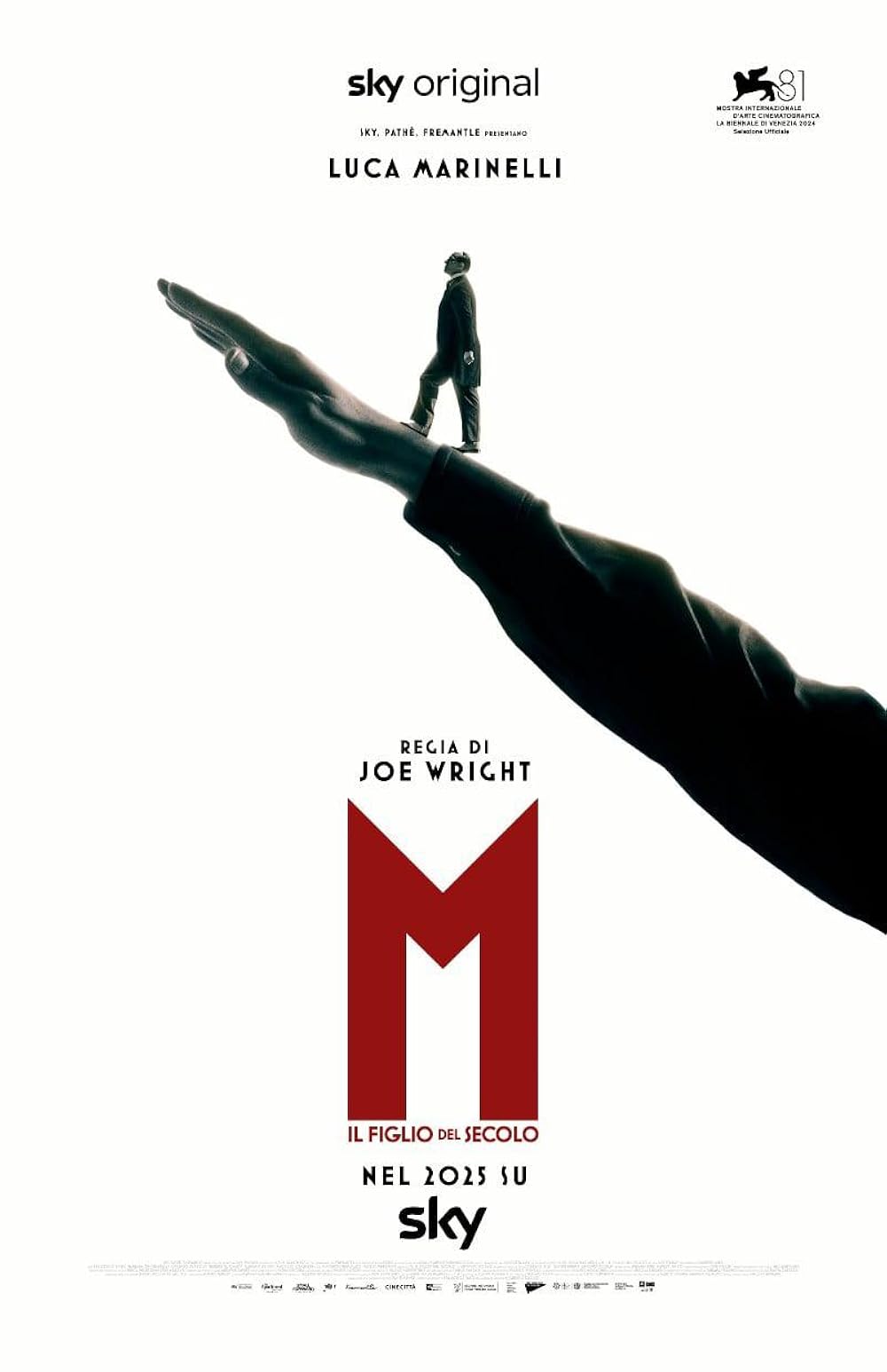
I remember when I was in college, I had a professor who used to place a lot of emphasis on the differences between advertising and propaganda. The old man would explain that the former tended to adapt to the tastes and customs of its target audience, while the latter was far more insidious, even subversive. Not only did it seek to influence its intended audience, but, to a certain extent, it aimed to alter their perceptions and stances on a given issue. In other words, its drive to persuade went beyond trivial matters and had serious consequences for those it was aimed at.
Something like that.
I bring this up and ask you to recall or imagine one of those old propaganda posters from Italian fascism. If you have even a smidgen of what the masses call “general culture,” you’ll see in your mind’s eye a postcard of Benito Mussolini –“Il Duce”– as a figure brimming with authority, chin raised, hands on hips, striking a virile, heroic pose before a uniform mass of followers.
This is no coincidence. The artist or person tasked with creating the poster knows which traits to display and highlight in the portrait. Above all, they know these traits must be inherently attractive and convincing. In the case of propaganda from the early and mid-20th century, the goal was to appeal to a kind of collective pride, directly conveying to the audience the idea of an exceptional individual capable of leading the nation through times of crisis.
All of this, however, is pretty discredited today. No self-respecting propaganda outlet would operate under these codes or style manuals anymore (they’re completely outdated; they come off as ridiculously solemn to the average citizen).
Now, if I wanted to convince the masses that Benito Mussolini and fascism are a great idea, do you know what I’d do?
Exactly what British director Joe Wright has done in his new series M: Il figlio del secolo (M: The Son of the Century). That is, portray him as a Scorsese-esque character, one of those charismatic antiheroes who must claw their way to the top from rock bottom. Add to this mix first-person narration (from minute one, Mussolini speaks directly to the camera, instantly seducing the viewer), fast-paced, violent montages accompanied by techno music, and heavy doses of dark humor.
If you follow these steps, it’s guaranteed that the viewer will sympathize with the portrayed figure (Mussolini) and with fascism (ideas that are widely unpopular today) or, at the very least, feel a pinch of fascination.
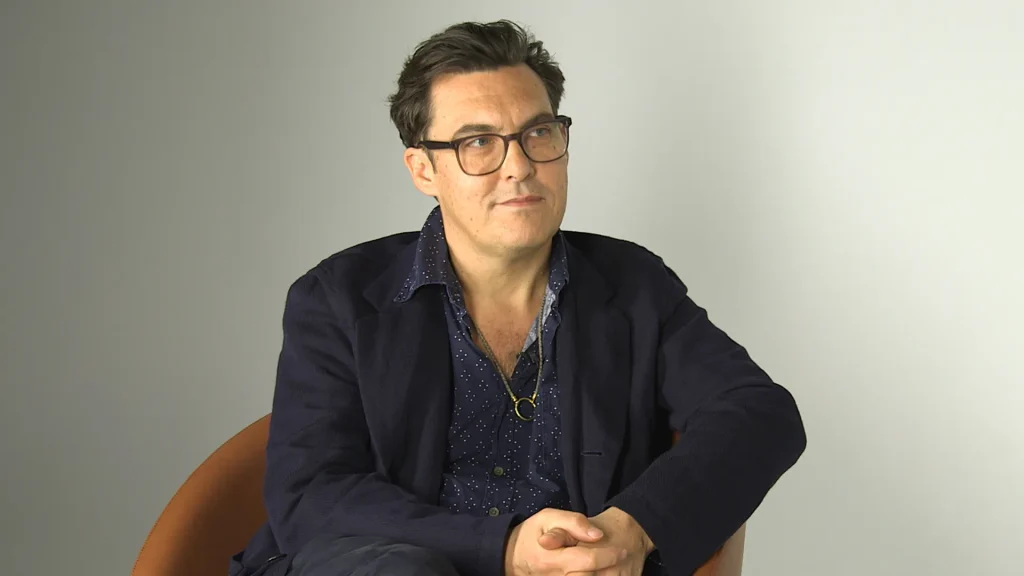
Joe Wright
Now, to be fair, I’ll give you the other side. Joe Wright is far from being a propagandist for the right. At least not intentionally. Wright is, in fact, one of those lanky cinema veterans with bottle-thick glasses, known for directing adaptations of Jane Austen novels. According to him, his purpose in taking on the eight episodes of the first season of Il figlio del secolo was to problematize “toxic masculinity” and its role in the rise of fascism to power:
I was very careful to tell the truth without being didactic; I tried to understand without sympathizing, maintaining a critical distance… Mussolini was fascinating; he seduced a nation and many others. If I didn’t show that charm, people might think all Italians were idiots. That balance was my main concern… On a more personal level, this is a series about toxic masculinity, which isn’t something alien to us: we carry it within. We must acknowledge our responsibilities and turn our backs on it, to avoid falling into moral bankruptcy.
The very existence of this series can also be explained by the fact that, culturally speaking, Mussolini’s figure hasn’t been as demonized as Hitler’s. In fact, some consider Benito little more than a meme, given his peculiar charisma and the dated political propaganda associated with his regime.
It’s worth noting, too, that in Italy, after World War II, there was no equivalent to Germany’s denazification process. To this day, Italians haven’t banned fascist symbols, historical revisionism hasn’t been criminalized, and events like the March on Rome can even be celebrated without police repercussions. Nor has Hollywood been as harsh on fascism (or, curiously, on Emperor Hirohito). It hasn’t dedicated hundreds of films to tearing it down, so today most people don’t even have a fully formed opinion about Mussolini.
This lack of a strong opinion around Il Duce, combined with the series’ release in a context of moral decline where gangsters and drug lords are often viewed sympathetically by audiences, means that what Joe Wright intends to portray as contradictory or outright evil in Mussolini’s character ends up–unintentionally, and thanks to Luca Marinelli’s brilliant performance–coming across as multifaceted and complex.
In other words, if Wright’s goal was to condemn Mussolini and, by extension, “toxic masculinity,” it’s fair to say he shot himself in the foot. Have you seen that meme, “This F*cking Sucks Actually”? If you don’t know what I’m talking about or just don’t get it, it’s a funny cartoon where a peanut character points accusingly at a hot dog on a skateboard and says, “that’s garbage.” The joke is that it’s actually the opposite. It’s actually “the literal coolest thing ever.”

Something similar happens when Wright adopts that progressive moral superiority and decides, in his own words, to “maintain a critical distance and just show.” So, what does the viewer see? Well, they see Mussolini leading a squad of Blackshirts, grinding away to keep his independent newspaper operational, practicing fencing, flying a monoplane while trying to evade the police, meticulously planning his next move to seize power like a professional chess player, standing alone in the middle of the street under torrential rain, facing down an Italian army platoon determined to arrest him, with no men by his side. Mussolini, in his own words, is a brute force capable of overcoming any obstacle in his path, “the coolest thing ever.” Despite his … efforts?, Wright fails to refute it:
You don’t understand people like me. You probably see us as clowns, as frauds, as lunatics, as conmen. And maybe there’s some truth to that, but it doesn’t matter. It’s irrelevant. Because we are the new. Every era has a guy who believes his dreams can come true. (Points to himself.) Thirty-nine years old, the black swan of politics, sixteen months in Parliament, the son of a blacksmith. And now, the King awaits me in Rome to name me Prime Minister. The youngest Prime Minister in the world.
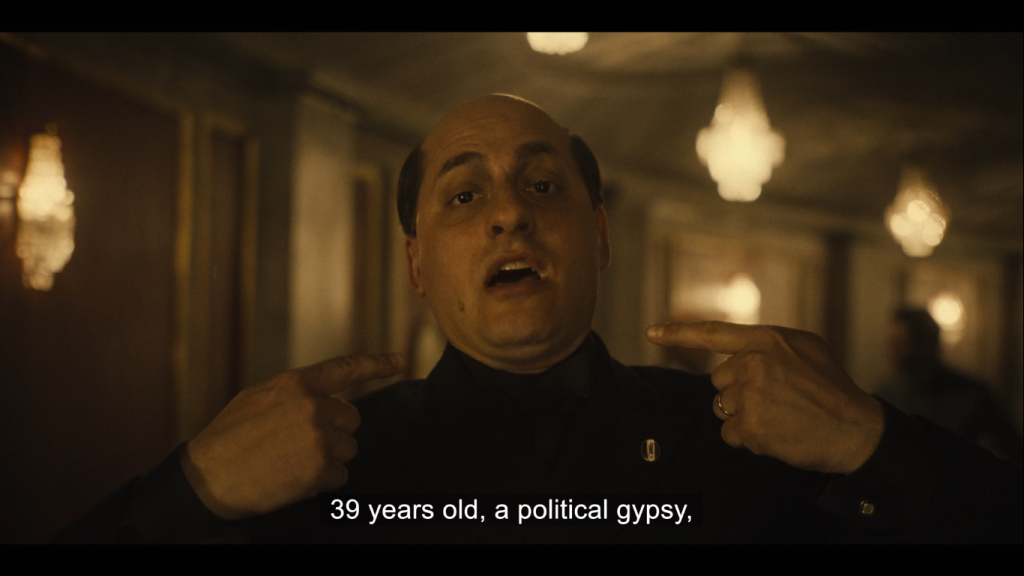
Luca Marinelli as Mussolini
And honestly, I’d much rather he just show Mussolini being Mussolini instead of trying to preach, because when he attempts the latter, he falls into empty, propagandistic gestures that break the viewer’s immersion. For example, when, at the end of the monologue I just quoted, Mussolini gives a thumbs-up, smiles, and says to the camera, “Make Italy great again.” This allegory of Donald Trump feels utterly childish and unnecessary, as if Wright suddenly realizes he’s inadvertently creating a propaganda piece and rushes to apologize.
I’ve lost count of how many times Hollywood has done this already. Please, just stop.
The despised, the marginalized, those at the bottom of the barrel
One of the most fascinating chapters in this discursive void surrounding fascism is, without a doubt, the supporting cast that accompanied Mussolini during his rise to power. Many seem to forget, but unlike his German counterpart, Il Duce reached the top almost meteorically. While it took Hitler fourteen years, Benito needed only three, from the formation of his Fasci italiani di combattimento (Italian combat leagues) to becoming Italy’s Prime Minister. Much of the credit goes to secondary figures like Margherita Sarfatti, Cesare Rossi, Gabriele D’Annunzio, Filippo Marinetti, and Italo Balbo, who, at times during the series, threaten to overshadow Mussolini’s commanding presence. And it’s curious because, in their own way, each of them embodies some facet of the Duce’s personality.
And here’s where, once again, in his effort to “maintain a critical distance and just show,” we stumble upon the series’ most subversive message by far, and once again, I don’t think this was Joe Wright’s intention. However, at some point in the scriptwriting process, these ideas or archetypes slipped unconsciously into his mind and ended up in the final product. I’m referring especially to the portrayal of Italo Balbo, one of the most fascinating and forgotten figures of the fascist era. Balbo, like Mussolini, is depicted as a Scorsese-esque character, a charismatic, daring, and courageous thug (with a not-so-subtle fondness for cocaine).
I’ll be brief. Any kid between fifteen and twenty-four years old who sees Lorenzo Zurzolo as Italo Balbo will instantly become a fascist.
Yes, that’s how badly Joe Wright’s plan backfired.
Italo Balbo and the Blackshirts, both in fiction and in their real historical roles, evoke those gangs of young aristocrats who terrorized the streets during the Italian Renaissance. If you’ve read Shakespeare’s Romeo and Juliet or know even the broad strokes of Caravaggio’s biography, you’ll know exactly what I mean. Swordsmen, pimps, prostitutes, painters, decadent nobles, thugs, or simple cutthroats … fast-forward four hundred years, and you find them during fascism. Those starving artists, pensionless war veterans, petty intellectuals, and small-time crooks trying to survive by any means, clawing their way up the social ladder. All of them longed to rally around a great leader who knew where to guide them in times of crisis. Mussolini puts it brilliantly in the first episode of the series: “History is made with outcasts, with the people at the bottom of the barrel. Ignite their rage. Give them bombs and weapons. With them, I will make a revolution!”
Regardless of the label or value judgment one might attach to each of these characters, no one can deny the immense danger they pose to any established order not grounded in values of a higher caliber. There’s a little quote from Bronze Age Pervert in his book Bronze Age Mindset (a classic of Sensitive Young Men’s Literature™) that sums this up perfectly:
I believe, on the contrary, that the end in previous cycles has varied, but what is very common and, most interestingly, is that one of the causes has been the emergence of brotherhoods of wild men who have decided to purify the earth and rid it of the infestation of ‘cockroach humanity.’
And what are the Blackshirts if not precisely that brotherhood of wild men rallied around the magnetic charisma of leaders like Italo Balbo or Benito Mussolini?
On the other hand, let’s be honest, this impulse, so characteristic of young kids today, is tempered by the state and its institutions, partly channeled into a kind of opportunistic, insipid political activism, lacking authenticity and rebellion, driven mostly by the ambition for a public office or, as happens quite often in the student unions, by the chance to hook up for free with fatherless girls riddled with STDs.
Seen this way, the orgies that the military supposedly threw during the dictatorship with young female students of the time strike me as far more honest than many are willing to admit (to me, it’s like Emperor Nero bringing pleasure to the Roman people, redistributing the capital of enjoyment among the humblest, the ensigns…but that’s a topic for another article).
Is M: Il figlio del secolo an anti-establishment work and pro-Sensitive Young Men™?
Summing up everything, M: Il figlio del secolo is pure propaganda. Maybe unintentionally, yes; maybe it uses a different register than the one employed by the fascist regime at its peak (this time transitioning from the messianic, perfect leader to the Scorsese-esque antihero, capable of anything to impose his will), but the result is the same: audiences will end up captivated by the figure of the Duce and his supporting cast. And the underlying message seems to be this: if you get together with a group of friends, you can change the world. You just need a ton of guts, that’s all.
Felipe Villamayor writes in Spanish at https://acontrapelorevista.com/
7 comments
Sounds good – I’ll definitely check it out.
Felipe, thanks for this very well-written review. I am going to watch this series!
I have watched several clips on Youtube, and I don’t think at all that this series is able “to convince the masses that Benito Mussolini and fascism are a great idea”. And if you think what you are seeing in this series is a “great idea”, either a hundred years ago or today, I seriously wonder about your sense of reality. If you take Scorsese for comparison, he can certainly convey the thrill of being a mobster and killing people, but if you leave the theatre thinking that what you just saw is actually a great idea, you are basically a psychopath or at least very immature.
Likewise this series certainly tries to make you feel how thrilling it may have been a to be a fascist in its revolutionary era or how thrilling it may have been to listen to Mussolini or be Mussolini himself, rising to power. It draws heavily on the appeal of early Italian fascist aesthetics, the black shirts, the thirst for violence, the direct action style, the restlessness, the sense of moving ever forward with an amoral energy and vitalism.
But it embeds all of this in a dark, feverish, dreamlike, manic, almost psychotic atmosphere. There is little daylight, everything is set in darkness, mostly interiors with warm, unnaturally glowing colors, creating an atmosphere of decadent claustrophobia filled with an unhealthy tension. The characters seem morbid and death & violence obsessed (D’Annunzio in particular is a romantic but not very appealing lunatic autistically playing a sort of death wish opera).
Mussolini is spellbinding, but like Dracula is, like some evil narcissist, hypnotising you while he directly speaks to you. The squadristi gleefully torturing and slaughtering unarmed socialist peasants in their barns or journalists in their offices hardly come off as heroic or worth of imitation in any way, but resemble Clockwork Orange’s maniacal droogies in their joy of violence and mayhem. There is never any question whether they are villains, even if they look as attractive as Italo Balbo.
But if you happen to read Balbo’s account of the “March on Rome”, this is not at all the way the fascists saw themselves, and some of them actually did have some serious political ideas, not just a mere thuggish lust for action and power. What you see in the film is a dark, highly stylised cartoon with cartoonish characters. That includes Mussolini, who is brilliantly played, but constantly on a single note only, without any other dimensions or nuances.
You may find all of this “cool”, but it is clearly presented as evil you are invited to enjoy on some aesthetic level, getting “captivated”. But nobody with a sane mind will think these are great people and “great ideas”. A film seriously presenting the fascists in a more positive or nuanced light as usual, would look much, much different.
Bummer, I thought this article was going to be about me.
Seriously though, the notion of the target of a hatchet job ending up looking appealing to the viewers reminds me of that hack Louis Theroux who did a bunch of documentaries on people considered right of center back in the 2000s. He did one on Tom Metzger that did nothing but humanize the great man, despite Theroux’s best efforts to make him look like a comic book character.
I think that strong, aggressive, charismatic figures who challenge unpopular governments will generally be seen as “cool.”
Look at Trump’s 2016 campaign: Confrontational rhetoric, bold claims, massive rallies, catchy slogans (Make America Great Again, Build the Wall, Lock Her Up) uniforms (the Red Hats). The rhetorical style and aesthetics of that campaign had some definite similarities to fascism, but his policies and governing style sadly did not. But millions still love him because he is seen (incorrectly) as a strongman who is doing battle against those they (correctly) see as enemies.
Leftists and Jews dislike Trump because they believe he is a fascist. I dislike Trump because I understand that he is not a fascist.
As misunderstood or rather not-quite-understood as the Fascist phenomenon is, there is no question that coolness is an indispensable part, though perhaps not intended, as it’s a young man’s worldview and starry-eyed dreamers or not, has some attraction to youth awaiting some excitement or national stimulation from monotonous drudgery. The Futurist influence in particular, and its glorification of youth, machinery, speed, and dynamic violence has attraction for the authentically rebellious youngster left to languish under wretched ziogoy cretins like donald, ronald, george, obama, and bill. Benito just sounds way cooler. Even antifa trash: “smash the Fash, man!!” Exactly, losers: Fash is smash, you are pass. (Fash)ionable, sleek dress to match their northern neighbors, Ambrosi’s Aeroritratto di Mussolini aviatore makes the Duce look way cooler than trump ever could, and AH’s Voce Del Popolo showed the man’s public speaking could easily rival the Fuhrer. Petronius commented: But nobody with a sane mind will think these are great people and “great ideas”. Fascism’s early influence by Georges Sorel? His name seems to get alot of continuous praise around here.
Hollywood, visual appeal, political fashion, impressionism, masculinity, propaganda, nationalism, emotional manipulation. Seems like this is what stirs peoples interest, what Mussolini also used to draw attention to his cause knowing the minds of the masses,, which has not changed at all reading this article and watching our own society at its impulsive peak. Want to be entertained? watch the series. Want to understand the movement read books, many out of publication or just collecting dust. Mussolini revolutionized government unlike any other in the 20th century. His accomplishments and influence were and still are long reaching.
Comments are closed.
If you have a Subscriber access,
simply login first to see your comment auto-approved.
Note on comments privacy & moderation
Your email is never published nor shared.
Comments are moderated. If you don't see your comment, please be patient. If approved, it will appear here soon. Do not post your comment a second time.