Counter-Currents
  • Advertise
  • Private Events
  • T&C
  • About
  • Contact
  • RSS
    • Main feed
    • Podcast feed
    • Videos feed
    • Comments feed
  • Welcome
  • Webzine
  • Books
  • Merch
  • Podcasts
  • Videos
  • Donate
  • Patrons
  • Subscribe
  • Crypto

LEVEL2

Donate Now Mailing list

Writers of May

(2 votes) Morris van de Camp David M. Zsutty Derek Stark Jayant Bhandari Greg Johnson

Articles of May

Heidegger on Nietzsche, Part One by Collin Cleary The Lunch Wars by David M. Zsutty 2 votes
  • Welcome
  • Webzine
  • Books
  • Merch
  • Podcasts
  • Videos
  • Donate
  • Patrons
  • Subscribe
  • Crypto
    • Counter-Currents Radio Podcast No. 691
      Rob Rundo Returns

      Counter-Currents Radio

    • The Fragile Polity that is Syria

      Morris van de Camp

      1

    • Nigel Farage Calls Britain a Two-Tier State

      Mark Gullick

      3

    • Nationalism This Week
      Letter to J. D. Vance

      Greg Johnson

      26

    • Lost In Trans-Mission:
      How the Media Fails To Reveal the Inconvenient Truth About the Usual Suspects

      Steven Tucker

      10

    • Liar, Liar, Pants on Fire!

      Beau Albrecht

      7

    • Editor’s Update
      Rob Rundo on Counter-Currents Radio, Fundraiser Update, & a New $20,000 Matching Grant

      Greg Johnson

    • The Bitter End of Western Metaphysics:
      Heidegger on Nietzsche, Part Three

      Collin Cleary

      10

    • Uncivil War

      Mark Gullick

      49

    • Exclusive Interview with Karel Veliky:
      The Final Chapter in the Film Series! Part II

      Ondrej Mann

      2

    • Happy Birthday to Us!

      Greg Johnson

      6

    • Zsutty’s Maximum

      David M. Zsutty

      16

    • Exclusive Interview with Karel Veliky:
      The Final Chapter in the Film Series! Part I

      Ondrej Mann

      2

    • The Union Jackal, June 2026

      Mark Gullick

      23

    • The Inferiority Behind Immigrant Superiority

      Jayant Bhandari

      15

    • Counter-Currents Radio Podcast No. 690
      Greg Johnson & David Zsutty Discuss Current Things: AI, Henry Nowak, the Iran Crisis, & More

      Counter-Currents Radio

      7

    • Collin Cleary: What Rome Means to Me

      Collin Cleary

      4

    • Paul Krugman: Closet Bolshevik

      Spencer J. Quinn

      21

    • Fugue of Ideas:
      Ibram X. Kendi’s Chain of Ideas

      Greg Johnson

      19

    • Based Blacks

      Lipton Matthews

      24

    • Black Intellectual Fatigue

      Derek Stark

      41

    • Why White Advocates Should Avoid “Based Blacks”

      Dani Vypont

      32

    • Nietzsche & Race

      Mark Gullick

    • Editor’s Update
      Rob Rundo Rescheduled to Next Week on Counter-Currents Radio;
      Tonight Greg Johnson & David Zsutty Answer Your Questions;
      Fundraiser Update & a New $20,000 Matching Grant

      Greg Johnson

    • The Counter-Currents 2026 Fundraiser
      Lifetime Subscriber Welcome Packages Extended

      Greg Johnson

    • Nationalism This Week
      Who’s Looking Back?

      Greg Johnson

      29

    • China’s Threat to American Security:
      Food, Farmland, Foreign Control, & Energy Policy

      Lipton Matthews

      5

    • The Bitter End of Western Metaphysics:
      Heidegger on Nietzsche, Part Two

      Collin Cleary

      16

    • The Killing of Henry Nowak

      Mark Gullick

      38

    • The Crisis of Chinese Technology Thieves

      Morris van de Camp

      1

    • The Strange World of Gender Bender Fiction:
      & What This Genre Tells Us About Autosexuality

      Dani Vypont

      3

    • Watching the Watchers:
      The Dark Triad Question

      David M. Zsutty

      14

    • The Remigration Movement Solidifies

      F. Roger Devlin

      2

    • Casting Aspersions:
      The Fatal Consequences of Race-Swapped Casting, From Helen of Troy to Henry of Southampton

      Steven Tucker

      20

    • The Murder of Henry Nowak

      Millennial Woes

      23

    • Don’t Forget to Vote in Our Writer & Article of the Month Poll

      Greg Johnson

    • The Robot Hotdog Stand

      Greg Johnson

      37

    • Laughing Our Way to Victory

      Dave Chambers

      7

    • The Zodiac Killer

      Mark Gullick

      11

    • Jared Taylor: What Rome Means to Me

      Jared Taylor

      1

    • An Interview with Endeavour:
      My Way of Life Is an Adventure!

      Ondrej Mann

      6

    • José Pedro Zúquete’s The Identitarians

      Greg Johnson

      3

    • Editor’s Update
      Fundraiser Update & How to Watch the Remigration Summit

      Greg Johnson

      5

    • The Bitter End of Western Metaphysics:
      Heidegger on Nietzsche, Part One

      Collin Cleary

      12

    • Berlin: City of Stones

      Spencer J. Quinn

      6

    • True Folk-Horror Is Horror of Your Own Folk:
      Mark Gatiss vs the Brexit Blind Dead  

      Steven Tucker

      4

    • Counter-Currents Radio Podcast No. 689
      Thomas Massie, the America 2050 Bust, the Need for Whites to Divest from America, the AI Economic Apocalypse, & Pro-White Project Pitches to Billionaires

      Counter-Currents Radio

      7

    • Nationalism This Week
      Remigration is Inevitable, Part 3

      Greg Johnson

      27

    • Why Billionaires Should Fund White Identity Politics

      Lipton Matthews

      8

    • How Cold War Two Came About

      Morris van de Camp

      5

    • Beau Albrecht

      The Fragile Polity that is Syria

      It seems that they didn't learn the lesson that diversity is a country's greatest strength.  How...

    • Will Williams

      I was interviewed by the NY Post Friday, mostly about Miss Heidi’s participation with the SPLC. The...

    • Will Williams

      Nigel Farage Calls Britain a Two-Tier State

      Farage may turn out to be the latest in a line of snake-oil salesmen posing as saviors…---He’s...

    • Joe Gould

      Nationalism This Week
      Letter to J. D. Vance

      "If Trump does not go quietly, Vance can withhold his pardon and let the dogs in Congress tear Trump...

    • Peter Quint

      Nationalism This Week
      Letter to J. D. Vance

      I can’t tell from this far off. I wouldn’t put it pass him; it is pretty common these days. 🙃

    • Adrian Roberts

      Nationalism This Week
      Letter to J. D. Vance

      Does he wear eye-liner?

    • Doug Harrison

      Nationalism This Week
      Letter to J. D. Vance

      So it's a good career move for the cabinet secretaries to save the country from a deranged chief...

    • Greg Johnson

      Nationalism This Week
      Letter to J. D. Vance

      I am pretty sure that everyone in the cabinet wants a political career or just to enjoy his life in...

    • Adrian Roberts

      Nigel Farage Calls Britain a Two-Tier State

      ‘Unelected PM’. This is a silly term, first used by David Cameron to taunt Gordon Brown after he...

    • Greg Johnson

      Nationalism This Week
      Letter to J. D. Vance

      He "stood up" to the neocons because Iran had the ability to completely wreck the Gulf and the...

    • Doug Harrison

      Nationalism This Week
      Letter to J. D. Vance

      Yes, the pardon would be Vance's defensive weapon. Who would Vance trust to confide in regarding the...

    • Lexi

      Nationalism This Week
      Letter to J. D. Vance

      Yes, I think a brief Democratic Congressional majority is now baked in.  There will not be a...

    • Judas

      Nationalism This Week
      Letter to J. D. Vance

      I'm not sure if Trump is a Svengali or more of a Pied Piper and I don't really know who may be...

    • Will Williams

      Uncivil War

      Paudi McCreevey: June 16, 2026  White Nationalism and Christianity are compatible.---No, they...

    • Peter Quint

      Nigel Farage Calls Britain a Two-Tier State

      This carefully crafted animus is reaching critical levels in the US after the conviction and...

    • Will Williams

      Uncivil War

      Peter Quint: June 12, 2026  There are many reports of Catholics and Protestants sitting down...

    • JaymunD

      Lost In Trans-Mission:
      How the Media Fails To Reveal the Inconvenient Truth About the Usual Suspects

      The same goes for the "race is a social construct" creed.  Pretty soon my Money Market Fund will be...

    • Paudi McCreevey

      Uncivil War

      I know. It's sad. They preach Woke and not the Scriptures. Dark times.

    • Greg Johnson

      Uncivil War

      Preach it in the churches.

    • Greg Johnson

      Nationalism This Week
      Letter to J. D. Vance

      It isn't like Leftism will start working magically. And it isn't like they will learn to moderate...

    • Earth Day Special

      John Morgan

      12

    • A Robertson Roundup
      Remembering Wilmot Robertson
      (April 16, 1915 – July 8, 2005)

      Margot Metroland

      13

    • The Paranoid Style in White Nationalism

      Greg Johnson

      30

    • Join the Dance!

      Andrew Hamilton

      1

    • We Can’t Save the Earth Without Reducing African Birth Rates

      James Dunphy

      36

    • “I’m Not a Conspiracy Theorist, but . . .”:
      Jeffrey Epstein’s Death Gives New Life to “Conspiracy Theories”

      Greg Johnson

      22

    • Sylvia Plath: Stasis in Darkness

      Vic Olvir

      17

    • Vanguardism, Vantardism, & Mainstreaming

      Greg Johnson

      80

    • Aviation, Geography, & Race

      Charles Lindbergh

      3

    • Some Thoughts on Yule

      Collin Cleary

      4

    • Living in Truth:
      A Yuletide Homily

      Jef Costello

      7

    • John Kennedy Toole’s A Confederacy of Dunces

      Greg Johnson

      20

    • On Aleksandr Solzhenitsyn’s Warning to the West

      Spencer J. Quinn

      7

    • Elitism, British Modernism, & Wyndham Lewis

      Jonathan Bowden

      6

    • Philip K. Dick’s Do Androids Dream of Electric Sheep? as Anti-Semitic/Christian-Gnostic Allegory

      Greg Johnson

      20

    • “Conspiracy Theory” or Conspiracy?

      Andrew Hamilton

      21

    • Remembering H. P. Lovecraft
      (August 20, 1890–March 15, 1937)

      Greg Johnson

      3

    • Who Are We?
      Nordics, Aryans, & Whites

      Greg Johnson

      71

    • Remembering William Gayley Simpson
      (July 23, 1892–December 31, 1990)
      A Pleasant Afternoon with Harriet & Bill Simpson

      Margot Metroland

      18

    • Here are the Young Men
      Remembering Ian Curtis
      (July 15, 1956–May 18, 1980)

      Mark Gullick

      18

    • Percy Grainger
      Artist of the Right

      Alex Graham

      7

    • Remembering Revilo Oliver
      (July 7, 1908–August 20, 1994)

      Greg Johnson

      18

    • The Meaning of July 4th for the White Man

      Gregory Hood

      13

    • The Front National’s Evolution

      Bruno Mégret

    • Merwin K. Hart
      Forgotten American Hero & Man of the Right

      Morris van de Camp

      10

    • George Orwell’s Nineteen Eighty-Four

      Jonathan Bowden

      8

    • Carleton S. Coon
      Scientist & Reluctant White Advocate

      Morris van de Camp

      3

    • The Kwanzaa Absurdity Will Be Dwarfed by Juneteenth

      Robert Hampton

      10

    • Stravinsky

      Alex Graham

      7

    • Like the Roman:
      Remembering Enoch Powell (1912-1998)

      Mark Gullick

      23

    • The 1970s: The Golden Age of Hijacking

      Morris van de Camp

      21

    • Jonathan Bowden’s Deliverance
      Part 6

      Jonathan Bowden

    • Do You Want to Play a Game?

      Mark Gullick

      1

    • Sexually Incontinent on the Indian Subcontinent:
      Who Rapes More Animals, Indians or Pakistanis? The Battle Continues!

      Steven Tucker

      3

    • Neo-Fascism in Film
      Part 5

      Karel Veliky

      15

    • The Game of Tarot

      Mark Gullick

      2

    • Institutions Cannot Be Transplanted

      Jayant Bhandari

      5

    • Jonathan Bowden’s Deliverance
      Part 5

      Jonathan Bowden

    • Crosstown Traffic:
      Jimi Hendrix & The Post-War Rock ‘N’ Roll Revolution

      Mark Gullick

      1

    • Slaves from the North:
      Finns & Karelians in the East European Slave Trade, 900–1600

      Lipton Matthews

      14

    • Neo-Fascism in Film
      Part 4

      Karel Veliky

      2

    • David Lean’s A Passage to India

      Spencer J. Quinn

      1

    • Elites are Essential to Development

      Lipton Matthews

      7

    • Jonathan Bowden’s Deliverance
      Part 4

      Jonathan Bowden

    • Neo-Fascism in Film
      Part 3

      Karel Veliky

      6

    • E. M. Forster’s A Passage to India & the Indian Mentality

      Spencer J. Quinn

      25

    • Jonathan Bowden’s Deliverance
      Part 3

      Jonathan Bowden

    • The Rest Is Silence
      Heidegger’s Quietism

      Mark Gullick

      2

    • Dispelling the Historical Fallacy of Indian Nationalism

      Lipton Matthews

      8

    • Neo-Fascism in Film
      Part 2

      Karel Veliky

      8

    • Jonathan Bowden’s Deliverance
      Part 2

      Jonathan Bowden

    • Life of a Klansman

      Mark Gullick

      8

    • Jonathan Bowden’s Deliverance, Part 1

      Jonathan Bowden

    • Decolonial Ideas are Holding Back Developing Countries

      Lipton Matthews

      8

    • Neo-fascism in Film, Part 1

      Karel Veliky

      21

    • Jonathan Bowden’s Onslaught, Part 8
      Divigations on Decadence

      Jonathan Bowden

    • Jonathan Bowden’s Onslaught, Part 7
      Intrigues in the National Front

      Jonathan Bowden

      1

    • Rotten to the Core

      Mark Gullick

      8

    • Strauss on Husserl’s “Philosophy as Rigorous Science”

      Greg Johnson

    • Jonathan Bowden’s Onslaught, Part 6
      Francis Bacon & Right-Wing Nihilism

      Jonathan Bowden

    • András László
    • Derek Hawthorne
    • Beau Albrecht
    • Alain de Benoist
    • Kerry Bolton
    • Jonathan Bowden
    • Collin Cleary
    • Jef Costello
    • Savitri Devi
    • Julius Evola
    • Jim Goad
    • Gregory Hood
    • Juleigh Howard-Hobson
    • Greg Johnson
    • Charles Krafft
    • Anthony M. Ludovici
    • Trevor Lynch
    • H. L. Mencken
    • J. A. Nicholl
    • James J. O’Meara
    • Christopher Pankhurst
    • Tito Perdue
    • Michael Polignano
    • Spencer J. Quinn
    • Fenek Solère
    • Irmin Vinson
    • Leo Yankevich
    • Francis Parker Yockey
    • Multiple authors
  • Editor-in-Chief

    • Greg Johnson, Ph.D.

    Featured Writers

    • Beau Albrecht
    • Gunnar Alfredsson
    • Collin Cleary, Ph.D.
    • Jef Costello
    • Morris V. de Camp
    • F. Roger Devlin, Ph.D.
    • Stephen Paul Foster, Ph.D.
    • Jim Goad
    • Alex Graham
    • Mark Gullick, Ph.D.
    • Greg Johnson, Ph.D.
    • Travis LeBlanc
    • Trevor Lynch
    • Margot Metroland
    • James J. O’Meara
    • Angelo Plume
    • Spencer J. Quinn
    • Fred Reed
    • Clarissa Schnabel
    • Michael Walker
    • David M. Zsutty

    Frequent Writers

    • Asier Abadroa
    • Aquilonius
    • Alain de Benoist
    • Kerry Bolton, Ph.D.
    • Dave Chambers
    • Steven Clark
    • James Dunphy
    • Endeavour
    • Richard Houck
    • Jason Kessler
    • Titus Livius
    • Ondrej Mann
    • Lipton Matthews
    • Mark Mazari
    • John Morgan
    • Jaroslav Ostrogniew
    • Kathryn S.
    • Christian Secor
    • Anne Wilson Smith
    • Thomas Steuben
    • William De Vere
    • Kenneth Vinther
    • Max West

    Classic Authors

    • Maurice Bardèche
    • Jonathan Bowden
    • Julius Evola
    • Guillaume Faye
    • Ernst Jünger
    • Kevin MacDonald, Ph.D.
    • D. H. Lawrence
    • Charles Lindbergh
    • Jack London
    • H. P. Lovecraft
    • Anthony M. Ludovici
    • Sir Oswald Mosley
    • National Vanguard
    • Friedrich Nietzsche
    • Revilo Oliver
    • William Pierce
    • Ezra Pound
    • Saint-Loup
    • Savitri Devi
    • Carl Schmitt
    • Miguel Serrano
    • Oswald Spengler
    • P. R. Stephensen
    • Jean Thiriart
    • John Tyndall
    • Dominique Venner
    • Leo Yankevich
    • Francis Parker Yockey

    Other Authors

    • Howe Abbott-Hiss
    • Michael Bell
    • Giles Corey
    • Jack Donovan
    • Richardo Duchesne, Ph.D.
    • Emile Durand
    • Guillaume Durocher
    • Mark Dyal
    • Tom Goodroch
    • Andrew Hamilton
    • Robert Hampton
    • Huntley Haverstock
    • Derek Hawthorne
    • Gregory Hood
    • Juleigh Howard-Hobson
    • Alexander Jacob
    • Ruuben Kaalep
    • Tobias Langdon
    • Julian Langness
    • Patrick Le Brun
    • G A Malvicini
    • John Michael McCloughlin
    • Millennial Woes
    • Michael O’Meara
    • Christopher Pankhurst
    • Michael Polignano
    • J. J. Przybylski
    • Quintilian
    • Edouard Rix
    • C. B. Robertson
    • C. F. Robinson
    • Herve Ryssen
    • Alan Smithee
    • Fenek Solere
    • Ann Sterzinger
    • Robert Steuckers
    • Tomislav Sunic
    • Donald Thoresen
    • Marian Van Court
    • Irmin Vinson
    • Book Reviews
    • Movie Reviews
    • TV Reviews
    • Music Reviews
    • Art Criticism
    • Graphic Novels & Comics
    • Video Game Reviews
    • Fiction
    • Poems
    • Interviews
    • Videos
    • English Translations
    • Other Languages
      • Arabic
      • Bulgarian
      • Croatian
      • Czech
      • Danish
      • Dutch
      • Estonian
      • Finnish
      • French
      • German
      • Greek
      • Hungarian
      • Italian
      • Lithuanian
      • Norwegian
      • Polish
      • Portuguese
      • Romanian
      • Russian
      • Slovak
      • Spanish
      • Swedish
      • Ukrainian
    • Commemorations
    • Why We Write
  • Archives
  • Top 100 Commenters
  • The Looney Bin
  • Advertise
  • Private Events
  • T&C
  • About
  • Contact
  • RSS
    • Main feed
    • Podcast feed
    • Videos feed
    • Comments feed
Sponsored Links
Europa.com Above Time Coffee Antelope Hill Publishing Paul Waggener IHR-Store Spencer J. Quinn American Renaissance Jim Goad The Occidental Observer
Print September 23, 2022 1 comment

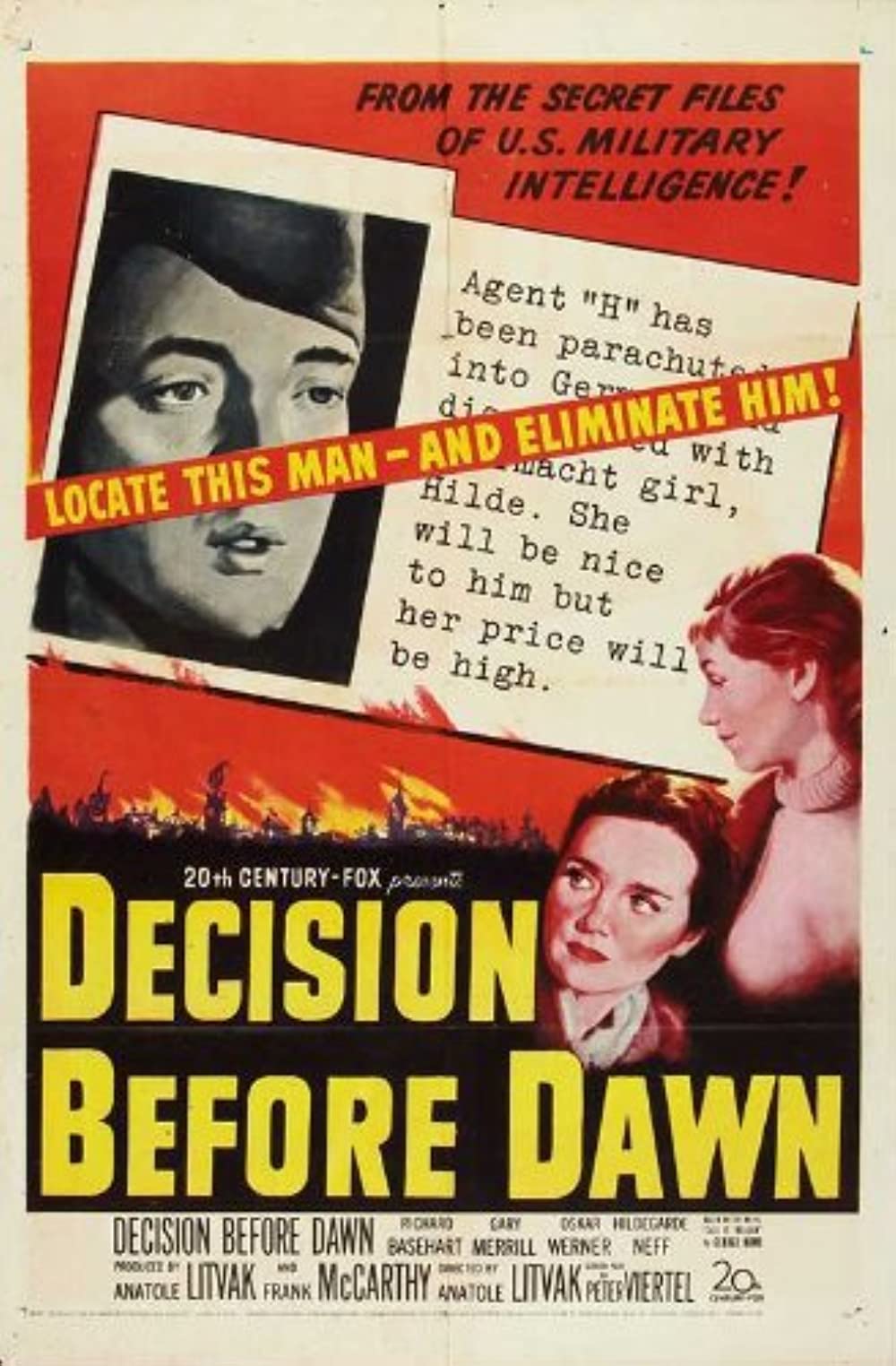
Decision Before Dawn:
The Good German

Steven Clark

3,266 words

I first saw Decision Before Dawn on TV in the mid-sixties on Saturday Night at the Movies, seemingly banal filler that offered a surprisingly good row of early fifties movies such as The Big Carnival (previously reviewed by me), The Desert Fox, and others that were gritty, blunt, and full of Cinéma vérité. This one always stuck with me, and I recently saw it again on YouTube.

What sticks? The realistic setting of this 1951 film in a battered Germany during the Second World War holding off the inevitable, and the strong performance of Oskar Werner as Corporal Mauer, a POW who is convinced by the Americans to go back into Germany on a mission that could supposedly end the war (don’t they all?).

Mauer is an easy touch. He has doubts about the war, and wants to be a Good German . . . to make up for the evil of the Third Reich.

Mauer and an officer surrender to Lt. Rennick, a moody Richard Basehart unsure about his reassignment to intelligence. Under Colonel Devlin (Gary Merrill), Rennick is shown a project Devlin is running involving German POWs who have been turned against the Reich to spy for the Americans. One of them, Tiger (Hans Christian Blech), is a prima donna spy. Devlin wants someone a little more humble, and Mauer is his man.

A companion who was with Mauer when they surrendered is a little too open about his dislike of Hitler and Germany’s blunders, and one night fellow POWs toss him out of a window. This changes Mauer’s mind, and he offers his services to Devlin.

I like the casting throughout this film. The German characters are all actual Germans or Austrians, and the Americans aren’t heroic. Basehart and Merrill don’t really seem like good guys; Rennick is uneasy and moody, and Devlin obviously sees the POWs as his pet project to please the brass. He seems to have good intentions, but is obviously willing to use people to get what he wants. I’m sure Devlin would have had a happy career in the CIA.

One of the American agents is Monique (Dominique Blanch), a French Algerian, and seems interested in Mauer, by this time called “Happy,” his code name. When Devlin asks her if she’s getting too emotionally involved with Mauer, she gets right to the point: He’s just a Boche. It reminds us that the theme of this film is people being used by others, and how emotions are a detriment in war and its element of distrust.

Of course, Monique probably had her own issues later. De Gaulle used the French Algerians to solidify his power, and later, in the Algerian uprising, easily sacrificed them to keep power in France and end the revolt of the native Algerians. This betrayal later led to assassination attempts, as depicted in fictional form in The Day of the Jackal.

Parachuted back into Germany, Mauer makes his way toward completing his mission by finding out the location of an armored corps. Again, I’m impressed by the cinematography; stark, brutal black-and-white filming amidst a background of wreckage, with people and soldiers jammed into trams and trucks, always being stopped to show their papers. The wartime damage shown is the real thing, as it was filmed in Wurzburg and Nuremburg, and I walked these palaces and streets, although they had already been repaired when I was stationed there.

The faces of the Germans are hard, unflinching, and fatalistic. No Hollywood casting here. There was, as I recall, such strength in those people.

Mauer isn’t a great spy. He always gives himself away, and on his first day, it’s known his parachute was found and the Gestapo are on the trail. His name is also on a German list of known captured, and so he will be suspect if he pops up in the middle of the Reich.

Mauer meets a woman on her way to a nursing post who knows him from his father, who is a doctor. He manages to stall her. He thinks to call his father to let him know he’s alive, then hangs up. Oskar Werner captures the genuine existential dilemma of his situation; he is an unperson, belonging no longer to his fatherland, but really not an American, either; Werner’s blank sadness contradicts his being “Happy.”

Mauer is befriended by Sergent Scholtz (Wilfred Seyferth), an SS motorcycle courier, but it’s a dangerous friendship. The man is too friendly, cynical, and always angling for drinks and free lodgings when none are available. His warmth, however, is shot away when Mauer says he was in France.

Where in France? Why, Alsace. Scholtz is angry. “That’s not French. It’s German. It always was, and we took it back.”
You can buy Jef Costello’s The Importance of James Bond here

Uh-oh. Mauer shrugs it off, but Scholtz has been tipped off.

As Scholtz drinks up, Mauer wins the attention of Hilde (Hildegard Knef). She’s a semi-hooker, and is intrigued by Mauer’s coldness. Werner plays hard-to-get very well, yet Hilde, for all her sauciness, is in pain. She admits to Mauer that she lost a child in a bombing raid. She opens her wound to him.

She’s aware that the Gestapo is after him, but it doesn’t matter. He must be a good man. He takes off, and she goes on.

Mauer’s on the lam, but for all his mistakes, he does get to the unit he’s assigned to tail. He winds up with Colonel Von Ecker (O. E. Hasse), commander of the brigade. He has heart problems, but is still a determined officer. Mauer witnesses a soldier brought before Von Ecker for desertion. The man pleads that he had to find his family, who had been bombed out. Von Ecker has no sympathy. Everyone has to do their duty.

Mauer, leaving the unit, passes the soldier, now dangling from a tree.

This would seem an example of Nazi cruelty, at least when I was a child, but again, Von Ecker is shown as decent, fair man. He is concerned about Mauer, since Mauer saves him from a heart attack. But the soldier executed was a deserter, and that’s what happens to deserters in war, and if you don’t hang them, there might not be an army. I remember how I was told the Nazis had executed hundreds of Germans for deserting, but the US had only executed one soldier, Eddie Slovik.

Not really true. We hung quite a few deserters, and desertion was a big, if hushed-up, problem. Need we remember the sainted Emmet Till’s father, who was hung for rape?

In Churchill’s War, David Irving recounts how many GIs in England deserted, became criminals, and were a nuisance to the British. Quite a few of them were black. Churchill was quietly annoyed, but he couldn’t afford to tick off FDR, who turned a blind eye to the misdoings of the colored troops that the British authorities hadn’t wanted sent to Britain in the first place. The British were told they had to take them on or else.

There is a quiet dignity and endurance that the Germans have that came out in this film. You see one woman with an artificial leg as a result of the bombing. Even the Gestapo agent pursuing Mauer isn’t some kind of Nazi robot. He’s flabby and near-sighted; you imagine all the best SS personnel had been siphoned off to Russia.

The film was considered very daring in showing Germans in an equal light, but early fifties movies had this kind of downbeat portrayal of life. See Paddy Chayefsky’s Marty, about normal, average-looking guys trying to find a girl who isn’t a “dog.”

Decision Before Dawn also recalls the film The Enemy Below (1959), where Robert Mitchum was a destroyer escort captain at war with a U-Boat whose captain (Kurt Jurgens) is shown as intelligent, humane, and every bit as human as Mitchum. This trend of humanizing the Germans was curtailed as the sixties came, but you still got to see the German side of things in films like The Battle of Britain or Cross of Iron.

It all died when the TV series Holocaust came out, and everything about the war ended up being about Jews, Jews, Jews. I noted a recent film about Dunkirk where the Germans were never even depicted — no faces, nothing. Just a strange enemy out there. This was in contrast to an earlier sixties film of the same event, where German commanders and flight crews were shown.

But back to Decision Before Dawn. I wondered, looking at the horrible damage inflicted on Germany, how Mauer could even complete his mission. He is a compassionate, uncertain, at times confused young man, and that type would have been easily susceptible to Allied propaganda. But Mauer can see what the Americans are doing to his country. He’s no friend of Hitler, and in the film few Germans are, but they keep fighting, because what choice have they? Nazi control is always apparent, but the wretched destruction and pounding of the cities by the bombers is certainly a statement on the merciless foe who is doing all of this for “democracy.”

The good Germans like Mauer could be understood as wanting a better life than the one Hitler gave them with a disastrous war, but he must have been aware of Allied propaganda, which called for Germany to be exterminated. The Morgenthau plan, which called for Germany to be pastoralized, as well as various pronouncements by Churchill, Stalin, and Roosevelt to the effect that the entire German officer class had to be killed off, as well as demands that most Germans be sterilized . . . The Allies never hid this, and Goebbels made sure the Germans knew it.

So really, why wouldn’t Mauer just be a good German in the POW camp and help the injured? Because he wants to do “something.”

Well, so did the German officers who tried to assassinate Hitler in 1944. They failed, and Hitler was disgusted. Why didn’t they just shoot him?, he argued. A bomb was cowardly. He was said to be almost relieved when it turned out to be officers, as he believed the working class would never have tried to kill him.

In Hitler’s War, David Irving reports Hitler’s summation:

. . . I keep asking myself what they were all after . . . As though Stalin or Churchill or Roosevelt would have been bothered for one instant by our sudden desire for peace! In eight days the Russians would have been in Berlin and it would have been all over for Germany — for good.

True. The Allies showed no interest in sponsoring any kind of coup against Hitler, and Churchill only hoped that when the Gestapo rounded up the conspirators, they would be killed. Fewer of them for the Allies to execute. There was little point in trying to make peace with the Allies. They — we — were bent on crushing Germany. Thus, Mauer is offering his life to the people wrecking his land and killing or maiming his people. The good German becomes a martyr for doing the right thing. It recalls the phrase “Win by losing” from O. T. Gunnarsson’s White Nationalist novel Hear the Cradle Song, which explains the Christian view of sacrifice. You die, suffer, and endure horrible torture, but it makes you superior to your tormenter. You win by losing.

In the post-war period, we were obsessed with finding “good Germans” who would help to build a democracy, fight Communism, and so on. This film was an example of the kind of German we wanted. Of course, it was all portrayed as if we and the Germans were equal allies, and that we would never coerce them . . . unlike the evil Russians.

The German Federal Republic that was established after the war broke all ties with Germany’s military past, and yet when they organized the Bundeswehr in the fifties as part of West Germany’s contribution to NATO (I remember reading a German publication at the time in which its officers proudly stated that they were not German officers, but “officers of NATO”). Germany has always been the most gung-ho NATO member, partly out of enthusiasm but also because they’re ordered to. But it’s tough to build a military while denouncing its traditions. We’re discovering that now by renaming military bases and ditching a lot of old heroes like Robert E. Lee for some obscure black PFC or social activist who did whatever in 1943.

In “democratic” Germany, the officers who plotted to kill Hitler are treated as heroes, but it still doesn’t work. They were, in effect, traitors, and if they had succeeded, it would have had no effect on saving Germany except to stop the killing, and even that wasn’t guaranteed had they not immediately surrendered unconditionally.

You can buy Son of Trevor Lynch’s White Nationalist Guide to the Movies here

I don’t say this to denounce them. I can see why they felt they had to do what they did, much like I understand Mauer wanting to do something good — but it’s better to stay with your own side. There usually isn’t any choice about it.

As for Mauer turning to the Allies after seeing his friend killed by fellow POWs, it was regrettable and perhaps savage, but that’s what prisoners do. If a GI had been pumping for Hitler while in a POW camp, he probably would have been killed by his fellows as well. In Stalag 17, another early fifties movie, director Billy Wilder’s film gives us a character placed by William Holden who is suspected by his fellow POWs of being a German sympathizer because of his cynical, unpatriotic attitude, and they savagely beat him for it. In Wilder’s film, no one comes out a hero. It’s a rotten situation. But Mauer’s good intentions might have been better served by not signing up with the enemy.

Mauer is a strong, decent man, and probably after the war he would have done a lot of good. As it is, he succeeds in his mission, but it all goes up in smoke. The great plan to end the war is negated by another Allied bombing raid that wounds a German general who could have surrendered his forces after being placed under heavy guard at an SS hospital.

There was no subtlety or tactical brilliance in Allied strategy. It was bomb and stamp the enemy into rubble and bones. Patton and Montgomery’s plans for sweeping tactical thrusts were rejected by Ike, who favored a grinding war of attrition. This traditional way of American warmaking began when Grant clawed his way to Richmond.

The film ends on a semi-sour note. Rennick escapes back to the Allied lines, and Devlin shrugs off the loss of “Happy.” He’ll keep up the program of using German POWs. It will become the standard American way of war: using someone else to do the slogging. The road from Devlin’s strategy leads through American strategy in Vietnam to the present day, where it’s acknowledged that we will fight Russia to the last Ukrainian.

Rennick is sadder but wiser, and content to be out of the shadow war and back in a conventional unit.

Decision Before Dawn was filled in a semi-documentary style, and the movie’s grittiness is one of it’s strengths — “telling the truth.”

Rennick understands Mauer is to be written off. He will only be referred to as “Happy” in American files. He is an unknown man. This is usually the fate of spies. Even in James Fenimore Cooper’s novel The Spy (1821), Harvey Birch, a simple peddler who is seen as a loyalist, is actually a spy for Washington, but his work must forever remain unknown despite his service. In his own way, Birch is forgotten.

Yet, Rennick came to admire Mauer. We see how the people he interacted with, from Hilde to Von Ecker, and even the Gestapo agent (for whom Mauer fetches his glasses so the agent can see before a gunfight), were affected by him. You watch this film and will never think of Germans as being faceless machines again. It would be interesting to see what Germans think of this film, especially since reunification, when the Jewish Holocaust propaganda really cranked up.

Rennick sums it up. “A man,” he says, “stays alive as long as he is remembered. He is killed only by forgetfulness.”

Yet, as Rennick is leaving, the driver asks about the mission. Rennick says little except that Happy was lost. The driver shrugs. “Oh, well. It was just another kraut.”

Change that word to “gook” or “raghead,” and you’ll have typical American gratitude to foreigners who support their war efforts. Rennick looks at the GI, saying nothing as he hops into the jeep and goes off to win the war.

It now seems that 75 years of being good Germans has led the country to shut itself down to save democracy in Ukraine, and there are some in the shadows who argue that America is partly doing this to destroy Germany as an economic competitor, although there are enough good Germans there to do the job without overt American backing.

It was poignant that, a few years after reunification, Germans began to talk about the war and their suffering, especially the bombing and starvation they had endured. There was open discussion about the bombings of Hamburg and Dresden, which killed hundreds of thousands of German civilians, and it had been more or less verboten to talk about the bombings before then. Reinhard Gehlen, a veteran of the Third Reich’s intelligence services, formed West Germany’s Federal Intelligence Service after the war. A spy ring jointly operated by Gehlen and the CIA was compromised in 1961 when agent “Felfe” was discovered to be an undercover East German agent who was sending lists of Western agents to the KGB and the Stasi. It was said that Felfe had taken the job mostly because of what had happened to Dresden. He hated the Americans and British for it.

I also noted that the Left clamped down on any German recollections of the bombing, as well as Allied atrocities against Germans, including the starvation of German POWs under Eisenhower. The German populace was, of course, expected to keep their mouths shut, be good Germans, and forget everything except suffering by the Jews. Or else.

I also think of how the stark, uneasy, and truthful depiction of an embattled Germany in Decision Before Dawn morphed into charming TV depictions like Hogan’s Heroes, where there is a Sergeant Schultz who “knows nothing.” I thought Scholtz in Decision Before Dawn was more likable and honest, but then Hogan’s Heroes was a show made by Jews and by and large featuring Jews in its cast. It was TV land, where Hogan and his gang pull off one espionage stunt per week. In Decision Before Dawn, even one espionage mission planned by Devlin was a long shot which ended up with losses.

Agents usually had a low survival rate. Interestingly, Americans posing as Germans were always caught by the Gestapo. They gave themselves away by various mannerisms, such as the fact that when they sat, they crossed their legs at a wide angle. Germans always cross their legs close. The agents who seemed to survive best were Jews, for obvious reasons.

As Marx said, when history is repeated, it usually becomes farce, and so it is that history eventually becomes a joke . . . at least in TV land. That’s why I enjoyed seeing Decision Before Dawn again. I thought of Rennick’s musing about being remembered, and about how the Germans have been drilled to forget — much like how we are now being similarly drilled to forget our history, race, and civilization. This film is a black-and-white world of truth and tragedy — cinema worth revisiting.

*  *  *

Counter-Currents has extended special privileges to those who donate $120 or more per year.

  • First, donor comments will appear immediately instead of waiting in a moderation queue. (People who abuse this privilege will lose it.)
  • Second, donors will have immediate access to all Counter-Currents posts. Non-donors will find that one post a day, five posts a week will be behind a “Paywall” and will be available to the general public after 30 days.
  • Third, Paywall members have the ability to edit their comments. 
  • Fourth, Paywall members can “commission” a yearly article from Counter-Currents. Just send a question that you’d like to have discussed to [email protected]. (Obviously, the topics must be suitable to Counter-Currents and its broader project, as well as the interests and expertise of our writers.)
  • Fifth, Paywall members will have access to the Counter-Currents Telegram group. 

To get full access to all content behind the paywall, sign up here:

Paywall Gift Subscriptions

If you are already behind the paywall and want to share the benefits, Counter-Currents also offers paywall gift subscriptions. We need just five things from you:

  • your payment
  • the recipient’s name
  • the recipient’s email address
  • your name
  • your email address

To register, just fill out this form and we will walk you through the payment and registration process. There are a number of different payment options.

Decision Before Dawn: The Good German

Decision%20Before%20Dawn%3A%20The%20Good%20German

Share

  • Gab
  • The Good German &body=%0D%0A%0D%0A%0D%0A%0D%0A%0D%0A%0D%0Ahttps://counter-currents.com/2022/09/decision-before-dawn-the-good-german/%0D%0A%0D%0A%0D%0A%0D%0A">

Enjoyed this article?

Be the first to leave a tip in the jar!

Instant Echeck GreenPay™

Related

  • The Russians are Coming/The Russians are Coming

  • Counter-Currents Radio Podcast No. 686

  • Le Debacle: Historical Echoes of Zola’s France

  • David Lean’s A Passage to India

  • Neo-Fascism in Film, Part 3

  • E. M. Forster’s A Passage to India & the Indian Mentality

  • Jonathan Bowden’s Deliverance, Part 3

  • The Rest Is Silence: Heidegger’s Quietism

Tags

anti-German violenceDecision Before DawnGermanymovie reviewspaywallspyingSteven Clarkthe Alliesthe Second World Warthe Third Reich

1 comment

  1. Clarissa S. says:
    October 23, 2022 at 11:30 pm

    Thank you for paroling this article from the paywall for my birthday – I’ve been looking forward to reading it!

    I’ve never watched the movie but I’ll definitely put it on my list now. Agreed, the 1950s (and even the late 1940s for that matter) had a number of excellent films that are still worth watching and that I’ve only learned to appreciate as I got older. The change in Hollywood to the “good German” narrative was of course prompted by the Cold War and the attempt to integrate West Germany into NATO. On the one hand, you had to play to German sensitivities (or psychosis…) by showing that, yes, we know there were good guys among you. On the other hand, you had to sell to a western audience the idea that all of a sudden “the most evil people on earth” (quote Band of Brothers interview) would fight alongside virtuous Allied forces. So in a way, it’s propaganda, but as long as it gives food for thought, I don’t mind too much.
    The Big Lift, a very early example of the narrative, came about mostly by accident, as actress Bruni Löbel explained. The original story was much more black and white, based for the most part on tales by US soldiers, until Löbel protested and had the filmmakers actually meet some Germans. The film is much better for it – and also worth watching for its very real ruined Berlin setting.

    As for what “Germans” would think of Decision Before Dawn today, I’m afraid I’ve yet to meet “them” in spite of having lived in Germany all my life. 😉 But I get your point. It certainly depends. Most would think little of the underlying issues, I suppose. And yet, if you talk to people who have even a rudimentary knowledge of history, they’re not impressed with Allied policy, east or west. “What we were taught in school, that was pure indoctrination anyway”, a colleague once told me. But that spoken or unspoken acknowledgment comes across not as angry or outraged but simply as bored. People know more than is generally talked about, they just don’t make a big deal out of it. Whether that’s a good thing or not is another topic…

    0
    0

Comments are closed.

If you have a Subscriber access,
simply login first to see your comment auto-approved.

Note on comments privacy & moderation

Your email is never published nor shared.

Comments are moderated. If you don't see your comment, please be patient. If approved, it will appear here soon. Do not post your comment a second time.

Writers of May

(2 votes) Morris van de Camp David M. Zsutty Derek Stark Jayant Bhandari Greg Johnson

Articles of May

Heidegger on Nietzsche, Part One by Collin Cleary The Lunch Wars by David M. Zsutty 2 votes
    • Counter-Currents Radio Podcast No. 691
      Rob Rundo Returns

      Counter-Currents Radio

    • The Fragile Polity that is Syria

      Morris van de Camp

      1

    • Nigel Farage Calls Britain a Two-Tier State

      Mark Gullick

      3

    • Nationalism This Week
      Letter to J. D. Vance

      Greg Johnson

      26

    • Lost In Trans-Mission:
      How the Media Fails To Reveal the Inconvenient Truth About the Usual Suspects

      Steven Tucker

      10

    • Liar, Liar, Pants on Fire!

      Beau Albrecht

      7

    • Editor’s Update
      Rob Rundo on Counter-Currents Radio, Fundraiser Update, & a New $20,000 Matching Grant

      Greg Johnson

    • The Bitter End of Western Metaphysics:
      Heidegger on Nietzsche, Part Three

      Collin Cleary

      10

    • Uncivil War

      Mark Gullick

      49

    • Exclusive Interview with Karel Veliky:
      The Final Chapter in the Film Series! Part II

      Ondrej Mann

      2

    • Happy Birthday to Us!

      Greg Johnson

      6

    • Zsutty’s Maximum

      David M. Zsutty

      16

    • Exclusive Interview with Karel Veliky:
      The Final Chapter in the Film Series! Part I

      Ondrej Mann

      2

    • The Union Jackal, June 2026

      Mark Gullick

      23

    • The Inferiority Behind Immigrant Superiority

      Jayant Bhandari

      15

    • Counter-Currents Radio Podcast No. 690
      Greg Johnson & David Zsutty Discuss Current Things: AI, Henry Nowak, the Iran Crisis, & More

      Counter-Currents Radio

      7

    • Collin Cleary: What Rome Means to Me

      Collin Cleary

      4

    • Paul Krugman: Closet Bolshevik

      Spencer J. Quinn

      21

    • Fugue of Ideas:
      Ibram X. Kendi’s Chain of Ideas

      Greg Johnson

      19

    • Based Blacks

      Lipton Matthews

      24

    • Black Intellectual Fatigue

      Derek Stark

      41

    • Why White Advocates Should Avoid “Based Blacks”

      Dani Vypont

      32

    • Nietzsche & Race

      Mark Gullick

    • Editor’s Update
      Rob Rundo Rescheduled to Next Week on Counter-Currents Radio;
      Tonight Greg Johnson & David Zsutty Answer Your Questions;
      Fundraiser Update & a New $20,000 Matching Grant

      Greg Johnson

    • The Counter-Currents 2026 Fundraiser
      Lifetime Subscriber Welcome Packages Extended

      Greg Johnson

    • Nationalism This Week
      Who’s Looking Back?

      Greg Johnson

      29

    • China’s Threat to American Security:
      Food, Farmland, Foreign Control, & Energy Policy

      Lipton Matthews

      5

    • The Bitter End of Western Metaphysics:
      Heidegger on Nietzsche, Part Two

      Collin Cleary

      16

    • The Killing of Henry Nowak

      Mark Gullick

      38

    • The Crisis of Chinese Technology Thieves

      Morris van de Camp

      1

    • The Strange World of Gender Bender Fiction:
      & What This Genre Tells Us About Autosexuality

      Dani Vypont

      3

    • Watching the Watchers:
      The Dark Triad Question

      David M. Zsutty

      14

    • The Remigration Movement Solidifies

      F. Roger Devlin

      2

    • Casting Aspersions:
      The Fatal Consequences of Race-Swapped Casting, From Helen of Troy to Henry of Southampton

      Steven Tucker

      20

    • The Murder of Henry Nowak

      Millennial Woes

      23

    • Don’t Forget to Vote in Our Writer & Article of the Month Poll

      Greg Johnson

    • The Robot Hotdog Stand

      Greg Johnson

      37

    • Laughing Our Way to Victory

      Dave Chambers

      7

    • The Zodiac Killer

      Mark Gullick

      11

    • Jared Taylor: What Rome Means to Me

      Jared Taylor

      1

    • An Interview with Endeavour:
      My Way of Life Is an Adventure!

      Ondrej Mann

      6

    • José Pedro Zúquete’s The Identitarians

      Greg Johnson

      3

    • Editor’s Update
      Fundraiser Update & How to Watch the Remigration Summit

      Greg Johnson

      5

    • The Bitter End of Western Metaphysics:
      Heidegger on Nietzsche, Part One

      Collin Cleary

      12

    • Berlin: City of Stones

      Spencer J. Quinn

      6

    • True Folk-Horror Is Horror of Your Own Folk:
      Mark Gatiss vs the Brexit Blind Dead  

      Steven Tucker

      4

    • Counter-Currents Radio Podcast No. 689
      Thomas Massie, the America 2050 Bust, the Need for Whites to Divest from America, the AI Economic Apocalypse, & Pro-White Project Pitches to Billionaires

      Counter-Currents Radio

      7

    • Nationalism This Week
      Remigration is Inevitable, Part 3

      Greg Johnson

      27

    • Why Billionaires Should Fund White Identity Politics

      Lipton Matthews

      8

    • How Cold War Two Came About

      Morris van de Camp

      5

    • Beau Albrecht

      The Fragile Polity that is Syria

      It seems that they didn't learn the lesson that diversity is a country's greatest strength.  How...

    • Will Williams

      I was interviewed by the NY Post Friday, mostly about Miss Heidi’s participation with the SPLC. The...

    • Will Williams

      Nigel Farage Calls Britain a Two-Tier State

      Farage may turn out to be the latest in a line of snake-oil salesmen posing as saviors…---He’s...

    • Joe Gould

      Nationalism This Week
      Letter to J. D. Vance

      "If Trump does not go quietly, Vance can withhold his pardon and let the dogs in Congress tear Trump...

    • Peter Quint

      Nationalism This Week
      Letter to J. D. Vance

      I can’t tell from this far off. I wouldn’t put it pass him; it is pretty common these days. 🙃

    • Adrian Roberts

      Nationalism This Week
      Letter to J. D. Vance

      Does he wear eye-liner?

    • Doug Harrison

      Nationalism This Week
      Letter to J. D. Vance

      So it's a good career move for the cabinet secretaries to save the country from a deranged chief...

    • Greg Johnson

      Nationalism This Week
      Letter to J. D. Vance

      I am pretty sure that everyone in the cabinet wants a political career or just to enjoy his life in...

    • Adrian Roberts

      Nigel Farage Calls Britain a Two-Tier State

      ‘Unelected PM’. This is a silly term, first used by David Cameron to taunt Gordon Brown after he...

    • Greg Johnson

      Nationalism This Week
      Letter to J. D. Vance

      He "stood up" to the neocons because Iran had the ability to completely wreck the Gulf and the...

    • Doug Harrison

      Nationalism This Week
      Letter to J. D. Vance

      Yes, the pardon would be Vance's defensive weapon. Who would Vance trust to confide in regarding the...

    • Lexi

      Nationalism This Week
      Letter to J. D. Vance

      Yes, I think a brief Democratic Congressional majority is now baked in.  There will not be a...

    • Judas

      Nationalism This Week
      Letter to J. D. Vance

      I'm not sure if Trump is a Svengali or more of a Pied Piper and I don't really know who may be...

    • Will Williams

      Uncivil War

      Paudi McCreevey: June 16, 2026  White Nationalism and Christianity are compatible.---No, they...

    • Peter Quint

      Nigel Farage Calls Britain a Two-Tier State

      This carefully crafted animus is reaching critical levels in the US after the conviction and...

    • Will Williams

      Uncivil War

      Peter Quint: June 12, 2026  There are many reports of Catholics and Protestants sitting down...

    • JaymunD

      Lost In Trans-Mission:
      How the Media Fails To Reveal the Inconvenient Truth About the Usual Suspects

      The same goes for the "race is a social construct" creed.  Pretty soon my Money Market Fund will be...

    • Paudi McCreevey

      Uncivil War

      I know. It's sad. They preach Woke and not the Scriptures. Dark times.

    • Greg Johnson

      Uncivil War

      Preach it in the churches.

    • Greg Johnson

      Nationalism This Week
      Letter to J. D. Vance

      It isn't like Leftism will start working magically. And it isn't like they will learn to moderate...

    • Earth Day Special

      John Morgan

      12

    • A Robertson Roundup
      Remembering Wilmot Robertson
      (April 16, 1915 – July 8, 2005)

      Margot Metroland

      13

    • The Paranoid Style in White Nationalism

      Greg Johnson

      30

    • Join the Dance!

      Andrew Hamilton

      1

    • We Can’t Save the Earth Without Reducing African Birth Rates

      James Dunphy

      36

    • “I’m Not a Conspiracy Theorist, but . . .”:
      Jeffrey Epstein’s Death Gives New Life to “Conspiracy Theories”

      Greg Johnson

      22

    • Sylvia Plath: Stasis in Darkness

      Vic Olvir

      17

    • Vanguardism, Vantardism, & Mainstreaming

      Greg Johnson

      80

    • Aviation, Geography, & Race

      Charles Lindbergh

      3

    • Some Thoughts on Yule

      Collin Cleary

      4

    • Living in Truth:
      A Yuletide Homily

      Jef Costello

      7

    • John Kennedy Toole’s A Confederacy of Dunces

      Greg Johnson

      20

    • On Aleksandr Solzhenitsyn’s Warning to the West

      Spencer J. Quinn

      7

    • Elitism, British Modernism, & Wyndham Lewis

      Jonathan Bowden

      6

    • Philip K. Dick’s Do Androids Dream of Electric Sheep? as Anti-Semitic/Christian-Gnostic Allegory

      Greg Johnson

      20

    • “Conspiracy Theory” or Conspiracy?

      Andrew Hamilton

      21

    • Remembering H. P. Lovecraft
      (August 20, 1890–March 15, 1937)

      Greg Johnson

      3

    • Who Are We?
      Nordics, Aryans, & Whites

      Greg Johnson

      71

    • Remembering William Gayley Simpson
      (July 23, 1892–December 31, 1990)
      A Pleasant Afternoon with Harriet & Bill Simpson

      Margot Metroland

      18

    • Here are the Young Men
      Remembering Ian Curtis
      (July 15, 1956–May 18, 1980)

      Mark Gullick

      18

    • Percy Grainger
      Artist of the Right

      Alex Graham

      7

    • Remembering Revilo Oliver
      (July 7, 1908–August 20, 1994)

      Greg Johnson

      18

    • The Meaning of July 4th for the White Man

      Gregory Hood

      13

    • The Front National’s Evolution

      Bruno Mégret

    • Merwin K. Hart
      Forgotten American Hero & Man of the Right

      Morris van de Camp

      10

    • George Orwell’s Nineteen Eighty-Four

      Jonathan Bowden

      8

    • Carleton S. Coon
      Scientist & Reluctant White Advocate

      Morris van de Camp

      3

    • The Kwanzaa Absurdity Will Be Dwarfed by Juneteenth

      Robert Hampton

      10

    • Stravinsky

      Alex Graham

      7

    • Like the Roman:
      Remembering Enoch Powell (1912-1998)

      Mark Gullick

      23

    • The 1970s: The Golden Age of Hijacking

      Morris van de Camp

      21

    • Jonathan Bowden’s Deliverance
      Part 6

      Jonathan Bowden

    • Do You Want to Play a Game?

      Mark Gullick

      1

    • Sexually Incontinent on the Indian Subcontinent:
      Who Rapes More Animals, Indians or Pakistanis? The Battle Continues!

      Steven Tucker

      3

    • Neo-Fascism in Film
      Part 5

      Karel Veliky

      15

    • The Game of Tarot

      Mark Gullick

      2

    • Institutions Cannot Be Transplanted

      Jayant Bhandari

      5

    • Jonathan Bowden’s Deliverance
      Part 5

      Jonathan Bowden

    • Crosstown Traffic:
      Jimi Hendrix & The Post-War Rock ‘N’ Roll Revolution

      Mark Gullick

      1

    • Slaves from the North:
      Finns & Karelians in the East European Slave Trade, 900–1600

      Lipton Matthews

      14

    • Neo-Fascism in Film
      Part 4

      Karel Veliky

      2

    • David Lean’s A Passage to India

      Spencer J. Quinn

      1

    • Elites are Essential to Development

      Lipton Matthews

      7

    • Jonathan Bowden’s Deliverance
      Part 4

      Jonathan Bowden

    • Neo-Fascism in Film
      Part 3

      Karel Veliky

      6

    • E. M. Forster’s A Passage to India & the Indian Mentality

      Spencer J. Quinn

      25

    • Jonathan Bowden’s Deliverance
      Part 3

      Jonathan Bowden

    • The Rest Is Silence
      Heidegger’s Quietism

      Mark Gullick

      2

    • Dispelling the Historical Fallacy of Indian Nationalism

      Lipton Matthews

      8

    • Neo-Fascism in Film
      Part 2

      Karel Veliky

      8

    • Jonathan Bowden’s Deliverance
      Part 2

      Jonathan Bowden

    • Life of a Klansman

      Mark Gullick

      8

    • Jonathan Bowden’s Deliverance, Part 1

      Jonathan Bowden

    • Decolonial Ideas are Holding Back Developing Countries

      Lipton Matthews

      8

    • Neo-fascism in Film, Part 1

      Karel Veliky

      21

    • Jonathan Bowden’s Onslaught, Part 8
      Divigations on Decadence

      Jonathan Bowden

    • Jonathan Bowden’s Onslaught, Part 7
      Intrigues in the National Front

      Jonathan Bowden

      1

    • Rotten to the Core

      Mark Gullick

      8

    • Strauss on Husserl’s “Philosophy as Rigorous Science”

      Greg Johnson

    • Jonathan Bowden’s Onslaught, Part 6
      Francis Bacon & Right-Wing Nihilism

      Jonathan Bowden

    • András László
    • Derek Hawthorne
    • Beau Albrecht
    • Alain de Benoist
    • Kerry Bolton
    • Jonathan Bowden
    • Collin Cleary
    • Jef Costello
    • Savitri Devi
    • Julius Evola
    • Jim Goad
    • Gregory Hood
    • Juleigh Howard-Hobson
    • Greg Johnson
    • Charles Krafft
    • Anthony M. Ludovici
    • Trevor Lynch
    • H. L. Mencken
    • J. A. Nicholl
    • James J. O’Meara
    • Christopher Pankhurst
    • Tito Perdue
    • Michael Polignano
    • Spencer J. Quinn
    • Fenek Solère
    • Irmin Vinson
    • Leo Yankevich
    • Francis Parker Yockey
    • Multiple authors
  • Editor-in-Chief

    • Greg Johnson, Ph.D.

    Featured Writers

    • Beau Albrecht
    • Gunnar Alfredsson
    • Collin Cleary, Ph.D.
    • Jef Costello
    • Morris V. de Camp
    • F. Roger Devlin, Ph.D.
    • Stephen Paul Foster, Ph.D.
    • Jim Goad
    • Alex Graham
    • Mark Gullick, Ph.D.
    • Greg Johnson, Ph.D.
    • Travis LeBlanc
    • Trevor Lynch
    • Margot Metroland
    • James J. O’Meara
    • Angelo Plume
    • Spencer J. Quinn
    • Fred Reed
    • Clarissa Schnabel
    • Michael Walker
    • David M. Zsutty

    Frequent Writers

    • Asier Abadroa
    • Aquilonius
    • Alain de Benoist
    • Kerry Bolton, Ph.D.
    • Dave Chambers
    • Steven Clark
    • James Dunphy
    • Endeavour
    • Richard Houck
    • Jason Kessler
    • Titus Livius
    • Ondrej Mann
    • Lipton Matthews
    • Mark Mazari
    • John Morgan
    • Jaroslav Ostrogniew
    • Kathryn S.
    • Christian Secor
    • Anne Wilson Smith
    • Thomas Steuben
    • William De Vere
    • Kenneth Vinther
    • Max West

    Classic Authors

    • Maurice Bardèche
    • Jonathan Bowden
    • Julius Evola
    • Guillaume Faye
    • Ernst Jünger
    • Kevin MacDonald, Ph.D.
    • D. H. Lawrence
    • Charles Lindbergh
    • Jack London
    • H. P. Lovecraft
    • Anthony M. Ludovici
    • Sir Oswald Mosley
    • National Vanguard
    • Friedrich Nietzsche
    • Revilo Oliver
    • William Pierce
    • Ezra Pound
    • Saint-Loup
    • Savitri Devi
    • Carl Schmitt
    • Miguel Serrano
    • Oswald Spengler
    • P. R. Stephensen
    • Jean Thiriart
    • John Tyndall
    • Dominique Venner
    • Leo Yankevich
    • Francis Parker Yockey

    Other Authors

    • Howe Abbott-Hiss
    • Michael Bell
    • Giles Corey
    • Jack Donovan
    • Richardo Duchesne, Ph.D.
    • Emile Durand
    • Guillaume Durocher
    • Mark Dyal
    • Tom Goodroch
    • Andrew Hamilton
    • Robert Hampton
    • Huntley Haverstock
    • Derek Hawthorne
    • Gregory Hood
    • Juleigh Howard-Hobson
    • Alexander Jacob
    • Ruuben Kaalep
    • Tobias Langdon
    • Julian Langness
    • Patrick Le Brun
    • G A Malvicini
    • John Michael McCloughlin
    • Millennial Woes
    • Michael O’Meara
    • Christopher Pankhurst
    • Michael Polignano
    • J. J. Przybylski
    • Quintilian
    • Edouard Rix
    • C. B. Robertson
    • C. F. Robinson
    • Herve Ryssen
    • Alan Smithee
    • Fenek Solere
    • Ann Sterzinger
    • Robert Steuckers
    • Tomislav Sunic
    • Donald Thoresen
    • Marian Van Court
    • Irmin Vinson
    • Book Reviews
    • Movie Reviews
    • TV Reviews
    • Music Reviews
    • Art Criticism
    • Graphic Novels & Comics
    • Video Game Reviews
    • Fiction
    • Poems
    • Interviews
    • Videos
    • English Translations
    • Other Languages
      • Arabic
      • Bulgarian
      • Croatian
      • Czech
      • Danish
      • Dutch
      • Estonian
      • Finnish
      • French
      • German
      • Greek
      • Hungarian
      • Italian
      • Lithuanian
      • Norwegian
      • Polish
      • Portuguese
      • Romanian
      • Russian
      • Slovak
      • Spanish
      • Swedish
      • Ukrainian
    • Commemorations
    • Why We Write
  • Archives
  • Top 100 Commenters
  • The Looney Bin
Sponsored Links
Europa.com Above Time Coffee Antelope Hill Publishing Paul Waggener IHR-Store Spencer J. Quinn American Renaissance Jim Goad The Occidental Observer
Donate Now Mailing list
Books for sale
  • The Philosopher Is In
  • Sexual Utopia in Power (Expanded Edition)
  • In Defense of Prejudice
  • Loving Our Own
  • Tyranny & Wisdom
  • The Populist Moment
  • Is America Doomed?
  • To all books
Copyright © 2026 Counter-Currents Publishing, Ltd.

Paywall Access


Please enter your email address.

Lost your password?

Edit your comment

Writer & Article of the Month May 2026

Voting for this month has concluded. Here are the final results!

Top Writers

  • #1 Morris van de Camp 2 votes
  • #2 David M. Zsutty 2 votes
  • #3 Derek Stark 2 votes
  • #4 Jayant Bhandari 2 votes
  • #5 Greg Johnson 2 votes
  • #6 Jared Taylor 1 vote
  • #7 Collin Cleary 1 vote
  • #8 Spencer J. Quinn 1 vote
  • #9 Mark Gullick 1 vote
  • #10 Lipton Matthews 1 vote
  • #11 Keith Woods 1 vote
  • #12 Steven Tucker 1 vote

Top Articles

  • #1 Heidegger on Nietzsche, Part One 2 votes
  • #2 The Lunch Wars 2 votes
  • #3 The 1970s: The Golden Age of Hijacking 1 vote
  • #4 True Folk-Horror Is Horror of Your Own Folk 1 vote
  • #5 Finding Atlantis Part 4 1 vote
  • #6 Berlin: City of Stones 1 vote
  • #7 The Ghost of the Confederacy 1 vote
  • #8 Lothrop Stoddard’s The Revolt Against Civilization 1 vote
  • #9 Could Fascism Work? 1 vote
  • #10 Jared Taylor's Elevator Pitch to a Billionaire 1 vote
  • #11 Predation Wearing the Mask of Civilization 1 vote
  • #12 Peak Fatigue in Fort Wayne 1 vote
  • #13 Keith Wood's Elevator Pitch to a Billionaire 1 vote
  • #14 Do You Want to Play a Game? 1 vote
  • #15 Why Billionaires Should Fund White Identity Politics 1 vote

Total votes cast: 17