Counter-Currents
  • Advertise
  • Private Events
  • T&C
  • About
  • Contact
  • RSS
    • Main feed
    • Podcast feed
    • Videos feed
    • Comments feed
  • Welcome
  • Webzine
  • Books
  • Merch
  • Podcasts
  • Videos
  • Donate
  • Patrons
  • Subscribe
  • Crypto

LEVEL2

Donate Now Mailing list
Upcoming podcasts
  • Rob Rundo on Counter-Currents Radio

    Rob Rundo on Counter-Currents Radio

    Counter-Currents Radio

    06/13/2026 — 3 pm EST / 9 pm CET

Writers of May

(2 votes) Morris van de Camp David M. Zsutty Derek Stark Jayant Bhandari Greg Johnson

Articles of May

Heidegger on Nietzsche, Part One by Collin Cleary The Lunch Wars by David M. Zsutty 2 votes
  • Welcome
  • Webzine
  • Books
  • Merch
  • Podcasts
  • Videos
  • Donate
  • Patrons
  • Subscribe
  • Crypto
    • Editor’s Update
      Rob Rundo on Counter-Currents Radio, Fundraiser Update, & a New $20,000 Matching Grant

      Greg Johnson

    • The Bitter End of Western Metaphysics:
      Heidegger on Nietzsche, Part Three

      Collin Cleary

      10

    • Uncivil War

      Mark Gullick

      32

    • Exclusive Interview with Karel Veliky:
      The Final Chapter in the Film Series! Part II

      Ondrej Mann

      2

    • Happy Birthday to Us!

      Greg Johnson

      6

    • Zsutty’s Maximum

      David M. Zsutty

      15

    • Exclusive Interview with Karel Veliky:
      The Final Chapter in the Film Series! Part I

      Ondrej Mann

      2

    • The Union Jackal, June 2026

      Mark Gullick

      23

    • The Inferiority Behind Immigrant Superiority

      Jayant Bhandari

      15

    • Counter-Currents Radio Podcast No. 690
      Greg Johnson & David Zsutty Discuss Current Things: AI, Henry Nowak, the Iran Crisis, & More

      Counter-Currents Radio

      5

    • Collin Cleary: What Rome Means to Me

      Collin Cleary

      4

    • Paul Krugman: Closet Bolshevik

      Spencer J. Quinn

      19

    • Fugue of Ideas:
      Ibram X. Kendi’s Chain of Ideas

      Greg Johnson

      18

    • Based Blacks

      Lipton Matthews

      12

    • Black Intellectual Fatigue

      Derek Stark

      38

    • Why White Advocates Should Avoid “Based Blacks”

      Dani Vypont

      29

    • Nietzsche & Race

      Mark Gullick

    • Editor’s Update
      Rob Rundo Rescheduled to Next Week on Counter-Currents Radio;
      Tonight Greg Johnson & David Zsutty Answer Your Questions;
      Fundraiser Update & a New $20,000 Matching Grant

      Greg Johnson

    • The Counter-Currents 2026 Fundraiser
      Lifetime Subscriber Welcome Packages Extended

      Greg Johnson

    • Nationalism This Week
      Who’s Looking Back?

      Greg Johnson

      29

    • China’s Threat to American Security:
      Food, Farmland, Foreign Control, & Energy Policy

      Lipton Matthews

      5

    • The Bitter End of Western Metaphysics:
      Heidegger on Nietzsche, Part Two

      Collin Cleary

      16

    • The Killing of Henry Nowak

      Mark Gullick

      38

    • The Crisis of Chinese Technology Thieves

      Morris van de Camp

      1

    • The Strange World of Gender Bender Fiction:
      & What This Genre Tells Us About Autosexuality

      Dani Vypont

      3

    • Watching the Watchers:
      The Dark Triad Question

      David M. Zsutty

      14

    • The Remigration Movement Solidifies

      F. Roger Devlin

      1

    • Casting Aspersions:
      The Fatal Consequences of Race-Swapped Casting, From Helen of Troy to Henry of Southampton

      Steven Tucker

      20

    • The Murder of Henry Nowak

      Millennial Woes

      23

    • Don’t Forget to Vote in Our Writer & Article of the Month Poll

      Greg Johnson

    • The Robot Hotdog Stand

      Greg Johnson

      37

    • Laughing Our Way to Victory

      Dave Chambers

      7

    • The Zodiac Killer

      Mark Gullick

      11

    • Jared Taylor: What Rome Means to Me

      Jared Taylor

      1

    • An Interview with Endeavour:
      My Way of Life Is an Adventure!

      Ondrej Mann

      6

    • José Pedro Zúquete’s The Identitarians

      Greg Johnson

      3

    • Editor’s Update
      Fundraiser Update & How to Watch the Remigration Summit

      Greg Johnson

      5

    • The Bitter End of Western Metaphysics:
      Heidegger on Nietzsche, Part One

      Collin Cleary

      12

    • Berlin: City of Stones

      Spencer J. Quinn

      6

    • True Folk-Horror Is Horror of Your Own Folk:
      Mark Gatiss vs the Brexit Blind Dead  

      Steven Tucker

      4

    • Counter-Currents Radio Podcast No. 689
      Thomas Massie, the America 2050 Bust, the Need for Whites to Divest from America, the AI Economic Apocalypse, & Pro-White Project Pitches to Billionaires

      Counter-Currents Radio

      7

    • Nationalism This Week
      Remigration is Inevitable, Part 3

      Greg Johnson

      27

    • Why Billionaires Should Fund White Identity Politics

      Lipton Matthews

      8

    • How Cold War Two Came About

      Morris van de Camp

      5

    • Now Available for Pre-Order at a Special Price!
      Greg Johnson’s The Philosopher Is In

      Greg Johnson

    • David Zsutty’s Elevator Pitch to a Billionaire

      David M. Zsutty

      1

    • Headbanging Lite

      Mark Gullick

      5

    • White Advocacy Past and Present

      Peter Bradley

      13

    • The Lunch Wars

      David M. Zsutty

      47

    • The Russians are Coming/The Russians are Coming

      Steven Clark

      1

    • Taig77

      Uncivil War

      "...the Republicans wanted Northern Ireland to be independent." will come as a great surprise to...

    • Collin Cleary

      Heidegger on Nietzsche Part Three

      I have not heard of the Beattie dissertation, or of any discussion of it. The Mansfield book is also...

    • Collin Cleary

      Heidegger on Nietzsche Part Three

      I believe in objective truth, just not the Christian claims about objective truth. Truth is what...

    • Collin Cleary

      Heidegger on Nietzsche Part Three

      Thank you very much!

    • tempus

      Why White Advocates Should Avoid “Based Blacks”

      As for lending money, that also goes for Whites. Never lend more than you are willing to make a gift...

    • tempus

      Why White Advocates Should Avoid “Based Blacks”

      The only person other than my brother to whom I have lent money who ever paid me back was a Black...

    • tempus

      Why White Advocates Should Avoid “Based Blacks”

      The Old South was nowhere near as anti-black as the Old North. Part of the Republican platform on...

    • tempus

      Black Intellectual Fatigue

      Hopefully, more Whites are ceasing to be racial nihilists and are abandoning the new morality (...

    • Jaego

      Uncivil War

      The Orthodox ideal - just like every other denomination - is people of all races worshiping together...

    • Jaego

      Uncivil War

      Isolate the police. Family or friends, no matter. Disown them. Maybe in time people will forgive...

    • Jaego

      Uncivil War

      Tikkun Olam. Repair of the World. Enabling mass immigration is a mitzvah or holy deed in the Repair...

    • I Do Not Surrender, My Hand Is Red.

      Uncivil War

      This is very good advice Joe. Very good.

    • NIdahoOrthodox

      Uncivil War

      How many tens of thousands of automatic weapons and tons of Semtex are in hidden caches in the North...

    • kolokol

      Uncivil War

      Stephen Ogilvie is the latest example of a decent, hard-working White person, killed by a useless...

    • Dr. X

      Uncivil War

      Great writeup. One error- I doubt the Republic of Ireland police (Garda) were responding on the...

    • kolokol

      Uncivil War

      This is a very good start. May it continue and accelerate, until all the invaders have been expelled...

    • Observer

      Heidegger on Nietzsche Part Three

      Ouch. Well, I had used the bullet formatting in the text box to break it up a bit... but it looks...

    • Gabe

      Uncivil War

      Scots-Irish is an American term. It's true that Presbyterians and others came from Scotland to...

    • Gabe

      Uncivil War

      I was just going to write that myself. The Garda Siochána, or guards, is a term they use in the...

    • Ondrej Mann

      Exclusive Interview with Karel Veliky Part 2

      Thanks for the cultural tip. I’m currently preparing an interview for CC with the Austrian band...

    • Earth Day Special

      John Morgan

      12

    • A Robertson Roundup
      Remembering Wilmot Robertson
      (April 16, 1915 – July 8, 2005)

      Margot Metroland

      13

    • The Paranoid Style in White Nationalism

      Greg Johnson

      30

    • Join the Dance!

      Andrew Hamilton

      1

    • We Can’t Save the Earth Without Reducing African Birth Rates

      James Dunphy

      36

    • “I’m Not a Conspiracy Theorist, but . . .”:
      Jeffrey Epstein’s Death Gives New Life to “Conspiracy Theories”

      Greg Johnson

      22

    • Sylvia Plath: Stasis in Darkness

      Vic Olvir

      17

    • Vanguardism, Vantardism, & Mainstreaming

      Greg Johnson

      80

    • Aviation, Geography, & Race

      Charles Lindbergh

      3

    • Some Thoughts on Yule

      Collin Cleary

      4

    • Living in Truth:
      A Yuletide Homily

      Jef Costello

      7

    • John Kennedy Toole’s A Confederacy of Dunces

      Greg Johnson

      20

    • On Aleksandr Solzhenitsyn’s Warning to the West

      Spencer J. Quinn

      7

    • Elitism, British Modernism, & Wyndham Lewis

      Jonathan Bowden

      6

    • Philip K. Dick’s Do Androids Dream of Electric Sheep? as Anti-Semitic/Christian-Gnostic Allegory

      Greg Johnson

      20

    • “Conspiracy Theory” or Conspiracy?

      Andrew Hamilton

      21

    • Remembering H. P. Lovecraft
      (August 20, 1890–March 15, 1937)

      Greg Johnson

      3

    • Who Are We?
      Nordics, Aryans, & Whites

      Greg Johnson

      71

    • Remembering William Gayley Simpson
      (July 23, 1892–December 31, 1990)
      A Pleasant Afternoon with Harriet & Bill Simpson

      Margot Metroland

      18

    • Here are the Young Men
      Remembering Ian Curtis
      (July 15, 1956–May 18, 1980)

      Mark Gullick

      18

    • Percy Grainger
      Artist of the Right

      Alex Graham

      7

    • Remembering Revilo Oliver
      (July 7, 1908–August 20, 1994)

      Greg Johnson

      18

    • The Meaning of July 4th for the White Man

      Gregory Hood

      13

    • The Front National’s Evolution

      Bruno Mégret

    • Merwin K. Hart
      Forgotten American Hero & Man of the Right

      Morris van de Camp

      10

    • George Orwell’s Nineteen Eighty-Four

      Jonathan Bowden

      8

    • Carleton S. Coon
      Scientist & Reluctant White Advocate

      Morris van de Camp

      3

    • The Kwanzaa Absurdity Will Be Dwarfed by Juneteenth

      Robert Hampton

      10

    • Stravinsky

      Alex Graham

      7

    • Like the Roman:
      Remembering Enoch Powell (1912-1998)

      Mark Gullick

      23

    • Jonathan Bowden’s Deliverance
      Part 6

      Jonathan Bowden

    • Do You Want to Play a Game?

      Mark Gullick

      1

    • Sexually Incontinent on the Indian Subcontinent:
      Who Rapes More Animals, Indians or Pakistanis? The Battle Continues!

      Steven Tucker

      3

    • Neo-Fascism in Film
      Part 5

      Karel Veliky

      15

    • The Game of Tarot

      Mark Gullick

      2

    • Institutions Cannot Be Transplanted

      Jayant Bhandari

      5

    • Jonathan Bowden’s Deliverance
      Part 5

      Jonathan Bowden

    • Crosstown Traffic:
      Jimi Hendrix & The Post-War Rock ‘N’ Roll Revolution

      Mark Gullick

      1

    • Slaves from the North:
      Finns & Karelians in the East European Slave Trade, 900–1600

      Lipton Matthews

      14

    • Neo-Fascism in Film
      Part 4

      Karel Veliky

      2

    • David Lean’s A Passage to India

      Spencer J. Quinn

      1

    • Elites are Essential to Development

      Lipton Matthews

      7

    • Jonathan Bowden’s Deliverance
      Part 4

      Jonathan Bowden

    • Neo-Fascism in Film
      Part 3

      Karel Veliky

      6

    • E. M. Forster’s A Passage to India & the Indian Mentality

      Spencer J. Quinn

      25

    • Jonathan Bowden’s Deliverance
      Part 3

      Jonathan Bowden

    • The Rest Is Silence
      Heidegger’s Quietism

      Mark Gullick

      2

    • Dispelling the Historical Fallacy of Indian Nationalism

      Lipton Matthews

      8

    • Neo-Fascism in Film
      Part 2

      Karel Veliky

      8

    • Jonathan Bowden’s Deliverance
      Part 2

      Jonathan Bowden

    • Life of a Klansman

      Mark Gullick

      8

    • Jonathan Bowden’s Deliverance, Part 1

      Jonathan Bowden

    • Decolonial Ideas are Holding Back Developing Countries

      Lipton Matthews

      8

    • Neo-fascism in Film, Part 1

      Karel Veliky

      21

    • Jonathan Bowden’s Onslaught, Part 8
      Divigations on Decadence

      Jonathan Bowden

    • Jonathan Bowden’s Onslaught, Part 7
      Intrigues in the National Front

      Jonathan Bowden

      1

    • Rotten to the Core

      Mark Gullick

      8

    • Strauss on Husserl’s “Philosophy as Rigorous Science”

      Greg Johnson

    • Jonathan Bowden’s Onslaught, Part 6
      Francis Bacon & Right-Wing Nihilism

      Jonathan Bowden

    • London After (& Before) Midnight:
      Aleister Crowley, The Landlord’s Worst Nightmare

      James J. O'Meara

      2

    • András László
    • Derek Hawthorne
    • Beau Albrecht
    • Alain de Benoist
    • Kerry Bolton
    • Jonathan Bowden
    • Collin Cleary
    • Jef Costello
    • Savitri Devi
    • Julius Evola
    • Jim Goad
    • Gregory Hood
    • Juleigh Howard-Hobson
    • Greg Johnson
    • Charles Krafft
    • Anthony M. Ludovici
    • Trevor Lynch
    • H. L. Mencken
    • J. A. Nicholl
    • James J. O’Meara
    • Christopher Pankhurst
    • Tito Perdue
    • Michael Polignano
    • Spencer J. Quinn
    • Fenek Solère
    • Irmin Vinson
    • Leo Yankevich
    • Francis Parker Yockey
    • Multiple authors
  • Editor-in-Chief

    • Greg Johnson, Ph.D.

    Featured Writers

    • Beau Albrecht
    • Gunnar Alfredsson
    • Collin Cleary, Ph.D.
    • Jef Costello
    • Morris V. de Camp
    • F. Roger Devlin, Ph.D.
    • Stephen Paul Foster, Ph.D.
    • Jim Goad
    • Alex Graham
    • Mark Gullick, Ph.D.
    • Greg Johnson, Ph.D.
    • Travis LeBlanc
    • Trevor Lynch
    • Margot Metroland
    • James J. O’Meara
    • Angelo Plume
    • Spencer J. Quinn
    • Fred Reed
    • Clarissa Schnabel
    • Michael Walker
    • David M. Zsutty

    Frequent Writers

    • Asier Abadroa
    • Aquilonius
    • Alain de Benoist
    • Kerry Bolton, Ph.D.
    • Dave Chambers
    • Steven Clark
    • James Dunphy
    • Endeavour
    • Richard Houck
    • Jason Kessler
    • Titus Livius
    • Ondrej Mann
    • Lipton Matthews
    • Mark Mazari
    • John Morgan
    • Jaroslav Ostrogniew
    • Kathryn S.
    • Christian Secor
    • Anne Wilson Smith
    • Thomas Steuben
    • William De Vere
    • Kenneth Vinther
    • Max West

    Classic Authors

    • Maurice Bardèche
    • Jonathan Bowden
    • Julius Evola
    • Guillaume Faye
    • Ernst Jünger
    • Kevin MacDonald, Ph.D.
    • D. H. Lawrence
    • Charles Lindbergh
    • Jack London
    • H. P. Lovecraft
    • Anthony M. Ludovici
    • Sir Oswald Mosley
    • National Vanguard
    • Friedrich Nietzsche
    • Revilo Oliver
    • William Pierce
    • Ezra Pound
    • Saint-Loup
    • Savitri Devi
    • Carl Schmitt
    • Miguel Serrano
    • Oswald Spengler
    • P. R. Stephensen
    • Jean Thiriart
    • John Tyndall
    • Dominique Venner
    • Leo Yankevich
    • Francis Parker Yockey

    Other Authors

    • Howe Abbott-Hiss
    • Michael Bell
    • Giles Corey
    • Jack Donovan
    • Richardo Duchesne, Ph.D.
    • Emile Durand
    • Guillaume Durocher
    • Mark Dyal
    • Tom Goodroch
    • Andrew Hamilton
    • Robert Hampton
    • Huntley Haverstock
    • Derek Hawthorne
    • Gregory Hood
    • Juleigh Howard-Hobson
    • Alexander Jacob
    • Ruuben Kaalep
    • Tobias Langdon
    • Julian Langness
    • Patrick Le Brun
    • G A Malvicini
    • John Michael McCloughlin
    • Millennial Woes
    • Michael O’Meara
    • Christopher Pankhurst
    • Michael Polignano
    • J. J. Przybylski
    • Quintilian
    • Edouard Rix
    • C. B. Robertson
    • C. F. Robinson
    • Herve Ryssen
    • Alan Smithee
    • Fenek Solere
    • Ann Sterzinger
    • Robert Steuckers
    • Tomislav Sunic
    • Donald Thoresen
    • Marian Van Court
    • Irmin Vinson
    • Book Reviews
    • Movie Reviews
    • TV Reviews
    • Music Reviews
    • Art Criticism
    • Graphic Novels & Comics
    • Video Game Reviews
    • Fiction
    • Poems
    • Interviews
    • Videos
    • English Translations
    • Other Languages
      • Arabic
      • Bulgarian
      • Croatian
      • Czech
      • Danish
      • Dutch
      • Estonian
      • Finnish
      • French
      • German
      • Greek
      • Hungarian
      • Italian
      • Lithuanian
      • Norwegian
      • Polish
      • Portuguese
      • Romanian
      • Russian
      • Slovak
      • Spanish
      • Swedish
      • Ukrainian
    • Commemorations
    • Why We Write
  • Archives
  • Top 100 Commenters
  • The Looney Bin
  • Advertise
  • Private Events
  • T&C
  • About
  • Contact
  • RSS
    • Main feed
    • Podcast feed
    • Videos feed
    • Comments feed
Sponsored Links
Europa.com Above Time Coffee Antelope Hill Publishing Paul Waggener IHR-Store Spencer J. Quinn American Renaissance Jim Goad The Occidental Observer
Print August 11, 2022 2 comments

The German Colonial Empire:
A Miracle of Progress

Morris van de Camp

2,182 words

Bruce Gilley
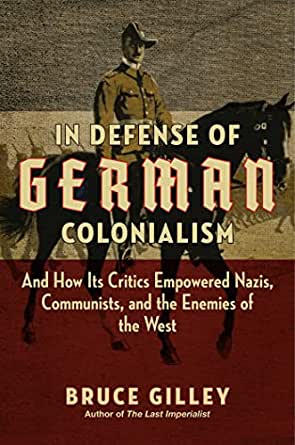
In Defense of German Colonialism: And How Its Critics Empowered Nazis, Communists, and the Enemies of the West
Washington, DC: Regnery Gateway, 2022

Bruce Gilley is a professor who was heavily criticized by a Maoist mob after he wrote an article entitled “The Case for Colonialism.” In his latest book, he takes a look at the much maligned German colonial empire, which stretched from Africa to Asia and even into the South Pacific until the the end of the First World War.

Gilley was prompted to write this book after researching the life of a British Empire colonial official, Sir Alan Burns. Sir Alan had been part of the British invasion of German Kamerun, in central Africa. The invasion was ultimately successful but was a tough slog, made very difficult by the tenacious resistance of Germany’s native African soldiers. This resistance raised the question: If German colonies were captured lands whose peoples were being enslaved by tyrannical Prussian despots, then why would African soldiers from these colonies fight so hard against their supposed liberators?

Gilley did some research and found that the idea that the German empire had been a vicious tyranny was wrong. Rather, the German colonies had highly progressive rulers who created prosperous nations in formerly backwards lands. Documented incidents of cruelty, such as flogging, were in fact part of the natives’ customs, and was in fact less severe than punishments meted out elsewhere. The natives often demanded the death or mutilation of a criminal guilty of minor infractions who was instead flogged. Other alleged German crimes such as a labor tax was not onerous, either. All governments require taxes to function, and in cash-strapped areas, roads that led all to prosper could be built with the sweat equity of those who would go on to use them.

The Spirit of Berlin

A case can be made that Europe’s efforts at establishing overseas empires began as early as the Crusades and the Kingdom of Jerusalem, but it is indisputable that European colonialism began in 1492, with Christopher Columbus’ first voyage. The first types of European colonies that were set up fell into three categories: ports and trading centers, often run by the Dutch or Portuguese; military conquests in pursuit of gold, such as Cortés’ conquest of Mexico; and settlements such as Plymouth Colony, where a small group of whites set up a community in keeping with their religious convictions.

The first colonies were developed in a wildcat fashion. Explorers acting with a broad mandate from a monarch were free to do what they wished, and societies as different as Saskatchewan and Guatemala developed as a result. After Brazil became independent in 1822, European governments started to formally organize colonies as part of a national effort with the primary aim being the uplift of the native peoples.

Germany only became a unified nation in 1871, therefore coming late to the European empire-building projects. By then, the Americas consisted mostly of independent nations in their own right. The only places left for Germany to colonize were in tropical Africa and Asia, as they hadn’t been colonized by Europeans due to the threat from disease, but advances in medicine made it possible by the late nineteenth century.

As Europeans started to move into Africa, the possibility for problems to develop between European nations due to overlapping colonial claims was high. In the winter of 1884/5, the Germans therefore hosted a conference where everyone’s colonial ambitions in Africa could be sorted out peacefully. Gilley writes:

This “Spirit of Berlin” was particularly relevant to Germany because its colonial era was just beginning. There was no “dark past” that needed to be excused, reformed, or forgotten. Instead, the Germans took pride that they had set a new standard for excellence in colonial administration. (p. 25)

The Berlin conference has been criticized for not taking into account the natives’ tribal identities, but Gilley shows that this was not true. The conference attendees were very conscious of tribal identities, and adjusted the colonies’ borders to keep tribal territories within one colony or another. Furthermore, there was a not entirely unreasonable assumption that the tribes could unify under a new national consciousness, since they often spoke similar languages and were of the same race.

Africa

The German colonies in Africa were German East Africa, which matched the borders of today’s mainland Tanzania, Burundi, and Rwanda; German South West Africa, which is today’s Namibia; and Togoland, which was in what is now parts of Togo and the Gold Coast.

As with all colonial endeavors, there were several wars. In German East Africa, there was the Maji Maji Rebellion, which was defeated by the German military. Today’s anti-colonialists praise the rebellion, but Gilley shows that it was in fact instigated by native slavers and Muslim fanatics who were seeking to work the area for their own purposes. The Maji Maji were the exploiters, not the Germans. The German suppression of this revolt was so appreciated by the natives that they fought to the end for the Germans during the First World War.

German linguists helped make Swahili the lingua franca of eastern Africa. They formalized the language, published dictionaries, and sponsored instruction in it. German linguists also did this with the Ewe language in Togoland.

American Renaissance

Togoland was a model colony until it was captured by the British and French during the war. The Germans initially found the area to be poor, but then quickly developed agricultural industries in cotton and tropical produce. To put it in economic terms, before the Germans arrived Togoland was not even on the production possibilities frontier, which was the hypothetical edge of goods and services a nation’s economy could produce. Afterwards, the natives had a chance to make their lives better and Togoland produced genuinely useful goods and services.

German South West Africa is often mentioned negatively in anti-colonialist literature and woke academic circles. This is due to the supposed “genocide” of the Herero and Nama people in 1904. Gilley shows that the Herero and Nama were led by an anti-European fanatic, Samuel Maharero, whose main activities were stealing cattle and causing trouble for the other tribes in the region. The reduction in the population documented by the censuses taken before and after the alleged killings can likely be explained by refugee out-migrations resulting from Maharero’s deeds rather than mass murder. The numbers of others peoples in the area such as the “Basters,” a caste of half-whites from the Cape Colony, also declined, and they were not attacked by any party.

Meanwhile, the Germans reduced travel time from the coast to German South West Africa’s capital from three weeks to three days by building a railroad. Gilley finds it bitterly ironic that anti-colonial and Maoist academics who drink spiced lattes, the ingredients of which originate in several continents, while sitting in Internet cafés then blog about the crisis of “modernity.”

Asia, the Pacific, & the First World War

Germany also had colonies in Asia and the South Pacific. They included New Guinea, the Bismarck Archipelago, and many of the Polynesian islands. The most prosperous colony was Qingdao, on the northern coast of China. Qingdao was a poverty-stricken area which became a German version of Hong Kong after colonization. The population was Chinese; they simply needed German law and order in order to build a functional society and economy.

Then, an anarchist Serb shot Archduke Franz Ferdinand and his wife Sophie in Sarajevo, and Europe collapsed into a more appalling version of the Peloponnesian War. The pre-war treaties had all held that the belligerents’ colonies would not fight each other in the event of a European war. Colonial armies were nevertheless soon locked in battle after the war began. The British Empire quickly captured most of Germany’s African colonies, but in German East Africa the resistance was so fierce that the British were never successful. In the Pacific, New Zealand and Australian troops captured Germany’s Pacific colonies.

Japan conquered Qingdao and several other German colonies in the Pacific Islands. Gilley argues that the British made a terrible miscalculation in allowing the Japanese to take Qingdao. The Japanese were not particularly just rulers, and they used Qingdao as a base from which to make further gains in China. The Japanese attack on China became one of the destabilizing forces that helped lead to the Second World War.

Weimar

It is well known that Germany’s Weimar Republic was dysfunctional. It is also well known that the Treaty of Versailles led to grievances that eventually brought the National Socialists to power, thus further destabilizing Central Europe. The ghosts of the colonies had an impact on the Republic’s fierce domestic politics. Gilley writes:

Overall trade in German colonies had grown by 17 percent a year from 1903 to 1913, but growth fell to just 2 percent year in the same territories from 1914 to 1929. This was in part because German planter families returned to Germany, leaving agricultural sectors in crisis. Along with them went missionary teachers, health workers, engineers, and accountants. German society united to support the return of their colonial settlers — Kolonialdeutschen — after they were expelled or made unwelcome by the mandate powers. Long before France had its Pieds-Noirs or Portugal its Retornados, Germany dealt with the trauma of decolonization on domestic politics. That trauma would have far worse consequences for Germany than for any other major colonial power. Heinrich Schnee coined the phrase “the myth of colonial guilt” (Die koloniale Schuldlüge) to refute the charges made at Versailles and to buck up pride in colonial achievements. German colonies had been beneficial and legitimate, he argued, and the League of Nations system was a failure. The mandate powers should be “honorable” and return the colonies to Germany (with the exception of Qingdao, now restored to China). A “colonial friends” (Kolonialfreund) movement of the 1920s was part of this ghostly apparition in German politics. (p. 186)

There was another issue as well. Gilley argues that the loss of its colonies helped to close Germany’s hitherto open and free society. A former naval captain and prolific journalist, Count Ernst Reventlow, argued against German colonialism in 1907. Reventlow believed that the colonies were distracting Germany from fruitful expansion into other parts of Europe. Reventlow later became a Nazi legislator.

Critical Thinking

Gilley goes on to describe how the Nazis were the first decolonizers, and they influenced later decolonialist thinkers like Frantz Fanon. I found this the book’s weakest argument. It has too much of the “Hitler did it also” logical fallacy. The loss of the colonies was indeed one of the Nazis’ grievances prior to the war, but it was of a much lower priority to them than other issues. Additionally, with so much potential trouble from the Soviet Union, Hitler was certainly right not to want to invest in African colonies.

Another weak part of the book is Gilley’s interpretation of the connection between Hitler and the then Grand Mufti of Jerusalem, Amin al-Husseini. The two parties were united in their concern with global Jewry, and were allies of convenience. In the 1930s the Palestinians were starting to feel the pinch from Zionist displacement and were looking for allies anywhere they could find them. For his part, Hitler recognized that his British enemy’s soft underbelly was its non-white empire. The British colonies were often economically impoverished and demanded a constant allocation of military resources. The British, for example, were forced to defend a lengthy frontier in India, leading to considerable trouble in the northwest.

Gilley also doesn’t mention the considerable anti-colonial activity in British and French colonies during the First World War. Had he read Lothrop Stoddard, he’d have noticed that the alarming problem of anti-colonialism began developing in places like Egypt as early as 1900, and was in full flower in all the colonies by the time of the First World War.

Gilley is on firmer ground when he describes East Germany’s anti-colonial efforts. German scholars, under the gun barrels of their Marxist commissars, published critical accounts of German colonialism to discredit not only Germany’s colonial empire, but all Western colonies, including the West’s interventions in the Third World during the Cold War. In the former colony of Namibia, East Germany even supported an insurgency against white-ruled and functional South Africa. Gilley documents how Leftist rule in Namibia destroyed many economically productive industries. Land reform, for example, ruined many productive farms, and the new farmers starved on their tiny plots of land.

Gilley is critical of anti-colonialist academics and writers such as Edward Said and Frantz Fanon. He argues that they are motivated more by destroying the West than helping their own people. This is true, but these academics are genuine representatives of non-whites’ envy and resentment of white accomplishments. This is the source of anti-colonial academic thought. It is not rational from a material standpoint, but it is human and natural.

Woke critics of Gilley are correct if they call Gilley a white supremacist. While he extols the virtues of the European empires, he doesn’t praise the Mongolian, Arab, or Japanese ones. But unlike how the term “white supremacist” is usually understood, Gilley is genuinely sympathetic to the decolonized peoples across the Third World.

*  *  *

Counter-Currents has extended special privileges to those who donate $120 or more per year.

  • First, donor comments will appear immediately instead of waiting in a moderation queue. (People who abuse this privilege will lose it.)
  • Second, donors will have immediate access to all Counter-Currents posts. Non-donors will find that one post a day, five posts a week will be behind a “Paywall” and will be available to the general public after 30 days.
  • Third, Paywall members have the ability to edit their comments. 
  • Fourth, Paywall members can “commission” a yearly article from Counter-Currents. Just send a question that you’d like to have discussed to [email protected]. (Obviously, the topics must be suitable to Counter-Currents and its broader project, as well as the interests and expertise of our writers.)
  • Fifth, Paywall members will have access to the Counter-Currents Telegram group. 

To get full access to all content behind the paywall, sign up here:

Paywall Gift Subscriptions

If you are already behind the paywall and want to share the benefits, Counter-Currents also offers paywall gift subscriptions. We need just five things from you:

  • your payment
  • the recipient’s name
  • the recipient’s email address
  • your name
  • your email address

To register, just fill out this form and we will walk you through the payment and registration process. There are a number of different payment options.

The German Colonial Empire: A Miracle of Progress

The%20German%20Colonial%20Empire%3A%20A%20Miracle%20of%20Progress

Share

  • Gab
  • A Miracle of Progress &body=%0D%0A%0D%0A%0D%0A%0D%0A%0D%0A%0D%0Ahttps://counter-currents.com/2022/08/the-german-colonial-empire-a-miracle-of-progress/%0D%0A%0D%0A%0D%0A%0D%0A">

Enjoyed this article?

Be the first to leave a tip in the jar!

Instant Echeck GreenPay™

Related

  • The Crisis of Chinese Technology Thieves

  • The Robot Hotdog Stand

  • Berlin: City of Stones

  • How Cold War Two Came About

  • The Cruelty of Kindness

  • Lothrop Stoddard’s The Revolt Against Civilization

  • Lewis Strauss Did Nothing Wrong:

  • The 1970s: The Golden Age of Hijacking

Tags

AfricaAmin al-Husseinianti-colonialismAsiabook reviewsBruce GilleycolonialismCommunismdecolonizationEast GermanyErnst ReventlowGerman anti-colonialismGerman colonialismGerman South West AfricaGermanyHerero peopleIn Defense of German ColonialismLothrop StoddardMorris van de CampNama peopleNamibiaNational Socialist GermanyPalestinianspaywallSamuel Maharerothe British Empirethe First World Warthe French Empirethe German empirethe Japanese Empirethe South Pacificthe Spirit of Berlinthe Third Reichthe Weimar Republicwhite supremacywokeness

2 comments

  1. Antipodean says:
    August 16, 2022 at 7:00 pm

    Thank you for bringing this neglected subject  to attention. I first came across this topic reading the entertaining Booker Prize nominated ( when that still meant sonething) 1982 novel An Ice Cream War by William Boyd. My recollection is that the Germans were given an even-handed treatment.

    May I make a point about our acquiescence to changing the names of places. This is part of the methodology of the global left, well-described in George Orwell’s most famous work and its appendix on NewSpeak. The German colony in coastal Northern China was TsingTao not Qing Dao. Just as  English-speakers, although pleasingly not the French, have allowed the name Peking to be transmuted to Beijing, it seems a similar process has happened in the case of Germany’s former territory, although the territory’s beer retains the original monicker.

    We ought to feel under no compulsion and in fact should actively resist demands to change our names for foreign territories and cities when they have established usage, as we should resist redefinition of incredibly important words like ‘sex’ and ‘gender’. We’ve even allowed the word ‘name’ to be changed from its original meaning of family name so that it now mostly connotes what used to be the ‘given’ or ‘Christian name’.

    0
    0
  2. Doug Huntington says:
    September 11, 2022 at 8:14 pm

    Excellent article, Mr. Van de Camp. I would like to add a few points to what you touched on in terms of Bruce Gilley’s account of Namibia. Unlike the other German colonies mentioned such as Togoland, Namibia was the focus of settler colonialism as opposed to resource extraction enterprises. Tens of thousands of White Germans settled in Namibia in the late 19th-early 20th century as the nascent German empire tried to build for themselves what the Anglos had in the North American west and Australia: new space for their people.

    Of course, everything fell apart after world war one, but according to Wikipedia (take it with the necessary grain of salt)  there are still around 30,000 White Germans in Namibia (a third of the country’s white population also consisting of Afrikaners and Anglos). While a lot of attention has been given to the South African government’s attempt to drive Boers off their land, Namibia’s black nationalist government has recently attempted similar efforts of confiscating German-owned farmland. I am interested to know if whites there suffer the same degree of vicious farm attacks that whites do in South Africa and whether they are able to create their own effective security structures independent of the government. Either way, it is a topic that deserves further examination.

    Had the world wars never happened, Germany would have had the demographic heft to settle Namibia with hundreds of thousands and perhaps even a million plus White Germans by now. The Kaiser’s dream of a German Australia in Southern Africa could have been realized. Interestingly, Namibia is almost twice the size of California, but it has a population of just over 2.5 million, making it one of the least densely populated countries in the world. In short, it certainly had the potential.

    0
    0

Comments are closed.

If you have a Subscriber access,
simply login first to see your comment auto-approved.

Note on comments privacy & moderation

Your email is never published nor shared.

Comments are moderated. If you don't see your comment, please be patient. If approved, it will appear here soon. Do not post your comment a second time.

Upcoming podcasts
  • Rob Rundo on Counter-Currents Radio

    Rob Rundo on Counter-Currents Radio

    Counter-Currents Radio

    Sat, Jun 13th — 3 pm EST / 9 pm CET

Writers of May

(2 votes) Morris van de Camp David M. Zsutty Derek Stark Jayant Bhandari Greg Johnson

Articles of May

Heidegger on Nietzsche, Part One by Collin Cleary The Lunch Wars by David M. Zsutty 2 votes
    • Editor’s Update
      Rob Rundo on Counter-Currents Radio, Fundraiser Update, & a New $20,000 Matching Grant

      Greg Johnson

    • The Bitter End of Western Metaphysics:
      Heidegger on Nietzsche, Part Three

      Collin Cleary

      10

    • Uncivil War

      Mark Gullick

      32

    • Exclusive Interview with Karel Veliky:
      The Final Chapter in the Film Series! Part II

      Ondrej Mann

      2

    • Happy Birthday to Us!

      Greg Johnson

      6

    • Zsutty’s Maximum

      David M. Zsutty

      15

    • Exclusive Interview with Karel Veliky:
      The Final Chapter in the Film Series! Part I

      Ondrej Mann

      2

    • The Union Jackal, June 2026

      Mark Gullick

      23

    • The Inferiority Behind Immigrant Superiority

      Jayant Bhandari

      15

    • Counter-Currents Radio Podcast No. 690
      Greg Johnson & David Zsutty Discuss Current Things: AI, Henry Nowak, the Iran Crisis, & More

      Counter-Currents Radio

      5

    • Collin Cleary: What Rome Means to Me

      Collin Cleary

      4

    • Paul Krugman: Closet Bolshevik

      Spencer J. Quinn

      19

    • Fugue of Ideas:
      Ibram X. Kendi’s Chain of Ideas

      Greg Johnson

      18

    • Based Blacks

      Lipton Matthews

      12

    • Black Intellectual Fatigue

      Derek Stark

      38

    • Why White Advocates Should Avoid “Based Blacks”

      Dani Vypont

      29

    • Nietzsche & Race

      Mark Gullick

    • Editor’s Update
      Rob Rundo Rescheduled to Next Week on Counter-Currents Radio;
      Tonight Greg Johnson & David Zsutty Answer Your Questions;
      Fundraiser Update & a New $20,000 Matching Grant

      Greg Johnson

    • The Counter-Currents 2026 Fundraiser
      Lifetime Subscriber Welcome Packages Extended

      Greg Johnson

    • Nationalism This Week
      Who’s Looking Back?

      Greg Johnson

      29

    • China’s Threat to American Security:
      Food, Farmland, Foreign Control, & Energy Policy

      Lipton Matthews

      5

    • The Bitter End of Western Metaphysics:
      Heidegger on Nietzsche, Part Two

      Collin Cleary

      16

    • The Killing of Henry Nowak

      Mark Gullick

      38

    • The Crisis of Chinese Technology Thieves

      Morris van de Camp

      1

    • The Strange World of Gender Bender Fiction:
      & What This Genre Tells Us About Autosexuality

      Dani Vypont

      3

    • Watching the Watchers:
      The Dark Triad Question

      David M. Zsutty

      14

    • The Remigration Movement Solidifies

      F. Roger Devlin

      1

    • Casting Aspersions:
      The Fatal Consequences of Race-Swapped Casting, From Helen of Troy to Henry of Southampton

      Steven Tucker

      20

    • The Murder of Henry Nowak

      Millennial Woes

      23

    • Don’t Forget to Vote in Our Writer & Article of the Month Poll

      Greg Johnson

    • The Robot Hotdog Stand

      Greg Johnson

      37

    • Laughing Our Way to Victory

      Dave Chambers

      7

    • The Zodiac Killer

      Mark Gullick

      11

    • Jared Taylor: What Rome Means to Me

      Jared Taylor

      1

    • An Interview with Endeavour:
      My Way of Life Is an Adventure!

      Ondrej Mann

      6

    • José Pedro Zúquete’s The Identitarians

      Greg Johnson

      3

    • Editor’s Update
      Fundraiser Update & How to Watch the Remigration Summit

      Greg Johnson

      5

    • The Bitter End of Western Metaphysics:
      Heidegger on Nietzsche, Part One

      Collin Cleary

      12

    • Berlin: City of Stones

      Spencer J. Quinn

      6

    • True Folk-Horror Is Horror of Your Own Folk:
      Mark Gatiss vs the Brexit Blind Dead  

      Steven Tucker

      4

    • Counter-Currents Radio Podcast No. 689
      Thomas Massie, the America 2050 Bust, the Need for Whites to Divest from America, the AI Economic Apocalypse, & Pro-White Project Pitches to Billionaires

      Counter-Currents Radio

      7

    • Nationalism This Week
      Remigration is Inevitable, Part 3

      Greg Johnson

      27

    • Why Billionaires Should Fund White Identity Politics

      Lipton Matthews

      8

    • How Cold War Two Came About

      Morris van de Camp

      5

    • Now Available for Pre-Order at a Special Price!
      Greg Johnson’s The Philosopher Is In

      Greg Johnson

    • David Zsutty’s Elevator Pitch to a Billionaire

      David M. Zsutty

      1

    • Headbanging Lite

      Mark Gullick

      5

    • White Advocacy Past and Present

      Peter Bradley

      13

    • The Lunch Wars

      David M. Zsutty

      47

    • The Russians are Coming/The Russians are Coming

      Steven Clark

      1

    • Taig77

      Uncivil War

      "...the Republicans wanted Northern Ireland to be independent." will come as a great surprise to...

    • Collin Cleary

      Heidegger on Nietzsche Part Three

      I have not heard of the Beattie dissertation, or of any discussion of it. The Mansfield book is also...

    • Collin Cleary

      Heidegger on Nietzsche Part Three

      I believe in objective truth, just not the Christian claims about objective truth. Truth is what...

    • Collin Cleary

      Heidegger on Nietzsche Part Three

      Thank you very much!

    • tempus

      Why White Advocates Should Avoid “Based Blacks”

      As for lending money, that also goes for Whites. Never lend more than you are willing to make a gift...

    • tempus

      Why White Advocates Should Avoid “Based Blacks”

      The only person other than my brother to whom I have lent money who ever paid me back was a Black...

    • tempus

      Why White Advocates Should Avoid “Based Blacks”

      The Old South was nowhere near as anti-black as the Old North. Part of the Republican platform on...

    • tempus

      Black Intellectual Fatigue

      Hopefully, more Whites are ceasing to be racial nihilists and are abandoning the new morality (...

    • Jaego

      Uncivil War

      The Orthodox ideal - just like every other denomination - is people of all races worshiping together...

    • Jaego

      Uncivil War

      Isolate the police. Family or friends, no matter. Disown them. Maybe in time people will forgive...

    • Jaego

      Uncivil War

      Tikkun Olam. Repair of the World. Enabling mass immigration is a mitzvah or holy deed in the Repair...

    • I Do Not Surrender, My Hand Is Red.

      Uncivil War

      This is very good advice Joe. Very good.

    • NIdahoOrthodox

      Uncivil War

      How many tens of thousands of automatic weapons and tons of Semtex are in hidden caches in the North...

    • kolokol

      Uncivil War

      Stephen Ogilvie is the latest example of a decent, hard-working White person, killed by a useless...

    • Dr. X

      Uncivil War

      Great writeup. One error- I doubt the Republic of Ireland police (Garda) were responding on the...

    • kolokol

      Uncivil War

      This is a very good start. May it continue and accelerate, until all the invaders have been expelled...

    • Observer

      Heidegger on Nietzsche Part Three

      Ouch. Well, I had used the bullet formatting in the text box to break it up a bit... but it looks...

    • Gabe

      Uncivil War

      Scots-Irish is an American term. It's true that Presbyterians and others came from Scotland to...

    • Gabe

      Uncivil War

      I was just going to write that myself. The Garda Siochána, or guards, is a term they use in the...

    • Ondrej Mann

      Exclusive Interview with Karel Veliky Part 2

      Thanks for the cultural tip. I’m currently preparing an interview for CC with the Austrian band...

    • Earth Day Special

      John Morgan

      12

    • A Robertson Roundup
      Remembering Wilmot Robertson
      (April 16, 1915 – July 8, 2005)

      Margot Metroland

      13

    • The Paranoid Style in White Nationalism

      Greg Johnson

      30

    • Join the Dance!

      Andrew Hamilton

      1

    • We Can’t Save the Earth Without Reducing African Birth Rates

      James Dunphy

      36

    • “I’m Not a Conspiracy Theorist, but . . .”:
      Jeffrey Epstein’s Death Gives New Life to “Conspiracy Theories”

      Greg Johnson

      22

    • Sylvia Plath: Stasis in Darkness

      Vic Olvir

      17

    • Vanguardism, Vantardism, & Mainstreaming

      Greg Johnson

      80

    • Aviation, Geography, & Race

      Charles Lindbergh

      3

    • Some Thoughts on Yule

      Collin Cleary

      4

    • Living in Truth:
      A Yuletide Homily

      Jef Costello

      7

    • John Kennedy Toole’s A Confederacy of Dunces

      Greg Johnson

      20

    • On Aleksandr Solzhenitsyn’s Warning to the West

      Spencer J. Quinn

      7

    • Elitism, British Modernism, & Wyndham Lewis

      Jonathan Bowden

      6

    • Philip K. Dick’s Do Androids Dream of Electric Sheep? as Anti-Semitic/Christian-Gnostic Allegory

      Greg Johnson

      20

    • “Conspiracy Theory” or Conspiracy?

      Andrew Hamilton

      21

    • Remembering H. P. Lovecraft
      (August 20, 1890–March 15, 1937)

      Greg Johnson

      3

    • Who Are We?
      Nordics, Aryans, & Whites

      Greg Johnson

      71

    • Remembering William Gayley Simpson
      (July 23, 1892–December 31, 1990)
      A Pleasant Afternoon with Harriet & Bill Simpson

      Margot Metroland

      18

    • Here are the Young Men
      Remembering Ian Curtis
      (July 15, 1956–May 18, 1980)

      Mark Gullick

      18

    • Percy Grainger
      Artist of the Right

      Alex Graham

      7

    • Remembering Revilo Oliver
      (July 7, 1908–August 20, 1994)

      Greg Johnson

      18

    • The Meaning of July 4th for the White Man

      Gregory Hood

      13

    • The Front National’s Evolution

      Bruno Mégret

    • Merwin K. Hart
      Forgotten American Hero & Man of the Right

      Morris van de Camp

      10

    • George Orwell’s Nineteen Eighty-Four

      Jonathan Bowden

      8

    • Carleton S. Coon
      Scientist & Reluctant White Advocate

      Morris van de Camp

      3

    • The Kwanzaa Absurdity Will Be Dwarfed by Juneteenth

      Robert Hampton

      10

    • Stravinsky

      Alex Graham

      7

    • Like the Roman:
      Remembering Enoch Powell (1912-1998)

      Mark Gullick

      23

    • Jonathan Bowden’s Deliverance
      Part 6

      Jonathan Bowden

    • Do You Want to Play a Game?

      Mark Gullick

      1

    • Sexually Incontinent on the Indian Subcontinent:
      Who Rapes More Animals, Indians or Pakistanis? The Battle Continues!

      Steven Tucker

      3

    • Neo-Fascism in Film
      Part 5

      Karel Veliky

      15

    • The Game of Tarot

      Mark Gullick

      2

    • Institutions Cannot Be Transplanted

      Jayant Bhandari

      5

    • Jonathan Bowden’s Deliverance
      Part 5

      Jonathan Bowden

    • Crosstown Traffic:
      Jimi Hendrix & The Post-War Rock ‘N’ Roll Revolution

      Mark Gullick

      1

    • Slaves from the North:
      Finns & Karelians in the East European Slave Trade, 900–1600

      Lipton Matthews

      14

    • Neo-Fascism in Film
      Part 4

      Karel Veliky

      2

    • David Lean’s A Passage to India

      Spencer J. Quinn

      1

    • Elites are Essential to Development

      Lipton Matthews

      7

    • Jonathan Bowden’s Deliverance
      Part 4

      Jonathan Bowden

    • Neo-Fascism in Film
      Part 3

      Karel Veliky

      6

    • E. M. Forster’s A Passage to India & the Indian Mentality

      Spencer J. Quinn

      25

    • Jonathan Bowden’s Deliverance
      Part 3

      Jonathan Bowden

    • The Rest Is Silence
      Heidegger’s Quietism

      Mark Gullick

      2

    • Dispelling the Historical Fallacy of Indian Nationalism

      Lipton Matthews

      8

    • Neo-Fascism in Film
      Part 2

      Karel Veliky

      8

    • Jonathan Bowden’s Deliverance
      Part 2

      Jonathan Bowden

    • Life of a Klansman

      Mark Gullick

      8

    • Jonathan Bowden’s Deliverance, Part 1

      Jonathan Bowden

    • Decolonial Ideas are Holding Back Developing Countries

      Lipton Matthews

      8

    • Neo-fascism in Film, Part 1

      Karel Veliky

      21

    • Jonathan Bowden’s Onslaught, Part 8
      Divigations on Decadence

      Jonathan Bowden

    • Jonathan Bowden’s Onslaught, Part 7
      Intrigues in the National Front

      Jonathan Bowden

      1

    • Rotten to the Core

      Mark Gullick

      8

    • Strauss on Husserl’s “Philosophy as Rigorous Science”

      Greg Johnson

    • Jonathan Bowden’s Onslaught, Part 6
      Francis Bacon & Right-Wing Nihilism

      Jonathan Bowden

    • London After (& Before) Midnight:
      Aleister Crowley, The Landlord’s Worst Nightmare

      James J. O'Meara

      2

    • András László
    • Derek Hawthorne
    • Beau Albrecht
    • Alain de Benoist
    • Kerry Bolton
    • Jonathan Bowden
    • Collin Cleary
    • Jef Costello
    • Savitri Devi
    • Julius Evola
    • Jim Goad
    • Gregory Hood
    • Juleigh Howard-Hobson
    • Greg Johnson
    • Charles Krafft
    • Anthony M. Ludovici
    • Trevor Lynch
    • H. L. Mencken
    • J. A. Nicholl
    • James J. O’Meara
    • Christopher Pankhurst
    • Tito Perdue
    • Michael Polignano
    • Spencer J. Quinn
    • Fenek Solère
    • Irmin Vinson
    • Leo Yankevich
    • Francis Parker Yockey
    • Multiple authors
  • Editor-in-Chief

    • Greg Johnson, Ph.D.

    Featured Writers

    • Beau Albrecht
    • Gunnar Alfredsson
    • Collin Cleary, Ph.D.
    • Jef Costello
    • Morris V. de Camp
    • F. Roger Devlin, Ph.D.
    • Stephen Paul Foster, Ph.D.
    • Jim Goad
    • Alex Graham
    • Mark Gullick, Ph.D.
    • Greg Johnson, Ph.D.
    • Travis LeBlanc
    • Trevor Lynch
    • Margot Metroland
    • James J. O’Meara
    • Angelo Plume
    • Spencer J. Quinn
    • Fred Reed
    • Clarissa Schnabel
    • Michael Walker
    • David M. Zsutty

    Frequent Writers

    • Asier Abadroa
    • Aquilonius
    • Alain de Benoist
    • Kerry Bolton, Ph.D.
    • Dave Chambers
    • Steven Clark
    • James Dunphy
    • Endeavour
    • Richard Houck
    • Jason Kessler
    • Titus Livius
    • Ondrej Mann
    • Lipton Matthews
    • Mark Mazari
    • John Morgan
    • Jaroslav Ostrogniew
    • Kathryn S.
    • Christian Secor
    • Anne Wilson Smith
    • Thomas Steuben
    • William De Vere
    • Kenneth Vinther
    • Max West

    Classic Authors

    • Maurice Bardèche
    • Jonathan Bowden
    • Julius Evola
    • Guillaume Faye
    • Ernst Jünger
    • Kevin MacDonald, Ph.D.
    • D. H. Lawrence
    • Charles Lindbergh
    • Jack London
    • H. P. Lovecraft
    • Anthony M. Ludovici
    • Sir Oswald Mosley
    • National Vanguard
    • Friedrich Nietzsche
    • Revilo Oliver
    • William Pierce
    • Ezra Pound
    • Saint-Loup
    • Savitri Devi
    • Carl Schmitt
    • Miguel Serrano
    • Oswald Spengler
    • P. R. Stephensen
    • Jean Thiriart
    • John Tyndall
    • Dominique Venner
    • Leo Yankevich
    • Francis Parker Yockey

    Other Authors

    • Howe Abbott-Hiss
    • Michael Bell
    • Giles Corey
    • Jack Donovan
    • Richardo Duchesne, Ph.D.
    • Emile Durand
    • Guillaume Durocher
    • Mark Dyal
    • Tom Goodroch
    • Andrew Hamilton
    • Robert Hampton
    • Huntley Haverstock
    • Derek Hawthorne
    • Gregory Hood
    • Juleigh Howard-Hobson
    • Alexander Jacob
    • Ruuben Kaalep
    • Tobias Langdon
    • Julian Langness
    • Patrick Le Brun
    • G A Malvicini
    • John Michael McCloughlin
    • Millennial Woes
    • Michael O’Meara
    • Christopher Pankhurst
    • Michael Polignano
    • J. J. Przybylski
    • Quintilian
    • Edouard Rix
    • C. B. Robertson
    • C. F. Robinson
    • Herve Ryssen
    • Alan Smithee
    • Fenek Solere
    • Ann Sterzinger
    • Robert Steuckers
    • Tomislav Sunic
    • Donald Thoresen
    • Marian Van Court
    • Irmin Vinson
    • Book Reviews
    • Movie Reviews
    • TV Reviews
    • Music Reviews
    • Art Criticism
    • Graphic Novels & Comics
    • Video Game Reviews
    • Fiction
    • Poems
    • Interviews
    • Videos
    • English Translations
    • Other Languages
      • Arabic
      • Bulgarian
      • Croatian
      • Czech
      • Danish
      • Dutch
      • Estonian
      • Finnish
      • French
      • German
      • Greek
      • Hungarian
      • Italian
      • Lithuanian
      • Norwegian
      • Polish
      • Portuguese
      • Romanian
      • Russian
      • Slovak
      • Spanish
      • Swedish
      • Ukrainian
    • Commemorations
    • Why We Write
  • Archives
  • Top 100 Commenters
  • The Looney Bin
Sponsored Links
Europa.com Above Time Coffee Antelope Hill Publishing Paul Waggener IHR-Store Spencer J. Quinn American Renaissance Jim Goad The Occidental Observer
Donate Now Mailing list
Books for sale
  • The Philosopher Is In
  • Sexual Utopia in Power (Expanded Edition)
  • In Defense of Prejudice
  • Loving Our Own
  • Tyranny & Wisdom
  • The Populist Moment
  • Is America Doomed?
  • To all books
Copyright © 2026 Counter-Currents Publishing, Ltd.

Paywall Access


Please enter your email address.

Lost your password?

Edit your comment

Writer & Article of the Month May 2026

Voting for this month has concluded. Here are the final results!

Top Writers

  • #1 Morris van de Camp 2 votes
  • #2 David M. Zsutty 2 votes
  • #3 Derek Stark 2 votes
  • #4 Jayant Bhandari 2 votes
  • #5 Greg Johnson 2 votes
  • #6 Jared Taylor 1 vote
  • #7 Collin Cleary 1 vote
  • #8 Spencer J. Quinn 1 vote
  • #9 Mark Gullick 1 vote
  • #10 Lipton Matthews 1 vote
  • #11 Keith Woods 1 vote
  • #12 Steven Tucker 1 vote

Top Articles

  • #1 Heidegger on Nietzsche, Part One 2 votes
  • #2 The Lunch Wars 2 votes
  • #3 The Ghost of the Confederacy 1 vote
  • #4 Lothrop Stoddard’s The Revolt Against Civilization 1 vote
  • #5 Could Fascism Work? 1 vote
  • #6 Jared Taylor's Elevator Pitch to a Billionaire 1 vote
  • #7 Predation Wearing the Mask of Civilization 1 vote
  • #8 Peak Fatigue in Fort Wayne 1 vote
  • #9 Keith Wood's Elevator Pitch to a Billionaire 1 vote
  • #10 Do You Want to Play a Game? 1 vote
  • #11 Why Billionaires Should Fund White Identity Politics 1 vote
  • #12 The 1970s: The Golden Age of Hijacking 1 vote
  • #13 True Folk-Horror Is Horror of Your Own Folk 1 vote
  • #14 Finding Atlantis Part 4 1 vote
  • #15 Berlin: City of Stones 1 vote

Total votes cast: 17