Counter-Currents
  • Advertise
  • Private Events
  • T&C
  • About
  • Contact
  • RSS
    • Main feed
    • Podcast feed
    • Videos feed
    • Comments feed
  • Welcome
  • Webzine
  • Books
  • Merch
  • Podcasts
  • Videos
  • Donate
  • Patrons
  • Subscribe
  • Crypto

LEVEL2

Donate Now Mailing list
  • Welcome
  • Webzine
  • Books
  • Merch
  • Podcasts
  • Videos
  • Donate
  • Patrons
  • Subscribe
  • Crypto
    • The Remigration Movement Solidifies

      F. Roger Devlin

    • Casting Aspersions:
      The Fatal Consequences of Race-Swapped Casting, From Helen of Troy to Henry of Southampton

      Steven Tucker

      6

    • The Murder of Henry Nowack

      Millennial Woes

      13

    • Don’t Forget to Vote in Our Writer & Article of the Month Poll

      Greg Johnson

    • The Robot Hotdog Stand

      Greg Johnson

      23

    • Laughing Our Way to Victory

      Dave Chambers

      2

    • The Zodiac Killer

      Mark Gullick

      9

    • Jared Taylor: What Rome Means to Me

      Jared Taylor

    • An Interview with Endeavour:
      My Way of Life Is an Adventure!

      Ondrej Mann

      6

    • José Pedro Zúquete’s The Identitarians

      Greg Johnson

      3

    • Editor’s Update
      Fundraiser Update & How to Watch the Remigration Summit

      Greg Johnson

      5

    • The Bitter End of Western Metaphysics:
      Heidegger on Nietzsche, Part One

      Collin Cleary

      10

    • Berlin: City of Stones

      Spencer J. Quinn

      6

    • True Folk-Horror Is Horror of Your Own Folk:
      Mark Gatiss vs the Brexit Blind Dead  

      Steven Tucker

      4

    • Counter-Currents Radio Podcast No. 689
      Thomas Massie, the America 2050 Bust, the Need for Whites to Divest from America, the AI Economic Apocalypse, & Pro-White Project Pitches to Billionaires

      Counter-Currents Radio

      7

    • Nationalism This Week
      Remigration is Inevitable, Part 3

      Greg Johnson

      26

    • Why Billionaires Should Fund White Identity Politics

      Lipton Matthews

      8

    • How Cold War Two Came About

      Morris van de Camp

      5

    • Now Available for Pre-Order at a Special Price!
      Greg Johnson’s The Philosopher Is In

      Greg Johnson

    • David Zsutty’s Elevator Pitch to a Billionaire

      David M. Zsutty

      1

    • Headbanging Lite

      Mark Gullick

      5

    • White Advocacy Past and Present

      Peter Bradley

      13

    • The Lunch Wars

      David M. Zsutty

      46

    • The Russians are Coming/The Russians are Coming

      Steven Clark

      1

    • Peak Fatigue in Fort Wayne

      Gabriel Anderson

      24

    • Keith Woods’ Elevator Pitch to a Billionaire

      Keith Woods

    • The Cruelty of Kindness

      Morris van de Camp

      9

    • Predation Wearing the Mask of Civilization

      Jayant Bhandari

      13

    • The Mandalorian & Grogu

      Trevor Lynch

      24

    • Editor’s Update
      Fundraiser Update & a New $20,000 Matching Grant
      Greg Johnson & David Zsutty Discuss Thomas Massie on Counter-Currents Radio

      Greg Johnson

      2

    • How the Jews Defeated Thomas Massie—& Themselves

      David M. Zsutty

      24

    • Jared Taylor’s Elevator Pitch to a Billionaire

      Jared Taylor

      15

    • Nationalism This Week
      Remigration Is Inevitable, Part 2

      Greg Johnson

      8

    • Could Fascism Work?

      Mark Gullick

      40

    • Jonathan Bowden’s Deliverance
      Part 7

      Jonathan Bowden

    • China’s Quiet Hand:
      Influence, Infiltration, & the Western Blind Spot

      Lipton Matthews

      9

    • Counter-Currents Radio Podcast No. 688
      Tyler Dykes on Running for US Congress in South Carolina

      Counter-Currents Radio

      3

    • Lothrop Stoddard’s The Revolt Against Civilization

      Spencer J. Quinn

      14

    • Lewis Strauss Did Nothing Wrong:
      How the politics of the Atom Bomb during the early Cold War Apply to Artificial Intelligence Today

      Morris van de Camp

      14

    • The Ghost of the Confederacy

      Dave Chambers

      12

    • America’s Century of Humiliation has Begun

      Greg Johnson

      27

    • Prepare for Africans & Schizophrenics!
      Welcome to the New Canadian Military

      Gunnar Alfredsson

      6

    • Remembering Julius Evola:
      May 19, 1898–June 11, 1974

      Greg Johnson

    • About Film “From the Right”

      Karel Veliky

    • Nostalgia Ain’t What It Used To Be. . . Now It’s Racist

      Steven Tucker

      8

    • To Depose The King

      Mark Gullick

      7

    • Editor’s Update
      Tyler Dykes on Counter-Currents Radio & The Best of Trevor Lynch Now in French

      Greg Johnson

    • Nationalism This Week
      Remigration Is Inevitable

      Greg Johnson

      21

    • You’re Nicked! The Story of The Sweeney

      Mark Gullick

      12

    • The Counter-Currents Fundraiser 2026:
      Help Us Provide You With All the News That’s Unfit To Print—Because It’s Actually Worth Reading!

      Steven Tucker

      3

    • kolokol

      Casting Aspersions

      "Lupita Nyong’o" (sic) is a ridiculous name. And she is hideously ugly. She is the antithesis of...

    • Bernie

      The Murder of Henry Nowak

      Many are saying this could be the straw that breaks the camel’s back in the UK. I certainly hope so...

    • Derek Stark

      The Zodiac Killer

      Another one is the “De Mau Mau” cult in Illinois in the 1970s, made up of black Viet Nam vets, who...

    • DM

      The Murder of Henry Nowak

      None. My only point is that it might be true that the attacker didn't remember stabbing the fellow.

    • Will Williams

      Remigration is Inevitable Part 3

      Uncle Semantic: June 1, 2026  The weebo is ryan dawson, another antiWhite prick… —Weebo?...

    • Chud

      The Murder of Henry Nowak

      Sub-continental migration appears good when the local migration industry isn't established in India...

    • Bryan

      The Murder of Henry Nowak

      What threat did an unarmed White 18-year-old present to the entitled, knife-carrying Sikh?

    • Hammerhead

      Casting Aspersions

      'These are the popular ‘soft’ things that reinforce this evil. It’s not just an abstract...

    • Will Williams

      The Zodiac Killer

      Derek Stark: June 2, 2026 …[T]here are more black serial killers per capita than white ones in the...

    • Vagrant Rightist

      The Murder of Henry Nowak

      Weren't Sikhs supposed to be the 'good ones' ? So much for that lie. Thanks MW, for the detailed...

    • Peter Quint

      The Murder of Henry Nowak

      Carry a Para-Ordnance 45 cal. sidearm everywhere like I do. 🙃

    • Peter Quint

      The Murder of Henry Nowak

      That is the same message White people in America have been getting for decades. 🙃

    • Thomas Johnson

      The Murder of Henry Nowak

      The message to white people in the UK is clear: if the nonwhite criminals don't get you, the coppers...

    • Glide Ratio 0:1

      Casting Aspersions

      Surprised you called Nyongongo Mgolo "average". As far as my eyes can see she's a black 2. Well...

    • Vagrant Rightist

      Casting Aspersions

      I'd be very surprised if Nolan himself believes in this stuff, but he knows full well his overlords...

    • Beau Albrecht

      The Robot Hotdog Stand

      Anyone remember this quote? "The simple statement that the People are not there for the sake of...

    • Greg Johnson

      The Robot Hotdog Stand

      You're arguing that a huge wave of post-AI business investment will employ the millions of people...

    • Peter Quint

      Casting Aspersions

      Great article! Sidney Sweeney would have been the best choice for Helen of Troy. Gerard Butler would...

    • YT

      The Murder of Henry Nowak

      People in UK (and everywhere) need to start saying online, in graffiti, in rough encounters in...

    • BigJimSportCamper

      The Murder of Henry Nowak

      Can I get a religious exemption to open carry my AR15 everywhere? That's what I thought...

    • Earth Day Special

      John Morgan

      12

    • A Robertson Roundup
      Remembering Wilmot Robertson
      (April 16, 1915 – July 8, 2005)

      Margot Metroland

      13

    • The Paranoid Style in White Nationalism

      Greg Johnson

      30

    • Join the Dance!

      Andrew Hamilton

      1

    • We Can’t Save the Earth Without Reducing African Birth Rates

      James Dunphy

      36

    • “I’m Not a Conspiracy Theorist, but . . .”:
      Jeffrey Epstein’s Death Gives New Life to “Conspiracy Theories”

      Greg Johnson

      22

    • Sylvia Plath: Stasis in Darkness

      Vic Olvir

      17

    • Vanguardism, Vantardism, & Mainstreaming

      Greg Johnson

      80

    • Aviation, Geography, & Race

      Charles Lindbergh

      3

    • Some Thoughts on Yule

      Collin Cleary

      4

    • Living in Truth:
      A Yuletide Homily

      Jef Costello

      7

    • John Kennedy Toole’s A Confederacy of Dunces

      Greg Johnson

      20

    • On Aleksandr Solzhenitsyn’s Warning to the West

      Spencer J. Quinn

      7

    • Elitism, British Modernism, & Wyndham Lewis

      Jonathan Bowden

      6

    • Philip K. Dick’s Do Androids Dream of Electric Sheep? as Anti-Semitic/Christian-Gnostic Allegory

      Greg Johnson

      20

    • “Conspiracy Theory” or Conspiracy?

      Andrew Hamilton

      21

    • Remembering H. P. Lovecraft
      (August 20, 1890–March 15, 1937)

      Greg Johnson

      3

    • Who Are We?
      Nordics, Aryans, & Whites

      Greg Johnson

      71

    • Remembering William Gayley Simpson
      (July 23, 1892–December 31, 1990)
      A Pleasant Afternoon with Harriet & Bill Simpson

      Margot Metroland

      18

    • Here are the Young Men
      Remembering Ian Curtis
      (July 15, 1956–May 18, 1980)

      Mark Gullick

      18

    • Percy Grainger
      Artist of the Right

      Alex Graham

      7

    • Remembering Revilo Oliver
      (July 7, 1908–August 20, 1994)

      Greg Johnson

      18

    • The Meaning of July 4th for the White Man

      Gregory Hood

      13

    • The Front National’s Evolution

      Bruno Mégret

    • Merwin K. Hart
      Forgotten American Hero & Man of the Right

      Morris van de Camp

      10

    • George Orwell’s Nineteen Eighty-Four

      Jonathan Bowden

      8

    • Carleton S. Coon
      Scientist & Reluctant White Advocate

      Morris van de Camp

      3

    • The Kwanzaa Absurdity Will Be Dwarfed by Juneteenth

      Robert Hampton

      10

    • Stravinsky

      Alex Graham

      7

    • Like the Roman:
      Remembering Enoch Powell (1912-1998)

      Mark Gullick

      23

    • Crosstown Traffic:
      Jimi Hendrix & The Post-War Rock ‘N’ Roll Revolution

      Mark Gullick

    • Slaves from the North:
      Finns & Karelians in the East European Slave Trade, 900–1600

      Lipton Matthews

      14

    • Neo-Fascism in Film
      Part 4

      Karel Veliky

      2

    • David Lean’s A Passage to India

      Spencer J. Quinn

      1

    • Elites are Essential to Development

      Lipton Matthews

      7

    • Jonathan Bowden’s Deliverance
      Part 4

      Jonathan Bowden

    • Neo-Fascism in Film
      Part 3

      Karel Veliky

      6

    • E. M. Forster’s A Passage to India & the Indian Mentality

      Spencer J. Quinn

      25

    • Jonathan Bowden’s Deliverance
      Part 3

      Jonathan Bowden

    • The Rest Is Silence
      Heidegger’s Quietism

      Mark Gullick

      2

    • Dispelling the Historical Fallacy of Indian Nationalism

      Lipton Matthews

      8

    • Neo-Fascism in Film
      Part 2

      Karel Veliky

      8

    • Jonathan Bowden’s Deliverance
      Part 2

      Jonathan Bowden

    • Life of a Klansman

      Mark Gullick

      8

    • Jonathan Bowden’s Deliverance, Part 1

      Jonathan Bowden

    • Decolonial Ideas are Holding Back Developing Countries

      Lipton Matthews

      8

    • Neo-fascism in Film, Part 1

      Karel Veliky

      21

    • Jonathan Bowden’s Onslaught, Part 8
      Divigations on Decadence

      Jonathan Bowden

    • Jonathan Bowden’s Onslaught, Part 7
      Intrigues in the National Front

      Jonathan Bowden

      1

    • Rotten to the Core

      Mark Gullick

      8

    • Strauss on Husserl’s “Philosophy as Rigorous Science”

      Greg Johnson

    • Jonathan Bowden’s Onslaught, Part 6
      Francis Bacon & Right-Wing Nihilism

      Jonathan Bowden

    • London After (& Before) Midnight:
      Aleister Crowley, The Landlord’s Worst Nightmare

      James J. O'Meara

      2

    • Jonathan Bowden’s Onslaught, Part 5
      The Post-War British Far Right

      Jonathan Bowden

    • No Rules: Rollerball

      Mark Gullick

      4

    • Jonathan Bowden’s Onslaught, Part 3
      Brett Easton Ellis’ American Psycho

      Jonathan Bowden

    • An Alternate History of the Harris Presidency

      Beau Albrecht

      5

    • The Origins of Mass Education:
      Augustina S. Paglayan’s Raised to Obey

      Francis Rockwell

      4

    • Jonathan Bowden’s Onslaught, Part 2
      Louis-Ferdinand Céline

      Jonathan Bowden

      1

    • The Four Philosophers of the Apocalypse

      Mark Gullick

      4

    • András László
    • Derek Hawthorne
    • Beau Albrecht
    • Alain de Benoist
    • Kerry Bolton
    • Jonathan Bowden
    • Collin Cleary
    • Jef Costello
    • Savitri Devi
    • Julius Evola
    • Jim Goad
    • Gregory Hood
    • Juleigh Howard-Hobson
    • Greg Johnson
    • Charles Krafft
    • Anthony M. Ludovici
    • Trevor Lynch
    • H. L. Mencken
    • J. A. Nicholl
    • James J. O’Meara
    • Christopher Pankhurst
    • Tito Perdue
    • Michael Polignano
    • Spencer J. Quinn
    • Fenek Solère
    • Irmin Vinson
    • Leo Yankevich
    • Francis Parker Yockey
    • Multiple authors
  • Editor-in-Chief

    • Greg Johnson, Ph.D.

    Featured Writers

    • Beau Albrecht
    • Gunnar Alfredsson
    • Collin Cleary, Ph.D.
    • Jef Costello
    • Morris V. de Camp
    • F. Roger Devlin, Ph.D.
    • Stephen Paul Foster, Ph.D.
    • Jim Goad
    • Alex Graham
    • Mark Gullick, Ph.D.
    • Greg Johnson, Ph.D.
    • Travis LeBlanc
    • Trevor Lynch
    • Margot Metroland
    • James J. O’Meara
    • Angelo Plume
    • Spencer J. Quinn
    • Fred Reed
    • Clarissa Schnabel
    • Michael Walker
    • David M. Zsutty

    Frequent Writers

    • Asier Abadroa
    • Aquilonius
    • Alain de Benoist
    • Kerry Bolton, Ph.D.
    • Dave Chambers
    • Steven Clark
    • James Dunphy
    • Endeavour
    • Richard Houck
    • Jason Kessler
    • Titus Livius
    • Ondrej Mann
    • Lipton Matthews
    • Mark Mazari
    • John Morgan
    • Jaroslav Ostrogniew
    • Kathryn S.
    • Christian Secor
    • Anne Wilson Smith
    • Thomas Steuben
    • William De Vere
    • Kenneth Vinther
    • Max West

    Classic Authors

    • Maurice Bardèche
    • Jonathan Bowden
    • Julius Evola
    • Guillaume Faye
    • Ernst Jünger
    • Kevin MacDonald, Ph.D.
    • D. H. Lawrence
    • Charles Lindbergh
    • Jack London
    • H. P. Lovecraft
    • Anthony M. Ludovici
    • Sir Oswald Mosley
    • National Vanguard
    • Friedrich Nietzsche
    • Revilo Oliver
    • William Pierce
    • Ezra Pound
    • Saint-Loup
    • Savitri Devi
    • Carl Schmitt
    • Miguel Serrano
    • Oswald Spengler
    • P. R. Stephensen
    • Jean Thiriart
    • John Tyndall
    • Dominique Venner
    • Leo Yankevich
    • Francis Parker Yockey

    Other Authors

    • Howe Abbott-Hiss
    • Michael Bell
    • Giles Corey
    • Jack Donovan
    • Richardo Duchesne, Ph.D.
    • Emile Durand
    • Guillaume Durocher
    • Mark Dyal
    • Tom Goodroch
    • Andrew Hamilton
    • Robert Hampton
    • Huntley Haverstock
    • Derek Hawthorne
    • Gregory Hood
    • Juleigh Howard-Hobson
    • Alexander Jacob
    • Ruuben Kaalep
    • Tobias Langdon
    • Julian Langness
    • Patrick Le Brun
    • G A Malvicini
    • John Michael McCloughlin
    • Millennial Woes
    • Michael O’Meara
    • Christopher Pankhurst
    • Michael Polignano
    • J. J. Przybylski
    • Quintilian
    • Edouard Rix
    • C. B. Robertson
    • C. F. Robinson
    • Herve Ryssen
    • Alan Smithee
    • Fenek Solere
    • Ann Sterzinger
    • Robert Steuckers
    • Tomislav Sunic
    • Donald Thoresen
    • Marian Van Court
    • Irmin Vinson
    • Book Reviews
    • Movie Reviews
    • TV Reviews
    • Music Reviews
    • Art Criticism
    • Graphic Novels & Comics
    • Video Game Reviews
    • Fiction
    • Poems
    • Interviews
    • Videos
    • English Translations
    • Other Languages
      • Arabic
      • Bulgarian
      • Croatian
      • Czech
      • Danish
      • Dutch
      • Estonian
      • Finnish
      • French
      • German
      • Greek
      • Hungarian
      • Italian
      • Lithuanian
      • Norwegian
      • Polish
      • Portuguese
      • Romanian
      • Russian
      • Slovak
      • Spanish
      • Swedish
      • Ukrainian
    • Commemorations
    • Why We Write
  • Archives
  • Top 100 Commenters
  • The Looney Bin
  • Advertise
  • Private Events
  • T&C
  • About
  • Contact
  • RSS
    • Main feed
    • Podcast feed
    • Videos feed
    • Comments feed
Sponsored Links
Europa.com Above Time Coffee Antelope Hill Publishing Paul Waggener IHR-Store Spencer J. Quinn American Renaissance Jim Goad The Occidental Observer
Print January 29, 2021 12 comments

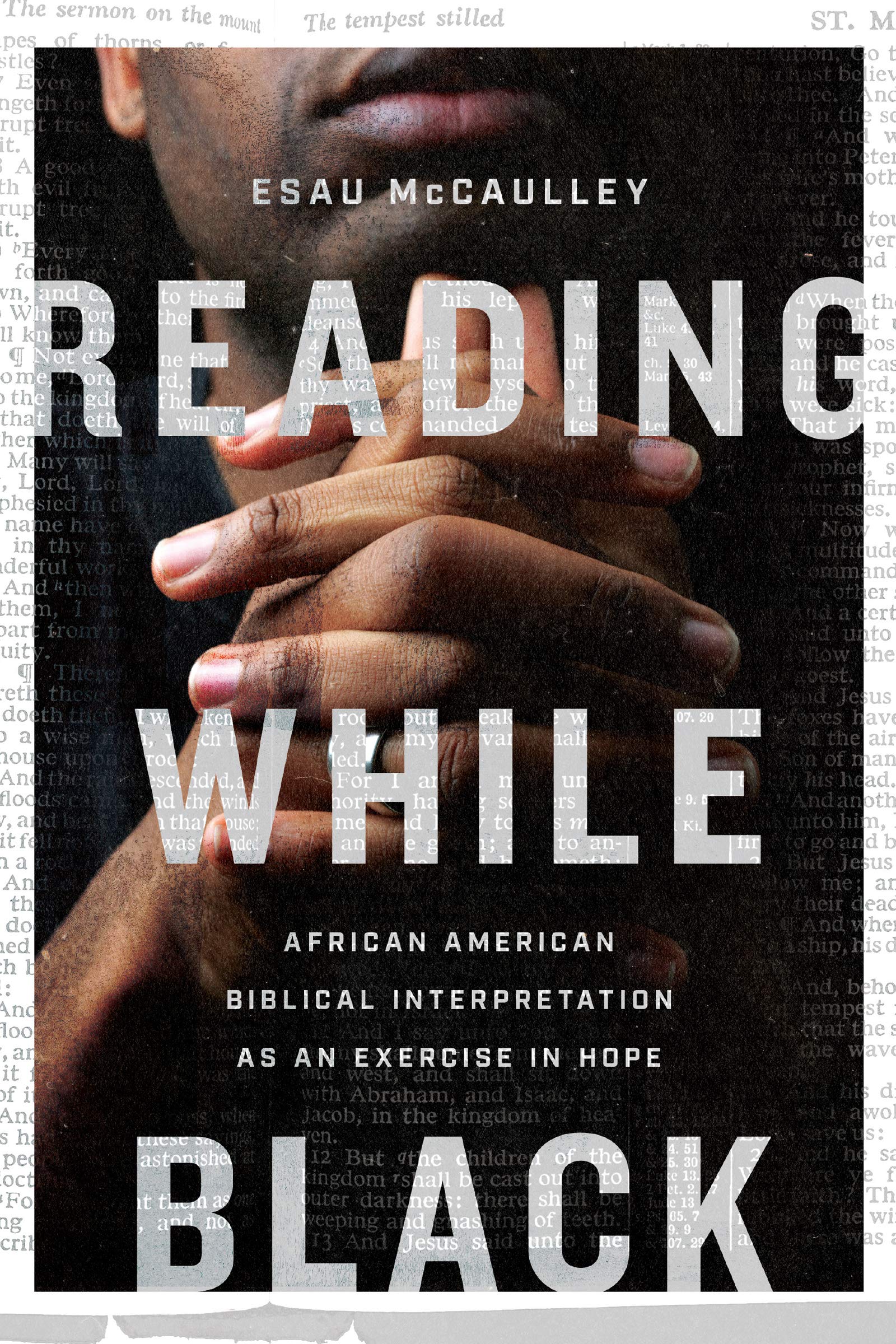
Esau McCaulley’s Reading While Black

Dabney Hixson

3,539 words

Esau McCaulley
Reading While Black: African American Biblical Interpretation as an Exercise in Hope
Downers Grove, Illinois: Intervarsity Press, 2020

Esau McCaulley has been on the faculty of Chicago-area evangelical bastion Wheaton College (alma mater of the likes of Billy Graham) since 2019, where he serves as an assistant professor of the New Testament. He is also a priest in the Anglican Church (despite his Primitive Baptist roots) and received his Ph.D. at St. Andrews in Scotland under internationally renowned New Testament scholar N.T. Wright. His dissertation, “Sharing in the Son’s Inheritance: Davidic Messianism and Paul’s Worldwide Interpretation of the Abrahamic Land Promise in Galatians,” is being published in 2021 in the respected Library of New Testament Studies series by T & T Clark. Not only is the title under review widely and vigorously promoted by respected evangelical publisher Intervarsity Press, but McCaulley has also been named the general editor of a forthcoming “multi-ethnic commentary series,” titled The New Testament in Color, from the same publisher. He has also been invited to write articles for national publications such as Christianity Today, the New York Times, and the Washington Post. His attractively designed personal website includes a link to his professionally-produced “Disputer’s Podcast,” co-sponsored by Intervarsity Press and Christianity Today. And this is just the tip of the accolade iceberg for McCauley and his ever-increasing CV.

How, one might ask, in the cutthroat world of academia, does a freshly minted Ph.D. merit a plum teaching post, three simultaneous book contracts, and invitations to write for national journals and newspapers, while his faculty page lists only one previously published academic journal article?

He who gets this kind of fast-track to success is either a one-in-a-billion genius or has made some Faustian deal with the devil. There is, however, another explanation. The clue comes in the title of his book Reading While Black. McCaulley is a new black “evangelical” intellectual being generously helped up the ladder of success while simultaneously condemning it.

Reading While Black is aimed at a popular audience, specifically for general black readers, but those of other races are welcomed to listen in on the conversation. Like other books of this type (like its more secular counterpart How to Be an Antiracist), it leans heavily on the author’s story. McCauley tells us what it was like to be a young black man listening to hip hop music, a genre that taught him how to “interpret the world that seemed to have its foot on the neck of Black and Brown bodies” in his city (p. 2). He found a ray of light in the Bible interpretation of the black church (what the author calls the “Black ecclesial interpretation”) (3).

In college, he studied African-American history and religion, finding that the reading in his Biblical studies classes mostly provided applications designed for “white middle-class Christians” (12). He was dismayed that there were so few “Black and Brown voices” (13).

Most of the black voices came from the “progressive” wing, while those blacks who promoted more traditional Christian views were “weaponized in evangelical spaces against Black progressive voices” (15). From Frederick Douglass, he learned the distinction between “slaveholder religion” and the Christianity “of Jesus and the Bible” (17).

The key to authentic hermeneutics, according to McCaulley, is to approach the Bible as “enslaved persons” did, to see the God of the Bible as “the liberator and humankind as one family under the rule of Christ” (19).

A “dialogue” between “the Black experience” and the Bible is what must be put forward in our day (20). By using this method, the author says he aims to be both progressive and traditional. He sees the book as a “love letter from a somewhat wayward son of the Black church” (24).

McCaulley’s orientation given, he then offers six chapters on the Bible and various topics.

The Bible and policing

This chapter begins with another “memoir moment” from the author. As a teen, he was pulled over at a gas station by the police, who were trying to crack down on the local drug trade. There were no arrests or harassment, but the brief stop and questioning by police became, of course, an example of racial oppression.

He then turns to Romans 13, a classic text for Christians on submission to civil authority, but suggests that the interpretation of this passage changes when the rulers are wicked. From there, he turns to a brief discussion of “policing” in the Roman Empire, drawing on Christopher J. Furhman’s Policing the Roman Empire: Soldiers, Administration, and Public Order (Oxford, 2012).

McCaulley concludes that contemporary African-Americans are uniquely situated to understand the experience of persecuted early Christians — the United States has crafted laws “over the course of centuries, not decades, that were designed to disenfranchise Black people” (38). What is needed is “a theology of policing” that protects black from unwarranted fear.

McCaulley expresses no appreciation for how equality under the law has essentially been secured in the modern era (if not routinely tilted in favor of minorities). There is no recognition of the fact that people of all races are generally arrested when they commit crimes, nor is there any discussion of widespread black criminality or the fact that blacks are generally hurt most not by police violence but by black-on-black crime, for which a strong police presence is usually welcomed by those of all races with any common sense. For McCaulley it is literally, and unironically, black and white. Police are oppressors. Blacks are innocent and meek victims. He has much to say about the “duties” of the police, but nothing to say about the duties of citizens to abide by the law. It is never mentioned that those who “fear” the police often do so not because they are innocent victims, but because they have done wrong and fear the repercussions.

The Bible and political witness

This chapter begins with a reference to Martin Luther King’s letter from a Birmingham jail, and the assertion that “Black Christians” have never had “the luxury” of separating “faith from political action” (48).

Just as a loophole was found to escape the weight of submission to authority in Romans 13, so here a loophole is found to avoid Paul’s admonition to pray for those in authority in 2 Timothy 2:1-4. Authorities need not be respected or prayed for if they “stand in the way” (52).

McCaulley sees Jesus calling Herod a worthless “fox” (Luke 12:32) as a prime example of political resistance. He sees another example in Paul’s reference to his present circumstances as the “present evil age” (Galatians 1:4), and another in John’s apocalyptic vision of the fall of Babylon (Revelations 18). Thus, “Protest is not unbiblical” (62).

The chapter ends with a review of Jesus’ Beatitudes in the Sermon on the Mount (Matthew 5). 

At one point, McCaulley notes that the teaching of Jesus “undergirds the actions of Paul, Isaiah, and Rev. Dr. King” (65). Really? King elevated in status to equality with Isaiah and Paul? That’s quite a promotion.

McCaulley asserts that if the church is going to be on the side of the “peacemakers,” there must be an “honest accounting of what this country has done and continues to do to Black and Brown people” (68). There follows a list of things that supposedly have to be “named” (whatever that means): “Housing discrimination has to be named. Unequal sentences and unfair policy has to be named. Sexism and commodification of the Black female body has to end” (69).

All the things that supposedly have to be “named” are generously blamed on the government. Who is responsible for sexualizing and commodifying the “Black female body?” FEMA, the US Postal Service, the IRS. Wouldn’t we say that the aforementioned hip-hop (and rap) music culture has had as much or more to do with this as anything else?

Biblical prophets addressed the sins of their own people. Nathan confronted David with “Thou art the man!” Jeremiah railed against his fellow Israelites (Where else did we get the term “jeremiad”?). Our new black prophets, however, seem to say nothing to their own people, instead pointing their fingers at whites or the government. 

This is somehow considered “edgy” and “prophetic.”

You can buy It’s Okay to Be White: The Best of Greg Johnson here.

The Bible and justice

The focus in this chapter begins with the Gospel of Luke. McCaulley claims the fact that Luke (a Gentile) wrote to a Gentile audience about the salvation of Gentiles has some special relevance for black Christians. He even calls Luke “a patron saint of African-American ecclesial interpretation” (79). He then tries to convince us that the “enslaved” would have felt special affinity with “Theophilus,” the recipient of Luke’s Gospel, since he supposedly first heard the Christian gospel by word of mouth and not by reading (78).

The line of fanciful interpretation continues when McCaulley next suggests that Zechariah and Elizabeth, the parents of John the Baptist, are equivalent to “the first generation of Black Christians who came to faith during slavery” (81).

This chapter also provides several examples of odd writing choices. At one point, McCaulley says that “the miracle of John’s birth spread like a virus of hope infecting the bloodstream of Israel” (83). A “virus of hope?” What’s next, the “constipation of joy?”

The author also makes some interesting remarks about the virgin birth, a doctrine that orthodox Christians (which he supposedly represents, as an evangelical) hold as essential to the faith. Still, the author tells us that some might find Luke’s stress on this venerable doctrine to smack of “sentimentalism or, even worse, fundamentalism” (85).

The “creative” interpretation continues with McCaulley’s analysis of Luke’s Mary, as he suggests a typological interpretation that I would guess is unique in the history of critical scholarship: “Mary stands in for Black (and all other) Christians who are called to give the entirety of themselves, their very bodies for a future that they cannot see . . . Mary is the patron saint of faithful activists who give their bodies as witnesses to God’s saving work” (86).

After some brief analysis of Jesus’ baptism and early ministry, McCaulley concludes that readers must get beyond “the slave master exegesis of the antebellum South” which bore false witness about God. Instead, one must affirm “our commitment to the refugee, the poor, and the disinherited” (91). In the conclusion, he takes a swipe at evangelicals who tend to care about the spirit but not the body, but then turns things around and makes sure also to take the same swipe at progressives who care about the body but neglect the spirit.

The Bible and black identity

This chapter begins with an effort to debunk the idea that Christianity is a white European religion. McCaulley argues that persons of African descent are in the Bible from the beginning and that Africans did not initially come to know the faith through colonization or slavery.

The Bible survey begins with the promise to Abraham that blessings will come to all nations through him (Genesis 12:3). It assumes that the sons of Joseph, Ephraim and Manasseh, were half-black because Joseph had an Egyptian wife. This assumption is problematic, however, since it is much more likely that the Egyptians of that day were, as they are now, primarily a Mediterranean people, rather than of black, sub-Saharan stock. The same objection can be lodged against the author’s claim that Simon of Cyrene (in Lybia), who carried the cross of Jesus, was also a black African (107-108). On the other hand, he is quite right to say that the Ethiopian Eunuch of Acts 8 was likely a sub-Saharan African.

Closing with reference to John’s vision in Revelation of all nations ultimately being part of the Christian movement and Paul’s oft-quoted statement in Galatians 3:28 that in Christ there is neither Jew nor Greek, McCaulley takes pains to point out this does not mean he accepts the claims of “colorblindness,” noting that “some White Christians have even begun to claim that they do not see color” (112). Why center on white Christians? Are they especially prone to accept this supposedly insensitive fallacy? McCaulley, in fact, makes the claim that race is forever, because God’s eschatology “requires my blackness and my neighbor’s Latina identity to endure forever,” though he does add that John’s final vision is incomplete “without Black and Brown persons worshipping alongside white persons” (116). No mention is made, however, of whiteness enduring forever. He closes: “Colorblindness is sub-biblical and falls short of the glory of God” (116).

The Bible and black anger

That such a chapter exists in this book is something of an acknowledgment that black rage exists. It also comes as little surprise, however, to learn he believes that whites are responsible for this because of their “dehumanizing” treatment of blacks.

This chapter begins with another memoir-esque narrative. This one involves McCaulley as a child. When sick at school, he called his mother’s workplace and was supposedly called a “N*****” by the person who answered the phone. He asks how this person even knew he was black: “Was it my diction or the register of my voice? Did my blackness seep through the phone and offend his sensibilities?” (119). This brought on a sense of rage. He continues: “I was helpless before this white man who didn’t know me” (119). McCaulley offers the previous statement with no seeming recognition of its latent hypocrisy. He assumes the person who answered his phone call was a “white man.” How did he know this? Was it his diction, the register of his voice, or something that seeped through the line? Is it possible the person on the other end of the line was a black man, and it was he who supposedly called McCaulley’s younger self the N-word?

McCaulley returns to the trope that black women are especially the victims of white dehumanization. They are “pushed and pulled into sexual stereotypes that present them as objects of pleasure. As hips and thighs develop so the threats to their safety” (120). Is he unaware of the statistics showing how rare it is for a black woman to suffer sexual assault at the hands of a white person? That, in fact, black girls and women are most likely to be assaulted by other blacks? While we are on the case, why not mention the role of Jews in producing pornography, dehumanizing men and women of all ethnicities?

While denouncing “colorblindness,” it appears that McCaulley is “black blind.” He never sees blacks as bearing any responsibility for their plight. He mentions here, of course, the rage induced by the legacy of slavery — “we were mercilessly dragged from our native land and flung to the far ends of the world to be beaten, bred, raped, and degraded” (121). Never, however, does he stop to ponder the fact that slavery existed before the colonial period and that it was Africans themselves who enslaved and sold their fellow Africans.

Once again, the author sees a special relationship between the Biblical people and enslaved people. Only they can grasp the significance of the exile of the ancient Israelites and the overflow of rage against the Babylonians as in Psalm 137.

In the end, he finds the answer to “the continual assault on Black bodies and souls” in the death and resurrection of Jesus, as suffering was redemptive and vindicated (135).

The Bible and slavery

The last chapter takes on the biggest topic: slavery. For McCaulley, this is the linchpin. If the Bible supports slavery, then it is immoral, and Christianity must be abandoned. Since the Gospels record no teaching of Jesus on slavery, he takes Jesus’s teaching on marriage and divorce as providing a proper hermeneutic. Jesus said that divorce has been allowed by God, but it was not his “creational intent” (141). The same is true for slavery.

The survey of the Bible’s teaching on slavery begins in the Old Testament. Since “God’s character speaks against slavery,” the positive Old Testament treatment of it must reflect divine permission and not approval. Even in these texts, there is a “trajectory . . . toward liberation” (151).

Turning to the New Testament, the focus rests on Paul’s epistle to Philemon. A supposedly important insight that black exegetes can offer is that Onesimus should not be considered a “runaway slave,” but one who had “escaped” (156). That, however, seems more than a little anachronistic. A bondservant on the lam in the first century is not equivalent to a runaway slave of the antebellum South. Furthermore, McCaulley suggests that if Paul had not demanded that Onesimus be freed from slavery by his Christian master Philemon, he should have. At the least, Paul was trying to “limit the damage done by slavery” and cause Christians to rethink the entire institution. One wonders, however, what McCaulley would make of R. L. Dabney’s articulate exegetical defense of slavery in his post-war book In Defense of Virginia and the South (1867).

There are many problems with McCaulley’s overly simplistic parallels between slavery as an institution in the Greco-Roman world and slavery in the antebellum Southern United States. Nothing is said about the role of white men (like Wilberforce) in bringing slavery to an end in the white Western world, while it continues in many places in contemporary Africa (like Sudan). Nor is anything said about the fact that America (and its historically white Christian population) fought a bloody civil war that resulted in the deaths of hundreds of thousands and the eventual emancipation of slaves in this nation.

Bonus Track: On Black Ecclesial Interpretation

The six main topics covered, the book ends with a brief conclusion and an addendum, called a “Bonus Track,” tracing the history of Black scholarly interpretation of the Bible. Three main historical approaches to black reading of the Bible are suggested: acquiescence (internalizing “the negative understanding of Black worth found among white Christians”) (170); critique (using the Bible to argue against racism and slavery); and rebellion (“Nate Turner is paradigmatic for this strand of interpretation”) (171). On the contemporary scene, of these three, only critique and rebellion remain.

The most important recent development in African-American Biblical interpretation, according to the author, is the emergence of “womanist biblical interpretation,” a fusion of black liberation theology and feminism (180).

He closes by saying black evangelicals have to develop a “double apologetic” responding to “Black separatists and white progressives” (184).

Closing thoughts: This will never end!

Reading While Black, of course, plays on the mythical dangers and discrimination of “driving (or jogging!) while black.” White evangelical Protestant Christianity had long been rock-solid in support of the “religious Right.” But as Robert P. Jones demographically demonstrated with chart after chart in The End of White Christian America, those days are long over. Trump’s unexpected victory in 2016 was likely but a bump in the road on the way to the final destination of white Christian decline in this nation.

Woke culture broke the mainline white churches decades ago, and it is now overrunning evangelical churches and institutions. McCaulley’s book is but the latest specimen of this. He is not splitting any differences between progressives and evangelicals. He is a progressive and only a slightly more sophisticated and nuanced “race hustler” than those of the past generation.

McCaulley makes clear in the conclusion of the book that there will never be any meaningful answer to racism nor will racial reconciliation be achieved — literally till Jesus comes! The “long tradition of Black reflection on our pain will continue. The slave question will be with us to the eschaton” (167). This will never end! There is penance in this new religion, but no salvation.

One of the saddest things to see is that woke white evangelicals are so desperate to prove how much they are not racist that they are promoting scholars like McCaulley to professorships in top institutions, showering them with book deals, and propping them up with professionally-produced podcasts. If this book is any example, McCaulley just isn’t that sharp a thinker or writer. His prose is mediocre at best. There is little meaningful self-critique and plenty of hackneyed braying about damage done to “Black bodies.” If he did not have “black privilege,” he’d likely be just another religion Ph.D. on a glutted education market willing to take any kind of adjunct work that came his way.

No doubt, a good number of evangelical students will have this book assigned in their Biblical studies classes and be forced to endure reading at least some of it, and they will, of course, be told how important it is. Even N. T. Wright exudes in a cover blurb about his former student: “Esau McCaulley’s voice is one we urgently need to hear.” My guess, however, is that most readers of this book (and let’s face it, the mainstay of its readers will be whites, not “people of color”) will respond to it with boredom. It’s just not that interesting. You can’t prop someone up and declare him to be an intellectual (or even a “skintellectual”) with important things to say. His writing and thinking must compel this conclusion.

McCaulley’s does not.

If you want to support Counter-Currents, please send us a donation by going to our Entropy page and selecting “send paid chat.” Entropy allows you to donate any amount from $3 and up. All comments will be read and discussed in the next episode of Counter-Currents Radio, which airs every weekend on DLive.

Don’t forget to sign up for the twice-monthly email Counter-Currents Newsletter for exclusive content, offers, and news.

Esau McCaulley’s Reading While Black

Esau%20McCaulleyand%238217%3Bs%20Reading%20While%20Black

Share

  • Gab

Enjoyed this article?

Be the first to leave a tip in the jar!

Instant Echeck GreenPay™

Related

  • Jared Taylor: What Rome Means to Me

  • A Novel Approach: Roberto Bolaño’s 2666

  • Restoring American Deterrence through Innovation and Industry

  • E. M. Forster’s A Passage to India & the Indian Mentality

  • What Rome Means to Me

  • The Theology Behind Ruby Ridge

  • The Rest Is Silence: Heidegger’s Quietism

  • Matt’s Negative Gloss: Matt Goodwin’s Suicide of a Nation, Part Two

Tags

Black ChristiansBlacks in Americabook reviewsChristianityDabney HixsonEsau McCaulleyevangelical Christiansidentity politicsReading While Blackthe Bible

12 comments

  1. Vehmgericht says:
    January 29, 2021 at 1:57 pm

    Dr McCaulley’s projection of modern ethnic and cultural tropes upon the ancient Hellenistic world seems to me perverse and textually unwarranted. I doubt any Greek-speaking early Christian ever considered the enslavement of sub-saharan africans to be a topos of scriptural exegesis.

    As the article notes, with the partial exception of the Ethiopians (themselves a genetically distinct population from the Horn of Africa with much mediterranean and west asian admixture) relatively few sub-saharans would have been present in that arena at that time.

    One really has to question whether this author knows his Koine Greek, let alone Hebrew. Or is it yet another case of the academic establishment being too pusillanimous to debunk Afro-centric pseudo-history?

    0
    0
  2. Spenglers Ghost says:
    January 29, 2021 at 3:44 pm

    Once you reject the Bible and the cult of Christ, all this becomes background noise. It’s goofy at best.

    0
    0
  3. Elenka says:
    January 30, 2021 at 4:27 am

    Yet one more reason to reclaim our pagan religious heritage and leave this 2000 year detour behind.

    0
    0
    1. WWWM says:
      February 8, 2021 at 4:12 am

      Brings to mind Savitri Devi’s view on Christianity – “The Bolshevism of the ancient world.” She wrote that it starts with Christianity, that we are all equal under god and should worship the same. Then it turns to democracy – we should all be politically equal. The natural end result of democracy is Marxism. That we should all be economically equal, regardless of anything else important. That is the stage we are headed for.

      0
      0
  4. Francis XB says:
    January 30, 2021 at 10:47 am

    Supposing on that fateful day in 1619 the first slave ship landing at Jamestown was repelled by Virginia colonists who decided they would implement a new fangled idea called “abolitionism.” And in this alternative universe, there is no slavery in what becomes the United States. Where would Esau McCaulley be today?

    Well, in Africa, that’s where.

    And then let’s assume that in this enlightened alternative universe, there was no European colonization of sub-Saharan Africa, no White people imposing their legal systems on blacks. Where would Esau McCaulley be today?

    Well, in Africa, that’s where. And not only that, McCaulley would probably be a slave.

    Why? Because it was Europeans who abolished slavery in Africa. This was a result of the Berlin West Africa Conference of 1884-5 which made abolition part of the deal for dividing up Africa among the European powers. No Atlantic passage, no European colonizers, no abolitionism: McCaulley’s ancestors would probably have been enslaved by other black Africans, or by Muslim slave raiders.

    Check of proof: since de-colonization, slavery has returned to Africa. Alternative universe McCaulley might now be doing forced labor in a fourth world sh*thole, digging for conflict metals, or more likely be dead given the standards of treatment of slaves in Africa.

    Of course, there is nothing to stop McCaulley from returning to sub-Saharan Africa today where he could enjoy all the benefits of the black majority eschaton, where policies of humanization are the order of the day, demonstrated by the liberating history of Liberia, Congo, Zimbabwe and points east. And if Africa is a bit too far, then there is always the island of Haiti, Wakanda right off the American shore where he could find his authentic voice.

    What I get out of McCaulley and his like-minded brethren is a class of people who can not fit into White civilization. Perhaps it is a question of median IQ or future time orientation or impulse control. Perhaps. Through their eyes they are strangers in a strange land. White history, White law, even White religion are waters in which they can not navigate.

    Whether or not McCaulley’s views are typical of most black Americans, or are the product of his playing to evangelical sponsors who have their own motivations, remains to be seen. Suffice it to say, this book is one more argument for a racial divorce.

    0
    0
    1. Flel says:
      January 30, 2021 at 1:47 pm

      Is there a story out there with a treatment of how wonderful our land would be today if those ships were rejected? And rejected in the Indies? And South America? No black slaves in the hemisphere. It would be a fun read with no civil war and only a calm rural South trading with the industrial North. Like the story about Germany winning WW II? I may have to write it myself.

      0
      0
      1. Francis XB says:
        January 31, 2021 at 4:38 am

        One novel you might look at is The Guns of the South by Harry Turtledove.

        A cadre of White South Africans from the modern world (1990s) go back in time to 1864 where they give the Confederate army AK-47 assault rifles and plenty of ammo. The Confederates then go on to handily win the Civil War. Turtledove tacks on a happy ending where R. E. Lee is elected president of the CSA and emancipates the slaves, leading to a kumbayah postwar South.

        The novel was initially published in 1992 just before the collapse of White rule in South Africa. Turtledove turns the South African time travelers into something of the villains of the piece for their daring to suggest that if the Union were to win the Civil War it would lead to a chain of events in which blacks would come to dominate in the Western World.

        Judging from the perspective of 2021, with the ANC dispossession of Whites in South Africa, the events of Rotherham, the flooding of Europe with third world invaders, and the ongoing BLM insurrection worldwide, Turtledove’s South Africans were right on the money…though I do not think that conclusion was the author’s intent.

        The novel does raise, even if inadvertently, the question of how far Whites ought to go to defend their own interests. It’s not a question of White Nationalism versus democracy. It comes down to White Nationalism versus self-destruction.

        Something to think about in the continuing crisis.

        0
        0
        1. Captain John Charity Spring MA says:
          February 1, 2021 at 1:27 pm

          That wouldnt help. More confederacy in that context would probably make the US blacker.

          Showing the Europeans how to grow sugarbeat would be more useful. Possibly some type of earlier mechanisation of agriculture in the early 1700s? Go back in time with modern farm equipment and spare parts chain for the combined harvesters and other farm vehicles?

          0
          0
  5. Captain John Charity Spring MA says:
    January 30, 2021 at 11:17 am

    White men are clearly uninterested in black women. How could anyone writing a book on such topics miss that fact?

    0
    0
    1. Flel says:
      January 30, 2021 at 1:48 pm

      Only in seemingly every commercial on tv lately. In real life, not so much.

      0
      0
  6. Brain, Not Body says:
    January 30, 2021 at 12:17 pm

    That communist academic-speak “bodies” thing has been around for a while. It wasn’t started by blacks, they just jumped on those “bodies” and ran with them. How could any normal person continue reading a piece after the author writes “bodies” unironically?

    0
    0
  7. Alexandra says:
    January 30, 2021 at 12:32 pm

    If all humankind is one big family under God (or Lord Jesus, or whomever), then how can anyone be enslaved? Christianity is so muddled.

    0
    0

Comments are closed.

If you have a Subscriber access,
simply login first to see your comment auto-approved.

Note on comments privacy & moderation

Your email is never published nor shared.

Comments are moderated. If you don't see your comment, please be patient. If approved, it will appear here soon. Do not post your comment a second time.

    • The Remigration Movement Solidifies

      F. Roger Devlin

    • Casting Aspersions:
      The Fatal Consequences of Race-Swapped Casting, From Helen of Troy to Henry of Southampton

      Steven Tucker

      6

    • The Murder of Henry Nowack

      Millennial Woes

      13

    • Don’t Forget to Vote in Our Writer & Article of the Month Poll

      Greg Johnson

    • The Robot Hotdog Stand

      Greg Johnson

      23

    • Laughing Our Way to Victory

      Dave Chambers

      2

    • The Zodiac Killer

      Mark Gullick

      9

    • Jared Taylor: What Rome Means to Me

      Jared Taylor

    • An Interview with Endeavour:
      My Way of Life Is an Adventure!

      Ondrej Mann

      6

    • José Pedro Zúquete’s The Identitarians

      Greg Johnson

      3

    • Editor’s Update
      Fundraiser Update & How to Watch the Remigration Summit

      Greg Johnson

      5

    • The Bitter End of Western Metaphysics:
      Heidegger on Nietzsche, Part One

      Collin Cleary

      10

    • Berlin: City of Stones

      Spencer J. Quinn

      6

    • True Folk-Horror Is Horror of Your Own Folk:
      Mark Gatiss vs the Brexit Blind Dead  

      Steven Tucker

      4

    • Counter-Currents Radio Podcast No. 689
      Thomas Massie, the America 2050 Bust, the Need for Whites to Divest from America, the AI Economic Apocalypse, & Pro-White Project Pitches to Billionaires

      Counter-Currents Radio

      7

    • Nationalism This Week
      Remigration is Inevitable, Part 3

      Greg Johnson

      26

    • Why Billionaires Should Fund White Identity Politics

      Lipton Matthews

      8

    • How Cold War Two Came About

      Morris van de Camp

      5

    • Now Available for Pre-Order at a Special Price!
      Greg Johnson’s The Philosopher Is In

      Greg Johnson

    • David Zsutty’s Elevator Pitch to a Billionaire

      David M. Zsutty

      1

    • Headbanging Lite

      Mark Gullick

      5

    • White Advocacy Past and Present

      Peter Bradley

      13

    • The Lunch Wars

      David M. Zsutty

      46

    • The Russians are Coming/The Russians are Coming

      Steven Clark

      1

    • Peak Fatigue in Fort Wayne

      Gabriel Anderson

      24

    • Keith Woods’ Elevator Pitch to a Billionaire

      Keith Woods

    • The Cruelty of Kindness

      Morris van de Camp

      9

    • Predation Wearing the Mask of Civilization

      Jayant Bhandari

      13

    • The Mandalorian & Grogu

      Trevor Lynch

      24

    • Editor’s Update
      Fundraiser Update & a New $20,000 Matching Grant
      Greg Johnson & David Zsutty Discuss Thomas Massie on Counter-Currents Radio

      Greg Johnson

      2

    • How the Jews Defeated Thomas Massie—& Themselves

      David M. Zsutty

      24

    • Jared Taylor’s Elevator Pitch to a Billionaire

      Jared Taylor

      15

    • Nationalism This Week
      Remigration Is Inevitable, Part 2

      Greg Johnson

      8

    • Could Fascism Work?

      Mark Gullick

      40

    • Jonathan Bowden’s Deliverance
      Part 7

      Jonathan Bowden

    • China’s Quiet Hand:
      Influence, Infiltration, & the Western Blind Spot

      Lipton Matthews

      9

    • Counter-Currents Radio Podcast No. 688
      Tyler Dykes on Running for US Congress in South Carolina

      Counter-Currents Radio

      3

    • Lothrop Stoddard’s The Revolt Against Civilization

      Spencer J. Quinn

      14

    • Lewis Strauss Did Nothing Wrong:
      How the politics of the Atom Bomb during the early Cold War Apply to Artificial Intelligence Today

      Morris van de Camp

      14

    • The Ghost of the Confederacy

      Dave Chambers

      12

    • America’s Century of Humiliation has Begun

      Greg Johnson

      27

    • Prepare for Africans & Schizophrenics!
      Welcome to the New Canadian Military

      Gunnar Alfredsson

      6

    • Remembering Julius Evola:
      May 19, 1898–June 11, 1974

      Greg Johnson

    • About Film “From the Right”

      Karel Veliky

    • Nostalgia Ain’t What It Used To Be. . . Now It’s Racist

      Steven Tucker

      8

    • To Depose The King

      Mark Gullick

      7

    • Editor’s Update
      Tyler Dykes on Counter-Currents Radio & The Best of Trevor Lynch Now in French

      Greg Johnson

    • Nationalism This Week
      Remigration Is Inevitable

      Greg Johnson

      21

    • You’re Nicked! The Story of The Sweeney

      Mark Gullick

      12

    • The Counter-Currents Fundraiser 2026:
      Help Us Provide You With All the News That’s Unfit To Print—Because It’s Actually Worth Reading!

      Steven Tucker

      3

    • kolokol

      Casting Aspersions

      "Lupita Nyong’o" (sic) is a ridiculous name. And she is hideously ugly. She is the antithesis of...

    • Bernie

      The Murder of Henry Nowak

      Many are saying this could be the straw that breaks the camel’s back in the UK. I certainly hope so...

    • Derek Stark

      The Zodiac Killer

      Another one is the “De Mau Mau” cult in Illinois in the 1970s, made up of black Viet Nam vets, who...

    • DM

      The Murder of Henry Nowak

      None. My only point is that it might be true that the attacker didn't remember stabbing the fellow.

    • Will Williams

      Remigration is Inevitable Part 3

      Uncle Semantic: June 1, 2026  The weebo is ryan dawson, another antiWhite prick… —Weebo?...

    • Chud

      The Murder of Henry Nowak

      Sub-continental migration appears good when the local migration industry isn't established in India...

    • Bryan

      The Murder of Henry Nowak

      What threat did an unarmed White 18-year-old present to the entitled, knife-carrying Sikh?

    • Hammerhead

      Casting Aspersions

      'These are the popular ‘soft’ things that reinforce this evil. It’s not just an abstract...

    • Will Williams

      The Zodiac Killer

      Derek Stark: June 2, 2026 …[T]here are more black serial killers per capita than white ones in the...

    • Vagrant Rightist

      The Murder of Henry Nowak

      Weren't Sikhs supposed to be the 'good ones' ? So much for that lie. Thanks MW, for the detailed...

    • Peter Quint

      The Murder of Henry Nowak

      Carry a Para-Ordnance 45 cal. sidearm everywhere like I do. 🙃

    • Peter Quint

      The Murder of Henry Nowak

      That is the same message White people in America have been getting for decades. 🙃

    • Thomas Johnson

      The Murder of Henry Nowak

      The message to white people in the UK is clear: if the nonwhite criminals don't get you, the coppers...

    • Glide Ratio 0:1

      Casting Aspersions

      Surprised you called Nyongongo Mgolo "average". As far as my eyes can see she's a black 2. Well...

    • Vagrant Rightist

      Casting Aspersions

      I'd be very surprised if Nolan himself believes in this stuff, but he knows full well his overlords...

    • Beau Albrecht

      The Robot Hotdog Stand

      Anyone remember this quote? "The simple statement that the People are not there for the sake of...

    • Greg Johnson

      The Robot Hotdog Stand

      You're arguing that a huge wave of post-AI business investment will employ the millions of people...

    • Peter Quint

      Casting Aspersions

      Great article! Sidney Sweeney would have been the best choice for Helen of Troy. Gerard Butler would...

    • YT

      The Murder of Henry Nowak

      People in UK (and everywhere) need to start saying online, in graffiti, in rough encounters in...

    • BigJimSportCamper

      The Murder of Henry Nowak

      Can I get a religious exemption to open carry my AR15 everywhere? That's what I thought...

    • Earth Day Special

      John Morgan

      12

    • A Robertson Roundup
      Remembering Wilmot Robertson
      (April 16, 1915 – July 8, 2005)

      Margot Metroland

      13

    • The Paranoid Style in White Nationalism

      Greg Johnson

      30

    • Join the Dance!

      Andrew Hamilton

      1

    • We Can’t Save the Earth Without Reducing African Birth Rates

      James Dunphy

      36

    • “I’m Not a Conspiracy Theorist, but . . .”:
      Jeffrey Epstein’s Death Gives New Life to “Conspiracy Theories”

      Greg Johnson

      22

    • Sylvia Plath: Stasis in Darkness

      Vic Olvir

      17

    • Vanguardism, Vantardism, & Mainstreaming

      Greg Johnson

      80

    • Aviation, Geography, & Race

      Charles Lindbergh

      3

    • Some Thoughts on Yule

      Collin Cleary

      4

    • Living in Truth:
      A Yuletide Homily

      Jef Costello

      7

    • John Kennedy Toole’s A Confederacy of Dunces

      Greg Johnson

      20

    • On Aleksandr Solzhenitsyn’s Warning to the West

      Spencer J. Quinn

      7

    • Elitism, British Modernism, & Wyndham Lewis

      Jonathan Bowden

      6

    • Philip K. Dick’s Do Androids Dream of Electric Sheep? as Anti-Semitic/Christian-Gnostic Allegory

      Greg Johnson

      20

    • “Conspiracy Theory” or Conspiracy?

      Andrew Hamilton

      21

    • Remembering H. P. Lovecraft
      (August 20, 1890–March 15, 1937)

      Greg Johnson

      3

    • Who Are We?
      Nordics, Aryans, & Whites

      Greg Johnson

      71

    • Remembering William Gayley Simpson
      (July 23, 1892–December 31, 1990)
      A Pleasant Afternoon with Harriet & Bill Simpson

      Margot Metroland

      18

    • Here are the Young Men
      Remembering Ian Curtis
      (July 15, 1956–May 18, 1980)

      Mark Gullick

      18

    • Percy Grainger
      Artist of the Right

      Alex Graham

      7

    • Remembering Revilo Oliver
      (July 7, 1908–August 20, 1994)

      Greg Johnson

      18

    • The Meaning of July 4th for the White Man

      Gregory Hood

      13

    • The Front National’s Evolution

      Bruno Mégret

    • Merwin K. Hart
      Forgotten American Hero & Man of the Right

      Morris van de Camp

      10

    • George Orwell’s Nineteen Eighty-Four

      Jonathan Bowden

      8

    • Carleton S. Coon
      Scientist & Reluctant White Advocate

      Morris van de Camp

      3

    • The Kwanzaa Absurdity Will Be Dwarfed by Juneteenth

      Robert Hampton

      10

    • Stravinsky

      Alex Graham

      7

    • Like the Roman:
      Remembering Enoch Powell (1912-1998)

      Mark Gullick

      23

    • Crosstown Traffic:
      Jimi Hendrix & The Post-War Rock ‘N’ Roll Revolution

      Mark Gullick

    • Slaves from the North:
      Finns & Karelians in the East European Slave Trade, 900–1600

      Lipton Matthews

      14

    • Neo-Fascism in Film
      Part 4

      Karel Veliky

      2

    • David Lean’s A Passage to India

      Spencer J. Quinn

      1

    • Elites are Essential to Development

      Lipton Matthews

      7

    • Jonathan Bowden’s Deliverance
      Part 4

      Jonathan Bowden

    • Neo-Fascism in Film
      Part 3

      Karel Veliky

      6

    • E. M. Forster’s A Passage to India & the Indian Mentality

      Spencer J. Quinn

      25

    • Jonathan Bowden’s Deliverance
      Part 3

      Jonathan Bowden

    • The Rest Is Silence
      Heidegger’s Quietism

      Mark Gullick

      2

    • Dispelling the Historical Fallacy of Indian Nationalism

      Lipton Matthews

      8

    • Neo-Fascism in Film
      Part 2

      Karel Veliky

      8

    • Jonathan Bowden’s Deliverance
      Part 2

      Jonathan Bowden

    • Life of a Klansman

      Mark Gullick

      8

    • Jonathan Bowden’s Deliverance, Part 1

      Jonathan Bowden

    • Decolonial Ideas are Holding Back Developing Countries

      Lipton Matthews

      8

    • Neo-fascism in Film, Part 1

      Karel Veliky

      21

    • Jonathan Bowden’s Onslaught, Part 8
      Divigations on Decadence

      Jonathan Bowden

    • Jonathan Bowden’s Onslaught, Part 7
      Intrigues in the National Front

      Jonathan Bowden

      1

    • Rotten to the Core

      Mark Gullick

      8

    • Strauss on Husserl’s “Philosophy as Rigorous Science”

      Greg Johnson

    • Jonathan Bowden’s Onslaught, Part 6
      Francis Bacon & Right-Wing Nihilism

      Jonathan Bowden

    • London After (& Before) Midnight:
      Aleister Crowley, The Landlord’s Worst Nightmare

      James J. O'Meara

      2

    • Jonathan Bowden’s Onslaught, Part 5
      The Post-War British Far Right

      Jonathan Bowden

    • No Rules: Rollerball

      Mark Gullick

      4

    • Jonathan Bowden’s Onslaught, Part 3
      Brett Easton Ellis’ American Psycho

      Jonathan Bowden

    • An Alternate History of the Harris Presidency

      Beau Albrecht

      5

    • The Origins of Mass Education:
      Augustina S. Paglayan’s Raised to Obey

      Francis Rockwell

      4

    • Jonathan Bowden’s Onslaught, Part 2
      Louis-Ferdinand Céline

      Jonathan Bowden

      1

    • The Four Philosophers of the Apocalypse

      Mark Gullick

      4

    • András László
    • Derek Hawthorne
    • Beau Albrecht
    • Alain de Benoist
    • Kerry Bolton
    • Jonathan Bowden
    • Collin Cleary
    • Jef Costello
    • Savitri Devi
    • Julius Evola
    • Jim Goad
    • Gregory Hood
    • Juleigh Howard-Hobson
    • Greg Johnson
    • Charles Krafft
    • Anthony M. Ludovici
    • Trevor Lynch
    • H. L. Mencken
    • J. A. Nicholl
    • James J. O’Meara
    • Christopher Pankhurst
    • Tito Perdue
    • Michael Polignano
    • Spencer J. Quinn
    • Fenek Solère
    • Irmin Vinson
    • Leo Yankevich
    • Francis Parker Yockey
    • Multiple authors
  • Editor-in-Chief

    • Greg Johnson, Ph.D.

    Featured Writers

    • Beau Albrecht
    • Gunnar Alfredsson
    • Collin Cleary, Ph.D.
    • Jef Costello
    • Morris V. de Camp
    • F. Roger Devlin, Ph.D.
    • Stephen Paul Foster, Ph.D.
    • Jim Goad
    • Alex Graham
    • Mark Gullick, Ph.D.
    • Greg Johnson, Ph.D.
    • Travis LeBlanc
    • Trevor Lynch
    • Margot Metroland
    • James J. O’Meara
    • Angelo Plume
    • Spencer J. Quinn
    • Fred Reed
    • Clarissa Schnabel
    • Michael Walker
    • David M. Zsutty

    Frequent Writers

    • Asier Abadroa
    • Aquilonius
    • Alain de Benoist
    • Kerry Bolton, Ph.D.
    • Dave Chambers
    • Steven Clark
    • James Dunphy
    • Endeavour
    • Richard Houck
    • Jason Kessler
    • Titus Livius
    • Ondrej Mann
    • Lipton Matthews
    • Mark Mazari
    • John Morgan
    • Jaroslav Ostrogniew
    • Kathryn S.
    • Christian Secor
    • Anne Wilson Smith
    • Thomas Steuben
    • William De Vere
    • Kenneth Vinther
    • Max West

    Classic Authors

    • Maurice Bardèche
    • Jonathan Bowden
    • Julius Evola
    • Guillaume Faye
    • Ernst Jünger
    • Kevin MacDonald, Ph.D.
    • D. H. Lawrence
    • Charles Lindbergh
    • Jack London
    • H. P. Lovecraft
    • Anthony M. Ludovici
    • Sir Oswald Mosley
    • National Vanguard
    • Friedrich Nietzsche
    • Revilo Oliver
    • William Pierce
    • Ezra Pound
    • Saint-Loup
    • Savitri Devi
    • Carl Schmitt
    • Miguel Serrano
    • Oswald Spengler
    • P. R. Stephensen
    • Jean Thiriart
    • John Tyndall
    • Dominique Venner
    • Leo Yankevich
    • Francis Parker Yockey

    Other Authors

    • Howe Abbott-Hiss
    • Michael Bell
    • Giles Corey
    • Jack Donovan
    • Richardo Duchesne, Ph.D.
    • Emile Durand
    • Guillaume Durocher
    • Mark Dyal
    • Tom Goodroch
    • Andrew Hamilton
    • Robert Hampton
    • Huntley Haverstock
    • Derek Hawthorne
    • Gregory Hood
    • Juleigh Howard-Hobson
    • Alexander Jacob
    • Ruuben Kaalep
    • Tobias Langdon
    • Julian Langness
    • Patrick Le Brun
    • G A Malvicini
    • John Michael McCloughlin
    • Millennial Woes
    • Michael O’Meara
    • Christopher Pankhurst
    • Michael Polignano
    • J. J. Przybylski
    • Quintilian
    • Edouard Rix
    • C. B. Robertson
    • C. F. Robinson
    • Herve Ryssen
    • Alan Smithee
    • Fenek Solere
    • Ann Sterzinger
    • Robert Steuckers
    • Tomislav Sunic
    • Donald Thoresen
    • Marian Van Court
    • Irmin Vinson
    • Book Reviews
    • Movie Reviews
    • TV Reviews
    • Music Reviews
    • Art Criticism
    • Graphic Novels & Comics
    • Video Game Reviews
    • Fiction
    • Poems
    • Interviews
    • Videos
    • English Translations
    • Other Languages
      • Arabic
      • Bulgarian
      • Croatian
      • Czech
      • Danish
      • Dutch
      • Estonian
      • Finnish
      • French
      • German
      • Greek
      • Hungarian
      • Italian
      • Lithuanian
      • Norwegian
      • Polish
      • Portuguese
      • Romanian
      • Russian
      • Slovak
      • Spanish
      • Swedish
      • Ukrainian
    • Commemorations
    • Why We Write
  • Archives
  • Top 100 Commenters
  • The Looney Bin
Sponsored Links
Europa.com Above Time Coffee Antelope Hill Publishing Paul Waggener IHR-Store Spencer J. Quinn American Renaissance Jim Goad The Occidental Observer
Donate Now Mailing list
Books for sale
  • The Philosopher Is In
  • Sexual Utopia in Power (Expanded Edition)
  • In Defense of Prejudice
  • Loving Our Own
  • Tyranny & Wisdom
  • The Populist Moment
  • Is America Doomed?
  • To all books
Copyright © 2026 Counter-Currents Publishing, Ltd.

Paywall Access


Please enter your email address.

Lost your password?

Edit your comment

Writer & Article of the Month May 2026

Select a writer and one of their articles.

1 vote
2 votes
1 vote
2 votes
1 vote
2 votes
1 vote
1 vote
1 vote
2 votes
1 vote
1 vote