
Counter-Currents
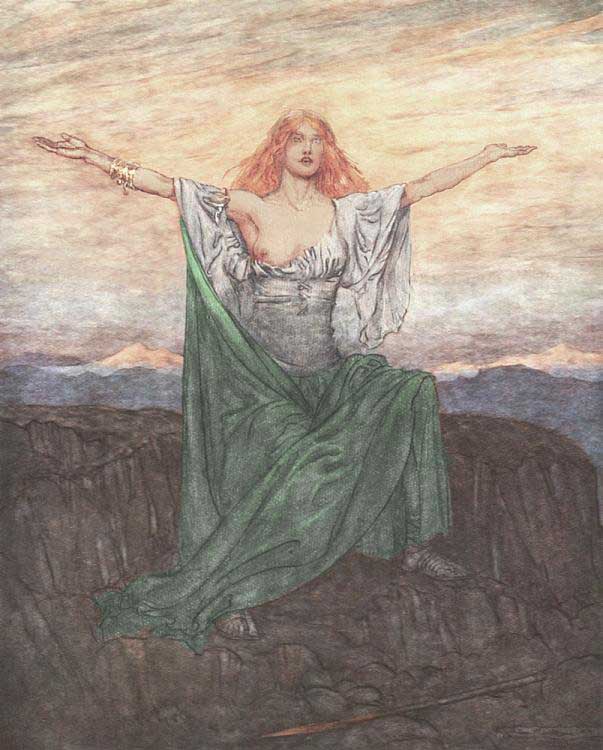
Hail to the Day by Arthur Rackham
Hail to the Day by Arthur Rackham
3,876 words
1. Introduction: Wisdom Speaking
In our last installment, we discussed Sigurd’s meeting with the Valkyrie Brynhild, and how their encounter recapitulates, on a higher level, the dualities found in the story of the dragon slaying. When Sigurd rides through the fire to meet the Valkyrie he is going within his own solar, masculine being to reach the lunar feminine. (more…)
5,369 words
1. Brynhild and Sigerdrifa
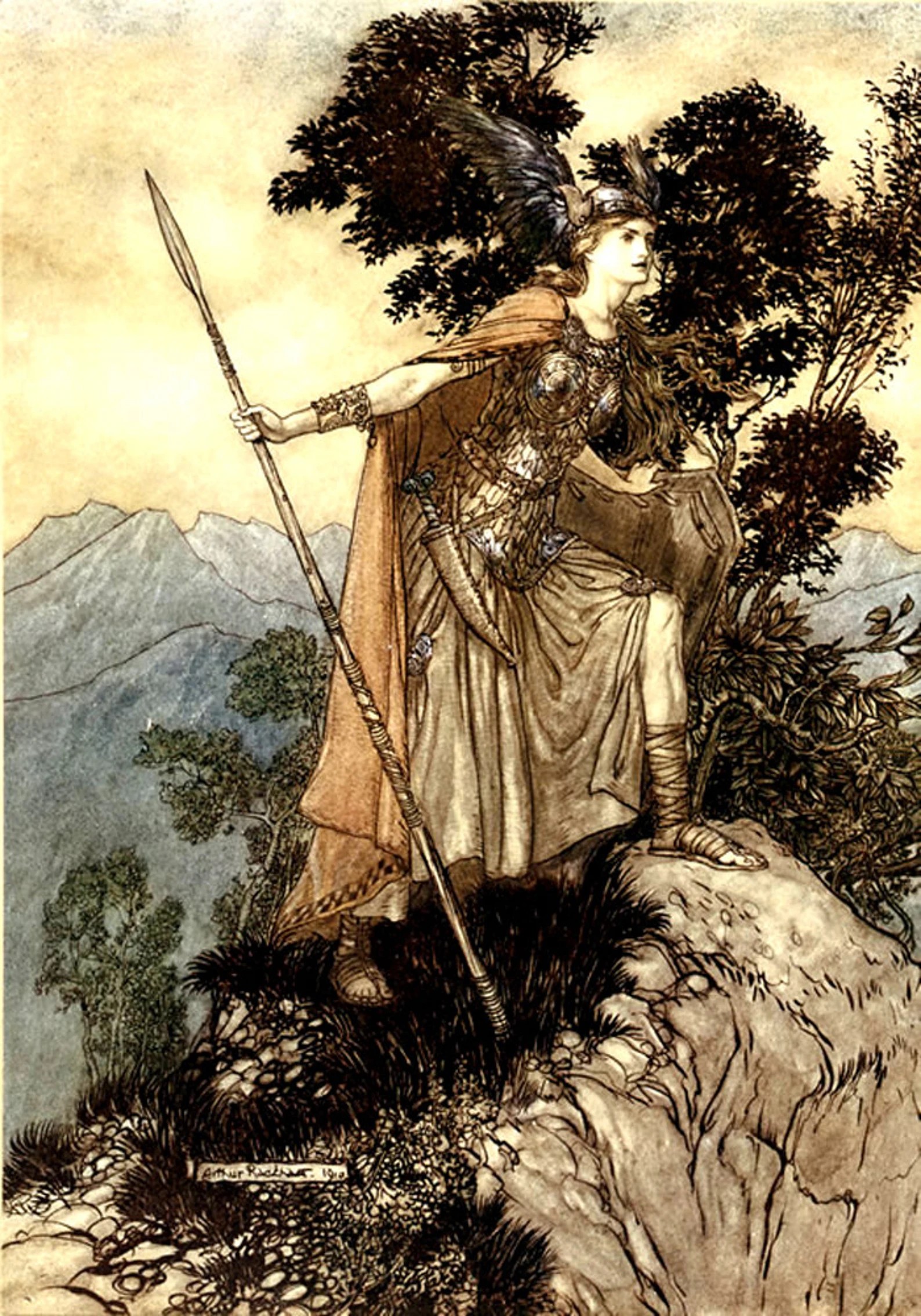
Sigurd has now slain the dragon Fafnir and tasted his blood, thereby acquiring knowledge of the language of birds. We discussed the esoteric significance of this in the last three installments. The birds tell Sigurd that he ought to ride “up to Hindarfjall, where Brynhild sleeps.” There, they say, “he would learn much wisdom.”[1] This is precisely where Sigurd heads, after loading Fafnir’s cursed treasure onto Grani. Two chapters of the saga are devoted to his meeting with Brynhild, and they are rich with occult significance. Among other things, the first of these chapters is one of the chief sources for our knowledge of rune magic. (more…)
1,443 words
Stephen E. Flowers
The Occult in National Socialism: The Symbolic, Scientific, and Magical Influences on the Third Reich
Rochester, Vt.: Inner Traditions, 2022
In the realm of the occult and its intersection with the Third Reich, Stephen E. Flowers’ The Occult in National Socialism: The Symbolic, Scientific, and Magical Influences on the Third Reich stands out as perhaps the most comprehensive, profound, and objective investigation to date. (more…)
1,869 words
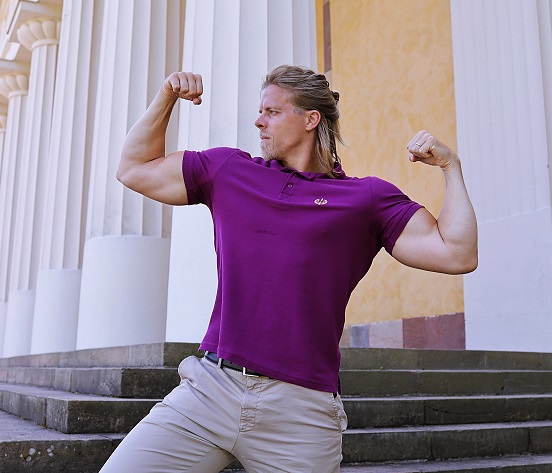
Marcus “The Golden One” Follin is a young star of the European New Right (see his previous appearances at Counter-Currents here). He has already published two books, written countless reviews, and is an entrepreneur, managing a line of clothing, nutrition, and other products through Legio Gloria. He is dedicated to the development of his body and spirit. (more…)
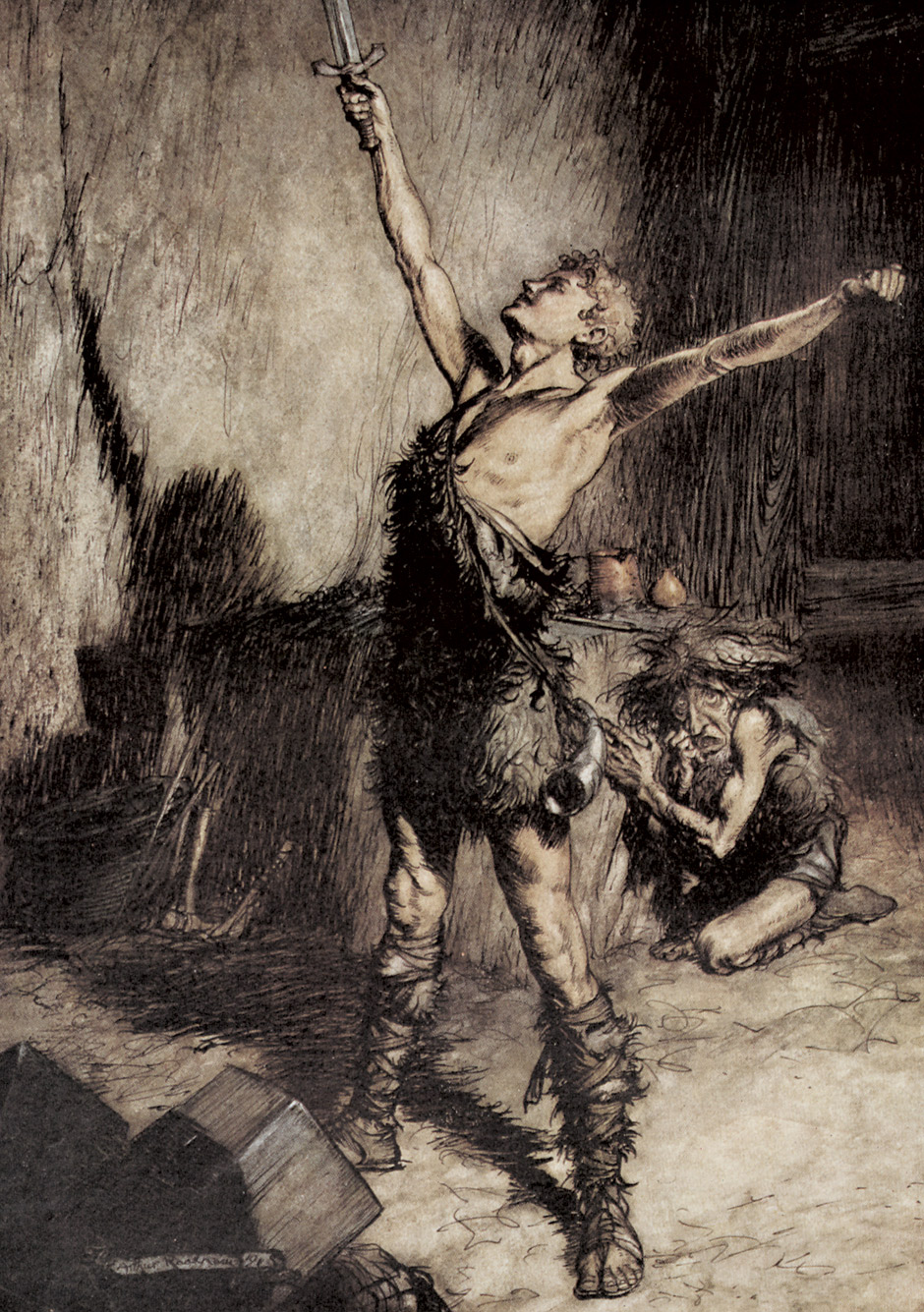
Siegfried & Mime, Arthur Rackham, 1911
Siegfried & Mime, Arthur Rackham, 1911
2,325 words
Part 4 of 4 (Part 1 here; Part 2 here; Part 3 here)
7. Concluding Reflections
I turn now to some thoughts on how the foregoing treatment of the influence of the past on the present ought to affect our own present, when we finish this essay and return to the real world.
It is a well-known fact that our ancestors acted with awareness of membership in the clan: trying to be worthy of their own ancestors, and not to disgrace them. (more…)

Rupert Sheldrake
Rupert Sheldrake
3,409 words
Part 3 of 4 (Part 1 here; Part 2 here; Part 4 here)
6. The Presence of the Past: A View from the Margins of Science
Some of the above remarks might suggest that we should interpret the Germanic hamingja–fylgja teaching as a mythic, symbolic, or even superstitious way of understanding the phenomenon of inheritance – something our ancestors relied upon because they did not have the modern science of genetics. (more…)
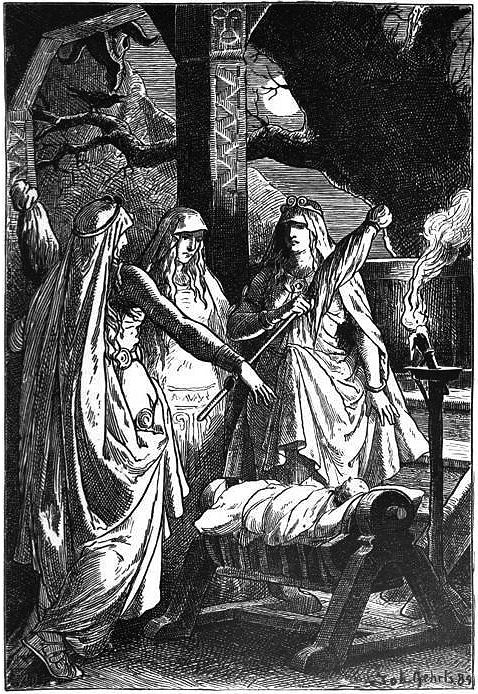
The Norns by Johannes Gehrts, 1889
The Norns by Johannes Gehrts, 1889
4,547 words
Part 2 of 4 (Part 1 here; Part 3 here; Part 4 here)
4. Tradition
Having now discussed the clannic being of the individual purely in philosophical terms, I now turn to a consideration of the treatment of this idea in the Germanic tradition.
The first thing we must note is what can be called the “primacy of the past” in that tradition. (more…)

2,185 words
Damon T. Berry
Blood and Faith: Christianity in American White Nationalism
Syracuse, N.Y.: Syracuse University Press, 2017
When I was in graduate school, one of my professors likened grading undergraduate exams to fever dreams, in which the events of the day — or, in his case, a whole semester’s worth of lectures — come back in garbled form. I have had the same experience reading about my ideas in the mainstream media. (more…)