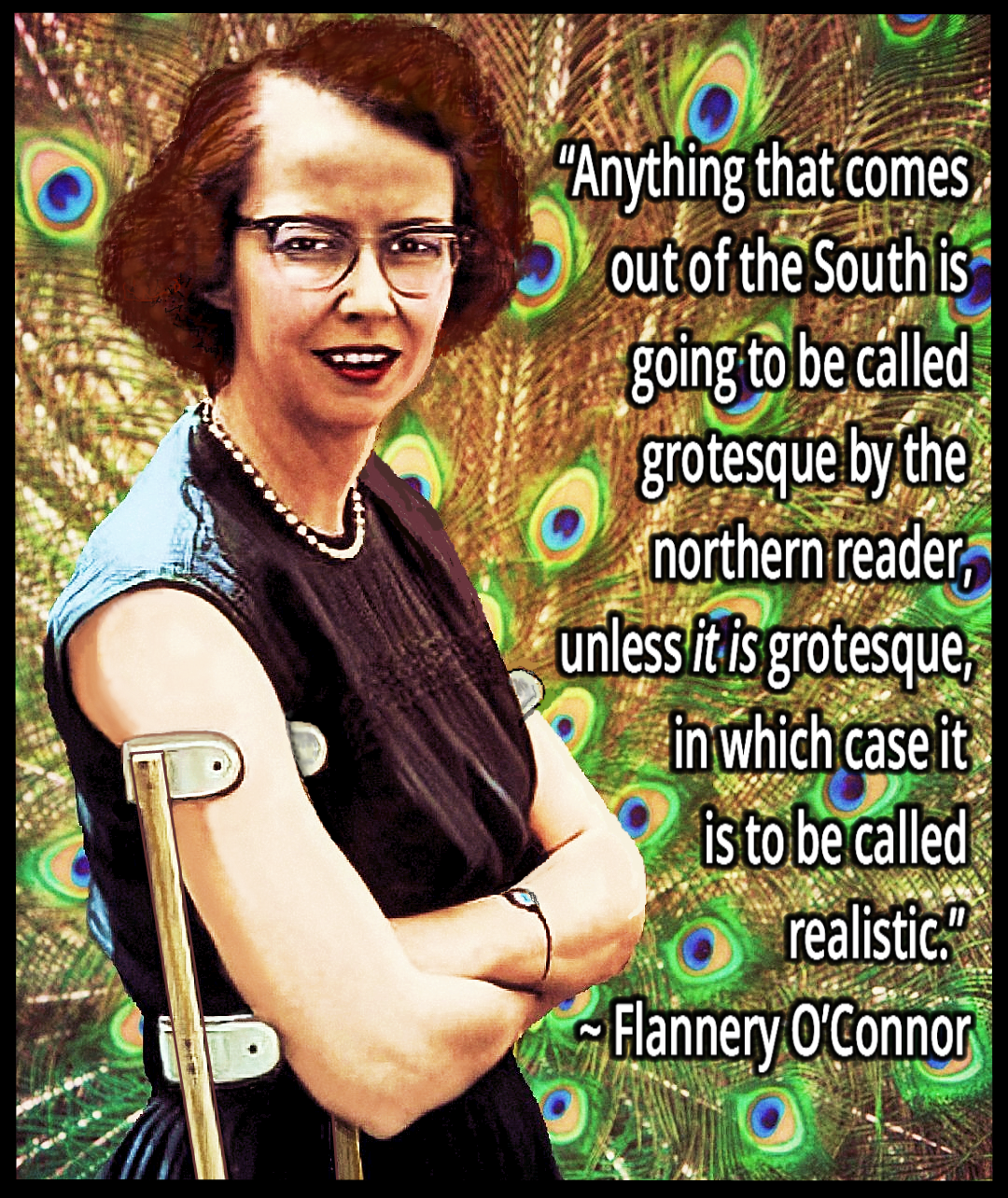
Phil Eiger Newmann, Flannery O’Connor, 2021.
1,971 words
Today is the birthday of Flannery O’Connor, one of America’s greatest storytellers and an underappreciated woman of the Right. In her short life of 39 years, O’Connor wrote two novels, 31 short stories, more than a hundred lectures, essays, and reviews, and a vast number of letters. Her fiction reflects her strong identity as both a Catholic and a white Southern woman.
Mary Flannery O’Connor was born in Savannah, Georgia. She was the only child of Edward Francis O’Connor and Regina Cline, both Irish-American Catholics. Edward O’Connor ran a real estate and property management business until the Great Depression, when he took a job with the US government in Atlanta. Regina Cline came from a large, wealthy, and well-connected family. When Edward O’Connor took his job in Atlanta, the O’Connors moved to Milledgeville, where Regina and Mary Flannery lived in the Cline mansion with a number of relatives. Edward O’Connor commuted back to Milledgeville on weekends. In 1937, Edward O’Connor was diagnosed with systemic lupus erythematosus, which led to his death in 1941.
In 1942, Mary Flannery entered an accelerated three-year program at Georgia State College for Women (now Georgia College and State University) and graduated in June 1945 with a BA in sociology and English literature. In both high school and college, she wrote articles and produced often sardonic cartoons for the student newspapers. She also wrote stories and poems for the college literary magazine, The Corinthian. While in college, she began to sign her work simply Flannery O’Connor, although her family continued to call her Mary Flannery.
In 1945, O’Connor was accepted to study at the prestigious Iowa Writers’ Workshop at the University of Iowa. Initially, she studied journalism but soon switched to creative writing. O’Connor received her Master of Fine Arts from the University of Iowa in 1947. She remained at the Iowa Writers’ Workshop for another year on a fellowship, working on her first novel, Wise Blood, and a number of short stories.
She continued working on Wise Blood at Yaddo, an artists’ retreat in Saratoga Springs, New York, beginning in the summer of 1948. O’Connor left Yaddo early, in 1949, when she and several other fellows petitioned the board to dismiss director Elizabeth Ames for endangering Yaddo by harboring a Soviet spy and propagandist, Agnes Smedley.
O’Connor then spent some time in New York City before moving to Ridgefield, Connecticut, to live with poet and translator Robert Fitzgerald and his wife Sally until the end of 1950, when O’Connor came down with lupus. After that, she spent the rest of her life living with her mother near Milledgeville on a family farm named Andalusia.
O’Connor & the Right
O’Connor’s relationship to the Right deserves extensive treatment. This is just a sketch.
O’Connor was a raised in a conservative, Southern, Irish-Catholic home. A highly gifted child, she may have chafed against the unintellectual aspects of this upbringing, but she never broke with it and eventually found a way to reconcile herself with it. Her Catholicism was orthodox and traditional. She did not believe the church needed to accommodate itself to liberalism and Marxism. She believed the world needed to accommodate itself to the Church. In high school and college, she was exposed to modern progressivism, liberalism, and Marxism. She rejected them all. She believed that the progressive thesis of the perfectibility of man was false.[1] Her fiction is filled with scathing satires of modern liberal intellectuals as vain, sentimental, tyrannical, and treasonous. She even thought that future generations would be better off if they were less educated.[2]
O’Connor believed that “Communism is a religion of the state, committed to the extinction of the Church,”[3] thus she opposed it fervently. This first manifested itself when she took a stand at Yaddo against Elizabeth Ames for harboring the Soviet agent, Agnes Smedley. She also felt deep disgust for the Leftist smear campaign launched in defense of Smedley and Ames.[4] To the end of her life, O’Connor did not allow translations of her books behind the Iron Curtain because she did not want her work to be used as anti-American propaganda.[5]
While at the University of Iowa, O’Connor met Robert Penn Warren, John Crowe Ransom, and Andrew Lytle, prominent members of the Southern Agrarians, America’s first truly anti-liberal metapolitical movement. They quickly saw her talent. Lytle and Ransom became important patrons of her work, publishing her stories, reviewing her books, and helping her get grants.
In 1951, Flannery O’Connor began corresponding with Caroline Gordon Tate, the wife of prominent Agrarian Andrew Tate. Caroline Gordon Tate became an important mentor for the rest of O’Connor’s life. Their surviving correspondence has been turned into a book.[6]
In 1953, Caroline and Andrew Tate introduced Flannery to Brainard and Fannie Cheney, who played an especially important role in the Agrarian milieu as networkers. O’Connor’s correspondence with the Cheneys has also been published as a book.[7] The Cheneys and Tates were converts to Catholicism, which was another bond with O’Connor.
O’Connor admitted that the Agrarians were important for her work.[8] Their influence is especially strong in her defense of regionalism and the spirit of place. She also shared their skepticism about progressivism. But O’Connor did not romanticize the Old South and what she somewhat dismissively called the “Wah Between the States.”[9]
Another important Right-wing influence on O’Connor was Russell Kirk, the author of The Conservative Mind, whom O’Connor met in October 1955 at the home of the Cheneys in Tennessee. O’Connor read a number of Kirk’s books, including The Conservative Mind, A Program for Conservatives, Academic Freedom, and Beyond the Dreams of Avarice. She also read Kirk’s journal, Modern Age. Kirk’s Burkean influence is visible in O’Connor’s distrust of theory and her conviction that secular humanitarianism leads inevitably to tyranny and terror.
Another conservative intellectual O’Connor read and admired was Eric Voegelin. She even reviewed the first three volumes of his monumental Order and History.[10]
O’Connor was also quite familiar with a number of literary figures who were out-and-out fascists, including Louis-Ferdinand Céline,[11] Percy Wyndham Lewis,[12] and Ezra Pound.
She probably heard about these figures from the poet Robert Lowell, whom she knew from the University of Iowa. Lowell visited Ezra Pound at St. Elizabeth’s Hospital in Washington, D.C., where he had been incarcerated after World War II. Lowell also knew Ezra’s wife, Dorothy, and son, Omar. O’Connor writes as if she also knew Omar.[13]
Another Pound connection was through translator and poet Robert Fitzgerald, who knew Pound and his family as well.[14] Apparently, in 1954, the Fitzgeralds stayed with Pound’s daughter Mary and her husband Boris de Rachewiltz in their castle in the Tyrolean Alps. O’Connor seemed to know a great deal about Pound’s complicated family life and writes as if she actually knew Mary Pound.[15]
These links may have something to do with Betty Hester’s accusation, in a lost letter to O’Connor, that her friend was a “fascist,” a charge that she disputed in several letters.[16] It certainly merits more study.
Like many Southern conservatives of her time, O’Connor despised the Republican Party. In one letter, she described herself as a “Kennedy conservative.”[17]
As a Catholic and an intellectual, O’Connor regarded the Ku Klux Klan with bemused contempt, but it didn’t prevent her from joking about attending Klan rallies with a liberal correspondent.[18] Beyond that, as I demonstrate in an ongoing series, O’Connor was very much a race realist, whose preferred solution to America’s race problem was to send all the blacks back to Africa, a position associated with “white trash,” the Klan, and neo-Nazis, not her family’s genteel social circles. She also despised the self-righteousness and sentimentalism of Northern integrationists and thought nothing good would come from them. Short of repatriating blacks, she hoped that America would somehow muddle through with desegregation. Had she lived beyond 1964, I seriously doubt she would have regarded integration as a success. It would have required too much self-deception.
During her lifetime, O’Connor completed four books:
- Wise Blood (a novel) (New York: Harcourt, Brace & Co., 1952).
- A Good Man Is Hard to Find and Other Stories (New York: Harcourt, Brace & Co., 1955).
- The Violent Bear It Away (a novel) (New York: Farrar, Straus & Giroux, 1960).
- Everything That Rises Must Converge (short stories, published posthumously) (New York: Farrar, Straus & Giroux, 1965).
After O’Connor’s death, a number of other works have appeared:
- Mystery and Manners: Occasional Prose, ed. Sally and Robert Fitzgerald (New York: Farrar, Straus & Giroux, 1969).
- The Complete Stories, ed. Robert Giroux (New York: Farrar, Straus & Giroux, 1971).
- The Habit of Being: Letters of Flannery O’Connor, ed. Sally Fitzgerald (New York: Farrar, Straus & Giroux, 1979).
- Collected Works, ed. Sally Fitzgerald (New York: The Library of America, 1988). (This beautiful Library of America volume contains Wise Blood, A Good Man Is Hard to Find, The Violent Bear it Away, and Everything That Rises Must Converge, plus some additional short stories and large selections from Mystery and Manners andThe Habit of Being. It should be everyone’s first Flannery O’Connor volume.)
Other posthumous works:
- The Presence of Grace and Other Book Reviews , compiled by Leo J. Zuber, ed. Carter W. Martin (Athens: University of Georgia Press, 1983).
- The Correspondence of Flannery O’Connor and the Brainard Cheneys, ed. C. Ralph Stephens (Jackson: University Press of Mississippi, 1986).
- Conversations with Flannery O’Connor, ed. Rosemary M. Magee (a collection of interviews) (Jackson: University Press of Mississippi, 1987).
- Flannery O’Connor: The Cartoons, ed. Barry Moser (Seattle: Fantagraphics, 2012).
- A Prayer Journal, ed. W. A. Sessions (New York: Farrar, Straus & Giroux, 2013).
- The Letters of Flannery O’Connor and Caroline Gordon, ed. Christine Flanagan (Athens: University of Georgia Press, 2018).
- Good Things out of Nazareth: The Uncollected Letters of Flannery O’Connor and Friends, ed. Benjamin B. Alexander (New York: Convergent, 2019).
- Dear Regina: Flannery O’Connor’s Letters from Iowa, ed. Monica Carol Miller (Athens: University of Georgia Press, 2022).
- Flannery O’Connor’s Why Do The Heathen Rage? A Behind-the-Scenes Look at a Work in Progress, ed. Jessica Hooten Wilson (fragments from an unfinished third novel) (Grand Rapids, Michigan: Brazos Press, 2024).
The O’Connor Estate authorized two biographies of Flannery O’Connor, both by friends who knew her well: Sally Fitzgerald and William Sessions. Unfortunately, both authors died before their work could be completed. The best biography is Brad Gooch, Flannery: A Life of Flannery O’Connor (New York: Little, Brown & Co., 2009).
Counter-Currents has already published a number of works on O’Connor, and we will continue to explore her life, work, and legacy.
On O’Connor:
- James J. O’Meara, “Angst and the City: The Education of Flannery O’Connor.”
- Greg Johnson, “Flannery O’Connor and Racism, Part 1: The Cancellation of Flannery O’Connor.”
- Greg Johnson, “Flannery O’Connor and Racism, Part 2: Down on the Farm.“
- Trevor Lynch reviews Wildcat.
- Trevor Lynch reviews John Huston’s Wise Blood.
- Margot Metroland, “Remembering Flannery O’Connor (March 25, 1925–August 4, 1964).”
- Margot Metroland, “Flannery O’Connor’s Mean Words.”
Interviews Mentioning Flannery O’Connor:
- “The Films of David Lynch, Part 1.”
- “Jonathan Bowden’s Last Interview, Part 1.”
- “The Sublime & the Grotesque.”
- “Interview with Tito Perdue, Part 1.”
See also posts tagged Flannery O’Connor.
Notes
[1] The Habit of Being: Letters of Flannery O’Connor, ed. Sally Fitzgerald (New York: Farrar, Straus & Giroux, 1979), p. 302
[2] The Habit of Being, p. 311
[3] The Habit of Being, p. 347.
[4] The Habit of Being, pp. 11–12.
[5] The Habit of Being, p. 151. Cf. Good Things out of Nazareth: The Uncollected Letters of Flannery O’Connor and Friends, ed. Benjamin B. Alexander (New York: Convergent, 2019), p. 348
[6] The Letters of Flannery O’Connor and Caroline Gordon, ed. Christine Flanagan (Athens: University of Georgia Press, 2018).
[7] The Correspondence of Flannery O’Connor and the Brainard Cheneys, ed. C. Ralph Stephens (Jackson: University Press of Mississippi, 1986).
[8] The Habit of Being, p. 148.
[9] The Habit of Being, p. 428.
[10] Flannery O’Connor, The Presence of Grace and Other Book Reviews, compiled by Leo J. Zuber, ed. Carter W. Martin (Athens: University of Georgia Press, 1983).
[11] The Habit of Being, pp. 95, 105, 124.
[12] The Habit of Being, pp. 96, 111, 161, 167, 174, 179–80, 217, 229, 393.
[13] The Habit of Being, p. 36.
[14] The Habit of Being, p. 132.
[15] The Letters of Flannery O’Connor and Caroline Gordon, pp. 104–105.
[16] The Habit of Being, pp. 97, 103, 107.
[17] The Habit of Being, p. 499.
[18] The Habit of Being, p. 573.
2 comments
Great article! My favorite story is The Artificial Nigger, which has a Lovecraft feel about it. My next favorite is Everything That Rises Must Converge. 🙃
A Good Man is Hard to Find is probably up there as one of the greats in English Literature. The simple and straightforward style reminds me of Hemingway. On a side note, I always thought “Paul’s Case” by Willa Cather another great one, although it isn’t loaded with heavy Christian symbolism.
If you have a Subscriber access,
simply login first to see your comment auto-approved.
Note on comments privacy & moderation
Your email is never published nor shared.
Comments are moderated. If you don't see your comment, please be patient. If approved, it will appear here soon. Do not post your comment a second time.