 1,844 words
Original in Czech: https://deliandiver.org/sadonacismus-ve-filmu-cast-2/
Translated by Ondrej Mann
“We are an elite society where anything goes.”
Visconti’s The Damned & Cavani’s The Night Porter
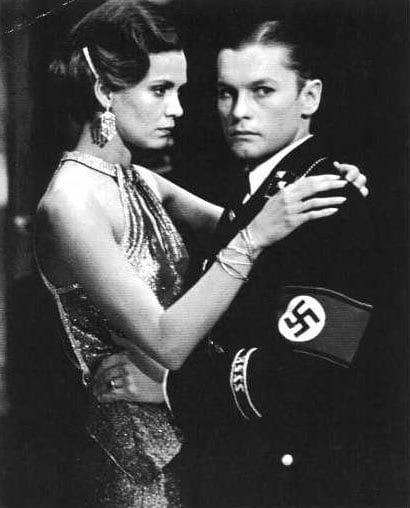
In every respect, the greatest film of this kind is The Damned (La caduta degli dei, 1969, directed by Luchino Visconti), which also started the whole “sadiconazista” wave, which is why we will stop at it for considerably longer than at the others. The director uses it to illustrate two well-known theories: the Marxist theory of the inevitable connection between fascism and the bourgeoisie in its last desperate attempt to prevent the proletarian revolution and thus save its property, and the Freudian-Marxist theory, according to which fascism releases all inhibitions and thus everything that is most vile and miserable in human nature.This is why instinctive, animalistic, and criminal instincts triumph in fascism. Sexual perversion then psychologically dominates weak individuals with undeveloped personalities, who easily become obedient puppets—executors—of a totalitarian regime.
The theme of The Damned is “the struggle for power.” The story begins in February 1933, when the Reichstag burned down. The protagonists are members of the Essenbeck steel dynasty (clearly modeled on the powerful Krupp and Thyssen families). The manipulator of their moral decline is the only significant character who appears to be an outsider [1]—the personification of “evil”—the Mephistophelean SS Hauptsturmführer Aschenbach, who chooses the weakest of the “nest of vipers” as his tool to control the company: the frustrated and degenerate Martin von Essenbeck, a transvestite, drug addict, and pedophile, an outsider who had previously been tolerated with disgust by his bourgeois family. After abusing a young Jewish girl, who subsequently hangs herself, Martin achieves his first satisfaction over his self-assured and dominatrix “mother” through incest, only to ultimately poison her and her new husband.
What distinguishes The Twilight of the Gods (The Damned) from all later imitations is the director’s genuine deep cultural background. The title itself refers to the last part of Wagner’s tetralogy The Ring of the Nibelung and to one of Nietzsche’s books, while the description of decay refers to the entrepreneurial family from Thomas Mann’s Buddenbrooks. However, the entire concept of the film is an acknowledged tribute to Shakespearean drama, especially the tragedy Macbeth—hence all the crime, tension, twisted love, hatred, and revenge. This is reflected in the essentially “theatrical” direction, the “operatic” quality and the sets [2] with their play of colors (shades of gray giving off an intense red and orange), the staging (most of the action takes place inside the family castle), the emphasis on musicality, [3] the stylized gestures, such as masks illuminating frozen faces (blue turning to green transforms them into grotesque monsters), the recurring “mythical” motif of fire—both destructive and regenerative – from metallurgical furnaces, through which Martin, already in his black uniform, gives the Nazi salute in the final shot, as from Dante’s Inferno.[4] The second highlight of the visual stylization, which also contains the only action sequence, is a relatively long scene from “The Night of the Long Knives,” which transitions from a wild drinking party in a Bavarian resort through a travesty show to an SA homoerotic orgy, ending in blood from the bullets of SS strike forces.[5]
In Aschenbach, brilliantly portrayed by Helmut Griem, the type of the sophisticated, educated SS officer is vividly depicted, who with a smile and without hesitation decides on the fate of those who foolishly still claim a leading role according to the dying liberal model.[6] This contrast between a cultivated exterior and a ruthless will to power (“go to extremes”) soon became a stereotype of numerous “film Nazis.” Aschenbach appears as a tempter who teaches people not to fear the “evil” within them, but to “work” with it; his part is inspired by the Three Witches in Macbeth! Helmut Berger reprised his role as Martin von Essenbeck, a debauched, psychopathic “SS poseur,” several times in more “B-movie” productions, which we will discuss later.[7]
It was probably difficult for cinema audiences to resist the dark Muse on the big screen, as The Damned is the only Visconti film to have achieved major commercial success, not only in Europe but also in the US.
If The Damned was repeatedly criticized from orthodox Marxist positions, then The Night Porter (Il Portiere di notte, 1974, directed by Liliana Cavani), Visconti’s favorite and protégée, caused real outrage on many sides because it depicts the “fatal attraction” between a former concentration camp prisoner and a former SS officer.
The story takes place in Vienna in 1957, where former Totenkopfverbände officer Max works as a night porter in a respectable hotel, but still meets up with his aging Kameraden.[8] Max’s mask of blasé confidence and nonchalance slips when he spots a woman among the guests whom he once tortured with relish in the camp. . . At first, they steal glances at each other, she panicked and neurotic, he disturbed to the point of distraction. Colorful memories return: naked bodies lining up for medical examinations, humiliating procedures under spotlights (Max documents them with a camera), rape. The tension rises, everything leads to a reunion between the torturer and his victim: their new encounter face to face turns into a wild struggle and ends in a loving embrace. The woman obediently accepts her submissive role—this time, she willingly does everything she was once forced to do. . .
“I was looking for an explanation for the ambiguity of human nature. . . I felt the need to analyze human nature to the limits of credibility, to see things through to the end. There is nothing more fantastic than reality. And what I show in The Night Porter is only the beginning of reality. It is not virtue that rules the world, but crime. That is why I consider the books of the Marquis de Sade to be fundamentally important and I think they should be required reading in schools,” the director provoked[9] in the spirit of Sade’s decadent literary reception, while at the same time ”scientifically” invoking the thesis of the so-called Stockholm syndrome, which was widely discussed at the time: the psychological bond between prisoner and captor can allegedly reach the strength of a serious addiction and thus grow into the only certainty that both find elsewhere—especially if this bond is enhanced by sexual undertones. Added to this is the fact that Cavani’s eccentric couple suppresses their desires in everyday life, Max (Dirk Bogarde) is a sadist,[10] Lucie (Charlotte Rampling) a masochist. The extreme situations they have experienced together and their shared past are the catalyst that allows them to express themselves naturally and let go. These “conspirators of pleasure” take their harmony to the end—they die hand in hand in a hail of bullets fired by Max’s fellow tribesmen, who have no understanding for them.
Strange erotic games with glass shards, chains, and beatings, white coats, black uniforms, injections, and tiles appealed to many viewers and creators. The most famous of these is undoubtedly the retrospective scene of a cabaret performance in “Joy Division” (note the symbolism of Pierrot), in which Lucie, dressed in a “Nazi outfit,” receives a box with a severed human head from Max. Similarly panoptic is the ballet etude of one of the SS men. These scenes left a deep impression on many minds of a generation, which was soon reflected in punk and new wave fashion.[11] Classical music, accompanying bizarre images, would continue to accompany “evil” on screen more and more. And the commotion surrounding “The Night Porter” will bring “holocaust pornography” out of the private shadows and into the public eye. More on that next time.
Notes
1] However, he also belongs to the “family”; Aschenbach is the “cousin” of Sophie, the “mother” of Martin von Essenbeck.
2] It would therefore be unfair to accuse the director of “unrealism” or to view certain techniques and themes as ahistorical clichés, but we can justifiably criticize him for the excessive declamatory nature of some scenes, such as Herbert’s anti-regime tirades. This is a flaw that appears in other Visconti films – recall Prince Salina’s “Marxist” monologue about the “departing class” in The Leopard (1963) or Tadzio’s meaning-laden gay smile in Death in Venice (1971), when he passes his sick admirer in a park lit by streetlights at night.
3] In addition to the original music by M. Jarre (“Doctor Zhivago“), Visconti used a fragment from the first movement of Bruckner’s Eighth Symphony and one of Zarah Leander‘s hits as sound effects. However, the great Wagner is heard only once, when the drunken Constantine plays “Isolde’s Death from Love” at the piano.
4] However, this list of “signs” and references is by no means exhaustive. Critics point out, for example, suggestive names. The name Aschenbach, borrowed from Mann (Death in Venice), means “stream of ash,” while Essenbeck is said to be derived from “die Esse” – chimney, forge. Experts enjoy determining which old master paintings the film images are derived from, or arguing about how much of the nihilist Stavrogin is in Martin. What is indisputable, however, is Dostoyevsky’s application of the “principle of scandal” when Martin performs a travesty of Marlene Dietrich’s “Blue Angel” at a family celebration, etc.
5] The source here was allegedly the novel The Night of the Long Knives by Lorrain Kempski.
6] In this regard, the scenes with Sophie in Aschenbach’s office and in the SS archives are crucial. Note the bouquet of white calla lilies – a symbol of cold beauty.
7] Berger, who was cast as Martin, Visconti’s lover, and spoke openly about his bisexuality, was so convincing as a depraved young German that his “mentor” immediately helped him land the role of a refined, ailing Jewish student in the film The Garden of the Finzi-Contini (Il Giardino dei Finzi-Contini, 1970, directed by Vittorio de Sica) so that he would not be typecast as a “deranged Nazi.”
8] And not “innocently”—Herren, with their gentlemanly appearance, continue to conspire and cover their trails. Philippe Leroy (Janéz from “Sandokan”) is particularly impressive in the role of Klaus!
9] Liliana Cavani made a four-hour television program about the Third Reich (Storia del Terzo Reich, 1962), as well as one about Stalin (L ´eta di Stalin, 1963). She dealt with the themes of resistance and collaboration. Visconti paid her a great compliment: “No, my young colleagues don’t have enough stamina and are steeped in conformism. And I see very few exceptions to this in our cinema. Amarcord, The Night Porter… I adore Cavani, at least she’s consistent among all those slackers. She was born in the Po Valley, in Carpi, and she’s stayed that way, she’s kept her mentality…” (L’Europeo, no. 47/1974)
10] Dirk Bogarde was popular mainly in his native Britain from the late 1950s (The Servant, Modesty Blaise), but it was his roles in Visconti’s films The Damned and Death in Venice (1971) that made him world famous. He too belonged to the international brotherhood of “inverts” described by Malaparte in The Skin (chapter “The Rose of the Body”).
11] Only the violent A Clockwork Orange can rival the influence of The Night Porter on British punk. Lucy’s concentration camp hairstyle is reminiscent of Bowie’s hairstyle from the Ziggy Stardust era or the Orwellian album Diamond Dogs (1974).
10 comments
These films sound absolutely punishing. Thanks for the warning.
In an interview, Cavani indicated that she had been a 68’er, or at least sympathetic. So The Night Porter is less doctrinaire than one would expect. Just the idea that a concentration camp inmate might consent to a relationship with her captor after the war caused some of the howls of outrage, but Cavani claimed that she based the story loosely on real events. That acceptance of the possibilities of human nature is one of the things that appeals to me about the movie. Its aesthetics are the other main appeal for me.
I would disagree with Cavani about making de Sade required reading in school. That would be absurd. But she touched on some things with The Night Porter that are worth considering. And she has a tendency to be anti-ideological, at least sometimes, which is also attractive.
This has been a good series. I may may try to watch the Visconti film— the Leopard is one of our favorites! I am a weak mind with an undeveloped personality. Maybe that’s why I follow you guys😂
According to Jewish psychologists, we are all at CC weak minds with undeveloped personalities. That is why we love high art, literature, classical music, and all things that come from white civilization, even though it is forbidden and highly controversial.
Aschenbach is also the name of the central character in Death in Venice. As for Cavani, she later did a film adaptation of The Skin.
All of this will be discussed in the next installments of the film series. Enjoy, as this is the only place where you will find it all covered in this way.
Great article! The Damned is a great movie. I think my favourite bit is when the drunk guys and gals sing the ‘Horst Wessel Song’. It’s interesting that I commented on the ballet interlude along with another commentator in the previous article. The choice of the small musical interlude from Gluck was interesting and very good. I think Siouxsie was certainly influenced by this certain chic.
You’re right, this aesthetic had an influence on new wave and post-punk. I noticed your comment. Next week, CC will publish an interview with a band you like.
“two well-known theories: the Marxist theory of the inevitable connection between fascism and the bourgeoisie in its last desperate attempt to prevent the proletarian revolution and thus save its property, and the Freudian-Marxist theory, according to which fascism releases all inhibitions and thus everything that is most vile and miserable in human nature.”
These theories represent delusional levels of political rationalization. I’ve often asked myself how a mind can distort reality that much to believe in nonsense of that tier. My conclusion (so far) is that ideological thinking is akin to aspergers or schizophrenia – a form of neurodivergence that offers certain evolutionary advantages, but at what price?
I was also very interested in these theories, but when you examine them in depth, you realize that they are nonsense. But when you have a large group of Marxist intellectuals and they have questions, you have to find answers for them. You can’t just say, “I don’t have an answer,” or “The National Socialists were honest and right about many things.” Then you enter the realm of manipulation, you put something abstract and difficult to grasp from psychology, sexuality, or economics into your answer, you praise the Marxists and denigrate the National Socialists. And if you succeed, your argument will be repeated by all Marxist publications, Marxist intellectuals, people who express opinions but think little. And also by many young intelligent people who easily adopt opinions but do not examine the sources of those oopinios.
Comments are closed.
If you have a Subscriber access,
simply login first to see your comment auto-approved.
Note on comments privacy & moderation
Your email is never published nor shared.
Comments are moderated. If you don't see your comment, please be patient. If approved, it will appear here soon. Do not post your comment a second time.