 706 words
Contemporary liberalism often appears strange and unmoored, but it sits squarely within an older moral tradition: Western abolitionism, a movement that combined genuine humanitarian concern with a pronounced fanatical element. From its inception, abolitionism elevated distant moral causes above domestic social obligations, rejected incremental improvement, and justified coercion in the name of absolute moral ends. These features have not disappeared. They have been inherited, refined, and redeployed.
William Wilberforce represents the respectable face of this tradition. While Britain’s miners and industrial laborers endured dangerous working conditions, low wages, and regressive food taxes, Wilberforce devoted his political energies to slavery in the West Indies. He did not deny the hardship of Britain’s working poor, but he consistently treated it as secondary. The suffering of enslaved Africans thousands of miles away carried greater moral weight than the visible deprivation of working-class Britons. This hierarchy of concern is familiar today. Modern liberals display intense moral urgency over immigration enforcement and border policy, while showing limited interest in the economic stagnation, wage suppression, and social decay experienced by large segments of the native working class.
Abolitionist moralism was reinforced by an insistence on absolutism. Reform short of abolition was dismissed as irrelevant or immoral, and any discussion of material conditions was treated as a distraction. Yet historical research complicates this posture. Studies using adult height as a proxy for nutrition and health show that enslaved people in the United States reached adult stature earlier than many European populations, and that adult male slaves were taller on average than British or Western European males in the nineteenth century, indicating higher net nutrition despite legal unfreedom.
Other evidence indicates that slaves in the West Indies were taller than African populations from which they were drawn, suggesting higher caloric intake than in their regions of origin. Furthermore, calorie based estimates suggest that the American South provided higher average food availability than Nigeria as late as the 1960s, and nutrition surveys conducted within the British Empire during the twentieth century found fewer nutritional deficiencies among populations of African descent in the West Indies than among populations in parts of West Africa. These findings do not vindicate slavery, but they do undermine the abolitionist refusal to think in comparative or material terms, a refusal that persists in modern liberal politics.
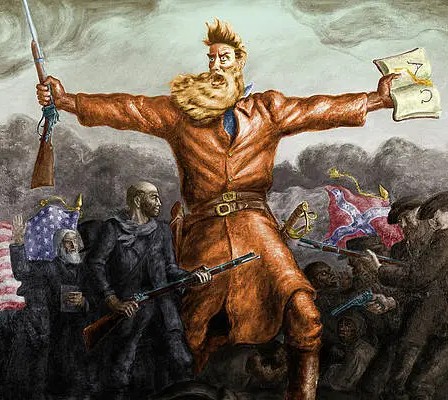
The fanatical edge of abolitionism makes this moral structure clearer. Nat Turner’s 1831 rebellion was not a strategic effort to secure reform or negotiation. It was a millenarian uprising grounded in religious delusion. Turner believed himself divinely appointed and killed entire households, including women and children, interpreting violence as a sacred obligation rather than a political means. John Brown followed the same logic. In 1856, at Pottawatomie Creek in Kansas, Brown and his followers dragged five men from their homes and hacked them to death with broadswords. Their crime was not slave ownership but political alignment; they were pro-Southern settlers whose views marked them as enemies. The killings were deliberate and punitive, demonstrating that Brown’s war was not against slavery as a specific institution but against anyone who fell outside his moral universe. His later raid on Harpers Ferry was militarily pointless and guaranteed retaliation, yet Brown pursued it with total certainty, indifferent to the consequences for his followers or for the broader political situation.
This mentality helps explain why compulsion was treated as virtue rather than excess. Harriet Tubman is a hero on the Left, but historical accounts note that she threatened to shoot enslaved people who hesitated or wished to turn back during escapes. Freedom, in this framework, was not a choice. Moral clarity overrode consent. The same pattern is visible today. Those who do not support anti-ICE protests or the cause of the moment are berated, ostracized, or treated as morally suspect. Participation is demanded, not courted.
The continuity between abolitionism and modern liberalism is not rhetorical but structural. Both privilege symbolic purification over incremental material improvement. Both reject tradeoffs and limits. Both elevate outgroups as moral touchstones while treating domestic working-class concerns as morally suspect or politically inconvenient. In the nineteenth century, this produced Wilberforce’s indifference and Brown’s massacres. In the present, it produces a politics that remains animated by moral certainty, indifferent to cost, and hostile to those who refuse to conform.
11 comments
Many of the moderate anti-slavery men were right in their concerns and approaches. Slavery caused problems not only for some of the slaves but also for their owners and society at large. Moral causes are part of what white people do. Causes can be very beneficial, such as the careful reforms of the Victorian period in Britain and America. Or they can be terribly harmful, as with John Brown, the Marxists, the New Left and the Woke. The radical abolitionists and the Fire-eaters caused the American Civil War.
Some DR people are wrong to blame the Puritans and earlier Quakers for the much later radicalism that caused the Civil War and more recent destruction. Religion in America underwent deep transformations in the early 19th Century, with the 2nd Great Awakening, the growth of Unitarianism, which heavily influenced the intellectuals, and the birth of many strange, radical sects. These all helped spur the abolitionists. The earlier Puritans and Quakers, such as William Penn, were very conservative socially.
But this essay is good, overall. We should aggressively criticize the white do-gooders who fanatically support non-whites, while ignoring the problems of their own people nearby. Mrs. Jellyby in one of Charles Dickens’ books is a vivid example of an obnoxious do-gooder. Dickens knew what he was talking about. He did great work in advocating reforms for British people, while recognizing the nature and the dangers of violent non-whites in the Empire. I would also put in a good word for Wilberforce too. He advocated in a Christian tradition, rather than in more extreme abolitionist ways.
It is only a matter of time, until some White mattoid massacres a group of Whites in the cause of the “border hoppers.” 🙃
What is a “mattoid”? I had to look it up. According to Dictionary dot com, it is: “a person displaying eccentric behavior and mental characteristics that approach the psychotic”. That definitely describes left-wingers. They’re all freaks and mutants. Some conceal it. Most are out in the open.
That definition is correct. It has expanded to mean that they are physically unattractive as well, many mugshots of antifa and other leftists prove this. Not all of them are ugly, but I would say most of them are. The fact that they aren’t highly valued on the dating market may contribute to their anger at society. Another term for mattoid is Bioleninisim or spiteful mutant.
I wrote about them here:
Are Leftist Radicals Literally Mutants And Mattoid Freaks? | Return of Kings (theredarchive.com)
There was an article done here several years ago, I don’t remember the name of it, Greg Johnson probably does. Anyways, the term was coined by an army officer who stated that a mattoid was a man who appeared to behave normally, and rationally in the daytime, but whom you would catch wearing a dress at night. Mr. Johnson, do you remember the name of that article? 🙃
We already have that with 2 transfreak shooters in the last few weeks in Canada and Rhode Island.
Left-wingers hate politics. They don’t reason and debate. They censor and assassinate. They are the ones taking fentanyl and other drugs. They are the trans-perverts. They are spiteful mutants, who should have died in early childhood from natural causes, but whom modern medicine has saved.
The abolitionists mentioned in this article are typical, early examples. Since then, they have evolved into even lower levels of degeneracy.
The spirit of John Brown was certainly alive and well at the Minnesota riots last month
We need to send these people overseas.
Furthermore, calorie based estimates suggest that the American South provided higher average food availability than Nigeria as late as the 1960s, and nutrition surveys conducted within the British Empire during the twentieth century found fewer nutritional deficiencies among populations of African descent in the West Indies than among populations in parts of West Africa.
Looks like the 78% Jewish slaveholders who owned and ran the Confederacy were breeding an army.
If you have a Subscriber access,
simply login first to see your comment auto-approved.
Note on comments privacy & moderation
Your email is never published nor shared.
Comments are moderated. If you don't see your comment, please be patient. If approved, it will appear here soon. Do not post your comment a second time.