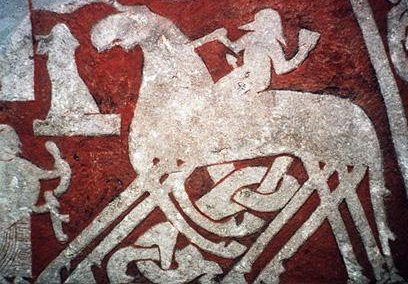
Odin riding Sleipnir in a detail on the Tjängvide stone
5,668 words
1. The Language of Birds
In our last installment, we explored the idea that Sigurd bathing in the dragon’s blood is a symbol for the achievement of the “spiritual corporeality.” In order to complete this alchemical transmutation, however, Sigurd must also consume the dragon’s blood, and its heart. To remind the reader: after Fafnir is slain, Regin drinks his brother’s blood and asks Sigurd to make a fire and grill the dragon’s heart so that he can eat it. Sigurd puts the heart on a spit and cooks it for a while, then pokes it with his finger to see if it is done. The hot flesh burns him, and he instinctively puts his finger in his mouth, tasting some of the dragon’s blood. The result is that he is suddenly able to understand the language of birds.
In earlier installments, I have already discussed the parallels between this tale and an episode in the medieval Irish Boyhood Deeds of Fionn, in which the hero accidentally tastes the “salmon of knowledge,” thereby acquiring total knowledge of all things in heaven and on earth. I also discussed other instances in the Scandinavian lore in which characters understand the language of birds or acquire such understanding. These occur in the poems Rigsthula, Helgakvitha Hundingsbana I, and Helgakvitha Hjorvarthssoner. We should bear in mind that this special power is clearly Odinic, since Odin could understand the language spoken by his two ravens, Huginn and Muninn.
Once Sigurd acquires this special ability, he hears the birds sitting in the trees speaking about him. They warn him of Regin’s treachery and one of them says that Sigurd ought to be the one who eats Fafnir’s heart, because “then he’d be wiser than any other man.”[1] This strongly suggests that eating the heart would confer total knowledge, just as the salmon does in The Boyhood Deeds of Fionn. The small taste Sigurd has already may constitute just a small part of that wisdom.
The motif of understanding bird language occurs elsewhere in Indo-European and other mythologies. This has been discussed with respect to the Greek context by the scholar Francisco Diez de Velasco. Interestingly, Velasco notes that acquiring this knowledge is linked to contact with serpents. For example, serpents lick the ears of the legendary soothsayer and healer Melampus giving him knowledge of bird language as well as the ability to see the future.[2] In one version of the story of the blinding of the seer Tiresias, Athena punishes him in this way after he sees the goddess naked. However, she compensates him for his loss of sight by giving him knowledge of bird language.[3]
Tiresias had been transformed into a woman when he touched two copulating snakes with his staff. Velasco suggests that the motif of entwined, copulating snakes and the staff suggests the kerykeion of Hermes. Usually referred to by the Latin term caduceus, this device was the rod of Hermes, around which were entwined two snakes. This image has frequently been compared to the symbolism of Kundalini yoga, with two serpents coiled around the spine, the subtle centers or chakras coinciding with the seven points at which the serpents touch.[4] The oldest representation of the caduceus may be the symbol of the Sumerian god Ningishzida, which features a staff with two serpents coiled around it (meeting at exactly seven points). This symbolism may date back to 4000-3000 BC.
You can buy Collin Cleary’s Summoning the Gods here.
Tiresias remains a woman for seven years. After this, he changes back into male form through encountering another pair of copulating serpents. In some versions of the story, he turns back into a man because he leaves the snakes alone, in other versions because he tramples on them. But is there any connection between Tiresias acquiring knowledge of the language of birds and his sexual transformation, precipitated by his encounter/s with the caduceus-like combination of serpents and staff? And do those encounters have any relevance to interpreting the dragon-slaying episode? So far, we have made clear only one parallel: the connection between serpents and understanding bird language.
To begin with, let us explore that connection further. Serpents and birds are connected in other places in the Germanic lore, and in other mythological systems. Modern science, of course, tells us that birds evolved from reptiles, a claim which genetics has now placed beyond doubt. Needless to say, our ancestors had no access to these scientific findings. However, it is highly likely that they would have made physical comparisons between birds and reptiles, since many of their common features are visible to the naked eye.
Both birds and reptiles lay eggs, have scales on their bodies (in birds, these are on the legs and feet), and have a similar skeletal structure. Some, such as turtles, have beaks. We may also note that, to the mytho-poetic mind, reptiles and birds represent polar opposites. The most familiar European reptile, the snake, slithers along the surface of the earth, whereas birds soar through the sky. This fact easily lends itself to an evaluative scheme according to which birds represent the attainment of a higher condition, in sharp contrast to the “unevolved” serpent. One is uranic, the other chthonic. One is tied to the purely physical, the other has ascended to the ideal (or to knowledge of it).
2. Yggdrasil and the Yoga of Power
In terms of Germanic lore, the most notable bird-serpent juxtaposition is found in the description of the world tree, Yggdrasil. Recall that there is a serpent at the base of this tree, Nidhoggr, who gnaws at its roots (note that another of the alchemical symbols mentioned by Evola as referring to the chaos principle is “the place of the tree”). By contrast, at the very top of the tree is an eagle, with a hawk sitting between its eyes. A squirrel, Ratatosk, scurries up and down the tree, conveying “words of abuse” between the eagle and the serpent.
Speaking of the archetype of the World Tree in general (not just in the Germanic context), Mircea Eliade notes that:
The creation of the world is the result of a conflict between two gods representing two polar principles: feminine (cosmologically lower, represented by the waters and the snake) and masculine (the upper region, the bird). During the struggle between these two antagonists, the World Tree (= the primordial totality) is destroyed. But its destruction is only temporary; archetype of all creative human activity, the World Tree is destroyed only that it may be reborn. In this myth we are inclined to see both the ancient cosmological schema of the hierogamy between heaven and earth (a schema also expressed, on another plane, by the symbolism of the complementary opposites bird-snake) and the “dualistic” structure of the ancient lunar mythologies (opposition between contraries, alternate destructions and creations, the eternal return).[5]
We may note that sometimes the figure of the caduceus is surmounted by wings—indeed, this is the most familiar modern representation of the caduceus (where it is used to symbolize medicine), though ancient examples have been found. In the Yggdrasil scheme, the serpent Nidhoggr represents a negative force hostile to life. The name Nidhoggr (Níðhǫggr) may come from –höggr meaning “biter” or “striker,” while níð was a term used by the Vikings which implied the loss of honor or the status of being a malefactor. In this connection, we may note that in one source Jormungandr, the Midgard Serpent, is described as “honorless.”[6]
In contrast to serpents, birds are usually depicted positively in Norse mythology. Odin, of course, depended heavily upon his two ravens Huginn and Muninn (Thought and Memory). The birds at the top of the world tree are deeply puzzling, however. To more than one writer, the hawk sitting between the eyes of the eagle has suggested the “third eye” or Ajna chakra.[7] This interpretation has some plausibility.
Why do the birds sit at the very top of the tree? Because it affords the most comprehensive view—a view of the entire universe, presumably.[8] But, in symbolic or mythological terms, why is it necessary to depict two birds at the top of the tree, both gazing upon the entire universe? It must be because they gaze in different ways; their vision is different. The fact that the hawk sits right between the eyes of the eagle seems to call attention to vision itself. How does the hawk’s vision differ from that of the eagle? If the “third eye” parallel is plausible, then the vision of the hawk is a vision of subtle being; of the ideal, or of metaphysical reality.
We can, indeed, develop an interpretation of the entire Yggdrasil myth, seeing in it a representation of the Universal Secret Science that Evola claims is expounded in Kundalini yoga, alchemy, and other sources. If the Yggdrasil myth is a representation of this, then the doctrine itself would have to be of great antiquity, and there would have to be some common source from which Kundalini and alchemy draw. There is some evidence to suggest that this is indeed the case.[9]
In Kundalini, the chakra system, which stretches up the spinal column, is understood to correspond to the “World Axis.” The World Tree is, of course, the World Axis. At the top is the third eye, represented by the hawk (though it must be mentioned that in Kundalini, Ajna is the sixth chakra; the seventh and highest chakra is Sahasrara). At the bottom of the tree is the serpent Nidhoggr, corresponding to the Kundalini serpent coiled at the base of the spine. It might be argued that there is a disanalogy here, since Kundalini does not seem to be the villain that Nidhoggr is. Recall from part eighteen, however, that the chaos principle, which Kundalini symbolizes, has dual aspects: creative or destructive. For it to function properly, it must be mastered, or “slain.”
“Slaying” the serpent may be equivalent to releasing the Kundalini and causing it to rise up the spinal column (the World Tree) and open the third eye (the hawk). Interestingly, the Greek hero Jason finds the golden fleece (which, for Evola, is yet another symbol for the goal of the alchemical opus) hanging in a tree, at the base of which is a dragon. Jason must slay the dragon to acquire the fleece. As discussed in part sixteen, the raising of the Kundalini—which Evola treats as identical with the alchemical opus—is simultaneously the enlightenment of the mind and the perfection of the body. It is also a uniting of the male and female energies (or solar and lunar energies), represented in the Kundalini system by the two serpents (Pingala and Ida) coiled around the spinal column, caduceus-style. It is this unification of opposite energies that may be represented in allegorical form by the androgyny of Tiresias.
We must also bear in mind the myth of Odin acquiring the runes, which involves the god hanging himself on the World Tree. This myth clearly represents an act of magical asceticism, with the attainment of special wisdom as its aim. Perhaps in this ritual the god does not literally “hang” on the tree, but identifies with it. In literal terms, the central column of oneself becomes the central column of the world. Odin’s sacrifice of “myself to myself” [10] is an act of self-overcoming (calling to mind Evola’s claim that the alchemist “reintegrates himself within himself”[11]).
You can buy Collin Cleary’s Wagner’s Ring & the Germanic Tradition here.
As discussed in part sixteen, this is the identification of the self with the “watching self” and the alchemical creation of a new body—the spiritual corporeality. Simultaneously, it is the raising of a primordial energy in oneself, an energy that lies “at the base” of the world itself, as that from which everything flows. At this point, all mysteries are revealed, including the mystery of the runes (we will have more to say on this point when we explore Sigurd’s meeting with Brynhild, in the next installment).
The dragon, as we have said, is symbolic of the chaos principle, over which the solar hero must be victorious. Sigurd’s slaying the dragon represents mastery of chaos. If the dragon is slain, the gold can be acquired. Gold here symbolizes the aim of the alchemical opus: the crystallization of the One from chaos, or the creation of a spiritual corporeality. The creation of this “new body” is symbolized by the hero bathing in the dragon’s blood, which makes his body invulnerable. Just as is the case with the spiritual corporeality, the body “remains as it is on the outside,” but has nonetheless been transformed.
The blood also raises consciousness from the chthonic, or purely physical, to the uranic. The hero now understands what the birds understand. He has moved from the realm of the serpent to the realm of the birds: from the very bottom of the tree, to the very top where the entire universe can be taken in at a glance—i.e., he has achieved wisdom. Chaos has been overcome, and the hero has acquired a new body and a new consciousness. As the birds tell him, eating the dragon’s heart will complete matters by making him wiser than any other man (though it is very important to note that Sigurd never eats the entire heart!).
René Guénon and Mircea Eliade both interpret knowledge of bird language in a manner that lends support to the account I have given. Guénon devotes an entire chapter of Symbols of Sacred Science to “The Language of the Birds,” and says this:
Elsewhere we read of heroes, vanquishers of the dragon, like Siegfried of Nordic legend, who in an instant comprehend the language of the birds; and this easily allows us to interpret the symbolism in question. In fact, victory over the dragon has as an immediate consequence the conquest of immortality, represented by some object to which the dragon bars approach [e.g., the gold]; And this conquest of immortality essentially implies reintegration into the center of the human state, that is, into the point where communication is established with the higher states of the being. It is this communication that is represented by understanding the language of the birds, and birds are in fact frequently taken as a symbol of the angels, that is, precisely, of the higher states. We have cited elsewhere the Gospel parable that refers in this very sense to “the birds of the sky” which come and roost in the branches of the tree, that same tree which represents the axis passing through the center of each state of the being and linking all the states with each other.[12]
Unlike Guénon, Eliade does not refer directly to the Sigurd story, but what he says is extremely relevant to our discussion. First of all, Eliade connects knowledge of the language of birds to shamanism, saying “we might speak of a new identity for the shaman, who becomes an animal-spirit, and ‘speaks,’ sings, or flies like the animals and birds.” Then, seeming to agree with Guénon’s analysis, he remarks that “‘Animal language’ is only a variant of ‘spirit language’ the secret shamanic tongue to which we shall shortly return.”[13] Significantly, Eliade notes that “The Germanic word for magic formula is galdr, derived from the verb galan, ‘to sing,’ a term applied especially to bird calls.”[14]
And, further,
All over the world learning the language of animals, especially of birds, is equivalent to knowing the secrets of nature and hence to being able to prophesy. Bird language is usually learned by eating snake or some other reputedly magical animal. These animals can reveal the secrets of the future because they are thought to be receptacles for the souls of the dead or epiphanies of the gods. Learning their language, imitating their voice, is equivalent to ability to communicate with the beyond and the heavens. . . . Birds are psychopomps. Becoming a bird oneself or being accompanied by a bird indicates the capacity, while still alive, to undertake the ecstatic journey to the sky and the beyond.[15]
In the following section, we will go a bit further in exploring the shamanic dimension to the lore, through a tale in which Odin does indeed become a bird and undertakes “the ecstatic journey to the sky and the beyond.”
3. Serpents, Eagles, and the Mead of Inspiration
If readers are not fully convinced by my analysis of the symbolism of the world tree then let us also consider the tale of how Odin won the poetic mead. This story is one of the highlights of Snorri’s Skaldskaparmal. It is the story of the origin of poetry itself, but principally it concerns Odin winning yet another source of wisdom and inspiration. It begins with the truce between the Aesir and the Vanir, which involves both parties spitting into a vat. The Aesir retain the spittle, and out of it they form a man called Kvasir who is so wise he can answer all questions put to him.
Two dwarfs wind up murdering Kvasir and pouring his blood into “two vats and a pot.”[16] The pot is called “Odrerir” (Óðroerir, “Stirrer of Inspiration”)—the first part of the name deriving ultimately from the same Proto-Germanic word (*wōðaz, “frenzied,” spirited,” “wrathful”) from which is derived Odin (*Wōðanaz). The dwarfs add honey to the blood and brew mead out of it. “Odrerir,” incidentally, is also used in our sources to refer to this mead. In typical dwarf fashion, they do not partake of the mead themselves but merely hoard it.
Then they go about creating other mischief. The dwarfs sail out to sea with a giant named Gilling. When their boat capsizes he drowns (though it is not clear that this is deliberate on the part of the dwarfs). Returning to land, they go to Gilling’s house and when his wife answers the door they drop a millstone on her head, killing her. After this, Gilling’s brother Suttung sets out to avenge him. He grabs the dwarfs and carries them out to sea, intending to drown them. The dwarfs, however, successfully bargain to save their lives by promising Sutting the mead.
After obtaining it, the giant places the three vessels containing the precious liquid deep inside a mountain—along with his daughter, Gunlod, who is assigned to guard them. Meanwhile, Odin learns about all of this via the reports of his ravens. He desires to taste the mead himself, so he dresses up as the Wanderer and heads off to Jotunheim. Along the way, the god encounters some thralls cutting hay. These are working in the service of Baugi, another brother of Gilling. Odin tricks the thralls into cutting each other to pieces with their scythes and then presents himself to Baugi, offering to cut the hay himself. Odin gives his name as Bolverk (Bölverkr, “evil-worker”) and promises to labor for Baugi an entire summer—in exchange for a single draught of the mead. Baugi agrees.
Odin then does exactly as he promised, and when fall comes he asks for his draught. Baugi, however, is hesitant to keep his promise, saying that he does not think he can openly ask Suttung for a portion of the mead. Odin then convinces Baugi to work with him to acquire the mead through cunning. This is the point at which the story begins to have relevance for our discussion. Producing an auger, Odin hands it to Baugi and asks him to drill into Suttung’s mountain. Odin’s drill has its own name, Rati, derived from vrati, meaning “the traveler” or possibly “the borer.” Interestingly, this same word is present in the name of the squirrel Ratatosk who runs up and down Yggdrasil conveying hate between the eagle and the serpent. His name may possibly mean “Tusk the traveler.”[17]
Baugi tries to trick Odin by drilling only so far, but the god easily detects this. Finally, Baugi bores all the way through and into the interior of the mountain — whereupon Odin changes himself into a snake and crawls inside. Baugi tries to stab him with the auger but is unsuccessful. Inside the mountain, Odin changes back into his usual form and finds himself in a giant cave before Gunlod. Aware of the prodigious sexual appetite of giantesses, Odin decides to woo her as a means of getting access to the mead. He sleeps with her for three nights, after which she produces the three vessels of mead and offers him just a sip from each. Instead, Odin completely drains all three—then changes himself into an eagle and flies out of the top of the mountain.
Hearing of this, Suttung also changes himself into an eagle and flies off in hot pursuit. From Asgard, the gods see the chase. They have prepared three vessels for the mead, and, arriving safely, Odin disgorges it into them. Along the way, however, he farts a few drops onto the earth. This portion of the mead is called “the rhymester’s share” and is the source of human poetic inspiration. Snorri says, “Thus we call poetry Odin’s booty and find, and his drink and his gift and the Aesir’s drink.”[18]
Let us consider some items of significance here. First of all, there is an important contrast between the giants and dwarfs, on the one hand, and the gods on the other. The former hoard the mead and do not make use of it. Odin, by contrast, intends to consume it. The difference here is a difference in consciousness. Odin is interested in the mead’s capacity to expand consciousness, whereas the giants and dwarfs have no interest in this at all. We must also bear in mind that human beings consume the mead as well—and for the same reasons as Odin. This myth really concerns the achievement of inspiration or spiritual awakening, of which not all beings are capable.
Further, Odin acquires the mead through “cunning and oath-breaking.”[19] This is how much he values the acquisition of wisdom. The lover of wisdom is willing to transgress the conventional laws that other men see as binding upon them. Appropriately, Odin becomes a snake in order to enter the mountain. As Edred Thorsson puts it, “He allies himself with the underworldly forces of dissolution.”[20] Once inside the mountain, he seduces and deceives. When he has drunk the mead, he turns into an eagle—the mytho-poetic opposite of a serpent, as we have seen. Once more, we have a juxtaposition of serpent and bird—just as we do in the myth of Yggdrasil, and in the saga. Furthermore, as in the Yggdrasil myth, we have a juxtaposition of the low and the high, and the movement from the serpentine level up to the top—in this case the top of the mountain.
I have argued that Sigurd’s acquiring knowledge of the language of birds represents his attainment of a higher state of knowledge and being. This is only possible if “the serpent” is overcome, or transcended. The birds at the top of the world tree similarly represent the attainment of a special sort of wisdom (the opening of the third eye). The mead changes Odin when he consumes it, and the result is his transformation into a being that, to repeat Guenon’s words, is “a symbol of the angels, that is, precisely, of the higher states.”
4. Odin the Shaman
We must also mention the “shamanic” overtones to the story of Odin acquiring the mead. That Odin may have some connection to shamanism has been conjectured by several scholars.[21] The evidence for this is fairly convincing. Eliade, in his monumental study on shamanism, seems convinced, though he approaches the subject with caution. Eliade states that Odin has been seen as “a particular type of ecstatic.” He quotes Adam of Bremen saying “Wodan, id est furor” (“Odin, that is, frenzy [or madness]”). and comments “in which lapidary definition shamanic overtones have inevitably been detected.”[22]
Odin rides an eight-legged horse called Sleipnir. Eliade remarks: “Now, the eight-hoofed horse is the shamanic horse par excellence; it is found among the Siberians, as well as elsewhere (e.g., the Muria), always in connection with the shaman’s ecstatic experience.”[23] Eliade conjectures that Odin’s ravens, Huginn and Muninn are typical shamanic “helping spirits in the shape of birds, which the Great Magician sent (in true shamanic fashion!) to the four corners of the world.”[24]
There is also the question of Odin’s knowledge of seidhr, which involved such typically shamanic practices as shapeshifting and travelling out of body. Odin is said to have learned seidhr from Freyja, and Eliade notes that in many cultures women act as shaman. He also mentions that in other cultures the role is played by sexual “inverts” (a term which has fallen into disuse, but which could refer either to homosexuals or to transsexuals). We may note that among the Germanic peoples seidhr was regarded as ergi (“unmanly”).
You can buy Collin Cleary’s What is a Rune? here
However, for our purposes here the most interesting parallel involves the shaman’s ability to turn into a bird. We have already discussed how knowledge of bird language is typically shamanic, and Eliade notes that the “ability to turn into a bird is the common property of all kinds of shamanism, not only the Turko-Mongol but also the Arctic, American, Indian, and Oceanian.”[25] Furthermore, the bird into which shamans most often transform themselves is the eagle,[26] and the eagle is often held to be “the father of the first shaman.”[27] The eagle, Eliade says, “plays a considerable role in the shaman’s initiation, and, finally, is at the center of a mythical complex that includes the World Tree and the shaman’s ecstatic journey.”[28]
Eliade also explicitly mentions the Yggdrasil complex: “We should recall the motif of the eagle and the cosmic tree (Yggdrasil) in Germanic mythology; Odin is sometimes called ‘Eagle.’”[29] (Eliade may be referring to Arnhöfði, one of the heiti for Odin, which means “eagle-headed one.”) He notes, further, that in “his initiatory dreams, the shaman is carried to the Cosmic Tree, in whose top is the Lord of the World. Sometimes the Supreme Being is represented in the form of an eagle, and in the branches of the tree are the souls of future shamans.”[30]
The picture that emerges is one in which both the story of Odin’s winning the poetic mead as well as his discovery of the runes may represent shamanic journeys. In the former, we have the perennial juxtaposition of serpent and bird/eagle, with Odin’s transformation into an eagle seeming to represent an ecstatic shamanic journey. What is won in this case is the means (or one of the means) of achieving the ecstatic state itself, a state which is conveyed in the very name of the god (again, * wōðaz [Adam of Bremen’s “furor”] > *Wōðanaz > Odin).
In the story of Odin acquiring runic wisdom, he hangs himself on Yggdrasil (or what is presumed to be Yggdrasil). This calls to mind the shaman’s journey up the cosmic tree, at whose top is the eagle: a movement from the “chaotic,” chthonic principle represented by the serpent at the base, to the uranic principle at the top. Reaching the eagle may represent rising to the level at which special wisdom may be acquired (which may be represented more specifically by the hawk between the eagle’s eyes). It is possible that the yogic-alchemical transformation we have spent so much time discussing has very ancient roots in shamanic traditions.
5. Summing Up, and Looking Forward
Let us now take a step back, sum things up, and see where we are headed. In this installment and the preceding two, I have offered esoteric readings of several key episodes from the Sigurd story: the reforging of the sword Gram, the prophecies of Gripir, the dragon slaying, bathing in the dragon’s blood, drinking the blood and acquiring the knowledge of the language of birds, and, finally, winning the gold. In connection with these, we have discussed the symbolism of the World Tree, and of the story of Odin acquiring the poetic mead.
The reforging of the sword symbolizes an advance beyond a purely physical virility or power to the quest for what Evola calls “spiritual virility.” It is a choice by Sigurd of the “heroic path” or “warrior’s path” of divinization. The first step in this process is the achievement of detachment. As “Ea” says in Introduction to Magic (Vol. 1), “Power eludes desire for power, like a woman shunning the lustful embrace of an impotent lover.”[31] Through the prophecies of his Uncle Gripir, Sigurd learns the entirety of his fate and can now act with complete detachment, free of concern for the outcome of his actions.
The dragon is symbolic of the alchemical chaos principle, which has dual aspects: it is the source of all being, but if it is allowed to dominate it produces disorder and calamity. Alchemy uses the image of an ouroboros—a serpent biting its tail—to symbolize chaos, and we have discussed the evidence that Fafnir is an ouroboros. The dragon slaying represents the domination of chaos: the emergence of definite, individuated being out of indefinite potentiality. This is the process of cosmic creation, but in the alchemical opus the operator dominates the chaos within himself. The result of this process is a recreation of the self.
Sigurd’s bathing in the dragon’s blood and becoming invulnerable represents the acquisition of the “spiritual corporeality”: a spiritualizing of the body and a corporealization of the spirit, in which both mind and body are perfected. This is the goal of the alchemical opus. For Evola, this is the same process described in Kundalini yoga: the awakening of the Kundalini serpent energy, and its transformation of the yogin as it passes through the subtle centers. This is the esoteric significance—the great secret—of the World Tree, Yggdrasil.
The achievement of the spiritual body is also the acquisition of wisdom. This is symbolized by Sigurd’s tasting the dragon’s blood and eating part of its heart. To understand “the language of birds” is to open the third eye. It is to have made the yogic (or shamanic) journey up the World Tree (or up the subtle channel along the spinal column) from the realm of the serpent at the base, to the realm of the birds. It is to achieve the vision of the hawk, which sees more than the eagle, for it perceives the metaphysical signatures of all things.
The climax of the dragon slaying episode involves Sigurd taking possession of the dragon’s hoard. The opus is complete: the alchemist has made gold. He has recreated and perfected himself. Sigurd loads the gold onto Grani, but when the horse is weighed down with this vast treasure he refuses to move. When Sigurd mounts Grani, however, he gallops off “as if unladen.” This signifies that Sigurd is now truly master of the gold: he is now truly the solar hero who has completed “the Great Work.” The apparent weightlessness of the gold represents the fact that the heavy, mundane “lead” of the body has been transformed into the “philosophical gold” of the spiritual corporeality.
Earlier, the birds suggested that Sigurd ride “up to Hindarfjall, where Brynhild sleeps.” They stated that there “he would learn much wisdom.”[32] This is the first time that Brynhild has been spoken of in the saga. So far in the story of Sigurd, he has acquired wisdom from several sources. Regin taught him runelore and other matters (possibly a runelore specific to the dwarfs). From Gripir he learned the future. From Odin he learned battle knowledge. From Fafnir he learned about the Norns and about Ragnarok (the origin of fate, as well as that which is fated to be). From Fafnir’s blood Sigurd acquired knowledge of the language of birds. And the birds themselves taught him prudence.
Sigurd’s next stop in the saga will be to visit Brynhild, who imparts to him more runic knowledge. This chapter is highly significant and brimming with esoteric meaning. It is also one of our principal sources for runelore.
Notes
[1] The Saga of the Volsungs, trans. R.G. Finch (London: Thomas Nelson, 1965), 34.
[2] Francisco Diez de Velasco, “Serpentine Power in Greece and India,” Yanika: Journal of the Indian Society for Greek and Roman Studies, No. 3 (1993): 13-31; 13. https://fradive.webs.ull.es/artic/yavanika.pdf
[3] Velasco, 14.
[4] See Velasco. See also Thomas McEvilley, The Shape of Ancient Thought (New York: Allworth Press, 2002), 208-224; C.W. Leadbeater, The Chakras (Adyar, 1929).
[5] Mircea Eliade, Shamanism: Archaic Techniques of Ecstasy, trans. Willard R. Trask (Princeton: Bollingen, 1964), 284-285.
[6] Voluspa 54, The Poetic Edda, trans. Jackson Crawford (Indianapolis: Hackett Publishing, 2015), 12.
[7] To my knowledge, this suggestion was first put forth by Joseph “Jost” Turner (1946-1996), who was the founder of the NS Kindred. Jost wrote several pamphlets in which, among other things, he interpreted Norse myth in light of Indian philosophy and mythology. In “The Path of Wotan,” he develops a systematic comparison of the Yggdrasil myth and Kundalini yoga. The result is more convincing than one might expect, and my interpretation is indebted to it. One can read the pamphlet here.
[8] Eliade states that the World Tree “represents the cosmos in its totality.” Eliade, Shamanism, 284-285:
[9] See McEvilley, 208-224.
[10] The Poetic Edda, trans. Lee M. Hollander (Austin: University of Texas Press, 1962), 36.
[11] Julius Evola, The Hermetic Tradition, trans. E.E. Rehmus (Rochester, VT: Inner Traditions, 1995), 27. Italics in original.
[12] René Guénon, Symbols of Sacred Science, trans. Henry D. Fohr (Hillsdale, NY: Sophia Perennis), 50-51.
[13] Eliade, Shamanism, 93.
[14] Eliade, Shamanism, 98.
[15] Eliade, Shamanism, 98. Italics added.
[16] Snorri Sturluson, Edda, trans. Anthony Faulkes (London: Everyman’s Library, 1995), 62.
[17] See Richard Cleasby and Guðbrandur Vigfússon, An Icelandic-English Dictionary (Clarendon Press, 1874), 483. https://cleasby-vigfusson-dictionary.vercel.app/word/rati
[18] Faulkes, 64.
[19] Edred Thorsson, Runelore (York Beach, Maine: Samuel Weiser, 1987), 193.
[20] Thorsson, Runelore, 195.
[21] In addition to Eliade there is also Hilda Ellis Davidson, The Lost Gods of Northern Europe (London: Routledge, 1993), see especially p. 69. Many others could be cited as well.
[22] Eliade, Shamanism, 375.
[23] Eliade, Shamanism, 380.
[24] Eliade, Shamanism, 381.
[25] Eliade, Shamanism, 403.
[26] See Eliade, Shamanism, 156: “The bird most often imitated is the eagle.”
[27] Eliade, Shamanism, 157.
[28] Eliade, Shamanism, 157-158.
[29] Eliade, Shamanism, 71.
[30] Eliade, Shamanism, 70.
[31] Julius Evola and the UR Group, Introduction to Magic, Volume One, trans. Guido Stucco (Rochester, VT: Inner Traditions, 2001), 262.
[32] Finch, 34.