Counter-Currents
  • Advertise
  • Private Events
  • T&C
  • About
  • Contact
  • RSS
    • Main feed
    • Podcast feed
    • Videos feed
    • Comments feed
  • Welcome
  • Webzine
  • Books
  • Merch
  • Podcasts
  • Videos
  • Donate
  • Patrons
  • Subscribe
  • Crypto

LEVEL2

Donate Now Mailing list
Upcoming podcasts
  • Rob Rundo on Counter-Currents Radio

    Rob Rundo on Counter-Currents Radio

    Counter-Currents Radio

    06/13/2026 — 3 pm EST / 9 pm CET

Writers of May

(2 votes) Morris van de Camp David M. Zsutty Derek Stark Jayant Bhandari Greg Johnson

Articles of May

Heidegger on Nietzsche, Part One by Collin Cleary The Lunch Wars by David M. Zsutty 2 votes
  • Welcome
  • Webzine
  • Books
  • Merch
  • Podcasts
  • Videos
  • Donate
  • Patrons
  • Subscribe
  • Crypto
    • The Bitter End of Western Metaphysics:
      Heidegger on Nietzsche, Part Three

      Collin Cleary

      6

    • Uncivil War

      Mark Gullick

      21

    • Exclusive Interview with Karel Veliky:
      The Final Chapter in the Film Series! Part II

      Ondrej Mann

      2

    • Happy Birthday to Us!

      Greg Johnson

      6

    • Zsutty’s Maximum

      David M. Zsutty

      15

    • Exclusive Interview with Karel Veliky:
      The Final Chapter in the Film Series! Part I

      Ondrej Mann

      2

    • The Union Jackal, June 2026

      Mark Gullick

      23

    • The Inferiority Behind Immigrant Superiority

      Jayant Bhandari

      15

    • Counter-Currents Radio Podcast No. 690
      Greg Johnson & David Zsutty Discuss Current Things: AI, Henry Nowak, the Iran Crisis, & More

      Counter-Currents Radio

      5

    • Collin Cleary: What Rome Means to Me

      Collin Cleary

      4

    • Paul Krugman: Closet Bolshevik

      Spencer J. Quinn

      19

    • Fugue of Ideas:
      Ibram X. Kendi’s Chain of Ideas

      Greg Johnson

      18

    • Based Blacks

      Lipton Matthews

      12

    • Black Intellectual Fatigue

      Derek Stark

      37

    • Why White Advocates Should Avoid “Based Blacks”

      Dani Vypont

      26

    • Nietzsche & Race

      Mark Gullick

    • Editor’s Update
      Rob Rundo Rescheduled to Next Week on Counter-Currents Radio;
      Tonight Greg Johnson & David Zsutty Answer Your Questions;
      Fundraiser Update & a New $20,000 Matching Grant

      Greg Johnson

    • The Counter-Currents 2026 Fundraiser
      Lifetime Subscriber Welcome Packages Extended

      Greg Johnson

    • Nationalism This Week
      Who’s Looking Back?

      Greg Johnson

      29

    • China’s Threat to American Security:
      Food, Farmland, Foreign Control, & Energy Policy

      Lipton Matthews

      5

    • The Bitter End of Western Metaphysics:
      Heidegger on Nietzsche, Part Two

      Collin Cleary

      16

    • The Killing of Henry Nowak

      Mark Gullick

      38

    • The Crisis of Chinese Technology Thieves

      Morris van de Camp

      1

    • The Strange World of Gender Bender Fiction:
      & What This Genre Tells Us About Autosexuality

      Dani Vypont

      3

    • Watching the Watchers:
      The Dark Triad Question

      David M. Zsutty

      14

    • The Remigration Movement Solidifies

      F. Roger Devlin

      1

    • Casting Aspersions:
      The Fatal Consequences of Race-Swapped Casting, From Helen of Troy to Henry of Southampton

      Steven Tucker

      20

    • The Murder of Henry Nowak

      Millennial Woes

      23

    • Don’t Forget to Vote in Our Writer & Article of the Month Poll

      Greg Johnson

    • The Robot Hotdog Stand

      Greg Johnson

      37

    • Laughing Our Way to Victory

      Dave Chambers

      7

    • The Zodiac Killer

      Mark Gullick

      11

    • Jared Taylor: What Rome Means to Me

      Jared Taylor

      1

    • An Interview with Endeavour:
      My Way of Life Is an Adventure!

      Ondrej Mann

      6

    • José Pedro Zúquete’s The Identitarians

      Greg Johnson

      3

    • Editor’s Update
      Fundraiser Update & How to Watch the Remigration Summit

      Greg Johnson

      5

    • The Bitter End of Western Metaphysics:
      Heidegger on Nietzsche, Part One

      Collin Cleary

      12

    • Berlin: City of Stones

      Spencer J. Quinn

      6

    • True Folk-Horror Is Horror of Your Own Folk:
      Mark Gatiss vs the Brexit Blind Dead  

      Steven Tucker

      4

    • Counter-Currents Radio Podcast No. 689
      Thomas Massie, the America 2050 Bust, the Need for Whites to Divest from America, the AI Economic Apocalypse, & Pro-White Project Pitches to Billionaires

      Counter-Currents Radio

      7

    • Nationalism This Week
      Remigration is Inevitable, Part 3

      Greg Johnson

      27

    • Why Billionaires Should Fund White Identity Politics

      Lipton Matthews

      8

    • How Cold War Two Came About

      Morris van de Camp

      5

    • Now Available for Pre-Order at a Special Price!
      Greg Johnson’s The Philosopher Is In

      Greg Johnson

    • David Zsutty’s Elevator Pitch to a Billionaire

      David M. Zsutty

      1

    • Headbanging Lite

      Mark Gullick

      5

    • White Advocacy Past and Present

      Peter Bradley

      13

    • The Lunch Wars

      David M. Zsutty

      47

    • The Russians are Coming/The Russians are Coming

      Steven Clark

      1

    • Peak Fatigue in Fort Wayne

      Gabriel Anderson

      24

    • Ondrej Mann

      Exclusive Interview with Karel Veliky Part 2

      Thanks for the cultural tip. I’m currently preparing an interview for CC with the Austrian band...

    • Observer

      Heidegger on Nietzsche Part Three

      Also, a semi-related topic, but have you read Darren Beattie's Heidegger PhD thesis? I know that it...

    • Observer

      Heidegger on Nietzsche Part Three

      My mood is always improved by a fresh Cleary article. Great work as always. It's always fun to see...

    • Joe Gould

      Zsutty’s Maximum

      "That Whites are the only racial ingroup in which there seems to be any significant number of...

    • Nicholas

      Paul Krugman: Closet Bolshevik

      https://youtu.be/02MV3DD5pFc This is the link I intended to share. Let's hope this works.

    • Greg Johnson

      Zsutty’s Maximum

      All groups are mean to one another, to some extent. The question is whether this level of ingroup...

    • Joe Gould

      Uncivil War

      For Whites, one of the goals of philosophy, and of education in general, has to be this: we must...

    • Dani Vypont

      Uncivil War

      Northern Ireland has been in a civil war, both hot and cold, for decades. This religiously and...

    • David M. Zsutty

      Zsutty’s Maximum

      That Whites can be very mean to each other is a correct observation. However, this is a case of...

    • Scott

      Why White Advocates Should Avoid “Based Blacks”

      Will Williams wrote: "Scott, it’s interesting that you call George Stephanopoulos a “Clinton...

    • Scott

      Paul Krugman: Closet Bolshevik

      Yeah, Trump is the most Kosher President to come down the pike ─ except for the last one, and the...

    • C#

      Heidegger on Nietzsche Part Three

      Well, that was depressing. Enlightening, but depressing. Personally, I suffer from the baggage of...

    • dogbone

      Based Blacks

      lol - I'd much rather watch Tate than Shapiro any day.

    • Joe Gould

      Uncivil War

      Confronting the police, which really means appealing to the police to do their jobs, gets you three...

    • Nicholas

      Paul Krugman: Closet Bolshevik

      This is me trying to pass CAPTCHA test for X: German Kid Flips Out

    • Malaparte

      Heidegger on Nietzsche Part Three

      I am going to order Fundamental Tendency of Our Time, seems like a good place to start. By the...

    • Will Williams

      Why White Advocates Should Avoid “Based Blacks”

      Scott, it’s interesting that you call George Stephanopoulos a “Clinton apologist,” considering how...

    • Flel

      Black Intellectual Fatigue

      In the words of that great humanitarian Rodney King, can’t we all just get along? Jk. A stirred pot...

    • Collin Cleary

      Heidegger on Nietzsche Part Three

      In fact, I had never heard of him until I read your comment. I have now looked at his Wikipedia...

    • New Flyer

      Uncivil War

      "One female politician (and a lot of them are women) interviewed on TV said that the problem was...

    • Earth Day Special

      John Morgan

      12

    • A Robertson Roundup
      Remembering Wilmot Robertson
      (April 16, 1915 – July 8, 2005)

      Margot Metroland

      13

    • The Paranoid Style in White Nationalism

      Greg Johnson

      30

    • Join the Dance!

      Andrew Hamilton

      1

    • We Can’t Save the Earth Without Reducing African Birth Rates

      James Dunphy

      36

    • “I’m Not a Conspiracy Theorist, but . . .”:
      Jeffrey Epstein’s Death Gives New Life to “Conspiracy Theories”

      Greg Johnson

      22

    • Sylvia Plath: Stasis in Darkness

      Vic Olvir

      17

    • Vanguardism, Vantardism, & Mainstreaming

      Greg Johnson

      80

    • Aviation, Geography, & Race

      Charles Lindbergh

      3

    • Some Thoughts on Yule

      Collin Cleary

      4

    • Living in Truth:
      A Yuletide Homily

      Jef Costello

      7

    • John Kennedy Toole’s A Confederacy of Dunces

      Greg Johnson

      20

    • On Aleksandr Solzhenitsyn’s Warning to the West

      Spencer J. Quinn

      7

    • Elitism, British Modernism, & Wyndham Lewis

      Jonathan Bowden

      6

    • Philip K. Dick’s Do Androids Dream of Electric Sheep? as Anti-Semitic/Christian-Gnostic Allegory

      Greg Johnson

      20

    • “Conspiracy Theory” or Conspiracy?

      Andrew Hamilton

      21

    • Remembering H. P. Lovecraft
      (August 20, 1890–March 15, 1937)

      Greg Johnson

      3

    • Who Are We?
      Nordics, Aryans, & Whites

      Greg Johnson

      71

    • Remembering William Gayley Simpson
      (July 23, 1892–December 31, 1990)
      A Pleasant Afternoon with Harriet & Bill Simpson

      Margot Metroland

      18

    • Here are the Young Men
      Remembering Ian Curtis
      (July 15, 1956–May 18, 1980)

      Mark Gullick

      18

    • Percy Grainger
      Artist of the Right

      Alex Graham

      7

    • Remembering Revilo Oliver
      (July 7, 1908–August 20, 1994)

      Greg Johnson

      18

    • The Meaning of July 4th for the White Man

      Gregory Hood

      13

    • The Front National’s Evolution

      Bruno Mégret

    • Merwin K. Hart
      Forgotten American Hero & Man of the Right

      Morris van de Camp

      10

    • George Orwell’s Nineteen Eighty-Four

      Jonathan Bowden

      8

    • Carleton S. Coon
      Scientist & Reluctant White Advocate

      Morris van de Camp

      3

    • The Kwanzaa Absurdity Will Be Dwarfed by Juneteenth

      Robert Hampton

      10

    • Stravinsky

      Alex Graham

      7

    • Like the Roman:
      Remembering Enoch Powell (1912-1998)

      Mark Gullick

      23

    • Jonathan Bowden’s Deliverance
      Part 6

      Jonathan Bowden

    • Do You Want to Play a Game?

      Mark Gullick

      1

    • Sexually Incontinent on the Indian Subcontinent:
      Who Rapes More Animals, Indians or Pakistanis? The Battle Continues!

      Steven Tucker

      3

    • Neo-Fascism in Film
      Part 5

      Karel Veliky

      15

    • The Game of Tarot

      Mark Gullick

      2

    • Institutions Cannot Be Transplanted

      Jayant Bhandari

      5

    • Jonathan Bowden’s Deliverance
      Part 5

      Jonathan Bowden

    • Crosstown Traffic:
      Jimi Hendrix & The Post-War Rock ‘N’ Roll Revolution

      Mark Gullick

      1

    • Slaves from the North:
      Finns & Karelians in the East European Slave Trade, 900–1600

      Lipton Matthews

      14

    • Neo-Fascism in Film
      Part 4

      Karel Veliky

      2

    • David Lean’s A Passage to India

      Spencer J. Quinn

      1

    • Elites are Essential to Development

      Lipton Matthews

      7

    • Jonathan Bowden’s Deliverance
      Part 4

      Jonathan Bowden

    • Neo-Fascism in Film
      Part 3

      Karel Veliky

      6

    • E. M. Forster’s A Passage to India & the Indian Mentality

      Spencer J. Quinn

      25

    • Jonathan Bowden’s Deliverance
      Part 3

      Jonathan Bowden

    • The Rest Is Silence
      Heidegger’s Quietism

      Mark Gullick

      2

    • Dispelling the Historical Fallacy of Indian Nationalism

      Lipton Matthews

      8

    • Neo-Fascism in Film
      Part 2

      Karel Veliky

      8

    • Jonathan Bowden’s Deliverance
      Part 2

      Jonathan Bowden

    • Life of a Klansman

      Mark Gullick

      8

    • Jonathan Bowden’s Deliverance, Part 1

      Jonathan Bowden

    • Decolonial Ideas are Holding Back Developing Countries

      Lipton Matthews

      8

    • Neo-fascism in Film, Part 1

      Karel Veliky

      21

    • Jonathan Bowden’s Onslaught, Part 8
      Divigations on Decadence

      Jonathan Bowden

    • Jonathan Bowden’s Onslaught, Part 7
      Intrigues in the National Front

      Jonathan Bowden

      1

    • Rotten to the Core

      Mark Gullick

      8

    • Strauss on Husserl’s “Philosophy as Rigorous Science”

      Greg Johnson

    • Jonathan Bowden’s Onslaught, Part 6
      Francis Bacon & Right-Wing Nihilism

      Jonathan Bowden

    • London After (& Before) Midnight:
      Aleister Crowley, The Landlord’s Worst Nightmare

      James J. O'Meara

      2

    • András László
    • Derek Hawthorne
    • Beau Albrecht
    • Alain de Benoist
    • Kerry Bolton
    • Jonathan Bowden
    • Collin Cleary
    • Jef Costello
    • Savitri Devi
    • Julius Evola
    • Jim Goad
    • Gregory Hood
    • Juleigh Howard-Hobson
    • Greg Johnson
    • Charles Krafft
    • Anthony M. Ludovici
    • Trevor Lynch
    • H. L. Mencken
    • J. A. Nicholl
    • James J. O’Meara
    • Christopher Pankhurst
    • Tito Perdue
    • Michael Polignano
    • Spencer J. Quinn
    • Fenek Solère
    • Irmin Vinson
    • Leo Yankevich
    • Francis Parker Yockey
    • Multiple authors
  • Editor-in-Chief

    • Greg Johnson, Ph.D.

    Featured Writers

    • Beau Albrecht
    • Gunnar Alfredsson
    • Collin Cleary, Ph.D.
    • Jef Costello
    • Morris V. de Camp
    • F. Roger Devlin, Ph.D.
    • Stephen Paul Foster, Ph.D.
    • Jim Goad
    • Alex Graham
    • Mark Gullick, Ph.D.
    • Greg Johnson, Ph.D.
    • Travis LeBlanc
    • Trevor Lynch
    • Margot Metroland
    • James J. O’Meara
    • Angelo Plume
    • Spencer J. Quinn
    • Fred Reed
    • Clarissa Schnabel
    • Michael Walker
    • David M. Zsutty

    Frequent Writers

    • Asier Abadroa
    • Aquilonius
    • Alain de Benoist
    • Kerry Bolton, Ph.D.
    • Dave Chambers
    • Steven Clark
    • James Dunphy
    • Endeavour
    • Richard Houck
    • Jason Kessler
    • Titus Livius
    • Ondrej Mann
    • Lipton Matthews
    • Mark Mazari
    • John Morgan
    • Jaroslav Ostrogniew
    • Kathryn S.
    • Christian Secor
    • Anne Wilson Smith
    • Thomas Steuben
    • William De Vere
    • Kenneth Vinther
    • Max West

    Classic Authors

    • Maurice Bardèche
    • Jonathan Bowden
    • Julius Evola
    • Guillaume Faye
    • Ernst Jünger
    • Kevin MacDonald, Ph.D.
    • D. H. Lawrence
    • Charles Lindbergh
    • Jack London
    • H. P. Lovecraft
    • Anthony M. Ludovici
    • Sir Oswald Mosley
    • National Vanguard
    • Friedrich Nietzsche
    • Revilo Oliver
    • William Pierce
    • Ezra Pound
    • Saint-Loup
    • Savitri Devi
    • Carl Schmitt
    • Miguel Serrano
    • Oswald Spengler
    • P. R. Stephensen
    • Jean Thiriart
    • John Tyndall
    • Dominique Venner
    • Leo Yankevich
    • Francis Parker Yockey

    Other Authors

    • Howe Abbott-Hiss
    • Michael Bell
    • Giles Corey
    • Jack Donovan
    • Richardo Duchesne, Ph.D.
    • Emile Durand
    • Guillaume Durocher
    • Mark Dyal
    • Tom Goodroch
    • Andrew Hamilton
    • Robert Hampton
    • Huntley Haverstock
    • Derek Hawthorne
    • Gregory Hood
    • Juleigh Howard-Hobson
    • Alexander Jacob
    • Ruuben Kaalep
    • Tobias Langdon
    • Julian Langness
    • Patrick Le Brun
    • G A Malvicini
    • John Michael McCloughlin
    • Millennial Woes
    • Michael O’Meara
    • Christopher Pankhurst
    • Michael Polignano
    • J. J. Przybylski
    • Quintilian
    • Edouard Rix
    • C. B. Robertson
    • C. F. Robinson
    • Herve Ryssen
    • Alan Smithee
    • Fenek Solere
    • Ann Sterzinger
    • Robert Steuckers
    • Tomislav Sunic
    • Donald Thoresen
    • Marian Van Court
    • Irmin Vinson
    • Book Reviews
    • Movie Reviews
    • TV Reviews
    • Music Reviews
    • Art Criticism
    • Graphic Novels & Comics
    • Video Game Reviews
    • Fiction
    • Poems
    • Interviews
    • Videos
    • English Translations
    • Other Languages
      • Arabic
      • Bulgarian
      • Croatian
      • Czech
      • Danish
      • Dutch
      • Estonian
      • Finnish
      • French
      • German
      • Greek
      • Hungarian
      • Italian
      • Lithuanian
      • Norwegian
      • Polish
      • Portuguese
      • Romanian
      • Russian
      • Slovak
      • Spanish
      • Swedish
      • Ukrainian
    • Commemorations
    • Why We Write
  • Archives
  • Top 100 Commenters
  • The Looney Bin
  • Advertise
  • Private Events
  • T&C
  • About
  • Contact
  • RSS
    • Main feed
    • Podcast feed
    • Videos feed
    • Comments feed
Sponsored Links
Europa.com Above Time Coffee Antelope Hill Publishing Paul Waggener IHR-Store Spencer J. Quinn American Renaissance Jim Goad The Occidental Observer
Print February 13, 2026 1 comment

An Esoteric Commentary on the Volsung Saga, Part XVIII:
The Dragon’s Blood

Collin Cleary

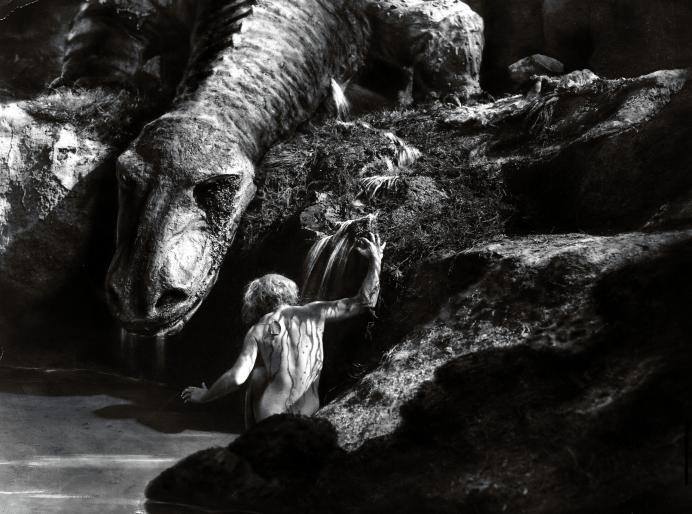
Siegfried bathes in the dragon’s blood in Fritz Lang’s 1924 epic Die Nibelungen.

3,726 words

1. Why Does Sigurd Slay the Dragon?

In How to Kill a Dragon, the linguist Calvert Watkins explores the common structure of the dragon or serpent slaying myths that are found throughout the Indo-European tradition. Midway through the book, he asks a crucial question, “Why does the hero slay the serpent? What is the function of this widespread if not universal myth, what is its meaning?” His answer employs language that must immediately remind us of Evola’s account of the “heroic path”: “The dragon symbolizes Chaos, in the largest sense, and killing the dragon represents the ultimate victory of Cosmic Truth over Chaos.”[1]

Now, we must be careful here. From the fact that Watkins and Evola both use the word “chaos,” it does not follow that they mean the same thing by it. On closer examination, however, they do seem to mean very much the same thing. We noted in part sixteen that Evola lists the following alchemical symbols for chaos: abyss, matrix, the “place of the tree,” the waters, mercury, serpent or dragon, and “the woman.” We also noted that in the Sigurd/Siegfried story the dragon and the waters have a functional similarity. The gold must be wrested from or retrieved from the waters, just as it must be from the dragon (and in the Nibelungenlied, the gold returns, in the end, to the water).

Now here is Watkins expanding on the meaning of the dragon: “The Chaos which the dragon symbolizes may take many manifestations in the different traditions. In Indo-Iranian it is the theme of the pent-up waters, the ‘resistance’. . . which is the blockage of life-giving forces, which are released by the victorious act of the hero.”[2] Furthermore, Watkins references the Indian myth of the god Indra (equivalent to Thor) slaying the serpent-monster Vṛtrá, releasing the “pent-up waters.” “Vṛtrá,” Watkins notes, “is a personification—confined to India—of an Indo-Iranian abstract noun *urtrám meaning ‘resistance’; the channel [which releases the waters] is the divine epithet vrtra-han-. . . originally ‘smashing resistance.’”[3]

Both the dragon and the waters thus symbolize, on Watkins’s interpretation, resistance or obstruction that somehow blocks “life-giving forces.” The hero is he who “smashes resistance.” Superficially, however, this does not seem to cohere with the account of the “chaos principle” given by Evola, which is pure formless potentiality for being.[4] It is this interpretation that most closely accords with the original Greek meaning of chaos, which referred to a “yawning” or “yawning void.” However, these interpretations of chaos are not as different as they might seem.
You can buy Collin Cleary’s Summoning the Gods here.

As I noted in part sixteen, if chaos is allowed to dominate, then the void and non-being reigns. Thus, chaos is something that must be subdued in order for it to be productive. Chaos can be the source of all being—or it can be that which obstructs or resists coming to be. This principle is clearly illustrated in the Norse creation myth. Ginnungagap (“yawning gap,” “gaping void”) is obviously equivalent to Greek chaos: that from which comes all things. But note that the first thing to emerge from chaos is the frost giant Ymir. This heralds the “Titanic age” in Norse myth. Forms appear haphazardly and are usually abortive humanoids. Creatures are produced out of ice blocks, or out of armpits, or from the mating of legs, etc.

I have argued elsewhere that in Norse myth the giants (and this could equally be said of the Greek Titans) represent a force that works against the orderly processes of change, growth, and development.[5] To use Calvert Watkins’s word, the giants represent the force of “resistance.” Ragnarok represents the conflict between the order of the gods and the “resistance” or disorder of the giants. Among the monsters that challenge the gods are two of the children of Loki (who is half giant) and the giantess Angrboda: the wolf Fenrir, and the Midgard Serpent, Jormungandr. Thor’s ongoing rivalry with Jormundgandr is yet another instance of the dragon slaying (or, in this case, dragon fighting) motif analyzed by Watkins.

The Titanic age in the Norse cosmogony ends when the brothers Odin, Vili, and Ve kill Ymir. Significantly, they return his body to the center of Ginnungagap and dismember him. From his remains they construct a cosmos (from Greek kosmos meaning “orderly arrangement”) where before there had been disorder. There can be little doubt that we are to understand Ginnungagap as the sort of pure potentiality for being that Evola identifies with Chaos. At the same time, however, what first emerges from Ginnungagap are monstrosities.

In order for chaos to produce a cosmos, it must be subdued or conquered by a principle of order (what Evola calls “egg”). Then the “pent-up waters,” or “life-giving forces” are released. If the chaos principle dominates or acts on its own, it produces disorder or calamity. Chaos thus has dual aspects. The dragon slaying motif represents the creation of being out of nothing: the emergence of definite, individuated being out of indefinite potentiality. The dragon slaying symbolizes the process of cosmic creation, as well as the creation, by the alchemist, of a spiritual corporeality—his recreation of himself (see part sixteen).

2. The Dragon as Ouroboros

In terms of the Hermetic path or what Evola calls “initiation,” slaying the dragon refers to dominating the chaos principle within oneself. To follow the “yoga” discussed in part sixteen—to achieve identification with the watching self—is to cause the One to emerge out of chaos. To repeat what was said there, detaching the self from chaos and remaining in that state is a movement from a “self” that is many, to a self that is one and indivisible in that it is one pure act of pristine awareness. The alchemist becomes not a one but the One.
You can buy Collin Cleary’s Wagner’s Ring & the Germanic Tradition here.

Evola interprets ☉, the symbol for both gold and the sun, as the Ouroboros, which represents chaos, coiled around the One which emerges from it (just as Kundalini coils around the subtle phallus, which can be represented by the Shiva bindu, which means drop, point, or dot). Gold represents the One that is crystallized out of chaos. Let us now try to go a step further in utilizing this imagery to understand the saga. Is Fafnir an Ouroboros? He is not explicitly depicted this way in the saga, but there are compelling reasons to think that he is one.

Did Fafnir coil around his treasure? The etymology of his name certainly suggests this, for it literally means something like “he who embraces” (from the verb faðma, “to embrace”). We will find much more convincing evidence, however, if we consider the depiction of serpents as Ouroboroi in other Germanic sources.

In Ragnar Lothbrok’s Saga, the sequel to the Volsung Saga, Jarl Herruth gives his daughter Thora a small snake as a gift. Thora puts it in a box and places a piece of gold underneath the snake. In time, both the snake and the gold begin to grow. Eventually, the snake grows into a huge dragon and the gold into a great hoard. Finally, the dragon becomes so big that it “encircled the cabin so that its head touched its tail.”[6] Slaying this dragon is Ragnar’s initial heroic act in the saga.

The dragon slain by Ragnar is thus explicitly depicted as an Ouroboros. As so often happens in the lore, Ragnar recapitulates the actions of earlier heroes, in this case Sigurd’s slaying Fafnir and winning the gold. This example from Ragnar Lothbrok’s Saga is especially significant given that it seems to establish a symbiotic relationship between the serpent and the gold. The gold seems to transform the snake into a dragon, but the gold grows as well. Is there anything like this in Fafnir’s relationship to his gold?

All we may say is this: we are not told—either in the Volsung Saga or in any other source—whether Fafnir chose to transform himself into a dragon, or whether it happens as an effect of the cursed treasure. Both Wagner and Tolkien seemed to think it was the latter. In Wagner’s Ring, Fafnir is a giant and his transformation into a dragon is a result of the corruption of the gold. In Tolkien’s Lord of the Rings, which was heavily influenced by Germanic mythology, the hobbit Sméagol is transformed by the gold ring into the hideous creature Gollum. The gold of the saga, in any case, clearly seems to have the power to corrupt. Snorri’s Edda mentions that when Odin initially saw the ring in Andvari’s hoard “he found it beautiful and removed it from the treasure.”  It is this detail that inspired Wagner to depict his Wotan as seduced by the ring.

However, there are other examples of Ouroboroi in the lore. The most famous example is Jormundgandr, the Midgard Serpent. Like the dragon in Ragnar Lothbrok’s Saga, he also grows and encircles. Snorri says that “when [Loki’s children] came to [Odin] he threw the serpent into that deep sea which lies around all lands, and this serpent grew so that it lies in the midst of the ocean encircling all lands and bites its own tail.”[7] As already mentioned, Thor’s battle with the serpent is the same mythological motif of the hero slaying the serpent discussed by Watkins, and is homologous with Sigurd’s battle with Fafnir.

We may mention a couple of other examples. In Helgakvitha Hjorvarthssonar, the hero, who at this point in the story has no name, encounters a group of nine Valkyries on horseback. One of them names him “Helgi,” and predicts a glorious future for him. Helgi responds, playfully, that he will not accept the name unless it is accompanied by a naming gift. The Valkyrie then says,

I know where there lie
forty-six
swords
in Sigarsholm.
But one of those
shield-breaking blades
is better than the others;
it’s decked with gold.

There’s a ring in the hilt,
And courage in its middle,
and there’s fear in its point—
fear of the man who wields it.
A blood-colored serpent
decorates the blade;
another serpent bites its tail
on the hilt’s hand-guard.

The sword is magical and one of the two snakes with which it is decorated is an ouroboros. Finally, we must mention another detail from Ragnar Lothbrok’s Saga. Ragnar has a child with Aslaug, the daughter of Sigurd and Brynhild, and the child is born with an image of a brown snake (or dragon) in one eye, hence the boy is named Sigurd Snake-Eye. The saga does not specify that the snake is an ouroboros, but it is difficult to imagine the snake in any other position than coiled around (or within) the iris. So, the motif strongly suggests an ouroboros.

It is highly appropriate that the grandson of Sigurd should be born with this image in his eye, since we are told in the Volsung Saga that Sigurd adopts the dragon as his personal emblem. Esoterically, this refers to his triumph over chaos.

3. The Baptism of Blood

We now come to the symbolism of the dragon’s blood. Those reading the saga for the first time are often surprised that Sigurd does not bathe in the blood of Fafnir. This motif occurs only in the continental German versions of the tale, whereas the Scandinavian versions have Sigurd drinking the blood and coming to understand the language of birds. In the German sources, Sigurd is Siegfried. It is the same character, but with different names, which do not mean the same thing. Sig/Sieg means “victory” in both cases, but –urd derives from Proto-Germanic *-ward meaning “protection” (hence, something like “Victory-Protector”) and –fried comes from Proto-Germanic *-frið or “peace” (thus, “Victory-Peace”).

The German sources in which Siegfried bathes in the dragon’s blood (or in which he is said to have done this) include the Nibelungenlied (13th century) and Rosengarten zu Worms (ca. 1300). Thidreks Saga (ca. 1250) is in Old Norse and features Sigurd both drinking the dragon’s blood (thus acquiring knowledge of the language of birds), as well as bathing in it. However, Thidreks Saga is mostly a translation of German materials. We must also mention the German Das Lied vom Hürnen Seyfrid (The Song of Horn-Skin Siegfried), in which Sigurd bathes in molten dragon’s skin rather than blood. Hürnen Seyfrid is the youngest of these texts, written around 1400.
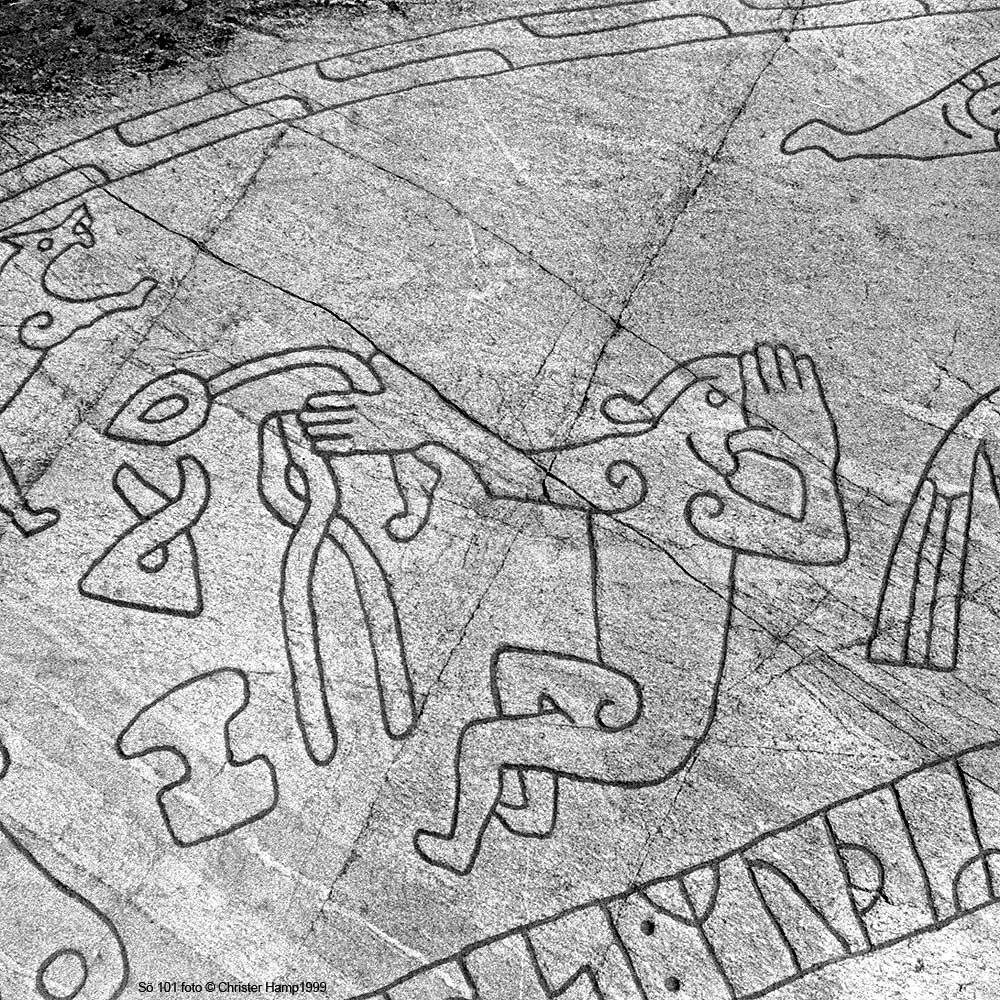
Sigurd tastes the dragon’s blood in this detail of the Ramsund carving.

Our oldest surviving sources for the Sigurd story are carvings, such as the Ramsund carving which dates from around 1030. Some of the poems dealing with Sigurd and related characters in the Codex Regius may be as early as the 10th century (though the text of the Codex Regius was written down in the 1270s). Despite the fact that the Scandinavian sources are older, scholars believe that the stories of Sigurd originated on the continent as an oral tradition, then made their way to Scandinavia.

Because of this latter fact, I feel we are justified in discussing the “bathing in dragon’s blood” episode in the life of Sigurd, even though it does not occur in the Volsung Saga. (For simplicity’s sake I will refer to Sigurd rather than Siegfried or “Sigurd/Siegfried.”) For all we know, this episode could have figured in the oldest oral versions of the Sigurd story. This is the same methodology I have followed in earlier installments, in which I have covered material from other sources (e.g., from the Codex Regius) which does not appear in the saga but which amplifies it.

In all the sources that depict Sigurd bathing in the blood, the effect is that his body becomes invulnerable. This is the whole point of “The Song of Horn-Skin Siegfried,” even though, as already mentioned, in that tale he bathes in molten dragon’s skin rather than blood. The effect is the same. Dragon’s blood clearly has some very special qualities, if it can both render skin invulnerable and confer wisdom. We noted in part fifteen that Sigurd asks Regin what will happen if he gets the dragon’s blood on his skin. This is a reasonable question, for the blood of Germanic dragons was widely reputed to be poisonous and corrosive.

We know from the saga that both Sigurd’s father, Sigmund, and his half-brother Sinfjotli could withstand poison falling on their skin. Only Sigmund could survive ingesting it, however. When Sinfjotli is a boy, Sigmund stops him from making bread from a bag of flour into which the boy had ground “a huge poisonous snake.” The sagaman then tells us, “Sigmund was so hardy that he could take poison and yet come to no harm. But though Sinfjotli was able to stand outward contact with poison, he could neither eat nor drink it.”[8] Years later, Sinfjotli is killed by a poisoned drink served to him by his wicked stepmother.

In Beowulf’s account of “Sigemund” slaying the dragon, after the serpent is killed the text says Wyrm hat gemealt, which Stephen Mitchell renders as “The dragon dissolved in its boiling blood,” interpreting what literally means “The dragon melted” as being caused by the dragon’s own blood.[9] (Grendel’s mother is also depicted as having corrosive blood.) The belief that serpent’s or dragon’s blood is poisonous may be very old, and not just confined to the Germanic world.

Let us consider, in this connection, a few passages from Evola’s Hermetic Tradition. He quotes the Chrysopoeia of Cleopatra (attributed to the 3rd—century figure Cleopatra the Alchemist) which says that “One is the serpent, which contains the poison, according to the double sign.” The texts says, further, “The One is the all, the source of all and the culmination of all: if the all did not contain the all, it would be nothing.”[10] This very short text also contains a famous image of an ouroboros, within which is the inscription hen to pan (“the all is one”).

As we have already noted, in alchemy the dragon symbolizes the chaos principle. In this connection, Evola also holds that the dragon represents the “spirit of dissolution,” and has this to say:

We have mentioned another association: the Serpent or Dragon. This is the “universal” or “cosmic serpent” . . . which, according to the gnostic expression, “moves through all things.” Its relation to the chaos principle—“Our chaos or Spirit is a Dragon of fire that conquers all”—and to the principle of dissolution. . . (the Dragon Ourobouros is the dissolution), goes back to the most ancient myths.[11]

He also lists “Venom, Viper, Universal Solvent, and Philosophical Vinegar” as alchemical symbols for the “spirit of dissolution” or “power of the undifferentiated.”[12] As noted in part sixteen, the alchemist must enter into the chaos principle—without, at the same time, surrendering his will—and allow it to transform him. Only then can the One emerge from chaos, and the alchemical opus be achieved in the body of the operator. Thus, the dragon, as chaos, is a dissolving principle. Through the dissolution effected by the poison found in the dragon, something new is coagulated. And recall these words of Evola’s:

In general it is the unanimous opinion of all the hermetic philosophers that a mortification must intervene; a dissolving of the waters, a disappearance into the mother’s womb that devours or kills the son, a domination of the Female over the Male, the Moon over the Sun, the volatile over the fixed, and so on; but all that is simply a provisional condition for returning potentiality to the son to enable him to reaffirm himself again over what has previously dominated and “dissolved” him, to make himself “more perfect and greater than his parents.”[13]

In a passage very significant for our purposes, Evola alludes to the views of the (probably legendary) 15th-century alchemist Bernard of Treviso, saying that this same chaos principle or principle of dissolution “confers victory over all things to the ‘King’ who knows how to bathe in it.”[14]

Sigurd’s bathing in the dragon’s blood and acquiring thereby an invulnerable body symbolizes the alchemical process by which the “spiritual corporeality” is created. We discussed this process extensively in part sixteen. Evola says that “it is a matter of the body, while remaining as it is on the outside, now existing solely as a function of the spirit and no longer for itself.” [15] The aim is to “embody the spirit and spiritualize the body in one and the same act.”[16] The transformation does not liberate the alchemist from his body. Instead, he remains in the world in what is outwardly the same body.

What is necessary, as Evola puts it, is for “consciousness to pass from an individualized state . . . to a nonindividualized, unshaped state (Waters, Solvents, Mercury, etc.). The symbols of this process are liquefaction, fusion, dissolution, solution, separation, and so on.”[17] This is exactly the esoteric function of the corrosive blood of the dragon, or its molten skin (in Hürnen Seyfrid). This liquid would destroy any other man but Sigurd “knows how to bathe in it” (i.e., he can withstand contact with it). To create the spiritual body the old body must be “dissolved”: the body must be “unmade,” then remade. Evola says that this dissolution can be approached “actively or passively, as dominator or dominated.”[18] He who approaches the chaos principle or principle of dissolution actively and masters it—he who can slay the dragon and bathe in its blood—is suffused with a life-force “which has the nature of diamond and of irresistible thunderbolt, [and] transforms the mortal and deprived condition into one of immortality.”[19]

In the last quotation, Evola seems to be alluding to two traditions that speak of the “spiritual corporeality.” These traditions may, furthermore, be connected. The Chinese alchemical tradition speaks of the creation of a “diamond body” through “internal cultivation.” This is also referred to as the “Phoenix” and the “Golden Dragon body.” Vajrayana Buddhism also teaches a path to the creation of a “diamond-thunderbolt body.” There is reason to think this is a perennial teaching. For Evola, it is the principal esoteric teaching of alchemy.

An important question remains. In some versions of the story of Sigurd’s bathing in the dragon’s blood (e.g., the Nibelungenlied) his body becomes invulnerable except in one place. A leaf falls on his back and sticks there, so that the blood does not transform him in that spot. This is, of course, his “Achilles heel,” and leads to his death. Esoterically, what does this represent? We will discuss this in a later installment. For now, all we will say is that it is important to keep in mind that Sigurd is a tragic figure. His is a story of alchemical transmutation—but one that seems incomplete in some important respect. What can this be?

In our next installment, we will explore the esoteric significance of “the language of birds,” of the World Tree (Yggdrasil), and of the tale of Odin winning the poetic mead.

Notes

[1] Calvert Watkins, How to Kill a Dragon (Oxford: Oxford University Press, 2001), 299.

[2] Watkins, 300.

[3] Watkins, 304. Please note that I have simplified spellings and have not used some of the special characters employed by Watkins in his transliterations and in his reconstructed Indo-European words.

[4] Eliade puts forward the same interpretation of the waters. See Mircea Eliade, Patterns in Comparative Religion, trans. Rosemary Sheed (New York: Meridien Books, 1963), 188-190.

[5] Edred Thorsson says that “The forces of nonconsciousness are embodied in the thurses. . . . They are, even in later tales, marked by their stupidity.” And they are “actively antagonistic toward the forces of consciousness and seek to destroy it through their rime-cold entropy.” See Edred Thorsson, Runelore (York Beach, Maine: Samuel Weiser, 1987), 188-189.

[6] The Saga of the Volsungs with the Saga of Ragnar Lothbrok, trans. Jackson Crawford (Indianapolis: Hackett Publishing, 2017), 89.

[7] Snorri Sturluson, Edda, trans. Anthony Faulkes (London: Everyman’s Library, 1995), 27.

[8] The Saga of the Volsungs, trans. R.G. Finch (London: Thomas Nelson, 1965), 10.

[9] Beowulf, trans. Stephen Mitchell (New Haven: Yale University Press, 2017), 59. See also Stephen E. Flowers, Sigurðr: Rebirth and the Rites of Transformation (Smithfield, TX: Rûna-Raven, 2011), 123.

[10] Julius Evola, The Hermetic Tradition, trans. E.E. Rehmus (Rochester, VT: Inner Traditions, 1995), 21. (Henceforth, “HT.”)

[11] Evola, HT, 31.

[12] Evola, HT, 31.

[13] Evola, HT, 72.

[14] Evola, HT, 31.

[15] Evola, HT, 165-166. Italics added.

[16] Evola, HT, 156. Evola italicizes this entire phrase, indicating its importance.

[17] Evola, HT, 71.

[18] Evola, HT, 71.

[19] See Evola, The Path of Enlightenment in the Mithraic Mysteries, trans. Guido Stucco (Edmonds, WA: Alexandrian Press, 1994), 19.

An Esoteric Commentary on the Volsung Saga, Part XVIII: The Dragon’s Blood

An%20Esoteric%20Commentary%20on%20the%20Volsung%20Saga%2C%20Part%20XVIII%3A%0AThe%20Dragon%E2%80%99s%20Blood%0A

Share

  • Gab

Enjoyed this article?

Be the first to leave a tip in the jar!

Instant Echeck GreenPay™

Related

  • Heidegger on Nietzsche Part Three

  • Exclusive Interview with Karel Veliky Part 2

  • Collin Cleary: What Rome Means to Me

  • Nietzsche & Race

  • Heidegger on Nietzsche, Part Two

  • Heidegger on Nietzsche, Part One

  • Remembering Julius Evola

  • Finding Atlantis Part 4

Tags

alchemyAn Esoteric Commentary on the Volsung SagaCalvert WatkinschaosCollin ClearydragonshermeticismJulius EvolaNorse mythologyNorse sagasRichard WagnerThe Hermetic TraditionThe Worm Ouroboros

Previous

« Time for an Independent Counsel for the Epstein Case

Next

» ICE and Mass Deportations

1 comment

  1. Vainovalkeat says:
    February 21, 2026 at 2:15 pm

    Mr Cleary,

    I started at Part I and have made it all the way to Part XVIII and I must say that your scholarship and mastery of various subjects is impeccable!

    0
    0

Comments are closed.

If you have a Subscriber access,
simply login first to see your comment auto-approved.

Note on comments privacy & moderation

Your email is never published nor shared.

Comments are moderated. If you don't see your comment, please be patient. If approved, it will appear here soon. Do not post your comment a second time.

Upcoming podcasts
  • Rob Rundo on Counter-Currents Radio

    Rob Rundo on Counter-Currents Radio

    Counter-Currents Radio

    Sat, Jun 13th — 3 pm EST / 9 pm CET

Writers of May

(2 votes) Morris van de Camp David M. Zsutty Derek Stark Jayant Bhandari Greg Johnson

Articles of May

Heidegger on Nietzsche, Part One by Collin Cleary The Lunch Wars by David M. Zsutty 2 votes
    • The Bitter End of Western Metaphysics:
      Heidegger on Nietzsche, Part Three

      Collin Cleary

      6

    • Uncivil War

      Mark Gullick

      21

    • Exclusive Interview with Karel Veliky:
      The Final Chapter in the Film Series! Part II

      Ondrej Mann

      2

    • Happy Birthday to Us!

      Greg Johnson

      6

    • Zsutty’s Maximum

      David M. Zsutty

      15

    • Exclusive Interview with Karel Veliky:
      The Final Chapter in the Film Series! Part I

      Ondrej Mann

      2

    • The Union Jackal, June 2026

      Mark Gullick

      23

    • The Inferiority Behind Immigrant Superiority

      Jayant Bhandari

      15

    • Counter-Currents Radio Podcast No. 690
      Greg Johnson & David Zsutty Discuss Current Things: AI, Henry Nowak, the Iran Crisis, & More

      Counter-Currents Radio

      5

    • Collin Cleary: What Rome Means to Me

      Collin Cleary

      4

    • Paul Krugman: Closet Bolshevik

      Spencer J. Quinn

      19

    • Fugue of Ideas:
      Ibram X. Kendi’s Chain of Ideas

      Greg Johnson

      18

    • Based Blacks

      Lipton Matthews

      12

    • Black Intellectual Fatigue

      Derek Stark

      37

    • Why White Advocates Should Avoid “Based Blacks”

      Dani Vypont

      26

    • Nietzsche & Race

      Mark Gullick

    • Editor’s Update
      Rob Rundo Rescheduled to Next Week on Counter-Currents Radio;
      Tonight Greg Johnson & David Zsutty Answer Your Questions;
      Fundraiser Update & a New $20,000 Matching Grant

      Greg Johnson

    • The Counter-Currents 2026 Fundraiser
      Lifetime Subscriber Welcome Packages Extended

      Greg Johnson

    • Nationalism This Week
      Who’s Looking Back?

      Greg Johnson

      29

    • China’s Threat to American Security:
      Food, Farmland, Foreign Control, & Energy Policy

      Lipton Matthews

      5

    • The Bitter End of Western Metaphysics:
      Heidegger on Nietzsche, Part Two

      Collin Cleary

      16

    • The Killing of Henry Nowak

      Mark Gullick

      38

    • The Crisis of Chinese Technology Thieves

      Morris van de Camp

      1

    • The Strange World of Gender Bender Fiction:
      & What This Genre Tells Us About Autosexuality

      Dani Vypont

      3

    • Watching the Watchers:
      The Dark Triad Question

      David M. Zsutty

      14

    • The Remigration Movement Solidifies

      F. Roger Devlin

      1

    • Casting Aspersions:
      The Fatal Consequences of Race-Swapped Casting, From Helen of Troy to Henry of Southampton

      Steven Tucker

      20

    • The Murder of Henry Nowak

      Millennial Woes

      23

    • Don’t Forget to Vote in Our Writer & Article of the Month Poll

      Greg Johnson

    • The Robot Hotdog Stand

      Greg Johnson

      37

    • Laughing Our Way to Victory

      Dave Chambers

      7

    • The Zodiac Killer

      Mark Gullick

      11

    • Jared Taylor: What Rome Means to Me

      Jared Taylor

      1

    • An Interview with Endeavour:
      My Way of Life Is an Adventure!

      Ondrej Mann

      6

    • José Pedro Zúquete’s The Identitarians

      Greg Johnson

      3

    • Editor’s Update
      Fundraiser Update & How to Watch the Remigration Summit

      Greg Johnson

      5

    • The Bitter End of Western Metaphysics:
      Heidegger on Nietzsche, Part One

      Collin Cleary

      12

    • Berlin: City of Stones

      Spencer J. Quinn

      6

    • True Folk-Horror Is Horror of Your Own Folk:
      Mark Gatiss vs the Brexit Blind Dead  

      Steven Tucker

      4

    • Counter-Currents Radio Podcast No. 689
      Thomas Massie, the America 2050 Bust, the Need for Whites to Divest from America, the AI Economic Apocalypse, & Pro-White Project Pitches to Billionaires

      Counter-Currents Radio

      7

    • Nationalism This Week
      Remigration is Inevitable, Part 3

      Greg Johnson

      27

    • Why Billionaires Should Fund White Identity Politics

      Lipton Matthews

      8

    • How Cold War Two Came About

      Morris van de Camp

      5

    • Now Available for Pre-Order at a Special Price!
      Greg Johnson’s The Philosopher Is In

      Greg Johnson

    • David Zsutty’s Elevator Pitch to a Billionaire

      David M. Zsutty

      1

    • Headbanging Lite

      Mark Gullick

      5

    • White Advocacy Past and Present

      Peter Bradley

      13

    • The Lunch Wars

      David M. Zsutty

      47

    • The Russians are Coming/The Russians are Coming

      Steven Clark

      1

    • Peak Fatigue in Fort Wayne

      Gabriel Anderson

      24

    • Ondrej Mann

      Exclusive Interview with Karel Veliky Part 2

      Thanks for the cultural tip. I’m currently preparing an interview for CC with the Austrian band...

    • Observer

      Heidegger on Nietzsche Part Three

      Also, a semi-related topic, but have you read Darren Beattie's Heidegger PhD thesis? I know that it...

    • Observer

      Heidegger on Nietzsche Part Three

      My mood is always improved by a fresh Cleary article. Great work as always. It's always fun to see...

    • Joe Gould

      Zsutty’s Maximum

      "That Whites are the only racial ingroup in which there seems to be any significant number of...

    • Nicholas

      Paul Krugman: Closet Bolshevik

      https://youtu.be/02MV3DD5pFc This is the link I intended to share. Let's hope this works.

    • Greg Johnson

      Zsutty’s Maximum

      All groups are mean to one another, to some extent. The question is whether this level of ingroup...

    • Joe Gould

      Uncivil War

      For Whites, one of the goals of philosophy, and of education in general, has to be this: we must...

    • Dani Vypont

      Uncivil War

      Northern Ireland has been in a civil war, both hot and cold, for decades. This religiously and...

    • David M. Zsutty

      Zsutty’s Maximum

      That Whites can be very mean to each other is a correct observation. However, this is a case of...

    • Scott

      Why White Advocates Should Avoid “Based Blacks”

      Will Williams wrote: "Scott, it’s interesting that you call George Stephanopoulos a “Clinton...

    • Scott

      Paul Krugman: Closet Bolshevik

      Yeah, Trump is the most Kosher President to come down the pike ─ except for the last one, and the...

    • C#

      Heidegger on Nietzsche Part Three

      Well, that was depressing. Enlightening, but depressing. Personally, I suffer from the baggage of...

    • dogbone

      Based Blacks

      lol - I'd much rather watch Tate than Shapiro any day.

    • Joe Gould

      Uncivil War

      Confronting the police, which really means appealing to the police to do their jobs, gets you three...

    • Nicholas

      Paul Krugman: Closet Bolshevik

      This is me trying to pass CAPTCHA test for X: German Kid Flips Out

    • Malaparte

      Heidegger on Nietzsche Part Three

      I am going to order Fundamental Tendency of Our Time, seems like a good place to start. By the...

    • Will Williams

      Why White Advocates Should Avoid “Based Blacks”

      Scott, it’s interesting that you call George Stephanopoulos a “Clinton apologist,” considering how...

    • Flel

      Black Intellectual Fatigue

      In the words of that great humanitarian Rodney King, can’t we all just get along? Jk. A stirred pot...

    • Collin Cleary

      Heidegger on Nietzsche Part Three

      In fact, I had never heard of him until I read your comment. I have now looked at his Wikipedia...

    • New Flyer

      Uncivil War

      "One female politician (and a lot of them are women) interviewed on TV said that the problem was...

    • Earth Day Special

      John Morgan

      12

    • A Robertson Roundup
      Remembering Wilmot Robertson
      (April 16, 1915 – July 8, 2005)

      Margot Metroland

      13

    • The Paranoid Style in White Nationalism

      Greg Johnson

      30

    • Join the Dance!

      Andrew Hamilton

      1

    • We Can’t Save the Earth Without Reducing African Birth Rates

      James Dunphy

      36

    • “I’m Not a Conspiracy Theorist, but . . .”:
      Jeffrey Epstein’s Death Gives New Life to “Conspiracy Theories”

      Greg Johnson

      22

    • Sylvia Plath: Stasis in Darkness

      Vic Olvir

      17

    • Vanguardism, Vantardism, & Mainstreaming

      Greg Johnson

      80

    • Aviation, Geography, & Race

      Charles Lindbergh

      3

    • Some Thoughts on Yule

      Collin Cleary

      4

    • Living in Truth:
      A Yuletide Homily

      Jef Costello

      7

    • John Kennedy Toole’s A Confederacy of Dunces

      Greg Johnson

      20

    • On Aleksandr Solzhenitsyn’s Warning to the West

      Spencer J. Quinn

      7

    • Elitism, British Modernism, & Wyndham Lewis

      Jonathan Bowden

      6

    • Philip K. Dick’s Do Androids Dream of Electric Sheep? as Anti-Semitic/Christian-Gnostic Allegory

      Greg Johnson

      20

    • “Conspiracy Theory” or Conspiracy?

      Andrew Hamilton

      21

    • Remembering H. P. Lovecraft
      (August 20, 1890–March 15, 1937)

      Greg Johnson

      3

    • Who Are We?
      Nordics, Aryans, & Whites

      Greg Johnson

      71

    • Remembering William Gayley Simpson
      (July 23, 1892–December 31, 1990)
      A Pleasant Afternoon with Harriet & Bill Simpson

      Margot Metroland

      18

    • Here are the Young Men
      Remembering Ian Curtis
      (July 15, 1956–May 18, 1980)

      Mark Gullick

      18

    • Percy Grainger
      Artist of the Right

      Alex Graham

      7

    • Remembering Revilo Oliver
      (July 7, 1908–August 20, 1994)

      Greg Johnson

      18

    • The Meaning of July 4th for the White Man

      Gregory Hood

      13

    • The Front National’s Evolution

      Bruno Mégret

    • Merwin K. Hart
      Forgotten American Hero & Man of the Right

      Morris van de Camp

      10

    • George Orwell’s Nineteen Eighty-Four

      Jonathan Bowden

      8

    • Carleton S. Coon
      Scientist & Reluctant White Advocate

      Morris van de Camp

      3

    • The Kwanzaa Absurdity Will Be Dwarfed by Juneteenth

      Robert Hampton

      10

    • Stravinsky

      Alex Graham

      7

    • Like the Roman:
      Remembering Enoch Powell (1912-1998)

      Mark Gullick

      23

    • Jonathan Bowden’s Deliverance
      Part 6

      Jonathan Bowden

    • Do You Want to Play a Game?

      Mark Gullick

      1

    • Sexually Incontinent on the Indian Subcontinent:
      Who Rapes More Animals, Indians or Pakistanis? The Battle Continues!

      Steven Tucker

      3

    • Neo-Fascism in Film
      Part 5

      Karel Veliky

      15

    • The Game of Tarot

      Mark Gullick

      2

    • Institutions Cannot Be Transplanted

      Jayant Bhandari

      5

    • Jonathan Bowden’s Deliverance
      Part 5

      Jonathan Bowden

    • Crosstown Traffic:
      Jimi Hendrix & The Post-War Rock ‘N’ Roll Revolution

      Mark Gullick

      1

    • Slaves from the North:
      Finns & Karelians in the East European Slave Trade, 900–1600

      Lipton Matthews

      14

    • Neo-Fascism in Film
      Part 4

      Karel Veliky

      2

    • David Lean’s A Passage to India

      Spencer J. Quinn

      1

    • Elites are Essential to Development

      Lipton Matthews

      7

    • Jonathan Bowden’s Deliverance
      Part 4

      Jonathan Bowden

    • Neo-Fascism in Film
      Part 3

      Karel Veliky

      6

    • E. M. Forster’s A Passage to India & the Indian Mentality

      Spencer J. Quinn

      25

    • Jonathan Bowden’s Deliverance
      Part 3

      Jonathan Bowden

    • The Rest Is Silence
      Heidegger’s Quietism

      Mark Gullick

      2

    • Dispelling the Historical Fallacy of Indian Nationalism

      Lipton Matthews

      8

    • Neo-Fascism in Film
      Part 2

      Karel Veliky

      8

    • Jonathan Bowden’s Deliverance
      Part 2

      Jonathan Bowden

    • Life of a Klansman

      Mark Gullick

      8

    • Jonathan Bowden’s Deliverance, Part 1

      Jonathan Bowden

    • Decolonial Ideas are Holding Back Developing Countries

      Lipton Matthews

      8

    • Neo-fascism in Film, Part 1

      Karel Veliky

      21

    • Jonathan Bowden’s Onslaught, Part 8
      Divigations on Decadence

      Jonathan Bowden

    • Jonathan Bowden’s Onslaught, Part 7
      Intrigues in the National Front

      Jonathan Bowden

      1

    • Rotten to the Core

      Mark Gullick

      8

    • Strauss on Husserl’s “Philosophy as Rigorous Science”

      Greg Johnson

    • Jonathan Bowden’s Onslaught, Part 6
      Francis Bacon & Right-Wing Nihilism

      Jonathan Bowden

    • London After (& Before) Midnight:
      Aleister Crowley, The Landlord’s Worst Nightmare

      James J. O'Meara

      2

    • András László
    • Derek Hawthorne
    • Beau Albrecht
    • Alain de Benoist
    • Kerry Bolton
    • Jonathan Bowden
    • Collin Cleary
    • Jef Costello
    • Savitri Devi
    • Julius Evola
    • Jim Goad
    • Gregory Hood
    • Juleigh Howard-Hobson
    • Greg Johnson
    • Charles Krafft
    • Anthony M. Ludovici
    • Trevor Lynch
    • H. L. Mencken
    • J. A. Nicholl
    • James J. O’Meara
    • Christopher Pankhurst
    • Tito Perdue
    • Michael Polignano
    • Spencer J. Quinn
    • Fenek Solère
    • Irmin Vinson
    • Leo Yankevich
    • Francis Parker Yockey
    • Multiple authors
  • Editor-in-Chief

    • Greg Johnson, Ph.D.

    Featured Writers

    • Beau Albrecht
    • Gunnar Alfredsson
    • Collin Cleary, Ph.D.
    • Jef Costello
    • Morris V. de Camp
    • F. Roger Devlin, Ph.D.
    • Stephen Paul Foster, Ph.D.
    • Jim Goad
    • Alex Graham
    • Mark Gullick, Ph.D.
    • Greg Johnson, Ph.D.
    • Travis LeBlanc
    • Trevor Lynch
    • Margot Metroland
    • James J. O’Meara
    • Angelo Plume
    • Spencer J. Quinn
    • Fred Reed
    • Clarissa Schnabel
    • Michael Walker
    • David M. Zsutty

    Frequent Writers

    • Asier Abadroa
    • Aquilonius
    • Alain de Benoist
    • Kerry Bolton, Ph.D.
    • Dave Chambers
    • Steven Clark
    • James Dunphy
    • Endeavour
    • Richard Houck
    • Jason Kessler
    • Titus Livius
    • Ondrej Mann
    • Lipton Matthews
    • Mark Mazari
    • John Morgan
    • Jaroslav Ostrogniew
    • Kathryn S.
    • Christian Secor
    • Anne Wilson Smith
    • Thomas Steuben
    • William De Vere
    • Kenneth Vinther
    • Max West

    Classic Authors

    • Maurice Bardèche
    • Jonathan Bowden
    • Julius Evola
    • Guillaume Faye
    • Ernst Jünger
    • Kevin MacDonald, Ph.D.
    • D. H. Lawrence
    • Charles Lindbergh
    • Jack London
    • H. P. Lovecraft
    • Anthony M. Ludovici
    • Sir Oswald Mosley
    • National Vanguard
    • Friedrich Nietzsche
    • Revilo Oliver
    • William Pierce
    • Ezra Pound
    • Saint-Loup
    • Savitri Devi
    • Carl Schmitt
    • Miguel Serrano
    • Oswald Spengler
    • P. R. Stephensen
    • Jean Thiriart
    • John Tyndall
    • Dominique Venner
    • Leo Yankevich
    • Francis Parker Yockey

    Other Authors

    • Howe Abbott-Hiss
    • Michael Bell
    • Giles Corey
    • Jack Donovan
    • Richardo Duchesne, Ph.D.
    • Emile Durand
    • Guillaume Durocher
    • Mark Dyal
    • Tom Goodroch
    • Andrew Hamilton
    • Robert Hampton
    • Huntley Haverstock
    • Derek Hawthorne
    • Gregory Hood
    • Juleigh Howard-Hobson
    • Alexander Jacob
    • Ruuben Kaalep
    • Tobias Langdon
    • Julian Langness
    • Patrick Le Brun
    • G A Malvicini
    • John Michael McCloughlin
    • Millennial Woes
    • Michael O’Meara
    • Christopher Pankhurst
    • Michael Polignano
    • J. J. Przybylski
    • Quintilian
    • Edouard Rix
    • C. B. Robertson
    • C. F. Robinson
    • Herve Ryssen
    • Alan Smithee
    • Fenek Solere
    • Ann Sterzinger
    • Robert Steuckers
    • Tomislav Sunic
    • Donald Thoresen
    • Marian Van Court
    • Irmin Vinson
    • Book Reviews
    • Movie Reviews
    • TV Reviews
    • Music Reviews
    • Art Criticism
    • Graphic Novels & Comics
    • Video Game Reviews
    • Fiction
    • Poems
    • Interviews
    • Videos
    • English Translations
    • Other Languages
      • Arabic
      • Bulgarian
      • Croatian
      • Czech
      • Danish
      • Dutch
      • Estonian
      • Finnish
      • French
      • German
      • Greek
      • Hungarian
      • Italian
      • Lithuanian
      • Norwegian
      • Polish
      • Portuguese
      • Romanian
      • Russian
      • Slovak
      • Spanish
      • Swedish
      • Ukrainian
    • Commemorations
    • Why We Write
  • Archives
  • Top 100 Commenters
  • The Looney Bin
Sponsored Links
Europa.com Above Time Coffee Antelope Hill Publishing Paul Waggener IHR-Store Spencer J. Quinn American Renaissance Jim Goad The Occidental Observer
Donate Now Mailing list
Books for sale
  • The Philosopher Is In
  • Sexual Utopia in Power (Expanded Edition)
  • In Defense of Prejudice
  • Loving Our Own
  • Tyranny & Wisdom
  • The Populist Moment
  • Is America Doomed?
  • To all books
Copyright © 2026 Counter-Currents Publishing, Ltd.

Paywall Access


Please enter your email address.

Lost your password?

Edit your comment

Writer & Article of the Month May 2026

Voting for this month has concluded. Here are the final results!

Top Writers

  • #1 Morris van de Camp 2 votes
  • #2 David M. Zsutty 2 votes
  • #3 Derek Stark 2 votes
  • #4 Jayant Bhandari 2 votes
  • #5 Greg Johnson 2 votes
  • #6 Jared Taylor 1 vote
  • #7 Collin Cleary 1 vote
  • #8 Spencer J. Quinn 1 vote
  • #9 Mark Gullick 1 vote
  • #10 Lipton Matthews 1 vote
  • #11 Keith Woods 1 vote
  • #12 Steven Tucker 1 vote

Top Articles

  • #1 Heidegger on Nietzsche, Part One 2 votes
  • #2 The Lunch Wars 2 votes
  • #3 The Ghost of the Confederacy 1 vote
  • #4 Lothrop Stoddard’s The Revolt Against Civilization 1 vote
  • #5 Could Fascism Work? 1 vote
  • #6 Jared Taylor's Elevator Pitch to a Billionaire 1 vote
  • #7 Predation Wearing the Mask of Civilization 1 vote
  • #8 Peak Fatigue in Fort Wayne 1 vote
  • #9 Keith Wood's Elevator Pitch to a Billionaire 1 vote
  • #10 Do You Want to Play a Game? 1 vote
  • #11 Why Billionaires Should Fund White Identity Politics 1 vote
  • #12 The 1970s: The Golden Age of Hijacking 1 vote
  • #13 True Folk-Horror Is Horror of Your Own Folk 1 vote
  • #14 Finding Atlantis Part 4 1 vote
  • #15 Berlin: City of Stones 1 vote

Total votes cast: 17