 5,317 words
1. Julius Evola’s Interpretation of Alchemy
In our last installment, we told the story of Sigurd slaying the dragon Fafnir and tasting his blood, which gives the hero knowledge of the language of birds. I proposed that this, and surrounding episodes, may be understood as an account of alchemical transmutation, in just the way Evola expounded this term in The Hermetic Tradition and other texts. In this essay I will introduce readers to Evola’s understanding of alchemy. In subsequent installments, I will expound an alchemical interpretation of Sigurd’s adventures.
We should first attempt to situate Evola’s understanding of alchemy in relation to other approaches. In the past six decades or so, there has been a good deal of academic research on the nature and history of alchemy. For many years, C.G. Jung’s psychological interpretation of alchemy was extraordinarily influential, especially outside the academy. Jung understands the alchemical opus as essentially an allegory of the ego’s process of achieving individuation, and the symbolism of the art as entirely psychological.
The Jungian approach became so influential that in certain quarters discussion of actual laboratory alchemy ceased almost entirely, and some uninformed laypeople, especially in New Age circles, came to doubt if laboratory alchemy had existed at all. To the extent that it was admitted to exist, the laboratory alchemists were dismissed as so-called “puffers” (from their constant use of the bellows) who had missed the real point of the art. Furthermore, to the extent that laboratory alchemy was discussed at all in academic circles, it was understood merely as a pseudo-scientific precursor to chemistry.
In the sort of “over-correction” typical of academia (and, really, of the modern world generally) the current fashion is to dismiss so-called “spiritual alchemy”—which includes, but is not limited to, the Jungian interpretation—as a rather recently-concocted fantasy. This new approach insists that “real alchemy” was entirely a matter of laboratory work and understands alchemical symbolism as referring exclusively to laboratory processes and to nothing else. The leading figure in this new approach to alchemy is the historian Lawrence M. Principe, who teaches at Johns Hopkins University.
Where does Evola stand with respect to these controversies? In fact, he provides us with a kind of middle ground. Evola was sharply critical of Jung’s interpretation of alchemy, regarding it as overly psychological and thus reductive. For Jung’s interpretation to be true, alchemy would have had to have been a naïve and unconscious projection of the alchemists’ psychological states. Evola does believe that alchemical symbolism refers to something besides laboratory work, but he holds that it represents an actual spiritual discipline—an “initiation,” as we shall see. Further, the use of such symbolism to express this discipline was, for Evola, conscious and deliberate, and not a psychological projection.
However, Evola does not go so far in these claims as to reject the idea that alchemical texts refer to laboratory work. In fact, Evola believes that the meaning of alchemical symbolism is multivalent. He believes that alchemical texts do indeed refer to laboratory procedures, and he is not as inclined as some to dismiss all laboratory alchemists as vulgar puffers. For Evola, alchemical symbolism refers at one and the same time to a spiritual process and to a laboratory process. This can be possible because there is a metaphysics underlying alchemy in light of which both physical and spiritual processes can be made intelligible.
That this should be the case accords with the famous principle enunciated by the Emerald Tablet, often rendered “As above, so below”: the microcosm and macrocosm correspond. According to the metaphysics of alchemy, the operator works upon the materials of nature in order to “complete” and to perfect creation. Gold, for example, is the perfection of metals, implying that all metals are potentially gold. The alchemist helps to actualize that potential. However, he can also act upon his own soul in order to bring it to perfection, through a process that is precisely analogous to alchemical transmutation. Indeed, for Evola, it is simply another form of alchemical transmutation.
Thus, for Evola, the alchemical teaching is essentially a metaphysical system which can be used to understand all levels of reality—the process of creation itself, the physical perfection of creation in the alchemist’s laboratory, and the spiritual perfection of the alchemist. Evola’s interpretation therefore constitutes an alternative to the competing approaches to alchemy discussed above, both of which are reductive. His approach eschews both the attempt to reduce alchemy entirely to something “spiritual,” as well as the attempt to reduce it to something entirely “chemical” or physical. This is an approach that, at least in broad outlines, might find some defenders even among academic historians of esotericism.
However, what Evola goes on to claim about the alchemical tradition would not be endorsed by even the most broadminded of academic specialists. He claims that alchemy is a coded presentation of an ancient and universal secret science, found in multiple cultures and throughout history (indeed, it is likely that he thought its origins were prehistorical). He also understands mythology to contain symbolic expressions of alchemical truths (an approach to myth not unlike that of the Neoplatonists).[1] Perhaps Evola’s most daring claim is that alchemy is more or less identical to the Kundalini yoga of India, something he makes clear in The Hermetic Tradition.
We will return to some of these points later but now let us begin to explore the nature of the Hermetic initiation.
2. The Royal Art
The first thing we must note is that Evola treats alchemy as a “heroic path.”[2] As a spiritual discipline it is, in other words, literally the path of the hero. Evola makes a distinction between two distinct paths to spiritual enlightenment: mysticism and “initiation.” The former is what he calls the “wet way,” because in following it one effectively drowns one’s individuality in the divine or the absolute. By contrast, initiation is the “dry way.” In following this path, the sense of being a distinct individual is retained, but the individual is “raised up” or reconstituted in a perfected form. This will seem awfully vague, but matters will hopefully become clearer as we proceed.
Initiation is a heroic path, because to retain one’s sense of individuality while undergoing a process of radical transformation requires the cultivation of strict discipline and involves a hard struggle. Thus, the heroic path is called such because it is the way of the warrior. As a result of this, Evola holds that initiation is the path of the spiritual Kshatriya (the traditional Indian warrior caste). Alchemy is frequently referred to in its literature as the “Royal Art” and Evola holds that this a clue to its status as a heroic path, or path of the warrior. Traditionally in Europe, India, and in many cultures, the hereditary rulers or royals were derived from the warrior class.
The Buddha was, of course, a Kshatriya and a prince. Evola (in The Doctrine of Awakening and elsewhere) takes his spiritual teaching to be a heroic path—indeed he understands Buddhism to be a spiritual revolt of the Kshatriyas against the Brahmins. Buddhism, for Evola, thus constitutes an alternative spiritual path for the warrior. Anyone who follows it and is true to the spirit of the Buddha’s original teaching is following a warrior’s way.
The alchemical transmutation constitutes the victory of a spiritual warrior over certain cosmic forces which we will shortly discuss. Evola links initiation to the process of creation, saying that, in fact, it constitutes the “reverse” of creation. Cosmic creation or coming-to-be can be understood as a process of individuation: ultimately, creation means the coming into being of distinct individuals (men, animals, plants, planets, chemical compounds, etc.). Evola, drawing upon traditional sources, refers to this as the “way down,” because creation is understood in metaphysics and theology to be the emergence of terrestrial individuality from a transcendent, Uranic source.
Initiation, by contrast, is the “way up,” meaning that it is a path followed by a human individual that constitutes a “return,” of sorts, to the source. Further, it is a return that does not obliterate the individual (as in the wet way) but instead gives him, effectively, a higher type of individuality. For Evola, the warrior is, in fact, the highest form of individual life in the terrestrial world. We might wish to qualify this by insisting that what he means is the “spiritual warrior.” But the “worldly warrior” (for lack of a better term) always possesses the potential to become a spiritual warrior, even if this potential remains unactualized, given that the “heroic path” is the application of a traditional warrior ethos to spiritual transformation.
Further, Evola understands initiation as a process of theosis or divinization. For him, the “way up” constitutes the further evolution of the warrior, the highest expression of man, but it is a way that must be consciously chosen. Evola’s cosmology thus places the warrior at the apex of terrestrial being and holds that any further or higher evolution of man (where evolution means “progress” or “perfection”) can be accomplished through him alone.
This evolutionary process is essentially one of producing gods. However, Evola holds that the universe is constituted in such a way that this path is made extraordinarily difficult. It is as if the gods or cosmic forces that gave rise to creation and govern it do not want men to ascend to divinity.[3] This is the primary reason, indeed, that the dry way is a heroic path: perfection or initiation is something that must be won. Only a warrior is capable of this kind of titanic struggle against the very forces of cosmic order.
Evola seems to conceive such warriors exclusively as men, and the heroic path as a masculine path. The process of “initiation” that Evola describes can be seen as an extension or radicalization of the basic psychological process through which men achieve “individuation.” This is a process that has been extensively discussed by psychologists, but particularly by Jung and his followers. Erich Neumann, for example, argues that the male consciousness (and Neumann holds that all consciousness, even that of women, is male) must differentiate itself from the chthonic, unconscious feminine. The “hero archetype” fights to free himself (i.e., to differentiate himself) from the “Great Mother.”[4]
The Jungian understanding of the individuation-process of the male consciousness is quite valid. But we must understand the “hero archetype” as having multiple levels of meaning and not reduce it entirely to a symbolic depiction of a process described by developmental psychology. For Evola, the heroic initiation is a further individuation, above and beyond the primal emergence of the male ego. This path must be consciously chosen and, moreover, it must be understood as magical rather than psychological.
3. Chaos and Egg
We must now speak more specifically about the nature of the alchemical transmutation. Evola makes it clear that initiation involves the creation of a unity or One through the overcoming of a primal, undifferentiated principle. The Hermetic philosophy speaks of the One as “egg” and conceives it as masculine; the undifferentiated principle is “chaos” and is feminine. These two principles are immanent in all things. Evola writes of chaos, “The premise is that at the root of all things having form, quality or individuality there lies an undifferentiated principle. This principle is without form or individuality, above and at the same time prior even to the opposition between I and not-I, between materiality and spirituality, between inner and outer.”[5]
It is easy to misunderstand what is meant by “chaos.” Today, we use this term to mean a kind of disorganized busy-ness, but that is not its original meaning. Heidegger writes of this Greek term, “Chaos, khaos, khaino means ‘to yawn’; it signifies something that opens wide or gapes. We conceive of khaos in most intimate connection with an original interpretation of the essence of aletheia [“unconcealment,” usually translated “truth”] as the self-opening abyss (cf. Hesiod, Theogony).”[6] The translator of this passage adds, in a footnote, that “khaos might be interpreted along the lines of the Timaean khōra [i.e., the khōra in Plato’s Timaeus], the ‘receptacle’ of ‘space,’ namely, as the open region in which all beings can first appear and be in being.”[7]
The original meaning of “chaos” thus does not refer to confusion but instead to an “open space” of indefiniteness in which beings appear: a matrix (from Latin māter, “mother”) or womb. Hence, the femininity of chaos. The Hesiodic chaos stands at the beginning of creation—and is exactly analogous to the Ginnungagap of Norse mythology. The “gap” in “Ginnungagap” means precisely what it does in modern English. “Ginnungagap” has been translated as “yawning gap” or “gaping void,” but—more interestingly—as a “space filled with magical powers.”[8]
Evola tells us that the alchemical literature refers to chaos using a variety of symbols: abyss, matrix, the “place of the tree,” the waters, mercury, serpent or dragon, and “the woman.” In the context of an alchemical interpretation of Sigurd’s exploits, the terms that interest us the most are, obviously, the dragon, and the waters. In previous installments, we have discussed the relationship between gold and water: the gold of the saga emerges from water (from Andvari’s Falls), and, in the Nibelungenlied and other texts, it returns to the water. (We shall discuss what gold symbolizes very soon). We might also keep in mind the symbolism of “the woman” when we turn to Sigurd’s encounter with Brynhild.
Now, the One, or the egg, emerges from chaos. The masculine is born of the feminine; man is always born of woman. The emergence of the One from chaos describes the process of creation itself: the coming into being of beings from out a very special kind of nothing that constitutes pure potentiality. Recall that these two principles are immanent in all things. Hence, they are found within the alchemist himself. The Hermetic art involves the alchemist replicating this process of creation within himself, within the microcosm. He must triumph over the chaos within himself to bring about the re-birth of the One.
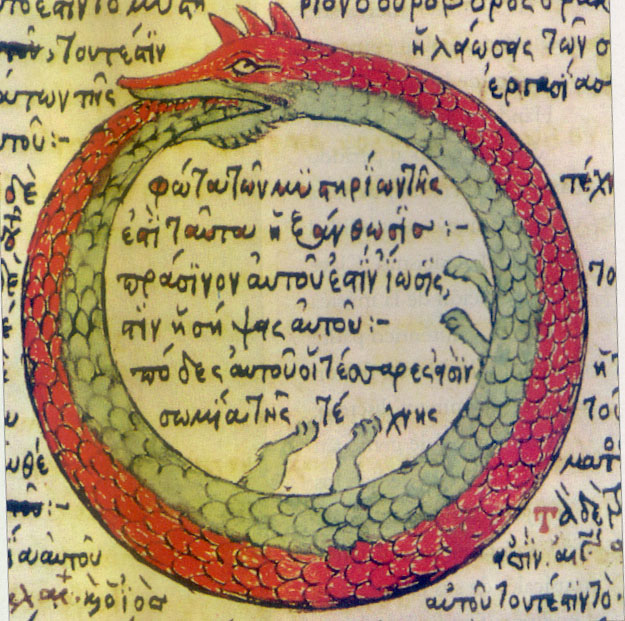
This is a process of self-overcoming, symbolized in the Hermetic art by the ancient symbol of the Ouroboros: a serpent or dragon coiled in a circle and biting its own tail. The One is not a transcendent ideal existing in a Platonic realm. Evola notes that the One does not refer to some single principle to which everything gets reduced. Instead, it is “an actual state.”[9] The One, in other words, is a “one-ing.” The alchemist, in overcoming the chaos within himself, embodies a basic principle that Evola expresses as follows, quoting Pseudo-Democritus: “Nature rejoices in nature, nature triumphs over nature, nature dominates nature.”[10]
Evola notes that “the all” is both dominating (masculine) and dominated (feminine).[11] Metaphysically, the chaos principle is the “dominated” insofar as it is what must be dominated so that being can emerge from the void. If, however, chaos is allowed to dominate, then the void and non-being reigns. This is a principle that is true on multiple levels, including in the political realm: if “the feminine” is allowed to dominate, then the world of man is dominated by a “will to nothingness” (see my essay “What is the Metaphysics of the Left?”).
But if chaos can be dominated then the One can be crystallized out of it. And this One is the gold of the alchemists. The alchemical symbol for gold is ⨀, a dot within a circle. Evola interprets the circle as representing chaos (the circle obviously being suggestive of the Ouroboros), with the dot representing egg or the One. As noted already, these are distinct principles but not, strictly speaking, completely separated, precisely because the One emerges out of chaos. The dot in the circle is the still point that emerges from the undifferentiated principle of pure possibility. Evola compares these principles to the relationship of Shiva to Shakti.
But what form does this One take? Exactly what does gold symbolize? According to Evola, it is the creation of a “spiritual corporeality.” This term can be highly misleading. One might take it to refer to some sort of ethereal embodiment; a body that is not really physical but “spiritual” (whatever that means). This is not the point, however. According to Evola, to carry out alchemical transmutation is to “embody the spirit and spiritualize the body in one and the same act”:[12]
In fact, the spiritualization of the body is not—as the materialism of certain modern “occultist” views suppose—simply its becoming less physically dense, as though passing into a gaseous, atomic, or similar state. Quite the contrary, it is a matter of the body, while remaining as it is on the outside, now existing solely as a function of the spirit and no longer for itself, on the basis of a certain coincidental “cosmic” conjunction and on obscure processes falling below the threshold of the waking consciousness.[13]
The term “philosopher’s stone” also refers to this spiritual corporeality. Evola quotes the sixteenth-century alchemist Gerhard Dorn saying, “Transform yourselves, ye dead stones into living philosophical stones.”[14] This transformation does not free the alchemist from his body and catapult him into some spiritual dimension. Instead, he remains in the world in what is outwardly the same body.
The nature of the spiritual corporeality is difficult to understand theoretically and to convey in words, for the simple reason that this corporeality is precisely a spiritual condition which can only be truly understood through experience. However, to try and shed a bit more light on it, let us return to Evola’s use of Shaivite categories. As noted already, for Evola the One is equivalent to Shiva, while chaos is equivalent to Shakti (manifestation, potentiality, or simply nature); they are the god and the goddess. Locked in embrace with Shakti, Shiva is unconscious, and so the awakening of Shiva must involve his detachment from Shakti.
So much for the symbolism, but what form will this detachment take for the yogin, who strives to be an embodiment of Shiva? “Maximus” in Introduction to Magic Vol. 3 notes that it is “the detachment from whatever in the personality is nature, necessity, or becoming, in order to identify with or liberate the virile principle made from pure consciousness which, immobile yet active in its immobility, is the center of every movement.”[15]
We will deal with some of the specifics of practice later, but let us note here that Evola believes that the “heroic path,” beginning with this detachment and leading to the creation of the “spirituality corporeality,” is exactly analogous to the awakening of Kundalini. As the divine feminine energy of the Kundalini moves through the different chakras or subtle centers of the body, different levels of awakening are achieved. This is an embodied awakening, in which those subtle centers are “activated” and vivified. The result is, in effect, the spiritualization of the body.
We may also note that in representations of the “subtle anatomy” of Kundalini yoga, the Kundalini is represented as a serpent coiled around a subtle lingam (phallus) at the base of the spine. The head of the serpent covers the “Brahma door” (i.e., the subtle urethral opening) of the lingam, which opens into sushumna, the central nadi or subtle channel that runs up the spine to the crown of the head. The yogin must cause the Kundalini to awaken and uncover the Brahma door and to ascend up sushumna, passing through all the subtle centers until it reaches Sahasrara, the crown chakra. We may note that in the ⨀ symbol, the circle represents the feminine principle and the dot the masculine – and that this corresponds exactly to the coiling of Kundalini around the subtle lingam as “seen from above”: the Shiva bindu within the circle of Shakti.
4. How to Make Gold
How is the Kundalini awakened, how is the gold or spiritual corporeality made? Let us take two steps back, summing up what we have learned so far, then take some giant steps forward.
Evola notes that initiation, or the achievement of the heroic path, involves a state “in which an individualizing power, the same ⨀ principle already manifested in the body as the ‘I’ hidden in the shadows, is reborn and reaffirmed.”[16] Recall that chaos is pure formless potentiality for being, and that creation or coming-to-be is a process of individuation: the generation of individual beings, with distinct forms, from the formless matrix.
Thus, an “individualizing power” is at work in creation. This is the “egg principle” understood as operating in creation itself—the One or unifying principle—which draws concrete being out of the void. As already noted, initiation, or the achievement of the spiritual corporeality, is the reverse of creation: the “way up,” as opposed to the “way down” of creation. To achieve the alchemical opus involves a kind of “return to the source” whereby the alchemist or hero reconnects with the individualizing power that gave birth to him and all creation, causing it to be “reborn” in him so that, in fact, the body itself may be regenerated in a perfected form. Evola writes:
“The living man,” as opposed to the tradition of the “sleeping” and the “dead,” esoterically would be precisely the one who has realized such direct contact with the innermost source of his corporeal life: with the force that makes his heart beat, the power that makes his lungs breathe and that by which the various physico-chemical transformations become what are considered to be “higher” functions.[17]
This is achieved by a process in which the alchemist, the microcosm, replicates in his own being an exact analogue to the macrocosmic forces of creation by which the “egg” principle draws individuality out of chaos. This is accomplished through the introduction of consciousness into the vital principle that is the basis of embodied being (“nature, necessity, or becoming”). On this point, the Indian alchemist C.S. Narayana Swami Aiyar, whose work appears in Introduction to Magic Vol. 3, states that “the active mind and the active will make contact with the power that has produced the organization of the body, and together with it they recapitulate all the phases of that organization.”[18]
Evola and the UR group also state “Now what matters is to make the whole body into an instrument of consciousness, which, by overcoming the limitation of the individual, must penetrate those vital layers where the dark and deep energies of a higher Self are at work, until the entrance of the path leading to the ‘closed palace of the King’ is found again.”[19] And in The Hermetic Tradition, Evola, drawing on the work of Eliphas Levi, states that life itself must be “given over” to the conscious will and must submit “in every organ to the spirit.” “All the faculties and senses must participate in the Work; nothing must be left inactive.”[20]
To be is to be awake, and the alchemical awakening is an awakening of the body.[21] Paradoxically, however, in order for this to take place the alchemist must first become detached from the body and all its manifestations (Shiva must detach from Shakti). We now come to some of the specifics of the practice that is alchemy, according to Evola. The alchemical opus traditionally consists of three stages: Nigredo, Albedo, and Rubedo. Evola’s discussion of these in The Hermetic Tradition is obscure and difficult. In particular, the line of demarcation between the stages is often unclear. It is perhaps best to think of the opus as one process that is somewhat artificially divided into three stages. Thus, in what follows I will speak of the process as a whole, distilling what Evola says into its essentials.
Evola writes of the beginning of the opus:
In general it is the unanimous opinion of all the hermetic philosophers that a mortification must intervene; a dissolving of the waters, a disappearance into the mother’s womb that devours or kills the son, a domination of the Female over the Male, the Moon over the Sun, the volatile over the fixed, and so on; but all that is simply a provisional condition for returning potentiality to the son to enable him to reaffirm himself again over what has previously dominated and “dissolved” him, to make himself “more perfect and greater than his parents.”[22]
Things begin with the suppression of the ego. Though the ego has individuated itself from nature, the body, and the feminine, it is in fact impure. It does not represent a true other to the feminine principle. Afterall, its self-identity has been formed through its genetic inheritance and personal experiences, all of which have taken place in naïve immersion in the body and the surrounding world, both the world of nature and the social world.
To negate this ego, which is a masculine principle, is to allow the feminine to (temporarily) dominate. How does one negate the ego? Through the suspension of desire—for the “vulgar ego” is defined almost entirely in terms of desires and attachments. How does one accomplish that? By bifurcating consciousness into an active, watching self and a passive self. The watching self watches the desires, attachments, habits, and preoccupations of the vulgar ego. But not just this. It observes the breath, the heart beating, the temperature of the air on the skin, the feet as they impact the pavement, and so on.
Further, the watching self observes not just the “internal world” of body and mind, but also the entire “external world” which it accesses through the senses. In short, the object (or objects) of the watching self is all that which is not the watching self, or, we could say, all that which this self can watch. This includes the “passive” self and the entire environing world. All this is object and thus “other.” To achieve this state is extraordinarily difficult. Obviously, it is correctly called “detachment.” And it is mortification: the dying of the vulgar ego, which loses its power under the gaze of the watching self, simply as a result of being observed. The vulgar self cannot flourish in the light; the light kills it.
This is true self-overcoming. It is the act of Odin hanging himself on the World Tree, sacrificing “myself to myself,” so that wisdom may be attained.[23] Evola notes that the Hermetic art involves a process by which the alchemist “reintegrates himself within himself.”[24] The challenge is to maintain this state, for Shakti/chaos will try every trick to kill this detachment so that the watching self evaporates and the hero returns to identification with the vulgar ego. The task is to achieve lasting identification with the watching self.
In this manner, what Evola calls “spiritual virility” is achieved.[25] The spiritually virile man has complete control over desire. He is the ultimate hero, the ultimate warrior who has triumphed over himself and all his desires, and over nature itself. The identification of the self with the watching self is the emergence of the One out of chaos. Just as the alchemist’s body was formed through an individualizing power as an “egg” emerging from the pure potentiality of chaos, so now as a result of his own will-driven consciousness a new self emerges from the chaos of carnal preoccupations.
When this is achieved. . .
. . . a miraculous transformation occurs. A blazing, whirling, divine life arises from the deep, quick as lightning. This new life-force permeates the whole body with the gleaming which transfigures. It recreates the body ad imo, as an entity of pure activity, as a glorious body of immortal splendor; this is the “radiating body,” the augoeides, the Hvareno, the vajra, the Dorje. These are all different names recurring in various Eastern and Western traditions, describing the same force. This new life-force, which has the nature of diamond and of irresistible thunderbolt, transforms the mortal and deprived condition into one of immortality.[26]
To achieve identification with the watching self is to become the One. Why? Because detaching the self from chaos and remaining in that state is a movement from a “self” that is, in fact, many “selves,” legion, to a self that is one and indivisible in that it is one pure act of pristine awareness. The alchemist becomes not a one but the One. Writing of the Gnostics, Hans Jonas states that “unification within [the self] is union with the One.”[27] To become one is literally to become the One; there is no difference. (Recall that the One is a state, a one-ing.) In philosophical terms, the One we achieve is the One because the self now stands opposed to all multiplicity; all being and becoming. It is the world axis, the dative of manifestation to which all appears. We are now the Transcendental Ego that has separated itself from nature (yet, as we shall see, still in nature); we are Shiva individuated from Shakti; we are Purusha freed from fascination with Prakriti.
This achievement, Evola promises, brings with it not just the transformation of conscious selfhood into the One, but a transformation of the physical medium in which this selfhood is embodied. We must cast aside conceptions of the soul as a disembodied entity, just as we must cast aside the notion of the One as some kind of transcendent ideal in the beyond. Consciousness is embodied—really, we cannot dichotomize consciousness and the body. Thus, the perfection of consciousness is simultaneously the perfection of the body, in which the entire body becomes not just “an instrument of consciousness” but an expression of it. To become the One is for the whole self, body and all, to become conscious. In sum, the alchemical opus is the process by which the mind/body is unmade and remade.
***
Of necessity, the above summary of alchemy according to Julius Evola omits a great deal. We have had to simplify much and, most importantly, we have had to omit almost entirely the great wealth of allusions and citations to alchemical literature provided by Evola to substantiate his claims. We have also had to limit discussion of the specifics of alchemical symbolism. Clearly, what we have in the Evolian interpretation of alchemy is a perennial teaching that has numerous points of correspondence with other traditions: Advaita Vedanta, the yoga of Patanjali, Kundalini yoga, Shaivism, Vajrayana, Zen, Sufism, Eckhartian mysticism, the theosis of Orthodox Christianity, the Gurdjieff teaching, etc.
In any event, we have covered Evola’s interpretation of alchemy in enough detail that, in our next installment, we can begin to explore how the dragon slaying in the Volsung Saga (and related episodes) can be understood as an account of alchemical transmutation.
Notes
[1] See, for example, Julius Evola, The Hermetic Tradition, trans. E.E. Rehmus (Rochester, VT: Inner Traditions, 1995), 27. (Henceforth, “HT.”)
[2] In case it is not obvious, all discussion of alchemy in this text will solely concern Evola’s understanding of the subject.
[3] See Evola, The Path of Enlightenment in the Mithraic Mysteries, trans. Guido Stucco (Edmonds, WA: Alexandrian Press, 1994), 17.
[4] See Erich Neumann, The Origins and History of Consciousness, trans. R.F.C. Hull (Princeton: Princeton University Press, 1970). See also Ricardo Duchesne, Greatness and Ruin (Antelope Hill Publishing, 2024), 39-45.
[5] Evola, HT, 203.
[6] Martin Heidegger, Nietzsche Vol. 2, trans. David Farrell Krell (New York: Harper Collins, 1984), 91.
[7] Heidegger, 92 (translator’s note).
[8] Because of the ginn– prefix, which is also found in terms denoting sacrality. See Jan De Vries, Altnordisches etymologisches Wörterbuch (Leiden: Brill, 1977), 167.
[9] Evola, HT, 20.
[10] Evola, HT, 21.
[11] Evola, HT, 21.
[12] Evola, HT, 156. Evola italicizes this entire phrase, indicating its importance.
[13] Evola, HT, 165-166. Italics added.
[14] Gerhard Dorn, Speculativae philosophiae in Theatrum chemicum, 1:265-67. Quoted in Evola, HT, 37-38.
[15] Julius Evola and the UR Group, Introduction to Magic Vol. 3, trans. Joscelyn Godwin (Rochester, VT: Inner Traditions, 2021), 358
[16] Evola, HT, 71.
[17] Evola, HT, 164.
[18] Evola, Introduction to Magic Vol. 3, 191-192.
[19] Julius Evola and the UR Group, Introduction to Magic Vol. 1, trans. Guido Stucco (Rochester, VT: Inner Traditions, 2001), 5.
[20] Evola, HT, 119.
[21] See Evola, HT, 77, 158.
[22] Evola, HT, 72.
[23] The Poetic Edda, trans. Lee M. Hollander (Austin: University of Texas Press, 1962), 36. Italics added.
[24] Evola, HT, 27. Italics in original.
[25] See Evola, HT, 90-92.
[26] Evola, Mithraic Mysteries,18-19.
[27] Hans Jonas, The Gnostic Religion (Boston: Beacon Press, 1963), 61.
4 comments
That must be some potent dragon’s blood indeed!
Excellently well-expressed.
Thank you.
I’ll begin reading The Hermetic Tradition soon.
What is the thinking on determinism regarding this path?
My experience is that I woke up to find I was already on it.
No one is determined to be on the path. In fact, so far as nature goes, we are determined NOT to be on it. To get on the path, we have to act against nature and determination, but only a few are capable of this.
I was very pleased by this article… or parts of it: it mentions an attitude that I´m aware of from the realm of meditation: observing… the observer… A term came up: “suppression of the ego”. It never made much sense to me. But in this article, it´s explained as “negate the ego” by a consciousness of “an active, watching self”. That makes sense to me!
So I really thank Collin Cleary for informing me about alchemy… Evola´s views on it… and that it´s of-course related to many other paths that we often hear about, “Advaita Vedanta, the yoga of Patanjali, Kundalini yoga” etc. etc.
(I have to say, I haven´t been able to read the articles of this series “Esoteric Commentary on the Volsung Saga”… it always sounded interesting but I usually couldn´t get past the first few paragraphs; different this time with this part of the series ! )
If you have a Subscriber access,
simply login first to see your comment auto-approved.
Note on comments privacy & moderation
Your email is never published nor shared.
Comments are moderated. If you don't see your comment, please be patient. If approved, it will appear here soon. Do not post your comment a second time.