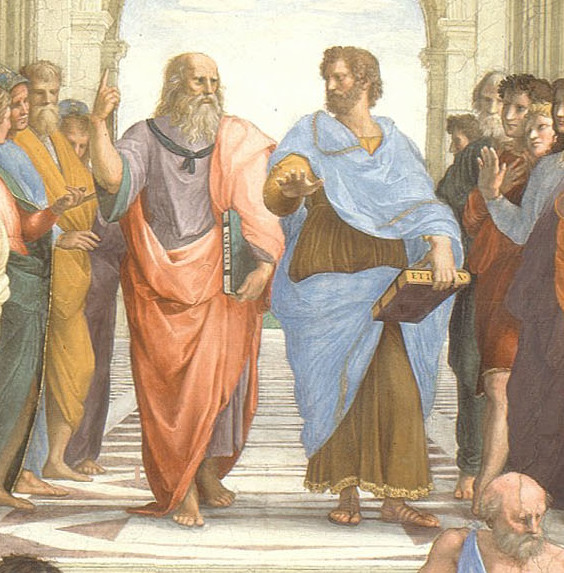
Courtesy of Wikimedia Commons.
2,865 words
In Greece in the fifth century BCE, “sophists” like Gorgias, Protagoras, Hippias, and Thrasymachus taught a combination of rhetoric and political science to ambitious young men who wished to pursue political careers. In his dialogue Gorgias, Plato depicts sophistry as a counterfeit form of philosophy.
For Plato, philosophy is the pursuit of wisdom, and wisdom is the ability to make right use of all things for the purpose of enjoying well-being or happiness (eudaimonia). Because wisdom makes use of all things, it is practical in orientation. Because it makes use of all things, it is comprehensive in scope.
The things that wisdom uses include all forms of knowledge, all technical skills, and all the conditions provided us by good or ill fortune. Wisdom discerns how to make all these things effective for the pursuit of happiness.
In the Gorgias, rhetoric, like philosophy is comprehensive and practical. Moreover, like philosophy, rhetoric stands above and looks down on all the technical skills and makes them effective. For instance, Gorgias points out that even though he knows nothing about medicine, his rhetorical skills make him better at persuading patients than an actual doctor. Since rhetoric was the path to power in ancient Athens, Gorgias claims that the rhetorician can make all other craftsmen his “slaves.” Thus, like philosophy, rhetoric can empower one to make use of all things.
But there are crucial differences between rhetoric and philosophy. Rhetoric can make use of all things, but it does not necessarily make right use of them. This is because rhetoric is a technical skill. The Greek word is “techne” (plural: technai) from which we get technology and technique. What we call arts and crafts are technai. For the Greeks, all such skills are morally neutral. The same technical skills can be used to do good or evil. A pharmacist, for instance, can cure or kill. The poison is in the dose. Thus to ensure right use, technical skills need to be supplemented from outside. They need wisdom to stand above them, look down upon them, and direct them toward the good.
Gorgias’ vision of society can be called a “technocracy,” because he envisions rhetoric as a master technique that can govern or make use of all the other arts and crafts. Every technique has a particular power to change the world. Rhetoric, as the master technique, is thus all-powerful. The greater the power, the greater the danger that power will be used wrongly. But the only way to deal with that problem is to step outside technique altogether and enter the realm of philosophy.
You can buy Greg Johnson’s The Trial of Socrates here.
In Plato’s Charmides, Socrates deals with another counterfeit of philosophy, which I shall call “epistemology,” meaning the theoretical study of knowledge, i.e., knowledge of knowledge. Like philosophy, epistemology is comprehensive. It is knowledge of all forms and branches of knowledge, which correlate to pretty much the whole world.
Like philosophy, epistemology is also practical, because it can distinguish genuine from fake forms of science and art. Thus if epistemologists were put in charge of society, they would be capable of discerning true experts from mere pretenders.
But, as we shall see, there are crucial differences between epistemology and true wisdom.
The advocate of putting epistemologists in charge of society is Critias, who was Athens’ most renowned sophist. Critias was also a celebrated playwright. But only fragments of Critias’ works have come down to us, perhaps in part because he became one of Athens’ most hated men.[1]
In 404 BCE, after Sparta defeated Athens in the Peloponnesian War, Critias was set up as the leader of a collaborationist regime known as the Thirty Tyrants. The Thirty promptly launched a reign of terror, killing more than 1,500 prominent Athenians and foreign residents and stealing their property. The Thirty were overthrown in 403 BCE, and Critias was killed in the fighting. Charmides, for whom the dialogue is named, also joined the Thirty and died in their fall.
Both Critias and Charmides were Plato’s kin through his mother, Perictione. Charmides was her brother, thus Plato’s uncle, and Critias was her first cousin. But Plato did not write the Charmides to defend his kin. Four years after the fall of the Thirty, Socrates was put on trial and executed, in part because of his association with Critias and Charmides, as well as the notorious traitor Alcibiades. One of Plato’s goals in dialogues like the Charmides, as well as the Greater Alcibiades, was to defend Socrates from his accusers by showing him moderating rather than encouraging tyrannical ambitions.
Indeed, the Greater Alcibiades explicitly argues against tyranny based on the concept of moderation (sophrosyne), and moderation is the central topic of the Charmides.
Moderation is a virtue. As a virtue, it is inherently good. You can never have too much of it, and there are no circumstances in which it is a bad thing. Thus at one point Critias asserts, “moderation I define in plain words to be the doing of good things” (163e).[2] He refines this formulation to: doing good deeds for oneself and others.
Socrates, however, objects that sometimes we don’t know if we really are doing good deeds. For instance, a doctor may cure a patient, but he doesn’t really know if that makes the patient better off. Thus on Critias’s definition, one can be moderate without knowing it.
But a central feature of the Greek idea of sophrosyne is self-knowledge. For the Greeks, to act moderately, one must know oneself and one’s limits, including one’s place in society: one’s station and its duties. Sophrosyne without self-knowledge is a contradiction in terms. Thus Critias claims that moderation is always a kind of self-knowledge.
Socrates suggests that if moderation is “a knowledge of anything, [it] must be a science, and a science of something” (165c). Socrates is testing Critias here by making an inappropriate suggestion. Self-knowledge is knowledge of a particular self. For Plato, science (episteme) is knowledge of unchanging universals. Thus there can be no science of the changing individual self. Thus if moderation is a form of self-knowledge, it is not a form of science. Instead, self-knowledge is more akin to the perception (aisthesis) of changeable particular beings.
Critias, however, takes the bait, declaring that moderation is “the science of itself” (165c), meaning science of science. He expands this to say that “moderation is the only science which is the science of itself as well as of the other sciences” (166c).
The individual self has completely dropped out of the picture and with it the moderate behavior that depends upon it. Moreover, as we shall see, the “science of science” is extolled as the power to rule society. Thus we can understand how Critias became a hubristic tyrant, ironically because of his own eccentric concept of moderation.

You can order Greg Johnson’s Tyranny and Wisdom here.
Socrates adds that moderation as “the science of science . . . will also be the science of the absence of science,” and Critias agrees (166e). The “science of the absence of science” means the ability to discern between genuine and fake sciences, and genuine and fake practitioners of the real sciences.
In the Charmides, science (episteme) is used interchangeably with art (techne), perhaps because both are bodies of rigorous and abstract knowledge. Thus moderation is the science of itself and the presence and absence of all other sciences, understood as both proper sciences (physics, biology) and technai (building, piloting, shoemaking).
Critias, in short, is outlining what later philosophers called “epistemology”: the theory of knowledge (the knowledge of knowledge and its absence) plus meta-level reflection on what makes epistemology possible. But these vaulting ambitions are quite far from the Greek virtue of moderation.
Socrates asks Critias to show that his epistemological concept of moderation is possible and beneficial.
There are actually two questions of possibility: First, is it possible to have a science of itself, i.e., a self-reflective science? Second, is it possible to have a higher order science of other sciences? We can set these questions aside, however, because after putting Critias through his paces, Socrates agrees to simply assume that moderation as Critias defines it is possible in order to deal with the question of its benefits. I should note that Socrates’ whole discussion is an example of what he questions is even possible: reflective knowledge of knowledge, a higher-order knowledge of first-order bodies of knowledge like the arts and sciences.
As for the question of the benefits of epistemology, Socrates sums up earlier conversations with Critias, in which he extolled the benefits of the Epistemologist King along these lines:
If, indeed, as we were supposing at first [namely in earlier conversations, as this topic has not been previously discussed in the Charmides], the moderate man had been able to distinguish what he knew and did not know, and that he knew the one and did not know the other, and to recognize a similar faculty of discernment in others, there would certainly have been a great advantage in being moderate; for then we should never have made a mistake, but have passed through life the unerring guides of ourselves and of those who are under us; and we should not have attempted to do what we did not know, but we should have found out those who knew, and have handed the business over to them and trusted in them; nor should we have allowed those who were under us to do anything which they were not likely to do well; and they would be likely to do well just that of which they had knowledge; and the house or state which was ordered or administered under the guidance of moderation, and everything else of which moderation was the lord, would have been well ordered; for truth guiding, and error having been eliminated, in all their doings, men would have done well, and would have been happy. (171d–172a)
Later Socrates lays out a “dream” that presumably Critias shared with him.
Let us suppose that moderation is such as we are now defining, and that she has absolute sway over us; then each action will be done according to the arts or sciences, and no one professing to be a pilot when he is not, or any physician or general, or anyone else pretending to know matters of which he is ignorant, will deceive or elude us; our health will be improved; our safety at sea, and also in battle, will be assured; our coats and shoes, and all other instruments and implements will be skillfully made, because the workmen will be good and true. . . . Now I quite agree that mankind, thus provided, would live and act according to knowledge, for moderation would watch and prevent ignorance from intruding on us. (173a–d)
Epistemology is primarily a form of theoretical knowledge. Yet here it is extolled for its practical uses. But these uses are confined to certifying the practitioners of different arts and sciences so that they can better minister to the needs of consumers.
Epistemology also offers benefits to individuals, helping them to learn more quickly and to criticize the claims of others:
[M]oderation, viewed in this new light merely as a knowledge of knowledge and ignorance, has this advantage: that he who possesses such knowledge will more easily learn anything which he learns; and that everything will be clearer to him, because, in addition to the knowledge of individuals, he sees the science, and this also will better enable him to test the knowledge which others have of what he knows himself; whereas the enquirer who is without this knowledge may be supposed to have a feebler and weaker insight? (172b)
Unlike rhetoric, epistemology is a science, not a techne. But in the Charmides, science and techne are treated as interchangeable. And the benefits of epistemology are entirely matters of technical improvements. Thus it is fair to characterize this regime as “technocratic” or “science- and techne-cratic.”
Socrates offers a specious argument for why epistemology cannot certify the other arts and sciences:
The only way to criticize a science or art is to know its content.
The epistemologist does not know the contents of particular sciences and arts.
Therefore, epistemology cannot criticize the sciences and arts, only their adepts can.
The first premise is false, because it overlooks the distinction that makes epistemology possible in the first place, namely between the form and the content of knowledge. Epistemology deals with formal matters. Logic, for instance, deals with forms of argument. And if there are valid and invalid forms of argument, one can criticize bodies of knowledge on those grounds alone, without being experts in their particular domains. Critias, however, fails to make this point.
But it doesn’t matter, because again Socrates is willing to grant, for the sake of argument, that epistemology might be able to certify the arts and sciences. But he still questions how beneficial this is. “But whether by acting according to knowledge we shall act well and be happy, my dear Critias—this is a point which we have not yet been able to determine” (173d).
Critias is incredulous: “If you discard knowledge, you will hardly find the crown of happiness in anything else” (173d). Yet Socrates asks what specific forms of knowledge lead to happiness. How about shoemaking? Working in brass, wood, or wool? Critias is scornful of such suggestions. When Socrates suggests knowledge of “health,” Critias responds, “Closer” (174b). When pressed for the “closest” knowledge, Critias replies, that “of good and evil” (174b). (The science of health is close to the science of good and evil, because health is a normative concept. Socrates himself treats virtue as analogous to health. Virtue is the health of the soul.)
When Critias mentions the knowledge of good and evil, Socrates pounces:
Scoundrel! You have been leading me in a circle and all this time hiding from me the fact that the life according to knowledge is not that which makes men act rightly and be happy, not even if knowledge include all the sciences, but one science only, that of good and evil. For, let me ask you, Critias, whether, if you take away this [knowledge of good and evil], medicine will not equally give health, and shoemaking equally produce shoes, and the art of the weaver clothes?—whether the art of the pilot will not equally save our lives at sea, and the art of the general in war? (174b–c)
Socrates’ point is that without knowledge of good and evil, the arts and sciences can still produce results.
But these results fall far short of the most important result we seek, namely well-being or happiness.
And yet, my dear Critias, none of these things will be well or beneficially done, if the science of the good be wanting. But that science is not moderation, but a science of human advantage; not a science of other sciences, or of ignorance, but of good and evil: and if this be of use, then moderation will not be of use. (174c)
Socrates’ point is that the good life requires more than just the information, goods, and services produced by the sciences and arts. For none of these are conducive to happiness unless they are used rightly, and right use presupposes knowledge of good and evil.
The best that epistemology can deliver is to fine-tune the arts and sciences to make them more productive. For instance, epistemology might help us to distinguish genuine doctors from quacks. But epistemology alone will not allow us to make right use of medicine or any of the other products of the arts and sciences.
To ensure right use, we must know how to distinguish right and wrong, which requires knowledge of good and evil, which is the foundation of wisdom as Plato understands it.
Mere knowledge is not wisdom. Knowledge isn’t necessarily a good thing. It is only good if used rightly. The only exception to this is knowledge of good and evil, which is integral to wisdom. You can never have too much knowledge of good and evil. There are no circumstances in which it is not a good thing.
Epistemology is easy to confuse with wisdom, because it is part of philosophy, which is the love of wisdom. But epistemology is only knowledge of knowledge, and knowledge is not wisdom. Epistemology, like most forms of knowledge, needs the supplement of wisdom to be used rightly.
Critias replies that if “moderation is a science of sciences, and has a sway over other sciences, surely she will have this particular science of the good under her control, and in this way will benefit us” (174d). But how would epistemology “rule” knowledge of good and evil in a beneficial way? At best, epistemology can help us to eliminate false accounts of good and evil.
Although epistemology can “rule” moral knowledge by criticizing it, Plato held that moral knowledge—practical wisdom—has the ultimate title to rule, because wisdom is unconditionally good, whereas knowledge is good only on the condition that it is used wisely. In other words, you can have too much epistemology for your own good, but you can never have too much wisdom.
Notes
[1] Critias’ surviving fragments are found in Rosamond Kent Sprague, ed., The Older Sophists (Indianapolis: Hackett, 2001).
[2] I am using Benjamin Jowett’s Charmides translation with my corrections. Principally, I replace his translation of sophrosyne as “temperance,” “wisdom,” and “wisdom and temperance” with the single word “moderation.” Plato, The Dialogues of Plato, trans. Benjamin Jowett, 2 vols (New York: Random House, 1937).
If you have a Subscriber access,
simply login first to see your comment auto-approved.
Note on comments privacy & moderation
Your email is never published nor shared.
Comments are moderated. If you don't see your comment, please be patient. If approved, it will appear here soon. Do not post your comment a second time.