 5,221 words
As we saw at the end of the previous installment, Alex Jones starts his manifesto against what he perceives as a plan for state-enforced “Eugenics” with Plato. While there is some justification for this, given that Plato’s Republic did present a model society (after which later plans of that sort were modeled) and also included the likely earliest mention of eugenic breeding in the Western canon [1], it is also undeniable that Jones is attempting to derive the origins of evil from the father of Western philosophy. As the narrative continues in the same manner, with the demonization of white geniuses like Thomas Malthus, Charles Darwin, and Francis Galton, we are justified in viewing Endgame as a work at the intersection between Conspiracy Culture and the Culture of Critique.
In this part of the movie nearly every sentence and statement is false or severely fact-distorting. Therefore, the main format of this article and the next will consist in a point-by-point analysis and refutation of Endgame’s unnecessarily vitriolic and dishonest propaganda.
1. Associating Galton, Darwin, and Malthus with the transatlantic slave trade.
Right after introducing Sir Francis Galton’s definition of eugenics, and immediately before mentioning Thomas Malthus, Endgame preaches that “The scientific rationale for tyranny has always been attractive to Elites, because it creates a convenient excuse for treating their fellow man as lower than animals” while showing old drawings that depict Negroid physiognomy as more ape-like than Europoid physiognomy, followed by images of overloaded Atlantic slave ships. The result is a malicious insinuation.
First, it’s chronologically inaccurate. While the North American Atlantic slave trade had begun in the 16th century and continued until 1808 [2], Darwin’s On the Origin of Species was published in 1859, six years before slavery would be abolished in the United States, and Francis Galton coined the term “Eugenics” a generation later in 1883. Therefore, black slavery in North America existed well before any notion of evolution or eugenics appeared, not requiring any “scientific rationale for tyranny.”
Secondly, it would be a massive understatement to say that Charles Darwin did not like slavery. The following excerpts from a biography of Darwin [3] illustrates this:
- “Slavery was the one institution that his whole family had inveighed against. It was evil, and Darwin suggested that the only solution was emancipation.”
- “‘Man springing from one stock’ – that was his axiom. From this it followed that all the human types were ‘varieties,’ so were their parasites closely related too? If he could prove this, it would be a blow to the apologists of slavery, who made the blacks a separate species.”
- “Darwin distilled his feelings, pushing a slamming indictment of slavery into the last pages of his Journal . . . ‘I thank God, I shall never again visit a slave country’”.
- “‘It makes one’s blood boil,’ he stormed. He cursed those who, seeing only the well-fed slaves of the ‘upper classes,’ call it a ‘tolerable evil.’”
- “The American Civil War only heightened Darwin’s detestation . . . he remained adamant ‘that the destruction of Slavery would be well worth a dozen years war.’”
No other subject seems to have elicited such strong emotions in the otherwise very level-headed naturalist. As a kind and sensible person, he “detested all forms of cruelty” [4], which makes it all the more outrageous and malicious to associate his name with slavery and genocide.
2. “Robert Thomas Malthus was famous for saying that a mass food collapse would be helpful . . . because it would wipe out the poor. His fictional scenario would later be called a ‘Malthusian catastrophe.’”
How to respond to or analyze an accusation as vague and malicious as this one? One way is to adopt the bird’s eye view and try to understand this particular slander in the context of the whole movie:
Alex Jones is interpreting the invention and development of eugenics as the unfolding of a conspiracy by psychopathic elites against mankind.
He starts his historical overview of eugenics with Thomas Malthus and the beginning of demography as a science. Malthus is famous for having been the first to draw attention to the catastrophic results of runaway population growth, a phenomenon thus dubbed the “Malthusian catastrophe.” As Malthus was the first to recognize the dangers of population growth, his name also became associated with attempts to limit that growth, which puts him right into Alex Jones’ focus.
Specifically, it was Malthus’ criticism of the English poor laws—prescient in light of modern-day problems with unconditional state welfare—that gave him a bad reputation in the 20th century:
I feel no doubt whatever that the parish laws of England have contributed to raise the price of provisions and to lower the real price of labour. They have therefore contributed to impoverish that class of people whose only possession is their labour. It is also difficult to suppose that they have not powerfully contributed to generate that carelessness and want of frugality observable among the poor, so contrary to the disposition frequently to be remarked among petty tradesmen and small farmers. The labouring poor, to use a vulgar expression, seem always to live from hand to mouth. Their present wants employ their whole attention, and they seldom think of the future. Even when they have an opportunity of saving they seldom exercise it, but all that is beyond their present necessities goes, generally speaking, to the ale-house. The poor laws of England may therefore be said to diminish both the power and the will to save among the common people, and thus to weaken one of the strongest incentives to sobriety and industry, and consequently to happiness. [5]
Malthus was making a responsible argument based on long-term and holistic thinking. Late 20th-century academics, however, preferred to interpret this as “Malthus’ willingness to let the poor starve” [6], which a dedicated conspiracy theorist could then turn into Malthus’ recommendation to let the poor starve.
It should be emphasized that, contra the liberal (resp. the conspiratorial) view, Malthus was quite concerned about the fate of the poor and wanted to limit population growth to save the poor of the future from inevitable starvation. Two further points that the makers of Endgame failed to take note of:
- Malthus was developing the basics of demography, so discussions about factors that reduce population numbers were inevitable. Among those factors, Malthus concluded that “famine seems to be the last, the most dreadful resource of nature [for resolving overpopulation].” [7]
- He mentions eugenics (though not by that name), which shows that Darwinism is not necessary for eugenics.
3. “Charles Darwin, an admirer of the Malthusian catastrophe model, developed the theory of evolution . . . its chief tenet being ‘the survival of the fittest.’’’
Here, we are dealing with moderate levels of exaggeration and distortion:
- As we discussed above, Malthus observed that runaway population growth led to boom-bust cycles of population (which can be observed all the time among animals). Exponential growth will eventually lead to catastrophe. Jones makes it seem as if this was just an ideology, a mere “model” that Malthus invented and Darwin believed in.
- “The survival of the fittest” is a fact of nature, observable in any species and habitat. Portraying it as an anti-moral ideology made up by Darwin, as Jones does, is plainly dishonest.
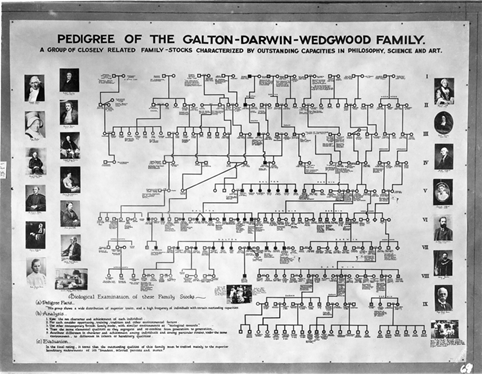
4. “The families: Darwin, Galton, Huxley, and Wedgwood were so obsessed with their new social design theory that they pledged their families would only breed with each other. They falsely predicted that within only a few generations, they would produce super-men. The emerging pseudo-science was only codifying the practice of inbreeding – already popular with Elites for millennia. The four families’ experiment was a disaster. Within only two generations of inbreeding, close to 90 percent of their offspring either died at birth, or were seriously mentally or physically handicapped.”
This is, arguably, the most fantastical, dishonest, and grotesque claim of the whole movie:
- There was no inbreeding of the families in question to speak of following Charles Darwin’s generation [8], so there was no connection between inbreeding and Darwin’s or Galton’s theories.
- On the contrary, Charles Darwin was overly concerned about inbreeding in his family line, almost to the point of paranoia:
Family inbreeding had long worried him . . . Of the ten Darwin children, two had died young from natural causes and the signs were ominous for the rest: George was sick and home from school, Etty languished in bed every morning, Lizzy still behaved strangely, and the baby was not normal. Charles believed that the main problem was hereditary: that his own constitutional weakness had been passed on, accentuated by Emma’s Wedgwood blood. The struggle for existence had already set in, and he expected the children’s health to fail at any time. [9]
- . . . as a consequence, Darwin “belaboured the ‘evil’ effects of inbreeding and the good effects of crossing” [10] in his works, warning that breeding with relatives would lead to a “‘decrease in . . . general vigour.’” [11]
- Darwin and Galton were among the foremost experts in heredity and breeding of their time. They would have never made a plan like the one Jones imagines, as they would have perfectly known how utterly foolish such an undertaking would be. To suggest they did requires being grossly uninformed about heredity (as the makers of Endgame probably are) and underestimating renowned geniuses like Galton to an insulting degree:
The facts are that close and continued interbreeding invariably does harm after a few generations, but that a single cross with near kinsfolk is practically innocuous. [12]
- Darwin’s eldest son George would publish an essay in 1873 “which suggested that it might prove necessary to place restrictions upon cousin marriage.” [13]
There is, however, a small kernel of truth to Jones’ grotesque tale, as Charles Darwin had married his first cousin, Emma Wedgwood, and there were other cousin marriages in the wider Darwin-Wedgwood family. Moreover, one of the Darwins’ ten children was born with what was probably Down Syndrome and several of their children remained childless themselves (as had Francis Galton, who was Darwin’s cousin). These biographical facts were the basis for a propagandistic tale made in particularly bad taste.
Let us put the aforementioned kernel in perspective, however:
- There was only limited inbreeding between the Darwin and the Wedgwood families and the practice was fairly common among the higher classes of Britain at that time (all occurring for entirely non-Darwinian, non-eugenic reasons).
- Charles Darwin and his wife Emma had ten children in total, of which only three did not reach adulthood (a fairly good rate for the time). One child died shortly after birth, another at the age of ten of scarlet fever or tuberculosis, and the third, likely suffering from Down Syndrome, at the age of two.
- The remaining seven (five boys and two girls) grew up to be productive adults, with three of his sons becoming fellows of the Royal society, one a soldier, public servant, economist and eugenicist [14] and the first-born son became a banker. Of his two daughters, one helped edit The Descent of Man. All of Darwin’s surviving sons became notable individuals in high-IQ professions, while his daughters were undoubtedly also of above average intelligence. This outcome is, in itself, a powerful argument for
- The health of Charles and Emma Darwin’s surviving children could not have been subpar either, as the mean age they would reach was 77 years, more than 20 years higher than the life expectancy in England and Wales in their generation [15] (though likely on par with the life expectancy of the British Upper Classes in that generation).
- It’s important to note that the handicapped child was born when Emma Darwin was 48 years old. Given that the prevalence of Down Syndrome increases strongly with maternal age and that Ms. Darwin married at 30 and bore a total of ten children—several of them in her 40s—genetics cannot be blamed in this case.
- Regarding childlessness, infectious diseases in childhood can cause infertility and in the 19th and early 20th century, it was not typically known which spouse was responsible for the inability to conceive. That said, it is true that half of Darwin’s children (two sons and one daughter) who married remained childless, though a tendency towards infertility may have been in the gene pool, given Galton’s childlessness. The aforementioned three had nine children of their own that reached adulthood (none being handicapped), which flatly disproves any notion that the family was bound to die out after several generations [16].
Why would Jones & Co lie like this?
- Darwin & Galton are imagined as die-hard eugenics fanatics who hold onto their wrong beliefs with insane tenacity, to the point of their families dying out (i.e., cartoonish evil and craziness).
- Eugenics is portrayed as leading to biological extinction (in other words, as being utterly unfeasible).
- The tale insinuates a considerable level of clannishness, making the Darwin & Galton families appear like some sort of aristocratic high-class Eugenicist mafia.
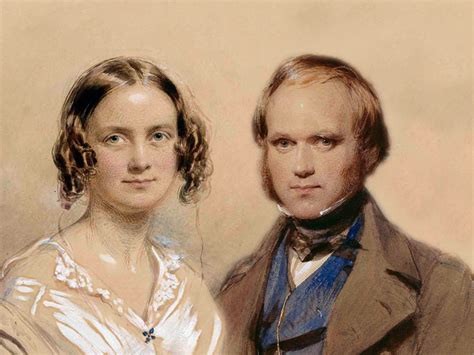
These are the people we’re supposed to regard as inbred genetic freaks.
5. “Biometrics appears to be a new science . . . but was actually developed by Galton, back in the 1870’s . . . as a way to track racial traits and genetic histories. And as a way to decide who would be licensed to breed.”
In reality, Galton argued that eugenics should not concern itself with the average man, but focus on supporting the reproduction of the most promising subset of the populace while being careful not to support that of “habitual criminals” or “the feeble-minded.”
I do not, of course, propose to neglect the sick, the feeble, or the unfortunate. I would do all that available means permit for their comfort and happiness, but I would exact an equivalent for the charitable assistance they receive, namely, that by means of isolation, or some other less drastic yet adequate measure, a stop should be put to the production of families of children likely to include degenerates. [17]
Nobody would be prevented from marrying or breeding, and there certainly wouldn’t be a license to have children. Rather, state assistance for people of exceptionally low quality who cannot support a family on their own would be contingent upon them not breeding.
However, the main mechanism for eugenics which he proposes is social shaming, specifically instituting a social taboo on non-eugenic marriages (citing the taboo on brother-sister marriages as an example or blueprint to emulate). In other words, he proposes a metapolitical, cultural solution rather than compulsory measures undertaken by an authoritarian state [18].
* * *
6. “In 1907, the first sterilization laws were passed in the United States. Citizens with mild deformities or low test scores on their report cards . . . were arrested and forcibly sterilized.”
That’s a strange way to frame a sterilization law which began with the passage “ . . . an act to prevent procreation of confirmed criminals, idiots, imbeciles and rapists.” [19] As for the actual context of the 1907 law:
In 1907, influenced by the eugenics movement, Indiana became the first state in the United States to adopt a law authorizing the sterilization of institutionalized persons thought to be unfit to reproduce. [20]
The law decreed that institutions in the state that were “entrusted with the care of confirmed criminals, idiots, rapists and imbeciles” had to appoint medical experts to “examine the mental and physical condition of such inmates.” It was then lawful to perform sterilization, yet the law explicitly states that “this operation shall not be performed except in cases that have been pronounced unimprovable.”
To sum up:
- This was a local law enacted in the state of Indiana.
- It referred only to criminals, rapists, and mentally handicapped people who were institutionalized.
- A professional examination had to take place.
- Sterilization was not mandatory, just allowed if the case was deemed “unimprovable.”
The image that Alex Jones’ conjures up—of regular people being taken into custody and made infertile for trivial or random-seeming reasons—belongs to the world of fantasy. Jones & Co must have counted on the low intelligence of their viewers, for the scenario they are alleging would have clashed with well-established constitutional rights in a way that the actual law, as it refers to extreme cases of institutionalized persons, did not.
We have to consider what subset of the population the law was dealing with: hardened criminals who had killed, raped, or repeatedly brutalized, robbed, or assaulted innocent citizens, and severely handicapped individuals who could not survive on their own, could not find any productive occupation, and were being supported at state-run institutions by the community’s tax dollars.
Three common objections or arguments shall be addressed at this point:
- Naturally, there would have been cases where mental feebleness was not, or mostly not, hereditary. Those cases are regrettable, but do not justify the kind of absurd, cartoonish tale Jones & Co serve up.
- All state-run programs create the opportunity for abuse; yet exceptions must be treated as exceptions rather than propagandistically exploited.
- It’s true that, based on absolute libertarian principles, the law was intolerable. Yet, does any libertarian actually sympathize with murderers and rapists?
Common sense would clearly advise us that the people running the state of Indiana in 1907 weren’t monsters and that they couldn’t possibly have intended to put in place a system even half as inhumane as Endgame suggests. Yet, with a sweeping big picture-narrative of psychopathic NWO elites in the back of our minds, and Jones’ shrill accusations ringing in our ears, that story may appear credible or even compelling.
7. “That same year [1927] in the United States . . . more than 25 states pass forced sterilization laws . . . and the Supreme Court ruled in favor of brutal sterilization policies.”
This ruling referred to “inmates of institutions supported by the State” who were “found to be afflicted with an hereditary form of insanity or imbecility.” [32] In other words, the same type of eugenic sterilizations as discussed above.

8. Short scenes from a 1934 movie called Tomorrow’s Children are shown. The movie is introduced as a “Pro-Eugenics Film.”
Tomorrow’s Children wasn’t a pro-eugenics film. To the contrary; common characterizations found online range from “a piece of anti-Eugenics tripe” [21] to “This is the scariest propaganda piece I’ve ever seen,” [22] and the movie is placed chiefly within the category of exploitation films. One reviewer even called it “one of the most engaging exploitation films of the period.” [23] This motivates a closer look at the people behind the movie, specifically the screenwriter.
The screenwriter was a black novelist named Wallace Thurman whose debut was The Blacker the Berry: A Novel of Negro Life (1929), a story about—who would have guessed—dark skin and discrimination. Thurman’s family story represented most of the vices and ills eugenics was supposed to reduce in frequency:
- His father had abandoned the family shortly after Thurman’s birth, and his mother “married some six times and reportedly was not very fond of her son.” [24]
- His maternal grandmother was selling alcohol illegally.
- He suffered from poor health as a child and experienced a nervous breakdown in university. [25]
- He was “prone to excessive drinking” [26] and died at 32 of tuberculosis, with long-term alcoholism likely having been a contributing factor.
He had moved to Harlem, New York in 1925, where he found employment as the managing editor for a black socialist magazine. Over the next decade, Thurman would become “the heart and soul of the Harlem Renaissance . . . ‘the most symbolic figure’ of the New Negro Renaissance.” [27]
Thus, the individual who brought us Tomorrow’s Children was not an unbiased observer, but represented a milieu or class of people who—more or less correctly, one might add—identified eugenics as opposed to their identity and deployed propaganda against it.
At a later point in the movie, Endgame mentions Tomorrow’s Children again, claiming that the 1934 film “brought the eugenics agenda to the silver screen in the United States.” It is quite insane—or just astonishingly dishonest—to present an anti-eugenics movie as the opposite. We may assume that Jones & Co not only did not see the movie, but did not even bother to do basic research about it, and relied on poisoned wells in the form of secondary sources instead.
9. “In 1910, the U.S. Eugenics Record Office was set up. By then, the British had created the first network of social workers . . . expressly to serve as spies and enforcers for the eugenics race cult that was rapidly taking control of Western society.”
This statement, which is off the rails even for Alex Jones, makes one think of marijuana-induced paranoia. Note how terms like “spies,” “race cult,” or “taking control of” are used to invoke the image of a dark conspiracy.
10. “At the 1912 International Eugenics Conference in London, Eugenics becomes an international craze, and gains superstar status. The futurist and best-selling science fiction author, H.G. Wells, had studied biology under top eugenicists, and was spreading the new faith worldwide… By 1927, eugenics hit the mainstream. The so-called science was aggressively pushed through contested schools, churches, and at state fairs.”
Endgame portrays eugenics as an artificial meme and astroturfed social movement, rather than a valid applied science people became increasingly aware of. Jones & Co ignore the compelling arguments and data eugenicists could offer to support their case, framing the success of eugenics as the result of elite-backed propaganda and cultish brainwashing. But it was science, so it didn’t have to be aggressively pushed, unlike Jones’ narrative and the Marxist propaganda against eugenics he relies upon.
11. “In 1916, H.G. Wells’ lover, Margaret Sanger, starts her promotion of eugenics in the United States. In 1923, Sanger receives massive funding from the Rockefeller family. Sanger wrote to fellow eugenicist, Clarence J. Gamble . . . that black men would need to be recruited to act as front-men in sterilization programs directed against blacks.”
The more subtle falsehood here is that Sanger’s work is reduced to eugenics, when her goals and activities were principally about birth control. Support from the Rockefeller family was thus mainly for birth control.
The latter and more fantastic and malicious claim rests on the following paragraph from a letter that Sanger wrote to Gamble in 1939:
The ministers work is also important and also he should be trained, perhaps by the Federation as to our ideals and the goal that we hope to reach. We do not want word to go out that we want to exterminate the Negro population and the minister is the man who can straighten out that idea if it ever occurs to any of their more rebelliuos [sic!] members.
In this case, the wording makes it possible—or even easy if one is inclined to creative interpretations—to insinuate a very dark intent. Yet what Sanger said was only that they do not wish the exterminationist idea to spread among the people they hope to get to trust them. Without any further evidence—specifically any evidence of animosity towards blacks—the passage does not mean anything. Given Sanger’s Leftist and feminist background, and her ties to the black community, the exterminationist interpretation has no basis.
This example reveals the soft-headed logic common among conspiracy theorists. First, one starts with the assumption that there really was a monolithic elite with a long-term plan for a massive population reduction. Then, one equates the cause for birth control that Sanger represented with said plan. Finally, the fact that Sanger received Rockefeller funding and that she had an affair with H.G. Wells (the author of The New World Order, see part 1 of this series, proves that she must have been part of the conspiracy, which implies that the aforementioned quote had to have a sinister meaning.
* * *
12. “In 1911, the Rockefeller family exports eugenics to Germany . . . by bankrolling the Kaiser Wilhelm Institute . . . which later would form a central pillar in the Third Reich.”
This statement is a cluster of confusions:
- There was not one Kaiser Wilhelm Institute; the term refers to “a whole series of industry- and agriculture-related research facilities” created in early 20th century Germany and run by the Kaiser Wilhelm Society [28]. Each institute had its own focus area and together, they covered nearly all major fields of science and engineering.
- Just a few of them are of interest to the debate about eugenics: the Institute for Psychiatry, the Institute for Brain Research, and, most notable, the Kaiser Wilhelm Institute for Anthropology, Human Heredity and Eugenics. So about ninety percent of all Kaiser Wilhelm Institutes were not even remotely connected to eugenics research.
- 1911 is the year when the Kaiser Wilhelm Society was founded by “the ‘Who’s Who’ of German industry.” The highly prestigious new institution would attract “numerous powerful donors, including many members of the Jewish middle classes.” [29] Funding provided by the American Rockefeller family would only become relevant in the Weimar era, when the German economy was in dire straits and neither the German state nor German-based businessmen could afford generous research grants.
So we see that Jones & Co are, again, making several basic mistakes in a single sentence, badly misreading history as a consequence. What about their point of Rockefeller funding for eugenics research in Germany?
- The Rockefellers were funding hundreds of researchers at various Kaiser Wilhelm Institutes. Hence, there was no focus on eugenics-related research specifically.
- Of the two big mid-to-late 1920s Rockefeller grants that are relevant in this context, [30] one went to a brain research institute led by a Socialist and his wife, and the other to the psychiatry institute led by Emil Kraepelin, a towering figure in psychiatry who had been generously funded by Jewish bankers of Kuhn Loeb before, and was more of an environmentalist (or even neo-Larmarckian) than a hereditarian. [31]
We can conclude that Jones & Co were trying to force a connection between Rockefeller money and National Socialist Eugenics without having any interest in or respect for the research landscape of interwar Germany. That the idea of Eugenics, and research pertaining to it, would spread from the English-speaking world where it was born to the German-speaking world is no surprise, nor does it require an elite conspiracy.
13. After pointing out that Adolf Hitler found Madison Grant inspiring, Jones goes on to claim that “Hitler developed his plan for mass-extermination of the Jews . . . and what he called ‘other sub-races,’ as well as the handicapped – from Grant.”
The key word here is “developed.” If we were to imagine a chain from Madison Grant to Hitler’s WWII actions, and justify each link in the chain, we could indeed argue that way. Yet the difference between the two ends of that chain would be so immense that it would be despicable to suggest a causal relation.
Why does Jones engage in senseless over-association in this case? Because the goal is to associate American racialism and eugenics with the worst aspects of Nazism. Guilt-by-association is a stretching exercise.
14. “When Hitler came into power in 1933, one of his first acts was to pass national eugenics laws . . . modeled after laws in the United States.”
The German National Socialists appropriating American eugenics and taking it into a different direction does not imply American guilt nor an American conspiracy but simply shows that eugenics can be horribly misused. Yet, did the Soviet Union, like the French First Republic before it, not prove that the same is the case for egalitarian ideas?
As the last couple of points highlight, Jones finds it intolerable that eugenics was once “a thing” and that it was once considered as a legitimate endeavor without any moral stigma.
15. “By 1936, Germany had become the world leader in eugenics . . . for taking effective action to sterilize, and euthanize, hundreds of thousands of victims. The “Big Three” of American eugenics—Davenport, Laughlin, and Gothe—were dispatched by the Rockefellers to Germany . . . where they advised the Nazis on the fine-tuning of their extermination system. With the strong support of the U.S. and England, Germany had gone over the edge . . . and tens of millions would pay with their lives.”
This propagandistic point is based on a deliberate conflation of sterilization with euthanasia. The Third Reich passed sterilization laws as early as 1933, yet involuntary euthanasia only began in 1939 [33], so American eugenics experts visiting in or around 1936 would have only observed and possibly provided guidance for the former. Furthermore, America’s top Eugenicists were not servants of the Rockefeller family and, as professionals, certainly would have been interested in seeing how the Germans applied eugenic ideas. Endgame is, once again, needlessly conspiratizing normal exchanges.
This passage, which is practically oozing with a shameless desire to blame the Anglosphere for Nazism and associated calamities, further conflates wartime deaths and concentration camp deaths with eugenic euthanasia.
* * *
In this part, we saw how Alex Jones treats the wider history of eugenics, from its inception in the era of Darwin and Galton to its application in the early 20th century. The fourth part of this series will follow Jones’ smear campaign through the postwar era and provide a concluding analysis that places Endgame’s venom against eugenics into the wider context of mainstream liberal and fringe Conspiratist disdain for the idea.
Lastly, we should contrast Jones’ attempt to portray eugenics as evil with Galton’s moral case for it:
Eugenic belief extends the function of philanthropy to future generations, it renders its action more pervading than hitherto, by dealing with families and societies in their entirety, and it enforces the importance of the marriage covenant by directing serious attention to the probable quality of the future offspring. It sternly forbids all forms of sentimental charity that are harmful to the race, while it eagerly seeks opportunity for acts of personal kindness, as some equivalent to the loss of what it forbids. It brings the tie of kinship into prominence and strongly encourages love and interest in family and race. In brief, eugenics is a virile creed, full of hopefulness, and appealing to many of the noblest feelings of our nature. [34]
Notes
[1] Plato, The Republic, book 5. Available online at: https://www.perseus.tufts.edu/hopper/text?doc=Perseus%3Atext%3A1999.01.0168%3Abook%3D5
[2] https://avalon.law.yale.edu/19th_century/sl004.asp
[3] Adrian Desmond and James Moore, Darwin: The Life of a Tormented Evolutionist (New York, NY.: Warner Books, 1992).
[4] Ibid., 541.
[5] Thomas Malthus, An Essay on the Principle of Population (London: J. Johnson 1798), 27; also available on the Internet Archive at:
https://ia800403.us.archive.org/17/items/essayonprinciple00malt_703/essayonprinciple00malt_703.pdf
[6] Peter J. Bowler, Charles Darwin: The Man and His Influence (Cambridge: Cambridge University Press, 1996), 83.
[7] Thomas Malthus, An Essay on the Principle of Population (London: J. Johnson 1798), 44.
[8] Galton remained childless, so he could not have participated in the incest scheme Jones fantasizes about anyway, and several of Darwin’s children married (half-)Americans. Moreover, Huxley’s children did not marry Darwin’s. The only instance of inbreeding that could be found is Leonard Darwin’s second marriage to his second cousin, Charlotte Mildred Darwin (born Charlotte Mildred Langton), which remained childless (as his first marriage had).
[9] Adrian Desmond and James Moore, Darwin: The Life of a Tormented Evolutionist (New York, NY.: Warner Books, 1992), 447.
[10] Ibid., 447.
[11] Ibid., 447.
[12] Francis Galton, Essays in Eugenics (London: The Eugenics Education Society, 1909), 54.
Available at: https://galton.org/books/essays-on-eugenics/galton-1909-essays-eugenics-1up.pdf
[13] https://library.fes.de/libalt/journals/swetsfulltext/16450438.pdf
[14] https://academic.oup.com/ije/article/48/2/362/4621368
[15] https://marypatcampbell.substack.com/p/very-long-term-mortality-trends-in
[16] There is only one known case of child mortality among this set, which means that Charles and Emma Darwin had ten grandchildren of which nine survived into adulthood.
[17] https://galton.org/essays/1900-1911/galton-1908-westminster-eugenics.pdf
[18] Francis Galton, Essays in Eugenics (London: The Eugenics Education Society, 1909). Galton discusses the subject of marriage in part III, concluding that “It is quite conceivable that a non-eugenic marriage should hereafter excite no less loathing than that of a brother and sister would do now.” [p. 56]
[19] https://en.wikisource.org/w/index.php?title=1907_Indiana_Eugenics_Law&oldid=11918245
[20] Ibid.
[21] https://archive.org/details/tomorrows-children-1934-american-forced-steri_2024069
[22] https://www.rottentomatoes.com/m/tomorrows_children_1934/reviews?type=user
[23] https://www.rottentomatoes.com/m/tomorrows_children_1934
[24] Aberjhani and Sandra L. West, Encyclopedia of the Harlem Renaissance (New York, NY.: Facts on File, 2003), 328.
[25] Singh and Scott, The Collected Writings of Wallace Thurman (New Brunswick, NJ, and London: Rutgers University Press, 2003), 3.
[26] Ibid., 15.
[27] Ibid., xii.
[28] https://www.mpg.de/195494/history-of-the-kaiser-wilhelm-society
[29] Ibid.
[30] “Eugenics and the Nazis — the California connection,” San Francisco Chronicle, November 9, 2003. Available at:
[31] Eric J. Engstrom, “‘On the Question of Degeneration’ by Emil Kraepelin (1908),” History of Psychiatry, 18(3) (2007): 389-404.
[32] https://supreme.justia.com/cases/federal/us/274/200/
[33] https://web.archive.org/web/20210721021133/https://www.britannica.com/event/T4-Program
[34] Francis Galton, Essays in Eugenics (London: The Eugenics Education Society, 1909), 70.
7 comments
Of course Alex Jones prefers dysgenics to eugenics. How else will he be able to maintain and increase the size of his audience? It’s depressing that websites like C-C talk in terms of thousands and a buffoon like Jones talks in terms of millions; if only there were some way to make the population less retarded . . .
Furthermore, it’s hard to produce the “super Nazis” that secretly control the world without using eugenics.
It is so incredibly wild, that anyone can even believe for a second, that the world is run by a secret cabal of Nazis…
That’s the power of myth.
Half a century of accumulated anti-German and Leftist storytelling gave the idea of “Evil Nazis” exceptional power and myth energy (search for terms like “egregore” [1] or “hypersigil” [2]).
[1] https://counter-currents.com/2013/08/nuremberg-or-the-promised-land/#comment-39239
[2] https://counter-currents.com/2016/09/creating-the-meme-superweapon/
It accumulates in layers, becoming bigger and bigger, and from the standpoint of someone trying to get to the bottom of it, a deeper and deeper rabbithole.
Eventually, it becomes a story universe on its own, with extensive lore, tantalizing “secrets” and a community of hardcore fans (= a subculture decidated to Nazi conspiracy stories).
Glad to finally see the continuation of this series. I’ve noticed that the “Christian nationalist” part of the right is particularly vulnerable to silly Alex Jones-style conspiracies (some kind of Nazis rule the world, every observable group of people with power in our society is secretly controlled by some more powerful but more elusive group, etc.).
I apologize for the hiatus! Part 4 is close to completion.
I think the reason for Christian susceptibility to this kind of thinking lies in the “Manichaean” dualism inherent in Christianity, where earth is imagined quite literally as a battlefield between the forces of darkness and the light of God. Neither Greco-Roman nor Enlightenment thought looked kindly upon such a simplified Black-White, Good-Bad scheme. Intellectual pluralism and moderation aren’t Christian values.
That makes sense. More specifically, I’m talking about people who dismiss (but don’t deny) influences that have a tangible effect on our society, like Jewish influence, in favor of something more obscure and intangible, like Alex Jones-style grandiose banker conspiracies, or even something like “decadence” or “sin” or some vague “cycle of history”. I often wonder if this is deliberate misdirection. In the case of some figures, like E. Michael Jones, it probably is. The Orthodox figure Jay Dyer, who has often crossed paths with people from our sphere, has hosted the Alex Jones show. Vox Day has been a guest on the show multiple times. They really should know better.
Sounds like you’re talking about Conspiracy Gnosticism – a belief system where the normal world (and the real political forces and ethnic groups active in it) is regarded as an illusion and a gigantic prison (“Prison Planet”) ruled by an evil God (Demiurge). Disdain for concrete reality and observable phenomena in favor of “hidden truths” that only initiates can see.
I’m glad you brought up Vox Day and Jay Dyer. I know what poison-wells they drank from and could write a whole series on each. It’s often the worst of the worst in the conspiracy world – self-referential schizophrenics (e.g. Anonymous Conservative), a Marxist cult comparable to Scientology (Lyndon LaRouche movement), 4chan conspiracy rumor mills.
I think the main error is that they, as Christians, believe in a “unity of evil” i.e. that everything which is evil in our world has a singular spiritual cause (Satan). This makes the solipcistic ramblings of schizophrenics and the reductionist propaganda of cult-like groups resonate with them.
Comments are closed.
If you have a Subscriber access,
simply login first to see your comment auto-approved.
Note on comments privacy & moderation
Your email is never published nor shared.
Comments are moderated. If you don't see your comment, please be patient. If approved, it will appear here soon. Do not post your comment a second time.