
Counter-Currents
  • Advertise
  • Private Events
  • T&C
  • About
  • Contact
  • RSS
    • Main feed
    • Podcast feed
    • Videos feed
    • Comments feed
  • Welcome
  • Webzine
  • Books
  • Merch
  • Podcasts
  • Videos
  • Donate
  • Patrons
  • Subscribe
  • Crypto

LEVEL2

Donate Now Mailing list
Upcoming podcasts
  • Rob Rundo on Counter-Currents Radio

    Rob Rundo on Counter-Currents Radio

    Counter-Currents Radio

    06/13/2026 — 3 pm EST / 9 pm CET
  • Daniel Tyrie on Counter-Currents Radio

    Daniel Tyrie on Counter-Currents Radio

    Counter-Currents Radio

    06/20/2026 — 3 pm EST / 9 pm CET

Writers of May

(2 votes) Morris van de Camp David M. Zsutty Derek Stark Jayant Bhandari Greg Johnson

Articles of May

The Lunch Wars by David M. Zsutty Heidegger on Nietzsche, Part One by Collin Cleary 2 votes
  • Welcome
  • Webzine
  • Books
  • Merch
  • Podcasts
  • Videos
  • Donate
  • Patrons
  • Subscribe
  • Crypto
    • Editor’s Update
      Rob Rundo Rescheduled to Next Week on Counter-Currents Radio;
      Tonight Greg Johnson & David Zsutty Answer Your Questions;
      Fundraiser Update & a New $20,000 Matching Grant

      Greg Johnson

    • The Counter-Currents 2026 Fundraiser
      Lifetime Subscriber Welcome Packages Extended

      Greg Johnson

    • Nationalism This Week
      Who’s Looking Back?

      Greg Johnson

      18

    • China’s Threat to American Security:
      Food, Farmland, Foreign Control, & Energy Policy

      Lipton Matthews

      1

    • The Bitter End of Western Metaphysics:
      Heidegger on Nietzsche, Part Two

      Collin Cleary

      10

    • The Killing of Henry Nowak

      Mark Gullick

      28

    • The Crisis of Chinese Technology Thieves

      Morris van de Camp

      1

    • The Strange World of Gender Bender Fiction:
      & What This Genre Tells Us About Autosexuality

      Dani Vypont

      3

    • Watching the Watchers:
      The Dark Triad Question

      David M. Zsutty

      14

    • The Remigration Movement Solidifies

      F. Roger Devlin

      1

    • Casting Aspersions:
      The Fatal Consequences of Race-Swapped Casting, From Helen of Troy to Henry of Southampton

      Steven Tucker

      20

    • The Murder of Henry Nowak

      Millennial Woes

      23

    • Don’t Forget to Vote in Our Writer & Article of the Month Poll

      Greg Johnson

    • The Robot Hotdog Stand

      Greg Johnson

      35

    • Laughing Our Way to Victory

      Dave Chambers

      7

    • The Zodiac Killer

      Mark Gullick

      11

    • Jared Taylor: What Rome Means to Me

      Jared Taylor

      1

    • An Interview with Endeavour:
      My Way of Life Is an Adventure!

      Ondrej Mann

      6

    • José Pedro Zúquete’s The Identitarians

      Greg Johnson

      3

    • Editor’s Update
      Fundraiser Update & How to Watch the Remigration Summit

      Greg Johnson

      5

    • The Bitter End of Western Metaphysics:
      Heidegger on Nietzsche, Part One

      Collin Cleary

      11

    • Berlin: City of Stones

      Spencer J. Quinn

      6

    • True Folk-Horror Is Horror of Your Own Folk:
      Mark Gatiss vs the Brexit Blind Dead  

      Steven Tucker

      4

    • Counter-Currents Radio Podcast No. 689
      Thomas Massie, the America 2050 Bust, the Need for Whites to Divest from America, the AI Economic Apocalypse, & Pro-White Project Pitches to Billionaires

      Counter-Currents Radio

      7

    • Nationalism This Week
      Remigration is Inevitable, Part 3

      Greg Johnson

      27

    • Why Billionaires Should Fund White Identity Politics

      Lipton Matthews

      8

    • How Cold War Two Came About

      Morris van de Camp

      5

    • Now Available for Pre-Order at a Special Price!
      Greg Johnson’s The Philosopher Is In

      Greg Johnson

    • David Zsutty’s Elevator Pitch to a Billionaire

      David M. Zsutty

      1

    • Headbanging Lite

      Mark Gullick

      5

    • White Advocacy Past and Present

      Peter Bradley

      13

    • The Lunch Wars

      David M. Zsutty

      47

    • The Russians are Coming/The Russians are Coming

      Steven Clark

      1

    • Peak Fatigue in Fort Wayne

      Gabriel Anderson

      24

    • Keith Woods’ Elevator Pitch to a Billionaire

      Keith Woods

    • The Cruelty of Kindness

      Morris van de Camp

      9

    • Predation Wearing the Mask of Civilization

      Jayant Bhandari

      13

    • The Mandalorian & Grogu

      Trevor Lynch

      24

    • Editor’s Update
      Fundraiser Update & a New $20,000 Matching Grant
      Greg Johnson & David Zsutty Discuss Thomas Massie on Counter-Currents Radio

      Greg Johnson

      2

    • How the Jews Defeated Thomas Massie—& Themselves

      David M. Zsutty

      25

    • Jared Taylor’s Elevator Pitch to a Billionaire

      Jared Taylor

      15

    • Nationalism This Week
      Remigration Is Inevitable, Part 2

      Greg Johnson

      8

    • Could Fascism Work?

      Mark Gullick

      40

    • Jonathan Bowden’s Deliverance
      Part 7

      Jonathan Bowden

    • China’s Quiet Hand:
      Influence, Infiltration, & the Western Blind Spot

      Lipton Matthews

      9

    • Counter-Currents Radio Podcast No. 688
      Tyler Dykes on Running for US Congress in South Carolina

      Counter-Currents Radio

      3

    • Lothrop Stoddard’s The Revolt Against Civilization

      Spencer J. Quinn

      14

    • Lewis Strauss Did Nothing Wrong:
      How the politics of the Atom Bomb during the early Cold War Apply to Artificial Intelligence Today

      Morris van de Camp

      14

    • The Ghost of the Confederacy

      Dave Chambers

      12

    • America’s Century of Humiliation has Begun

      Greg Johnson

      27

    • Connor McDowell

      Who’s Looking Back?

      HAL9000 in 2001 was never truly “sentient”. “His” programming had a conflict that couldn’t be...

    • Will Williams

      Nationalism This Week: Victory First

      There are several C-C essays that mention Gaza, but this appears to be the only one where comments...

    • Observer

      Heidegger on Nietzsche, Part Two

      In Platonism, we find the insistence that being, true being, is identical with “the forms.” The...

    • JBP

      Heidegger on Nietzsche, Part Two

      Thanks. Unfortunately I must fall into the 95% that Jane refers to. My brain is not putting the...

    • Will Williams

      Who’s Looking Back?

      Vauquelin: June 7, 2026 ...You must judge AI/LLM based on those who control it. With the likes of...

    • Hi-ya!

      Heidegger on Nietzsche, Part Two

      Love to engage in this with more attention ; I’ve never seen “clearing” in presocratics and my hot...

    • Vauquelin

      Who’s Looking Back?

      You must judge AI/LLM based on those who control it. With the likes of Sam Altman and Alex Karp...

    • Chud

      Who’s Looking Back?

      There's another dangerous option where homebrew AI models scale up and the consumers get their...

    • Gabe

      Who’s Looking Back?

      Boom. Nailed it.

    • Joe Gould

      The Killing of Henry Nowak

      This is a good article. The only thing I want to add is, above all we must guard ourselves against...

    • Greg Johnson

      Who’s Looking Back?

      Thank you I also wonder if these AI bots are being used to gather intelligence on influential...

    • E_Perez

      Heidegger on Nietzsche, Part Two

      "Philosophy helps Western man understand how we got to where we are, and where things went wrong...

    • Chud

      Who’s Looking Back?

      I'll try to give a rundown. AI is a language learning model (LLM) that uses floating point...

    • Will Williams

      How the Jews Defeated Thomas Massie—And Themselves

      Massie to Honor USS Liberty Crew on House Floor [email protected]  June 6, 2026  thomas...

    • JBP

      Editor’s Update

      Sorry but... Wrong, wrong wrong and wrong. The current momentum of history will not change with a...

    • Will Williams

      The SPLC Indictment

      The indictment of the Southern Poverty Law Center by the Department of Justice on 21 April is...

    • Zarathustra

      Heidegger on Nietzsche, Part Two

      I rather liked this song by Puscifer.

    • Will Williams

      The Killing of Henry Nowak

      Pray in one hand, shit in the other, and see which hand fills up first.Connor McDowell: June 6...

    • Julius Strange

      Who’s Looking Back?

      It is always possible to run AI models locally to prevent data being collected. The bigger and more...

    • tempus

      Casting Aspersions

      There is a measure of beauty. It is the “Helen.” One Helen equals that quantity of beauty that...

    • Earth Day Special

      John Morgan

      12

    • A Robertson Roundup
      Remembering Wilmot Robertson
      (April 16, 1915 – July 8, 2005)

      Margot Metroland

      13

    • The Paranoid Style in White Nationalism

      Greg Johnson

      30

    • Join the Dance!

      Andrew Hamilton

      1

    • We Can’t Save the Earth Without Reducing African Birth Rates

      James Dunphy

      36

    • “I’m Not a Conspiracy Theorist, but . . .”:
      Jeffrey Epstein’s Death Gives New Life to “Conspiracy Theories”

      Greg Johnson

      22

    • Sylvia Plath: Stasis in Darkness

      Vic Olvir

      17

    • Vanguardism, Vantardism, & Mainstreaming

      Greg Johnson

      80

    • Aviation, Geography, & Race

      Charles Lindbergh

      3

    • Some Thoughts on Yule

      Collin Cleary

      4

    • Living in Truth:
      A Yuletide Homily

      Jef Costello

      7

    • John Kennedy Toole’s A Confederacy of Dunces

      Greg Johnson

      20

    • On Aleksandr Solzhenitsyn’s Warning to the West

      Spencer J. Quinn

      7

    • Elitism, British Modernism, & Wyndham Lewis

      Jonathan Bowden

      6

    • Philip K. Dick’s Do Androids Dream of Electric Sheep? as Anti-Semitic/Christian-Gnostic Allegory

      Greg Johnson

      20

    • “Conspiracy Theory” or Conspiracy?

      Andrew Hamilton

      21

    • Remembering H. P. Lovecraft
      (August 20, 1890–March 15, 1937)

      Greg Johnson

      3

    • Who Are We?
      Nordics, Aryans, & Whites

      Greg Johnson

      71

    • Remembering William Gayley Simpson
      (July 23, 1892–December 31, 1990)
      A Pleasant Afternoon with Harriet & Bill Simpson

      Margot Metroland

      18

    • Here are the Young Men
      Remembering Ian Curtis
      (July 15, 1956–May 18, 1980)

      Mark Gullick

      18

    • Percy Grainger
      Artist of the Right

      Alex Graham

      7

    • Remembering Revilo Oliver
      (July 7, 1908–August 20, 1994)

      Greg Johnson

      18

    • The Meaning of July 4th for the White Man

      Gregory Hood

      13

    • The Front National’s Evolution

      Bruno Mégret

    • Merwin K. Hart
      Forgotten American Hero & Man of the Right

      Morris van de Camp

      10

    • George Orwell’s Nineteen Eighty-Four

      Jonathan Bowden

      8

    • Carleton S. Coon
      Scientist & Reluctant White Advocate

      Morris van de Camp

      3

    • The Kwanzaa Absurdity Will Be Dwarfed by Juneteenth

      Robert Hampton

      10

    • Stravinsky

      Alex Graham

      7

    • Like the Roman:
      Remembering Enoch Powell (1912-1998)

      Mark Gullick

      23

    • The Game of Tarot

      Mark Gullick

      1

    • Institutions Cannot Be Transplanted

      Jayant Bhandari

      5

    • Jonathan Bowden’s Deliverance
      Part 5

      Jonathan Bowden

    • Crosstown Traffic:
      Jimi Hendrix & The Post-War Rock ‘N’ Roll Revolution

      Mark Gullick

      1

    • Slaves from the North:
      Finns & Karelians in the East European Slave Trade, 900–1600

      Lipton Matthews

      14

    • Neo-Fascism in Film
      Part 4

      Karel Veliky

      2

    • David Lean’s A Passage to India

      Spencer J. Quinn

      1

    • Elites are Essential to Development

      Lipton Matthews

      7

    • Jonathan Bowden’s Deliverance
      Part 4

      Jonathan Bowden

    • Neo-Fascism in Film
      Part 3

      Karel Veliky

      6

    • E. M. Forster’s A Passage to India & the Indian Mentality

      Spencer J. Quinn

      25

    • Jonathan Bowden’s Deliverance
      Part 3

      Jonathan Bowden

    • The Rest Is Silence
      Heidegger’s Quietism

      Mark Gullick

      2

    • Dispelling the Historical Fallacy of Indian Nationalism

      Lipton Matthews

      8

    • Neo-Fascism in Film
      Part 2

      Karel Veliky

      8

    • Jonathan Bowden’s Deliverance
      Part 2

      Jonathan Bowden

    • Life of a Klansman

      Mark Gullick

      8

    • Jonathan Bowden’s Deliverance, Part 1

      Jonathan Bowden

    • Decolonial Ideas are Holding Back Developing Countries

      Lipton Matthews

      8

    • Neo-fascism in Film, Part 1

      Karel Veliky

      21

    • Jonathan Bowden’s Onslaught, Part 8
      Divigations on Decadence

      Jonathan Bowden

    • Jonathan Bowden’s Onslaught, Part 7
      Intrigues in the National Front

      Jonathan Bowden

      1

    • Rotten to the Core

      Mark Gullick

      8

    • Strauss on Husserl’s “Philosophy as Rigorous Science”

      Greg Johnson

    • Jonathan Bowden’s Onslaught, Part 6
      Francis Bacon & Right-Wing Nihilism

      Jonathan Bowden

    • London After (& Before) Midnight:
      Aleister Crowley, The Landlord’s Worst Nightmare

      James J. O'Meara

      2

    • Jonathan Bowden’s Onslaught, Part 5
      The Post-War British Far Right

      Jonathan Bowden

    • No Rules: Rollerball

      Mark Gullick

      4

    • Jonathan Bowden’s Onslaught, Part 3
      Brett Easton Ellis’ American Psycho

      Jonathan Bowden

    • An Alternate History of the Harris Presidency

      Beau Albrecht

      5

    • András László
    • Derek Hawthorne
    • Beau Albrecht
    • Alain de Benoist
    • Kerry Bolton
    • Jonathan Bowden
    • Collin Cleary
    • Jef Costello
    • Savitri Devi
    • Julius Evola
    • Jim Goad
    • Gregory Hood
    • Juleigh Howard-Hobson
    • Greg Johnson
    • Charles Krafft
    • Anthony M. Ludovici
    • Trevor Lynch
    • H. L. Mencken
    • J. A. Nicholl
    • James J. O’Meara
    • Christopher Pankhurst
    • Tito Perdue
    • Michael Polignano
    • Spencer J. Quinn
    • Fenek Solère
    • Irmin Vinson
    • Leo Yankevich
    • Francis Parker Yockey
    • Multiple authors
  • Editor-in-Chief

    • Greg Johnson, Ph.D.

    Featured Writers

    • Beau Albrecht
    • Gunnar Alfredsson
    • Collin Cleary, Ph.D.
    • Jef Costello
    • Morris V. de Camp
    • F. Roger Devlin, Ph.D.
    • Stephen Paul Foster, Ph.D.
    • Jim Goad
    • Alex Graham
    • Mark Gullick, Ph.D.
    • Greg Johnson, Ph.D.
    • Travis LeBlanc
    • Trevor Lynch
    • Margot Metroland
    • James J. O’Meara
    • Angelo Plume
    • Spencer J. Quinn
    • Fred Reed
    • Clarissa Schnabel
    • Michael Walker
    • David M. Zsutty

    Frequent Writers

    • Asier Abadroa
    • Aquilonius
    • Alain de Benoist
    • Kerry Bolton, Ph.D.
    • Dave Chambers
    • Steven Clark
    • James Dunphy
    • Endeavour
    • Richard Houck
    • Jason Kessler
    • Titus Livius
    • Ondrej Mann
    • Lipton Matthews
    • Mark Mazari
    • John Morgan
    • Jaroslav Ostrogniew
    • Kathryn S.
    • Christian Secor
    • Anne Wilson Smith
    • Thomas Steuben
    • William De Vere
    • Kenneth Vinther
    • Max West

    Classic Authors

    • Maurice Bardèche
    • Jonathan Bowden
    • Julius Evola
    • Guillaume Faye
    • Ernst Jünger
    • Kevin MacDonald, Ph.D.
    • D. H. Lawrence
    • Charles Lindbergh
    • Jack London
    • H. P. Lovecraft
    • Anthony M. Ludovici
    • Sir Oswald Mosley
    • National Vanguard
    • Friedrich Nietzsche
    • Revilo Oliver
    • William Pierce
    • Ezra Pound
    • Saint-Loup
    • Savitri Devi
    • Carl Schmitt
    • Miguel Serrano
    • Oswald Spengler
    • P. R. Stephensen
    • Jean Thiriart
    • John Tyndall
    • Dominique Venner
    • Leo Yankevich
    • Francis Parker Yockey

    Other Authors

    • Howe Abbott-Hiss
    • Michael Bell
    • Giles Corey
    • Jack Donovan
    • Richardo Duchesne, Ph.D.
    • Emile Durand
    • Guillaume Durocher
    • Mark Dyal
    • Tom Goodroch
    • Andrew Hamilton
    • Robert Hampton
    • Huntley Haverstock
    • Derek Hawthorne
    • Gregory Hood
    • Juleigh Howard-Hobson
    • Alexander Jacob
    • Ruuben Kaalep
    • Tobias Langdon
    • Julian Langness
    • Patrick Le Brun
    • G A Malvicini
    • John Michael McCloughlin
    • Millennial Woes
    • Michael O’Meara
    • Christopher Pankhurst
    • Michael Polignano
    • J. J. Przybylski
    • Quintilian
    • Edouard Rix
    • C. B. Robertson
    • C. F. Robinson
    • Herve Ryssen
    • Alan Smithee
    • Fenek Solere
    • Ann Sterzinger
    • Robert Steuckers
    • Tomislav Sunic
    • Donald Thoresen
    • Marian Van Court
    • Irmin Vinson
    • Book Reviews
    • Movie Reviews
    • TV Reviews
    • Music Reviews
    • Art Criticism
    • Graphic Novels & Comics
    • Video Game Reviews
    • Fiction
    • Poems
    • Interviews
    • Videos
    • English Translations
    • Other Languages
      • Arabic
      • Bulgarian
      • Croatian
      • Czech
      • Danish
      • Dutch
      • Estonian
      • Finnish
      • French
      • German
      • Greek
      • Hungarian
      • Italian
      • Lithuanian
      • Norwegian
      • Polish
      • Portuguese
      • Romanian
      • Russian
      • Slovak
      • Spanish
      • Swedish
      • Ukrainian
    • Commemorations
    • Why We Write
  • Archives
  • Top 100 Commenters
  • The Looney Bin
  • Advertise
  • Private Events
  • T&C
  • About
  • Contact
  • RSS
    • Main feed
    • Podcast feed
    • Videos feed
    • Comments feed
Sponsored Links
Europa.com Above Time Coffee Antelope Hill Publishing Paul Waggener IHR-Store Spencer J. Quinn American Renaissance Jim Goad The Occidental Observer
Print January 31, 2024 5 comments

Bill Hopkins’ The Leap!

Greg Johnson

3,098 words

Bill Hopkins (1928–2011) was a British Right-wing writer and intellectual who was associated in the 1950s with the so-called Angry Young Men, which was less a movement than a loose journalistic appellation for writers from mostly working- and middle-class backgrounds who were dubbed “angry” because of their disillusionment with post-Second World War British society. Some of the Angries hardly knew each other.

In 1957, Hopkins’ first novel, The Divine and the Decay, was published in London by MacGibbon & Kee.[1] Also in 1957, MacGibbon & Kee published his manifesto, “Ways Without a Precedent,” in Declaration,[2] an anthology of the Angry Young Men, along with contributions by Colin Wilson, Stuart Holroyd, Lindsay Anderson, Kenneth Tynan, John Osborne, and others, including Doris Lessing, who was neither young nor angry, and was also a woman.

It was a promising start. Many of Hopkins’ fellow Angries went on to enjoy outstanding careers. Anderson was an award-winning film, television, and theatre director, as well as a critic. His best-known movie is If . . . . (1968). Tynan enjoyed success as a theatre critic and writer, best known for some filth called Oh! Calcutta! (1969). Osborne was a playwright, screenwriter, and actor best known for Look Back in Anger (1956). Wilson published well over 100 books. Holroyd, too, became a prolific author. (The odd girl out, Lessing, wrote more than 50 novels. She won the Nobel Prize in Literature in 2007 — and actually deserved it.)

Hopkins’ career, however, was cut short by the storm of criticism that greeted The Divine and the Decay, which was condemned not just as bad writing but as a danger to liberal democracy.[3] To protect human rights and impressionable youth, Hopkins’ publisher decided to withdraw and pulp all unsold copies, even though the book was enjoying respectable sales not merely despite but because of the critical furor.

Hopkins never accepted the judgment of his critics, of course, but the experience was still demoralizing. When the manuscript of his second novel, Time of Totality, was accidentally destroyed by a cigarette, Hopkins did not bother to retype it.[4] Instead, Hopkins became a successful art and antiques dealer. He disappeared so completely from the literary scene that Doris Lessing thought that he had died young.[5]

You can buy James J. O’Meara’s Mysticism After Modernism here.

The Divine and the Decay was republished in 1984 as The Leap! by a London-based firm called Deverell & Birdsey.[6] Hopkins’ faithful friend Colin Wilson penned a Foreword. This time, however, the book went almost unnoticed. If the first edition was aborted, the second was stillborn.

When it comes to literature, I never read bad books. I admit that I have started many of them. But as soon as it becomes clear that a book is bad, I toss it aside. Life is just too short for bad books. I have read The Leap! twice, which means that I think it is a good book. But if I am reading The Leap! correctly, I must conclude that everyone else has gotten it wrong: not just the critics but Hopkins himself, as well as his friends Colin Wilson and Jonathan Bowden, and even the redoubtable Revilo P. Oliver.[7]

To a man, they all see Peter Plowart, the main character of The Leap!, as an earnest portrait of a Nietzschean Übermensch who aspires to dictatorial power and is willing to wade through oceans of blood to attain it. This sent Hopkins’ critics into paroxysms of rage while spurring his friends to admiration and apologetics.

But I read The Leap! as a darkly comic depiction of a man who is both loathsome and laughable. Plowart is a narcissistic sociopath. He has delusions of grandeur. He thinks of himself as a great man, a man of destiny. He also thinks himself far cleverer than he actually is. Moreover, he repeatedly sabotages himself through arrogance, impulsiveness, and downright stupidity.

The Leap! is genuinely comic, but darkly comic, because Plowart leaves a wake of misery and death behind him. He may well die in the end. Hopkins leaves that unclear. But if he does survive, it is by sheer luck and the connivance of another piece of human dross.

The Leap! is ideal material for a Coen Brothers film in the vein of Blood Simple or Fargo. Many episodes of the plot are farcical, featuring a cheating wife, a jealous drunken husband, and even a lover climbing into a window with a rope and grappling hook. Midway in the novel, Hopkins introduces a letter confessing to a shocking murder. This letter is stolen, then retrieved, then stolen again, then used as blackmail to arrange a sexual encounter (employing the aforementioned rope and grapple), then retrieved through another murder. No, Plowart does not drop an anvil on the victim’s head.

The Leap! is set in Britian in the 1950s. Peter Plowart is the second-in-command of a Right-wing political party, the New Britain League. On the eve of an election, he decides to murder the party leader, Sir Gregory Bourcey, and take control. He finds someone to commit the crime. Then, to give himself an alibi, he travels to the fictional isle of Vachau, in the Channel Islands.

This is a hare-brained scheme. Because Plowart has arranged the murder, presumably he can arrange the time. Thus he can provide himself with an alibi anywhere, simply by being with someone at the time of the crime. And wouldn’t it be better to be with people who knew him, rather than strangers who might take no notice of him? Beyond that, simply having an alibi is not sufficient to clear one of involvement if one had partners in crime.

Being a narcissist, Plowart is the kind of man who walks into a room and immediately sizes up everyone in terms of a hierarchy: some are to be sucked up to; most are to be shat down upon. This, he tells himself, is the Nietzschean way: will-to-power and all that.

But that’s just a rationalization for a self-defeating psychological compulsion to gain attention for himself by causing pain in others. Beautiful and charming narcissists attract admiration by being beautiful and charming. Ugly and disagreeable narcissists attract attention by being obnoxious. Everywhere Plowart goes, he takes pleasure in making others uncomfortable, even if it is merely by being a surly conversationalist. Nota bene: If you want to gain power, shouldn’t you be concerned with making friends rather than enemies everywhere you go?

Despite his conviction of his own superiority, Plowart’s obnoxious behavior is rooted in an inferiority complex. He is convinced that he will fail in every relationship, so he destroys them in advance in order to maintain a sense of control. Convinced that he is doomed to lose, he resolves at least to lose on his own terms.[8]

Because Plowart decided to go to Vachau for his alibi, he can’t easily keep abreast of the news, especially news of his crime. Thus he takes a short-wave radio with him. When the radio is accidentally broken on the journey, he flies into a rage and slaps the man who bumped it. When the man and his friends threaten retaliation, Plowart draws a knife. Who are these peasants to get in his way? Why should he treat them any better than a dog he might kick in the street? But it turns out that all three are among the 70 residents of Vachau. He’ll be seeing more of them. Nota bene: If you are trying to establish your alibi for an upcoming murder for which you will be a person of interest, it is best not to act like a violent psychopath in public.

Plowart then takes great pains to get his radio fixed. When this proves impossible, he seeks out a place on Vachau where he can listen to the radio the next day. It is only after he hears of Bourcey’s murder the following morning that he begins to think that he has shown a bit too much interest in listening to the news, something that practically everyone he has encountered could testify to, along with his violent temper. What a brilliant alibi this genius has woven for himself.

You can find this essay and many others in Greg Johnson’s book Novel Takes: Essays on Literature, available for order here

When Plowart arrives on Vachau, the natives already know who he is and give him a chilly reception. When an outcast named Buffonet carries Plowart’s luggage for money, he is beaten for breaking ranks. Fortunately, Plowart is not the only outsider on the island. He stays in the house of a crippled English drunkard named Lumas and his unfaithful local wife. The host installs Plowart in an attic room, accessible only by a ladder. This is the room used by his wife and her lover for their assignations, since the cripple cannot climb the ladder. As soon as he sets foot in his new room, Plowart tears down the pictures and tears up the rugs. Beyond creating conflict, what is the point of such behavior? He’s only a temporary resident. When Mrs. Lumas asks Plowart to change rooms (because her lover will soon visit), he haughtily refuses, deepening her resentment. This pointlessly boorish behavior will soon have consequences, as everyone but a Nietzschean Übermensch could predict.

A police detective is sent to interview Plowart about his comrade’s death. As a general rule, detectives love criminals with highly inflated egos: medical doctors, college professors, your garden variety Übermensch. They are never as clever as they think they are, so it is child’s play to catch them lying. Plowart is arrogant and evasive. In the first few seconds, he establishes himself as the prime suspect by pretending to be surprised at the news of Bourcey’s death, even though the locals — and thus the detective — know that he already heard the news. He has, moreover, already written and posted statements on Bourcey’s death.

Plowart is later told that a letter has come for him from the mainland, but the detective has intercepted it. Plowart demands the letter before the detective has a chance to open it. When he reads it, he is thunderstruck. Plowart the genius apparently chose complete imbeciles to kill Bourcey. They were supposed to make it look like a robbery gone wrong, but they forgot to steal anything. Plowart has a nasty temper, so to placate him, one of the imbeciles sat down and wrote a letter of apology detailing the entire murder and incriminating both of them in the process.

Later, Mrs. Lumas’ brutish lover Lachanell gives Plowart a well-deserved beating and steals the letter. But he, too, is an imbecile. When he reads the letter, his first thought is not to protect his lover from the homicidal psychopath staying in her house. Instead, he uses the letter to blackmail Plowart so he no longer prevents him from visiting Mrs. Lumas. Plowart, however, lures Lachanell into a trap and incites the drunken Mr. Lumas to attack him. Lachanell is stabbed, maybe even killed, and the incriminating letter is recovered and burned. Hopkins’ description of how Plowart hatches this scheme is telling: Plowart spends a morning chain-smoking and getting staggering drunk on rum. This is typical sociopath behavior. Shallow emotions lead to easy boredom. Boredom leads to the pursuit of easy stimulation though drugs and alcohol.

The most remarkable resident of Vachau is a young woman, Claremont Capothy, the daughter of the Island’s Seigneur. (Vachau is modeled on Sark, which had a feudal form of government until 2008, when it was ended due to the connivance of the European Union and the billionaire Barclay brothers.) Claremont is highly intelligent, psychologically insightful, and entirely self-possessed. She immediately sees through Plowart’s façade of self-confidence and superiority. He is crippled by an inner emptiness and tormented by nightmares. The inner emptiness is his lack of a soul, i.e. empathy for others, hence his lack of conscience and estrangement from humanity, which he mistakes for superiority. Her diagnosis of Plowart is: “. . . fear is your strongest characteristic, and you can only go forward by a desperate explosion of will.”[9]

Plowart is drawn to Claremont because he wants to know the secret of her self-possession. She is also a beautiful young woman. And, being a narcissist, he needs an audience. Unfortunately, since Plowart is a phony, he needs an audience of people he can fool, which simply adds to his loneliness. He seems to fool nobody but himself, but after a few moments, most people give him a wide berth, so he persists in his delusion of superiority. He is in the pit of hell but thinks he is just lonely at the top.

Claremont proves to be a dangerously perceptive audience. After just a few minutes of Plowart’s Nietzschean posturing, she intuits that he was behind Bourcey’s murder. When she asks him flat-out, his reaction is damning. You’d think a genius would have anticipated such a possibility. Plowart’s lack of empathy made it possible for him to commit murder. His narcissism makes it impossible for him to keep it a secret. Also, his lack of empathy guarantees that his attempts to manipulate others are clumsy and obvious to normal people.

In the absence of her father, the Seigneur, Claremont is the law on Vachau. But instead of arresting Plowart, she tries to help him. Clearly she is smitten. Claremont is drawn to Plowart because, like so many women, she initially mistakes his Dark Triad traits—narcissism, sociopathy, and would-be Machiavellianism (as we see, his schemes are pathetically clumsy and self-defeating)—as healthy “Alpha” traits. Hopkins does not really describe Plowart’s appearance but does mention that he has a superb physique, which can’t hurt.

The two have a brief but complicated relationship. When Plowart tries to rape her, she stops him cold by displaying her naked body, which is beautiful, but the gesture destroys his ardor. Later, she invites him to stay over at the Seigneury, which leads to what Ayn Rand called “rape by engraved invitation.” Claremont’s superior self-possession, however, leaves Plowart feeling empty and humiliated. But when Plowart gleefully outlines how he incited Lumas to assault and likely murder his wife’s lover, Claremont decides that Plowart cannot be helped. Instead, he must die.

Claremont tells Plowart that the secret of her self-possession is a quasi-mystical experience she had when she swam to some rocks off Vachau through a swift and deadly current. At a certain point, as she crossed the dangerous waters, “the rocks moved” toward her.
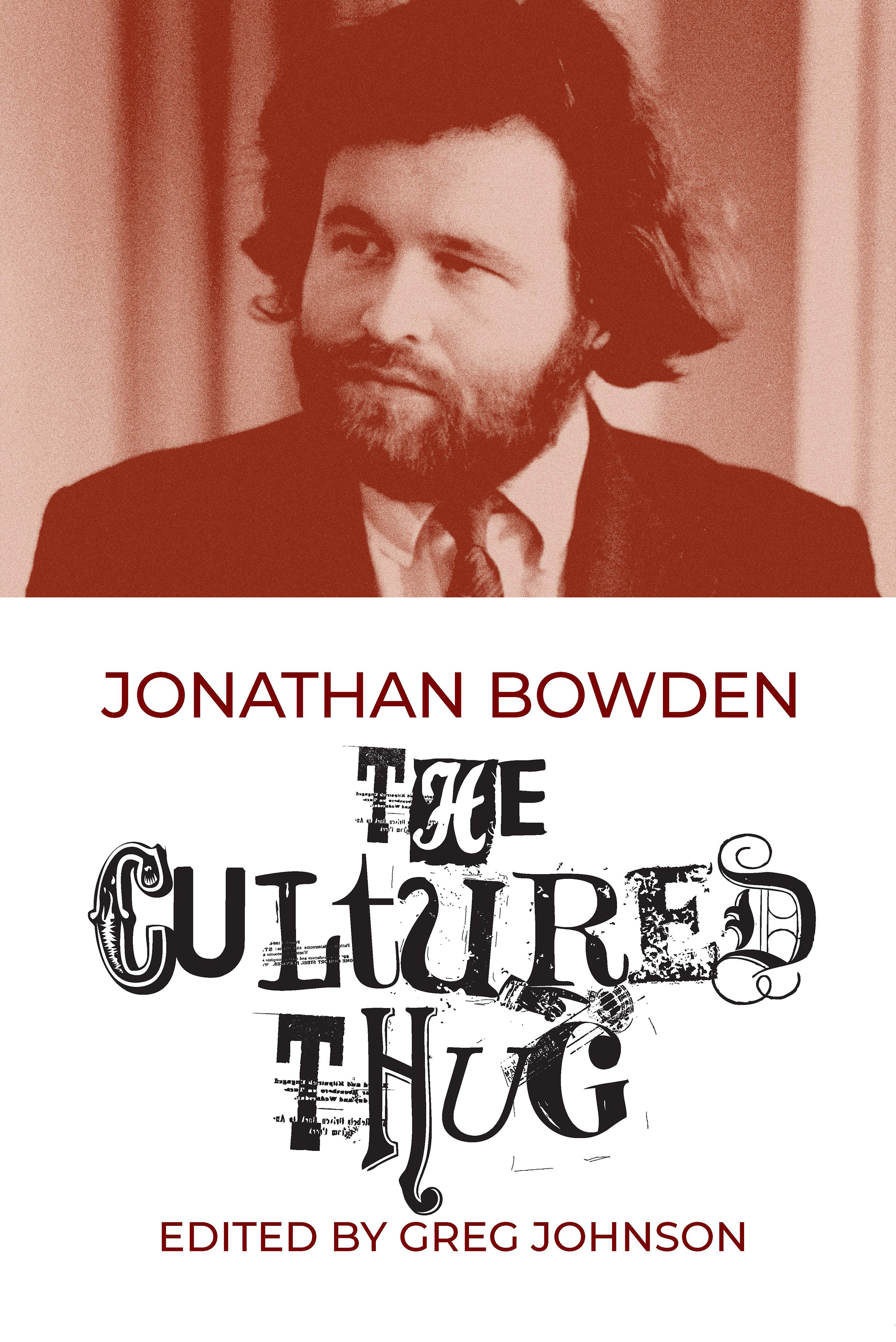
You can buy Jonathan Bowden’s collection The Cultured Thug here.

What she means by this is unclear. Did the current suddenly shift? Or did she overcome the currents and her fear “by a desperate explosion of will”?

Maybe she never swam to the rocks at all. Maybe she is trying to lure Plowart to certain death. Or maybe she is just trying to test him by putting him in a dangerous situation. (Something she has already done in the novel.)

Claremont joins him in the swim. If the swim is impossible, then she is killing herself. If the swim is possible, then she still may be counting on her superior skills to save her while the currents rid the world of Plowart.

Whatever her intent, the whole idea seems hare-brained. Wouldn’t it have been simpler to just call the police? This sequence, moreover, is the climax of the novel. This is a serious dramatic flaw that I first encountered in A Passage to India. One should never make the climax of a story contingent on an inscrutable twist or kink of feminine psychology.

Claremont is swept away, probably to her doom. Plowart, however, has that “desperate explosion of will.” “The rocks move.” Exhausted, he manages to clamber upon them to safety.

When Claremont and Plowart plunge into the dangerous waters, a local sounds the alarm, and a rescue boat is launched. When it arrives at the rocks, it is captained by Quiller, the local whom Plowart slapped and threatened with a knife for accidentally breaking his radio. Quiller decides to leave Plowart to the elements for allowing Claremont to drown, as well as for being an all-round bastard.

As the boat turns away, Plowart begins shouting, “You can’t kill me, you fools! I’m indestructible, I tell you . . .”[10] This is the precise opposite of what he should say. I am sure Plowart’s delusions of grandeur are sincere. But in truth, he’s on the brink of destruction, his life is entirely in Quiller’s hands, and a bit of contrition is his only rational hope. But Plowart is so detached from reality that he can’t even lie to save his life.

As the boat moves off, however, one of the men on board slyly releases a life preserver. It is Buffonet, the outcast. It is never made clear if Plowart finds the life preserver or reaches shore. But he continues his insulting harangue. The last words of the novel are: “Indestructible, you fools!”

You’d need a heart of stone not to find this funny.

You can buy The Alternative Right, ed. Greg Johnson, here

The critics of The Leap! evidently thought that Hopkins wished to depict Peter Plowart as a hero to be emulated. Thus the book had to be stopped, first by bad reviews, then by being pulled from publication.

My defense is that The Leap! is obviously a satire, that Plowart is not a hero but a buffoon, that no intelligent person could admire or imitate him, and that Hopkins’ liberal critics should be deeply satisfied that Plowart gets his comeuppance in the end.

But this was not the defense offered by Hopkins or his po-faced friends Wilson and Bowden. Moreover, as the careers of various Alt Right Plowarts prove, there is no shortage of people who will follow transparent narcissists and sociopaths, sticking with them through self-induced crisis after self-induced crisis and never getting the joke.

In a way, it is fortunate that the Right seems to attract only Dark Dyad types: narcissistic sociopaths who are so inept at Machiavellianism that they are incapable of concealing their repulsive traits and reining in their self-destructive impulses. True Dark Triad types would be harder to spot, and thus far more damaging. But they probably gravitate toward mainstream politics, where the real money and power are.

So maybe The Leap! is only a comedy by accident. Maybe it really is a dangerous book. But if Hopkins’ portrait of Peter Plowart can inoculate readers against falling for real-life versions, you may find the The Leap! worth diving into.

Notes

[1] Bill Hopkins, The Divine and the Decay (London: MacGibbon & Kee, 1957).

[2] Bill Hopkins, “Ways Without a Precedent,” in Declaration, ed. Tom Maschler (London: MacGibbon & Kee, 1957).

[3] I am drawing upon Colin Wilson’s The Angry Years: The Rise and Fall of the Angry Young Men (London: Robson Books, 2007), pp. 126–30.

[4] Wilson, The Angry Years, p. 130.

[5] Jonathan Bowden, “Bill Hopkins’ The Divine and the Decay,” Western Civilization Bites Back, ed. Greg Johnson (San Francisco: Counter-Currents, 2014), p. 158.

[6] Bill Hopkins, The Leap!, Foreword by Colin Wilson (London: Deverell & Birdsey, 1984).

[7] Revilo P. Oliver, “Bill Hopkins’ The Divine and the Decay,” Counter-Currents, June 7, 2011.

[8] Greg Johnson, “Honorable Defeatists,” In Defense of Prejudice (San Francisco: Counter-Currents, 2017).

[9] The Leap!, p. 53.

[10] The Leap!, p. 234.

Bill Hopkins’ The Leap!

Bill%20Hopkinsand%238217%3B%20The%20Leap%21%0A

Share

  • Gab

Enjoyed this article?

Be the first to leave a tip in the jar!

Instant Echeck GreenPay™

*  *  *

Counter-Currents has extended special privileges to those who donate at least $10/month or $120/year.

  1. Donors will have immediate access to all Counter-Currents posts. Everyone else will find that one post a day, five posts a week will be behind a “paywall” and will be available to the general public after 30 days. Naturally, we do not grant permission to other websites to repost paywall content before 30 days have passed.
  2. Paywall member comments will appear immediately instead of waiting in a moderation queue. (People who abuse this privilege will lose it.)
  3. Paywall members have the option of editing their comments.
  4. Paywall members get an Badge badge on their comments.
  5. Paywall members can “like” comments.
  6. Paywall members can “commission” a yearly article from Counter-Currents. Just send a question that you’d like to have discussed to [email protected]. (Obviously, the topics must be suitable to Counter-Currents and its broader project, as well as the interests and expertise of our writers.)

To get full access to all content behind the paywall, please visit our redesigned Paywall page. 

Related

  • Who’s Looking Back?

  • The Strange World of Gender Bender Fiction

  • Watching the Watchers

  • The Robot Hotdog Stand

  • José Pedro Zúquete’s The Identitarians

  • Counter-Currents Radio Podcast No. 689

  • Remigration is Inevitable Part 3

  • Why Billionaires Should Fund White Identity Politics

Tags

Bill Hopkinsbook reviewsColin WilsonGreg JohnsonJonathan BowdennarcissismnovelspaywallRevilo OliverRevilo P. Oliversociopathythe Dark TriadThe Divine and the DecayThe Leap!

5 comments

  1. DarkPlato says:
    January 31, 2024 at 1:04 pm

    Interesting.  Oliver used a word I didn’t know, “hypocoristic.”

    The book is likely about a real person the Illuminati are after, Kabbalistic in nature, as is everything, so I agree that it’s most likely satirical and intended to mock the character of  Plowart.  “Leap!” means he should leap to his death.  So it’s probably about some actual leader of an antisemitic organization around that time.  Oliver suggests Mosley.  Yockey maybe.   I have a theory that all altright groups trace their lineage to one of these people.  No one seeks the badlands of their own choice.

    I don’t think anyone on our side could be a true dark triad type.  We may have serious flaws, but by its nature white nationalism involves putting one’s race and western culture above one’s ego, which is antithetical to psychopathy.  We’re  certainly not in it for the money.  Those people are in mainstream politics, particularly the Democratic Party.

    1
    1
    • kolokol
    Reply
    1. John Morgan says:
      February 1, 2024 at 8:41 am

      There are, because not everyone who claims to be on our side actually is. For some it’s merely a grift or a power trip, or a way to role-play or vent their spleen.

      3
      3
      • DarkPlato
      • Flin Flon
      • Greg Johnson
      Reply
  2. Malaparte says:
    January 31, 2024 at 5:54 pm

    I tracked down this book based upon a previous Counter-Currents review, perhaps by Margot Metroland.  I couldn’t see what the fuss was about, let alone how the book posed a danger to the liberal order.  Your review is on the mark.

    2
    2
    • kolokol
    • Greg Johnson
    Reply
    1. Margot Metroland says:
      February 3, 2024 at 7:12 pm

      If it had any meaning, ultimately, Bill was opaque about it with me. He needed to write a few more black comedies in this genre (to get a reputation) but didn’t, and that might be because his life suddenly got soft and his original publisher got gobbled up.

      0
      0
      Reply
  3. Montgomery says:
    March 2, 2024 at 1:30 pm

    Is it possible to destroy the manuscript of a novel with a smouldering cigarette?
    This is the way that ‘Time of Totality,’ Bill Hopkins’ second novel, supposedly met its end. There was no carbon copy, and as far as I am aware there are not even any fragments extant.
    I’ve been thinking about this since watching the BBC documentary, Soho Boho, linked below. There is a section at about 50 minutes, in which Bill Hopkins becomes quite emotional, talking about the toll taken on writers trying to ‘fight the battle of the inexpressible.’ Was Hopkins defeated, and burnt the manuscript, saying it was destroyed by accident rather than admit, ‘I can’t do it, I can’t do it’?
    Here’s what he says: ‘When writers, for instance, hit word-block, they can’t formulate ideas for a book, and they go backwards, and dash forward to dash themselves against this invisible wall, and retire again even more smashed, to advance again against the wall, and that leads to many suicides, I mean, ‘I can’t do it, I can’t do it,’ and so one kills oneself.’ The words verbatim cannot convey the man’s emotion, however…


    (66) Soho Boho – YouTube

    0
    0
    Reply

If you have a Subscriber access,
simply login first to see your comment auto-approved.

Post a comment Cancel reply

Note on comments privacy & moderation

Your email is never published nor shared.

Comments are moderated. If you don't see your comment, please be patient. If approved, it will appear here soon. Do not post your comment a second time.

Upcoming podcasts
  • Rob Rundo on Counter-Currents Radio

    Rob Rundo on Counter-Currents Radio

    Counter-Currents Radio

    Sat, Jun 13th — 3 pm EST / 9 pm CET
  • Daniel Tyrie on Counter-Currents Radio

    Daniel Tyrie on Counter-Currents Radio

    Counter-Currents Radio

    Sat, Jun 20th — 3 pm EST / 9 pm CET

Writers of May

(2 votes) Morris van de Camp David M. Zsutty Derek Stark Jayant Bhandari Greg Johnson

Articles of May

The Lunch Wars by David M. Zsutty Heidegger on Nietzsche, Part One by Collin Cleary 2 votes
    • Editor’s Update
      Rob Rundo Rescheduled to Next Week on Counter-Currents Radio;
      Tonight Greg Johnson & David Zsutty Answer Your Questions;
      Fundraiser Update & a New $20,000 Matching Grant

      Greg Johnson

    • The Counter-Currents 2026 Fundraiser
      Lifetime Subscriber Welcome Packages Extended

      Greg Johnson

    • Nationalism This Week
      Who’s Looking Back?

      Greg Johnson

      18

    • China’s Threat to American Security:
      Food, Farmland, Foreign Control, & Energy Policy

      Lipton Matthews

      1

    • The Bitter End of Western Metaphysics:
      Heidegger on Nietzsche, Part Two

      Collin Cleary

      10

    • The Killing of Henry Nowak

      Mark Gullick

      28

    • The Crisis of Chinese Technology Thieves

      Morris van de Camp

      1

    • The Strange World of Gender Bender Fiction:
      & What This Genre Tells Us About Autosexuality

      Dani Vypont

      3

    • Watching the Watchers:
      The Dark Triad Question

      David M. Zsutty

      14

    • The Remigration Movement Solidifies

      F. Roger Devlin

      1

    • Casting Aspersions:
      The Fatal Consequences of Race-Swapped Casting, From Helen of Troy to Henry of Southampton

      Steven Tucker

      20

    • The Murder of Henry Nowak

      Millennial Woes

      23

    • Don’t Forget to Vote in Our Writer & Article of the Month Poll

      Greg Johnson

    • The Robot Hotdog Stand

      Greg Johnson

      35

    • Laughing Our Way to Victory

      Dave Chambers

      7

    • The Zodiac Killer

      Mark Gullick

      11

    • Jared Taylor: What Rome Means to Me

      Jared Taylor

      1

    • An Interview with Endeavour:
      My Way of Life Is an Adventure!

      Ondrej Mann

      6

    • José Pedro Zúquete’s The Identitarians

      Greg Johnson

      3

    • Editor’s Update
      Fundraiser Update & How to Watch the Remigration Summit

      Greg Johnson

      5

    • The Bitter End of Western Metaphysics:
      Heidegger on Nietzsche, Part One

      Collin Cleary

      11

    • Berlin: City of Stones

      Spencer J. Quinn

      6

    • True Folk-Horror Is Horror of Your Own Folk:
      Mark Gatiss vs the Brexit Blind Dead  

      Steven Tucker

      4

    • Counter-Currents Radio Podcast No. 689
      Thomas Massie, the America 2050 Bust, the Need for Whites to Divest from America, the AI Economic Apocalypse, & Pro-White Project Pitches to Billionaires

      Counter-Currents Radio

      7

    • Nationalism This Week
      Remigration is Inevitable, Part 3

      Greg Johnson

      27

    • Why Billionaires Should Fund White Identity Politics

      Lipton Matthews

      8

    • How Cold War Two Came About

      Morris van de Camp

      5

    • Now Available for Pre-Order at a Special Price!
      Greg Johnson’s The Philosopher Is In

      Greg Johnson

    • David Zsutty’s Elevator Pitch to a Billionaire

      David M. Zsutty

      1

    • Headbanging Lite

      Mark Gullick

      5

    • White Advocacy Past and Present

      Peter Bradley

      13

    • The Lunch Wars

      David M. Zsutty

      47

    • The Russians are Coming/The Russians are Coming

      Steven Clark

      1

    • Peak Fatigue in Fort Wayne

      Gabriel Anderson

      24

    • Keith Woods’ Elevator Pitch to a Billionaire

      Keith Woods

    • The Cruelty of Kindness

      Morris van de Camp

      9

    • Predation Wearing the Mask of Civilization

      Jayant Bhandari

      13

    • The Mandalorian & Grogu

      Trevor Lynch

      24

    • Editor’s Update
      Fundraiser Update & a New $20,000 Matching Grant
      Greg Johnson & David Zsutty Discuss Thomas Massie on Counter-Currents Radio

      Greg Johnson

      2

    • How the Jews Defeated Thomas Massie—& Themselves

      David M. Zsutty

      25

    • Jared Taylor’s Elevator Pitch to a Billionaire

      Jared Taylor

      15

    • Nationalism This Week
      Remigration Is Inevitable, Part 2

      Greg Johnson

      8

    • Could Fascism Work?

      Mark Gullick

      40

    • Jonathan Bowden’s Deliverance
      Part 7

      Jonathan Bowden

    • China’s Quiet Hand:
      Influence, Infiltration, & the Western Blind Spot

      Lipton Matthews

      9

    • Counter-Currents Radio Podcast No. 688
      Tyler Dykes on Running for US Congress in South Carolina

      Counter-Currents Radio

      3

    • Lothrop Stoddard’s The Revolt Against Civilization

      Spencer J. Quinn

      14

    • Lewis Strauss Did Nothing Wrong:
      How the politics of the Atom Bomb during the early Cold War Apply to Artificial Intelligence Today

      Morris van de Camp

      14

    • The Ghost of the Confederacy

      Dave Chambers

      12

    • America’s Century of Humiliation has Begun

      Greg Johnson

      27

    • Connor McDowell

      Who’s Looking Back?

      HAL9000 in 2001 was never truly “sentient”. “His” programming had a conflict that couldn’t be...

    • Will Williams

      Nationalism This Week: Victory First

      There are several C-C essays that mention Gaza, but this appears to be the only one where comments...

    • Observer

      Heidegger on Nietzsche, Part Two

      In Platonism, we find the insistence that being, true being, is identical with “the forms.” The...

    • JBP

      Heidegger on Nietzsche, Part Two

      Thanks. Unfortunately I must fall into the 95% that Jane refers to. My brain is not putting the...

    • Will Williams

      Who’s Looking Back?

      Vauquelin: June 7, 2026 ...You must judge AI/LLM based on those who control it. With the likes of...

    • Hi-ya!

      Heidegger on Nietzsche, Part Two

      Love to engage in this with more attention ; I’ve never seen “clearing” in presocratics and my hot...

    • Vauquelin

      Who’s Looking Back?

      You must judge AI/LLM based on those who control it. With the likes of Sam Altman and Alex Karp...

    • Chud

      Who’s Looking Back?

      There's another dangerous option where homebrew AI models scale up and the consumers get their...

    • Gabe

      Who’s Looking Back?

      Boom. Nailed it.

    • Joe Gould

      The Killing of Henry Nowak

      This is a good article. The only thing I want to add is, above all we must guard ourselves against...

    • Greg Johnson

      Who’s Looking Back?

      Thank you I also wonder if these AI bots are being used to gather intelligence on influential...

    • E_Perez

      Heidegger on Nietzsche, Part Two

      "Philosophy helps Western man understand how we got to where we are, and where things went wrong...

    • Chud

      Who’s Looking Back?

      I'll try to give a rundown. AI is a language learning model (LLM) that uses floating point...

    • Will Williams

      How the Jews Defeated Thomas Massie—And Themselves

      Massie to Honor USS Liberty Crew on House Floor [email protected]  June 6, 2026  thomas...

    • JBP

      Editor’s Update

      Sorry but... Wrong, wrong wrong and wrong. The current momentum of history will not change with a...

    • Will Williams

      The SPLC Indictment

      The indictment of the Southern Poverty Law Center by the Department of Justice on 21 April is...

    • Zarathustra

      Heidegger on Nietzsche, Part Two

      I rather liked this song by Puscifer.

    • Will Williams

      The Killing of Henry Nowak

      Pray in one hand, shit in the other, and see which hand fills up first.Connor McDowell: June 6...

    • Julius Strange

      Who’s Looking Back?

      It is always possible to run AI models locally to prevent data being collected. The bigger and more...

    • tempus

      Casting Aspersions

      There is a measure of beauty. It is the “Helen.” One Helen equals that quantity of beauty that...

    • Earth Day Special

      John Morgan

      12

    • A Robertson Roundup
      Remembering Wilmot Robertson
      (April 16, 1915 – July 8, 2005)

      Margot Metroland

      13

    • The Paranoid Style in White Nationalism

      Greg Johnson

      30

    • Join the Dance!

      Andrew Hamilton

      1

    • We Can’t Save the Earth Without Reducing African Birth Rates

      James Dunphy

      36

    • “I’m Not a Conspiracy Theorist, but . . .”:
      Jeffrey Epstein’s Death Gives New Life to “Conspiracy Theories”

      Greg Johnson

      22

    • Sylvia Plath: Stasis in Darkness

      Vic Olvir

      17

    • Vanguardism, Vantardism, & Mainstreaming

      Greg Johnson

      80

    • Aviation, Geography, & Race

      Charles Lindbergh

      3

    • Some Thoughts on Yule

      Collin Cleary

      4

    • Living in Truth:
      A Yuletide Homily

      Jef Costello

      7

    • John Kennedy Toole’s A Confederacy of Dunces

      Greg Johnson

      20

    • On Aleksandr Solzhenitsyn’s Warning to the West

      Spencer J. Quinn

      7

    • Elitism, British Modernism, & Wyndham Lewis

      Jonathan Bowden

      6

    • Philip K. Dick’s Do Androids Dream of Electric Sheep? as Anti-Semitic/Christian-Gnostic Allegory

      Greg Johnson

      20

    • “Conspiracy Theory” or Conspiracy?

      Andrew Hamilton

      21

    • Remembering H. P. Lovecraft
      (August 20, 1890–March 15, 1937)

      Greg Johnson

      3

    • Who Are We?
      Nordics, Aryans, & Whites

      Greg Johnson

      71

    • Remembering William Gayley Simpson
      (July 23, 1892–December 31, 1990)
      A Pleasant Afternoon with Harriet & Bill Simpson

      Margot Metroland

      18

    • Here are the Young Men
      Remembering Ian Curtis
      (July 15, 1956–May 18, 1980)

      Mark Gullick

      18

    • Percy Grainger
      Artist of the Right

      Alex Graham

      7

    • Remembering Revilo Oliver
      (July 7, 1908–August 20, 1994)

      Greg Johnson

      18

    • The Meaning of July 4th for the White Man

      Gregory Hood

      13

    • The Front National’s Evolution

      Bruno Mégret

    • Merwin K. Hart
      Forgotten American Hero & Man of the Right

      Morris van de Camp

      10

    • George Orwell’s Nineteen Eighty-Four

      Jonathan Bowden

      8

    • Carleton S. Coon
      Scientist & Reluctant White Advocate

      Morris van de Camp

      3

    • The Kwanzaa Absurdity Will Be Dwarfed by Juneteenth

      Robert Hampton

      10

    • Stravinsky

      Alex Graham

      7

    • Like the Roman:
      Remembering Enoch Powell (1912-1998)

      Mark Gullick

      23

    • The Game of Tarot

      Mark Gullick

      1

    • Institutions Cannot Be Transplanted

      Jayant Bhandari

      5

    • Jonathan Bowden’s Deliverance
      Part 5

      Jonathan Bowden

    • Crosstown Traffic:
      Jimi Hendrix & The Post-War Rock ‘N’ Roll Revolution

      Mark Gullick

      1

    • Slaves from the North:
      Finns & Karelians in the East European Slave Trade, 900–1600

      Lipton Matthews

      14

    • Neo-Fascism in Film
      Part 4

      Karel Veliky

      2

    • David Lean’s A Passage to India

      Spencer J. Quinn

      1

    • Elites are Essential to Development

      Lipton Matthews

      7

    • Jonathan Bowden’s Deliverance
      Part 4

      Jonathan Bowden

    • Neo-Fascism in Film
      Part 3

      Karel Veliky

      6

    • E. M. Forster’s A Passage to India & the Indian Mentality

      Spencer J. Quinn

      25

    • Jonathan Bowden’s Deliverance
      Part 3

      Jonathan Bowden

    • The Rest Is Silence
      Heidegger’s Quietism

      Mark Gullick

      2

    • Dispelling the Historical Fallacy of Indian Nationalism

      Lipton Matthews

      8

    • Neo-Fascism in Film
      Part 2

      Karel Veliky

      8

    • Jonathan Bowden’s Deliverance
      Part 2

      Jonathan Bowden

    • Life of a Klansman

      Mark Gullick

      8

    • Jonathan Bowden’s Deliverance, Part 1

      Jonathan Bowden

    • Decolonial Ideas are Holding Back Developing Countries

      Lipton Matthews

      8

    • Neo-fascism in Film, Part 1

      Karel Veliky

      21

    • Jonathan Bowden’s Onslaught, Part 8
      Divigations on Decadence

      Jonathan Bowden

    • Jonathan Bowden’s Onslaught, Part 7
      Intrigues in the National Front

      Jonathan Bowden

      1

    • Rotten to the Core

      Mark Gullick

      8

    • Strauss on Husserl’s “Philosophy as Rigorous Science”

      Greg Johnson

    • Jonathan Bowden’s Onslaught, Part 6
      Francis Bacon & Right-Wing Nihilism

      Jonathan Bowden

    • London After (& Before) Midnight:
      Aleister Crowley, The Landlord’s Worst Nightmare

      James J. O'Meara

      2

    • Jonathan Bowden’s Onslaught, Part 5
      The Post-War British Far Right

      Jonathan Bowden

    • No Rules: Rollerball

      Mark Gullick

      4

    • Jonathan Bowden’s Onslaught, Part 3
      Brett Easton Ellis’ American Psycho

      Jonathan Bowden

    • An Alternate History of the Harris Presidency

      Beau Albrecht

      5

    • András László
    • Derek Hawthorne
    • Beau Albrecht
    • Alain de Benoist
    • Kerry Bolton
    • Jonathan Bowden
    • Collin Cleary
    • Jef Costello
    • Savitri Devi
    • Julius Evola
    • Jim Goad
    • Gregory Hood
    • Juleigh Howard-Hobson
    • Greg Johnson
    • Charles Krafft
    • Anthony M. Ludovici
    • Trevor Lynch
    • H. L. Mencken
    • J. A. Nicholl
    • James J. O’Meara
    • Christopher Pankhurst
    • Tito Perdue
    • Michael Polignano
    • Spencer J. Quinn
    • Fenek Solère
    • Irmin Vinson
    • Leo Yankevich
    • Francis Parker Yockey
    • Multiple authors
  • Editor-in-Chief

    • Greg Johnson, Ph.D.

    Featured Writers

    • Beau Albrecht
    • Gunnar Alfredsson
    • Collin Cleary, Ph.D.
    • Jef Costello
    • Morris V. de Camp
    • F. Roger Devlin, Ph.D.
    • Stephen Paul Foster, Ph.D.
    • Jim Goad
    • Alex Graham
    • Mark Gullick, Ph.D.
    • Greg Johnson, Ph.D.
    • Travis LeBlanc
    • Trevor Lynch
    • Margot Metroland
    • James J. O’Meara
    • Angelo Plume
    • Spencer J. Quinn
    • Fred Reed
    • Clarissa Schnabel
    • Michael Walker
    • David M. Zsutty

    Frequent Writers

    • Asier Abadroa
    • Aquilonius
    • Alain de Benoist
    • Kerry Bolton, Ph.D.
    • Dave Chambers
    • Steven Clark
    • James Dunphy
    • Endeavour
    • Richard Houck
    • Jason Kessler
    • Titus Livius
    • Ondrej Mann
    • Lipton Matthews
    • Mark Mazari
    • John Morgan
    • Jaroslav Ostrogniew
    • Kathryn S.
    • Christian Secor
    • Anne Wilson Smith
    • Thomas Steuben
    • William De Vere
    • Kenneth Vinther
    • Max West

    Classic Authors

    • Maurice Bardèche
    • Jonathan Bowden
    • Julius Evola
    • Guillaume Faye
    • Ernst Jünger
    • Kevin MacDonald, Ph.D.
    • D. H. Lawrence
    • Charles Lindbergh
    • Jack London
    • H. P. Lovecraft
    • Anthony M. Ludovici
    • Sir Oswald Mosley
    • National Vanguard
    • Friedrich Nietzsche
    • Revilo Oliver
    • William Pierce
    • Ezra Pound
    • Saint-Loup
    • Savitri Devi
    • Carl Schmitt
    • Miguel Serrano
    • Oswald Spengler
    • P. R. Stephensen
    • Jean Thiriart
    • John Tyndall
    • Dominique Venner
    • Leo Yankevich
    • Francis Parker Yockey

    Other Authors

    • Howe Abbott-Hiss
    • Michael Bell
    • Giles Corey
    • Jack Donovan
    • Richardo Duchesne, Ph.D.
    • Emile Durand
    • Guillaume Durocher
    • Mark Dyal
    • Tom Goodroch
    • Andrew Hamilton
    • Robert Hampton
    • Huntley Haverstock
    • Derek Hawthorne
    • Gregory Hood
    • Juleigh Howard-Hobson
    • Alexander Jacob
    • Ruuben Kaalep
    • Tobias Langdon
    • Julian Langness
    • Patrick Le Brun
    • G A Malvicini
    • John Michael McCloughlin
    • Millennial Woes
    • Michael O’Meara
    • Christopher Pankhurst
    • Michael Polignano
    • J. J. Przybylski
    • Quintilian
    • Edouard Rix
    • C. B. Robertson
    • C. F. Robinson
    • Herve Ryssen
    • Alan Smithee
    • Fenek Solere
    • Ann Sterzinger
    • Robert Steuckers
    • Tomislav Sunic
    • Donald Thoresen
    • Marian Van Court
    • Irmin Vinson
    • Book Reviews
    • Movie Reviews
    • TV Reviews
    • Music Reviews
    • Art Criticism
    • Graphic Novels & Comics
    • Video Game Reviews
    • Fiction
    • Poems
    • Interviews
    • Videos
    • English Translations
    • Other Languages
      • Arabic
      • Bulgarian
      • Croatian
      • Czech
      • Danish
      • Dutch
      • Estonian
      • Finnish
      • French
      • German
      • Greek
      • Hungarian
      • Italian
      • Lithuanian
      • Norwegian
      • Polish
      • Portuguese
      • Romanian
      • Russian
      • Slovak
      • Spanish
      • Swedish
      • Ukrainian
    • Commemorations
    • Why We Write
  • Archives
  • Top 100 Commenters
  • The Looney Bin
Sponsored Links
Europa.com Above Time Coffee Antelope Hill Publishing Paul Waggener IHR-Store Spencer J. Quinn American Renaissance Jim Goad The Occidental Observer
Donate Now Mailing list
Books for sale
  • The Philosopher Is In
  • Sexual Utopia in Power (Expanded Edition)
  • In Defense of Prejudice
  • Loving Our Own
  • Tyranny & Wisdom
  • The Populist Moment
  • Is America Doomed?
  • To all books
Copyright © 2026 Counter-Currents Publishing, Ltd.

Paywall Access


Please enter your email address.

Lost your password?

Edit your comment

Writer & Article of the Month May 2026

Voting for this month has concluded. Here are the final results!

Top Writers

  • #1 Morris van de Camp 2 votes
  • #2 David M. Zsutty 2 votes
  • #3 Derek Stark 2 votes
  • #4 Jayant Bhandari 2 votes
  • #5 Greg Johnson 2 votes
  • #6 Jared Taylor 1 vote
  • #7 Collin Cleary 1 vote
  • #8 Spencer J. Quinn 1 vote
  • #9 Mark Gullick 1 vote
  • #10 Lipton Matthews 1 vote
  • #11 Keith Woods 1 vote
  • #12 Steven Tucker 1 vote

Top Articles

  • #1 The Lunch Wars 2 votes
  • #2 Heidegger on Nietzsche, Part One 2 votes
  • #3 Could Fascism Work? 1 vote
  • #4 Jared Taylor's Elevator Pitch to a Billionaire 1 vote
  • #5 Predation Wearing the Mask of Civilization 1 vote
  • #6 Peak Fatigue in Fort Wayne 1 vote
  • #7 Keith Wood's Elevator Pitch to a Billionaire 1 vote
  • #8 Do You Want to Play a Game? 1 vote
  • #9 Why Billionaires Should Fund White Identity Politics 1 vote
  • #10 The 1970s: The Golden Age of Hijacking 1 vote
  • #11 True Folk-Horror Is Horror of Your Own Folk 1 vote
  • #12 Finding Atlantis Part 4 1 vote
  • #13 Berlin: City of Stones 1 vote
  • #14 The Ghost of the Confederacy 1 vote
  • #15 Lothrop Stoddard’s The Revolt Against Civilization 1 vote

Total votes cast: 17

Insert/edit link

Enter the destination URL

Or link to existing content

    No search term specified. Showing recent items. Search or use up and down arrow keys to select an item.