Counter-Currents
  • Advertise
  • Private Events
  • T&C
  • About
  • Contact
  • RSS
    • Main feed
    • Podcast feed
    • Videos feed
    • Comments feed
  • Welcome
  • Webzine
  • Books
  • Merch
  • Podcasts
  • Videos
  • Donate
  • Patrons
  • Subscribe
  • Crypto

LEVEL2

Donate Now Mailing list
Upcoming podcasts
  • Rob Rundo on Counter-Currents Radio

    Rob Rundo on Counter-Currents Radio

    Counter-Currents Radio

    06/13/2026 — 3 pm EST / 9 pm CET

Writers of May

(2 votes) Morris van de Camp David M. Zsutty Derek Stark Jayant Bhandari Greg Johnson

Articles of May

Heidegger on Nietzsche, Part One by Collin Cleary The Lunch Wars by David M. Zsutty 2 votes
  • Welcome
  • Webzine
  • Books
  • Merch
  • Podcasts
  • Videos
  • Donate
  • Patrons
  • Subscribe
  • Crypto
    • Editor’s Update
      Rob Rundo on Counter-Currents Radio, Fundraiser Update, & a New $20,000 Matching Grant

      Greg Johnson

    • The Bitter End of Western Metaphysics:
      Heidegger on Nietzsche, Part Three

      Collin Cleary

      7

    • Uncivil War

      Mark Gullick

      26

    • Exclusive Interview with Karel Veliky:
      The Final Chapter in the Film Series! Part II

      Ondrej Mann

      2

    • Happy Birthday to Us!

      Greg Johnson

      6

    • Zsutty’s Maximum

      David M. Zsutty

      15

    • Exclusive Interview with Karel Veliky:
      The Final Chapter in the Film Series! Part I

      Ondrej Mann

      2

    • The Union Jackal, June 2026

      Mark Gullick

      23

    • The Inferiority Behind Immigrant Superiority

      Jayant Bhandari

      15

    • Counter-Currents Radio Podcast No. 690
      Greg Johnson & David Zsutty Discuss Current Things: AI, Henry Nowak, the Iran Crisis, & More

      Counter-Currents Radio

      5

    • Collin Cleary: What Rome Means to Me

      Collin Cleary

      4

    • Paul Krugman: Closet Bolshevik

      Spencer J. Quinn

      19

    • Fugue of Ideas:
      Ibram X. Kendi’s Chain of Ideas

      Greg Johnson

      18

    • Based Blacks

      Lipton Matthews

      12

    • Black Intellectual Fatigue

      Derek Stark

      37

    • Why White Advocates Should Avoid “Based Blacks”

      Dani Vypont

      26

    • Nietzsche & Race

      Mark Gullick

    • Editor’s Update
      Rob Rundo Rescheduled to Next Week on Counter-Currents Radio;
      Tonight Greg Johnson & David Zsutty Answer Your Questions;
      Fundraiser Update & a New $20,000 Matching Grant

      Greg Johnson

    • The Counter-Currents 2026 Fundraiser
      Lifetime Subscriber Welcome Packages Extended

      Greg Johnson

    • Nationalism This Week
      Who’s Looking Back?

      Greg Johnson

      29

    • China’s Threat to American Security:
      Food, Farmland, Foreign Control, & Energy Policy

      Lipton Matthews

      5

    • The Bitter End of Western Metaphysics:
      Heidegger on Nietzsche, Part Two

      Collin Cleary

      16

    • The Killing of Henry Nowak

      Mark Gullick

      38

    • The Crisis of Chinese Technology Thieves

      Morris van de Camp

      1

    • The Strange World of Gender Bender Fiction:
      & What This Genre Tells Us About Autosexuality

      Dani Vypont

      3

    • Watching the Watchers:
      The Dark Triad Question

      David M. Zsutty

      14

    • The Remigration Movement Solidifies

      F. Roger Devlin

      1

    • Casting Aspersions:
      The Fatal Consequences of Race-Swapped Casting, From Helen of Troy to Henry of Southampton

      Steven Tucker

      20

    • The Murder of Henry Nowak

      Millennial Woes

      23

    • Don’t Forget to Vote in Our Writer & Article of the Month Poll

      Greg Johnson

    • The Robot Hotdog Stand

      Greg Johnson

      37

    • Laughing Our Way to Victory

      Dave Chambers

      7

    • The Zodiac Killer

      Mark Gullick

      11

    • Jared Taylor: What Rome Means to Me

      Jared Taylor

      1

    • An Interview with Endeavour:
      My Way of Life Is an Adventure!

      Ondrej Mann

      6

    • José Pedro Zúquete’s The Identitarians

      Greg Johnson

      3

    • Editor’s Update
      Fundraiser Update & How to Watch the Remigration Summit

      Greg Johnson

      5

    • The Bitter End of Western Metaphysics:
      Heidegger on Nietzsche, Part One

      Collin Cleary

      12

    • Berlin: City of Stones

      Spencer J. Quinn

      6

    • True Folk-Horror Is Horror of Your Own Folk:
      Mark Gatiss vs the Brexit Blind Dead  

      Steven Tucker

      4

    • Counter-Currents Radio Podcast No. 689
      Thomas Massie, the America 2050 Bust, the Need for Whites to Divest from America, the AI Economic Apocalypse, & Pro-White Project Pitches to Billionaires

      Counter-Currents Radio

      7

    • Nationalism This Week
      Remigration is Inevitable, Part 3

      Greg Johnson

      27

    • Why Billionaires Should Fund White Identity Politics

      Lipton Matthews

      8

    • How Cold War Two Came About

      Morris van de Camp

      5

    • Now Available for Pre-Order at a Special Price!
      Greg Johnson’s The Philosopher Is In

      Greg Johnson

    • David Zsutty’s Elevator Pitch to a Billionaire

      David M. Zsutty

      1

    • Headbanging Lite

      Mark Gullick

      5

    • White Advocacy Past and Present

      Peter Bradley

      13

    • The Lunch Wars

      David M. Zsutty

      47

    • The Russians are Coming/The Russians are Coming

      Steven Clark

      1

    • kolokol

      Uncivil War

      Stephen Ogilvie is the latest example of a decent, hard-working White person, killed by a useless...

    • Dr. X

      Uncivil War

      Great writeup. One error- I doubt the Republic of Ireland police (Garda) were responding on the...

    • kolokol

      Uncivil War

      This is a very good start. May it continue and accelerate, until all the invaders have been expelled...

    • Observer

      The Bitter End of Western Metaphysics:
      Heidegger on Nietzsche, Part Three

      Ouch. Well, I had used the bullet formatting in the text box to break it up a bit... but it looks...

    • Gabe

      Uncivil War

      Scots-Irish is an American term. It's true that Presbyterians and others came from Scotland to...

    • Gabe

      Uncivil War

      I was just going to write that myself. The Garda Siochána, or guards, is a term they use in the...

    • Ondrej Mann

      Exclusive Interview with Karel Veliky:
      The Final Chapter in the Film Series! Part II

      Thanks for the cultural tip. I’m currently preparing an interview for CC with the Austrian band...

    • Observer

      The Bitter End of Western Metaphysics:
      Heidegger on Nietzsche, Part Three

      Also, a semi-related topic, but have you read Darren Beattie's Heidegger PhD thesis? I know that it...

    • Observer

      The Bitter End of Western Metaphysics:
      Heidegger on Nietzsche, Part Three

      My mood is always improved by a fresh Cleary article. Great work as always. It's always fun to see...

    • Joe Gould

      Zsutty’s Maximum

      "That Whites are the only racial ingroup in which there seems to be any significant number of...

    • Nicholas

      Paul Krugman: Closet Bolshevik

      https://youtu.be/02MV3DD5pFc This is the link I intended to share. Let's hope this works.

    • Greg Johnson

      Zsutty’s Maximum

      All groups are mean to one another, to some extent. The question is whether this level of ingroup...

    • Joe Gould

      Uncivil War

      For Whites, one of the goals of philosophy, and of education in general, has to be this: we must...

    • Dani Vypont

      Uncivil War

      Northern Ireland has been in a civil war, both hot and cold, for decades. This religiously and...

    • David M. Zsutty

      Zsutty’s Maximum

      That Whites can be very mean to each other is a correct observation. However, this is a case of...

    • Scott

      Why White Advocates Should Avoid “Based Blacks”

      Will Williams wrote: "Scott, it’s interesting that you call George Stephanopoulos a “Clinton...

    • Scott

      Paul Krugman: Closet Bolshevik

      Yeah, Trump is the most Kosher President to come down the pike ─ except for the last one, and the...

    • C#

      The Bitter End of Western Metaphysics:
      Heidegger on Nietzsche, Part Three

      Well, that was depressing. Enlightening, but depressing. Personally, I suffer from the baggage of...

    • dogbone

      Based Blacks

      lol - I'd much rather watch Tate than Shapiro any day.

    • Joe Gould

      Uncivil War

      Confronting the police, which really means appealing to the police to do their jobs, gets you three...

    • Earth Day Special

      John Morgan

      12

    • A Robertson Roundup
      Remembering Wilmot Robertson
      (April 16, 1915 – July 8, 2005)

      Margot Metroland

      13

    • The Paranoid Style in White Nationalism

      Greg Johnson

      30

    • Join the Dance!

      Andrew Hamilton

      1

    • We Can’t Save the Earth Without Reducing African Birth Rates

      James Dunphy

      36

    • “I’m Not a Conspiracy Theorist, but . . .”:
      Jeffrey Epstein’s Death Gives New Life to “Conspiracy Theories”

      Greg Johnson

      22

    • Sylvia Plath: Stasis in Darkness

      Vic Olvir

      17

    • Vanguardism, Vantardism, & Mainstreaming

      Greg Johnson

      80

    • Aviation, Geography, & Race

      Charles Lindbergh

      3

    • Some Thoughts on Yule

      Collin Cleary

      4

    • Living in Truth:
      A Yuletide Homily

      Jef Costello

      7

    • John Kennedy Toole’s A Confederacy of Dunces

      Greg Johnson

      20

    • On Aleksandr Solzhenitsyn’s Warning to the West

      Spencer J. Quinn

      7

    • Elitism, British Modernism, & Wyndham Lewis

      Jonathan Bowden

      6

    • Philip K. Dick’s Do Androids Dream of Electric Sheep? as Anti-Semitic/Christian-Gnostic Allegory

      Greg Johnson

      20

    • “Conspiracy Theory” or Conspiracy?

      Andrew Hamilton

      21

    • Remembering H. P. Lovecraft
      (August 20, 1890–March 15, 1937)

      Greg Johnson

      3

    • Who Are We?
      Nordics, Aryans, & Whites

      Greg Johnson

      71

    • Remembering William Gayley Simpson
      (July 23, 1892–December 31, 1990)
      A Pleasant Afternoon with Harriet & Bill Simpson

      Margot Metroland

      18

    • Here are the Young Men
      Remembering Ian Curtis
      (July 15, 1956–May 18, 1980)

      Mark Gullick

      18

    • Percy Grainger
      Artist of the Right

      Alex Graham

      7

    • Remembering Revilo Oliver
      (July 7, 1908–August 20, 1994)

      Greg Johnson

      18

    • The Meaning of July 4th for the White Man

      Gregory Hood

      13

    • The Front National’s Evolution

      Bruno Mégret

    • Merwin K. Hart
      Forgotten American Hero & Man of the Right

      Morris van de Camp

      10

    • George Orwell’s Nineteen Eighty-Four

      Jonathan Bowden

      8

    • Carleton S. Coon
      Scientist & Reluctant White Advocate

      Morris van de Camp

      3

    • The Kwanzaa Absurdity Will Be Dwarfed by Juneteenth

      Robert Hampton

      10

    • Stravinsky

      Alex Graham

      7

    • Like the Roman:
      Remembering Enoch Powell (1912-1998)

      Mark Gullick

      23

    • Jonathan Bowden’s Deliverance
      Part 6

      Jonathan Bowden

    • Do You Want to Play a Game?

      Mark Gullick

      1

    • Sexually Incontinent on the Indian Subcontinent:
      Who Rapes More Animals, Indians or Pakistanis? The Battle Continues!

      Steven Tucker

      3

    • Neo-Fascism in Film
      Part 5

      Karel Veliky

      15

    • The Game of Tarot

      Mark Gullick

      2

    • Institutions Cannot Be Transplanted

      Jayant Bhandari

      5

    • Jonathan Bowden’s Deliverance
      Part 5

      Jonathan Bowden

    • Crosstown Traffic:
      Jimi Hendrix & The Post-War Rock ‘N’ Roll Revolution

      Mark Gullick

      1

    • Slaves from the North:
      Finns & Karelians in the East European Slave Trade, 900–1600

      Lipton Matthews

      14

    • Neo-Fascism in Film
      Part 4

      Karel Veliky

      2

    • David Lean’s A Passage to India

      Spencer J. Quinn

      1

    • Elites are Essential to Development

      Lipton Matthews

      7

    • Jonathan Bowden’s Deliverance
      Part 4

      Jonathan Bowden

    • Neo-Fascism in Film
      Part 3

      Karel Veliky

      6

    • E. M. Forster’s A Passage to India & the Indian Mentality

      Spencer J. Quinn

      25

    • Jonathan Bowden’s Deliverance
      Part 3

      Jonathan Bowden

    • The Rest Is Silence
      Heidegger’s Quietism

      Mark Gullick

      2

    • Dispelling the Historical Fallacy of Indian Nationalism

      Lipton Matthews

      8

    • Neo-Fascism in Film
      Part 2

      Karel Veliky

      8

    • Jonathan Bowden’s Deliverance
      Part 2

      Jonathan Bowden

    • Life of a Klansman

      Mark Gullick

      8

    • Jonathan Bowden’s Deliverance, Part 1

      Jonathan Bowden

    • Decolonial Ideas are Holding Back Developing Countries

      Lipton Matthews

      8

    • Neo-fascism in Film, Part 1

      Karel Veliky

      21

    • Jonathan Bowden’s Onslaught, Part 8
      Divigations on Decadence

      Jonathan Bowden

    • Jonathan Bowden’s Onslaught, Part 7
      Intrigues in the National Front

      Jonathan Bowden

      1

    • Rotten to the Core

      Mark Gullick

      8

    • Strauss on Husserl’s “Philosophy as Rigorous Science”

      Greg Johnson

    • Jonathan Bowden’s Onslaught, Part 6
      Francis Bacon & Right-Wing Nihilism

      Jonathan Bowden

    • London After (& Before) Midnight:
      Aleister Crowley, The Landlord’s Worst Nightmare

      James J. O'Meara

      2

    • András László
    • Derek Hawthorne
    • Beau Albrecht
    • Alain de Benoist
    • Kerry Bolton
    • Jonathan Bowden
    • Collin Cleary
    • Jef Costello
    • Savitri Devi
    • Julius Evola
    • Jim Goad
    • Gregory Hood
    • Juleigh Howard-Hobson
    • Greg Johnson
    • Charles Krafft
    • Anthony M. Ludovici
    • Trevor Lynch
    • H. L. Mencken
    • J. A. Nicholl
    • James J. O’Meara
    • Christopher Pankhurst
    • Tito Perdue
    • Michael Polignano
    • Spencer J. Quinn
    • Fenek Solère
    • Irmin Vinson
    • Leo Yankevich
    • Francis Parker Yockey
    • Multiple authors
  • Editor-in-Chief

    • Greg Johnson, Ph.D.

    Featured Writers

    • Beau Albrecht
    • Gunnar Alfredsson
    • Collin Cleary, Ph.D.
    • Jef Costello
    • Morris V. de Camp
    • F. Roger Devlin, Ph.D.
    • Stephen Paul Foster, Ph.D.
    • Jim Goad
    • Alex Graham
    • Mark Gullick, Ph.D.
    • Greg Johnson, Ph.D.
    • Travis LeBlanc
    • Trevor Lynch
    • Margot Metroland
    • James J. O’Meara
    • Angelo Plume
    • Spencer J. Quinn
    • Fred Reed
    • Clarissa Schnabel
    • Michael Walker
    • David M. Zsutty

    Frequent Writers

    • Asier Abadroa
    • Aquilonius
    • Alain de Benoist
    • Kerry Bolton, Ph.D.
    • Dave Chambers
    • Steven Clark
    • James Dunphy
    • Endeavour
    • Richard Houck
    • Jason Kessler
    • Titus Livius
    • Ondrej Mann
    • Lipton Matthews
    • Mark Mazari
    • John Morgan
    • Jaroslav Ostrogniew
    • Kathryn S.
    • Christian Secor
    • Anne Wilson Smith
    • Thomas Steuben
    • William De Vere
    • Kenneth Vinther
    • Max West

    Classic Authors

    • Maurice Bardèche
    • Jonathan Bowden
    • Julius Evola
    • Guillaume Faye
    • Ernst Jünger
    • Kevin MacDonald, Ph.D.
    • D. H. Lawrence
    • Charles Lindbergh
    • Jack London
    • H. P. Lovecraft
    • Anthony M. Ludovici
    • Sir Oswald Mosley
    • National Vanguard
    • Friedrich Nietzsche
    • Revilo Oliver
    • William Pierce
    • Ezra Pound
    • Saint-Loup
    • Savitri Devi
    • Carl Schmitt
    • Miguel Serrano
    • Oswald Spengler
    • P. R. Stephensen
    • Jean Thiriart
    • John Tyndall
    • Dominique Venner
    • Leo Yankevich
    • Francis Parker Yockey

    Other Authors

    • Howe Abbott-Hiss
    • Michael Bell
    • Giles Corey
    • Jack Donovan
    • Richardo Duchesne, Ph.D.
    • Emile Durand
    • Guillaume Durocher
    • Mark Dyal
    • Tom Goodroch
    • Andrew Hamilton
    • Robert Hampton
    • Huntley Haverstock
    • Derek Hawthorne
    • Gregory Hood
    • Juleigh Howard-Hobson
    • Alexander Jacob
    • Ruuben Kaalep
    • Tobias Langdon
    • Julian Langness
    • Patrick Le Brun
    • G A Malvicini
    • John Michael McCloughlin
    • Millennial Woes
    • Michael O’Meara
    • Christopher Pankhurst
    • Michael Polignano
    • J. J. Przybylski
    • Quintilian
    • Edouard Rix
    • C. B. Robertson
    • C. F. Robinson
    • Herve Ryssen
    • Alan Smithee
    • Fenek Solere
    • Ann Sterzinger
    • Robert Steuckers
    • Tomislav Sunic
    • Donald Thoresen
    • Marian Van Court
    • Irmin Vinson
    • Book Reviews
    • Movie Reviews
    • TV Reviews
    • Music Reviews
    • Art Criticism
    • Graphic Novels & Comics
    • Video Game Reviews
    • Fiction
    • Poems
    • Interviews
    • Videos
    • English Translations
    • Other Languages
      • Arabic
      • Bulgarian
      • Croatian
      • Czech
      • Danish
      • Dutch
      • Estonian
      • Finnish
      • French
      • German
      • Greek
      • Hungarian
      • Italian
      • Lithuanian
      • Norwegian
      • Polish
      • Portuguese
      • Romanian
      • Russian
      • Slovak
      • Spanish
      • Swedish
      • Ukrainian
    • Commemorations
    • Why We Write
  • Archives
  • Top 100 Commenters
  • The Looney Bin
  • Advertise
  • Private Events
  • T&C
  • About
  • Contact
  • RSS
    • Main feed
    • Podcast feed
    • Videos feed
    • Comments feed
Sponsored Links
Europa.com Above Time Coffee Antelope Hill Publishing Paul Waggener IHR-Store Spencer J. Quinn American Renaissance Jim Goad The Occidental Observer
Print May 29, 2023 4 comments

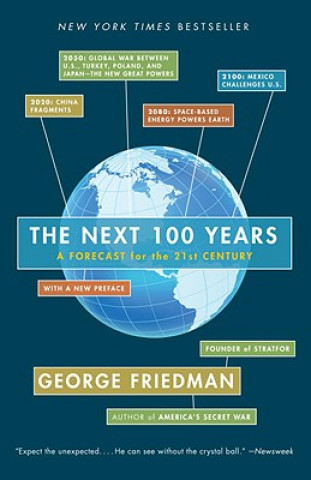
George Friedman’s The Next 100 Years

Thomas Steuben

2,500 words

George Friedman
The Next 100 Years: A Forecast for the 21st Century
New York: Anchor Books, 2009

George Friedman’s The Next 100 Years is an intriguing forecast of how the twenty-first century will play out. Friedman gets a lot of things wrong, but there is nevertheless a method to his analysis, and we have much to learn from what the broader center-Left, of which Friedman is a part, gets right. It’s also interesting because glowing reviews in the mainstream media suggests that the book has been guiding the establishment’s thinking, and thus explains some of their odd decisions.

The author has limitations, however. He comes from a Jewish family who escaped Communist Hungary, and this seems to account for his obliviousness to racial issues and failure to delve deep enough into cultural issues, along with his optimism concerning the United States. This seems to be the result of naïveté as opposed to bad faith, however, which is a refreshing change in 2023.

In this book Friedman epitomizes the old center-Left, which I may disagree with but could at least respect. The Next 100 Years was published in 2009 — a time when Barack Obama opposed gay marriage and there was exuberant talk of a post-racial America. His predictions, while well-reasoned, seem trapped in a past era that seems almost as remote as the Austro-Hungarian Empire is to us today. The book was thus more suggestive of nostalgia than futurism for me.

While Friedman is still ultimately a progressive, his observation that there is a cyclical rhythm to the United States’ crises shows that he rejects the arrogant “end of history” paradigm. Additionally, Friedman’s view of geopolitics is that world leaders, despite appearing to have a lot of power, are actually quite constrained in the choices they can make. This is akin to how master chess players know their options better and are thus more constrained than novices, as they are ironically easier to predict.

This leads to some weaknesses in Friedman’s approach. What if some of the players are being given bad information, such as how Vladimir Putin was led to underestimate Ukraine’s tenacity? What if some of the players are mentally unstable, or have unconventional goals? Donald Trump kept the peace in part by being — or at least appearing to be — unstable.

Also, consider that there are different paths to victory, hidden agendas, and the like in board and computer games. These games are as informative as they are amusing because art imitates life. The US regime’s doubling down on the transgender agenda at home and abroad is very similar to a team in a game that pursues a victory condition of “paint the map X% ideology or religion.” While world leaders are usually rational, they are nonetheless human, and thus not immune from the same sort of emotional pettiness that board games tend to bring out in even the most cool-headed of players.

Furthermore, Friedman says he appreciates culture, but he does not seem to follow through in appreciating it quite enough, or by recognizing that there is human agency behind cultural changes. For example, he claims that traditional family values are changing simply because of economic reasons. This is patently incorrect, as the Jews are notorious for continually undermining family values, either for shekels or simply out of an ethnic animus.

He likewise correctly identifies that declining birth rates are the single most important demographic fact. Friedman predicts that the developed nations will begin competing against each other to attract immigrants for economic reasons, and that those who come from the Third World will assimilate just as previous waves of immigrants did because they will be scattered across their new nations rather than physically attached to their old countries or concentrated in a borderland (he makes an exception for Mexicans, but solely because Mexico is contiguous with America). We of course understand that this is a recipe for the Great Replacement and tumbling national IQs, even if the new immigrants actually do assimilate, which experience has shown to be unlikely.

Sadly, Friedman’s analysis is limited given that it does not account for race realism. While not technically immigrants, blacks have yet to assimilate into American society despite numerous efforts at integration. Even if they have higher IQs, new immigrants are just as foreign as blacks and cannot be expected to assimilate, either. Friedman’s optimism about this being an American century is therefore faulty because it is based on the idea that the US will outcompete other countries in attracting immigrants and then assimilate them.

One of the points Friedman does make correctly is that the US is not great because of its founding documents, but because it has vast natural resources, access to two oceans, and emerged from the Second World War unscathed while its competitors were bombed into rubble. Such realism is a nice reprieve from constitutional chauvinism, which fails to take into account the fact that Liberia’s constitution is a copy of America’s, and yet it hasn’t followed the same path to success. Regardless, given recent events I am doubtful that these advantages alone will be enough to maintain America’s dominance for another decade, let alone the rest of this century.
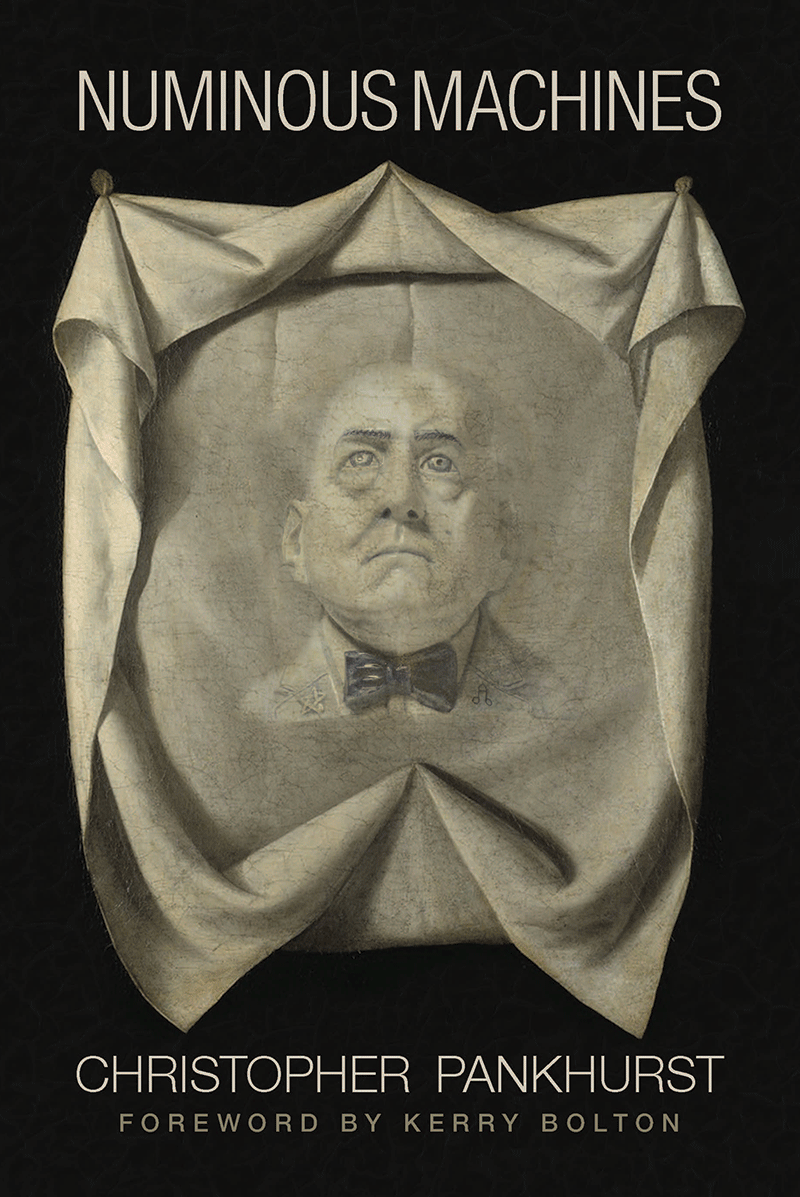
You can buy Christopher Pankhurst’s essay collection Numinous Machines here.

The US is a victim of its own success. The advantages Friedman rightfully identifies allowed the US to enjoy a wide margin of error in its policies, as the author himself admits. Less powerful countries have to be far more careful, because a small mistake can be disastrous for them.

The problem is that America’s ability to make wise decisions has atrophied from lack of use. This is akin to the fact that while a millionaire usually has good judgment, his descendants often do not, even if they inherit his wealth. This decline, when added to the fact that America has been growing increasingly culturally abrasive, has annoyed most other countries to at least some extent. Friedman thinks that decades will pass before these realities catch up with the US, because no other country wants to be the nail that sticks up and is then hammered down by the world’s policeman. Nevertheless, Iran’s recent rapprochement with Saudi Arabia shows that other countries are willing to put long-standing resentments aside when it’s to their mutual advantage. And after the Taliban’s triumph in Afghanistan, not to mention the US visibly losing domestic support for its policies, the rest of the world knows that American boots on the ground are much less likely today.

America’s prime strategy for maintaining its dominance for so long has been not to “win,” but to prevent others from winning. This explains why the US establishment always appears unfazed by disasters such as the Vietnam War, Iraq falling to Iranian influence after a costly US invasion, or the fall of Kabul to America’s sworn enemies. Like the British Empire, America’s goal as a sea power is to prevent any other power from becoming too strong. This is not an effective long-term strategy, however, as It relies on the fact that none of the other players will ever find a way to become a genuine threat. Imagine a player in a board game whose strategy consists entirely of disrupting the other players’ strategies. He would quickly anger the entire room, and cause his opponents to work together against him.

Such a policy is moreover demoralizing on the home front, as it never offers any real sense of national accomplishment despite the sacrifices the people are expected to make in blood and treasure. It rather causes the regime to be simultaneously despised for its tyrannical injustice as well as its ineptitude.

Friedman predicts, from the point of view of 2009, that the “War on Terror” would eventually dissipate given that America’s actual strategic goal was not the elimination of Islamic extremism but rather to prevent the ideology from uniting the Islamic world. Friedman was correct about this, even though he does not entirely concede that the “War on Terror” itself was primarily instigated by the US itself. While Islamic extremism seems less threatening today than it did then, it nevertheless feels like a pyrrhic victory given the price we had to pay, both materially and in terms of humiliation, not to mention how it damaged America’s relations around the world.

Friedman is also correct in saying that the War in Iraq was insignificant in terms of the casualties inflicted on the US and its allies. What he neglects to add is that the fact that the war divided the country so deeply is a sign of the US rotting from within. The regime no longer has a positive vision with which to inspire its citizenry, aside from vague nonsense about spreading human rights. The costs likewise fell disproportionately on a small portion of the country that has grown tired of sweating and bleeding for the Washington elite.

Friedman rightfully says that America’s sometimes apparently odd behavior as a nation can be partially explained by the fact that it is a young country. Like a stereotypical teenager, it is both arrogantly headstrong while also full of self-doubt. But there are other factors as well, such as the fact that much of the ruling establishment is Jewish, and thus neurotic. Also, while the US as a nation is young, it is nevertheless also part of the Faustian West, which, as we know from Oswald Spengler, is in its civilizational winter. National immaturity, civilizational senility, and Jewish neuroticism is a perfect combination for making poor geopolitical decisions.

Similar to his analysis of the Iraq War, Friedman is half correct in saying that, from an objective perspective, the 2008 market crash was not that severe. What he fails to mention is led to a dramatic increase in the ever-widening wealth gap. The Century Foundation reported several metrics in 2013 by which the wealth gap had dramatically increased as a result of the 2008 crisis. Today, wages are lagging so far behind inflation — especially in relation to housing — that many people do not feel that it is worthwhile any longer to work hard and contribute to society. The effects of this range from shoddier work to people becoming addicts or perpetual NEETs (not in education employment or training). Meanwhile, society’s upper crust has grown openly hostile towards the very same people they refuse to pay decently. The legacy of 2008 thus cannot be understated, because it was the turning point at which home ownership, the ability to start a family, and other activities once taken for granted began to be out of reach for ordinary Americans. As a result, the Atlas of the white worker is beginning to shrug.

Many of Friedman’s errors are reasonable errors for the time, however, such as that he miscalculated by thinking that Russia would splinter apart and China would be at risk of splintering if the US did not artificially prop them up. He also posits that China will eventually become more dependent on the US than vice versa. Despite taking culture seriously, it was a lack of understanding of culture which led to his miscalculations.

First, while Russia might be a multi-ethnic hodgepodge, its peoples are accustomed to and even welcome imperial despotism. China is similar. Although, as Friedman points out, China has a history of bloody rural rebellions against its coastal elites, it also has a long history of submission to authority.

Second, China used the COVID pandemic to further construct a robust surveillance state and exercise dehumanizing control over its population. Russia didn’t go nearly as far as China, but it also used the opportunity to increase surveillance and control.

Third, many potential dissidents left Russia at the start of the Ukraine War.
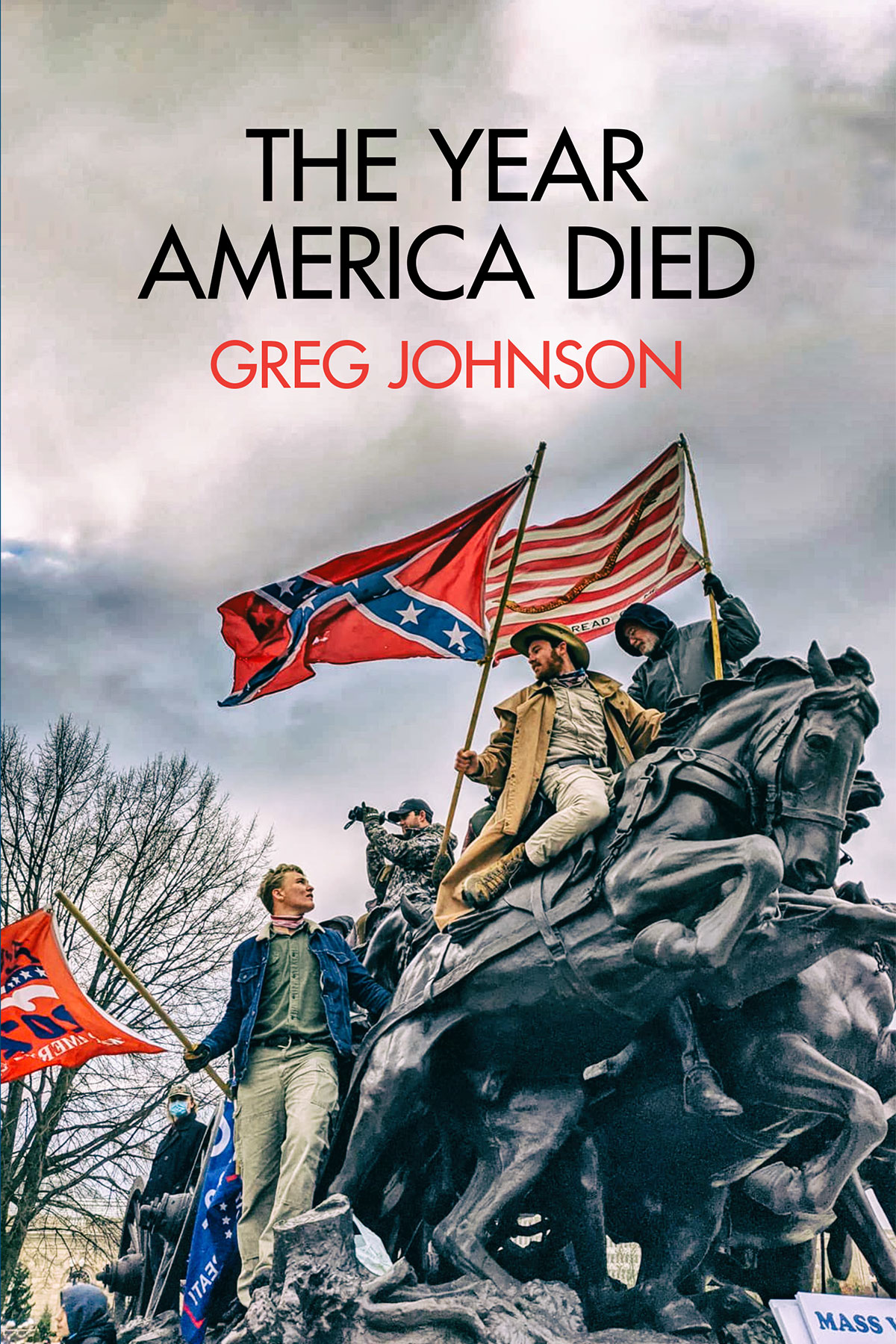
You can buy Greg Johnson’s The Year America Died here.

And fourth, Russia as a historical empire has experience in dealing with its subject peoples that the US lacks. Russia was able to convert the Chechens from sworn enemies into shock troops in a little over a decade. In contrast, the US State Department excels at alienating peoples. The US itself is certainly at risk of splintering after the events of 2020, as outlined in Greg Johnson’s The Year America Died. Russia and China are not.

This brings us to the single most important aspect of The Next 100 Years: its widespread popularity, especially among establishment policymakers and those who implement them. This could explain many of the regime’s odd decisions. For example, the establishment’s handling of the Ukraine War seems less about benefiting Ukraine than destabilizing Russia by drawing out the war at Ukraine’s expense in blood and ours in gold. This might make sense when viewed from the perspective of Friedman’s rational, yet incorrect predictions. Friedman’s claim that “Russia will most likely splinter” became “Russia will definitely splinter,” and then to “We must break Russia up to fulfill the prophecy of an American century!”

Friedman’s incorrect predictions about Russia and China threw off the rest of the predictions as well. His prophecy of a future Japanese-Turkish coalition that would fight a sci-fi-style war against the US is as intriguing as it is unlikely.

One of Friedman’s predictions that is likely to come true is that Poland and its neighbors in the Visegrád Group will become regional powers. This will indeed happen because they have no other choice. Russia is their enemy, while the US and Western Europe have become unreliable as a result of their decline. Friedman’s fundamental premise is therefore entirely correct in this instance: nations and leaders do have a kind of destiny, because their choices are constrained. History has thrust greatness upon Eastern Europe, and I wish them luck in rising to the task.

Friedman hits the mark more accurately when it comes to technological matters. I don’t know if we will see warriors fighting in armor powered by electricity beamed from space, but Elon Musk’s recent Space X endeavors are certainly turning the dream of energy transmitted from space into a reality.

Friedman also provides a much-needed sanity check on the Left’s climate hysteria. He predicts that global warming will not become an issue due to space-based energy and falling birth rates, which together will resolve the issue on their own. To this I would add that climate change is powered by the Sun more than anything else, and that a small amount of global warming could actually be beneficial for agriculture, such as it was during the medieval warming period.

Despite my criticisms, I strongly recommend The Next 100 Years because it is a fast and engaging read and a rare opportunity to meaningfully engage with an alternate viewpoint. Even Friedman’s errors are reasonable, and we can supplement his method with our facts. And while I have not yet read it, from the description of Friedman’s 2020 book, The Storm Before the Calm, it appears that Friedman is standing by his prediction that the US will ultimately prevail.

Friedman says that he is fine with being wrong, however, which gives him the courage to apply his method and sometimes make correct predictions. This is a refreshing change from the endless pursuit for hot takes that we see in both the dissident Right and the mainstream media.

* * *

Like all journals of dissident ideas, Counter-Currents depends on the support of readers like you. Help us compete with the censors of the Left and the violent accelerationists of the Right with a donation today. (The easiest way to help is with an e-check donation. All you need is your checkbook.)

GreenPay™ by Green Payment

Select donation type

Select or enter an amount to give

Select or enter an amount to give monthly

For other ways to donate, click here.

George Friedman’s The Next 100 Years

George%20Friedmanand%238217%3Bs%20The%20Next%20100%20Years%0A

Share

  • Gab

Enjoyed this article?

Be the first to leave a tip in the jar!

Instant Echeck GreenPay™

Related

  • Uncivil War

  • Zsutty’s Maximum

  • The Inferiority Behind Immigrant Superiority

  • China’s Threat to American Security

  • The Crisis of Chinese Technology Thieves

  • The Remigration Movement Solidifies 

  • Jared Taylor: What Rome Means to Me

  • An Interview with Endeavour:

Tags

2008 financial crisisassimilationbirth ratesbook reviewsChinaculturedecline of AmericaGeorge FriedmanimmigrationIslamismpaywallpredictionsrace realismRussiaRusso-Ukrainian Warspace-based energythe Iraq warThe Next 100 Yearsthe wealth gapThomas SteubenUkraine crisisUkraine WarUS-China relationsVisegrad GroupWar in UkraineWar on Terror

4 comments

  1. ArminiusMaximus says:
    May 29, 2023 at 1:01 pm

    Thank you for the review. I will give this a read. Looking at the reviews and your description it seems like the biggest issue is whether America will be a state. It is attacking the identity of its majority population, replacing its majority population making them a despised minority.

    It is hard to see how America is a global force when it is stirring up tribal passions, destroying an already abysmal primary education system, and embarking on such a rabid internal destabilization program.

    0
    0
    1. Antipodean says:
      May 29, 2023 at 1:44 pm

      The States will not break up. Five Eyes (Formerly Anglo-Saxon lands) form a superstate under complete control of the ‘Money Power’ with Jews running the show, now more or less openly. Brainwashed white women ( and men ) can be easily supplemented by compliant Chinese and Indians to run the place and completely replace us as required. This is happening now, perhaps less so in the States.  Europe is more or less enmeshed in this scheme but for it to really work they need Russia as well, hence the intransigence over the Ukraine. If China falls or can be contained they’ve won. Either way white people lose unless we collectively grow a backbone pretty jolly quick.

      0
      0
  2. The Antichomsky says:
    May 29, 2023 at 6:19 pm

    Good article.  I try to avoid books on geopolitics written by dudes named Friedman.

    0
    0
  3. Gallus says:
    May 30, 2023 at 5:47 am

    Thank you for the summary. Never heard of this book. Interesting reading.

    0
    0

Comments are closed.

If you have a Subscriber access,
simply login first to see your comment auto-approved.

Note on comments privacy & moderation

Your email is never published nor shared.

Comments are moderated. If you don't see your comment, please be patient. If approved, it will appear here soon. Do not post your comment a second time.

Upcoming podcasts
  • Rob Rundo on Counter-Currents Radio

    Rob Rundo on Counter-Currents Radio

    Counter-Currents Radio

    Sat, Jun 13th — 3 pm EST / 9 pm CET

Writers of May

(2 votes) Morris van de Camp David M. Zsutty Derek Stark Jayant Bhandari Greg Johnson

Articles of May

Heidegger on Nietzsche, Part One by Collin Cleary The Lunch Wars by David M. Zsutty 2 votes
    • Editor’s Update
      Rob Rundo on Counter-Currents Radio, Fundraiser Update, & a New $20,000 Matching Grant

      Greg Johnson

    • The Bitter End of Western Metaphysics:
      Heidegger on Nietzsche, Part Three

      Collin Cleary

      7

    • Uncivil War

      Mark Gullick

      26

    • Exclusive Interview with Karel Veliky:
      The Final Chapter in the Film Series! Part II

      Ondrej Mann

      2

    • Happy Birthday to Us!

      Greg Johnson

      6

    • Zsutty’s Maximum

      David M. Zsutty

      15

    • Exclusive Interview with Karel Veliky:
      The Final Chapter in the Film Series! Part I

      Ondrej Mann

      2

    • The Union Jackal, June 2026

      Mark Gullick

      23

    • The Inferiority Behind Immigrant Superiority

      Jayant Bhandari

      15

    • Counter-Currents Radio Podcast No. 690
      Greg Johnson & David Zsutty Discuss Current Things: AI, Henry Nowak, the Iran Crisis, & More

      Counter-Currents Radio

      5

    • Collin Cleary: What Rome Means to Me

      Collin Cleary

      4

    • Paul Krugman: Closet Bolshevik

      Spencer J. Quinn

      19

    • Fugue of Ideas:
      Ibram X. Kendi’s Chain of Ideas

      Greg Johnson

      18

    • Based Blacks

      Lipton Matthews

      12

    • Black Intellectual Fatigue

      Derek Stark

      37

    • Why White Advocates Should Avoid “Based Blacks”

      Dani Vypont

      26

    • Nietzsche & Race

      Mark Gullick

    • Editor’s Update
      Rob Rundo Rescheduled to Next Week on Counter-Currents Radio;
      Tonight Greg Johnson & David Zsutty Answer Your Questions;
      Fundraiser Update & a New $20,000 Matching Grant

      Greg Johnson

    • The Counter-Currents 2026 Fundraiser
      Lifetime Subscriber Welcome Packages Extended

      Greg Johnson

    • Nationalism This Week
      Who’s Looking Back?

      Greg Johnson

      29

    • China’s Threat to American Security:
      Food, Farmland, Foreign Control, & Energy Policy

      Lipton Matthews

      5

    • The Bitter End of Western Metaphysics:
      Heidegger on Nietzsche, Part Two

      Collin Cleary

      16

    • The Killing of Henry Nowak

      Mark Gullick

      38

    • The Crisis of Chinese Technology Thieves

      Morris van de Camp

      1

    • The Strange World of Gender Bender Fiction:
      & What This Genre Tells Us About Autosexuality

      Dani Vypont

      3

    • Watching the Watchers:
      The Dark Triad Question

      David M. Zsutty

      14

    • The Remigration Movement Solidifies

      F. Roger Devlin

      1

    • Casting Aspersions:
      The Fatal Consequences of Race-Swapped Casting, From Helen of Troy to Henry of Southampton

      Steven Tucker

      20

    • The Murder of Henry Nowak

      Millennial Woes

      23

    • Don’t Forget to Vote in Our Writer & Article of the Month Poll

      Greg Johnson

    • The Robot Hotdog Stand

      Greg Johnson

      37

    • Laughing Our Way to Victory

      Dave Chambers

      7

    • The Zodiac Killer

      Mark Gullick

      11

    • Jared Taylor: What Rome Means to Me

      Jared Taylor

      1

    • An Interview with Endeavour:
      My Way of Life Is an Adventure!

      Ondrej Mann

      6

    • José Pedro Zúquete’s The Identitarians

      Greg Johnson

      3

    • Editor’s Update
      Fundraiser Update & How to Watch the Remigration Summit

      Greg Johnson

      5

    • The Bitter End of Western Metaphysics:
      Heidegger on Nietzsche, Part One

      Collin Cleary

      12

    • Berlin: City of Stones

      Spencer J. Quinn

      6

    • True Folk-Horror Is Horror of Your Own Folk:
      Mark Gatiss vs the Brexit Blind Dead  

      Steven Tucker

      4

    • Counter-Currents Radio Podcast No. 689
      Thomas Massie, the America 2050 Bust, the Need for Whites to Divest from America, the AI Economic Apocalypse, & Pro-White Project Pitches to Billionaires

      Counter-Currents Radio

      7

    • Nationalism This Week
      Remigration is Inevitable, Part 3

      Greg Johnson

      27

    • Why Billionaires Should Fund White Identity Politics

      Lipton Matthews

      8

    • How Cold War Two Came About

      Morris van de Camp

      5

    • Now Available for Pre-Order at a Special Price!
      Greg Johnson’s The Philosopher Is In

      Greg Johnson

    • David Zsutty’s Elevator Pitch to a Billionaire

      David M. Zsutty

      1

    • Headbanging Lite

      Mark Gullick

      5

    • White Advocacy Past and Present

      Peter Bradley

      13

    • The Lunch Wars

      David M. Zsutty

      47

    • The Russians are Coming/The Russians are Coming

      Steven Clark

      1

    • kolokol

      Uncivil War

      Stephen Ogilvie is the latest example of a decent, hard-working White person, killed by a useless...

    • Dr. X

      Uncivil War

      Great writeup. One error- I doubt the Republic of Ireland police (Garda) were responding on the...

    • kolokol

      Uncivil War

      This is a very good start. May it continue and accelerate, until all the invaders have been expelled...

    • Observer

      The Bitter End of Western Metaphysics:
      Heidegger on Nietzsche, Part Three

      Ouch. Well, I had used the bullet formatting in the text box to break it up a bit... but it looks...

    • Gabe

      Uncivil War

      Scots-Irish is an American term. It's true that Presbyterians and others came from Scotland to...

    • Gabe

      Uncivil War

      I was just going to write that myself. The Garda Siochána, or guards, is a term they use in the...

    • Ondrej Mann

      Exclusive Interview with Karel Veliky:
      The Final Chapter in the Film Series! Part II

      Thanks for the cultural tip. I’m currently preparing an interview for CC with the Austrian band...

    • Observer

      The Bitter End of Western Metaphysics:
      Heidegger on Nietzsche, Part Three

      Also, a semi-related topic, but have you read Darren Beattie's Heidegger PhD thesis? I know that it...

    • Observer

      The Bitter End of Western Metaphysics:
      Heidegger on Nietzsche, Part Three

      My mood is always improved by a fresh Cleary article. Great work as always. It's always fun to see...

    • Joe Gould

      Zsutty’s Maximum

      "That Whites are the only racial ingroup in which there seems to be any significant number of...

    • Nicholas

      Paul Krugman: Closet Bolshevik

      https://youtu.be/02MV3DD5pFc This is the link I intended to share. Let's hope this works.

    • Greg Johnson

      Zsutty’s Maximum

      All groups are mean to one another, to some extent. The question is whether this level of ingroup...

    • Joe Gould

      Uncivil War

      For Whites, one of the goals of philosophy, and of education in general, has to be this: we must...

    • Dani Vypont

      Uncivil War

      Northern Ireland has been in a civil war, both hot and cold, for decades. This religiously and...

    • David M. Zsutty

      Zsutty’s Maximum

      That Whites can be very mean to each other is a correct observation. However, this is a case of...

    • Scott

      Why White Advocates Should Avoid “Based Blacks”

      Will Williams wrote: "Scott, it’s interesting that you call George Stephanopoulos a “Clinton...

    • Scott

      Paul Krugman: Closet Bolshevik

      Yeah, Trump is the most Kosher President to come down the pike ─ except for the last one, and the...

    • C#

      The Bitter End of Western Metaphysics:
      Heidegger on Nietzsche, Part Three

      Well, that was depressing. Enlightening, but depressing. Personally, I suffer from the baggage of...

    • dogbone

      Based Blacks

      lol - I'd much rather watch Tate than Shapiro any day.

    • Joe Gould

      Uncivil War

      Confronting the police, which really means appealing to the police to do their jobs, gets you three...

    • Earth Day Special

      John Morgan

      12

    • A Robertson Roundup
      Remembering Wilmot Robertson
      (April 16, 1915 – July 8, 2005)

      Margot Metroland

      13

    • The Paranoid Style in White Nationalism

      Greg Johnson

      30

    • Join the Dance!

      Andrew Hamilton

      1

    • We Can’t Save the Earth Without Reducing African Birth Rates

      James Dunphy

      36

    • “I’m Not a Conspiracy Theorist, but . . .”:
      Jeffrey Epstein’s Death Gives New Life to “Conspiracy Theories”

      Greg Johnson

      22

    • Sylvia Plath: Stasis in Darkness

      Vic Olvir

      17

    • Vanguardism, Vantardism, & Mainstreaming

      Greg Johnson

      80

    • Aviation, Geography, & Race

      Charles Lindbergh

      3

    • Some Thoughts on Yule

      Collin Cleary

      4

    • Living in Truth:
      A Yuletide Homily

      Jef Costello

      7

    • John Kennedy Toole’s A Confederacy of Dunces

      Greg Johnson

      20

    • On Aleksandr Solzhenitsyn’s Warning to the West

      Spencer J. Quinn

      7

    • Elitism, British Modernism, & Wyndham Lewis

      Jonathan Bowden

      6

    • Philip K. Dick’s Do Androids Dream of Electric Sheep? as Anti-Semitic/Christian-Gnostic Allegory

      Greg Johnson

      20

    • “Conspiracy Theory” or Conspiracy?

      Andrew Hamilton

      21

    • Remembering H. P. Lovecraft
      (August 20, 1890–March 15, 1937)

      Greg Johnson

      3

    • Who Are We?
      Nordics, Aryans, & Whites

      Greg Johnson

      71

    • Remembering William Gayley Simpson
      (July 23, 1892–December 31, 1990)
      A Pleasant Afternoon with Harriet & Bill Simpson

      Margot Metroland

      18

    • Here are the Young Men
      Remembering Ian Curtis
      (July 15, 1956–May 18, 1980)

      Mark Gullick

      18

    • Percy Grainger
      Artist of the Right

      Alex Graham

      7

    • Remembering Revilo Oliver
      (July 7, 1908–August 20, 1994)

      Greg Johnson

      18

    • The Meaning of July 4th for the White Man

      Gregory Hood

      13

    • The Front National’s Evolution

      Bruno Mégret

    • Merwin K. Hart
      Forgotten American Hero & Man of the Right

      Morris van de Camp

      10

    • George Orwell’s Nineteen Eighty-Four

      Jonathan Bowden

      8

    • Carleton S. Coon
      Scientist & Reluctant White Advocate

      Morris van de Camp

      3

    • The Kwanzaa Absurdity Will Be Dwarfed by Juneteenth

      Robert Hampton

      10

    • Stravinsky

      Alex Graham

      7

    • Like the Roman:
      Remembering Enoch Powell (1912-1998)

      Mark Gullick

      23

    • Jonathan Bowden’s Deliverance
      Part 6

      Jonathan Bowden

    • Do You Want to Play a Game?

      Mark Gullick

      1

    • Sexually Incontinent on the Indian Subcontinent:
      Who Rapes More Animals, Indians or Pakistanis? The Battle Continues!

      Steven Tucker

      3

    • Neo-Fascism in Film
      Part 5

      Karel Veliky

      15

    • The Game of Tarot

      Mark Gullick

      2

    • Institutions Cannot Be Transplanted

      Jayant Bhandari

      5

    • Jonathan Bowden’s Deliverance
      Part 5

      Jonathan Bowden

    • Crosstown Traffic:
      Jimi Hendrix & The Post-War Rock ‘N’ Roll Revolution

      Mark Gullick

      1

    • Slaves from the North:
      Finns & Karelians in the East European Slave Trade, 900–1600

      Lipton Matthews

      14

    • Neo-Fascism in Film
      Part 4

      Karel Veliky

      2

    • David Lean’s A Passage to India

      Spencer J. Quinn

      1

    • Elites are Essential to Development

      Lipton Matthews

      7

    • Jonathan Bowden’s Deliverance
      Part 4

      Jonathan Bowden

    • Neo-Fascism in Film
      Part 3

      Karel Veliky

      6

    • E. M. Forster’s A Passage to India & the Indian Mentality

      Spencer J. Quinn

      25

    • Jonathan Bowden’s Deliverance
      Part 3

      Jonathan Bowden

    • The Rest Is Silence
      Heidegger’s Quietism

      Mark Gullick

      2

    • Dispelling the Historical Fallacy of Indian Nationalism

      Lipton Matthews

      8

    • Neo-Fascism in Film
      Part 2

      Karel Veliky

      8

    • Jonathan Bowden’s Deliverance
      Part 2

      Jonathan Bowden

    • Life of a Klansman

      Mark Gullick

      8

    • Jonathan Bowden’s Deliverance, Part 1

      Jonathan Bowden

    • Decolonial Ideas are Holding Back Developing Countries

      Lipton Matthews

      8

    • Neo-fascism in Film, Part 1

      Karel Veliky

      21

    • Jonathan Bowden’s Onslaught, Part 8
      Divigations on Decadence

      Jonathan Bowden

    • Jonathan Bowden’s Onslaught, Part 7
      Intrigues in the National Front

      Jonathan Bowden

      1

    • Rotten to the Core

      Mark Gullick

      8

    • Strauss on Husserl’s “Philosophy as Rigorous Science”

      Greg Johnson

    • Jonathan Bowden’s Onslaught, Part 6
      Francis Bacon & Right-Wing Nihilism

      Jonathan Bowden

    • London After (& Before) Midnight:
      Aleister Crowley, The Landlord’s Worst Nightmare

      James J. O'Meara

      2

    • András László
    • Derek Hawthorne
    • Beau Albrecht
    • Alain de Benoist
    • Kerry Bolton
    • Jonathan Bowden
    • Collin Cleary
    • Jef Costello
    • Savitri Devi
    • Julius Evola
    • Jim Goad
    • Gregory Hood
    • Juleigh Howard-Hobson
    • Greg Johnson
    • Charles Krafft
    • Anthony M. Ludovici
    • Trevor Lynch
    • H. L. Mencken
    • J. A. Nicholl
    • James J. O’Meara
    • Christopher Pankhurst
    • Tito Perdue
    • Michael Polignano
    • Spencer J. Quinn
    • Fenek Solère
    • Irmin Vinson
    • Leo Yankevich
    • Francis Parker Yockey
    • Multiple authors
  • Editor-in-Chief

    • Greg Johnson, Ph.D.

    Featured Writers

    • Beau Albrecht
    • Gunnar Alfredsson
    • Collin Cleary, Ph.D.
    • Jef Costello
    • Morris V. de Camp
    • F. Roger Devlin, Ph.D.
    • Stephen Paul Foster, Ph.D.
    • Jim Goad
    • Alex Graham
    • Mark Gullick, Ph.D.
    • Greg Johnson, Ph.D.
    • Travis LeBlanc
    • Trevor Lynch
    • Margot Metroland
    • James J. O’Meara
    • Angelo Plume
    • Spencer J. Quinn
    • Fred Reed
    • Clarissa Schnabel
    • Michael Walker
    • David M. Zsutty

    Frequent Writers

    • Asier Abadroa
    • Aquilonius
    • Alain de Benoist
    • Kerry Bolton, Ph.D.
    • Dave Chambers
    • Steven Clark
    • James Dunphy
    • Endeavour
    • Richard Houck
    • Jason Kessler
    • Titus Livius
    • Ondrej Mann
    • Lipton Matthews
    • Mark Mazari
    • John Morgan
    • Jaroslav Ostrogniew
    • Kathryn S.
    • Christian Secor
    • Anne Wilson Smith
    • Thomas Steuben
    • William De Vere
    • Kenneth Vinther
    • Max West

    Classic Authors

    • Maurice Bardèche
    • Jonathan Bowden
    • Julius Evola
    • Guillaume Faye
    • Ernst Jünger
    • Kevin MacDonald, Ph.D.
    • D. H. Lawrence
    • Charles Lindbergh
    • Jack London
    • H. P. Lovecraft
    • Anthony M. Ludovici
    • Sir Oswald Mosley
    • National Vanguard
    • Friedrich Nietzsche
    • Revilo Oliver
    • William Pierce
    • Ezra Pound
    • Saint-Loup
    • Savitri Devi
    • Carl Schmitt
    • Miguel Serrano
    • Oswald Spengler
    • P. R. Stephensen
    • Jean Thiriart
    • John Tyndall
    • Dominique Venner
    • Leo Yankevich
    • Francis Parker Yockey

    Other Authors

    • Howe Abbott-Hiss
    • Michael Bell
    • Giles Corey
    • Jack Donovan
    • Richardo Duchesne, Ph.D.
    • Emile Durand
    • Guillaume Durocher
    • Mark Dyal
    • Tom Goodroch
    • Andrew Hamilton
    • Robert Hampton
    • Huntley Haverstock
    • Derek Hawthorne
    • Gregory Hood
    • Juleigh Howard-Hobson
    • Alexander Jacob
    • Ruuben Kaalep
    • Tobias Langdon
    • Julian Langness
    • Patrick Le Brun
    • G A Malvicini
    • John Michael McCloughlin
    • Millennial Woes
    • Michael O’Meara
    • Christopher Pankhurst
    • Michael Polignano
    • J. J. Przybylski
    • Quintilian
    • Edouard Rix
    • C. B. Robertson
    • C. F. Robinson
    • Herve Ryssen
    • Alan Smithee
    • Fenek Solere
    • Ann Sterzinger
    • Robert Steuckers
    • Tomislav Sunic
    • Donald Thoresen
    • Marian Van Court
    • Irmin Vinson
    • Book Reviews
    • Movie Reviews
    • TV Reviews
    • Music Reviews
    • Art Criticism
    • Graphic Novels & Comics
    • Video Game Reviews
    • Fiction
    • Poems
    • Interviews
    • Videos
    • English Translations
    • Other Languages
      • Arabic
      • Bulgarian
      • Croatian
      • Czech
      • Danish
      • Dutch
      • Estonian
      • Finnish
      • French
      • German
      • Greek
      • Hungarian
      • Italian
      • Lithuanian
      • Norwegian
      • Polish
      • Portuguese
      • Romanian
      • Russian
      • Slovak
      • Spanish
      • Swedish
      • Ukrainian
    • Commemorations
    • Why We Write
  • Archives
  • Top 100 Commenters
  • The Looney Bin
Sponsored Links
Europa.com Above Time Coffee Antelope Hill Publishing Paul Waggener IHR-Store Spencer J. Quinn American Renaissance Jim Goad The Occidental Observer
Donate Now Mailing list
Books for sale
  • The Philosopher Is In
  • Sexual Utopia in Power (Expanded Edition)
  • In Defense of Prejudice
  • Loving Our Own
  • Tyranny & Wisdom
  • The Populist Moment
  • Is America Doomed?
  • To all books
Copyright © 2026 Counter-Currents Publishing, Ltd.

Paywall Access


Please enter your email address.

Lost your password?

Edit your comment

Writer & Article of the Month May 2026

Voting for this month has concluded. Here are the final results!

Top Writers

  • #1 Morris van de Camp 2 votes
  • #2 David M. Zsutty 2 votes
  • #3 Derek Stark 2 votes
  • #4 Jayant Bhandari 2 votes
  • #5 Greg Johnson 2 votes
  • #6 Jared Taylor 1 vote
  • #7 Collin Cleary 1 vote
  • #8 Spencer J. Quinn 1 vote
  • #9 Mark Gullick 1 vote
  • #10 Lipton Matthews 1 vote
  • #11 Keith Woods 1 vote
  • #12 Steven Tucker 1 vote

Top Articles

  • #1 Heidegger on Nietzsche, Part One 2 votes
  • #2 The Lunch Wars 2 votes
  • #3 The Ghost of the Confederacy 1 vote
  • #4 Lothrop Stoddard’s The Revolt Against Civilization 1 vote
  • #5 Could Fascism Work? 1 vote
  • #6 Jared Taylor's Elevator Pitch to a Billionaire 1 vote
  • #7 Predation Wearing the Mask of Civilization 1 vote
  • #8 Peak Fatigue in Fort Wayne 1 vote
  • #9 Keith Wood's Elevator Pitch to a Billionaire 1 vote
  • #10 Do You Want to Play a Game? 1 vote
  • #11 Why Billionaires Should Fund White Identity Politics 1 vote
  • #12 The 1970s: The Golden Age of Hijacking 1 vote
  • #13 True Folk-Horror Is Horror of Your Own Folk 1 vote
  • #14 Finding Atlantis Part 4 1 vote
  • #15 Berlin: City of Stones 1 vote

Total votes cast: 17