 3,203 words
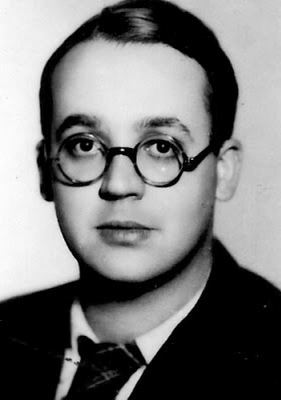
Editor’s Note: March 31st marks the 117th birthday of Robert Brasillach, the French journalist, novelist, film historian, and man of the Right who was sentenced to death and executed by firing squad for “intellectual crimes” he was alleged to have committed as a German collaborator during the Second World War. The translation below is offered as a commemoration, and links to other resources regarding Brasillach’s life and work are at the end.
Robert Brasillach & Notre avant-guerre:
The Pre-Phony War (Part II)
* * *
In our last episode of his memoir Notre avant-guerre, Robert Brasillach told us what it was like in September 1938, when he was suddenly called up for mobilization over the Sudetenland crisis, and found himself, like thousands of others, lost in the haste and confusion.
For days on end, Brasillach rides slow trains out to the northeast of France, at one point discovering that his unit was sent to the wrong place entirely, and they were supposed to go to Alsace. He starts the journey again and engages in conversation with some pugnacious workingmen who make it clear they don’t trust politicians or whoever is behind this war scare, but they’re ready to defend themselves and their country from any and all attacks.
As we resume the story, everyone is still on the train, and Brasillach gives us impressionistic memories of his long ride and many mood swings in the last days before Munich.
From Avant notre-guerre:
* * *
….It would have been a waste of time to point out that no one was attacking them right now. But it wasn’t at all disagreeable to watch. It was just the simple healthy reflex of a man ready to fight and defend himself, whether he’s right or wrong.
They also wanted to talk with me about Germany, more out of curiosity than hatred. I expected them to be full of weird ideas, but their proletarian notion of absolute power was something I found utterly hilarious:
— In Germany, the people eat sauerkraut, but Hitler and Göring eat chicken!
They didn’t mean any harm in this. It struck me that they were all aware Hitler had been doing a lot for the working class. They knew that Hitler was a man of the People. One of them summed it up bluntly:
— Basically, Hitler’s got some really good points.
From these days and nights on the train, some faces are going to stick with me for a long time. I can see again that metalworker from Nord…widowed for five months with two children…he’s got on a dark blue shirt, with white polka dots. He’s just left that morning, and already has had a lot to drink. He shows me photos of his kids.
And then I see the Breton peasant who barely speaks French, and hasn’t eaten since morning. All these people are good. And they can be great, so long as we don’t misuse them. Is there any shame in admitting that for a few hours I had more affection for this guy than I’d ever felt for anyone?
And now we were thrust into the night, rolling on through the dark countryside. In my memory, the whole journey seems to take place at night. Even the daytime seems nocturnal in color, with the train compartments always warm and smoky. Outside, we see Laon at night…then Guise in the morning, and some empty buses in the foggy countryside. Later, Nancy at night…some slippery roads…stations buried in the shadows. In memory’s eye everything has the same appearance for me, a long darkness streaked with blue lights.
Twice, a prankster sounds the alarm and stalls this train that’s been chugging along at 100 km an hour. We pass around our bottles of vin rouge, but we eat little. Sometimes there’s a bizarre scene. A former sergeant from the last war suddenly feels the need to explain in detail how one gets out of the trench when the attack comes. And how it is not as easy as one thinks to remove a bayonet from a belly! «You have to stick your foot here!» The two poor guys who have to listen to him turn a little green, don’t dare to say anything. I silence him, as kindly as possible, and he goes:
— It’s very important that I explain this all to them! They’ll see for themselves when they get there!
The two listeners now give me a grateful look, I think.
Everyone shows me their call-up booklets, and pump me with extravagant questions. They have a funny confidence about them. They pass me the bottle, and try to find out if I think “like them”: I mean, whether I’m a communist! I tell them no. But it’s all the same to them. I drink, they drink, and their talk is as open and frank as ever. I’m thinking, I’ve never been on a journey like this before. Such profundity and such frankness.
This mobilization of September 1938 only lasted two days[1], but it taught us some great lessons—or at least it would have, if we’d bothered to understand them! It would have made up for all the hazy guesswork we got a year later, all those mistakes and inconveniences we went through in 1939-40. But we didn’t make much use of the experience at all, did we? So many tragic blunders we could have avoided if we’d only paid attention. For example, the utter lack of organization and discipline.
During this journey, we passed through one city on a Sunday morning, and there were thousands of men milling about the train station, men not yet in uniform. They’d been up all night, attacking cafés, trying to plunder the cellars of restaurants.
“They wanted to throw a marbletop table at my head,” one café’s patronne told me, not so much terrified of the danger as bothered by the inconvenience.
Everything in this town was shuttered, even the grocery stores. Iron curtains were pulled down over all the shopfronts. Even now, though, we weren’t particularly worried. No, indeed! We were counting on the French genius for improvisation to pull us through. The word I heard most often on these trips was, naturally enough, pagaïe. As in: Quelle pagaïe! What a mess!
Ah yes! What messes indeed! But they were messes we’d slip out of, more or less, with unexpected joy and eagerness. None of us did the tasks we were supposedly assigned to. No, we all ran around doing different crazy chores. Some local nuns took on the job of feeding the men, since there was no official organization yet. A young mayor, age 27, showed up with prodigious energy; he helped with everything. We and our new comrades would take charge of loading bundles of gas disinfectants and typewriters, when there wasn’t so much as a mobilization order provided for this stuff.
I have never in my life signed more papers that I had no right to sign, being in no way an officer of this train, just another guy waiting to be directed somewhere. We’d stop people on the roads and give them vouchers for their cars. In short, we felt the intoxication of absolute power.
And we enjoyed all this, working with these good guys we met in Lorraine, all of them in good humor. And then their ladies coming by in the afternoon, bringing bottles and snacks. Such familiarity is perhaps the key factor in supporting a strong and cohesive army.
But then on Monday we had a depressing afternoon, just before Hitler made his big speech[2]. In Nancy, where we’d just been, Havas[3] put out the most pessimistic news bulletin. And Sarraut[4] was giving evacuation advice to the Parisians.
Now, we all thought: this is it! But around two o’clock in the morning, we reopened a local bistro to drink beer with the Lorraine men who had been helping us. We heard about Hitler’s speech, and an Alsatian gave us his impression of what was said. Suddenly we regained confidence.[5]
Two charming days followed. The parish priest offered me some mirabelle plums. I tried to teach the officers some Fascist songs. I got myself a chauffeur, naturally enough an eccentric one called Gaxotte. He dressed in a multicolored scarf and fantastic jodhpurs. What a wild fellow, I thought. Some of the local rightists recognized me and they let me know, with some well-chosen watchwords, that there were some formidable nationalist cells hereabouts.
By Wednesday morning, it sounded as though Paris had faced the inevitable and was accepting the certainty of war. Beginning on Monday night, we’d seen motorcyclists arrive by the train, carrying orders. We harpooned a few of these riders and put the question to them: those orders—is that the call for general mobilization? No, it turned they were just routine pre-mobilization reminders, what they called «numéro 6».
Life was good, it now seemed. And then for a little while, we didn’t know anything or hear any new reports. For some pathetic hours on Wednesday, I felt I was in nothing more than a chaotic, disorganized roll-call. Long lines of cars would drive in, ready to depart at dawn. But the weather at least was nice.
I learned some of my comrades were looking for a car for me, not so much to impress me as to allow me to ride in a normal vehicle for a day or two. One new companion was a very friendly marshal of the local “Fascist” cell, so I secretly passed him some factional newspapers.
And soon enough the trucks with their tarpaulins, the “coaches of Lorraine,” as we called them, were loaded, and got ready to depart. The whole village gathered at the gates to watch the armies of the Republic leave, in our cars and those transport vehicles. On some trucks, we noticed the name: Louis Dixneuf. This wasn’t some new royal pretender, or the last Dauphin of France.[6] No, it turned out to be just the name of some wholesale grocer whose vehicles had been requisitioned! And so, by a charming irony of fate, we were amused to see our column suddenly become the army of Louis XIX, the last king of France!
And now, it’s matin profond, deep morning. The motorcyclists go up the column, the road brigade marks our route…and does it badly enough that we get lost. But all is well, there’s not too much traffic here otherwise. Just a few civilian cars loaded with red quilts and packages, evacuees from the cities. Sometimes we’d also see cars marked with a D for Deutschland, driving about peacefully. How can we believe there’s going to be war? We are here, very relaxed, and a lot more free-spirited than the folks in Paris.
The weather is cool and fine; from here you can see Baccarat, and over there is the road to Sion; and there is Saint-Nicolas-du-Port, and then Saverne. So the armies of Louis XIX haven’t lost their way.
Approaching another little village, in Alsace this time, we’re driving by night and see four blue lights signaling the intersection. The locals walk about with lamps in hand, under the starry sky. Beautiful weather, the early part of this week, as we drive into the fortified regions.[7] In Paris the weather might be bad, but the rain hasn’t reached us. Later on it will come and spoil the open-air bivouacs, but not now.
The cafés in these parts—it seems we’re not closing them here. They only have their shutters locked. And we’re able to review what the Spanish War already showed us some months ago: the role played today by the T.S.F.[8] On the evening of Hitler’s speech, [and on] the evening when the Munich conference was announced, everyone keeps quiet and listens in.[9] We also get to hear Roosevelt’s good words, and the Pope’s moving speech. Out in the streets, near the shuttered windows, soldiers and civilians gather around, to listen to these voices coming out of the radio boxes. It’s dark out when the speeches come on, with words that will mean peace or war.
All these details give color to that strange week we lived. There were serious happenings, and funny ones. It now seems to me I left Paris two months ago…but actually it has been only four days. Out here, in Lorraine and Alsace, we don’t know any news until we finally hear it that evening by the radio. We are lucky to avoid the Parisian panic. Everything is far from us. For those of us out here and not locked up in the casemates[10], and even for the civilians in the region, it’s like we’re all enveloped in a special universe. What helps make it all bearable, even pleasant, is the irony with which everyone accepts comic events. An irony that’s never lacking in the lives of men who gather together in great hordes.
* * *
It would have been surprising if the Jewish question did not arise, somehow, during this mobilization. While riding in from Nancy I was struck by some talk I heard from an exceptional lady who turned out to look like a frightened peasant woman. She was making some pretty violent remarks about Israel[11]. I recall how an officer tried to explain it to me:
Jewish communities in Alsace were correct and proper, and from the start always tried to make themselves congenial and available to us. Of course it’s true (he added) that the story of Israel interests them. But in Alsace we know very old communities that, until recently, got along well with the French. They have given, for many years, proofs of loyalty, similar to those given by the loyal Kabyle [Algerian Berber] tribes[12].
The only problem is that, since the peace [1918], Alsace and part of Lorraine have been the favorite invasion lands of the chosen people [from the East]. And all their Jewish warmongering excitement has borne fruit. And we ransacked, here and there, shops whose owners had had only nice words to say about France. Some Jews got attacked. In Nancy, I saw a fur shop that got completely demolished. Next day, on the palisade that separated the shop from the street, some of us had written: “France for the French.” The owner must have been taken to the hospital, where, I was told, he died.
As though pursued by Jehovah, when I arrived in Alsace —in a car requisitioned by one Lieutenant Dreyfus—I was immediately housed with a Mr. Blum! Above my bed, a calendar with the portraits of the last four presidents of the Republic. Everywhere in the village, the merchants are Juifs: Abraham, Latzarus, Bloch, Jud, Brunschwig, Levi. And twenty-four hours later, the Jewish military chaplain showed up, and he was entrusted to me!
The fact that a co-editor of Je suis partout now became responsible for organizing Israelite worship in the fortified region, is surely one of those things that make us believe that irony is the fourth theological virtue.
Monsieur Rabbi the military chaplain himself looked like a man of peace. He told me that his family had been in Alsace for three centuries, and he refused to get cozy with the local rabbi. So now I learned that there is a rabbi and then there is a rabbi; that the French Israelite soldier was a true one, with the civilian only a kind of sub-deacon; and finally that the dignity of a true rabbi forbade him to sleep with the quasi-rabbi!
As Wednesday, October 4, was the feast of Great Forgiveness or Yom Kippur, it was necessary to make things easier for the Jewish mobilized.
— They must not be many, says this dignified man without malice.
I hastened, of course, to help the rabbi in his duties. Unfortunately, the military authority had just requisitioned the local cantor’s house and his oratory.
—It’s a profanity, whispered the rabbi.
—Has the prayer pulpit been moved? I asked.
—Certainly. You shouldn’t touch it. At least, promise me that no one will sleep in the oratory.
We swore it to him. Moreover, we could not immediately occupy the oratory, because despite prolonged disinfection, there was an abominable sweet and fragrant smell, intermediate between that of urine and that of Armenian paper, for which all the goyim present searched in vain for the cause.
Notes
[1] The call-ups and transports of September 1938 are not rated as “mobilization” in most accounts, for whatever reason. “Pre-mobilization” might be more precise here, and Brasillach’s ordeal stretched over nearly two weeks, not two days.
[2] Hitler made two speeches in September 1938 regarding the Sudetenland, on Monday the 12th at Nuremberg and two weeks later at the Sportspalast, following his meeting with Neville Chamberlain in Bad Godesberg. This would be the latter speech, though it is not clear why some believed it was mollifying.
[3] Havas: French news agency (founded 1835), now worldwide public relations and advertising conglomerate.
[4] Albert Sarraut, politician and newspaper publisher, twice prime minister in the 1930s.
[5] One gathers this new confidence had more to do with the late-night relaxation in the bistro than anything Hitler may have said.
[6] Louis Antoine, Duke of Angoulême, was the son of the abdicated Charles X, and is said to have ruled for 30 minutes in 1830. Known to Legitimists as Louis XIX.
[7] “Fortified regions”: Brasillach avoids naming the Maginot Line—an embarrassing memory by time of publication in 1941, perhaps?
[8] T.S.F.: the French wireless telegraphy system, but Brasillach clearly also means broadcast audio. In the last two years of the Spanish war, the Reds and Republicans were at a disadvantage when their two holdout regions (Madrid and the Northeast) became isolated from each other, with limited communication. The Nationalists however built a robust system, partly with mobile transmitters from Germany.
[9] The Munich Conference was first announced on (Wednesday) September 28, two days after Hitler’s intransigent speech in the Sportpalast. Brasillach is perhaps misremembering the dates.
[10] The gun emplacements in the unmentioned Maginot Line.
[11] We must assume that “Israel” does not mean Palestine, but Jews in general, for reasons explained below.
[12] A curious fact about the Algerian troubles of the 1950s, something about which Charles de Gaulle was quite aware, is that a large minority of the “French” citizens of French Algeria were Jewish. And not vineyard owners or manufacturers from Alsace, for the most part, but Sephardic Jews who had been in the region for many hundreds of years; as long as the Arabs, in fact. During the Franco-Prussian War the Jews in Algeria were all granted French citizenship (Cremieux Decree). But the Arabs and even the pro-French Berbers received no blanket decree. French people might forget about this, but the Moslem populations of North Africa surely would not. Furthermore, Jews native to Metropolitan France were not regarded as “Jews” by law. They were considered fully French, in a special category called “Israelite.” The officer giving his account in this passage is thus explaining the accepted distinction between Jewish people with a long history in France, and “Jews,” which in legal parlance referred to recent immigrants to France, largely from Eastern Europe in the 1930s. The officer’s complaint encompasses these many shades of ambiguity, as well as a complacent belief that the old “Israelites” were loyal Frenchmen, unlike these troublesome new arrivals. And then we find that the Alsatian military rabbi likes the latter even less.
2 comments
Thank you for the article and for the reminder.
Thank you for the excerpt from Avant notre-guerre. If these memoirs were to be published on the CC website in a series, I would be grateful to the translator. I enjoy the works of Robert Brasillach and other collaborators. This particular excerpt is similar to the beginning of Journey to the End of the Night by Louis-Ferdinand Céline.
If you have a Subscriber access,
simply login first to see your comment auto-approved.
Note on comments privacy & moderation
Your email is never published nor shared.
Comments are moderated. If you don't see your comment, please be patient. If approved, it will appear here soon. Do not post your comment a second time.