 1,936 words
Some of the most profound stories in cinema come from the unlikeliest of places. Who would have thought that a low-budget, Apartheid-era South African comedy featuring a San Bushman from Namibia, could ring so true after so many years?
The genius behind Jamie Uys’ The Gods Must Be Crazy reveals itself in many ways, most notably through its dynamic use of the classic journey trope. It’s like the subtitle of Tolkien’s The Hobbit: “There and back again.” Except with Gods we also have a mirror journey—one through a patchwork of cherished movie and television genres. One can call it a loving homage of twentieth-century entertainment. There’s also the film’s undisguised amateurishness and technical limitations, which often plays itself off humorously. More important is the film’s complete rejection of cynicism and its undeniable, indefatigable sweetness which somehow overcomes its not insignificant portrayal of violence and death. Finally, there’s the film’s tacit and thoroughly benign nod to race realism (and wildlife realism). This is Africa, after all. And Uys, who wrote, produced, edited, and directed The Gods Must Be Crazy knew Africa.
Xi (played by real-life Bushman N!Xau ǂToma) is a simple farmer in the Kalahari Desert who shares his tranquil life with his extended family in his isolated village. He is, quite literally, Rousseau’s noble savage—generous and kind, primitive and ignorant, yet perfectly suited for his harsh environment. Striking the pedagogical tone of a nature documentary, the film’s narrator tells us about the “little people of the Kalahari.” Naturally, he has a snooty British accent and condescends to his subjects as if they were a cute family of meerkats making their way in the world.
Pretty, dainty, small, and graceful, the Bushmen. Where any other person would die of thirst in a few days, they live quite contentedly in this desert that doesn’t look like a desert. They know where to dig for roots and bugs and tubers, and which berries and pods are good to eat. And of course, they know what to do about water. For instance, in the early morning you can collect dew drops from leaves that were carefully laid out the previous evening.
By running so hard with the hackneyed noble savage trope right out of the gate, the audience must realize that this isn’t real—although, anthropologically speaking, it is. The survival techniques described above and depicted elsewhere in the film are based in fact. Dew harvesting, for example, happens in many arid places across the world, especially in the Sahara. Yet, Uys appears to be spoofing the ideologically addled mindset which led to the Gentle Tasaday hoax from the 1970s. One can go to Margaret Mead and her mischaracterization of the indigenous peoples of Samoa in the 1930s for the genesis of that. Even back in 1980, few Bushmen were as isolated and primitive as they are portrayed in The Gods Must be Crazy. In a sense, Xi and his fellow villagers are as real as the Hobbits of the Shire. And like the Hobbits of the Shire, it’s impossible not to feel for them.
As with all classic myths, something happens to upset the stasis which Xi and his family enjoy—something which forces him to go to great lengths to fix the problem. He thus becomes a stand-in for Joseph Campbell’s epic hero who must embark on a journey of cosmic proportions and risk being changed forever. He must mingle with the gods in order to save the souls of his people. And what happens that causes all of this?
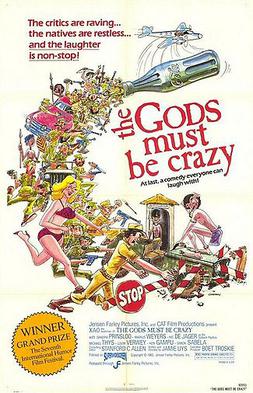
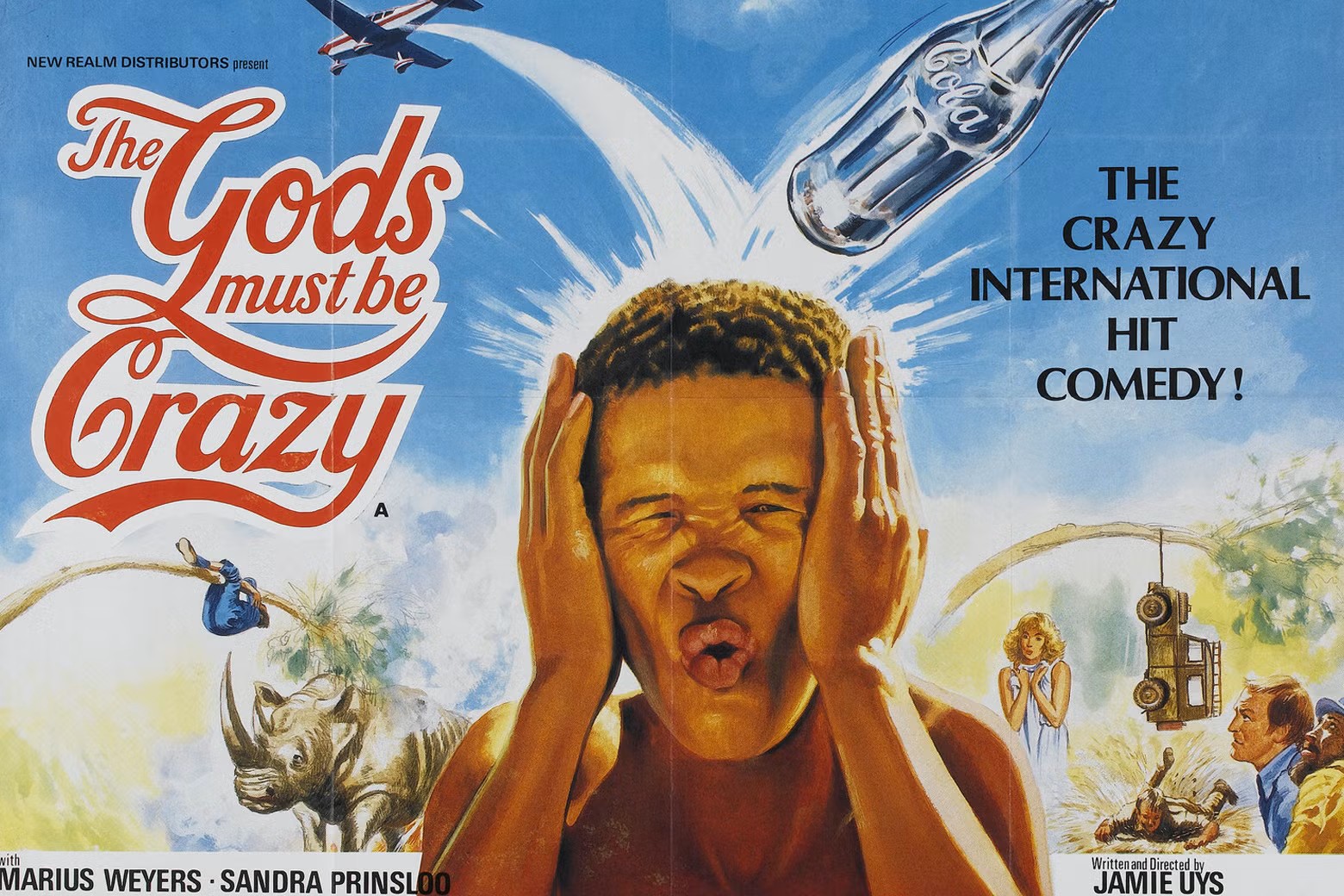
A glass Coke bottle falls out of an airplane and lands in the sand. Xi and his people do not know what to make of this magnificent object and assume it was ineffably bestowed upon them by the gods. They try to use it in a variety of ways, and quickly grow so fond of it that petty jealousies and violent rivalries erupt over it. Seeing that this unholy object is breaking apart his village, Xi takes it upon himself to dispose of it by throwing it off the edge of the Earth.
 Like any brilliantly conceived work of art, The Gods Must be Crazy simultaneously operates on many levels. On one level, Xi is the archetypical mythic hero. His travails do roughly match the circular “Hero’s Journey” as mapped out by Campbell. On another, he’s a benighted aboriginal going on a fool’s errand. This is laughably obvious. On another level, he’s Don Quixote, whose perceptions of himself and the world are catastrophically incomplete and misguided, yet his ironclad self-confidence and sheer innocence before God induces a thrilling epistemological crisis in the audience. Could it be that his journey will teach us something we don’t already know? And on yet another level—and this must be credited entirely to Uys—Xi’s episodic journey takes us through various genres of film and television. Imagine Nanook of the North meeting Mutual of Omaha’s Wild Kingdom, meeting Charlie Chaplin, meeting the Three Stooges, meeting the Keystone Cops, meeting Hanna-Barbera cartoons, meeting Woody Allen, meeting any number of third-world-centric B-movies with lots of car chases, explosions, automatic gunfire, and general mayhem effectuated through cheap special effects, campy dialogue, and bad acting.
There’s a lot going on along the periphery of Xi’s journey. We have the bumbling biologist, the idealistic school teacher, the conceited safari guide, and the wisecracking mechanic—all but the last of whom are white. There’s also a band of mostly black terrorists who just slaughtered half the government of a neighboring country. They then hijack a school full of children to gain safe passage through Botswana where the story takes place.
Then there are the several one-off episodes you can find only in Africa, such as the one involving the tribe that shakes their head to say yes and nods to say no. Another involves the African myth that rhinos stamp out campfires. And did you know that the sap from a certain African kind of tree burns like hell when you touch it? The most memorable vignette for me happens when Kate the schoolteacher (played by Sandra Prinsloo) is forced to spend the night outdoors with Andrew the biologist (played by Marius Weyers) who is chauffeuring her to the school. She undresses by a wait-a-bit tree, the prickers of which latch onto her while she stands gloriously in her underwear. It’s up to our shy and awkward biologist to rescue her, which forces him to get a little more intimate with her than either of them had intended.
Revealing any more of Xi’s journey will spoil this wonderful movie. Suffice to say, there are thrills and chills, laughs and gaffes, and a few moments of genuine pathos. This despite how the film was imperfectly dubbed into English from its original Afrikaans. Like many a student filmmaker, Uys resorts often to his zoom lens when outdoors to make up for his lack of a dolly. And the soundtrack alternates from spare melodies played with tribal instruments such as pan pipe to a kind of droll and sedate jazz which recalls (for me at least) sitcoms from the 1960s. Like much of The Gods Must be Crazy, it’s inapt yet hilarious.
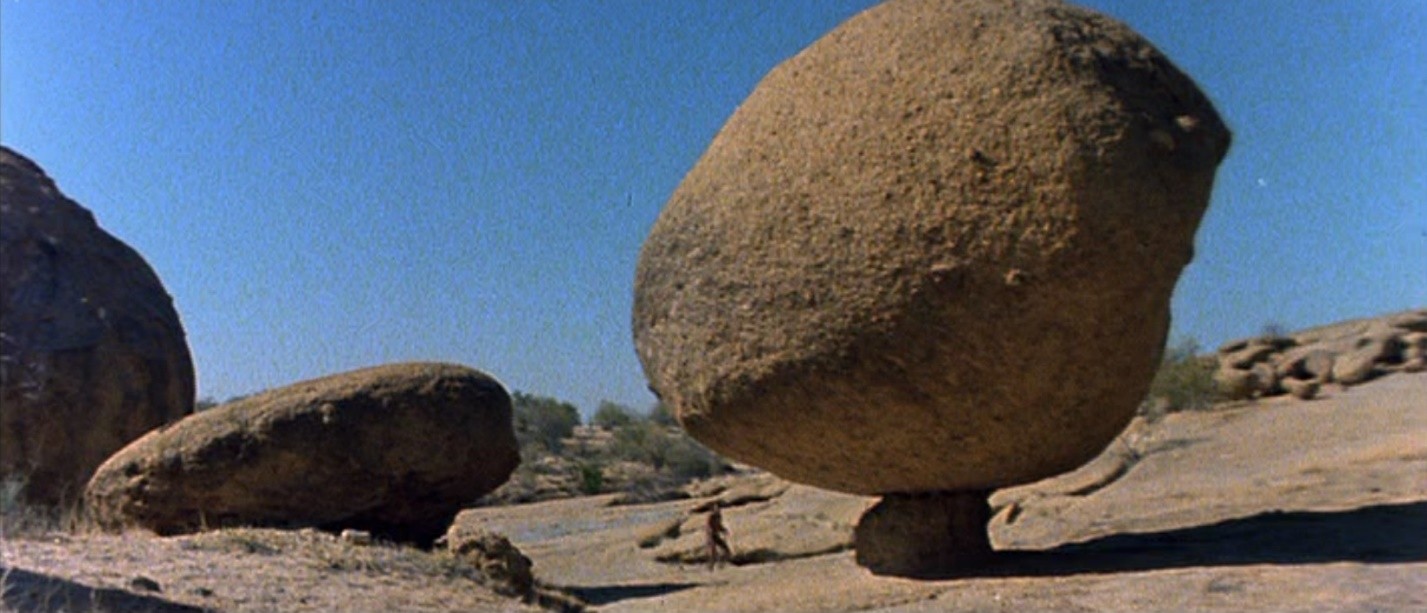
And yet, there are few stunning images, such as this one for its jaw-dropping lithic geometry:
 And this one for its how-did-they-do-it factor:
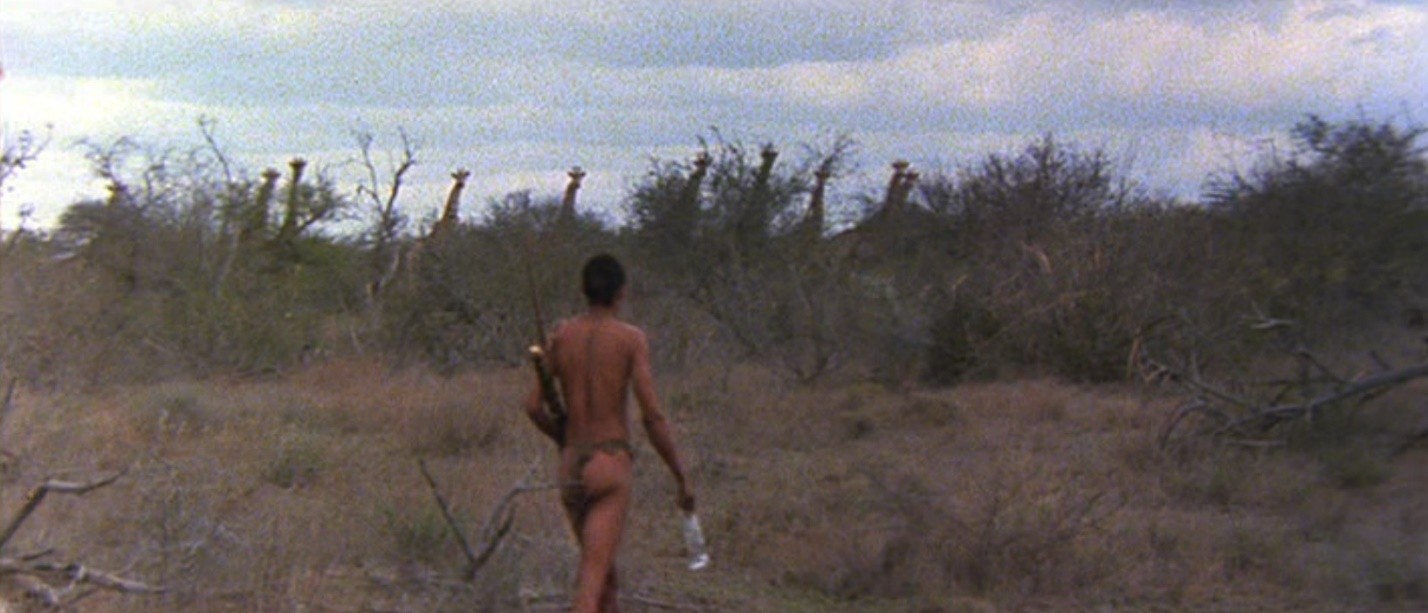 I really would like to know how Jamie Uys got 10 giraffes to stand still and watch his main character traipse through the desert like they’re about to pass the popcorn.
As for the elephant in the room, race is portrayed realistically in Gods. Whenever whites interact with blacks, the whites assume a cooperative yet superior role. This is the case for Andrew and the mechanic M’Pudi (played by Michael Thys), who appears to be at least half-black. This is the case for the black terrorists who have a swarthy white as their leader in Sam Broga (played by Louw Verwey). This is also the case for the safari guide Jack (played by Nic de Jager) who bosses black police officers around while dealing with Broga and his gang. There are black authority figures in Gods but they never exert real authority over whites.
Thankfully, there’s no mention of Apartheid, something that many reviewers chided the film for when it was released in the West in the mid-1980s. Interpreting silence as tacit approval, anti-Apartheid activists actually picketed Gods in certain places. And while Andrew and M’Pudi have genuine affection and respect for Xi and go out of their way to help him on his quest, they treat him much more like intelligent wildlife than a human peer. Implicit is the understanding that Xi and his people cannot adapt to the modern world and are best left alone in the environment to which they have adapted to over millennia. According to genetic and psychometric data, this is as biologically correct as it is politically incorrect. It’s also humane, given that this approach not only grants the Bushmen a certain autonomy but also protects them from the corrupting influences of the modern world, which can devastate a community whose average IQ is 75.
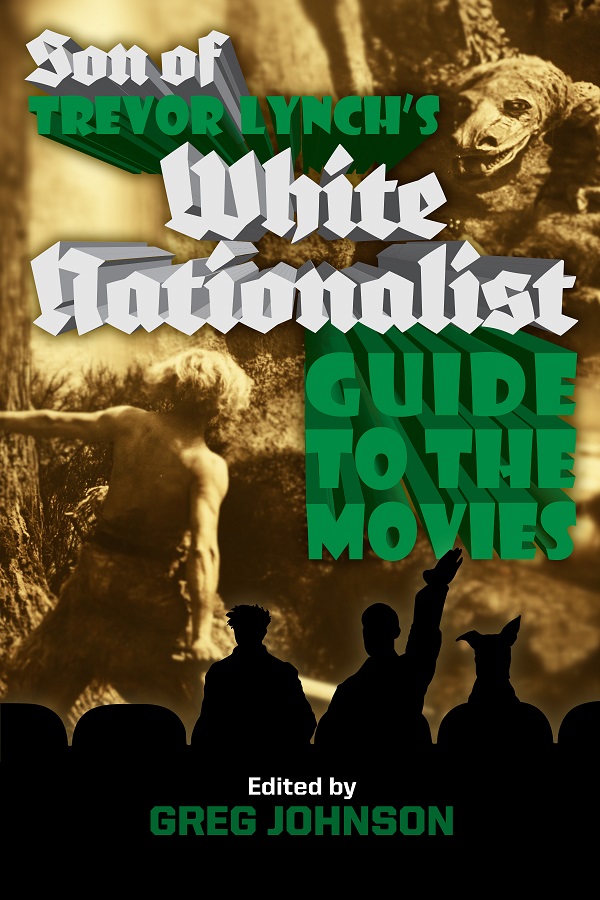
You can buy Son of Trevor Lynch’s White Nationalist Guide to the Movies here
If Xi had tried to integrate into the modern world rather than return home, or if Uys somehow used Xi to depict the evils of colonization, oppression, racism, or any other bugbear of the Left, then The Gods Must be Crazy would have amounted to little more than liberal wish casting, which is neither funny nor endearing. Fortunately, Uys knew better. Yes, the modern world, as symbolized by that Coke bottle, corrupts Xi’s village. But this is because humans are inherently corruptible, not because the modern world is inherently corrupt. In the world depicted in Gods that Coke bottle and the civilization which produced it are as innocent as Xi is. And when things go awry—as with the Broga and the terrorists—civilization self-corrects, just like Xi did when he went on his journey.
There is an inherent goodness in all the characters found in Gods, especially the white ones. Kate is attempting to educate poor blacks in Botswana. The hilarious Chaplinesque gag of Andrew contending with every gate he encounters on the road evinces his deep respect for the rule of law. Despite being Andrew’s rival for Kate’s attention (and exceedingly pleased with himself to boot), Jack remains a decent sort who shows courage under fire. The blacks are also entirely unobjectionable. As for the terrorists, they at least have the decency to train their fire only on their political enemies—who, to be fair, are trying to kill them in return. When they hijack the school, they are not overly cruel to Kate and the children. They are even at times amusing, such as the goofy pair that cannot stop sneaking off to play cards. A jazzy horn rendition of “Rock-a-bye Baby” appearing on the soundtrack when the tranquilized terrorists slowly fall asleep is especially funny.
I understand that much of The Gods Must be Crazy falls short of reality. That an attractive white woman like Kate can travel alone through Botswana and not worry about getting mugged, raped, or murdered stretches credibility quite a bit. That said, when do comedies ever have to stand toe-to-toe with reality? Kate, Andrew, and the others are real enough as types, which we recognize and appreciate. Xi, however, is a heroic archetype. And he’s perfect, not simply because he embarks on a grand journey of mythical proportions, but also because he exhibits the highest form of character there is—he knows his place in the world, and is true to both himself and his people.
20 comments
Excellent review of an excellent movie.
If white liberals had their way they would bring Xi and his tribe here, put them in public housing and give them EBT cards.
The tribe of ANOTHER Xi is already here.
That film was popular on college campuses in the mid and late eighties.
Great article! I think I caught the tail-end of this movie back in the 80s. I recall an aborigine coming to the edge of a great cliff, looking down on the forest below, and throwing a bottle over the edge. Is that the movie? 🙃
That’s the one.
I saw it at a campus theater when it first came out. Charming and very funny. Great review!
Did you consider that Jamie Uys chose a Coke bottle, because of the (1971) advertisement, I’d Like To Teach The World To Sing In Perfect Harmony? If he did, doesn’t that add nuance, after all the bottle only brought strife, and division? Look at how the title of the movie is laid out in the poster where the bottle hits the aborigine on the head–the same way Coca Cola was spelled on those old bottles? 🙃
Thanks for the great review of a good movie. When I was a teenager, we loved this movie and enjoyed quoting lines from it. I’m going to watch it again tonight.
Fine review. I saw this with my first wife in the theater. I remember it was pretty funny and the gal was quite the looker. The rhino bit was clever and consistent. I didn’t see the sequel. Didn’t see much point to it after the original. I would try to mimic the bushmen language to my wife when I was trying to ignore her. Good times for all.
I remember liking this movie as a young child, although I can only fully remember the early on coke bottle scenes.
I think we can forgive noble savage tropes in media because they’re fun. It’s only intolerable when they’re used as a bludgeon to portray white society as inauthentic and emotionally bereft.
There’s an Australian film that does just that and it really frustrated me, it’s called Walkabout (1971). Something that stumbled right out of the Culture of Critique, but there seems to be no jews involved. Whites are portrayed as corrupted, violent and evil, borderline on the level of Saturday morning cartoon villains. Aboriginals are portrayed as pure, open and innocent with a more authentic lifestyle. And the woman character finishes off the movie by ignoring her boring husband to day-dream about frolicking in nature with an aboriginal.
https://en.wikipedia.org/wiki/Walkabout_(film)
The movie Walkabout was a total corruption of the novel. In the novel, the two white kids are survivors of a plane crash and are aided by a young Aboriginal in getting back to civilization. The kids are overjoyed when they arrive back home. A perfectly plausible indeed wholesome story. The movie degenerates this by having the kids in the wilderness due to their own father trying to murder them, upon regaining civilization the first white they meet is ugly, surly and hostile-recognizing the evilness of white, the kids escape back to the Aboriginal. Absolutely disgusting but made tolerable by the beauty of Jenny Agutter.
The propaganda goes all the way back to the early 1970’s. And it was in Australia as well; no English-speaking country gets left out of the indoctrination.
As a teenager, I also liked the 1986 film Crocodile Dundee. If you’re looking for a topic to review, work on this one.
One of those rare surprise hit movies from out of nowhere with a sequel that’s equally great.
I loved the scene that was like a silent movie from the 1920s where a 90-year-old black gent dressed in a suit and tie with a cigarette in his mouth is working at a sewing machine in the middle of a dusty street. For some reason someone shoots at him from a distance. The first shot, the bullet knocks a fob off the machine and the gent sees it and is puzzled but continues sewing. The second shot knocks the ash off his cigarette, and he is puzzled but continues sewing. Herzog, eat your heart out!
This movie was a favorite of my family’s back in the eighties when it was on HBO regularly. When I finally got around to watching it again 25 years later I was surprised how much I still liked it.
Another great South African film is The Naked Prey from 1965, directed by and starring Cornel Wilde.
The Naked Prey was reviewed on this site years ago, just use the search feature on the top of the page. 🙃
In the last years of the Soviet Union this movie was shown in theaters, but as producing country only Botswana was named, “racist” ZA was not mentioned.
Fans of the subject movie may also enjoy reading about the exploits of W. D. M. “Karamojo” Bell, a real trail-brazing Africa big game hunter in the early 1900. Bell was often the only White man on a safari and observed the native bantus with an unbiased eye. The natives had good traits as well as bad, and often with comical results. Available on Amazon kindle for a pittance. https://www.amazon.com/s?k=karamojo+bell&i=digital-text&crid=K7WWC6RNX7AC&sprefix=Karamojo%2Cdigital-text%2C940&ref=nb_sb_ss_p13n-expert-pd-ops-ranker_1_8
I first saw the movie when it came out, and had a girlfriend who was really emotional. We had another argument about “the relationship” (I’m sure you’ve been there), and during the film, she kept saying “you aren’t thinking about ME…you’re thinking about this movie.” well, duh…we had to leave to do more roundabout blather about “the relationship.” But what I did see was a pretty clever if kind of clunky film, but Rys showing the silliness of white SA (a wife driving twelve feet to get her mail instead of just walking to the box in front of their house, and the nuttiness of revolutionaries, as well as Xi’s problems with the Coke bottle was inventive. It was funny how the Coke bottle disrupted a happy (or at least functional society), and Xi’s decision to toss it off the edge of the world was very logical. I would Toss rap music, leaf blowers, and nose rings off the edge of the world in a heartbeat. I did see the second part later, and while Kate and Andrew seemed a bit saccharine and formulaic, they were also funny, and male shyness is a fact of life. It was a lot of fun, and people liked the film, but others thought a “movie made in South Africa” would talk about THE PROBLEM. Rys showing the place as fairly normal was good, but might also show how vulnerable the society was when the left and corporations put pressure on it. When a country wants to do things to be liked, you wind up like me and that girlfriend wanting to dissect “the relationship.” Fortunately, I dumped her. Not so easy to do with SA’s enemies.
A point about the likelihood of Kate being alone in Africa. Actually, Africa can be very safe. In his book Congo Kitabu, Jean Hallet noted he had no fear traveling alone among Africans. They were always hospitable and respected people. He said the real problem came with the communists and tribal leaders jockeying for power, and they could manipulate Africans, who were pretty simple. Much like he disliked views africans were backward. They didn’t wear clothes, he said, because the climate didn’t need clothes, and wet clothes could easily cause sickness. As for inventing the wheel, you don’t and can’t use wheeled vehicles in a dense jungle. The tribal system was very strong and kept people in line. He said weakening it in favor of colonial or western ideas was damaging to Africans. Of course a real problem in SA was the country was simply overwhelmed with blacks streaming in and then making demands. I often wonder if SA might have been better off in, say, 1945 if they closed off all blacks entering and brought in a few hundred thousand refugee Germans and east europeans. In the end, demography is destiny, as we are discovering.
And a rhino can stamp out ANYTHING it wants to.
Comments are closed.
If you have a Subscriber access,
simply login first to see your comment auto-approved.
Note on comments privacy & moderation
Your email is never published nor shared.
Comments are moderated. If you don't see your comment, please be patient. If approved, it will appear here soon. Do not post your comment a second time.