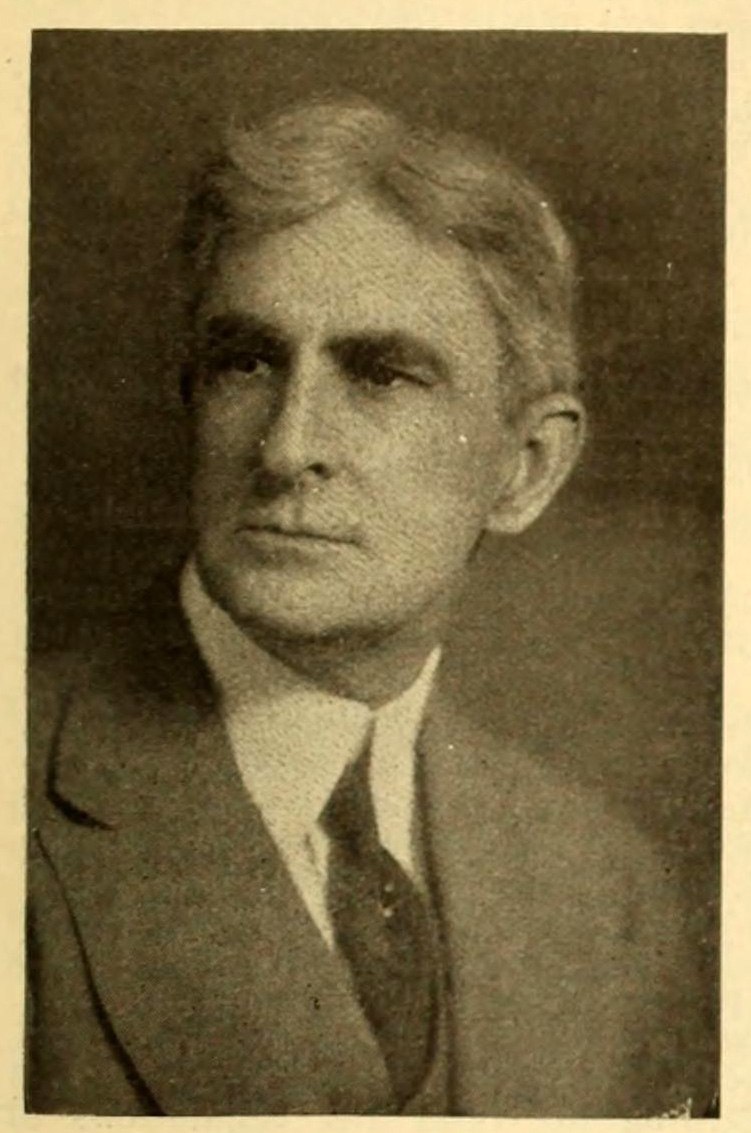
Thomas Dixon. Image courtesy of Wikimedia Commons.
2,412 words
Thomas Dixon Jr. was a committed White Nationalist who worked tirelessly to promote race realism and white solidarity. At various points in his life, he was an attorney, a legislator, a Baptist minister, a lecturer, a novelist, and a filmmaker. He is best known as the author of the screenplay for D.W. Griffith’s 1915 film The Birth of a Nation, and of the 1905 novel The Clansman on which the film was based. In his lifetime, however, Dixon’s influence extended far beyond one novel and one film, even though the film in question was the most famous of its era. But after his death, Thomas Dixon did not receive the recognition that he deserves.
In 1968, Biographer Raymond A. Cook wrote that Dixon was “today unknown to 99 per cent of our present population.”[1] And in 2004, film historian Anthony Slide referred to him as “relatively unknown.”[2] However, critics of Dixon’s views have occasionally conceded his significance. In 2006, the Louisiana State University Press released a collection of essays titled Thomas Dixon Jr. And the Birth of Modern America. And in 2019, the Washington Post published an article titled “Thomas Dixon Jr: The great-granddaddy of American white nationalism.” This was not meant as a compliment, but I think the notion that Dixon is one of the foremost proponents of post-Civil War White Nationalism in the United States is justified.
Thomas Frederick Dixon Jr. was born in North Carolina in 1864. The elder Thomas Dixon was a Baptist preacher, and he married Amanda Elvira McAfee, the wealthy daughter of a prominent planter and slaveholder. Before the outbreak of war, Reverend Dixon had opposed secession.[3] The young Dixon grew up poor during Reconstruction, and the family was twice forced to move because they could not afford to keep their home. Both his father and his uncle became members of the Ku Klux Klan.[4]
Thomas and Amanda Dixon had five children, including Fundamentalist minister A.C. Dixon and Elizabeth Delia-Dixon Carrol, a physician and advocate for women’s suffrage. “The Dixon children” writes Anthony Slide “were exceptionally intelligent, charismatic individuals and would often correspond with one another in Latin or Greek; they were all subjects of entries in Who’s Who in America prior to their thirtieth birthdays.”[5] After graduating “with more honors than any other student before him” from Wake Forest University in his native North Carolina, Thomas continued his studies in Baltimore, Maryland, and at Johns Hopkins University where he became friends with future president Woodrow Wilson.[6]
The two decades between Dixon’s graduation from Wake Forest and the publishing of his first novel were full of action. He married Harriett Bussey, with whom he had three children. While a short-lived attempt at an acting career ended in failure, the young man succeeded in just about everything else that he attempted. Stephen P. Smith, in his review of Dixon’s autobiography, recounts Dixon’s many professional triumphs:
By 1886, Dixon was a twenty-two-year-old newlywed, a practicing lawyer, and a state legislator. A political career, in which he might redress the wrongs done to the South by the Radicals, seemed to beckon. Yet he was still restless. In the autumn of that year, he resolved his inner tensions by resigning from the legislature and entering the Baptist ministry, fulfilling a wish of his father. After brief pastorates at Goldsboro and Raleigh in his home state, he found his way north once again, first to a Baptist pulpit in Boston, then to a pastoral appointment at the Twenty-Third Street Baptist Church in New York. In the metropolis, Dixon, never known for modesty or thinking small, began to dream truly grand designs. So that his audience could expand beyond one congregation of one denomination, he conceived of a non-denominational “People’s Church,” housed in its own commercial-office building and offering a wide range of social outreach programs to the city’s teeming millions. He boldly approached John D. Rockefeller, Sr., and gained the backing of “the Oil King” for his idea. But the jealousy and obstruction of rival ministers frustrated his plan, and it never came to fruition. Also while in New York, Dixon tackled the Tammany machine; both sides notched some victories in their mismatched war.[7]
According to Slide, no Protestant preacher at the time had a larger congregation than Thomas Dixon. He “quickly became noted as a flamboyant and sensationalist preacher” and “was very much the social crusader, taking on issues with the intensity that anyone of a liberal persuasion would admire” which included criticizing the city government, advocating for the poor, and supporting Cuba’s struggle for independence from Spain.[8]
In 1898, Dixon left his church and began traveling across the country to deliver public lectures. He quickly gained a reputation as a superb speaker. As Raymond A. Cook describes:
Persons who heard Dixon lecture were enthusiastic about his ability as an orator, in a day when people placed more importance upon oratory than they do now. He was repeatedly referred to as “the best” lecturer in the country. During a four-year period, Dixon was heard by more than five million people, an unusually large number when it is recalled that his lecturing career occurred before the day of radio and television. For a program of two hundred lectures a year, Dixon’s audiences averaged more than six thousand listeners on each occasion.[9]
During his time living in the North, Dixon became incensed on two occasions upon hearing what he felt were unfair condemnations of Southern whites. The first took place in Boston, where Dixon listened to a speech about the so-called “Southern Problem” and the second came in New York when he saw a stage production of Harriett Beecher Stowe’s novel Uncle Tom’s Cabin.[10] To counter the negative perception of the South held by some Northerners, Dixon wrote a trilogy of novels which portrayed the Reconstruction years from the perspective of Southern whites. These were The Leopard’s Spots, The Clansman, and The Traitor.
The Leopard’s Spots depicts the life of the fictional hero Charles Gaston as he spends his childhood impoverished living under the Yankee occupation but ultimately marries the beautiful daughter of a Confederate general and is elected governor of North Carolina. Gaston’s political platform is centered upon the disenfranchisement of blacks, and his views on race are learned from minister John Durham, who wishes to deport the black population of the state back to Africa. The Leopard’s Spots was intended as a rebuttal to Uncle Tom’s Cabin, and two of the villains from Stowe’s novel reappear in Dixon’s book, but as wicked abusers and exploiters of whites rather than of blacks. The Clansman is about the misfortune that befalls the whites of a South Carolina town when Radical Republican leader Austin Stoneman moves in. Stoneman, who is modeled after Pennsylvania congressman Thaddeus Stevens, organizes a black militia that terrorizes local whites. These efforts are thwarted by the Ku Klux Klan, headed by Confederate veteran Ben Cameron. In The Traitor, John Graham, the head of the North Carolina Klan, attempts to disband the organization believing that it is no longer necessary. However, against Graham’s wishes it is reorganized under the direction of Steve Hoyle. Hoyle is a younger, more impulsive leader who engages in cruel abuses of power. A local Republican judge is assassinated by a rival within his own party who commits the deed while disguising himself as a Klan member, and Graham is put on trial for the murder. With the assistance of the dead judge’s daughter, who improbably falls in love with Graham, the real killer is finally exposed, and Graham’s innocence proven.
In each of the novels, blacks are depicted as unintelligent, violent, and incapable of responsible government. Whites who back the Reconstruction regime, be they Northern “carpetbaggers” or Southern “scalawags,” are vindictive and contemptible. Dixon sets out to convince his readers that racial equality is absurd, that integration is doomed to fail, and that miscegenation is an evil that should not be tolerated. These messages are constantly present throughout the trilogy. The novels were undeniably commercially successful. According to Cook, The Leopard’s Spots ultimately sold more than one million copies,[11] The Clansman “far beyond one million copies,”[12] and The Traitor “nearly a million copies.”[13]
Capitalizing on the popularity of his works, Dixon adapted The Clansman and The Traitor into dramatic form, and the works were performed on stages across the country.
Though The Birth of a Nation is notorious for its positive portrayal of the Ku Klux Klan, and the secret order is shown as a positive force in The Leopard’s Spots and The Clansman, it would not be accurate to label Dixon as an unqualified Klan apologist. In his trilogy, the Klan is indeed shown as heroic when led by wise and experienced Confederate veterans. However, when it falls into the hands of younger men chasing danger and excitement, it swiftly devolves into a force for evil and a powerful tool misused for settling personal scores and harming innocents. The Traitor shows this most clearly, as elder statesman John Graham struggles in vain to combat Steve Hoyle’s revived version of the order.
For Dixon, the original Klan was a justifiable reaction to wrongs committed against Southern whites during Reconstruction, but it should not have stayed in existence a moment longer than was necessary. Furthermore, Thomas Dixon was a harsh critic of the Second Ku Klux Klan, which gained influence after the First World War as a populist vehicle for white Protestant identity politics. Though Dixon was himself a former minister and very much a populist, he fiercely attacked the new Klan. Here is Dixon quoted by the New York Times in January 1923:
“When organized a few years ago, this modern Klan sent me an invitation to join,” he said. “I promptly declined, and in my letter warned the organizers that if they dared to use the disguise in a secret oath-bound order today, with the courts of law working under a civilized Government, the end was sure-riot, anarchy, bloodshed and martial law. We have already reached the point of riot and bloodshed, and unless this thing is throttled promptly we are in sight of martial law.”[14]
Dixon also opposed the immigration restriction as espoused by the Klan:
Our fathers who landed before the Revolution blazed the way through the wilderness for the trembling feet of liberty. They built a beacon on these shores, flashing its rays of hope to all the oppressed of the earth. Shall we, their sons, meet the humble immigrant of today at the water’s edge with a mask and dagger and push him back into hell? If this is 100 per cent. Americanism, I for one spit on it.[15]
In evaluating this statement, it should be kept in mind that “the humble immigrant of today” that Dixon referred to in 1923 was arriving from Europe. Dixon, as a staunch racial separatist, would have viewed non-white migrants quite differently.
On the other hand, Dixon apparently saw Jews not only as white people, but as the best kind of white people. This attitude seems closely connected to his Christianity. As the same Times article reported, the devoutly Christian Dixon was extremely pro-Jewish, and condemned the Klan for excluding Jews:
Dr. Dixon said that the Klan’s proscription of the Jew was a curious revival of a malignant form of mob insanity. “Why should any man attack the Jew in this country, the home of the free and the refuge of the oppressed?” he asked. “There are but 5,000,000 Jews in this country, half of them in New York. Jew baiting has always been a form of idiocy. Jesus Christ was the son of a Jewish mother. From Jesus Christ down the ages to the last philosopher and thinker, the greatest ones have been Jews. The Jew is the greatest race of people that God has ever created.”[16]
Dixon was a constant promoter of white unity in the United States and sought reconciliation between its Northern and Southern sections. Though Reconstruction was certainly a divisive topic, his novels place the blame upon Radical Republicans like Thaddeus Stevens and on opportunistic bureaucrats. He does not disparage Abraham Lincoln, who he counted as a fellow White Nationalist, and authored biographical novels celebrating the lives of both Lincoln and Confederate President Jefferson Davis. To Dixon, the War Between the States was a dispute over the meaning of the Constitution fought between two honorable armies.
Dixon stressed the duty of wealthy whites not to look down on or engage in the exploitation of their poorer kinsmen and, despite his origins as the son of a minister in the Anglo-Protestant South, did not harbor biases against Roman Catholics. Regional, class, and sectarian strife among white Americans had no place in Dixon’s vision of racial solidarity. However, plenty of White Nationalists today could quite reasonably see his “big tent” approach as too broad. Limiting immigration from other white countries to give newcomers time to assimilate is a sensible position, and Dixon’s pro-Jewish remarks foreshadow the Christian Zionist dogma that has played such a key role in corrupting America’s foreign policy.
Thomas Dixon Jr. continued to write novels until he was in his seventies, with his final book being The Flaming Sword, a plea for racial separation which celebrated the program of Black Nationalist Marcus Garvey.[17] He tried his hand at filmmaking in California and started his own studio. After Harriet Dixon died, Thomas married actress Madelyn Donovan in 1939. Dixon’s creative output was simply incredible, consisting of no fewer than eighteen novels, twelve plays, and eighteen films.
He died in his native North Carolina in 1946, at the age of seventy-eight.
Dixon’s life story should serve as an inspiration to all who speak on behalf of our race. This creative genius was born into poverty and spent his childhood under military occupation, part of a people who were hated and humiliated. Yet, he overcame these challenges, fearlessly spoke what he believed to be the truth, and in the end his words and ideas were communicated to millions.
Notes
- Raymond A. Cook, Fire from the Flint: The Amazing Careers of Thomas Dixon (Winston-Salem: J.F. Blair), 1968, viii.
- Anthony Slide, American Racist: The Life and Films of Thomas Dixon (Lexington: University of Kentucky Press), 2004, 3.
- Cook, 5.
- Ibid., 14.
- Slide, 18.
- Ibid., 18-19.
- Stephen P. Smith, “Southern Horizons,” Abbeville Institute, March 20, 2018.
- Slide 20-22.
- Cook, 103.
- Ibid., 105.
- Ibid., 112.
- Ibid., 131.
- Ibid., 152.
- “KLAN IS DENOUNCED BY ‘THE CLANSMAN’; Thomas Dixon Blames It for Riots and Bloodshed and Demands It Be Throttled.” New York Times, January 23, 1923.
- Ibid.
- Ibid.
- Tony Martin, Race First: The Ideological and Organizational Struggles of Marcus Garvey and the United Negro Improvement Association (Westport: Greenwood Press, 1976), 352-54.
17 comments
Sounds like a solid White man who nonetheless possessed that curious Southern blind spot towards Jews. The 1924 Immigration Act was meant largely to keep out Jews, the fact that he opposed the legislation speaks volumes.
The old south, the acien regime I guess, tends to be philosemitic. The confederacy was friendly to Jews, and many Jews had high positions, such as Judah Benjamin, confederate secretary of war, whereas the north was more anti-Semitic—Sherman and Grant did not allow Jews in their military camps. Many plantation owners and slaveholders in the south were in fact, Jewish, especially in the carribean. The first king of Carnival, the king of the Parade Rex back in the 1800s was Jewish! I think that has to do with a split within the Jewish community. The Jews that Southerners had contact with were more of Sephardic extraction, who are more closely aligned with as I said, with the ancien regime, whereas the Jews that the yanks had experience with were Ashkenazi Jews, Ostjuden, who were more like the Jews who are prevalent today– leftist, politically radical. But I think at the time of the Civil War, eastern European Jewish immigration to the United States had not had enough of an impact to change the US politically, so this tendency was still well under the radar.
So anyway, Dixon’s thought primarily derived from the old south and the confederacy, so he tended to be philosemitic, I suppose, or rather that was the origins of his philoSemitism. The first clan was highly philosemitic, as was the second clan. it was the third clan that began to be antisemitic, and that was mainly in response to perceived Jewish involvement in the integration process. There were actually three Clans in history. It’s interesting.
That is my understanding, and Hunter Wallace at Occidental Dissent has said pretty much the same thing re White-Jewish relations in the South.
https://occidentaldissent.com/2025/03/26/southern-nationalism-national-socialism-and-the-jewish-question
Yeah, it’s true, I think it’s the racial element that he leaves out, that there is nuance within the Jewish species. Sephardic jews were the issue in late medieval /early modern Europe, when the Jews were expelled from Spain and such. But later they were much more kindred to the old European aristocracy, ie conservative, pro monarchy, pro slavery, etc., etc., and most of the Jews in the south were of Sephardic extraction. Also true to a lesser degree German Ashkenazi Jews, who were sort of between Sephardic Jews and eastern European Jews. But since that time Sephardic Jews have almost gone extinct, being absorbed into the wider Jewish community or Gentile society. The earlier two groups were always much smaller than the ostjudin. You also have oriental or Mizrahi Jews in the Middle East, who are much different, and there are native Greek or Cipriot Jews, too.
Thank You, I think you are correct all around. One way to think about it is that the Jews in the South had undergone the so called ordeal of civility, whereas the ones in the North (the Ostjuden) had not, and they looked it with the black coat, the black hat, the black beard and hair, and the snarling Yiddish. Hence the very different reactions to Jews in the American North and South.
I am *so* thankful that Thomas Dixon is finally getting recognition here on Counter Currents. I was thinking back a while ago that he really needed a “Remembering…”-type article that Counter currents is famous for. Dixon was a profound artist and intellectual and ought to revered among White Nationalists, and all White Americans quite frankly.
Agreed. Now that we have a couple pieces on Dixon, we will start an annual commemoration post, and more articles will be added in coming years.
The two Italian-Americans I’ve known best (only one of whom I’m still friends with) side with non-white immigrants (“I can’t see how we can keep them out”). They cite the same reason, that “wise old Italian women” told them as children, during the civil rights struggle in the South, that whites who oppose black social equality also opposed the entry of Italians. That is, the second Klan was motivated by white immigration. My friends are wrong about two things. First, as far as I know, Italians were never subjects of segregation (by custom in the North, law in the South) as blacks were. Second, the conclusion to draw is quite different: that to deviate from the founding stock–Protestant northern Europeans–is to invite discord; as religion, a fortiori, goes race. Now that the descendants of white Catholics from Italy, Poland and Ireland are settled Americans, they should oppose nonwhite immigration. But the ones I have known steadfastly oppose white identity politics,
A lot of the best White Nationalists I know are Ellis Island Americans or have some such ancestry, such as Kevin Deanna and David Zsutty.
The irony is the most militant racialist hardliners say Italians “aren’t really White” yet they’re the one Euro-amerikan group most tribally ethnocentric. Their enclave-exclusionary “us-ness” wherever it remains is to be emulated by other Whites as a benchmark of group identity. I recently discovered Kevin Deanna’s rumble channel. Great speaker. Would like to see him contribute on here if any way possible.
Kevin wrote here for many years as Gregory Hood. He works exclusively for AmRen now.
The tiresome “whiter than thou” stuff is generated by colonial or imperial projects, which lead to the question, “Are Xs white enough to be integrated into my white imperium?” Once you abandon such projects, the question loses salience.
I don’t really care if Finns are white enough for Wilmot Robertson’s imperium, because they are all Finnish enough to have their own homeland.
Whiteness remains relevant only as the outermost boundary of assimilability. There will always be some Europeans who want to intermarry with and settle in other European countries. But no non-white can or should be allowed to become part of a European nation.
This one guy said, “White? Sicilians? DAGOS?” I was in the first grade with this fellow. His family had a produce market. Now he’s in Houston participating in leftist “resistance.” I replied that “white” just means of European ancestry. It’s not difficult. That was back in 2017. He will not speak to me.
Most Italians I know in the south are very conservative on racial issues and social issues in general. Most Italians are intermarried to a large degree with the surrounding populace and most everyone has some degree of Italian heritage here in Nola. One of the most pure ethnically italian families I know took their kids out of public school when they saw a Black History Month poster up for the first time and moved them into private school.
I have brainwashed Italian relatives, including my own father who gets his news from Whoopie Goldberg and the other dames on The View, who don’t seem to understand the difference between ethnicity and race. They don’t like my views on race and immigration because they say that since they were once made to feel unwelcome on occasion, that we should welcome anyone who wants to come and work. I have heard the same attitude from some Irish commies– you know, the kind that celebrates MLK. Once upon a time, some Irish, Greeks, Portuguese, Polish, Ukrainians, etc., came to predominantly British North America, had their feelings hurt and so want some kind of payback. Or maybe they think it is the Christian and correct position to take.
There’s something utterly mindless about the idea that since we or our ancestors all stepped off boats, we have the same interest as the people showing up today on boats.
The white “ethnic” version is that since “we” were outsiders, we must identity with total exotics because they are outsiders too.
Happy belated birthday Thomas Dixon. I have The Leopard’s Spots, The Clansman and The Traitor in the cheap, old, red hardback editions, I just haven’t gotten around to reading them yet. 🙃
Thank you Dave Chambers for this very observant commentary on the White Baptist Southerner Thomas Dixon.
Thomas Dixon seems to be like the majority of White Southerners I have tried to work with when I fled Chicago, war torn New York City 1991.
They are good White people, with a distinct and overwhelmingly Southern history and Southern Heritage/culture point of view. They know the Negro good and bad because they have been living amongst the Negro, Blacks, the Colored Folks, now Black African Americans for hundreds of years and they at least look to other places where the divide was/is White Christian and the Negro/Blacks
Haiti/Santo Domingo
Rhodesia/South Africa or finally in Urban Northern Cities after at least one of the great Black migrations to work in Northern factories during Wold War I and World War II.
But other than the White Christian and the Negro problem – it seems that Thomas Dixon literally has
NO CLUE about racial realities, no clue about the JQ, no clue about Islam – Arabs, Turks, Ottoman Empire, no clue about Communism (Part of the JQ).
Thomas Dixon and his Southern Christian Baptist kind often lived in taught in North Cities like my Chicago or New York City at a time when everyone was White European, with just some minor (not always) divides between White Catholics and White protestants or Southern Europeans, or German Jews and just some Eastern European jews.
This was a time when places like the University of Chicago (where I grew up) were actually Baptist Christian, funded by John D Rockefeller – so he has that Southern Baptist, Bible Belt view that everything is going to be OK as soon as everyone in North America or the whole wold (All of China) converts to their version (Baptist Protestant) Christian.
This mindset, this Opium of the masses and of the educated Southern elite was still going strong up through the 1950s with the China Lobby, Southern Protestant Baptists Missionaries working to SAVE all the heathen souls in China. These idiots pushed through Prohibition, most the women’s temperance league.
Now we have the added opium of Christian Zionism, the Southern Baptists under Russel Moore renouncing all White Southern History , Mike the Huckster Huckabee ( the real Christian GOP Presidential candidate as opposed to LDS Mormon Mitt Romney WTF?), Mike Pence (The collapse of White European Civilization in our Cities is “Not My Concern Tucker).
My experience in the South trying to work with, in the Christian Religious Right is that it’s pretty much impossible to get White Southern adults over the age of 35 to reject this world view, to see 9-11-01, the fall of Constantine, the muslim migrant colonization of London/Londonstan or try to get them to stop hating on White European now Christian again Russians in St. Petersburg – too m any Rambo movies, Reagan Bush boomers.
So I wouldn’t even try to bother. Let’s concentrate on White youth, under the age of 30 – start to get them to interact with Pakistanis, turd eating East Indians, Somalians and then work in the JQ.
Thank you Mr Dave Chambers.
Jaye
left behind outside of Chicago
Comments are closed.
If you have a Subscriber access,
simply login first to see your comment auto-approved.
Note on comments privacy & moderation
Your email is never published nor shared.
Comments are moderated. If you don't see your comment, please be patient. If approved, it will appear here soon. Do not post your comment a second time.