Counter-Currents
  • Advertise
  • Private Events
  • T&C
  • About
  • Contact
  • RSS
    • Main feed
    • Podcast feed
    • Videos feed
    • Comments feed
  • Welcome
  • Webzine
  • Books
  • Merch
  • Podcasts
  • Videos
  • Donate
  • Patrons
  • Subscribe
  • Crypto

LEVEL2

Donate Now Mailing list

Writer of June

(4 votes) David M. Zsutty

Article of June

Why White Advocates Should Avoid “Based Blacks” by Dani Vypont 4 votes
  • Welcome
  • Webzine
  • Books
  • Merch
  • Podcasts
  • Videos
  • Donate
  • Patrons
  • Subscribe
  • Crypto
    • Replacement Migration & Hypergamy

      F. Roger Devlin

      20

    • Kurds of a Feather Flock Together:
      Europe’s “Racist” Parakeet Tweet-Storm

      Steven Tucker

      1

    • Elevator Pitch to a Billionaire
      Money, Money, Money

      Ondrej Mann

      1

    • All Hail Rhodesia

      Spencer J. Quinn

      3

    • Nationalism This Week
      Disenfranchisement

      Greg Johnson

      28

    • The Murder of Ann Widdecombe

      Lipton Matthews

      9

    • Disclosure Day
      Please, Keep It Undisclosed

      Francisco Albanese

      11

    • Remembering Carl Schmitt
      July 11, 1888–April 7, 1985

      Greg Johnson

      1

    • Editor’s Update
      Fundraiser Update & New Books

      Greg Johnson

      1

    • Third Homeland Institute Poll on the Great Replacement

      David M. Zsutty

      12

    • The Bitter End of Western Metaphysics:
      Heidegger on Nietzsche, Part Five (Conclusion)

      Collin Cleary

      9

    • Fraudulent Black British History

      Mark Gullick

      7

    • A White Nationalist Response to Scott Greer

      Dave Chambers

      25

    • The Miami Mall Incident:
      Black Youths or Black Extraterrestrials?

      Dominic Fox

      6

    • The Theology of Three Populisms

      Morris van de Camp

      2

    • The Dangers of Skilled Immigration

      Lipton Matthews

      25

    • The Brotherhood of the Bell

      Beau Albrecht

      16

    • Endeavor: What Rome Means to Me

      Endeavour

    • When the Family Becomes Predation

      Jayant Bhandari

      5

    • RICU: The Gentle Art of Persuasion

      Mark Gullick

      7

    • Mind of Darkness:
      A Review of Lipton Matthews’s Busting African Delusions

      Derek Stark

      12

    • Remembering Revilo Oliver
      July 7, 1908–August 20, 1994

      Greg Johnson

      2

    • Some Advantages of Irish Nationalism

      Greg Johnson

      30

    • America at 250 from the National Cathedral

      Gabriel Anderson

      18

    • Why Not Stop All the Clocks?
      Modern Conservatism’s Flagging Commitment Towards Turning Back Time

      Steven Tucker

      3

    • Remembering Jean Raspail
      July 5, 1925–June 13, 2020

      Greg Johnson

      2

    • Editor’s Update
      Fundraiser Update & New Books

      Greg Johnson

    • The Ethnic Reality of FIFA 2026

      Samuel Valleus

      13

    • Nationalism This Week
      Tucker’s New Party

      Greg Johnson

      30

    • Ethiopia Against Italy
      How the Italo-Ethiopian Wars were part of the conflict between Eastern & Western Christiandom

      Morris van de Camp

    • Please Vote in Our Writer & Article of the Month Poll

      Greg Johnson

    • Available for Pre-Order!
      F. Roger Devlin’s Not Hooking Up

      F. Roger Devlin

    • Kolberg: The Last Nazi (or Prussian?) Film

      Steven Clark

      2

    • America 250 & The Fate of Empires

      Richard Houck

      20

    • Available for Pre-Order!
      Greg Johnson’s The Battle of the Books

      Greg Johnson

    • Why All the Silence About Blacks Being Kicked Out of South Africa?
      Because It’s Other Blacks That Are Doing It.

      Steven Tucker

      10

    • Zelensky, the Jewish Conspiracy Narrative, & the Demographic Replacement of Ukraine:
      A Critical Analysis of a Disinformation Discourse within the European Identitarian Right

      Luís Graça

      30

    • The Original Congressional Debate on Birthright Citizenship

      Alex Graham

      13

    • America at 250
      Unmanifested Destiny  

      David M. Zsutty

      32

    • The Normies are Waking Up:
      The Alliance for Responsible Citizenship Conference, London 2026

      Lipton Matthews

      2

    • Ethnic Vigilantism: The Movie

      Mark Gullick

      15

    • Lothrop Stoddard’s The Revolt against Civilization

      Kevin MacDonald

      2

    • David Zsutty on Political Organizing

      David M. Zsutty

    • PC-Incompatible Gaming:
      Plantation Simulator and the “Problem” of Racist Video Games

      Steven Tucker

      3

    • Remembering Lothrop Stoddard
      June 29, 1883–May 1, 1950

      Greg Johnson

      1

    • Editor’s Update
      Fundraiser Update & Upcoming Projects

      Greg Johnson

    • Nationalism This Week
      Metapolitics Wins:
      Scott Greer’s Whitepill

      Greg Johnson

      8

    • Remembering Colin Wilson
      June 26, 1931–December 5, 2013

      Greg Johnson

      3

    • Kevin Deanna on Political Organizing

      Kevin Deanna

      1

    • The Bitter End of Western Metaphysics:
      Heidegger on Nietzsche, Part Four

      Collin Cleary

      6

    • Dani Vypont

      Replacement Migration & Hypergamy

      What parts of the United States would you say have the most and least interracial relationships?It...

    • Dave Chambers

      All Hail Rhodesia

      Rhodesia is an inspiration to all of us whose families have had to flee the neighborhoods and...

    • CC reader

      Disclosure Day
      Please, Keep It Undisclosed

      Duel was a very good movie, and it was made for tv. Good suspense, camera work, musical score, and...

    • WU

      Replacement Migration & Hypergamy

      I visited Norway 3 years ago, and the experience was so strange it is worth relating. In Bergen,...

    • Dave Chambers

      Replacement Migration & Hypergamy

      What parts of the United States would you say have the most and least interracial relationships?

    • CC reader

      Third Homeland Institute Poll on the Great Replacement

      If a white ethnostate is carved out, the 67% who voted against returning to 60% white or higher...

    • Zarathustra

      Replacement Migration & Hypergamy

      MTV and Hollywood are partly to blame for this.

    • Dani Vypont

      Replacement Migration & Hypergamy

      I once had a Norwegian nationalist ask me to tell him the degree of mixing between White women &...

    • James Sunderland

      Replacement Migration & Hypergamy

      With regard to one of your earlier posts, I did some research, and it is possible to determine the...

    • Glide Ratio 0:1

      Replacement Migration & Hypergamy

      Maybe the NSDAP were correct about Persians (you could be Arab?) being Aryan. You seem to suffer...

    • Fionn McCool

      Replacement Migration & Hypergamy

      Dani, for what it’s worth, your 92% figure refers to biracial children born to black fathers and...

    • Dani Vypont

      Replacement Migration & Hypergamy

      Both of those sources rely on marriage data. The first one is titled "Intermarriage in America Post-...

    • Fionn McCool

      Replacement Migration & Hypergamy

      Most people are the most attracted to individuals of their own race. Regardless, the broader...

    • James Sunderland

      Replacement Migration & Hypergamy

      Here is analysis conducted using U.S. Census Data. You can't get better than this: https://www....

    • Hairy Iranian Dude

      Replacement Migration & Hypergamy

      I love Norway. It’s a real country (used to be?). I was there for six days in 2018: Oslo and Bergen...

    • Dani Vypont

      Replacement Migration & Hypergamy

      In the U.S., white woman have the lowest rate of miscegenation across all intersections of race and...

    • Glide Ratio 0:1

      Replacement Migration & Hypergamy

      This is one hundred percent my observations moving from England to the USA. White American females...

    • Fionn McCool

      Replacement Migration & Hypergamy

      It would have been good if FRD had offered some statistics to support his claim rather than mere...

    • Greg Johnson

      Nationalism This Week
      Disenfranchisement

      People constantly bemoan the fact that old politicians send young men to die in wars. I guess that...

    • Peter Quint

      Replacement Migration & Hypergamy

      Sounds like Norway needs its own Casa Pound. 🦈

    • Earth Day Special

      John Morgan

      12

    • A Robertson Roundup
      Remembering Wilmot Robertson
      (April 16, 1915 – July 8, 2005)

      Margot Metroland

      13

    • The Paranoid Style in White Nationalism

      Greg Johnson

      30

    • Join the Dance!

      Andrew Hamilton

      1

    • We Can’t Save the Earth Without Reducing African Birth Rates

      James Dunphy

      36

    • “I’m Not a Conspiracy Theorist, but . . .”:
      Jeffrey Epstein’s Death Gives New Life to “Conspiracy Theories”

      Greg Johnson

      22

    • Sylvia Plath: Stasis in Darkness

      Vic Olvir

      17

    • Vanguardism, Vantardism, & Mainstreaming

      Greg Johnson

      80

    • Aviation, Geography, & Race

      Charles Lindbergh

      3

    • Some Thoughts on Yule

      Collin Cleary

      4

    • Living in Truth:
      A Yuletide Homily

      Jef Costello

      7

    • John Kennedy Toole’s A Confederacy of Dunces

      Greg Johnson

      20

    • On Aleksandr Solzhenitsyn’s Warning to the West

      Spencer J. Quinn

      7

    • Elitism, British Modernism, & Wyndham Lewis

      Jonathan Bowden

      6

    • Philip K. Dick’s Do Androids Dream of Electric Sheep? as Anti-Semitic/Christian-Gnostic Allegory

      Greg Johnson

      20

    • “Conspiracy Theory” or Conspiracy?

      Andrew Hamilton

      21

    • Remembering H. P. Lovecraft
      (August 20, 1890–March 15, 1937)

      Greg Johnson

      3

    • Who Are We?
      Nordics, Aryans, & Whites

      Greg Johnson

      71

    • Remembering William Gayley Simpson
      (July 23, 1892–December 31, 1990)
      A Pleasant Afternoon with Harriet & Bill Simpson

      Margot Metroland

      18

    • Here are the Young Men
      Remembering Ian Curtis
      (July 15, 1956–May 18, 1980)

      Mark Gullick

      18

    • Percy Grainger
      Artist of the Right

      Alex Graham

      7

    • Remembering Revilo Oliver
      (July 7, 1908–August 20, 1994)

      Greg Johnson

      18

    • The Meaning of July 4th for the White Man

      Gregory Hood

      13

    • The Front National’s Evolution

      Bruno Mégret

    • Merwin K. Hart
      Forgotten American Hero & Man of the Right

      Morris van de Camp

      10

    • George Orwell’s Nineteen Eighty-Four

      Jonathan Bowden

      8

    • Carleton S. Coon
      Scientist & Reluctant White Advocate

      Morris van de Camp

      4

    • The Kwanzaa Absurdity Will Be Dwarfed by Juneteenth

      Robert Hampton

      12

    • Stravinsky

      Alex Graham

      7

    • Like the Roman:
      Remembering Enoch Powell (1912-1998)

      Mark Gullick

      23

    • Exclusive Interview with Karel Veliky:
      The Final Chapter in the Film Series! Part II

      Ondrej Mann

      2

    • Exclusive Interview with Karel Veliky:
      The Final Chapter in the Film Series! Part I

      Ondrej Mann

      2

    • Nietzsche & Race

      Mark Gullick

    • The Crisis of Chinese Technology Thieves

      Morris van de Camp

      1

    • The Zodiac Killer

      Mark Gullick

      12

    • José Pedro Zúquete’s The Identitarians

      Greg Johnson

      3

    • Berlin: City of Stones

      Spencer J. Quinn

      6

    • Headbanging Lite

      Mark Gullick

      5

    • The Russians are Coming/The Russians are Coming

      Steven Clark

      2

    • The Cruelty of Kindness

      Morris van de Camp

      11

    • Jonathan Bowden’s Deliverance
      Part 7

      Jonathan Bowden

    • Lothrop Stoddard’s The Revolt Against Civilization

      Spencer J. Quinn

      15

    • About Film “From the Right”

      Karel Veliky

    • The 1970s: The Golden Age of Hijacking

      Morris van de Camp

      21

    • Jonathan Bowden’s Deliverance
      Part 6

      Jonathan Bowden

    • Do You Want to Play a Game?

      Mark Gullick

      1

    • Sexually Incontinent on the Indian Subcontinent:
      Who Rapes More Animals, Indians or Pakistanis? The Battle Continues!

      Steven Tucker

      3

    • Neo-Fascism in Film
      Part 5

      Karel Veliky

      15

    • The Game of Tarot

      Mark Gullick

      2

    • Institutions Cannot Be Transplanted

      Jayant Bhandari

      5

    • Jonathan Bowden’s Deliverance
      Part 5

      Jonathan Bowden

    • Crosstown Traffic:
      Jimi Hendrix & The Post-War Rock ‘N’ Roll Revolution

      Mark Gullick

      1

    • Slaves from the North:
      Finns & Karelians in the East European Slave Trade, 900–1600

      Lipton Matthews

      14

    • Neo-Fascism in Film
      Part 4

      Karel Veliky

      2

    • David Lean’s A Passage to India

      Spencer J. Quinn

      1

    • Elites are Essential to Development

      Lipton Matthews

      7

    • Jonathan Bowden’s Deliverance
      Part 4

      Jonathan Bowden

    • Neo-Fascism in Film
      Part 3

      Karel Veliky

      6

    • E. M. Forster’s A Passage to India & the Indian Mentality

      Spencer J. Quinn

      25

    • Jonathan Bowden’s Deliverance
      Part 3

      Jonathan Bowden

    • András László
    • Derek Hawthorne
    • Beau Albrecht
    • Alain de Benoist
    • Kerry Bolton
    • Jonathan Bowden
    • Collin Cleary
    • Jef Costello
    • Savitri Devi
    • Julius Evola
    • Jim Goad
    • Gregory Hood
    • Juleigh Howard-Hobson
    • Greg Johnson
    • Charles Krafft
    • Anthony M. Ludovici
    • Trevor Lynch
    • H. L. Mencken
    • J. A. Nicholl
    • James J. O’Meara
    • Christopher Pankhurst
    • Tito Perdue
    • Michael Polignano
    • Spencer J. Quinn
    • Fenek Solère
    • Irmin Vinson
    • Leo Yankevich
    • Francis Parker Yockey
    • Multiple authors
  • Editor-in-Chief

    • Greg Johnson, Ph.D.

    Featured Writers

    • Beau Albrecht
    • Gunnar Alfredsson
    • Collin Cleary, Ph.D.
    • Jef Costello
    • Morris V. de Camp
    • F. Roger Devlin, Ph.D.
    • Stephen Paul Foster, Ph.D.
    • Jim Goad
    • Alex Graham
    • Mark Gullick, Ph.D.
    • Greg Johnson, Ph.D.
    • Travis LeBlanc
    • Trevor Lynch
    • Margot Metroland
    • James J. O’Meara
    • Angelo Plume
    • Spencer J. Quinn
    • Fred Reed
    • Clarissa Schnabel
    • Michael Walker
    • David M. Zsutty

    Frequent Writers

    • Asier Abadroa
    • Aquilonius
    • Alain de Benoist
    • Kerry Bolton, Ph.D.
    • Dave Chambers
    • Steven Clark
    • James Dunphy
    • Endeavour
    • Richard Houck
    • Jason Kessler
    • Titus Livius
    • Ondrej Mann
    • Lipton Matthews
    • Mark Mazari
    • John Morgan
    • Jaroslav Ostrogniew
    • Kathryn S.
    • Christian Secor
    • Anne Wilson Smith
    • Thomas Steuben
    • William De Vere
    • Kenneth Vinther
    • Max West

    Classic Authors

    • Maurice Bardèche
    • Jonathan Bowden
    • Julius Evola
    • Guillaume Faye
    • Ernst Jünger
    • Kevin MacDonald, Ph.D.
    • D. H. Lawrence
    • Charles Lindbergh
    • Jack London
    • H. P. Lovecraft
    • Anthony M. Ludovici
    • Sir Oswald Mosley
    • National Vanguard
    • Friedrich Nietzsche
    • Revilo Oliver
    • William Pierce
    • Ezra Pound
    • Saint-Loup
    • Savitri Devi
    • Carl Schmitt
    • Miguel Serrano
    • Oswald Spengler
    • P. R. Stephensen
    • Jean Thiriart
    • John Tyndall
    • Dominique Venner
    • Leo Yankevich
    • Francis Parker Yockey

    Other Authors

    • Howe Abbott-Hiss
    • Michael Bell
    • Giles Corey
    • Jack Donovan
    • Richardo Duchesne, Ph.D.
    • Emile Durand
    • Guillaume Durocher
    • Mark Dyal
    • Tom Goodroch
    • Andrew Hamilton
    • Robert Hampton
    • Huntley Haverstock
    • Derek Hawthorne
    • Gregory Hood
    • Juleigh Howard-Hobson
    • Alexander Jacob
    • Ruuben Kaalep
    • Tobias Langdon
    • Julian Langness
    • Patrick Le Brun
    • G A Malvicini
    • John Michael McCloughlin
    • Millennial Woes
    • Michael O’Meara
    • Christopher Pankhurst
    • Michael Polignano
    • J. J. Przybylski
    • Quintilian
    • Edouard Rix
    • C. B. Robertson
    • C. F. Robinson
    • Herve Ryssen
    • Alan Smithee
    • Fenek Solere
    • Ann Sterzinger
    • Robert Steuckers
    • Tomislav Sunic
    • Donald Thoresen
    • Marian Van Court
    • Irmin Vinson
    • Book Reviews
    • Movie Reviews
    • TV Reviews
    • Music Reviews
    • Art Criticism
    • Graphic Novels & Comics
    • Video Game Reviews
    • Fiction
    • Poems
    • Interviews
    • Videos
    • English Translations
    • Other Languages
      • Arabic
      • Bulgarian
      • Croatian
      • Czech
      • Danish
      • Dutch
      • Estonian
      • Finnish
      • French
      • German
      • Greek
      • Hungarian
      • Italian
      • Lithuanian
      • Norwegian
      • Polish
      • Portuguese
      • Romanian
      • Russian
      • Slovak
      • Spanish
      • Swedish
      • Ukrainian
    • Commemorations
    • Why We Write
  • Archives
  • Top 100 Commenters
  • The Looney Bin
  • Advertise
  • Private Events
  • T&C
  • About
  • Contact
  • RSS
    • Main feed
    • Podcast feed
    • Videos feed
    • Comments feed
Sponsored Links
Europa.com Above Time Coffee Antelope Hill Publishing Paul Waggener IHR-Store Spencer J. Quinn American Renaissance Jim Goad The Occidental Observer
Print July 9, 2019 2 comments

The European Idea of Progress Supersedes the Axial Age, Part III

Ricardo Duchesne

The Mask of Agamemnon

4,700 words

Part 3 of 4 (Part 2 here, Part 4 here)

Rituals in simple mythic cultures

According to Bellah, humans express their highest values and cultural practices in those activities we define as “play” and “ritual,” because these activities are performed when humans are in a “relaxed” state away from evolutionary pressures. During these relaxed times, humans have the opportunity to be guided by motivations and goals freed from the everyday jealousies and divisions that characterized life in the Darwinian struggle for existence. It is not hard to understand why Bellah would identify play as a “relaxed field” of activity. According to the standard dictionary definition, the word “play” means activity “engaged in for enjoyment and recreation rather than a serious or practical purpose, especially by children.”

Kalapalo tribe in Brazil: Ritual Dances

But why would he identify ritual practices as a form of “relaxation,” considering that rituals are performed with the utmost seriousness, involving communication with the gods? According to the dictionary definition, “rituals are a feature of all known human societies,” a “repeated set of actions,” “a sequence of activities involving gestures, words, and objects, performed in a sequestered place,” as “prescribed by the traditions of a community.” Rituals involve practices believed to bring community members closer to their gods; they can be defined as prescribed acts for the purpose of communicating or receiving the support of gods through mimetic movements, repeated phrases, and music. In the case of Bellah, he draws attention to the egalitarian aspects found in the rituals practiced by foraging and simple horticultural societies: the solidarity, the communal feasting, and the transgression of social divisions; the way all members of the tribe would come together in a state of communistic celebration irrespective of ranking; and other daily rules that permeated the struggle for survival.

From his argument that play among humans occurs during the long period of parenting, once the biological needs of children are satisfied, Bellah goes on to argue that ritual “is the primordial form of serious play in human evolutionary history” (p. 92), and is the first cultural instance where the sense of moral equality is exhibited among humans. Human ritual is heavily mimetic and non-verbal, with origins in non-human animals, in the ritualization observed in sexual or aggressive situations. However, animals are episodic creatures who give acute attention only to the here and now, though they are informed by memories of past events. The ritualistic behavior we find among animals is genetically fixed. The ritual that concerns Bellah is “characterized precisely by a lack of genetic fixation, by the relatively free form and creativity that are features of mammalian play” (p. 93). Ritualistic “celebrations” can be said to be found among chimpanzees upon the arrival of bountiful supplies of food in which biological hierarchies are temporarily relaxed and relations of “tolerance and reciprocity” find play. But these celebrations are “evoked” by the arrival of plentiful food, and are not deliberate. Bellah wonders whether ritualistic celebrations became “deliberate” forms of serious play among hominids living in groups that were too large in size, and where the maintenance of order through dominance hierarchies and kinship alone may have been too difficult. Serious play in the form of rituals might have been a new development among hominids serving to provide extra solidarity, as well as to fortify in-group cohesion and outgroup hostility through the playful features of less hierarchical ritualistic celebrations.

What concerns Bellah, however, are mimetic ritualistic actions among humans in mythic cultures. While rituals precede myths, they play an indispensable role in mythic cultures. As examples of ritual practices in primitive cultures, he chooses the Kalapalo in central Brazil, the Australian Aborigines, and the Navajo tribes in North America. I will bring out only a few observations about the Kalapalo. They were horticulturalists who deliberately organized many ritual events between May and September. This society was organized along kinship lines, divided into households and lineages, naturally preoccupied with the struggle for survival, “with all the jealousies and conflicts that that implies” (p. 141). They had mythical stories about the “earliest humans,” “the Dawn People,” from which they believed they were descended. These people could appear in dreams or in unusual circumstances in human form, but sometimes in animal form. Encounters with these people require protective rituals – otherwise, the Kalapalo would encounter dangers. The focus of ritual life was the reproduction of the world of these powerful beings through mimetic movements, elaborate body painting, masks, and other performative actions, along with music as a means of communicating with these powerful beings.

Kalapalo rituals were endeavors in which everyone in the tribe would participate, involving collective activities where people would experience a sense of communal solidarity and identify as “Kalapalo,” temporarily “freed” from their membership in particular lineages. The basic value of Kalapalo life, to which the word ifutisu refers, and which means generosity, modesty, and equanimity, was extended to every member of the community regardless of lineage. During ritual, the Kalapalo produced their culture in a state of relaxation and moral equality away from natural selective pressures and hierarchical orders: in musical performances, dances, elaborate body painting, flower decoration, and masks.

These ideas don’t come across in clear-cut terms in what is otherwise a very erudite exposition. It takes a few close readings (of extended parts of his book) to draw out his argument that the “serious play” found in ritual performances was the primeval soil out of which humans developed concepts of equality, justice, and notions of a “common humanity” – in a state of temporal relaxation from Darwinian pressures.

Obviously the Kalapalo did not develop any notions of a common humanity, but instead used their rituals – as Bellah reluctantly recognizes – to reinforce in-group solidarity against out-groups. I should add that Bellah never explains (within the framework of his developmental progressive narrative) why primitive peoples were less developed mentally than the Axial Age peoples he so dearly praises for cultivating truly “universal values.” Here he just drops a line about the lack of “inquiry and dissent” (p. 153) in early mythic cultures, from which point he immediately warns against “Westerners” who “think of mythic explanation as irrational, failing to note the subtle and complex uses to which [mythic] narrative thinking can be put . . . [T]his condescending attitude toward mythic explanation is typical of the theoretic mind” (p. 142).

He also warns white students that, “far from being being ‘primitive,’ Aboriginal culture is in some ways superior to our own” (p. 156). He brings up the “devastating incursions of European colonization” against this culture (p. 154), and says of the Navajo community member that he “is not like an Anglo individualist, seeking his own interest first of all. Rather the ideal [member of this community] is one who reciprocates blessings and takes responsibility for others” (p. 171). This kind of judgement makes it all the more difficult to understand the ways in which Axial Age cultures (of which Western culture, by his own criteria, is a product) stood intellectually above prior cultures. We will see below that a major problem with Bellah’s notion of development is that it hinges heavily on the development of egalitarianism, and less so on the development of a theoretic culture.

Bellah sometimes sounds like a 12-year-old who believes that the simple sharing of resources within a small community constitutes the highest act of human achievement.

Rituals in early chiefdoms

It would seem that once we move past the primitive egalitarian (hunting and gathering, and simple horticultural) societies we just examined into the complex chiefdoms that came next in development, we are dealing with increasingly less attractive cultures – increasingly hierarchical and despotic societies, without the universal-theoretic ideals of the Axial Age civilizations. This movement towards social differentiation in power is already evident in simple chiefdoms, sometimes known as “Big Man” cultures. Bellah uses the example of Tikopia, a Polynesian society, to show that even though the chief “had few prerogatives of wealth and power (p. 189), the chief was now exclusively in charge of offering sacrifices to the powerful beings; the rituals “were no longer enacted collectively; the people no longer became one with the powerful beings through music and dance” (p. 186).

The Tikopia chief was the only rightful intermediary between the people and the gods. He was not seen as a divine figure, but “he was indeed a sacred object; he was not touched by others; one bowed or knelled in his presence; one never turned one’s back on him.” The chief and other lineage heads were “obsessed by a thirst for prestige and power, and a hunger for land, and ready to resort to violence to secure their ends” (p. 189). Yet for all this rising social divisions, Bellah still senses in Tikopia rituals an egalitarian atmosphere. The entire community participated in the ritual process – the singing, dancing, and feasting. The chief would redistribute a proportion of the goods he produced in his larger lands; and there was a “democratic” aspect to the required acclamation of the chief by the people.

In this context, Bellah acknowledges that “the disposition to dominate . . . is probably a part of our biological heritage.” What he wants to bring out, however, is the ways in which an egalitarian ethic was manifested during those cultural practices and times when the daily struggles of life were suspended. He believes that “the disposition to nurture,” the parental care emerging among mammals which was extended in years with the coming of the genus Homo, found expression in Tikopia chiefs “caring for their people, not only by channeling the benevolence of the gods, but also by organizing the great ritual that were inevitably redistributive” (p. 191).

High-income academics obsessed with their earnings love appealing to the redistributive ethic of primitive peoples, including early chiefdoms, as models to encourage white students to intensify racial equality measures in Western societies. In The Uniqueness of Western Civilization, I recounted how sociobiology was expelled from the social sciences in order to block students from learning that egalitarianism does not coexist easily with the biological disposition of humans to dominate, including the disposition of academics to dominate the thoughts of their students.

This emphasis on the egalitarian inclinations of primitive peoples, however, has made it very difficult for academics to explain the rise of ranked chiefdoms. Their answers have invariably highlighted some external material factor – population pressures, climate change, or functional requirements – while leaving out the role of aggressive, competitive traits. I explained in Uniqueness that the intensification of production by “big men” was not simply a result of material forces compelling otherwise egalitarian humans to turn inegalitarian, or a “safety net” against seasonal fluctuations. The redistribution of goods by chiefs was an act of dominance, driven by highly energetic men seeking the immaterial prestige that came along with being the main provider, the deference that came with being a provider, and the manly respect that came from the heads of competing lineages.

The higher “unsocial sociability” of Indo-European man

There is truth to Camille Paglia’s observation that “if civilization had been left in female hands, we would still be living in grass huts.” The “mothering” side of life is important and necessarily essential to building strong bonds, as well as caring for one’s family and ethnic in-group. But we can’t look into the feminine side of life to explain the energy required to make history, even if longer parental caring was an important development connected to the relaxation of Darwinian pressures, the rise of a field of play with its attendant cultural innovations. Bellah is obsessed with egalitarianism and identifies development with this ideal, at times equating Merlin’s concept of a theoretic culture with the development of “critical” ideas against the inequalities of power structures.

In Uniqueness, I emphasized instead the “unsocial sociability” of humans, a term coined by Kant, encapsulating a well-established – if now forgotten – argument in the Western canon about how “self-interest, ambition, and vainglory” have been the driving forces of progress. Looking at the wide span of history, Kant concluded that without the vain desire for honor and status, humans would have never developed beyond a primitive Arcadian existence of self-sufficiency and egalitarian passivity. There can be no high culture without conflict, aggression, and pride. There is a biological basis for this behavior, selected by nature for its enhancement of the survival of tribal groups. But the primordial identity of Western civilization cannot be accounted solely in materialistic terms, notwithstanding the importance of Darwinian pressures and the significant role the material lifestyle of Indo-Europeans played (their horse-riding, nomadic way of life, and vital diet of daily products and meat, in contrast to the heavy grain diet of the Near Eastern cultures).

The “unsocial sociability” of humans, which is primarily a male attribute, assumed a more intense expression among the Indo-European speakers who stormed out of the Pontic steppes starting in the fourth millennium as a result of their uniquely aristocratic lifestyle, which afforded individual warriors the opportunity to strive for pure prestige through the performance of heroic acts in a state of freedom from their appetitive instincts. This competitive aristocratic culture, which is already visible in their early chiefdom stages, continued among Europeans as their societies evolved into complex hierarchical chiefdoms. Leaders in complex European chiefdoms were “first among equals” rather than increasingly despotic, as was the case in non-European chiefdoms, where there was no true aristocracy but rather a ruling class slavishly bowing to a paramount chief increasingly claiming a divine status for himself.

Rituals in late chiefdoms
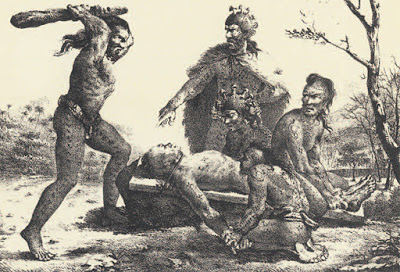
Human sacrifice in Hawaiian chiefdom

But before elaborating on how the aristocratic culture of Europeans created a masculine field of play, let’s see what Bellah has to say about the “relaxed fields of play” that emerged in complex chiefdoms. He focuses on Hawaiian chiefdoms in which “hierarchy was greatly intensified” and chiefs ruled by divine right. The “arbitrary power and the oppression of the common people over whom he ruled represent a remarkable breakdown of tribal egalitarianism . . . a particularly harsh form of despotism” (p. 208). The chief was surrounded by a court consisting of relatives, officials, and bodyguards; the ruler and his court were a world unto themselves, outside the sight of the commoners and in full control of religious ceremonies. “The rituals took place in walled temples where the general populace could not enter” (p. 571). Sacrifices – including human sacrifices – were undertaken to augment the power and prestige of the paramount chiefs. Moreover, the paramount had the power to tax and conscript for military service for his own objectives, and not for the sake of redistributing resources to the people.

Having made these observations, Bellah goes on to locate certain egalitarian motifs in Hawaiian rituals characterized by a relaxation of the Darwinian disposition to dominate. He describes a yearly festival that lasted for months in which war and human sacrifices were forbidden. He notes a “Carnival-like status reversal,” or “status leveling,” occurring throughout society during these months. One of the high points, after much feasting, dancing, and drinking was a ritual bathing in which both nobles and commoners would bath in the ocean in an orgy of sexual relations. Bellah identifies these practices as examples in which hierarchical rules and the instinct to dominate were temporarily suspended.

The aristocratic egalitarianism of Indo-European chiefdoms

Bellah’s account wrongly assumes that the development of hierarchical chiefdoms with increasingly despotic rulers was a general tendency in the evolution of societies across the world. Like every other academic, he makes no distinctions between the ruling classes of Indo-European cultures and non-European cultures. In Marxist fashion, he identifies all “aristocracies” as mere exploiters of commoners. In contrast, I use the term “aristocratic” to refer only to the ethos of “being-for self” or self-assertiveness and defiance which characterized the ruling class at the top of Indo-European chiefdoms. From this perspective, there were no aristocracies outside the Indo-European world. This term should be used exclusively for aristocratic men who view their leaders as first among equals, too proud to prostrate in front of anyone, and too dignified to behave slavishly in front of their gods. Indo-European gods were elegant and human-like sky gods in the sight of which nobles were not in a state of fear and submission, but in a state of confidence, elevated by their gods, strengthened in their courage and their actions.

I hope in the future to contrast the dark, secret cult-like nature – and sometimes gross and debasing – gods of non-European chiefdoms with the beauty and grace of Indo-European gods. I will suggest now that there were two basic types of chiefdoms emerging in the world: the “group-oriented” chiefdoms of the non-white world and the “individualizing” chiefdoms of the Indo-European world. In the former, there was greater emphasis on centralizing-collective activities aimed at integrating the population in the performance of irrigation agriculture and the building of temples and monumental architecture at the behest of paramount chiefs increasingly taking on a divine character. In the latter, there was greater emphasis on the personal status and prestige of ruling aristocracies, and less on communal and public construction. The aristocratic chief, with his retinue of warriors, was the focus of economic activity, and the units of production were not communistic estates but individual farmsteads. Individualizing chiefdoms were dominated by “wealth finance” or “prestige goods economies,” whereas collective chiefdoms were dominated by “staple finance and tributary systems.” Staple chiefdoms were regulated by “vertical relations of production and exchange” in the sense that authorities chiefly obtained their sources of income by extracting staple goods from the commoners to finance public works, pay the personnel attached to the chief, and trade with other chiefdoms. Prestige chiefdoms were characterized by “horizontal relations” whereby aristocrats obtained their income by controlling exchange networks, supplies of prestige goods, and decentralized units of rain-fed farming communities.

The rise of complex chiefdoms in Europe staring in about 1500 BC was linked to an “ideological and military complex of aristocratic warriors” in control of long-distance elite exchange in prestige goods that spread from the Mycenaean area through Central Europe and Scandinavia. The agrarian system of these chiefdoms was based on husbandry of free-grazing herds and rotating fields in an open landscape. Prestige goods were used as political currency to reward followers and enhance one’s status. The ethos of individual heroism was the engine behind the prestige goods economy, since the status of the chiefs was individually associated with the pursuit of prestige in warfare. The acquisition of prestige objects was not the means to acquire status. Rather, the possession of luxurious weapons and personal items symbolized that one had achieved high status in warfare.

The aristocratic ethos of companionship and equality is the most important trait of individualizing chiefdoms. Despite increased hierarchization, individual warriors were able to attract a retinue of followers through sheer personal initiative. The chiefs sought to attract followers and win the loyalty of lesser aristocratic warriors by giving gifts. The formation of voluntary war bands held together by oaths, camaraderie, and a common self-interest was a characteristic of these chiefdoms. One’s status and rank as a noble were still openly determined by one’s heroic deeds and by the number of followers and clients one could afford. Despite the principle of loyalty and companionship, there was always competition for power, and endless personal rivalries. This was not a rigidified structure in which men lost their individuality and vitality, as was the case in staple chiefdoms. It was free and open, and therefore prone to constant disruptions of violence.
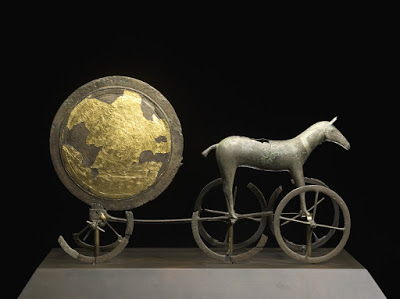
Sun chariot from Bronze Age Denmark

Citizen warrior states and republican governments have emerged only out of prior individualizing chiefdoms. In group-oriented chiefdoms, authority became increasingly concentrated in the hands of one supreme chief from whom wealth and power were seen to flow vertically to the majority at the bottom as well as to the few “aristocrats” under the subservience of the supreme despotic chief. While paramount chiefs faced competition from upstarts seeking to upstage him, and while status enhancement through the performance of deeds was still a factor in social mobility, the opportunity to achieve renown and prestige was increasingly difficult and rare as non-white chiefdoms became centralized. It is only among the individualizing chiefdoms of Indo-Europeans that one finds true tales of personal heroism in such poems, sagas, and myths as Beowulf, Lebor na hUidre, the Njáls  Saga, the Gísla Saga, and the Nibelungenlied. These were tales of an aristocratic culture, of the meetings, games, and feasting of chieftains, clients, and warriors. The culture of Indo-Europeans was tightly connected to these stories, recounted by poets, singers, and musicians. None of the staple chiefdoms produced any heroic epic literature.

Bellah completely ignores the unique cultural expressions of aristocratic societies, preferring to write about the egalitarian rituals and carnival-like orgies of non-European chiefdoms. We can say, however, that the field of relaxation from Darwinian pressures achieved within Indo-European chiefdoms took on the form of a “struggle to the death for pure prestige” over and against the most powerful biological drives humans have for self-preservation and comfort. To be an aristocrat, one had to demonstrate one’s capacity to be free by struggling for immaterial ends without submitting to the basest instincts. It is not that they acted against selective pressures, but that they created a cultural field of action that was self-chosen by them, rather than being a function of adaptive pressures only.

European males were the first beings in history to exhibit awareness of themselves as beings capable of acting according to self-chosen immaterial aims beyond the mere pressures of biology and the commands of gods.

Archaic civilizations

This aristocratic spirit continued in the more advanced archaic civilizations of Europe, such as Mycenae, during the second millennium. The political structure of Mycenaean Greece was one of autonomous feudal warlords surrounded by aristocratic retainers under the nominal overlordship of the city of Mycenae. For Bellah, however, Mycenae was just another archaic civilization, to which he pays no particular attention other than to identify it (erroneously) as “Eastern.” He focuses on the archaic civilizations of ancient Mesopotamia, ancient Egypt, and Shang/Western Zhou China. Unfortunately, through this chapter (and the following long chapters on the Axial civilizations), Bellah ceases to write explicitly about the ways in which these civilizations exhibited egalitarian cultural practices within a “relaxed field” of play and ritual. The whole discussion about play and rituals suddenly ceases. Only later, in the book’s conclusion, he tries to connect cultural developments in archaic and Axial times to the concept of “relaxed fields.” Suffice to say now that the main drift of his argument is that in archaic and Axial civilizations, the trend towards inequality, divination of rulers, and subjection of the commoners intensifies. So what happens to the development of an egalitarian field of play? His thesis is that the Axial Age sees the birth of a universal egalitarian ethic based on second order thinking. This ethic, articulated by prophets and philosophers, is the form in which humans escaped the Darwinian struggle for existence during the Axial Age.

Archaic civilizations were characterized by monumental architecture, wide networks of trade, some form of writing, cities, intensive agriculture, a centralized bureaucracy, and rulers with an exalted status reaching divinity (or close to it). Bellah emphasizes in particular how kinship by itself was no longer the basic principle governing the relationship between the state and the commoners. Religion now coexisted with an exalted and distant form of kinship. Kin relations obviously still played a role in the close-knit families out of which the ruling officials emerged, and within the extended families prevalent everywhere, but “something new in the religious realm appears in archaic societies: gods and the worship of gods,” with kings having a singular relation to the gods, or were frequently considered to be gods themselves (p. 212). Obligations and prohibitions had little to do with universal ideals of morality. The orders of Mesopotamian kings came about “without discussion, without protest, without criticism, in a perfect and fatalistic submission” (p. 223). The Pharaoh in Egypt was seen as the incarnation of god, with his commandments accepted accordingly.

The invention of writing in these archaic civilizations should not be equated with a “literacy revolution.” In Mesopotamia, writing was used mostly for administrative purposes and the enactment of bureaucratic orders; repetitions of myths or hymns were the norm in the literary texts. These civilizations “remained largely oral cultures throughout their history” (p. 226). In Egypt, too, texts were limited to administrative matters and temple rituals. The Middle Kingdom period (2040-1650 BC) sees some “wisdom” texts, hymns, and tales in which fathers imparted moral advice to their sons, as well as royal inscriptions about order, justice, and truth, but their language was restricted to the finite interests and customs of Egypt without aiming at the construction of universal principles for humans as such. In the Coffin Text from the Middle Kingdom, there is an emphasis on equality and an incipient concept that all humans are alike which may be identified as “proto-Axial,” but the religious community was still dependent on kinship ties and the idea of a common humanity was not really crystallized. The notion that there was a deep unity between God and King precluded the idea of a God standing above the King, with independently enacted moral commandments having a universal import.

In the New Kingdom (1550-1070 BC), writing that seems to involve “conscious reflection” on religion emerges, but there was no theoretic discourse in ancient Egypt; the thinking remained mythical, though it was bordering on theoretical reflection, according to Bellah. The centrality of the King in “every dimension of religious practice” (performance of cult, construction and maintenance of temples, responsibility for maintenance of the cosmic order) precluded any real discourse, as would happen in Axial times, when a group of itinerant intellectuals would carry a persistent assault on the culture of ritual and myth while searching for more universal answers about the meaning of life and the best forms of government.

The state in Shang China was essentially an extension of the ruler’s court, in unison with lineages from members of the court. While it had bureaucratic attributes, such as a variety of appointed civil and military officers under the King, such positions were mere extensions of the King’s patrimonial rule. In fact, lineage was so pervasive in Shang China that ancestor worship was the central practice of religion, leaving a “permanent legacy for all later Chinese culture.” It was difficult to create solidarity among all classes and regions, because even though archaic societies were territorially extensive and included millions of unrelated inhabitants, the rulers were a close-knit group connected by kinship ties without universal values connecting them to the people. No moral philosophy or texts were put forward from which to criticize unjust rulers based on notions about a universal God, a Mandate of Heaven, or the best form of government for humans as such.

What about archaic Mycenaean civilization? Bellah brings this civilization into his discussion when he deals with Axial Greece, as we will see in Part Four, insisting it was “Eastern.” I believe that Homer’s poems reflect the central aristocratic values of the Mycenaean age. While the leader was now a king rather than a chief of a tribal society, he did not have despotic powers, but ruled together with feudal warlords who were identified as the “companions” of the King. The Iliad captures this aristocratic relationship when it has Agamemnon, King of Mycenae, surrounded by free, prideful men who are always deliberating and debating their actions rather than subserviently following the commands of an autocratic King. King Agamemnon was no Pharaoh ruling by divine right. Most of the Iliad consists of speeches by aristocrats arguing over strategy, and debating the King’s proposals over the conduct of war. There is no literature from the East – not the Epic of Gilgamesh, as I explained at length in Uniqueness – portraying a world of aristocratic freedom. The ruler depicted in Gilgamesh, a king of Uruk or Erech, a city of Mesopotamia, appears as a typical despot, and not a very admirable “heroic” figure, but rather as an insolent character yearning and weeping for everlasting life, in contrast to the heroes of the Iliad, who rejected a long life without memorable deeds for a short life with immortal deeds.

This article was reproduced from the Council of European Canadians Website.

The European Idea of Progress Supersedes the Axial Age, Part III

The%20European%20Idea%20of%20Progress%20Supersedes%20the%20Axial%20Age%2C%20Part%20III

Share

  • Gab

Enjoyed this article?

Be the first to leave a tip in the jar!

Instant Echeck GreenPay™

Related

  • The Dangers of Skilled Immigration 

  • Lothrop Stoddard on the French Colonists in San Domingo

  • Zsutty’s Maximum

  • An Interview with Endeavour:

  • Curtis Dozier’s The White Pedestal

  • Eternal Glory

  • Jonathan Bowden’s Onslaught, Part 8

  • Liberal Individualism vs. Self-Actualization

Tags

aristocracyAxial AgeCouncil of European Canadiansegalitarianismindividualismingroup vs. outgroup preferencesRicardo DuchesneritualRobert N. BellahWestern uniqueness

2 comments

  1. Randall Crowley says:
    July 9, 2019 at 5:01 pm

    Ricardo, When is your magnum opus coming back into print?

    0
    0
  2. margot metroland says:
    July 10, 2019 at 4:52 am

    Altogether too much attention is paid to the behavior of savages. Whenever someone wants to flog an anthropological theory to me and begins with the Trobiand Islanders, a race who have no words for “why” or “because,” I want to say, Shut UP, you!

    The Agamemnon mask was also used as an illustration by Will Durant for one of his Story of Blahblah books. Whittaker Chambers reviewed it in the back of TIME, and had little good to say about Durant or the book, but gave the nod to Agamemnon. I suspect it’s not even a good likeness.

    0
    0

Comments are closed.

If you have a Subscriber access,
simply login first to see your comment auto-approved.

Note on comments privacy & moderation

Your email is never published nor shared.

Comments are moderated. If you don't see your comment, please be patient. If approved, it will appear here soon. Do not post your comment a second time.

Writer of June

(4 votes) David M. Zsutty

Article of June

Why White Advocates Should Avoid “Based Blacks” by Dani Vypont 4 votes
    • Replacement Migration & Hypergamy

      F. Roger Devlin

      20

    • Kurds of a Feather Flock Together:
      Europe’s “Racist” Parakeet Tweet-Storm

      Steven Tucker

      1

    • Elevator Pitch to a Billionaire
      Money, Money, Money

      Ondrej Mann

      1

    • All Hail Rhodesia

      Spencer J. Quinn

      3

    • Nationalism This Week
      Disenfranchisement

      Greg Johnson

      28

    • The Murder of Ann Widdecombe

      Lipton Matthews

      9

    • Disclosure Day
      Please, Keep It Undisclosed

      Francisco Albanese

      11

    • Remembering Carl Schmitt
      July 11, 1888–April 7, 1985

      Greg Johnson

      1

    • Editor’s Update
      Fundraiser Update & New Books

      Greg Johnson

      1

    • Third Homeland Institute Poll on the Great Replacement

      David M. Zsutty

      12

    • The Bitter End of Western Metaphysics:
      Heidegger on Nietzsche, Part Five (Conclusion)

      Collin Cleary

      9

    • Fraudulent Black British History

      Mark Gullick

      7

    • A White Nationalist Response to Scott Greer

      Dave Chambers

      25

    • The Miami Mall Incident:
      Black Youths or Black Extraterrestrials?

      Dominic Fox

      6

    • The Theology of Three Populisms

      Morris van de Camp

      2

    • The Dangers of Skilled Immigration

      Lipton Matthews

      25

    • The Brotherhood of the Bell

      Beau Albrecht

      16

    • Endeavor: What Rome Means to Me

      Endeavour

    • When the Family Becomes Predation

      Jayant Bhandari

      5

    • RICU: The Gentle Art of Persuasion

      Mark Gullick

      7

    • Mind of Darkness:
      A Review of Lipton Matthews’s Busting African Delusions

      Derek Stark

      12

    • Remembering Revilo Oliver
      July 7, 1908–August 20, 1994

      Greg Johnson

      2

    • Some Advantages of Irish Nationalism

      Greg Johnson

      30

    • America at 250 from the National Cathedral

      Gabriel Anderson

      18

    • Why Not Stop All the Clocks?
      Modern Conservatism’s Flagging Commitment Towards Turning Back Time

      Steven Tucker

      3

    • Remembering Jean Raspail
      July 5, 1925–June 13, 2020

      Greg Johnson

      2

    • Editor’s Update
      Fundraiser Update & New Books

      Greg Johnson

    • The Ethnic Reality of FIFA 2026

      Samuel Valleus

      13

    • Nationalism This Week
      Tucker’s New Party

      Greg Johnson

      30

    • Ethiopia Against Italy
      How the Italo-Ethiopian Wars were part of the conflict between Eastern & Western Christiandom

      Morris van de Camp

    • Please Vote in Our Writer & Article of the Month Poll

      Greg Johnson

    • Available for Pre-Order!
      F. Roger Devlin’s Not Hooking Up

      F. Roger Devlin

    • Kolberg: The Last Nazi (or Prussian?) Film

      Steven Clark

      2

    • America 250 & The Fate of Empires

      Richard Houck

      20

    • Available for Pre-Order!
      Greg Johnson’s The Battle of the Books

      Greg Johnson

    • Why All the Silence About Blacks Being Kicked Out of South Africa?
      Because It’s Other Blacks That Are Doing It.

      Steven Tucker

      10

    • Zelensky, the Jewish Conspiracy Narrative, & the Demographic Replacement of Ukraine:
      A Critical Analysis of a Disinformation Discourse within the European Identitarian Right

      Luís Graça

      30

    • The Original Congressional Debate on Birthright Citizenship

      Alex Graham

      13

    • America at 250
      Unmanifested Destiny  

      David M. Zsutty

      32

    • The Normies are Waking Up:
      The Alliance for Responsible Citizenship Conference, London 2026

      Lipton Matthews

      2

    • Ethnic Vigilantism: The Movie

      Mark Gullick

      15

    • Lothrop Stoddard’s The Revolt against Civilization

      Kevin MacDonald

      2

    • David Zsutty on Political Organizing

      David M. Zsutty

    • PC-Incompatible Gaming:
      Plantation Simulator and the “Problem” of Racist Video Games

      Steven Tucker

      3

    • Remembering Lothrop Stoddard
      June 29, 1883–May 1, 1950

      Greg Johnson

      1

    • Editor’s Update
      Fundraiser Update & Upcoming Projects

      Greg Johnson

    • Nationalism This Week
      Metapolitics Wins:
      Scott Greer’s Whitepill

      Greg Johnson

      8

    • Remembering Colin Wilson
      June 26, 1931–December 5, 2013

      Greg Johnson

      3

    • Kevin Deanna on Political Organizing

      Kevin Deanna

      1

    • The Bitter End of Western Metaphysics:
      Heidegger on Nietzsche, Part Four

      Collin Cleary

      6

    • Dani Vypont

      Replacement Migration & Hypergamy

      What parts of the United States would you say have the most and least interracial relationships?It...

    • Dave Chambers

      All Hail Rhodesia

      Rhodesia is an inspiration to all of us whose families have had to flee the neighborhoods and...

    • CC reader

      Disclosure Day
      Please, Keep It Undisclosed

      Duel was a very good movie, and it was made for tv. Good suspense, camera work, musical score, and...

    • WU

      Replacement Migration & Hypergamy

      I visited Norway 3 years ago, and the experience was so strange it is worth relating. In Bergen,...

    • Dave Chambers

      Replacement Migration & Hypergamy

      What parts of the United States would you say have the most and least interracial relationships?

    • CC reader

      Third Homeland Institute Poll on the Great Replacement

      If a white ethnostate is carved out, the 67% who voted against returning to 60% white or higher...

    • Zarathustra

      Replacement Migration & Hypergamy

      MTV and Hollywood are partly to blame for this.

    • Dani Vypont

      Replacement Migration & Hypergamy

      I once had a Norwegian nationalist ask me to tell him the degree of mixing between White women &...

    • James Sunderland

      Replacement Migration & Hypergamy

      With regard to one of your earlier posts, I did some research, and it is possible to determine the...

    • Glide Ratio 0:1

      Replacement Migration & Hypergamy

      Maybe the NSDAP were correct about Persians (you could be Arab?) being Aryan. You seem to suffer...

    • Fionn McCool

      Replacement Migration & Hypergamy

      Dani, for what it’s worth, your 92% figure refers to biracial children born to black fathers and...

    • Dani Vypont

      Replacement Migration & Hypergamy

      Both of those sources rely on marriage data. The first one is titled "Intermarriage in America Post-...

    • Fionn McCool

      Replacement Migration & Hypergamy

      Most people are the most attracted to individuals of their own race. Regardless, the broader...

    • James Sunderland

      Replacement Migration & Hypergamy

      Here is analysis conducted using U.S. Census Data. You can't get better than this: https://www....

    • Hairy Iranian Dude

      Replacement Migration & Hypergamy

      I love Norway. It’s a real country (used to be?). I was there for six days in 2018: Oslo and Bergen...

    • Dani Vypont

      Replacement Migration & Hypergamy

      In the U.S., white woman have the lowest rate of miscegenation across all intersections of race and...

    • Glide Ratio 0:1

      Replacement Migration & Hypergamy

      This is one hundred percent my observations moving from England to the USA. White American females...

    • Fionn McCool

      Replacement Migration & Hypergamy

      It would have been good if FRD had offered some statistics to support his claim rather than mere...

    • Greg Johnson

      Nationalism This Week
      Disenfranchisement

      People constantly bemoan the fact that old politicians send young men to die in wars. I guess that...

    • Peter Quint

      Replacement Migration & Hypergamy

      Sounds like Norway needs its own Casa Pound. 🦈

    • Earth Day Special

      John Morgan

      12

    • A Robertson Roundup
      Remembering Wilmot Robertson
      (April 16, 1915 – July 8, 2005)

      Margot Metroland

      13

    • The Paranoid Style in White Nationalism

      Greg Johnson

      30

    • Join the Dance!

      Andrew Hamilton

      1

    • We Can’t Save the Earth Without Reducing African Birth Rates

      James Dunphy

      36

    • “I’m Not a Conspiracy Theorist, but . . .”:
      Jeffrey Epstein’s Death Gives New Life to “Conspiracy Theories”

      Greg Johnson

      22

    • Sylvia Plath: Stasis in Darkness

      Vic Olvir

      17

    • Vanguardism, Vantardism, & Mainstreaming

      Greg Johnson

      80

    • Aviation, Geography, & Race

      Charles Lindbergh

      3

    • Some Thoughts on Yule

      Collin Cleary

      4

    • Living in Truth:
      A Yuletide Homily

      Jef Costello

      7

    • John Kennedy Toole’s A Confederacy of Dunces

      Greg Johnson

      20

    • On Aleksandr Solzhenitsyn’s Warning to the West

      Spencer J. Quinn

      7

    • Elitism, British Modernism, & Wyndham Lewis

      Jonathan Bowden

      6

    • Philip K. Dick’s Do Androids Dream of Electric Sheep? as Anti-Semitic/Christian-Gnostic Allegory

      Greg Johnson

      20

    • “Conspiracy Theory” or Conspiracy?

      Andrew Hamilton

      21

    • Remembering H. P. Lovecraft
      (August 20, 1890–March 15, 1937)

      Greg Johnson

      3

    • Who Are We?
      Nordics, Aryans, & Whites

      Greg Johnson

      71

    • Remembering William Gayley Simpson
      (July 23, 1892–December 31, 1990)
      A Pleasant Afternoon with Harriet & Bill Simpson

      Margot Metroland

      18

    • Here are the Young Men
      Remembering Ian Curtis
      (July 15, 1956–May 18, 1980)

      Mark Gullick

      18

    • Percy Grainger
      Artist of the Right

      Alex Graham

      7

    • Remembering Revilo Oliver
      (July 7, 1908–August 20, 1994)

      Greg Johnson

      18

    • The Meaning of July 4th for the White Man

      Gregory Hood

      13

    • The Front National’s Evolution

      Bruno Mégret

    • Merwin K. Hart
      Forgotten American Hero & Man of the Right

      Morris van de Camp

      10

    • George Orwell’s Nineteen Eighty-Four

      Jonathan Bowden

      8

    • Carleton S. Coon
      Scientist & Reluctant White Advocate

      Morris van de Camp

      4

    • The Kwanzaa Absurdity Will Be Dwarfed by Juneteenth

      Robert Hampton

      12

    • Stravinsky

      Alex Graham

      7

    • Like the Roman:
      Remembering Enoch Powell (1912-1998)

      Mark Gullick

      23

    • Exclusive Interview with Karel Veliky:
      The Final Chapter in the Film Series! Part II

      Ondrej Mann

      2

    • Exclusive Interview with Karel Veliky:
      The Final Chapter in the Film Series! Part I

      Ondrej Mann

      2

    • Nietzsche & Race

      Mark Gullick

    • The Crisis of Chinese Technology Thieves

      Morris van de Camp

      1

    • The Zodiac Killer

      Mark Gullick

      12

    • José Pedro Zúquete’s The Identitarians

      Greg Johnson

      3

    • Berlin: City of Stones

      Spencer J. Quinn

      6

    • Headbanging Lite

      Mark Gullick

      5

    • The Russians are Coming/The Russians are Coming

      Steven Clark

      2

    • The Cruelty of Kindness

      Morris van de Camp

      11

    • Jonathan Bowden’s Deliverance
      Part 7

      Jonathan Bowden

    • Lothrop Stoddard’s The Revolt Against Civilization

      Spencer J. Quinn

      15

    • About Film “From the Right”

      Karel Veliky

    • The 1970s: The Golden Age of Hijacking

      Morris van de Camp

      21

    • Jonathan Bowden’s Deliverance
      Part 6

      Jonathan Bowden

    • Do You Want to Play a Game?

      Mark Gullick

      1

    • Sexually Incontinent on the Indian Subcontinent:
      Who Rapes More Animals, Indians or Pakistanis? The Battle Continues!

      Steven Tucker

      3

    • Neo-Fascism in Film
      Part 5

      Karel Veliky

      15

    • The Game of Tarot

      Mark Gullick

      2

    • Institutions Cannot Be Transplanted

      Jayant Bhandari

      5

    • Jonathan Bowden’s Deliverance
      Part 5

      Jonathan Bowden

    • Crosstown Traffic:
      Jimi Hendrix & The Post-War Rock ‘N’ Roll Revolution

      Mark Gullick

      1

    • Slaves from the North:
      Finns & Karelians in the East European Slave Trade, 900–1600

      Lipton Matthews

      14

    • Neo-Fascism in Film
      Part 4

      Karel Veliky

      2

    • David Lean’s A Passage to India

      Spencer J. Quinn

      1

    • Elites are Essential to Development

      Lipton Matthews

      7

    • Jonathan Bowden’s Deliverance
      Part 4

      Jonathan Bowden

    • Neo-Fascism in Film
      Part 3

      Karel Veliky

      6

    • E. M. Forster’s A Passage to India & the Indian Mentality

      Spencer J. Quinn

      25

    • Jonathan Bowden’s Deliverance
      Part 3

      Jonathan Bowden

    • András László
    • Derek Hawthorne
    • Beau Albrecht
    • Alain de Benoist
    • Kerry Bolton
    • Jonathan Bowden
    • Collin Cleary
    • Jef Costello
    • Savitri Devi
    • Julius Evola
    • Jim Goad
    • Gregory Hood
    • Juleigh Howard-Hobson
    • Greg Johnson
    • Charles Krafft
    • Anthony M. Ludovici
    • Trevor Lynch
    • H. L. Mencken
    • J. A. Nicholl
    • James J. O’Meara
    • Christopher Pankhurst
    • Tito Perdue
    • Michael Polignano
    • Spencer J. Quinn
    • Fenek Solère
    • Irmin Vinson
    • Leo Yankevich
    • Francis Parker Yockey
    • Multiple authors
  • Editor-in-Chief

    • Greg Johnson, Ph.D.

    Featured Writers

    • Beau Albrecht
    • Gunnar Alfredsson
    • Collin Cleary, Ph.D.
    • Jef Costello
    • Morris V. de Camp
    • F. Roger Devlin, Ph.D.
    • Stephen Paul Foster, Ph.D.
    • Jim Goad
    • Alex Graham
    • Mark Gullick, Ph.D.
    • Greg Johnson, Ph.D.
    • Travis LeBlanc
    • Trevor Lynch
    • Margot Metroland
    • James J. O’Meara
    • Angelo Plume
    • Spencer J. Quinn
    • Fred Reed
    • Clarissa Schnabel
    • Michael Walker
    • David M. Zsutty

    Frequent Writers

    • Asier Abadroa
    • Aquilonius
    • Alain de Benoist
    • Kerry Bolton, Ph.D.
    • Dave Chambers
    • Steven Clark
    • James Dunphy
    • Endeavour
    • Richard Houck
    • Jason Kessler
    • Titus Livius
    • Ondrej Mann
    • Lipton Matthews
    • Mark Mazari
    • John Morgan
    • Jaroslav Ostrogniew
    • Kathryn S.
    • Christian Secor
    • Anne Wilson Smith
    • Thomas Steuben
    • William De Vere
    • Kenneth Vinther
    • Max West

    Classic Authors

    • Maurice Bardèche
    • Jonathan Bowden
    • Julius Evola
    • Guillaume Faye
    • Ernst Jünger
    • Kevin MacDonald, Ph.D.
    • D. H. Lawrence
    • Charles Lindbergh
    • Jack London
    • H. P. Lovecraft
    • Anthony M. Ludovici
    • Sir Oswald Mosley
    • National Vanguard
    • Friedrich Nietzsche
    • Revilo Oliver
    • William Pierce
    • Ezra Pound
    • Saint-Loup
    • Savitri Devi
    • Carl Schmitt
    • Miguel Serrano
    • Oswald Spengler
    • P. R. Stephensen
    • Jean Thiriart
    • John Tyndall
    • Dominique Venner
    • Leo Yankevich
    • Francis Parker Yockey

    Other Authors

    • Howe Abbott-Hiss
    • Michael Bell
    • Giles Corey
    • Jack Donovan
    • Richardo Duchesne, Ph.D.
    • Emile Durand
    • Guillaume Durocher
    • Mark Dyal
    • Tom Goodroch
    • Andrew Hamilton
    • Robert Hampton
    • Huntley Haverstock
    • Derek Hawthorne
    • Gregory Hood
    • Juleigh Howard-Hobson
    • Alexander Jacob
    • Ruuben Kaalep
    • Tobias Langdon
    • Julian Langness
    • Patrick Le Brun
    • G A Malvicini
    • John Michael McCloughlin
    • Millennial Woes
    • Michael O’Meara
    • Christopher Pankhurst
    • Michael Polignano
    • J. J. Przybylski
    • Quintilian
    • Edouard Rix
    • C. B. Robertson
    • C. F. Robinson
    • Herve Ryssen
    • Alan Smithee
    • Fenek Solere
    • Ann Sterzinger
    • Robert Steuckers
    • Tomislav Sunic
    • Donald Thoresen
    • Marian Van Court
    • Irmin Vinson
    • Book Reviews
    • Movie Reviews
    • TV Reviews
    • Music Reviews
    • Art Criticism
    • Graphic Novels & Comics
    • Video Game Reviews
    • Fiction
    • Poems
    • Interviews
    • Videos
    • English Translations
    • Other Languages
      • Arabic
      • Bulgarian
      • Croatian
      • Czech
      • Danish
      • Dutch
      • Estonian
      • Finnish
      • French
      • German
      • Greek
      • Hungarian
      • Italian
      • Lithuanian
      • Norwegian
      • Polish
      • Portuguese
      • Romanian
      • Russian
      • Slovak
      • Spanish
      • Swedish
      • Ukrainian
    • Commemorations
    • Why We Write
  • Archives
  • Top 100 Commenters
  • The Looney Bin
Sponsored Links
Europa.com Above Time Coffee Antelope Hill Publishing Paul Waggener IHR-Store Spencer J. Quinn American Renaissance Jim Goad The Occidental Observer
Donate Now Mailing list
Books for sale
  • Not Hooking Up
  • The Battle of the Books
  • The Philosopher Is In
  • Sexual Utopia in Power (Expanded Edition)
  • In Defense of Prejudice
  • Loving Our Own
  • Tyranny & Wisdom
  • To all books
Copyright © 2026 Counter-Currents Publishing, Ltd.

Paywall Access


Please enter your email address.

Lost your password?

Edit your comment

Writer & Article of the Month June 2026

Voting for this month has concluded. Here are the final results!

Top Writers

  • #1 David M. Zsutty 4 votes
  • #2 Mark Gullick 3 votes
  • #3 Morris van de Camp 2 votes
  • #4 Ondrej Mann 2 votes
  • #5 Dani Vypont 2 votes
  • #6 Greg Johnson 2 votes
  • #7 Collin Cleary 1 vote
  • #8 Millennial Woes 1 vote
  • #9 Beau Albrecht 1 vote
  • #10 Dave Chambers 1 vote
  • #11 Steven Tucker 1 vote
  • #12 Jayant Bhandari 1 vote

Top Articles

  • #1 Why White Advocates Should Avoid “Based Blacks” 4 votes
  • #2 Zsutty’s Maximum 3 votes
  • #3 The Murder of Henry Nowak 2 votes
  • #4 China’s Threat to American Security 1 vote
  • #5 Ethnic Vigilantism: The Movie 1 vote
  • #6 The Inferiority Behind Immigrant Superiority 1 vote
  • #7 Uncivil War 1 vote
  • #8 Liar, Liar, Pants on Fire! 1 vote
  • #9 Small Is Beautiful: The Napoleon of Notting Hill 1 vote
  • #10 Interview with Gerhard Hallstatt of Allerseelen 1 vote
  • #11 Monkeys and Typewriters 1 vote
  • #12 The Remigration Movement Solidifies  1 vote
  • #13 I’m Glad He Failed 1 vote
  • #14 The Killing of Henry Nowak 1 vote
  • #15 Alex Jones’ Endgame: Blueprint for Global Enslavement, Part 4 1 vote

Total votes cast: 21