 3,676 words
Duncan Smith
The Surprising Liberation
Sydney: Alfadex Books, 2025
Who ultimately runs the world? That depends on who you ask. But one thing is clear; someone does. Even if we can’t look into the inner chambers of power and see who is working the levers, we can at least agree that there is power. Someone is exercising it, and they are probably not doing so for our good. That there exists such power is provable by its effects; By his works shall ye know him, and those works are many. The “globalists,” whoever they may be, are not using two or three basic techniques of subversion and coercion to herd the Western indigenous populace both geographically and ideologically, and pen them in where they want them. “They” are using hundreds, even thousands of such strategies, techniques and psy-ops, all interlocking, interdependent, and almost too many to list. Fortunately, such an inventory now exists.
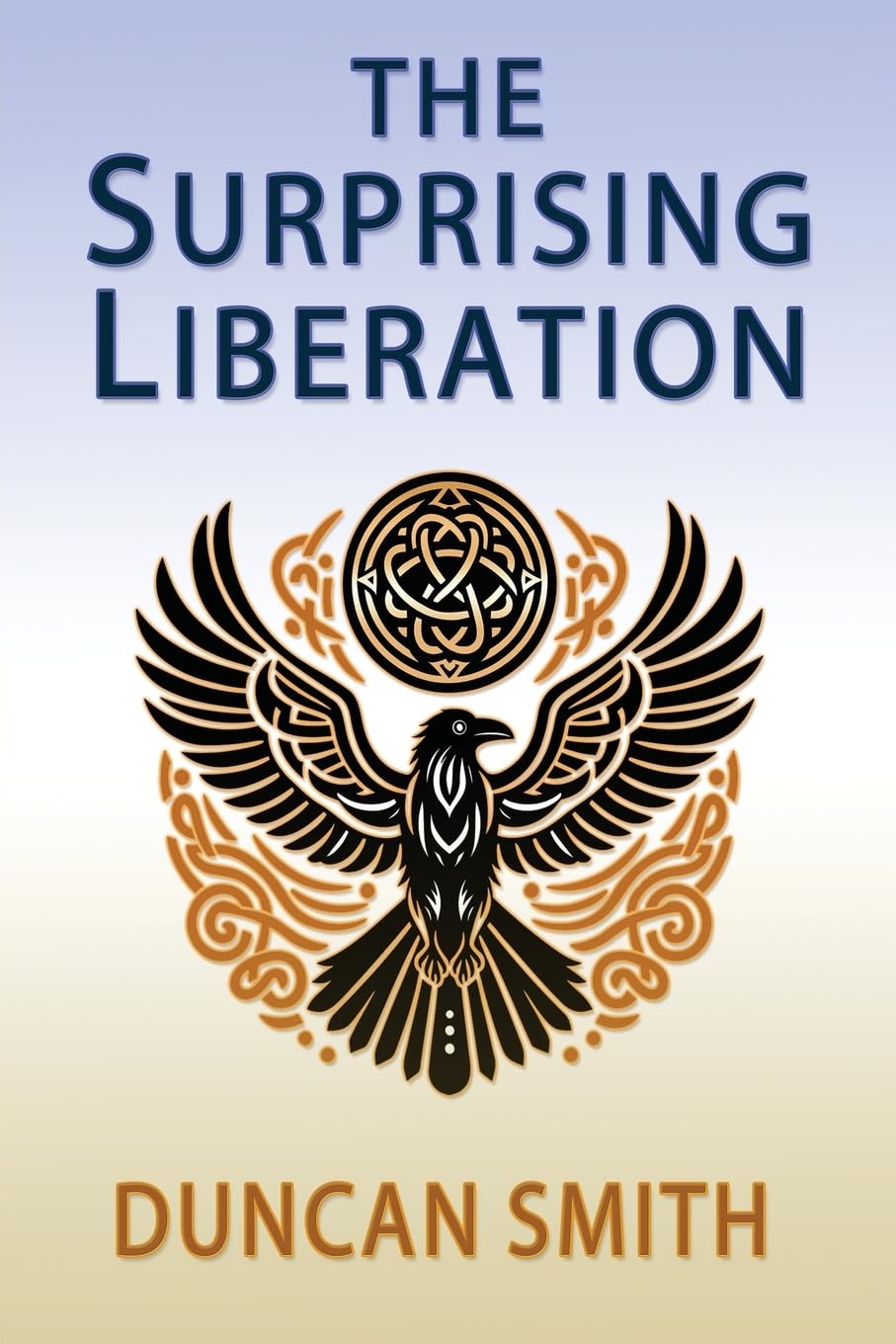
Duncan Smith’s 2025 book, The Surprising Liberation is recent enough to give a contemporary snapshot, not of who our ultimate rulers might be, but of what their methods and practices provably are. Mr. Smith is an Australian author and musician, and a musical ear never harms analysis; this is a well-organized, harmonic book. The thesis of TSL is laid out early and concisely; we live in a GPR, or Global Progressive Regime. This is a play on the GDR, the old German Democratic Republic, and the author provides a mission statement for this new world order:
In the GPR there are a number of ideas to which moral and educated people are supposed to pledge their allegiance. They include… ‘anti-racism’, feminism, diversity, and equality. When you live in the GPR, you are expected to not just believe in all of these, but enthusiastically support them.
So far, so North Korean. But, over the course of TSL, Mr. Smith will enumerate and take to task not just the usual suspects such as those noted above, but a host of other and more insidious strains of the current virus afflicting the West, whoever’s lab they came from.
The author does consider the possible existence of “a secret group of powerful elites” but is non-committal, aside from making one thing clear:
Now, a disclaimer. It has been said that the term ‘globalist’ is a reference to Jews, and therefore some kind of anti-Semitic slur. In that case, I’ll be clear that I’m not referring to Jews or any other ethnic group in particular.
I am not accusing the author of cowardice or complicity, far from it. There is a lot of Dissident Right commentary on other people’s features about the power of the Jew, but precious few readable books on the subject. I merely note that it is always wise to clear the air early, before it thickens. One of the several strengths of TSL is that it does not get bogged down in one ultimate focus. This is not a Who’s Who of global Jewry; it’s not distracted from its main aim of itemizing the globalist-funded operations forcing a great civilization into decline.
The author himself made the familiar and gradual political switch from Left to Right, as many did, and for the same reason; he became skeptical of the ideology of the Left. This is one secret power the Right have; the crazier the Left becomes, the more defections to reality there will be. Mr. Smith cites Peter Hitchens, the veteran and conservative English political journalist, on several occasions, and he made a more severe journey. Hitchens was a self-confessed Trotskyite before his own personal Epiphany. Those who have made the journey from Left to Right tend to know whereof they speak in any critique of their old encampment, and to understand the nature of the concentrated assault being made on freedom across the West. What are the assault weapons?
They are all here, all the flies in the Western ointment, assembled like a gang of super-villains in a Marvel movie: CRT, BLM, DEI (although the author prefers DIE), cancel culture, the Great Replacement, stolen land, the gender pay-gap, slavery and reparations, historical revisionism, the patriarchy. . . The gang’s all here, and Mr. Smith is comprehensive. His book is like an account of a malevolent carnival rolling into town, and it is to the author’s credit that he separates these elements out and explains them before putting them back into the context of GPR policy and seeing how the whole system works. And all these operations use the same reductive concept; identity.
Mr. Smith points out that the points-based identitarian system of privilege and protection is essentially the old class warfare in a new coat of paint. “Protected characteristics” are like children’s trump cards in the playground; some are worth more points than others. One of his insights is the synchronicity with which these ops all hit the Western world and Commonwealth at the same time. The “unity of thought” the author describes on the Left is in position, and now coordinated strikes can take place.
As far as the political Right are concerned, Mr. Smith covers just about every contentious topic of the modern age, all save one. The only surprising omission is any mention of transgender issues, but the author gives a reason for what I think it is a wise move. The subject of feminism is an area of expertise for the author. He has written another book, The Vast and the Spurious, on the thorny subject of gender (in)equality, and knows his subject. The chapters on feminism in STL are thus the richest in the book, and to bring in trans issues would have clouded the water. On issues of race and gender, the arguments are essentially biological. With transgender, the central argument becomes epistemological, more concerned with the nature of truth than with genetics, chromosomes, or cells.
One of the interesting offshoots of the rise of militant feminism, and the supposed “empowerment of women” that this heralds, is that it simply produces another system to be gamed. The author examines the irrationality of the “MeToo” movement, as well as the false idol of the “girl boss,” where the girls get to dress up like the boys in the name of equity. Public figures differ in how seriously they take the scrutiny of the modern age, and how legislation supposed to protect the vulnerable can be abused, but many are now having to think ahead of the modern traps and snares that come with girl power. The author mentions the “Mike Pence Rules,” named for the US Vice President who would never be alone with a woman in any room. This, he maintained, meant there could never be any allegations made of any impropriety. This is a different kind of social paranoia.

You can order Alain de Benoist’s The Populist Moment here
The most educational chapters of the book for me were those which dealt with the author’s home country of Australia. The racial tension there, of course, is between the white Australians and the Aborigines, who are to Australia what the Native Americans are to the USA. I knew next to nothing about Australian Aboriginals I didn’t learn from Nic Roeg’s 1971 movie, Walkabout, but TSL has a potted history from an alternative viewpoint to that being forced on the Australian public. Ordinary Australians, who have seen “Australia Day” denigrated, have to endure a “Sorry Day” to atone for stealing land. “Stealing Australia” began in 1788, and immediately there arises the problem, not of who was there longest, but who did what quickest? As the author emphasizes, Aborigines had Australia far longer than current Australians; about 60,000 years against a mere 200. What were they doing all that time? Well, Aboriginal history is known to their people as “Dreamtime,” so possibly they just overslept. The lack of indigenous progress pre-colonization is not unique to Australia, and is reminiscent of the story of the Dutch arriving in Africa for the first time, and noting that the tallest buildings were those built by termites.
The problem of the Aboriginal claim to land has long been politicized and, of course, claimed as a cause célèbre by the perennially concerned Left. The ongoing claims came to a head with the proposed “Voice to Parliament,” a legislative instrument which would have guaranteed native Aborigines a permanent presence in Parliament, like one party in a coalition. I remember being fascinated with the vote at the time, in 2023, and being staggered by the terms under which a “Yes” vote would have been served out. It had no term limit. Aborigines would have been a part of Australian government in perpetuity. They would have had representatives admitted to any and every session of Parliament, by constitutional right. But the aspect of the claim that amused me most, and is covered by the author, was the Uluru Statement. This was originally a scrap of paper, bearing 433 words, and purporting to be the entire textual and legal basis of Aboriginal land claims. As the case progressed, it came to light that this pocket-sized version of the American Constitution was in fact 26 pages long, and had a lot more to claim than the original. The government first denied it existed, then denied it was relevant, then denied the claim altogether when they lost the vote. Australia dodged a bullet with that one.
The problem for the average Australian, however, is not simply one of land rights and spurious documents. It is also making sure they respond to these outrageous claims in the approved manner:
White Australians are supposed to listen contritely, not answer back, and then make amends with yet more apologies, concessions, and billions paid to the Aboriginal Industry as a form of “reparations.”
The author describes a female Australian politician sitting cross-legged with some Aborigine tribal elder. He describes the look of awe and wonder as she gazes into the eyes of this shaman, doubtless the same love-light to be found in the eyes of UN delegates watching Greta Thunberg perform.
Australia was probably more surprised than most at their sudden introduction to authoritarianism under the guise of healthcare during what some call the “Scamdemic.” The level of deception increases as Covid slips into the past, and there is little time now to investigate the past scandals. You still don’t see much interest in the fact that UK flu cases dropped to zero in the first winter of Covid-19, and it just seems to be a wearily accepted fact that the whole thing was a cross between a psy-op and a boondoggle for those who made money. I was pleased—and chilled once more—that the author quotes Jacinda Ardern, then Premier of neighboring New Zealand. Concerned with the new globalist plaything, “misinformation,” Ms. Ardern assured the public that her government “are your only source of truth.” It’s a line that belongs in the script of a movie like V for Vendetta rather than the real world.
One of strongest themes of TSL is the analysis of the Leftist mindset, and particularly what it is that coerces apparently articulate, intelligent people to take up sides with the hysterical Left. Mr. Smith’s Australian heritage gives him a special understanding of my country, England, and the UK as a whole. Considering the entertainment business, and its fawning attitude to all the approved scriptural responses to world events, he chooses three Englishmen as disappointingly typical of the tendency, even for intelligent people, to walk in line: John Cleese, Johnny Marr, and Brian May. All three are iconic in England, all mildly outspoken, and all infected with the same raving platitudes any other entertainer would spout when it comes to Donald Trump. How unlike Marr’s creative partner, Morrissey, who is always in trouble with the British media for comments which are mildly contentious at most. Entertainment is an area in which the culture wars are inflicting a beating on those who wish to conserve what is strong in a culture, rather than despoil it just to promote the illusion of progress.
The author chooses one particularly iconic work of modern culture for an extended study, and once again it is British; Dr. Who. The chapter on the Time Lord with two hearts is perhaps the strongest in a strong book, and shows exactly the anatomy of “woke” that has destroyed one of Britain’s finest TV series. I vaguely remember William Hartnell, but really grew up on Patrick Troughton, Jon Pertwee, and Tom Baker. Aside from the famously dreadful special effects and the novelty of the ideas and monsters, the only moral lessons to be drawn from Dr. Who for children of my generation were the occasional little homilies, nothing preachy. Well, that and never trust a Dalek. The Doctor was just a nice, eccentric old gentleman who span through space and time in a police call-box of the kind kids saw everywhere in the UK back then. We saw him making friends, acting as a gentleman ought, and occasionally saving the universe. However, and even given the unpredictability of time, that was then and this is now. The author charts the show’s sudden and horrific plunge into ideological chaos, with a female Doctor, a gay black Doctor (for extra identitarian points), and plenty of scoldings for misgendering aliens. Predictably, ratings have dropped through the floor, and the show is now confirming the new adage; “Get woke, go broke.”
The defenders of this cultural pillage have nowhere to hide from Mr. Smith, despite their mealy-mouthed blather. A producer of Dr. Who was asked why he had portrayed Victorian London as 50% black. He replied that this was “an imaginary, better version of the world” he was helping to bring about. And that version includes implanting the notion that London was always half black. Accept that, and you won’t mind some more cultural enrichment. As the author drily notes “Dr. Who stories were often about resisting alien invasions. Now, apparently they want to assist them”.
The grand finale is the most original section of the book. The stated intent is to “examine left-wing pathologies,” but this is not clinical in the medical sense. I’ve written myself about the startling overlap between standard Left-wing behaviors and various personality disorders in DSM V, but Mr. Smith goes far deeper. He creates, or allocates, his own list of personality types, each of which paints the Leftist in a slightly different light, and from a different perspective: The Fear Monger; The Edenist; Pieties and Kowtowing; Right Side of History. It is an entertaining arcade of familiar types of dysfunction.
Mr. Smith also dissects and displays the Left, and their psychology and pathology, without petulance or spite, but rather with the calm of a biology tutor mounting a frog on a display board. The author notes the presence of Rousseau’s “noble savage” in the Leftist mindset, a concept which is a sort of comfort-blanket to the liberal. They see an enlightened, non-sexist Adam, knowing as they do nothing of how primitive man actually behaves in a tribal setting. They would know nothing, of course, of the savagery anthropologists have noted in untamed tribes. Rousseau’s simple savage is in accord with the whole Leftist view of how nature should be (which is never what nature is). There is a good examination of the old philosophical problem of “Is/Ought” here, a conundrum at least as old as David Hume. I would say that, while the Left believe the world is unfair, the Right believe it should be unfair. Mr. Smith unpacks this into a quasi-theological position:
Many leftists see life as a simple tale of good and evil, with themselves on the side of good. They can’t seem to empathize with their opponents, or see the other side of an argument.
This is a Manichaean view of the world. The Manicheans were a third-century sect who believed that the nature of reality was composed of two types of ultimate particle, black or white, good or evil. There was no tertium quid, no third way. This is very much the debating position of the modern Left.
Mr. Smith is also aware that much of the blame for the current Western ideological collapse is self-wrought, as it turns out that tolerance was not one of our strengths after all, and for the simple reason that Western man forgot something along the way. The author notes that, even after centuries and millennia of the gradual accretion of culture, we still have a fatal flaw that has left us outflanked and outrun. One strand in the increasingly weak Western rope is the lack of training modern Westerners have had in putting their own racial type first. They have been taught quite the opposite, in fact. It is an error in thinking that leads to this fatal flaw. Smith writes, concerning “the type who work for the BBC”:
Such people have a naïve allegiance to abstract values – justice, equality, or tolerance, for example – not realizing such values are not universally held. Tribalism is a far more common state of mind.
Perhaps it is only when other tribes invade that a tribe remembers it is a tribe at all.
As a whole, the book has an easy flow, and salient points are made with such an uncluttered clarity that it is hard to grasp whether the Right’s disagreement with them is ignorance or malevolence: “To find a truly patriarchal country, you would have to go to a non-Western one” is so obviously true to all but Guardian readers and their ilk. The fact is stressed that the Left believe they are the resistance rather than the new establishment. They see themselves as engaged in some life-or-death struggle against an evil foe, when they are the ones who both provoke such a struggle, and desperately need to be struggled against. And Mr. Smith enumerates all the separate battlefields which make up the culture war: The war against family, traditional values, Christianity, white men, heterosexuality. As the book progresses, it becomes obvious that it could become a primer for anyone who has sensed the connections between separate fields of cultural aggression on the ground, but never seen it from an aerial view. I applauded one maxim in particular, as I had noticed it when studying the British Empire; “Retrospective morality is not carbon-dating.” All Leftist historical revisionists should have that tattooed somewhere prominently, against their will, if necessary.
Mr. Smith uses citations sparingly but to the point, and the book never gets mired in the over-academic. I am glad to see Yuri Bezmenov referenced. The Soviet defector who explained in the 1980s how the subversion of a nation from within works should always be close to hand, and he is becoming more of a prophet by the year. I thoroughly recommend The Strangest Liberation as a history and analysis of what exactly has gone wrong with the West at a cultural level. The book could be used as a reference work, and is great for anyone under 20 and new to the dysfunction which older people have watched unfold this millennium. In fact, TSL reminded me, not of another book but of another type of book. Is it a compendium? An encyclopedia? It finally dawned on me; it’s an almanac. Old Moore’s Almanack, first published in 1697 and still in existence today, began as a manual of the weather, seasons, tides, and stars, and was generally a Bible for the farmer and the rural population of England. Now, it makes economic and sporting predictions, but has retained its image as an essential book to have within easy reach if you wish to understand the world around you. I might suggest TSL as an ideological almanac.
An almanac of subversion, then, which doesn’t tell us who is doing the subverting. As noted, the author does not set out to tell us the identity of the Secret Chiefs, but rather to show us exactly what it is they are doing, and what it is they have in mind for the future. There is power being exerted from somewhere, secret undersea island or not, and at the end of the book, Mr. Smith uses language that sounds oddly familiar:
Is there a secret group of powerful elites trying to destroy the West? There have been conspiracy theories around this idea for a long time, but there is no decisive proof. Still, we can infer the possible existence of such a group from observable results. [Italics added.]
This is almost the language of the cosmologist. The phenomenon known as “dark matter”” cannot be observed, say physicists, but must exist because a range of effects consistent with its existence have been proven to exist without any other cause. Dark matter can’t be proved to exist, but nor can its effects be proved not to. We can observe the effects, but not the dark matter itself. In the same way, we don’t know who the Masters of the Universe are, but that doesn’t mean we can’t watch them at work, and watch closely.
In TSL, Duncan Smith has anatomized the machineries of subversion with which the elites—those shadowy Olympians—wish to tame those of us they can’t replace. But despite walking through this bomb-scarred and occupied territory, and providing a full report of how desperate things have become, the author ends on a note of optimism, reinforced by the one great advantage the Right have over our enemies. What is the surprising liberation?
Essentially, it is to see the Global Progressive Regime for what it is—an enormous psy-op that’s been inflicted on us. One that we must see through and move beyond.
Mr. Smith cites Thomas Sowell on several occasions; it must never be forgotten that everything the Left do, they do to establish and express their moral superiority. The Right have something more precious; Socratic humility. The first step in resistance is not to know your enemy, but to understand the weaponry they are using, and what you have with which to fight back. The Surprising Liberation is as comprehensive a guide as you will find, and it is time to take the weapons from the wall.
10 comments
Great article! I shall purchase the book. I am old-school in my perceptions of the conspiracy, which means that I think it is the jews, but sometimes even I have apprehensions that something else is going on. A thing so hideously evil, that to observe it directly will blast the mind. 🙃
Having read Duncan Smith’s brilliantly insightful, and often humorous, novel “Conquest By Concept: A Novel About the Culture War”, I was keen to read more by this author, and the book reviewed here was the next book by Smith I bought. The Surprising Liberation, has insights that whilst I had noticed them myself, never could I have articulated them as does Smith. I very much related to the references to what was done to the science fiction series Dr Who and feel Smith must be around the same age as me. The book also does a good job of digging into the psychology of Leftist, and the impact all this has on the dynamics between men and women. Highly recommended.
I’ve read the book. A key chapter is ‘The Leftist Cartel in the Arts’ which is about the dominance of left ideas in all forms of the creative arts. Controlled by gatekeepers and award-givers, there is now total conformity of political thought from today’s artists. Then, as the reviewer said, one of the best parts is ‘Leftist Pathologies’ with its clinical dissection of our opponents’ thought processes.
Does anyone know if his 25 problems with feminism book is worth the buy or pretty much synonymous with everything Roger Devlin covers on here.
Quick thought:
The trend in voter ID is that you will have to bring an American birth certificate to vote. Which would automatically exclude Obama from the polls.
Or also a Certificate of Naturalization I suppose…
“Who ultimately runs the world? That depends on who you ask. But one thing is clear; someone does.”
Not, necessarily. Here (https://txt.fyi/1f53f8191b878762) is a more complicated answer, given within 1000 pictures.
Feminism liberated women from the natural dignity of their sex and turned them into inferior men – Francis Parker Yockey
Those who claim the COVID pandemic was a scam or psych op are certified Morons
Outstanding review. Before I finished, I clicked over to Amazon to order.
If you have a Subscriber access,
simply login first to see your comment auto-approved.
Note on comments privacy & moderation
Your email is never published nor shared.
Comments are moderated. If you don't see your comment, please be patient. If approved, it will appear here soon. Do not post your comment a second time.