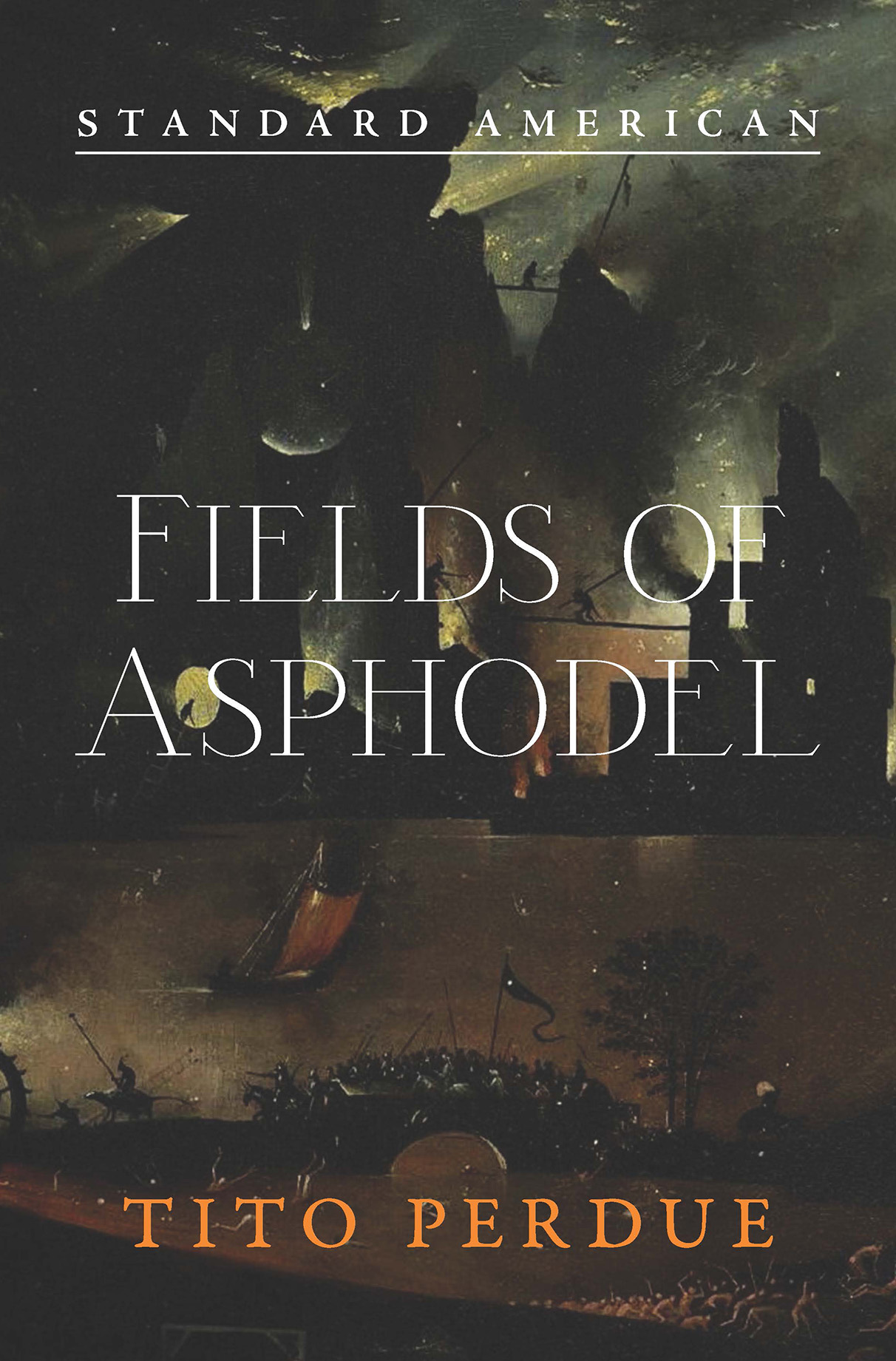
You can buy Tito Perdue’s Fields of Asphodel here.
1,210 words
Tito Perdue
Fields of Asphodel
Second Edition
Brent, Alabama: Standard American Publishing Co., 2023
Imagine if Dante’s Divine Comedy were actually funny, and you’ll begin to understand what’s going on in Tito Perdue’s remarkable novel Fields of Asphodel, the journey of elitist misanthrope and cultured thug Lee Pefley through a frozen hell and a postmodern purgatory to the gates of paradise: a reunion with his beloved wife, Judy.
Lee Pefley is the center of Tito Perdue’s literary universe. Most of his novels deal with Lee, his ancestors, and his legacy. Fields of Asphodel follows him into his afterlife.
Lee is basically Tito Perdue himself. Like Tito, Lee is married to a woman named Judy. Like Tito, Lee is an elitist and a misanthrope:
Always he had wanted a small world getting smaller, a fine people getting finer, all of whom dwelling far apart in hand-builded cottages on a glebe getting gorgeouser. Whileas for the poor, the rich, the rotten, for sports fans and philistines . . . Over the edge with them! (p. 201)
Like Tito, Lee is an aesthete: “all his life he had been tracking Beauty to its lair . . .” (p. 51) But above all else, Lee resembles Tito in his love of books, for it is by reading the great books of the West that Lee elevates himself above the common run of humanity, the sort of people he affixes with his “17,000-book glare” (p. 175). He also has a 12,000-book glare for less egregious cases (p. 200). Eventually, he pares the number he has read down to 9,000, and only admits the true number—7,000—when he meets God himself. Still, they were really good books.
Unlike Tito, however, Lee lacks manners, circumspection, and moral restraints. In short, Lee is basically his author in a bad mood.
Fields of Asphodel begins with Lee uttering the words “I died.” Later it is hinted that he died by his own hand (p. 16). But instead of oblivion, Lee wakes up in a strange world, the afterlife as conceived by pagan Greeks and Christian Europeans. The title refers to the herb that the shades graze upon in Hades. There is also an allusion to the Mount of Purgatory in Dante’s Divine Comedy. Near the end of the novel, at the farthest reaches of Purgatory, there is a beautiful allusion to Shelley’s “Ozymandias.”
Fields of Asphodel also blends in modern literature and even popular culture. The bureaucracy of the afterlife is clearly owes something to Kafka, or maybe just Terry Gilliam’s Brasil. There’s a scene where Lee looks down on a village, and the description brings to mind the Grinch contemplating Whoville in The Grinch Who Stole Christmas. There’s also a droll sequence in which Lee is hooked up to a bicycle-powered Rube Goldberg contraption that he is promised will help locate his wife Judy, who had a head start on the afterlife. The whole thing should be filmed by Terry Gilliam, and I wonder if that’s how Perdue imagined it in the first place.
Initially Lee is alone in what appears to be a dead world. He sees an anthill and finds himself staring at it anxiously for signs of life: “. . . he who had always fled from human company, now was he swept with self-pity to see himself like this, an old man still waiting in a panic for but one single ant—he did not ask for words—a single ant to cheer him forward in this new world” (p. 4).
Soon, however, other people begin to show up. Initially, Lee is wary. The first man he encounters is dressed in women’s clothes and has “The pained look so characteristic of those who had gone through a greater number of years than of books” (p. 6). But eventually, Lee’s loneliness overwhelms his snobbery and diffidence.
Soon Lee is surrounded by a vividly drawn cast of droll and crotchety old men, as well as some broken-down old women of the same cast. Unfortunately, they are all just as disagreeable as Lee is. Many of them are eaten up with envy and self-pity.
One wonders, however, if it is all a dream, for Lee routinely meets people who already know his name, his character, even his thoughts. This would make sense if they are just projections of Lee’s dreaming imagination.
It soon becomes clear that in the afterlife, people are grouped together based on common character traits. Thus Lee finds himself in the company of fellow egoists (p. 31). Later, a bureaucrat sums up Lee’s character as follows:
“Says here”—he touched the screen with his finger, reading slowly—“says that you have always behaved in your own self-interest, but have always expected everyone else to behave from principle. Hey, that doesn’t sound too good.” (p. 111)
Hell is other people, other people like oneself. Fortunately, though, the egoists manage to cooperate with one another enough to provide food, shelter, and company, of sorts. But they are like Schopenhauer’s famed shivering porcupines, driven together out of necessity, but forced apart by their prickly personalities.
Lee is, however, capable of loving other people, especially his late wife Judy, whom he is trying to track down. But he’s quite certain that he will not find her in the company of fellow egoists.
The plot of Fields of Asphodel is quite simple. First, Lee awakens in Hell, a desert waste, hot by day, freezing by night, where food and water are scarce. He bands together with other egoists for survival. It is bad, but doesn’t seem all that hellish, until he encounters a series of warehouses and fields where really evil people—e.g., male feminists, the rich, libtards, members of the publishing industry (present company excluded, I hope)—suffer terrors worthy of Hieronymus Bosch.
Eventually, Lee finds his way to Purgatory, which is more urban and technological, increasingly resembling postmodern America. There, he picks up Judy’s trail. (She has left a trail of pages from Tito’s debut novel, Lee.)
Finally, when Lee has completely given up hope, reaching “the lowest point in his whole nadir” (p. 210), he comes across a village which is entirely to his liking, with no signs of “the three graces of his own day—neither Atrophy nor Entropy, not even Anomie in her mannish suit” (p. 217). In fact, the whole place seems . . . heavenly. Indeed, the village confectioner seems to be God himself. And Judy herself may be waiting for him, just down the path.
There are many things I love about Fields of Asphodel. The prose is some of Perdue’s best: poetic, precise, rhythmic, driving. Characters are crisply drawn. There are passages of surrealistic beauty and sheer fantasy. There are horrors in Hell, to be sure. But for the most part, Fields of Asphodel is truly a divine comedy. There is whimsy: “It was a garish place with walls the color of paint” (p. 149). There are “running gags,” such as Lee’s Canadian penny, that no one will take, not even in Hell. But most of all, there is inspired satire of perennial human follies and recent civilizational mistakes. I find such satire bracing, because if you can laugh at something, you’ve already risen above it. I have read this novel several times, with increasing pleasure. Now it is my pleasure to recommend it to you.
2 comments
I recently read Lee and am currently reading The New Austerities. Perdue’s writing style takes a little getting used to, but once you “get it,” the ride is pretty enjoyable. Lee’s interactions with the “normal” people he encounters is classic absurdist humor, just dark enough to remind me a little of Ambrose Bierce. Oddly enough, I think the themes he addresses are far more relevant now than they were in the 1990s when they were written. Anyway, I learned about Perdue here at CC, so kudos.
Thank you! My next review will be of The New Austerities.
If you have a Subscriber access,
simply login first to see your comment auto-approved.
Note on comments privacy & moderation
Your email is never published nor shared.
Comments are moderated. If you don't see your comment, please be patient. If approved, it will appear here soon. Do not post your comment a second time.